



Community hub
Recent from talks
Contribute something
Nothing was collected or created yet.
Scalability
View on Wikipedia | This article needs additional citations for verification. (March 2012) |
| Complex systems |
|---|
| Topics |
Scalability is the property of a system to handle a growing amount of work. One definition for software systems specifies that this may be done by adding resources to the system.[1]
In an economic context, a scalable business model implies that a company can increase sales given increased resources. For example, a package delivery system is scalable because more packages can be delivered by adding more delivery vehicles. However, if all packages had to first pass through a single warehouse for sorting, the system would not be as scalable, because one warehouse can handle only a limited number of packages.[2]
In computing, scalability is a characteristic of computers, networks, algorithms, networking protocols, programs and applications. An example is a search engine, which must support increasing numbers of users, and the number of topics it indexes.[3] Webscale is a computer architectural approach that brings the capabilities of large-scale cloud computing companies into enterprise data centers.[4]
In distributed systems, there are several definitions according to the authors, some considering the concepts of scalability a sub-part of elasticity, others as being distinct. According to Marc Brooker: "a system is scalable in the range where marginal cost of additional workload is nearly constant." Serverless technologies fit this definition but you need to consider total cost of ownership not just the infra cost.[5]
In mathematics, scalability mostly refers to closure under scalar multiplication.
In industrial engineering and manufacturing, scalability refers to the capacity of a process, system, or organization to handle a growing workload, adapt to increasing demands, and maintain operational efficiency. A scalable system can effectively manage increased production volumes, new product lines, or expanding markets without compromising quality or performance. In this context, scalability is a vital consideration for businesses aiming to meet customer expectations, remain competitive, and achieve sustainable growth. Factors influencing scalability include the flexibility of the production process, the adaptability of the workforce, and the integration of advanced technologies. By implementing scalable solutions, companies can optimize resource utilization, reduce costs, and streamline their operations. Scalability in industrial engineering and manufacturing enables businesses to respond to fluctuating market conditions, capitalize on emerging opportunities, and thrive in an ever-evolving global landscape.[citation needed]
Examples
[edit]The Incident Command System (ICS) is used by emergency response agencies in the United States. ICS can scale resource coordination from a single-engine roadside brushfire to an interstate wildfire. The first resource on scene establishes command, with authority to order resources and delegate responsibility (managing five to seven officers, who will again delegate to up to seven, and on as the incident grows). As an incident expands, more senior officers assume command.[6]
Dimensions
[edit]Scalability can be measured over multiple dimensions, such as:[7]
- Administrative scalability: The ability for an increasing number of organizations or users to access a system.
- Functional scalability: The ability to enhance the system by adding new functionality without disrupting existing activities.
- Geographic scalability: The ability to maintain effectiveness during expansion from a local area to a larger region.
- Load scalability: The ability for a distributed system to expand and contract to accommodate heavier or lighter loads, including, the ease with which a system or component can be modified, added, or removed, to accommodate changing loads.
- Generation scalability: The ability of a system to scale by adopting new generations of components.
- Heterogeneous scalability is the ability to adopt components from different vendors.
Domains
[edit]- A routing protocol is considered scalable with respect to network size, if the size of the necessary routing table on each node grows as O(log N), where N is the number of nodes in the network. Some early peer-to-peer (P2P) implementations of Gnutella had scaling issues. Each node query flooded its requests to all nodes. The demand on each peer increased in proportion to the total number of peers, quickly overrunning their capacity. Other P2P systems like BitTorrent scale well because the demand on each peer is independent of the number of peers. Nothing is centralized, so the system can expand indefinitely without any resources other than the peers themselves.
- A scalable online transaction processing system or database management system is one that can be upgraded to process more transactions by adding new processors, devices and storage, and which can be upgraded easily and transparently without shutting it down.
- The distributed nature of the Domain Name System (DNS) allows it to work efficiently, serving billions of hosts on the worldwide Internet.
Horizontal (scale out) and vertical scaling (scale up)
[edit]
Resources fall into two broad categories: horizontal and vertical.[8]
Horizontal or scale out
[edit]Scaling horizontally (out/in) means adding or removing nodes, such as adding a new computer to a distributed software application. An example might involve scaling out from one web server to three. High-performance computing applications, such as seismic analysis and biotechnology, scale workloads horizontally to support tasks that once would have required expensive supercomputers. Other workloads, such as large social networks, exceed the capacity of the largest supercomputer and can only be handled by scalable systems. Exploiting this scalability requires software for efficient resource management and maintenance.[7]
Vertical or scale up
[edit]Scaling vertically (up/down) means adding resources to (or removing resources from) a single node, typically involving the addition of CPUs, memory or storage to a single computer.[7]
Benefits to scale-up include avoiding increased management complexity, more sophisticated programming to allocate tasks among resources and handling issues such as throughput, latency, and synchronization across nodes. Moreover some applications do not scale horizontally.
Network scalability
[edit]Network function virtualization defines these terms differently: scaling out/in is the ability to scale by adding/removing resource instances (e.g., virtual machine), whereas scaling up/down is the ability to scale by changing allocated resources (e.g., memory/CPU/storage capacity).[9]
Database scalability
[edit]Scalability for databases requires that the database system be able to perform additional work given greater hardware resources, such as additional servers, processors, memory and storage. Workloads have continued to grow and demands on databases have followed suit.
Algorithmic innovations include row-level locking and table and index partitioning. Architectural innovations include shared-nothing and shared-everything architectures for managing multi-server configurations.
Strong versus eventual consistency (storage)
[edit]In the context of scale-out data storage, scalability is defined as the maximum storage cluster size which guarantees full data consistency, meaning there is only ever one valid version of stored data in the whole cluster, independently from the number of redundant physical data copies. Clusters which provide "lazy" redundancy by updating copies in an asynchronous fashion are called 'eventually consistent'. This type of scale-out design is suitable when availability and responsiveness are rated higher than consistency, which is true for many web file-hosting services or web caches (if you want the latest version, wait some seconds for it to propagate). For all classical transaction-oriented applications, this design should be avoided.[10]
Many open-source and even commercial scale-out storage clusters, especially those built on top of standard PC hardware and networks, provide eventual consistency only, such as some NoSQL databases like CouchDB and others mentioned above. Write operations invalidate other copies, but often don't wait for their acknowledgements. Read operations typically don't check every redundant copy prior to answering, potentially missing the preceding write operation. The large amount of metadata signal traffic would require specialized hardware and short distances to be handled with acceptable performance (i.e., act like a non-clustered storage device or database).[citation needed]
Whenever strong data consistency is expected, look for these indicators:[citation needed]
- the use of InfiniBand, Fibrechannel or similar low-latency networks to avoid performance degradation with increasing cluster size and number of redundant copies.
- short cable lengths and limited physical extent, avoiding signal runtime performance degradation.
- majority / quorum mechanisms to guarantee data consistency whenever parts of the cluster become inaccessible.
Indicators for eventually consistent designs (not suitable for transactional applications!) are:[citation needed]
- write performance increases linearly with the number of connected devices in the cluster.
- while the storage cluster is partitioned, all parts remain responsive. There is a risk of conflicting updates.
Performance tuning versus hardware scalability
[edit]It is often advised to focus system design on hardware scalability rather than on capacity. It is typically cheaper to add a new node to a system in order to achieve improved performance than to partake in performance tuning to improve the capacity that each node can handle. But this approach can have diminishing returns (as discussed in performance engineering). For example: suppose 70% of a program can be sped up if parallelized and run on multiple CPUs instead of one. If is the fraction of a calculation that is sequential, and is the fraction that can be parallelized, the maximum speedup that can be achieved by using P processors is given according to Amdahl's Law:


Substituting the value for this example, using 4 processors gives
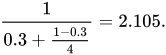
Doubling the computing power to 8 processors gives
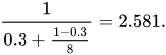
Doubling the processing power has only sped up the process by roughly one-fifth. If the whole problem was parallelizable, the speed would also double. Therefore, throwing in more hardware is not necessarily the optimal approach.
Universal Scalability Law
[edit]In distributed systems, you can use Universal Scalability Law (USL) to model and to optimize scalability of your system. USL is coined by Neil J. Gunther and quantifies scalability based on parameters such as contention and coherency. Contention refers to delay due to waiting or queueing for shared resources. Coherence refers to delay for data to become consistent. For example, having a high contention indicates sequential processing that could be parallelized, while having a high coherency suggests excessive dependencies among processes, prompting you to minimize interactions. Also, with help of USL, you can, in advance, calculate the maximum effective capacity of your system: scaling up your system beyond that point is a waste.[11]
Weak versus strong scaling
[edit]High performance computing has two common notions of scalability:
- Strong scaling is defined as how the solution time varies with the number of processors for a fixed total problem size.
- Weak scaling is defined as how the solution time varies with the number of processors for a fixed problem size per processor.[12]
See also
[edit]References
[edit]- ^ Bondi, André B. (2000). Characteristics of scalability and their impact on performance. Proceedings of the second international workshop on Software and performance – WOSP '00. p. 195. doi:10.1145/350391.350432. ISBN 158113195X.
- ^ Hill, Mark D. (1990). "What is scalability?" (PDF). ACM SIGARCH Computer Architecture News. 18 (4): 18. doi:10.1145/121973.121975. S2CID 1232925. and
Duboc, Leticia; Rosenblum, David S.; Wicks, Tony (2006). A framework for modelling and analysis of software systems scalability (PDF). Proceedings of the 28th international conference on Software engineering – ICSE '06. p. 949. doi:10.1145/1134285.1134460. ISBN 1595933751. - ^ Laudon, Kenneth Craig; Traver, Carol Guercio (2008). E-commerce: Business, Technology, Society. Pearson Prentice Hall/Pearson Education. ISBN 9780136006459.
- ^ "Why web-scale is the future". Network World. 2020-02-13. Retrieved 2017-06-01.
- ^ Building Serverless Applications on Knative. O'Reilly Media. ISBN 9781098142049.
- ^ Bigley, Gregory A.; Roberts, Karlene H. (2001-12-01). "The Incident Command System: High-Reliability Organizing for Complex and Volatile Task Environments". Academy of Management Journal. 44 (6): 1281–1299. doi:10.5465/3069401 (inactive 12 July 2025). ISSN 0001-4273.
{{cite journal}}: CS1 maint: DOI inactive as of July 2025 (link) - ^ a b c Hesham El-Rewini and Mostafa Abd-El-Barr (April 2005). Advanced Computer Architecture and Parallel Processing. John Wiley & Sons. p. 66. ISBN 978-0-471-47839-3.
- ^ Michael, Maged; Moreira, Jose E.; Shiloach, Doron; Wisniewski, Robert W. (March 26, 2007). Scale-up x Scale-out: A Case Study using Nutch/Lucene. 2007 IEEE International Parallel and Distributed Processing Symposium. p. 1. doi:10.1109/IPDPS.2007.370631. ISBN 978-1-4244-0909-9.
- ^ "Network Functions Virtualisation (NFV); Terminology for Main Concepts in NFV". Archived from the original (PDF) on 2020-05-11. Retrieved 2016-01-12.
- ^ Sadek Drobi (January 11, 2008). "Eventual consistency by Werner Vogels". InfoQ. Retrieved April 8, 2017.
- ^ Gunther, Neil (2007). Guerrilla Capacity Planning: A Tactical Approach to Planning for Highly Scalable Applications and Services. ISBN 978-3540261384.
- ^ "The Weak Scaling of DL_POLY 3". STFC Computational Science and Engineering Department. Archived from the original on March 7, 2014. Retrieved March 8, 2014.
External links
[edit]
- Links to diverse learning resources – page curated by the memcached project.
- Scalable Definition – by The Linux Information Project (LINFO)
- Scale in Distributed Systems B. Clifford Neuman, In: Readings in Distributed Computing Systems, IEEE Computer Society Press, 1994

| General | |
|---|---|
| Levels | |
| Multithreading | |
| Theory | |
| Elements | |
| Coordination | |
| Programming | |
| Hardware | |
| APIs | |
| Problems | |

| Qualities |
| ||||
|---|---|---|---|---|---|
| Standards and lists | |||||
| Processes | |||||

Scalability
View on GrokipediaFundamentals
Definition and Importance
Scalability refers to the ability of a system, network, or process to handle an increasing amount of work or to expand in capacity to accommodate growth, typically by adding resources in a manner that avoids a proportional increase in costs or degradation in performance.[1] In computing and engineering contexts, this property ensures that systems can adapt to rising demands, such as higher user loads or data volumes, while maintaining operational efficiency.[5] The importance of scalability lies in its role in enabling efficient resource utilization, facilitating business expansion, and preventing performance bottlenecks during periods of high demand.[5] Originating in the 1960s with the advent of mainframe computers and early distributed systems, scalability addressed the need to process larger workloads as computing transitioned from isolated machines to networked environments.[6] Today, it is essential in cloud computing, where dynamic resource allocation supports massive scale without downtime, underpinning the growth of digital services and economies.[7] Beyond computing, scalability applies to organizational growth, where businesses can expand operations and customer bases without structural constraints impeding efficiency or incurring disproportionate expenses.[3] Primary metrics for assessing scalability include throughput, which measures the volume of work processed per unit time; response time, indicating the duration to complete a task under load; and resource efficiency, evaluating utilization of hardware or other inputs relative to output gains.[8][9]Dimensions of Scalability
Scalability in distributed systems is multifaceted, encompassing various dimensions that capture the system's capacity to expand without proportional increases in complexity or performance degradation. These core dimensions—administrative, functional, geographic, load, generation, and heterogeneous—provide a structured framework for evaluating growth potential, each with distinct metrics and inherent challenges. Administrative scalability measures a system's ability to accommodate an increasing number of organizations or subjects across separate administrative domains, such as when multiple entities share resources while maintaining independent management. Key metrics include coordination efficiency, such as the time required to align policies across domains, and the overhead of access control mechanisms. Challenges primarily involve reconciling conflicting management practices and ensuring secure resource sharing without centralized bottlenecks, which can lead to increased administrative overhead as the number of domains grows. Functional scalability assesses the ease with which a system can incorporate new features or services without disrupting existing operations or requiring extensive redesign. Metrics focus on integration time for new functionalities and sustained throughput under expanded service diversity. A primary challenge is preserving performance and compatibility when adding diverse capabilities, as interdependencies between features can introduce unforeseen bottlenecks or require costly refactoring. Geographic scalability evaluates performance as user requests spread over larger physical distances, emphasizing the system's resilience to spatial expansion. Relevant metrics include end-to-end latency and network reliability under distributed loads. Challenges stem from inherent network delays and variability in wide-area connectivity, which can amplify response times and complicate synchronization, particularly in synchronous communication models. Load scalability examines a system's capacity to handle fluctuating workloads by dynamically adjusting resources to match demand. Core metrics are peak throughput, such as transactions per second, and average response time under varying loads. Key challenges include resource contention during spikes and efficient load distribution to prevent single points of failure, which can degrade overall efficiency if not addressed through adaptive mechanisms. Generation scalability refers to the system's adaptability when integrating newer hardware or software generations, ensuring seamless upgrades without service interruptions. Metrics include interoperability success rates and the cost or duration of migration efforts. Challenges arise from compatibility issues with legacy components, often necessitating complex transition strategies to avoid downtime or data loss. Heterogeneous scalability addresses the integration of diverse components, such as varying hardware architectures or software stacks, while maintaining cohesive operation. Metrics encompass adaptability rates, like successful cross-platform data exchanges, and overall system interoperability. Major challenges involve standardizing interfaces amid differences in data representation and processing capabilities, which can hinder performance if middleware fails to abstract underlying variances. These dimensions have evolved significantly with technological advancements, shifting from an early emphasis on hardware-focused load scalability in parallel computing environments of the 1980s and 1990s—where growth was limited by physical resource constraints—to modern software-defined paradigms in cloud and distributed architectures. This expansion incorporates administrative and heterogeneous aspects to support multi-tenant, globally dispersed systems, driven by virtualization and containerization that enable elastic, on-demand scaling across diverse ecosystems.Illustrative Examples
In the business domain, scalability is exemplified by McDonald's expansion from a single restaurant in 1955 to a global chain operating over 43,000 locations as of 2024, primarily through its franchising model that allowed rapid growth without proportional increases in corporate capital investment.[10] This approach enabled the company to serve more customers worldwide while maintaining standardized operations and quality control across diverse markets.[11] In engineering, bridge design demonstrates scalability by incorporating redundancy and modular elements to accommodate rising traffic loads over time, as seen in frameworks that emphasize structural resilience to handle increased vehicle volumes without full reconstruction.[12] For instance, modern designs use high-strength materials and expandable support systems to support growing urban transportation demands, ensuring longevity and adaptability to population shifts.[12] Biological systems illustrate concepts analogous to scalability limits through population dynamics in ecosystems, where growth follows patterns like the logistic model, initially expanding rapidly but stabilizing due to resource constraints such as food availability and habitat limits.[13] In a forest ecosystem, for example, a deer population may surge exponentially in the presence of abundant forage but eventually plateaus as competition and predation intensify, reflecting the system's capacity to self-regulate at sustainable levels.[13] In computing, a simple illustration of scalability occurs when an e-commerce website manages surges in user traffic during events like Black Friday sales, where platforms handle millions of simultaneous visitors by dynamically allocating resources to prevent slowdowns.[14] This ensures seamless browsing and transactions even as demand spikes temporarily, highlighting the need for systems that expand capacity on demand.[14] Historically, the scalability of telephone networks in the 20th century is evident in the Bell System's growth from nearly 600,000 phones in 1900 to over 5.8 million by 1910, achieved through infrastructure expansions like automated switches and long-distance lines that connected users nationwide without proportional cost increases.[15] By the 1930s, innovations in switching technology further enabled the network to support millions more subscribers, transforming communication from local to global scale.[16]Scaling Strategies
Vertical Scaling
Vertical scaling, also known as scaling up, refers to the process of enhancing the performance and capacity of an individual computing node by upgrading its internal resources, such as adding more central processing units (CPUs), random access memory (RAM), or storage to a single server or machine.[17] This approach increases computational power without distributing workload across multiple nodes, allowing software to leverage greater hardware capabilities directly. For instance, in cloud environments like Microsoft Azure, vertical scaling can involve migrating an application to a larger virtual machine instance with higher specifications.[17] In Amazon Web Services (AWS), similar upgrades can be achieved by changing to larger instance types.[18] One key advantage of vertical scaling is its relative simplicity in implementation, as it avoids the complexities of data partitioning, synchronization, or load balancing required in distributed systems.[19] It enables higher throughput for intensive workloads on a single node; for example, in graph processing systems like GraphLab, a scale-up machine handling a large Twitter graph dataset achieves better performance than a scale-out cluster due to reduced communication overhead (as studied in 2013).[20] Additionally, for data analytics tasks in Hadoop, vertical scaling on a single server processes jobs with inputs under 100 GB as efficiently as or better than clusters, in terms of performance, cost, and power consumption (based on 2013 evaluations).[19] This makes it particularly cost-effective for scenarios where workloads fit within the memory and processing limits of one machine, such as CPU-bound tasks like word counting in MapReduce, where it delivers up to 3.4 times speedup over scale-out configurations (per 2013 benchmarks).[21] However, vertical scaling has notable limitations stemming from the physical and architectural constraints of a single node, leading to diminishing returns as resources approach hardware ceilings, such as maximum CPU sockets or memory slots.[21] High-end machines incur elevated costs per unit time—for example, certain large AWS instances cost around $3 to $5 per hour depending on type and region (as of 2025)—making it less efficient for light or variable workloads where resources remain underutilized.[22] Furthermore, it lacks indefinite scalability and inherent fault tolerance, as adding resources cannot overcome single-point failures or I/O bottlenecks, such as network-limited storage access on a solitary gigabit port.[21] In contrast to horizontal scaling, which expands capacity by adding nodes, vertical scaling is bounded by monolithic hardware limits.[19] Vertical scaling is well-suited for applications requiring tight data locality and low-latency access, such as legacy relational databases like Oracle, where upgrading a single server's RAM or CPUs improves query performance without redistributing data.[24] It is also effective for short-lived bursts in containerized environments or analytics workloads that do not exceed single-node capacities, ensuring simpler management for monolithic systems.[25]Horizontal Scaling
Horizontal scaling, also known as scaling out, involves expanding a system's capacity by adding more machines, servers, or instances to distribute workloads across multiple independent nodes in a distributed architecture. This approach contrasts with vertical scaling by focusing on breadth rather than depth, allowing systems to handle increased demand through parallelism rather than enhancing individual components.[26][27] The mechanics of horizontal scaling rely on tools like load balancers to route incoming requests evenly across nodes and clustering techniques to enable nodes to operate as a cohesive unit, sharing responsibilities for processing tasks. For instance, in a web farm setup, multiple servers behind a load balancer handle HTTP requests, ensuring no single node becomes overwhelmed. Similarly, microservices architectures facilitate horizontal scaling by allowing individual services to replicate independently, distributing specific functions like user authentication or data processing across additional instances. This distribution promotes efficient resource utilization and supports dynamic adjustments to varying loads.[28][29][30] Key advantages of horizontal scaling include the potential for near-linear performance improvements as nodes are added, enabling systems to grow proportionally with demand, and inherent fault tolerance through redundancy, where the failure of one node does not compromise overall operations. These benefits are particularly evident in large-scale web applications, where redundancy ensures high availability during peak traffic. However, limitations arise from the added complexity of synchronizing data and states across nodes, which can introduce network overhead and latency in communication. Additionally, challenges such as managing single points of failure—for example, the load balancer—require careful design to maintain reliability.[31][32] In practice, horizontal scaling is implemented using orchestration platforms like Kubernetes, which automate the provisioning, deployment, and scaling of containerized workloads across clusters, simplifying the management of distributed nodes without delving into domain-specific optimizations.[33] Many modern systems employ hybrid approaches, combining vertical and horizontal scaling to optimize for specific workloads and cost structures.[34]Domain-Specific Applications
Network Scalability
Network scalability refers to the ability of communication networks to handle increasing demands in traffic volume, device connectivity, and geographical coverage without proportional degradation in performance. Key challenges include bandwidth saturation, where network links become overwhelmed by data traffic exceeding capacity, leading to congestion and packet loss. This issue is exacerbated in high-demand scenarios such as video streaming surges or cloud service peaks. Additionally, routing table growth poses a significant hurdle, as the expansion of internet-connected devices and autonomous systems results in exponentially larger tables that strain router memory and processing resources.[35] A prominent example of routing scalability limitations is seen in the Border Gateway Protocol (BGP), the de facto inter-domain routing protocol for the internet. BGP faces issues with update churn and table size, where the global routing table has grown from approximately 200,000 entries in 2005 to over 900,000 by 2023, driven by address deaggregation and multi-homing practices. This growth increases convergence times and memory demands on routers, potentially leading to instability in large-scale deployments. Protocol limitations in BGP, such as its reliance on full-mesh peering for internal BGP (iBGP), further amplify scalability concerns in expansive networks.[36][37] To address these challenges, several solutions have been developed. Hierarchical routing organizes networks into layers, such as core, distribution, and access levels, reducing the complexity of routing decisions by aggregating routes at higher levels and limiting the scope of detailed topology information. This approach, outlined in foundational design principles, significantly curbs routing table sizes and update overhead in large networks. Content Delivery Networks (CDNs) mitigate bandwidth saturation by caching content at edge locations closer to users, thereby offloading traffic from the core backbone and improving global throughput. For instance, CDNs like Akamai distribute static web assets across thousands of servers, reducing origin server load and latency for end users. Software-Defined Networking (SDN) enhances scalability by centralizing control logic, allowing dynamic resource allocation and traffic engineering without hardware reconfiguration, though it requires careful controller placement to avoid bottlenecks.[38][39][40] Common metrics for evaluating network scalability include throughput per node, which measures the sustainable data rate each router or switch can handle under varying loads, and latency under load, assessing end-to-end delays during peak traffic. In practice, scalable networks aim for linear throughput scaling with added nodes, as seen in internet backbone expansions where fiber-optic upgrades have increased aggregate capacity from terabits to petabits per second across transoceanic links. For example, major providers have expanded backbones to support exabyte-scale monthly traffic without proportional latency increases. Emerging aspects of network scalability are particularly evident in 5G and 6G networks, designed to accommodate the explosive growth of Internet of Things (IoT) devices, estimated at around 20 billion as of 2025. 5G introduces network slicing for virtualized resources tailored to IoT applications, enabling massive connectivity with densities up to 1 million devices per square kilometer while maintaining low latency. 6G builds on this with terahertz frequencies and AI-driven orchestration to further enhance scalability, addressing challenges like spectrum efficiency and energy constraints in ultra-dense IoT ecosystems. These advancements ensure robust support for real-time IoT data flows in smart cities and industrial automation.[41][42][43]Database Scalability
Database scalability addresses the challenges of managing growing data volumes and query loads in storage and retrieval systems, particularly as applications demand higher throughput for transactions and analytics. Key challenges include read and write bottlenecks, where intensive write operations in transactional workloads can overload single servers, and the need for data partitioning to distribute load effectively. Online Transaction Processing (OLTP) systems, common in real-time applications like e-commerce, prioritize frequent writes for operations such as order updates but face limited scalability due to the complexity of maintaining ACID properties across growing datasets.[44] In contrast, Online Analytical Processing (OLAP) systems emphasize read-heavy queries for data analysis, encountering bottlenecks in aggregating large datasets without impacting performance.[45] To overcome these issues, databases employ techniques like sharding and replication. Sharding partitions data across multiple servers based on a shard key, such as user ID, enabling horizontal scaling by allowing independent query handling on each shard, which improves both read and write capacity as data grows.[46] Replication, particularly master-slave configurations, designates a primary (master) node for writes while secondary (slave) nodes handle reads, offloading query traffic and providing fault tolerance through data synchronization.[47] NoSQL databases like Apache Cassandra further enhance scalability by adopting distributed designs that leverage eventual consistency, where writes are propagated asynchronously across nodes to prioritize availability and partition tolerance over immediate synchronization, allowing clusters to handle massive datasets without single points of failure.[48] Performance in scalable databases is often measured by queries per second (QPS), which quantifies the system's ability to process read and write operations under load, and storage efficiency, which assesses how effectively space is utilized relative to data access speed. For instance, in e-commerce transaction databases, sharding and replication can elevate QPS from thousands to millions during peak events like sales, ensuring sub-second response times for inventory checks and payments while maintaining storage efficiency through compressed partitioning.[49][50] Modern trends in database scalability favor cloud-native solutions like Amazon Aurora, which provide elastic scaling by automatically adjusting compute and storage resources in response to demand, supporting up to 256 tebibytes (TiB) per cluster without manual intervention. Aurora's architecture separates storage from compute, enabling seamless read replicas and serverless modes that dynamically provision capacity for variable workloads, such as fluctuating e-commerce traffic.[51][52]Consistency in Distributed Systems
Strong Consistency
Strong consistency in distributed systems refers to models such as linearizability and strict serializability, which ensure that operations appear to take effect instantaneously at some point between their invocation and response, preserving real-time ordering and equivalence to a legal sequential execution.[53] Linearizability, a foundational model for concurrent objects, guarantees that if one operation completes before another starts, the second sees the effects of the first, enabling high concurrency while maintaining the illusion of sequential behavior.[54] Strict serializability extends this to multi-operation transactions, ensuring they appear to execute in an order consistent with their real-time commit points, thus providing the strongest guarantee of immediate global agreement on data state across replicas. Key mechanisms for achieving strong consistency include the two-phase commit (2PC) protocol and consensus algorithms like Paxos and Raft. In 2PC, a coordinator first solicits votes from participants in a prepare phase; if all agree, a commit phase broadcasts the decision, ensuring atomicity and consistency by either fully applying or fully aborting distributed transactions.[55] Paxos achieves consensus on a single value among distributed processes through a two-phase process: proposers obtain promises from a majority of acceptors before accepting values, guaranteeing that only one value is chosen and enabling replicated state machines to maintain consistent order.[56] Similarly, Raft simplifies consensus for replicated logs by electing a strong leader that replicates entries to a majority of followers before committing, ensuring all servers apply the same sequence of commands and thus strong consistency in state machines.[57] Strong consistency simplifies application logic by allowing developers to reason about operations as if they occur sequentially, reducing the need for complex conflict resolution and ensuring correctness in scenarios requiring precise data integrity.[53] It guarantees that no stale reads occur, providing reliability for critical operations where inconsistencies could lead to errors. However, it introduces trade-offs, including higher latency from synchronization overhead, as operations must wait for majority acknowledgments, and reduced availability during network partitions per the CAP theorem implications.[54] In practice, strong consistency is essential for financial systems that demand ACID (Atomicity, Consistency, Isolation, Durability) transactions, such as banking applications where transfers must reflect immediately across replicas to prevent overdrafts or double-spending.[55] Databases like CockroachDB employ strict serializability for such use cases to maintain transactional guarantees in distributed environments. Despite its strengths, strong consistency faces limitations in high-throughput scenarios, where the coordination costs can bottleneck scalability, often leading to throughput reductions compared to weaker models.[58]Eventual Consistency
Eventual consistency is a consistency model in distributed systems that guarantees if no new updates are made to a data item, all subsequent accesses to that item will eventually return the last updated value, after an inconsistency window during which temporary discrepancies may occur.[59] This approach forms a core part of the BASE properties—Basically Available, Soft state, and Eventual consistency—which emphasize system availability and tolerance for transient inconsistencies over strict atomicity, differing from ACID models by accepting soft states that may change without input.[60] Systems implementing eventual consistency typically use mechanisms like quorum reads and writes to balance availability with convergence. In quorum-based protocols, a write operation succeeds if confirmed by a write quorum (W) of replicas, while a read requires a read quorum (R), with the condition R + W > N (where N is the total number of replicas) ensuring that read quorums overlap with recent writes to promote consistency over time.[61] For conflict detection and resolution in concurrent updates, vector clocks are employed to capture the partial ordering of events across replicas, allowing the system to identify and merge divergent versions, often through application-specific logic like last-writer-wins or more sophisticated reconciliation.[61] Amazon's Dynamo, a highly available key-value store, exemplifies these techniques by propagating updates asynchronously to replicas and using hinted handoff for temporary failures, enabling scalability across data centers.[61] The advantages of eventual consistency lie in its support for high availability and low-latency operations, as clients receive responses without requiring global synchronization, which is particularly beneficial in partitioned networks.[62] Under the CAP theorem, it allows systems to favor availability and partition tolerance (AP) over consistency, ensuring the system remains operational during failures by serving data from local replicas, even if temporarily outdated.[63] However, this introduces trade-offs such as the risk of stale reads, which in collaborative applications like document editing may necessitate client-side handling, such as versioning or user-mediated resolution, to mitigate user-perceived inconsistencies without compromising overall scalability.[61] Common use cases for eventual consistency include social media feeds, where updates such as posts, likes, or comments can tolerate brief propagation delays across global replicas to maintain responsiveness for millions of users.[60] It is also prevalent in caching layers, such as content delivery networks, where serving slightly outdated data accelerates access times, with background anti-entropy processes like read repair ensuring convergence without blocking foreground operations.[64] In production systems like Amazon DynamoDB, eventual consistency powers scalable workloads in e-commerce, enabling cost-effective reads (at half the price of strongly consistent ones) for scenarios like inventory views or user sessions where immediate accuracy is secondary to throughput.[65]Performance Considerations
Performance Tuning vs. Hardware Scalability
Performance tuning involves software-based optimizations aimed at enhancing system efficiency without requiring additional hardware resources. These techniques include algorithmic improvements that reduce computational complexity, such as refining data structures or parallelizing workloads to better utilize existing processors.[66] For instance, in database systems, query optimization selects efficient execution plans to minimize processing time, while caching mechanisms store frequently accessed data in fast-access memory to avoid redundant computations.[67] Such methods can significantly boost throughput; in high-performance web applications, dynamic caching has been shown to handle increased query loads by deriving results from materialized views, reducing latency by up to 10x in real-world deployments.[68] In contrast, hardware scalability focuses on expanding physical resources to accommodate growing workloads, often through vertical scaling by upgrading components like adding more CPU cores or RAM to a single machine, or horizontal scaling by incorporating additional servers. This approach directly increases capacity, as seen in systems where adding GPUs enables parallel processing for compute-intensive tasks, such as machine learning inference, where a single high-end GPU can outperform multiple CPUs by orders of magnitude in matrix operations. However, hardware expansions are constrained by factors like interconnect bandwidth and power limits, which can limit linear performance gains beyond a certain scale.[69] The key distinction lies in their application and economics: performance tuning provides cost-effective, short-term improvements by maximizing resource utilization—such as improving CPU utilization through better threading—delaying the need for hardware investments.[8] Hardware scalability, while enabling long-term growth for sustained demand, incurs higher upfront costs and complexity in integration, making it suitable for scenarios where software limits are exhausted. For example, in scaling web applications, teams often tune code for efficient database queries and caching before horizontally adding servers, achieving significant throughput gains without proportional hardware costs. This hybrid strategy aligns with vertical and horizontal scaling principles but prioritizes software tweaks for immediate efficiency.[70]Weak Scaling vs. Strong Scaling
In parallel computing, strong scaling refers to the performance improvement achieved by solving a fixed-size problem using an increasing number of processors, with the goal of reducing execution time while ideally achieving linear speedup.[71] This approach is particularly relevant for applications where the problem size is constrained, such as optimizing simulations within fixed time budgets, but it is inherently limited by the sequential portions of the code and inter-processor communication overheads.[72] Amdahl's law quantifies these limits by stating that the maximum speedup with processors is bounded by the reciprocal of the serial fraction of the workload, expressed as , highlighting how even small serial components cap overall efficiency as grows.[73] In contrast, weak scaling evaluates performance by proportionally increasing both the problem size and the number of processors, aiming to maintain constant execution time per processor and thus overall efficiency for larger-scale problems.[71] This model assumes that additional resources handle additional work without degrading the workload balance, making it suitable for scenarios where scalability enables tackling bigger domains rather than faster solutions.[72] Gustafson's law supports weak scaling by reformulating Amdahl's framework to emphasize scaled speedup, where the serial fraction's impact diminishes as problem size grows with processors, allowing near-linear efficiency for highly parallelizable tasks.[74] A key metric for both scaling types is parallel efficiency, defined as the ratio of achieved speedup to the number of processors, , which ideally approaches 1 but typically declines due to overheads like load imbalance or synchronization.[75] In strong scaling, efficiency often drops sharply beyond a certain processor count due to Amdahl's serial bottlenecks, whereas weak scaling sustains higher efficiency longer by distributing work evenly, though communication costs can still erode gains at extreme scales.[71] High-performance computing applications, such as weather modeling, illustrate these concepts distinctly. For instance, strong scaling might accelerate a fixed-resolution forecast simulation on more nodes to meet tight deadlines, achieving up to 80-90% efficiency on mid-scale clusters before communication limits intervene.[76] Weak scaling, however, enables simulating larger atmospheric domains—like global models with doubled grid points—using proportionally more processors, maintaining execution times around 1-2 hours for ensemble runs on supercomputers while preserving over 95% efficiency for memory-bound workloads.[77]Website Platform Performance and Reliability
For website platforms supporting scaling businesses, essential performance and reliability aspects include fast loading times, mobile responsiveness, high uptime, and the ability to scale for growth in pages and visitors. Fast loading is critical, as 40% of users abandon websites that take more than three seconds to load.[78] This can be achieved through optimization tools such as image compression, minification of CSS and JavaScript, and browser caching mechanisms.[79] Mobile responsiveness ensures a seamless user experience across various devices and screen sizes, typically implemented via modular and responsive design principles.[78] High uptime and reliability are maintained through robust infrastructure and built-in Content Delivery Networks (CDNs), which cache content in multiple global locations to reduce latency, distribute traffic, and handle sudden spikes without downtime.[79] These features enable platforms to scale horizontally by adding servers or resources as needed, accommodating increased traffic and content volume effectively.[78]Theoretical Models
Universal Scalability Law
The Universal Scalability Law (USL) provides a mathematical framework for predicting system performance as resources are scaled, accounting for both contention and coherency overheads that limit ideal linear growth. Developed by Neil Gunther, it extends classical scaling models by incorporating queueing theory to model real-world bottlenecks in parallel and distributed systems. The law is particularly useful for quantifying how throughput degrades under increasing load or resource count, enabling engineers to forecast capacity needs without exhaustive testing.[80] The core formulation of the USL for relative scalability , which normalizes throughput against a single-resource baseline, is given by: where represents the number of resources (e.g., processors, nodes, or concurrent users), (0 ≤ α ≤ 1) is the contention coefficient capturing serial bottlenecks such as resource sharing or queuing delays, and (β ≥ 0) is the coherency coefficient modeling global synchronization costs like cache invalidation or data consistency checks. For absolute throughput , the model includes a concurrency factor , yielding , where is the baseline throughput. As , , highlighting the eventual dominance of coherency in large-scale systems.[80][81] Derivationally, the USL builds on Amdahl's Law, which models scalability via a serial fraction but ignores inter-process communication; Gunther augments this with the term derived from synchronous queueing bounds in a machine-repairman model, where jobs represent computational tasks and repairmen symbolize resources. It also generalizes Gustafson's Law, which assumes scalable problem sizes, by explicitly parameterizing contention () for fixed workloads and coherency () for dynamic synchronization, proven equivalent to queueing throughput limits in parallel transaction systems. This foundation allows the USL to apply beyond HPC to transactional environments, with parameters fitted via nonlinear regression on sparse throughput measurements.[80][82] In practice, the USL models throughput in databases and web systems by fitting empirical data to generate scalability curves, revealing saturation points. For instance, in MySQL benchmarking on a Cisco UCS server, USL parameters (α ≈ 0.015, β ≈ 0.0013) predicted peak throughput of 11,133 queries per second at 27 concurrent threads, aligning with load tests and illustrating contention-limited scaling in OLTP workloads. Similarly, web application servers like those in enterprise middleware use USL to plot relative capacity versus user load, identifying when adding nodes yields diminishing returns due to coherency overhead in distributed caches. These curves aid in capacity planning, such as forecasting if a system can handle 10x load via horizontal scaling.[83][80] Despite its versatility, the USL assumes linear resource addition and steady-state conditions, which may not capture nonlinear cloud dynamics like auto-scaling or variable latency; extensions incorporate hybrid queueing models for cloud-native applications, such as stream processing in Kubernetes, to better handle elastic environments. It also requires accurate, low-variance measurements for reliable parameter estimation and cannot isolate specific bottlenecks without complementary diagnostics.[80][84][83]Related Scaling Laws
Amdahl's law provides a foundational theoretical bound on the speedup achievable through parallel processing, emphasizing the limitations imposed by inherently serial components in a workload. Formulated by Gene Amdahl in 1967, the law states that the maximum speedup from using processors is given by where represents the fraction of the workload that must be executed serially.[73] This model assumes a fixed problem size, illustrating that even with an infinite number of processors, the speedup is capped at , as the serial portion remains a bottleneck.[73] In practice, Amdahl's law highlights why strong scaling—accelerating a fixed task with more resources—often yields diminishing returns beyond a certain processor count, particularly in applications with significant non-parallelizable elements like data initialization or I/O operations. Gustafson's law, proposed by John L. Gustafson in 1988, addresses these limitations by considering scenarios where problem size scales proportionally with available resources, enabling weak scaling for larger computations. The scaled speedup is expressed as where is again the serial fraction and is the number of processors. Unlike Amdahl's fixed-size assumption, this formulation posits that parallel portions can expand with more processors, allowing near-linear speedup for workloads where serial time remains constant while parallel work grows. Gustafson's approach is particularly relevant for scientific simulations and data-intensive tasks, where increasing resources permits tackling bigger problems without the serial bottleneck dominating. Brewer's CAP theorem, introduced by Eric Brewer in 2000 and formally proven by Seth Gilbert and Nancy Lynch in 2002, extends scalability considerations to distributed systems by delineating trade-offs among consistency (C), availability (A), and partition tolerance (P). The theorem asserts that in the presence of network partitions, a distributed system can guarantee at most two of these properties, forcing designers to prioritize based on application needs.[85] For scalable systems, this implies that achieving high availability and partition tolerance often requires relaxing strong consistency, leading to eventual consistency models that enhance throughput in large-scale deployments like NoSQL databases.[85] Recent extensions in serverless computing leverage these principles to achieve near-linear scalability, where functions scale automatically with demand without managing infrastructure, as demonstrated in platforms like AWS Lambda that handle variable loads efficiently under partition-tolerant designs. These laws collectively inform practical scalability limits across domains: Amdahl's and Gustafson's models guide resource allocation in high-performance computing (HPC) environments, where supercomputers achieve efficient weak scaling for climate modeling but face strong scaling barriers in serial-heavy codes, while CAP influences cloud architectures by balancing availability with consistency for global services.[73] In artificial intelligence workloads, such as large model training, gaps persist as communication overheads and data movement violate ideal assumptions in both Amdahl's and Gustafson's frameworks, limiting efficiency on GPU clusters despite hardware advances.References
- https://lexu1.web.engr.[illinois](/page/Illinois).edu/scaleOutUp.pdf