



Community hub
Recent from talks
Contribute something
Nothing was collected or created yet.
Second-order arithmetic
View on WikipediaIn mathematical logic, second-order arithmetic is a collection of axiomatic systems that formalize the natural numbers and their subsets. It is an alternative to axiomatic set theory as a foundation for much, but not all, of mathematics.
A precursor to second-order arithmetic that involves third-order parameters was introduced by David Hilbert and Paul Bernays in their book Grundlagen der Mathematik.[1] The standard axiomatization of second-order arithmetic is denoted by Z2.
Second-order arithmetic includes, but is significantly stronger than, its first-order counterpart Peano arithmetic. Unlike Peano arithmetic, second-order arithmetic allows quantification over sets of natural numbers as well as numbers themselves. Because real numbers can be represented as (infinite) sets of natural numbers in well-known ways, and because second-order arithmetic allows quantification over such sets, it is possible to formalize the real numbers in second-order arithmetic. For this reason, second-order arithmetic is sometimes called "analysis".[2]
Second-order arithmetic can also be seen as a weak version of set theory in which every element is either a natural number or a set of natural numbers. Although it is much weaker than Zermelo–Fraenkel set theory, second-order arithmetic can prove essentially all of the results of classical mathematics expressible in its language.
A subsystem of second-order arithmetic is a theory in the language of second-order arithmetic each axiom of which is a theorem of full second-order arithmetic (Z2). Such subsystems are essential to reverse mathematics, a research program investigating how much of classical mathematics can be derived in certain weak subsystems of varying strength. Much of core mathematics can be formalized in these weak subsystems, some of which are defined below. Reverse mathematics also clarifies the extent and manner in which classical mathematics is nonconstructive.
Definition
[edit]Syntax
[edit]The language of second-order arithmetic is two-sorted. The first sort of terms and in particular variables, usually denoted by lower case letters, consists of individuals, whose intended interpretation is as natural numbers. The other sort of variables, variously called "set variables", "class variables", or even "predicates" are usually denoted by upper-case letters. They refer to classes/predicates/properties of individuals, and so can be thought of as sets of natural numbers. Both individuals and set variables can be quantified universally or existentially. A formula with no bound set variables (that is, no quantifiers over set variables) is called arithmetical. An arithmetical formula may have free set variables and bound individual variables.
Individual terms are formed from the constant 0, the unary function S (the successor function), and the binary operations + and (addition and multiplication). The successor function adds 1 to its input. The relations = (equality) and < (comparison of natural numbers) relate two individuals, whereas the relation ∈ (membership) relates an individual and a set (or class). Thus in notation the language of second-order arithmetic is given by the signature .


For example, , is a well-formed formula of second-order arithmetic that is arithmetical, has one free set variable X and one bound individual variable n (but no bound set variables, as is required of an arithmetical formula)—whereas is a well-formed formula that is not arithmetical, having one bound set variable X and one bound individual variable n.


Semantics
[edit]Several different interpretations of the quantifiers are possible. If second-order arithmetic is studied using the full semantics of second-order logic then the set quantifiers range over all subsets of the range of the individual variables. If second-order arithmetic is formalized using the semantics of first-order logic (Henkin semantics) then any model includes a domain for the set variables to range over, and this domain may be a proper subset of the full powerset of the domain of individual variables.[3]
Axioms
[edit]Basic
[edit]The following axioms are known as the basic axioms, or sometimes the Robinson axioms. The resulting first-order theory, known as Robinson arithmetic, is essentially Peano arithmetic without induction. The domain of discourse for the quantified variables is the natural numbers, collectively denoted by N, and including the distinguished member , called "zero."

The primitive functions are the unary successor function, denoted by prefix , and two binary operations, addition and multiplication, denoted by the infix operator "+" and "", respectively. There is also a primitive binary relation called order, denoted by the infix operator "<".

Axioms governing the successor function and zero:
- ("the successor of a natural number is never zero")
- ("the successor function is injective")
- ("every natural number is zero or a successor")
![{\displaystyle \forall m[Sm=0\rightarrow \bot ].}](https://wikimedia.org/api/rest_v1/media/math/render/svg/b0a8f3ffca8c5cc849df18690f46bf1e8d2bab3b)
![{\displaystyle \forall m\forall n[Sm=Sn\rightarrow m=n].}](https://wikimedia.org/api/rest_v1/media/math/render/svg/df7fdd8e9d172deeab2412d40a53bc1091cd7839)
![{\displaystyle \forall n[0=n\lor \exists m[Sm=n]].}](https://wikimedia.org/api/rest_v1/media/math/render/svg/17a818e8072d48fb1e448d64e9d227434cb3e9ba)
Addition defined recursively:
![{\displaystyle \forall m[m+0=m].}](https://wikimedia.org/api/rest_v1/media/math/render/svg/2ffd7e3100e9303ccb01ab4a4be980abc190cc80)
![{\displaystyle \forall m\forall n[m+Sn=S(m+n)].}](https://wikimedia.org/api/rest_v1/media/math/render/svg/e474ea6efcfdc12cdcab571a6cdf942c61b4852a)
Multiplication defined recursively:
![{\displaystyle \forall m[m\cdot 0=0].}](https://wikimedia.org/api/rest_v1/media/math/render/svg/caef550c2bcd17efe0cc5f98fff865def039f2e0)
![{\displaystyle \forall m\forall n[m\cdot Sn=(m\cdot n)+m].}](https://wikimedia.org/api/rest_v1/media/math/render/svg/065e803bdf6d53602cffad597a7d1385762ee4ed)
Axioms governing the order relation "<":
- ("no natural number is smaller than zero")
- ("every natural number is zero or bigger than zero")
![{\displaystyle \forall m[m<0\rightarrow \bot ].}](https://wikimedia.org/api/rest_v1/media/math/render/svg/4d037a9e910a8abefe6e02931e8f7a0a56214e74)
![{\displaystyle \forall n\forall m[m<Sn\leftrightarrow (m<n\lor m=n)].}](https://wikimedia.org/api/rest_v1/media/math/render/svg/207a5708c22334f5f5f0a08f69521964025cb0ac)
![{\displaystyle \forall n[0=n\lor 0<n].}](https://wikimedia.org/api/rest_v1/media/math/render/svg/30c04b939d04aad652f928d0bc933a7cd4f5a4e5)
![{\displaystyle \forall m\forall n[(Sm<n\lor Sm=n)\leftrightarrow m<n].}](https://wikimedia.org/api/rest_v1/media/math/render/svg/03b25b287ebba2d74f3889b3038f48e8907e6867)
These axioms are all first-order statements. That is, all variables range over the natural numbers and not sets thereof, a fact even stronger than their being arithmetical. Moreover, there is but one existential quantifier, in Axiom 3. Axioms 1 and 2, together with an axiom schema of induction make up the usual Peano–Dedekind definition of N. Adding to these axioms any sort of axiom schema of induction makes redundant the axioms 3, 10, and 11.
Induction and comprehension schema
[edit]If φ(n) is a formula of second-order arithmetic with a free individual variable n and possibly other free individual or set variables (written m1,...,mk and X1,...,Xl), the induction axiom for φ is the axiom:

The (full) second-order induction scheme consists of all instances of this axiom, over all second-order formulas.
One particularly important instance of the induction scheme is when φ is the formula "" expressing the fact that n is a member of X (X being a free set variable): in this case, the induction axiom for φ is


This sentence is called the second-order induction axiom.
If φ(n) is a formula with a free variable n and possibly other free variables, but not the variable Z, the comprehension axiom for φ is the formula

This axiom makes it possible to form the set of natural numbers satisfying φ(n). There is a technical restriction that the formula φ may not contain the variable Z, for otherwise the formula would lead to the comprehension axiom
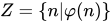

- ,

which is inconsistent. This convention is assumed in the remainder of this article.
The full system
[edit]The formal theory of second-order arithmetic (in the language of second-order arithmetic) consists of the basic axioms, the comprehension axiom for every formula φ (arithmetic or otherwise), and the second-order induction axiom. This theory is sometimes called full second-order arithmetic to distinguish it from its subsystems, defined below. Because full second-order semantics imply that every possible set exists, the comprehension axioms may be taken to be part of the deductive system when full second-order semantics is employed.[3]
Models
[edit]This section describes second-order arithmetic with first-order semantics. Thus a model of the language of second-order arithmetic consists of a set M (which forms the range of individual variables) together with a constant 0 (an element of M), a function S from M to M, two binary operations + and · on M, a binary relation < on M, and a collection D of subsets of M, which is the range of the set variables. Omitting D produces a model of the language of first-order arithmetic.

When D is the full powerset of M, the model is called a full model. The use of full second-order semantics is equivalent to limiting the models of second-order arithmetic to the full models. In fact, the axioms of second-order arithmetic have only one full model. This follows from the fact that the Peano axioms with the second-order induction axiom have only one model under second-order semantics.
Definable functions
[edit]The first-order functions that are provably total in second-order arithmetic are precisely the same as those representable in system F.[4] Almost equivalently, system F is the theory of functionals corresponding to second-order arithmetic in a manner parallel to how Gödel's system T corresponds to first-order arithmetic in the Dialectica interpretation.
More types of models
[edit]When a model of the language of second-order arithmetic has certain properties, it can also be called these other names:
- When M is the usual set of natural numbers with its usual operations, is called an ω-model. In this case, the model may be identified with D, its collection of sets of naturals, because this set is enough to completely determine an ω-model. The unique full -model, which is the usual set of natural numbers with its usual structure and all its subsets, is called the intended or standard model of second-order arithmetic.[5]
- A model of the language of second-order arithmetic is called a β-model if , i.e. the Σ11-statements with parameters from that are satisfied by are the same as those satisfied by the full model.[6] Some notions that are absolute with respect to β-models include " encodes a well-order"[7] and " is a tree".[6]
- The above result has been extended to the concept of a βn-model for , which has the same definition as the above except is replaced by , i.e. is replaced by .[6] Using this definition β0-models are the same as ω-models.[8]


Subsystems
[edit]There are many named subsystems of second-order arithmetic.
A subscript 0 in the name of a subsystem indicates that it includes only a restricted portion of the full second-order induction scheme.[9] Such a restriction lowers the proof-theoretic strength of the system significantly. For example, the system ACA0 described below is equiconsistent with Peano arithmetic. The corresponding theory ACA, consisting of ACA0 plus the full second-order induction scheme, is stronger than Peano arithmetic.
Arithmetical comprehension
[edit]Many of the well-studied subsystems are related to closure properties of models. For example, it can be shown that every ω-model of full second-order arithmetic is closed under Turing jump, but not every ω-model closed under Turing jump is a model of full second-order arithmetic. The subsystem ACA0 includes just enough axioms to capture the notion of closure under Turing jump.
ACA0 is defined as the theory consisting of the basic axioms, the arithmetical comprehension axiom scheme (in other words the comprehension axiom for every arithmetical formula φ) and the ordinary second-order induction axiom. It would be equivalent to also include the entire arithmetical induction axiom scheme, in other words to include the induction axiom for every arithmetical formula φ.
It can be shown that a collection S of subsets of ω determines an ω-model of ACA0 if and only if S is closed under Turing jump, Turing reducibility, and Turing join.[10]
The subscript 0 in ACA0 indicates that not every instance of the induction axiom scheme is included this subsystem. This makes no difference for ω-models, which automatically satisfy every instance of the induction axiom. It is of importance, however, in the study of non-ω-models. The system consisting of ACA0 plus induction for all formulas is sometimes called ACA with no subscript.
The system ACA0 is a conservative extension of first-order arithmetic (or first-order Peano axioms), defined as the basic axioms, plus the first-order induction axiom scheme (for all formulas φ involving no class variables at all, bound or otherwise), in the language of first-order arithmetic (which does not permit class variables at all). In particular it has the same proof-theoretic ordinal ε0 as first-order arithmetic, owing to the limited induction schema.
The arithmetical hierarchy for formulas
[edit]A formula is called bounded arithmetical, or Δ00, when all its quantifiers are of the form ∀n<t or ∃n<t (where n is the individual variable being quantified and t is an individual term), where

stands for

and

stands for
- .

A formula is called Σ01 (or sometimes Σ1), respectively Π01 (or sometimes Π1) when it is of the form ∃mφ, respectively ∀mφ where φ is a bounded arithmetical formula and m is an individual variable (that is free in φ). More generally, a formula is called Σ0n, respectively Π0n when it is obtained by adding existential, respectively universal, individual quantifiers to a Π0n−1, respectively Σ0n−1 formula (and Σ00 and Π00 are both equal to Δ00). By construction, all these formulas are arithmetical (no class variables are ever bound) and, in fact, by putting the formula in Skolem prenex form one can see that every arithmetical formula is logically equivalent to a Σ0n or Π0n formula for all large enough n.
Recursive comprehension
[edit]The subsystem RCA0 is a weaker system than ACA0 and is often used as the base system in reverse mathematics. It consists of: the basic axioms, the Σ01 induction scheme, and the Δ01 comprehension scheme. The former term is clear: the Σ01 induction scheme is the induction axiom for every Σ01 formula φ. The term "Δ01 comprehension" is more complex, because there is no such thing as a Δ01 formula. The Δ01 comprehension scheme instead asserts the comprehension axiom for every Σ01 formula that is logically equivalent to a Π01 formula. This scheme includes, for every Σ01 formula φ and every Π01 formula ψ, the axiom:

The set of first-order consequences of RCA0 is the same as those of the subsystem IΣ1 of Peano arithmetic in which induction is restricted to Σ01 formulas. In turn, IΣ1 is conservative over primitive recursive arithmetic (PRA) for sentences. Moreover, the proof-theoretic ordinal of is ωω, the same as that of PRA.


It can be seen that a collection S of subsets of ω determines an ω-model of RCA0 if and only if S is closed under Turing reducibility and Turing join. In particular, the collection of all computable subsets of ω gives an ω-model of RCA0. This is the motivation behind the name of this system—if a set can be proved to exist using RCA0, then the set is recursive (i.e. computable).
Weaker systems
[edit]Sometimes an even weaker system than RCA0 is desired. One such system is defined as follows: one must first augment the language of arithmetic with an exponential function symbol (in stronger systems the exponential can be defined in terms of addition and multiplication by the usual trick, but when the system becomes too weak this is no longer possible) and the basic axioms by the obvious axioms defining exponentiation inductively from multiplication; then the system consists of the (enriched) basic axioms, plus Δ01 comprehension, plus Δ00 induction.
Stronger systems
[edit]Over ACA0, each formula of second-order arithmetic is equivalent to a Σ1n or Π1n formula for all large enough n. The system Π11-comprehension is the system consisting of the basic axioms, plus the ordinary second-order induction axiom and the comprehension axiom for every (boldface[11]) Π11 formula φ. This is equivalent to Σ11-comprehension (on the other hand, Δ11-comprehension, defined analogously to Δ01-comprehension, is weaker).
Projective determinacy
[edit]Projective determinacy is the assertion that every two-player perfect information game with moves being natural numbers, game length ω and projective payoff set is determined, that is, one of the players has a winning strategy. (The first player wins the game if the play belongs to the payoff set; otherwise, the second player wins.) A set is projective if and only if (as a predicate) it is expressible by a formula in the language of second-order arithmetic, allowing real numbers as parameters, so projective determinacy is expressible as a schema in the language of Z2.
Many natural propositions expressible in the language of second-order arithmetic are independent of Z2 and even ZFC but are provable from projective determinacy. Examples include coanalytic perfect subset property, measurability and the property of Baire for sets, uniformization, etc. Over a weak base theory (such as RCA0), projective determinacy implies comprehension and provides an essentially complete theory of second-order arithmetic — natural statements in the language of Z2 that are independent of Z2 with projective determinacy are hard to find.[12]


ZFC + {there are n Woodin cardinals: n is a natural number} is conservative over Z2 with projective determinacy[citation needed], that is a statement in the language of second-order arithmetic is provable in Z2 with projective determinacy if and only if its translation into the language of set theory is provable in ZFC + {there are n Woodin cardinals: n∈N}.
Coding mathematics
[edit]Second-order arithmetic directly formalizes natural numbers and sets of natural numbers. However, it is able to formalize other mathematical objects indirectly via coding techniques, a fact that was first noticed by Weyl.[13] The integers, rational numbers, and real numbers can all be formalized in the subsystem RCA0, along with complete separable metric spaces and continuous functions between them.[14]
The research program of reverse mathematics uses these formalizations of mathematics in second-order arithmetic to study the set-existence axioms required to prove mathematical theorems.[15] For example, the intermediate value theorem for functions from the reals to the reals is provable in RCA0,[16] while the Bolzano–Weierstrass theorem is equivalent to ACA0 over RCA0.[17]
The aforementioned coding works well for continuous and total functions, assuming a higher-order base theory plus weak Kőnig's lemma.[18] As perhaps expected, in the case of topology, coding is not without problems.[19]
See also
[edit]References
[edit]- ^ Hilbert, D.; Bernays, P. (1934). Grundlagen der Mathematik. Springer-Verlag. MR 0237246.
- ^ Sieg, W. (2013). Hilbert's Programs and Beyond. Oxford University Press. p. 291. ISBN 978-0-19-970715-7.
- ^ a b Shapiro, Stewart (1991). Foundations Without Foundationalism: A Case for Second-Order Logic. Oxford Logic Guides. Vol. 17. The Clarendon Press, Oxford University Press, New York. pp. 66, 74–75. ISBN 0-19-853391-8. MR 1143781.
- ^ Girard, Jean-Yves (1987). Proofs and Types. Translated by Taylor, Paul. Cambridge University Press. pp. 122–123. ISBN 0-521-37181-3.
- ^ Simpson, S. G. (2009). Subsystems of Second Order Arithmetic. Perspectives in Logic (2nd ed.). Cambridge University Press. pp. 3–4. ISBN 978-0-521-88439-6. MR 2517689.
- ^ a b c Marek, W. (1974–1975). "Stable sets, a characterization of β2-models of full second order arithmetic and some related facts". Fundamenta Mathematicae. 82: 175–189. doi:10.4064/fm-82-2-175-189. MR 0373897.
- ^ Marek, W. (1978). "ω-models of second order arithmetic and admissible sets". Fundamenta Mathematicae. 98 (2): 103–120. doi:10.4064/fm-98-2-103-120. MR 0476490.
- ^ Marek, W. (1973). "Observations concerning elementary extensions of ω-models. II". The Journal of Symbolic Logic. 38: 227–231. doi:10.2307/2272059. JSTOR 2272059. MR 0337612.
- ^ Friedman, H. (1976). "Systems of second order arithmetic with restricted induction, I, II". Meeting of the Association for Symbolic Logic. Journal of Symbolic Logic (Abstracts). 41: 557–559. JSTOR 2272259.
- ^ Simpson 2009, pp. 311–313.
- ^ Welch, P. D. (2011). "Weak systems of determinacy and arithmetical quasi-inductive definitions" (PDF). The Journal of Symbolic Logic. 76 (2): 418–436. doi:10.2178/jsl/1305810756. MR 2830409.
- ^ Woodin, W. H. (2001). "The Continuum Hypothesis, Part I". Notices of the American Mathematical Society. 48 (6).
- ^ Simpson 2009, p. 16.
- ^ Simpson 2009, Chapter II.
- ^ Simpson 2009, p. 32.
- ^ Simpson 2009, p. 87.
- ^ Simpson 2009, p. 34.
- ^ Kohlenbach, Ulrich (2002). "Foundational and mathematical uses of higher types". Reflections on the Foundations of Mathematics: Essays in honor of Solomon Feferman, Papers from the symposium held at Stanford University, Stanford, CA, December 11–13, 1998. Lecture Notes in Logic. Vol. 15. Urbana, Illinois: Association for Symbolic Logic. pp. 92–116. ISBN 1-56881-169-1. MR 1943304.
- ^ Hunter, James (2008). Higher order Reverse Topology (PDF) (Doctoral dissertation). University of Madison-Wisconsin.
Further reading
[edit]- Burgess, J. P. (2005). Fixing Frege. Princeton University Press.
- Buss, S. R. (1998). Handbook of Proof Theory. Elsevier. ISBN 0-444-89840-9.
- Takeuti, G. (1975). Proof Theory. ISBN 0-444-10492-5.
Second-order arithmetic
View on GrokipediaOverview and Historical Context
Core Concepts
Second-order arithmetic is a formal theory in mathematical logic that extends the foundations of arithmetic by incorporating quantification over sets of natural numbers, providing a framework for much of classical analysis and beyond. It is formulated as a two-sorted first-order theory, with one sort for individual natural numbers (typically denoted by variables like ) and another sort for sets of natural numbers (denoted by variables like ). This structure allows the theory to reason about both numerical computations and higher-level properties of collections of numbers, such as sequences, functions, and relations definable over .[3] In contrast to first-order Peano arithmetic (PA), which is limited to quantification solely over individual natural numbers and thus cannot directly express concepts involving infinite subsets or full induction over all properties, second-order arithmetic introduces variables ranging over the power set . This enables the full second-order induction axiom, which asserts that any property definable by a formula involving set quantifiers holds for all natural numbers if it holds for zero and is preserved under the successor function. Additionally, the comprehension scheme allows the existence of sets defined by arbitrary formulas, ensuring that the theory can construct subsets of corresponding to predicates in its language, thereby capturing the expressive power needed for mathematical analysis without invoking a full set-theoretic universe.[3] A basic illustration of this capability is how second-order arithmetic models the power set of the naturals: set variables directly represent elements of , and the comprehension axiom guarantees that for any formula , there exists a unique set such that if and only if holds, all within the theory's arithmetic base. This avoids the need for a separate axiomatic set theory like ZFC, as the sets are inherently tied to arithmetic predicates, providing a lightweight yet potent system for encoding countable mathematics.[3] Informally, second-order arithmetic motivates much of reverse mathematics, a program that classifies theorems of ordinary mathematics by determining the minimal subsystems of the theory required to prove them, revealing the logical strength underlying concepts from analysis, algebra, and geometry.[3]Development and Significance
The formalization of second-order arithmetic traces back to Richard Dedekind's 1888 work Was sind und was sollen die Zahlen?, where he employed second-order quantification to axiomatize the natural numbers and prove the uniqueness of their structure up to isomorphism, with significant developments in the early 20th century as part of efforts to formalize the foundations of analysis and arithmetic within a predicative framework. Hermann Weyl introduced a foundational system in his 1918 work Das Kontinuum, which restricted comprehension to arithmetical definitions, resembling the modern subsystem ACA₀ and emphasizing predicative methods to avoid impredicative set formations. This approach was motivated by Weyl's critique of classical analysis, aiming to construct the real numbers using only hereditarily finite sets and arithmetical predicates. Subsequently, David Hilbert and Paul Bernays developed a more comprehensive second-order arithmetic in their Grundlagen der Mathematik (Volumes I and II, 1934 and 1939), integrating it into Hilbert's program for finitistic proofs of consistency. Their system formalized substantial fragments of real analysis, using second-order variables to represent sets of naturals, and served as a bridge between finitary arithmetic and higher mathematics.[3][4] Key advancements in the mid-20th century built on these foundations through model-theoretic and proof-theoretic analyses. In the 1950s, Georg Kreisel contributed significantly to the study of models of second-order arithmetic, particularly in his 1950 paper on arithmetic models for predicate calculus formulae, where he explored consistency and definability using hyperarithmetical sets. Kreisel's work in the 1950s and 1960s further examined predicative subsystems, showing limitations like the failure of the perfect set theorem in such systems and advancing ordinal analyses that informed later hierarchies. The field gained renewed momentum in the late 20th century with Stephen G. Simpson's development of reverse mathematics during the 1970s and 1980s, culminating in his 2009 book Subsystems of Second Order Arithmetic. Simpson systematized the "Big Five" subsystems (RCA₀, WKL₀, ACA₀, ATR₀, Π¹₁-CA₀), demonstrating how they calibrate the set existence axioms needed for core mathematical theorems.[3] The significance of second-order arithmetic lies in its role as a foundational framework that bridges first-order arithmetic with analysis, allowing the formalization of much of classical mathematics—such as countable algebra, graph theory, and parts of analysis—without the full power of Zermelo-Fraenkel set theory with choice (ZFC). It provides the basis for reverse mathematics, where theorems are "reversed" to identify minimal axioms for their proofs, revealing the logical structure underlying ordinary mathematics and partial realizations of Hilbert's program. This bridge enables precise studies of computability and definability, as sets of naturals correspond to reals, facilitating encodings of continuous structures within discrete arithmetic. As of 2025, second-order arithmetic remains central to ongoing research in proof theory, where subsystems inform ordinal notations and consistency strengths; in computability theory, supporting analyses of hyperarithmetic sets and Turing degrees; and in descriptive set theory, underpinning determinacy results for projective sets. Recent works, such as those on constructive variants and their proof-theoretic ordinals, continue to extend its applications, highlighting its enduring relevance in foundational mathematics.[5]Formal Foundations
Syntax
Second-order arithmetic is formalized in a two-sorted first-order language , consisting of a sort for natural numbers and a sort for subsets of natural numbers.[3] The individual variables, often denoted by lowercase letters such as , range over the natural numbers . The set variables, denoted by uppercase letters such as , range over subsets of .[3] The language includes the constant symbols and for the numerical terms, as well as the binary function symbols and (multiplication, often denoted ) for addition and multiplication on natural numbers.[3] Numerical terms are formed recursively: they include the number variables, the constants and , and expressions built from these using and , such as or .[3] The predicate symbols consist of equality (between numerical terms), the strict order (between numerical terms), and membership (relating a numerical term to a set variable, as in ).[3] Atomic formulas are the equality statements , the order statements , and the membership statements , where are numerical terms and is a set variable.[3] Well-formed formulas are constructed inductively from atomic formulas using the propositional connectives (negation), (conjunction), (disjunction), (implication), and (biconditional), as well as the quantifiers: universal and existential quantifiers over numbers (, ) and over sets (, ).[3] A formula with no free variables is called a sentence.[3] Formulas in are classified based on their quantifier structure, distinguishing the first-order and second-order aspects. Arithmetical formulas (or and higher levels in the arithmetical hierarchy) are those that use only number quantifiers and no set quantifiers, effectively forming the first-order part of the language equivalent to Peano arithmetic.[3] Second-order formulas incorporate set quantifiers, enabling the expression of properties involving subsets of natural numbers, such as comprehension principles.[3]Semantics
The semantics of second-order arithmetic interprets its language in mathematical structures that capture both individual natural numbers and collections of such numbers, providing a precise meaning to formulas involving quantification over sets. A structure for second-order arithmetic consists of a pair , where is the domain of standard natural numbers equipped with the usual operations of addition (+), multiplication (·), and the order relation (<), along with constants 0 and 1, and denotes the full power set of , serving as the domain for second-order variables that range over all possible subsets of natural numbers.[3][1] The satisfaction relation for formulas in second-order arithmetic follows a Tarskian definition, recursively specifying when a structure satisfies a given formula under a variable assignment. For the first-order fragment, satisfaction is defined in the standard way over , evaluating atomic formulas using the interpretations of predicates and functions. Second-order quantifiers, such as or where is a second-order variable, are satisfied if the formula holds for all (or some) elements of , respectively, with the assignment interpreting as an arbitrary subset of .[1][6] Two primary semantic frameworks distinguish interpretations of second-order arithmetic: full semantics and Henkin semantics. In full semantics, second-order quantifiers range over the complete power set , including all subsets, which ensures a robust interpretation but leads to incompleteness with respect to provability since not all subsets are definable. Henkin semantics, in contrast, permits a partial interpretation where second-order quantifiers range over a restricted collection of subsets (e.g., those definable by formulas in the language), allowing for a completeness theorem but yielding non-categorical models that may not capture the full expressive power of the theory.[1][3] In the standard model of second-order arithmetic, denoted , truth is determined by evaluating formulas against all subsets of , encompassing both recursive (computable) sets and non-recursive sets that cannot be effectively described by any algorithm. This model uniquely characterizes the intended structure up to isomorphism under full semantics, as the second-order induction axiom and comprehension principles enforce the standard naturals and their full power set.[3][1]Axioms
Second-order arithmetic, often denoted as or SOA, is formalized in a two-sorted first-order language with individual variables for natural numbers and set variables for subsets of the natural numbers, including symbols for zero (0), one (1), addition (+), multiplication (×), ordering (<), and membership (∈). The successor function is expressed by the term .[3] The basic axioms consist of the first-order Peano axioms adapted to this language, governing the structure of the natural numbers and the arithmetic operations. These include:- ∀n (n + 1 ≠ 0)
- ∀m ∀n (m + 1 = n + 1 → m = n)
- ∀m (m + 0 = m)
- ∀m ∀n (m + (n + 1) = (m + n) + 1)
- ∀m (m × 0 = 0)
- ∀m ∀n (m × (n + 1) = (m × n) + m)
- ¬∃m (m < 0)
- ∀m ∀n (m < n + 1 ↔ (m < n ∨ m = n))