Hubbry Logo
AgonistAgonistMain
Open search
Agonist
Community hub
Agonist
logo
8 pages, 0 posts
0 subscribers
Be the first to start a discussion here.
Agonist
Agonist
from Wikipedia
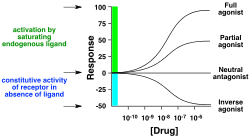
Dose response curves of a full agonist, partial agonist, neutral antagonist, and inverse agonist

An agonist is a chemical that activates a receptor to produce a biological response. Receptors are cellular proteins whose activation causes the cell to modify what it is currently doing. In contrast, an antagonist blocks the action of the agonist, while an inverse agonist causes an action opposite to that of the agonist.

Etymology

[edit]

The word originates from the Greek word ἀγωνιστής (agōnistēs), "contestant; champion; rival" < ἀγών (agōn), "contest, combat; exertion, struggle" < ἄγω (agō), "I lead, lead towards, conduct; drive."

Types of agonists

[edit]

Receptors can be activated by either endogenous agonists (such as hormones and neurotransmitters) or exogenous agonists (such as drugs), resulting in a biological response. A physiological agonist is a substance that creates the same bodily responses but does not bind to the same receptor.

  • An endogenous agonist for a particular receptor is a compound naturally produced by the body that binds to and activates that receptor. For example, the endogenous agonist for serotonin receptors is serotonin, and the endogenous agonist for dopamine receptors is dopamine.[1]
  • Full agonists bind to and activate a receptor with the maximum response that an agonist can elicit at the receptor. One example of a drug that can act as a full agonist is isoproterenol, which mimics the action of adrenaline at β adrenoreceptors. Another example is morphine, which mimics the actions of endorphins at μ-opioid receptors throughout the central nervous system. However, a drug can act as a full agonist in some tissues and as a partial agonist in other tissues, depending upon the relative numbers of receptors and differences in receptor coupling.[medical citation needed]
  • A co-agonist works with other co-agonists to produce the desired effect together. NMDA receptor activation requires the binding of both glutamate, glycine and D-serine co-agonists. Calcium can also act as a co-agonist at the IP3 receptor.
  • A selective agonist is selective for a specific type of receptor. E.g. buspirone is a selective agonist for serotonin 5-HT1A.
  • Partial agonists (such as buspirone, aripiprazole, buprenorphine, or norclozapine) also bind and activate a given receptor, but have only partial efficacy at the receptor relative to a full agonist, even at maximal receptor occupancy. Agents like buprenorphine are used to treat opiate dependence for this reason, as they produce milder effects on the opioid receptor with lower dependence and abuse potential.
  • An inverse agonist is an agent that binds to the same receptor binding-site as an agonist for that receptor and inhibits the constitutive activity of the receptor. Inverse agonists exert the opposite pharmacological effect of a receptor agonist, not merely an absence of the agonist effect as seen with an antagonist. An example is the cannabinoid inverse agonist rimonabant.
  • A superagonist is a term used by some to identify a compound that is capable of producing a greater response than the endogenous agonist for the target receptor. It might be argued that the endogenous agonist is simply a partial agonist in that tissue.
  • An irreversible agonist is a type of agonist that binds permanently to a receptor through the formation of covalent bonds.[2][3]
  • A biased agonist is an agent that binds to a receptor without affecting the same signal transduction pathway. Oliceridine is a μ-opioid receptor agonist that has been described to be functionally selective towards G protein and away from β-arrestin2 pathways.[4]

New findings that broaden the conventional definition of pharmacology demonstrate that ligands can concurrently behave as agonist and antagonists at the same receptor, depending on effector pathways or tissue type. Terms that describe this phenomenon are "functional selectivity", "protean agonism",[5][6][7] or selective receptor modulators.[8]

Mechanism of action

[edit]

As mentioned above, agonists have the potential to bind in different locations and in different ways depending on the type of agonist and the type of receptor.[9] The process of binding is unique to the receptor-agonist relationship, but binding induces a conformational change and activates the receptor.[9][10] This conformational change is often the result of small changes in charge or changes in protein folding when the agonist is bound.[10][11] Two examples that demonstrate this process are the muscarinic acetylcholine receptor and NMDA receptor and their respective agonists.

Simplified depiction of the mechanism of an agonist binding to a GPCR.

For the muscarinic acetylcholine receptor, which is a G protein-coupled receptor[10](GPCR), the endogenous agonist is acetylcholine. The binding of this neurotransmitter causes the conformational changes that propagate a signal into the cell.[10] The conformational changes are the primary effect of the agonist, and are related to the agonist's binding affinity and agonist efficacy.[9][12] Other agonists that bind to this receptor will fall under one of the different categories of agonist mentioned above based on their specific binding affinity and efficacy.

Simplified depiction of co-agonists activating a receptor.

The NMDA receptor is an example of an alternate mechanism of action, as the NMDA receptor requires co-agonists for activation. Rather than simply requiring a single specific agonist, the NMDA receptor requires both the endogenous agonists, N-methyl-D-aspartate (NMDA) and glycine.[11] These co-agonists are both required to induce the conformational change needed for the NMDA receptor to allow flow through the ion channel, in this case calcium.[11] An aspect demonstrated by the NMDA receptor is that the mechanism or response of agonists can be blocked by a variety of chemical and biological factors.[11] NMDA receptors specifically are blocked by a magnesium ion unless the cell is also experiencing depolarization.[11]

These differences show that agonists have unique mechanisms of action depending on the receptor activated and the response needed.[9][10] The goal and process remains generally consistent however, with the primary mechanism of action requiring the binding of the agonist and the subsequent changes in conformation to cause the desired response at the receptor.[9][12] This response as discussed above can vary from allowing flow of ions to activating a GPCR and transmitting a signal into the cell.[9][10]

Activity

[edit]
Efficacy spectrum of receptor ligands.

Potency

[edit]

Potency is the amount of agonist needed to elicit a desired response. The potency of an agonist is inversely related to its half maximal effective concentration (EC50) value. The EC50 can be measured for a given agonist by determining the concentration of agonist needed to elicit half of the maximum biological response of the agonist. The EC50 value is useful for comparing the potency of drugs with similar efficacies producing physiologically similar effects. The smaller the EC50 value, the greater the potency of the agonist, the lower the concentration of drug that is required to elicit the maximum biological response.

Therapeutic index

[edit]

Therapeutic index is a meaure of a drug's safety margin. When a drug is used therapeutically, it is important to understand the margin of safety that exists between the dose needed for the desired effect and the dose that produces unwanted and possibly dangerous side-effects (measured by the TD50, the dose that produces toxicity in 50% of individuals). This relationship, termed the therapeutic index, is defined as the ratio TD50:ED50. In general, the narrower this margin, the more likely it is that the drug will produce unwanted effects. The therapeutic index emphasizes the importance of the margin of safety, as distinct from the potency, in determining the usefulness of a drug.

See also

[edit]

References

[edit]
Revisions and contributorsEdit on WikipediaRead on Wikipedia
from Grokipedia
In , an agonist is a substance, typically a or endogenous , that binds to a specific receptor on a cell surface or within the cell and activates it, thereby initiating a biological response that mimics or enhances the effect of the natural signaling molecule. Agonists are fundamental to , the study of how interact with biological targets to produce therapeutic effects, and they play a central role in for treating conditions ranging from and cardiovascular diseases to neurological disorders. Agonists are classified based on their efficacy, which measures the maximum response they can elicit relative to the endogenous . A full agonist produces the maximal possible response from the receptor system, fully activating downstream signaling pathways even if it occupies only a fraction of available receptors due to receptor reserve. In contrast, a binds to the same receptor but generates a submaximal response, regardless of the concentration used, making it useful in scenarios where complete activation could lead to , such as in opioid therapy with drugs like . Additionally, inverse agonists bind to receptors with constitutive (basal) activity and stabilize an inactive conformation, reducing this background signaling below normal levels, which has implications for treating conditions involving overactive receptors, such as certain psychiatric disorders. The binding of agonists typically occurs at the orthosteric site—the primary location where the natural interacts—leading to conformational changes in the receptor that trigger intracellular events like opening, activation, or modulation. This mechanism underpins the therapeutic utility of agonists in clinical practice, including beta-2 agonists for relief and GLP-1 receptor agonists for , while also highlighting risks like receptor desensitization or downregulation with prolonged exposure. Understanding agonist action is essential for developing selective therapies that minimize off-target effects and optimize efficacy.

Fundamentals

Definition

In , an is a or that binds to a specific receptor and activates it, thereby producing a biological response akin to that triggered by the endogenous . This activation mimics the natural signaling process, leading to downstream cellular effects that can influence physiological functions. A key requirement for a substance to qualify as an is the possession of both affinity and intrinsic efficacy. Affinity refers to the strength with which the agonist binds to its target receptor, often quantified by the (K_d). Intrinsic efficacy, on the other hand, describes the agonist's ability to stabilize the receptor in an active conformation, thereby eliciting a measurable response upon binding. Without both properties, a may bind but fail to produce the characteristic activation seen in true . In contrast to neutral antagonists, which occupy the receptor without inducing , agonists initiate signaling cascades that propagate the biological signal within the cell. This distinction underscores the functional role of agonists in therapeutic applications, where receptor is desired to achieve pharmacological outcomes. Agonists commonly target receptors such as G-protein coupled receptors (GPCRs), which mediate a wide array of physiological processes.

Etymology

The term "agonist" derives from the noun agōnistēs (ἀγωνιστής), signifying a "contestant," "," or "rival" in athletic or theatrical competitions, rooted in agōn (ἀγών), which denoted a public contest, struggle, or exertion implying active engagement and opposition. This etymological foundation emphasized participation in conflict or performance, as seen in and where the agonist represented the central figure driving the action. The word entered English in the early (first recorded around ) through the Latin agonista, initially retaining its classical connotations of a competitor in games, a dramatic , or one who provokes or strife, often in literary or rhetorical contexts. By the 18th and 19th centuries, it had broadened slightly to include general notions of opposition or , but remained distant from scientific applications. In scientific usage, particularly and , "agonist" was specialized in the mid-20th century, with its pharmacological meaning—referring to a substance that actively binds and activates a receptor—first documented around 1948, emerging from studies contrasting it with "antagonists" in receptor interactions. This shift from a broad sense of contention to a precise descriptor of molecular activity was influenced by foundational receptor theory developed in the early 1900s by pharmacologists such as , who coined "receptor" in 1900, and J.N. Langley, laying the groundwork for terms highlighting active versus opposing roles in biological systems. The adoption reflected a conceptual toward viewing agonists as proactive agents in physiological processes, aligning with their Greek origin of active participation.

Classification

Full and Partial Agonists

Full agonists are substances that, upon binding to a specific receptor, elicit the maximum possible biological response that the receptor system can produce, achieving 100% efficacy relative to the system's capacity. This maximal activation occurs even if only a of receptors need to be occupied, depending on the receptor reserve in the tissue. For instance, acts as a full agonist at mu-opioid receptors, producing profound analgesia, , and respiratory depression by fully activating downstream signaling pathways. In contrast, partial agonists bind to the same receptor but generate a submaximal response, with efficacy less than 100%, even when all receptors are occupied. This limited activation stems from the agonist's lower intrinsic , resulting in a ceiling effect on the biological response. exemplifies a partial agonist at mu-opioid receptors, where it produces moderate analgesia and but cannot fully replicate the effects of full agonists like , even at high doses. Dose-response curves illustrate these differences graphically, plotting drug concentration against effect magnitude. Full agonists exhibit a sigmoidal curve that plateaus at the system's maximum effect (Emax), allowing them to achieve full tissue responses at relatively lower concentrations compared to partial agonists aiming for the same submaximal level, due to their higher efficacy. Partial agonist curves, however, plateau below Emax, reflecting their inability to fully activate the receptor regardless of dose, which can lead to competitive antagonism against full agonists when both are present. Clinically, partial agonists offer safer profiles in treatments requiring controlled receptor activation, particularly for , where they alleviate withdrawal symptoms and cravings while blocking the euphoric effects of full agonists, thereby reducing overdose risk through their ceiling effect on respiratory depression. 's partial agonism enables it to stabilize patients without promoting abuse liability, making it a preferred option in medication-assisted to promote long-term and prevention.

Inverse and Biased Agonists

Inverse agonists represent a class of ligands that bind to receptors exhibiting constitutive activity and actively suppress this basal signaling by stabilizing the inactive conformation of the receptor, thereby producing effects opposite to those of agonists. This mechanism contrasts with neutral antagonists, which merely block agonist binding without affecting basal activity, and highlights the existence of receptor states with intrinsic signaling even in the absence of ligands. The concept of inverse agonism was first demonstrated by Costa and Herz in 1989 at delta-opioid receptors. A classic example at GABA_A receptors is the Ro 15-4513, a partial inverse at the site, which in states of elevated constitutive activity increases neuronal excitability by reducing basal conductance, leading to and proconvulsant effects. The concept of inverse agonism challenges classical receptor theory, which traditionally viewed receptors as binary switches between inactive and active states activated solely by agonists; instead, it posits a dynamic equilibrium where ligands can shift the population toward the inactive state, influencing for conditions involving receptor overexpression or mutations leading to hyperactivity, such as in certain cancers or neurological disorders. Identification of inverse agonists gained prominence in the through studies on G protein-coupled receptors (GPCRs) and ion channels, with early examples emerging from research on H1 and D2 receptors. Biased agonists, or ligands exhibiting , preferentially stabilize specific receptor conformations that activate a of downstream signaling pathways while attenuating others, allowing for tailored therapeutic effects that minimize off-target actions. For instance, functions as a biased agonist at β1-adrenergic receptors, favoring β-arrestin-mediated signaling over pathways, which contributes to cardioprotective benefits like improved contractility without excessive . This selectivity arises from the ligand-induced conformational changes that differentially recruit transducers like or arrestins. Research on biased agonism has accelerated since the early 2000s, driven by structural and biophysical studies of GPCRs, with key advancements from the Lefkowitz laboratory elucidating pathway-specific signaling in and β-adrenergic receptors. Unlike partial agonists, which elicit submaximal responses across all pathways, biased agonists enable pathway-specific modulation, revolutionizing GPCR-targeted therapies for diseases like and .

Mechanism of Action

Receptor Interaction

Agonists initiate their effects by binding to specific receptor sites, forming a -receptor complex that stabilizes an active conformation of the receptor. The affinity of an agonist for its receptor is quantified by the Kd=[L][R][LR]K_d = \frac{[L][R]}{[LR]}, where [L][L] is the concentration of free (agonist), [R][R] is the concentration of free receptor, and [LR][LR] is the concentration of the -receptor complex; a lower KdK_d indicates higher binding affinity. This binding equilibrium drives the interaction, with the agonist occupying the orthosteric site to induce a conformational shift in the receptor's structure, such as the outward movement of transmembrane helix 6 in G protein-coupled receptors (GPCRs). At the molecular level, agonist-receptor docking involves key non-covalent interactions, including bonding between polar groups on the and receptor residues, as well as hydrophobic interactions that bury non-polar moieties within the receptor's binding pocket. For instance, in GPCRs like the β2-adrenergic receptor, agonists such as epinephrine form bonds with serine and residues in transmembrane helices while engaging in hydrophobic contacts with and side chains. Similarly, in ion channels like the , the agonist interacts via cation-π bonds with aromatic residues (e.g., ) and bonds with backbone carbonyls, facilitating channel opening. Endogenous agonists, such as neurotransmitters like acetylcholine, are naturally produced molecules that bind to their cognate receptors to mediate physiological signaling, whereas exogenous agonists are synthetic compounds designed to mimic this binding, such as carbachol for muscarinic receptors. The specificity and strength of these interactions can be modulated by receptor subtypes, which exhibit sequence variations leading to differential affinities (e.g., α1 vs. α2 adrenergic receptors), and by allosteric sites, where modulators bind remotely to alter the orthosteric site's conformation and agonist efficacy.

Signal Transduction Pathways

Agonist binding to G protein-coupled receptors (GPCRs) initiates signal transduction by inducing a conformational change that facilitates interaction with heterotrimeric G proteins, leading to GDP-GTP exchange on the Gα subunit and subsequent dissociation into Gα and Gβγ components. These activated subunits then modulate downstream effectors; for instance, Gs-coupled receptors stimulate adenylyl cyclase to increase cyclic AMP (cAMP) levels, activating protein kinase A (PKA) and promoting processes like glycogenolysis, while Gq-coupled receptors activate phospholipase C (PLC), generating inositol trisphosphate (IP3) and diacylglycerol (DAG) to release intracellular calcium and activate protein kinase C (PKC), respectively. Gi-coupled receptors, conversely, inhibit adenylyl cyclase, reducing cAMP and dampening excitatory signals. In contrast, agonists binding to ionotropic receptors, such as nicotinic acetylcholine receptors (nAChRs), directly open ligand-gated ion channels, allowing rapid influx of cations like Na⁺ and Ca²⁺, which depolarizes the and triggers immediate excitatory responses in neurons or muscle cells. This ion flux can propagate action potentials or initiate contraction without intermediary proteins, exemplifying a fast, non-amplified signaling mode compared to GPCR cascades. Signal amplification occurs through enzymatic cascades in GPCR pathways, where second messengers like cAMP or IP3 activate multiple targets, leading to widespread effects such as gene transcription via CREB or enzymatic modifications that alter and activity. For example, elevated can numerous proteins, amplifying the initial signal to influence cellular proliferation or secretion over minutes to hours. Different agonists can selectively bias GPCR signaling toward specific pathways, a phenomenon known as biased agonism, where one preferentially activates G protein-mediated responses over β-arrestin pathways, resulting in distinct cellular outcomes like enhanced contraction in versus increased in endocrine cells. This pathway selection arises from agonist-induced receptor conformations that stabilize particular effector interactions, allowing therapeutic targeting of beneficial effects while minimizing side effects. Prolonged agonist exposure often leads to desensitization, where receptors undergo by kinases like kinases (GRKs) or internalization via , reducing responsiveness and contributing to —a rapid decline in effect despite continued stimulation. This regulatory mechanism prevents overstimulation, as seen in β-adrenergic receptors where agonist-bound forms are preferentially phosphorylated, uncoupling them from G proteins.

Pharmacological Properties

Potency and Efficacy

In , potency refers to the concentration of an required to produce a given effect, typically quantified by the EC50, which is the concentration that elicits 50% of the maximal response. A lower EC50 value indicates higher potency, reflecting the agonist's ability to achieve half-maximal at lower doses, independent of the total response magnitude. For example, isoproterenol, a potent β-adrenergic , exhibits an EC50 in the nanomolar range (approximately 52 nM) for β2-receptor , enabling effective at low concentrations. Efficacy, in contrast, measures the maximal response (Emax) an can produce upon full receptor occupancy, representing the intrinsic ability to activate the receptor and downstream signaling. Unlike potency, is independent of concentration requirements; partial agonists, for instance, may display high potency (low EC50) but low due to their limited capacity to stabilize the active receptor conformation, resulting in an Emax below that of full agonists. This distinction is crucial, as it allows agonists with similar potencies to differ markedly in therapeutic ceiling effects. The relationship between agonist concentration and response is described by the dose-response curve, which typically follows a sigmoid shape and is modeled by the Hill equation: E=Emax[D]nEC50n+[D]nE = E_{\max} \frac{[D]^n}{EC_{50}^n + [D]^n} where EE is the response, [D][D] is the concentration, and nn is the Hill coefficient indicating or steepness of the curve (often near 1 for simple agonist-receptor interactions). Potency (EC50) and (Emax) from this model can be influenced by factors such as receptor density, where higher density enhances both parameters by increasing available binding sites, and coupling efficiency, which affects from receptor to effector and thus the observed maximal response.

Therapeutic Index and Safety

The therapeutic index (TI) of an is defined as the ratio of the toxic dose that produces adverse effects in 50% of subjects (TD50) to the effective dose that achieves the desired therapeutic response in 50% of subjects (ED50), expressed as TI = TD50/ED50. A wide TI is particularly desirable for agonists to minimize the risk of from excessive receptor activation, allowing a broader dosing range before harmful effects occur. Safety concerns with agonists primarily arise from overactivation of target receptors, which can lead to receptor downregulation, tolerance development, and various side effects. Receptor downregulation occurs as a compensatory mechanism following prolonged agonist exposure, reducing receptor density and responsiveness over time. Tolerance similarly emerges from adaptive changes, diminishing the drug's and necessitating higher doses, which heightens toxicity risks. For instance, beta-agonists can induce as a cardiovascular side effect due to non-selective of beta-1 receptors in the heart. Several factors influence the TI of agonists, including their subtype. Partial agonists often exhibit a wider TI owing to their ceiling effects, where maximal efficacy plateaus below full receptor activation, limiting overdose potential and adverse outcomes like respiratory depression. Inverse agonists, by contrast, are advantageous in disorders involving constitutive receptor activity, as they suppress basal signaling without the overactivation risks of full agonists, potentially enhancing safety in such contexts. Regulatory oversight of agonist TI has evolved significantly, influenced by the 1962 Kefauver-Harris Amendments following the tragedy, which mandated rigorous proof of safety and efficacy for drug approval. The U.S. Food and Drug Administration (FDA) classifies drugs with a narrow (NTI)—those where small differences in dose or blood concentration may lead to serious therapeutic failures or adverse drug reactions—as requiring stricter standards and monitoring to ensure safety margins during approval and post-market use. This framework prioritizes comprehensive preclinical and clinical data on TI to mitigate risks associated with agonist therapies.

Applications and Examples

Physiological Roles

Agonists play crucial roles in physiological processes by binding to specific receptors and eliciting biological responses essential for normal bodily functions. In , endogenous agonists such as act at dopamine D2 receptors to modulate neuronal activity, influencing mood regulation in the and motor control in the . Dysregulation of signaling at these receptors is implicated in disorders like , where reduced dopaminergic activity impairs movement, and mood disorders such as depression. In hormonal signaling, epinephrine serves as a key endogenous agonist at adrenergic receptors, primarily α1- and β-adrenergic subtypes, to mediate the acute physiological changes during the . This activation increases , dilates bronchioles, and redirects blood flow to skeletal muscles, enabling rapid adaptation to stress. Epinephrine's binding to these receptors triggers intracellular cascades that enhance alertness and energy mobilization, underscoring its role in survival mechanisms. Agonists are integral to homeostasis, exemplified by insulin binding to its receptor as an endogenous agonist to promote glucose uptake in peripheral tissues like skeletal muscle and adipose tissue. This process involves the translocation of glucose transporter 4 (GLUT4) to the cell membrane, facilitating efficient blood glucose clearance and maintaining metabolic balance. Disruptions in insulin receptor activation, such as in insulin resistance, impair this uptake and contribute to the pathogenesis of type 2 diabetes, where elevated blood glucose levels result from inadequate cellular response to insulin. From an evolutionary perspective, as ligands in receptor signaling systems have been essential for the development of multicellular organisms, enabling precise and rapid intercellular communication required for coordinated growth, differentiation, and response to environmental cues. The diversification of ligand-receptor pairs during allowed for high-affinity interactions that support complex tissue organization and physiological integration across . This foundational role highlights how agonist-mediated signaling underpins the transition from unicellular to multicellular , fostering adaptive cellular networks.

Therapeutic Uses

Agonists play a central role in modern by selectively activating receptors to elicit desired physiological responses, enabling targeted interventions for various diseases. In , full opioid agonists such as are cornerstone treatments for severe acute and conditions. , a synthetic mu-opioid receptor agonist, delivers potent analgesia through binding to mu receptors in the , exhibiting 50 to 100 times the potency of and providing rapid onset for postoperative and cancer-related pain relief. Its formulation allows sustained delivery for chronic severe pain in opioid-tolerant patients, improving in settings. In respiratory , short-acting beta-2 adrenergic agonists like albuterol are first-line agents for acute bronchodilation in and . Albuterol activates beta-2 receptors on airway , leading to relaxation and alleviation of , with inhaled administration providing quick symptom relief during exacerbations. This selectivity minimizes systemic effects, making it suitable for both and in reversible obstructive airways disease. Dopamine agonists, exemplified by , are essential in managing by compensating for deficiency in the . , a non-ergot D2/D3 receptor agonist, reduces motor symptoms such as bradykinesia and rigidity when used as monotherapy in early stages or adjunctively with levodopa in advanced disease. Clinical trials have demonstrated its efficacy in increasing "on" time without , offering a favorable profile for long-term use. Post-2010 advancements in precision medicine have spotlighted biased agonists, which preferentially activate specific signaling pathways downstream of G-protein-coupled receptors to optimize therapeutic outcomes while mitigating adverse effects. In treatment, biased agonists at D2 receptors, such as those explored in novel s, enhance against positive symptoms but reduce extrapyramidal side effects by avoiding beta-arrestin recruitment. This approach enables personalized dosing based on receptor signaling profiles, potentially improving adherence and reducing metabolic disturbances associated with traditional s. Drug development trends since the have emphasized rational design of agonists, utilizing crystallographic structures of G-protein-coupled receptors to engineer compounds with high specificity for targeted subtypes. This structure-based approach has accelerated the creation of agonists like those for beta-2 and , enhancing binding affinity and minimizing off-target interactions. By integrating computational modeling with , researchers have developed agonists that balance potency—measured by values—for clinical efficacy without excessive dosing requirements.

References

Add your contribution
Related Hubs
User Avatar
No comments yet.