


Community hub
Recent from talks
Contribute something
Nothing was collected or created yet.
Semeru
View on Wikipedia
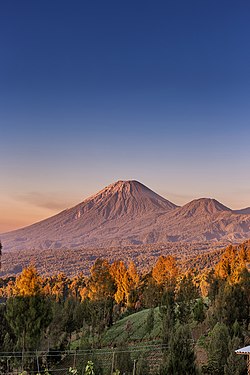
Semeru is the highest mountain on the Indonesian island of Java and an active volcano located in the province of East Java in a subduction zone, where the Indo-Australian Plate subducts under the Eurasian Plate. Semeru is 3,676 m tall at its peak, making it the third tallest volcano in Indonesia. [3]
Key Information


The name "Semeru" is derived from Meru, the central world mountain in Hinduism, or Sumeru, the abode of gods. This stratovolcano is Mahameru, meaning "The Great Mountain" in Sanskrit.[4][1]

Geology
[edit]Semeru rises steeply above the coastal plains of eastern Java. Maars containing crater lakes have formed along a line through the volcano's summit. It was formed south of the overlapping Ajek-ajek and Jambangan calderas.[5] The eruptive products are andesitic.[6] Semeru lies at the south end of the Tengger Volcanic Complex.
Eruptive history
[edit]Semeru's eruptive history is extensive. Since 1818, at least 61 eruptive periods have been recorded[7] (11 of which resulted in fatalities) consisting of lava and pyroclastic flows. Almost all historical eruptions have had a Volcanic Explosivity Index (VEI) of 2 or 3.[8] Semeru has been in a state of near-constant eruption from 1967 to the present.[9] The volcano's most recent eruption occurred in 2025.[10]
2021 eruption
[edit]In 2021, Semeru erupted in January, and on 4 and 6 December.[11] The eruption caused 11 km (6.8 mi) high ejections, lava flows for 5–11.5 km (3.1–7.1 mi) and ash rains for 30 km (19 mi).[12]
At least 57 people died,[13] 104 more were injured, while 23 were unaccounted for.[14] More than 10,000 people were displaced, and 1,027 houses, 43 public facilities and two bridges affected.[12]
2022 eruption
[edit]Monsoon rains in 2022 and 2023 led to the collapse of the lava dome; Semeru erupted again on 4 December 2022 with a pyroclastic flow of 12 km (7.5 mi) length, a pyroclastic earthquake and 13 eruptions earthquakes.[12]
2025 eruption
[edit]
On 19 November 2025, Semeru erupted with a pyroclastic flow over the southern slope[15] that reached 7 km (4.3 mi), along with an ash cloud that reached a height of 2 km (1.2 mi).[16] As of 20 November 2025, three people were injured, 1,156 were displaced, and 200 houses along with one school building were damaged.[17][18]
Legends
[edit]Semeru is named after Sumeru, the central world mountain in Hinduism. As stated in legend, it was transplanted from India to create the island of Java; the tale is recorded in the 15th-century East Javanese work Tantu Pagelaran. It was originally placed in the western part of the island, but that caused the island to tip, so the gods moved it eastward. On that journey, parts kept coming off the lower rim, forming the mountains Lawu, Wilis, Kelud, Kawi, Arjuno and Welirang. The damage thus caused to the foot of the mountain caused it to shake, and the top came off and created Penanggungan as well.[19] Indonesian Hindus also hold a belief that the mountain is the abode of Shiva in Java.[20]
Floral problems
[edit]Non-native invasive plants
[edit]25 non-native plants have been found in Mount Semeru National Park.[21] The non-native plants, which threaten the endemic local plants, were imported via many ways in the colonial era.[22]: 26–27 Around 1906-1907, M. Buysman, a Dutch botanical park owner in Nongkojajar in western slope of Tengger Mts., developed a huge collection of introduced plants in his park, which later spread widely to the surrounding areas.[23]: 57–59 They include Foeniculum vulgare, Verbena brasiliensis, Chromolaena odorata, and Salvinia molesta.[21]
Vegetable plantations
[edit]Mud erosion from surrounding vegetable plantations is adding silt to Ranu Pani Lake, causing the lake to gradually shrink. Research has predicted that the lake will disappear by about 2025, unless the vegetable plantations on the hillsides are replaced with more ecologically sustainable perennials.[24]
See also
[edit]
References
[edit]- ^ a b "Global Volcanism Program | Semeru". Smithsonian Institution | Global Volcanism Program. Retrieved 29 September 2022.
- ^ "Residents are evacuating as Mount Semeru, Indonesia's highest volcano, has erupted". Associated Press. 4 December 2022. Retrieved 4 December 2022.
- ^ "Mount Semeru". Archived from the original on 6 December 2021. Retrieved 31 May 2018.
- ^ "Indonesia: Death toll rises to 14 after eruption of Semeru volcano". The Guardian. 5 December 2021.
- ^ "Semeru: Summary". Global Volcanism Program. Smithsonian Institution.
- ^ "Semeru Volcano".
- ^ "Semeru: Eruptive History". Global Volcanism Program. Smithsonian Institution. Retrieved 26 September 2025.
- ^ "Semeru: Eruptive History". Global Volcanism Program. Smithsonian Institution. Retrieved 26 September 2025.
- ^ "Volcano erupts in Indonesia". www.abc.net.au. 6 March 2009. Retrieved 6 November 2020.
- ^ "Indonesia's Mount Semeru Erupts for the Second Time on Friday, February 16". Tempo. 17 February 2024.
- ^ Kurniawan, W.; Adriansyah, T. (2021). "Indonesia volcano erupts again as death toll rises to 22". KSL. Retrieved 6 December 2021.
- ^ a b c Bachri, S.; Sanjaya, E.H.; Sendari, S.; Shrestha, R.P.; Irawan, L.Y.; Billah, E.N.; Putri, N.R.C.; Prastiwi, M.R.H.; Hakiki, A.; Hidiyah, T.M. (2024). "The Development of Disaster Risk Map for Semeru Volcano Eruption 2021-2022, East Java, Indonesia". Indonesian Journal of Geography. 56 (3): 446–455. doi:10.22146/ijg.89918.
- ^ Latu Ratri Mubyarsah, ed. (2021). "Hari Terakhir Pencarian Korban Erupsi Semeru, 57 Orang Meninggal" (in Indonesian). Jawa Pos. Archived from the original on 20 December 2021. Retrieved 20 December 2021.
- ^ "Semeru Volcano Eruption Indonesia". No. Semeru Eruption. Reliefweb. 2021. Archived from the original on 7 December 2021. Retrieved 7 December 2021.
- ^ martin (19 November 2025). "Semeru volcano (East Java, Indonesia): massive block and ash flow created billowing ash plume". Volcano Discovery. Volcanological Survey of Indonesia. Retrieved 19 November 2025.
- ^ "Indonesia raises alert for Mount Semeru volcano to the highest level after a series of eruptions". AP News. Jakarta: Associated Press. 19 November 2025. Retrieved 19 November 2025.
- ^ Huda, Miftahul; Wadrianto, Glori K. (20 November 2025). "Korban Luka akibat Erupsi Gunung Semeru Bertambah Jadi 3 Orang" [The number of injured victims from the Mount Semeru eruption has increased to 3]. Kompas Surabaya (in Indonesian). Lumajang: Kompas.com. Retrieved 21 November 2025.
- ^ "Pengungsi Akibat Erupsi Gunung Semeru Bertambah Jadi 1.156 Orang" [The number of people displaced by the Mount Semeru eruption has increased to 1,156]. CNN Indonesia (in Indonesian). 20 November 2025. Retrieved 21 November 2025.
- ^ Soekmono (1973). Pengantar Sejarah Kebudayaan Indonesia 2. Yogyakarta, Indonesia: Penerbit Kanisius. p. 119. ISBN 979-413-290-X.
- ^ Larasati, Ayu Utami (6 December 2021). "Legenda Gunung Semeru yang Melekat di Masyarakat". Tagar.id (in Indonesian). Retrieved 25 May 2022.
- ^ a b Widianto, Eko (25 October 2014). "Foreign Plantations Invade Mt Semeru". Tempo.
- ^ Steenis, CGGJ van (1972). The Mountain Flora of Java. Leiden: EJ Brill.
- ^ Backer, CA (1936). "Verwilderingscentra op Java van uitheemsche planten." De Tropische Natuur 25 Jub.uitg.:51-60.
- ^ Priyasidharta, David (15 December 2014). "Ranu Pane Lake Estimated to Disappear in 10 Years". Tempo.
General sources
[edit]- "Semeru". Global Volcanism Program. Smithsonian Institution.
- Holt, Claire. Art in Indonesia: Continuities and Change. Ithaca: Cornell University Press, 1967. Page 36 explains the mythological aspect of the mountain.
External links
[edit]
Semeru
View on GrokipediaGeography
Location and Regional Context
Semeru is situated at coordinates 8°06′28″S 112°55′20″E in the East Java province on the island of Java, Indonesia, making it a prominent feature of the country's densely populated and volcanically active southern region.[2] As the highest peak in Java, Semeru rises to an elevation of 3,676 meters (12,060 feet) and is integrated into the Bromo Tengger Semeru National Park, a protected area spanning approximately 50,276 hectares (502 km²) across the Tengger Mountains.[6] The volcano lies south of the expansive Tengger Caldera and is positioned near the southern coast of Java, close to the Indian Ocean, which influences local weather patterns and accessibility from coastal areas.[2] This strategic placement within a volcanic massif enhances its role as a dominant landscape element in eastern Java's rugged terrain. Semeru borders the regencies of Lumajang and Malang, with nearby settlements including the village of Ranu Pani at its southeastern base, which serves as a primary gateway for climbers and visitors.[7] The area is accessible via well-maintained roads from major cities, such as Surabaya, located about 300 km to the north, allowing for relatively straightforward travel despite the mountainous surroundings.[8] The regional climate is tropical monsoon, featuring distinct wet and dry seasons with annual rainfall up to 6,600 mm, primarily concentrated between November and March.[9] This precipitation regime fosters a varied altitudinal zonation of vegetation, transitioning from dense lowland tropical forests at lower elevations to montane shrublands and alpine meadows near the summit, supporting unique biodiversity within the national park.[10]Topography and Physical Features
Mount Semeru, a steep stratovolcano, rises approximately 2,500 meters above the surrounding Tengger caldera plains to a summit elevation of 3,676 meters at Mahameru peak.[1] The active Jonggring-Seloko crater, situated at the summit, measures roughly 500 by 600 meters and serves as the primary vent for ongoing volcanic activity.[2] This prominent cone dominates the landscape, with its rugged slopes descending sharply, particularly on the southeastern flank where visible lava flows extend up to 500 meters and pyroclastic deposits scar the terrain.[2] Key surface features include a series of scenic lakes within the broader caldera system of Bromo Tengger Semeru National Park, such as Ranu Pani (covering about 0.75 hectares at 2,100 meters elevation due to sedimentation), Ranu Regulo (0.75 hectares nearby), and Ranu Kumbolo (a freshwater alpine lake at 2,400 meters often used as a climber's rest point).[6] The lower to mid-slopes host expansive savanna grasslands interspersed with edelweiss fields, providing stark contrast to the volcanic rock outcrops and contributing to the park's diverse ecosystems.[6] Vegetation varies distinctly by elevation: lowland dipterocarp forests dominate up to 1,200 meters, transitioning to montane rainforests rich in Fagaceae and other families up to 2,500 meters, while the barren summit zone above 3,000 meters features sparse sub-alpine and ericaceous shrubs adapted to harsh conditions.[11] These zones support over 1,000 flora species, enhancing the area's biodiversity within the national park.[6] Semeru serves as a major hydrological source, feeding rivers such as the Brantas, which originates in part from its slopes and sustains regional agriculture downstream.[7] Channels like the Kobokan River, draining the southeastern flank, are particularly prone to lahars due to the steep topography and frequent ash accumulation.[2]Geology
Tectonic Setting
Semeru volcano is situated within the Sunda Arc, a major convergent margin where the Indo-Australian Plate subducts obliquely beneath the Eurasian Plate at a convergence rate of approximately 7 cm per year.[12] This subduction process generates a Wadati-Benioff zone characterized by intermediate-depth earthquakes extending to depths of up to 600 km, reflecting the downward flexure and internal deformation of the subducting slab.[13] The ongoing plate convergence drives partial melting in the mantle wedge through mechanisms such as slab dehydration, releasing volatiles that facilitate magma generation and ascent.[14] As part of the eastern segment of the Java volcanic arc, Semeru lies approximately 150 km north of the Java Trench, the surface expression of the subduction zone off the southern coast of Java.[15] This positioning places the volcano within the active volcanic front, where the subducting oceanic lithosphere influences the distribution of magmatic activity across the island.[16] The tectonic setting contributes to associated seismic hazards, including Benioff zone seismicity that can propagate stress changes far inland. For instance, the 2006 Yogyakarta earthquake (Mw 6.3), occurring approximately 250 km west of Semeru, indirectly triggered enhanced volcanic activity at the volcano by altering regional stress fields.[17] Slab dehydration processes in this environment are linked to the production of andesitic magmas that characterize Semeru's eruptions.[18] Semeru forms part of a cluster of active volcanoes in the Tengger-Semeru massif, including Bromo and Batok within the Tengger Caldera complex, and is one of 34 active volcanoes on Java Island.[19][16] This regional volcanism underscores the intense magmatic productivity driven by the Sunda subduction system.[20]Stratigraphy and Composition
Semeru volcano originated as part of the broader Semeru-Tengger volcanic massif in East Java, Indonesia, with its formation following the development of earlier calderas in the region, including the Jambangan and Tengger structures during the Pleistocene epoch. The Mahameru edifice, the older core of Semeru, began building after the collapse of the Tengger Caldera complex approximately 100,000 years ago, through the accumulation of layered andesitic lavas and pyroclastic deposits south of the caldera rim. This construction phase marked Semeru's emergence as a stratovolcano, with subsequent growth forming the prominent summit cone via repeated effusive and explosive activity. The volcano's architecture reflects a north-south alignment of eruptive centers within the massif, transitioning from older caldera-forming events to the younger, persistent strato-cone of Semeru.[21] The stratigraphy of Semeru consists of nested calderas beneath the main edifice, including the Ajek-Ajek and Jambangan structures extending northward approximately 6 km, overlain by the Mahameru summit cone and associated flank vents. These elements form a composite structure with multiple vents, such as the active Jonggring-Seloko crater at the summit (elevation 3,657 m), built atop deposits exceeding 3 km in total thickness from accumulated lavas, pyroclastic flows, tephra falls, and lahars. Rock composition is predominantly andesitic, with silica content ranging from 55-60 wt% SiO₂, interspersed with basaltic-andesite layers; this intermediate composition contributes to the magma's high viscosity, favoring explosive eruptions over effusive flows. Mineralogically, the rocks feature phenocrysts of plagioclase (up to 0.5 cm), pyroxene, and hornblende within a calc-alkaline matrix derived from subduction-related magmatism.[21][22][23] Geophysical investigations reveal a magma storage system with reservoirs at depths of 5 km and deeper (up to 20 km), identified through seismic tomography showing low-velocity anomalies indicative of partial melt or fluids. These structures support the volcano's ongoing activity, with ground deformation patterns exhibiting inflation-deflation cycles linked to magma recharge and discharge in the shallow conduit. Tiltmeter records have documented precursory inflation on the order of several microradians prior to explosive events, followed by deflation, reflecting pressure changes within the system.[21][24]Eruptive History
Pre-1967 Eruptions
Semeru's eruptive history prior to 1967 is marked by episodic activity, with the first documented eruption occurring in 1818. This event involved explosive emissions that generated ash plumes rising approximately 1 km above the summit, accompanied by lava flows descending the flanks.[2] Dutch colonial observers noted the volcano's rhythmic explosions at intervals of 20-30 minutes during this period, establishing an early pattern of persistent, low-level unrest based on pre-instrumental records. Throughout the 19th and early 20th centuries, Semeru experienced 61 recorded eruptions, primarily of Strombolian style characterized by moderate explosions, ash emissions, and occasional lava flows.[2] These events resulted in fatalities from 11 incidents, totaling around 300 deaths, often due to secondary hazards like lahars rather than direct explosive impacts. Activity in the 1880s was notable for the formation of new summit vents, reflecting ongoing magmatic unrest and crater modifications.[2] A major escalation occurred during the 1909 Plinian eruption, which ejected approximately 0.1 km³ of material and triggered devastating lahars that killed more than 100 people in surrounding areas. From 1941 to 1945, the volcano produced a series of explosions generating pyroclastic flows that extended up to 5 km down the southeastern flanks, damaging vegetation and infrastructure.[2] These pre-1967 events highlight Semeru's predominantly andesitic composition, with eruptions varying from effusive to highly explosive.1967-Present Continuous Activity
Since 1967, Mount Semeru has maintained nearly continuous eruptive activity, initiated by the extrusion of a lava dome at the summit crater, transitioning the volcano from intermittent historical eruptions to persistent Strombolian-style explosions occasionally exhibiting Vulcanian characteristics. This ongoing regime involves frequent ejections of incandescent material, with daily ash plumes typically rising 500-1,000 meters above the crater rim and drifting variably based on wind direction. Incandescent avalanches and block-and-ash flows commonly descend up to 3-4 kilometers down the southeastern flanks, particularly into the Kobokan and Bang drainages, contributing to the volcano's status as one of Indonesia's most active.[25][2][26] Significant hazards during this period include lahars, such as the May 14, 1981 event when heavy rains triggered mudflows that killed 275 people in Sapitur village.[27] Activity intensified in 1994-1995 with frequent explosions and pyroclastic avalanches reaching 1 km from the summit.[1] In the 21st century, activity has periodically intensified, as seen in the December 4, 2021, eruption triggered by partial dome collapse amid heavy rainfall, which produced a massive pyroclastic density current extending 12 kilometers down the southeastern flank and an ash plume reaching 15 kilometers altitude. This event caused 51 deaths, injured dozens, and displaced over 10,000 residents from nearby villages due to pyroclastic flows, ashfall, and subsequent lahars. Pyroclastic flows continued in January 2022, with multiple events traveling up to 5 kilometers into the Kobokan drainage, accompanied by ash emissions up to 1 kilometer high. By 2023, through June, the volcano generated ash avalanches and pyroclastic flows, including one on June 26 that reached 5 kilometers, alongside plumes up to 1.5 kilometers.[28][28][28][29][30] Activity persisted into 2024 with ongoing ash plumes reaching 1.5 kilometers, including an eruption on November 5 that produced a column 1 kilometer high. In 2025, eruptions escalated in November, with an explosion on November 6 heard 10 kilometers away and ash rising 1 kilometer above the summit; a lahar triggered by rainfall remobilized deposits on November 7, flowing down the Kobokan River; another eruption on November 9 at 15:06 WIB, amid 23 seismic events recorded in the preceding week; an eruption on November 15 producing ash emissions; and an eruption on November 17 at 10:47 WIB. Continuing into 2026, on January 14, a pyroclastic flow occurred from 11:25 to 12:15 WIB, with a maximum amplitude of 20 mm, lasting 3,000 seconds, and traveling 5 km from the summit.[5] As of November 17, 2025, over decades, this continuous activity has led to cumulative ashfall impacting more than 50 villages across Lumajang and Malang districts, while rain-remobilized pyroclastic deposits pose ongoing lahar risks to downstream communities and infrastructure.[2][31][32][33][34][35][28][36][37][3]Cultural Significance
Mythological Legends
Mount Semeru derives its name from Sumeru, the central world-mountain in Hindu cosmology, revered as the cosmic axis connecting heaven and earth and serving as the abode of the gods.[38] According to ancient Javanese legend recorded in the 15th-century Old Javanese text Tantu Pagelaran, the gods, led by Batara Guru (an incarnation of Shiva), transplanted Mount Mahameru from its original location in India to Java to stabilize the island, which was then adrift on the ocean.[39] During the transport, fragments broke off, forming surrounding peaks such as Mount Lawu and Mount Wilis, while the main portion became Semeru, effectively nailing Java to the earth.[40] In Javanese folklore from the Majapahit Empire era, Semeru is depicted as a sacred dwelling for deities, embodying the divine presence in the landscape.[41] This association underscores Semeru's status as a pivotal element in the mythological framework of the region, linking earthly events to celestial will. Symbolically, Semeru represents bravery and spiritual ascent, mirroring the cosmic significance of its namesake Mount Meru.[38] In Javanese wayang kulit shadow puppetry, the gunungan prop—a stylized mountain silhouette—symbolizes Mount Meru, Semeru's namesake, as the sacred axis of the universe and frames the performance's cosmic narrative. In batik motifs, the peak appears as a revered emblem of divine elevation, often integrated into patterns evoking natural and spiritual harmony.[42]Religious and Local Traditions
The Tenggerese people, an ethnic subgroup of the Javanese who adhere to a form of Hinduism and trace their ancestry to the Majapahit Kingdom, regard the Bromo Tengger Semeru region as a sacred landscape central to their spiritual identity.[43] Mount Semeru, as the highest peak in Java, holds cosmological significance as the abode where purified ancestral spirits ascend to the divine after rituals at nearby Mount Bromo.[44] This belief system emphasizes harmony with the mountains, viewed as living entities inhabited by leluhur ngaluhur—ancestor spirits who guard the community's well-being and the natural environment.[44] A key expression of these beliefs is the annual Yadnya Kasada ceremony, held at Mount Bromo's crater during the full moon of the Hindu month of Kasada (typically July).[45] Tenggerese pilgrims from surrounding villages climb the volcano's slopes, led by shamans who chant mantras and prayers, to offer fruits, vegetables, rice, money, and livestock into the crater as tributes to the mountain gods and ancestors.[45][43] These offerings aim to express gratitude for bountiful harvests, seek protection from natural calamities, and ensure communal prosperity, reinforcing the spiritual bond between the people and the volcanic landscape that includes Semeru.[44][46] Climbing rituals extend beyond Bromo to Semeru, where Tenggerese pilgrims occasionally ascend for meditative practices known as semedi, seeking spiritual guidance and purification in the mountain's sacred heights.[44] Local folklore integrates tales of guardian spirits residing in the peaks and forests, which demand respect through taboos on environmental harm and rituals that maintain ecological balance.[44] In villages like Ngadas, situated on Semeru's slopes, communities perform post-eruption prayers such as pujan mubeng—a ritual involving colored offerings at village boundaries—to invoke ancestral protection and restore harmony after volcanic events.[46] These practices frame eruptions not as punishments but as sacred communications from the spirits, provided rituals like Yadnya Kasada are upheld.[44] Tenggerese traditions are preserved through communal adherence and external recognition, notably the 2015 designation of the Bromo Tengger Semeru-Arjuno Biosphere Reserve by UNESCO, which highlights the integration of indigenous knowledge in sustainable land use. This status promotes ecotourism that respects spiritual protocols, such as avoiding disruption of sacred sites, thereby supporting the ethical transmission of cultural practices amid modern pressures.[47]Environmental Concerns
Invasive Plant Species
Invasive plant species pose a significant threat to the unique montane ecosystems of Mount Semeru within Bromo Tengger Semeru National Park, where non-native flora have proliferated in disturbed habitats. Surveys in key areas like Ranupani forest have identified at least nine exotic species, including Salvinia molesta (giant salvinia), Acacia decurrens (wattle), Eupatorium inulifolium (now classified as Austroeupatorium inulaefolium), Lantana camara, and Chromolaena odorata (Siam weed or kirinyuh), with broader inventories across Java's protected areas confirming Chromolaena odorata and Lantana camara as widespread invaders in the park.[48][49] Additional invasives such as Foeniculum vulgare (fennel), Verbena brasiliensis, and Ageratina riparia have been documented in savannahs and trails around Semeru, with surveys identifying at least nine exotic species and broader inventories confirming additional widespread invaders in the park's flora.[50][51] These species thrive in the park's diverse altitudinal zones, from aquatic systems to subalpine grasslands, exploiting the volcano's dynamic environment. Introduction of these invasives primarily occurred through human-mediated pathways linked to agriculture and tourism since the 1970s, when the national park was established and enclave villages expanded vegetable farming. Seeds and propagules were transported via hikers, livestock, and runoff from nearby agricultural fields, with species like Acacia decurrens and Foeniculum vulgare introduced intentionally for erosion control or fodder before escaping cultivation.[50][48] Post-eruption disturbances, such as ash falls and trail creation, have accelerated spread by creating open, nutrient-poor soils ideal for rapid colonization, as seen with Chromolaena odorata dominating recovering slopes.[49] Aquatic invaders like Salvinia molesta likely entered Ranu Pani Lake through contaminated water sources or boating equipment from lowland areas.[48] Ecologically, these invasives outcompete native vegetation, leading to reduced biodiversity in an ecosystem boasting over 800 plant species, including endemics like Javanese edelweiss (Anaphalis javanica).[52] For instance, Chromolaena odorata forms dense thickets that suppress understory growth and alter soil nutrient cycling by increasing nitrogen levels, while Salvinia molesta blankets lakes, blocking light and oxygen to aquatic flora and exacerbating siltation in Ranu Pani.[50][48] Verbena brasiliensis has invaded 20 hectares of savannah, displacing grasses and altering fire regimes through higher fuel loads, which further favors fire-adapted invasives over slow-growing natives.[51] Overall, these changes diminish habitat for endemic species and hinder forest regeneration in restoration zones.[53] Control efforts by park authorities began intensifying around 2010, focusing on manual eradication and community engagement to curb spread. Programs targeting Salvinia molesta involve mass removal from Ranu Pani Lake using volunteers and local Tengger communities, though regrowth persists due to vegetative propagation and water flow dispersal.[54] For terrestrial species like Chromolaena odorata and Foeniculum vulgare, initiatives promote utilization by enclave villages for crafts or fodder to reduce populations, alongside clearing in restoration areas like Ranupani, but success remains limited by prolific seed production and ongoing disturbances.[50][48] National policies, including Indonesia's 2015 invasive species management plan, support these actions through monitoring and awareness, yet comprehensive eradication challenges persist in the park's rugged terrain.[55]Erosion from Human Land Use
Human land use, particularly agriculture in the buffer zones of Bromo Tengger Semeru National Park, has accelerated soil erosion on the volcano's steep slopes. Vegetable farming, including crops such as cabbage, carrots, potatoes, and chili, is prevalent on inclines exceeding 30%, often in monoculture systems that expose soil to heavy rainfall and runoff. These practices have expanded in villages like Gubukklakah, where horticulture covers approximately 326 hectares—over 85% of the local land area—contributing to land degradation and reduced soil fertility.[56][57] The erosion from these agricultural activities generates significant sediment loads, flowing into downstream water bodies and causing siltation in lakes like Ranu Pane, which has shrunk to approximately 3.5 hectares as of 2022 from about 7 hectares in 2015, representing a roughly 50% reduction in surface area. As of 2025, the lake continues to serve as a starting point for treks, though monitoring is ongoing to address sedimentation. The lake's depth has also decreased from 7 meters to 3 meters due to accumulated mud from uphill farms, with ongoing shrinkage posing a risk of eventual disappearance if agricultural trends continue; however, as of 2025, the lake remains extant.[58][59][60] Additional pressures stem from overgrazing by livestock in communal pastures, which compacts soil and increases runoff vulnerability, as well as trail degradation from hiker foot traffic on popular routes. Post-eruption, farmers often cultivate fresh ash deposits for short-term vegetable yields, further destabilizing loose volcanic soils and amplifying erosion during rains. These human-induced factors interact with invasive species to compound overall land degradation, though agricultural modifications remain the primary driver of physical sediment transport.[61][62] Mitigation efforts include park regulations prohibiting intensive cropping above 2,200 meters to protect core conservation zones, alongside promotion of agroforestry systems like coffee interplanted with shade trees to reduce erosion by up to 50% compared to bare monocultures. However, enforcement faces challenges from over 10,000 residents in surrounding Tengger villages who depend on farming for livelihoods, leading to ongoing encroachments despite community reforestation initiatives. Dredging and perennial crop transitions are recommended for sites like Ranu Pane, but adoption is limited by economic reliance on high-value vegetables.[57][58]Human Impacts and Management
Tourism and Mountaineering
Mount Semeru attracts thousands of mountaineers and adventure seekers annually, serving as a premier trekking destination within Bromo Tengger Semeru National Park. The mountain highlights its status as one of Indonesia's most sought-after volcanic hikes. The typical itinerary spans three days, beginning at Ranu Pani village at 2,100 meters elevation and ascending through diverse landscapes to the 3,676-meter summit.[63] The primary route covers approximately 16 kilometers one way, with the ascent from Ranu Pani taking 7 to 9 hours depending on fitness and weather conditions. Key segments include a 3-kilometer forested path to Landengan Dowo, another 3 kilometers to Watu Rejeng, a 2-kilometer descent to Ranu Kumbolo lake, followed by steady climbs to Cemoro Kandang, Kalimati base camp, and finally the steep, sandy slope to the crater rim. Climbers must obtain permits from the national park authority, which enforces a daily limit of 200 people to manage capacity and environmental impact.[64] The permit fee stands at Rp 225,000 for foreign visitors, while the route is closed from January to March due to heavy monsoon rains that increase risks and trail erosion.[65][66][9][67] Beyond the physical challenge, Semeru's attractions include panoramic views of the Bromo-Tengger caldera from higher vantage points, stunning sunrise vistas at the summit that illuminate the surrounding volcanic landscape, and alpine meadows adorned with edelweiss flowers along the trail near Ranu Kumbolo. Many climbers opt for guided tours, which emphasize Leave No Trace principles to preserve the fragile ecosystem, such as proper waste disposal and staying on marked paths. Some tours incorporate brief cultural rituals at trailhead shrines, respecting local Tenggerese traditions.[68][69] Tourism to Semeru plays a vital economic role in the region, particularly in Lumajang Regency, supporting local employment in guiding, lodging, transportation, and related services. Following the 2021 eruption, recovery efforts have included the development of eco-lodges near Ranu Pani, promoting sustainable accommodations that blend with the natural environment and boost local incomes through community-based operations. As of 2025, the daily climbing quota remains limited to 200 to ensure safety and sustainability.[70]Monitoring, Hazards, and Mitigation
The Center for Volcanology and Geological Hazard Mitigation (CVGHM), Indonesia's primary agency for volcanic monitoring, has overseen Semeru's surveillance since the 1970s, when initial seismic and visual observation equipment was installed following earlier eruptive episodes.[71] The network includes four seismic stations to detect earthquakes and tremors, two web cameras for real-time visual feeds of plumes and avalanches, and instruments for gas emissions such as SO2 flux measurements using cameras and satellite data.[72][73] Deformation monitoring via tiltmeters and GPS stations complements these tools, enabling the assessment of ground movement and dome stability. CVGHM uses this data to assign alert levels from 1 (normal) to 4 (severe), triggered by factors like ash plume heights exceeding 400 meters or increased seismicity, with level 2 being common during ongoing activity.[74][2] Semeru's primary hazards stem from its persistent explosive eruptions, including pyroclastic flows that can extend up to 16 kilometers southeast during dome collapses, as observed in the 2021 event.[72] Lahars, triggered by heavy rainfall remobilizing loose volcanic deposits, pose ongoing risks in river valleys like the Besuk Kobokan, frequently damaging infrastructure and agriculture.[75] Ashfall from plumes reaching 1,000 meters or more disrupts aviation, contaminates water sources, and affects respiratory health in nearby communities, while recent rain-induced lahars in November 2025 highlighted continued vulnerability in downstream areas, though no fatalities were reported.[2][34][36] Mitigation strategies emphasize predefined evacuation zones, with restrictions typically set at a 5-kilometer radius from the summit in all directions and up to 8 kilometers southeast, alongside 500-meter buffers from riverbanks to account for lahar paths.[76] Early warning systems include sirens installed in high-risk villages such as those near Curah Kobokan, alerting residents to seismic or visual cues within a 500-meter radius.[77] Following the 2021 eruption, which displaced over 10,000 people and destroyed homes, authorities relocated approximately 3,000 households from red zones to safer areas, supported by international collaboration with the U.S. Geological Survey's Volcano Disaster Assistance Program for technical aid and remote sensing.[78][79] Community-based adaptations, including regular evacuation drills, have improved response efficacy by fostering familiarity with alert protocols and reducing panic during events.[80]References
- https://en.wikivoyage.org/wiki/Bromo-Tengger-Semeru_National_Park