


Community hub
Recent from talks
Contribute something
Nothing was collected or created yet.
Sarat Chandra Chattopadhyay
View on Wikipedia
Key Information


 | This article needs additional citations for verification. (February 2026) |
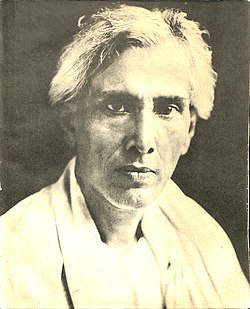
Sarat Chandra Chattopadhyay (anglicised as Sarat Chandra Chatterjee; 15 September 1876 – 16 January 1938) was a Bengali novelist and short story writer of the early 20th century.[1][2] He generally wrote about the lives of Bengali family and society in cities and villages.[3] However, his keen powers of observation, great sympathy for fellow human beings, a deep understanding of human psychology (including the "ways and thoughts and languages of women and children"), an easy and natural writing style, and freedom from political biases and social prejudices enable his writing to transcend barriers and appeal to all Indians.[4] He remains the most popular, translated, and adapted Indian author of all time.[5][6]
Early life
[edit]Sarat Chandra Chattopadhyay was born on 15 September 1876,[7] in a Bengali Brahmin family in Debanandapur,[8] a small village in Hooghly, West Bengal, about 50 kilometres from Kolkata.[9][10] He was his father Matilal and mother Bhubanmohini's eldest son and second child.[11]

Debanandapur was the hometown of Baikuntha Chattopadhyay, the grandfather of Sarat Chandra Chattopadhyay. Sarat Chandra's grandmother relocated back to Debanandapur with Matilal after Baikuntha was murdered by his zamindar.[12] Motilal was given a piece of land by his mother's brothers. Some time later, he married Bhubanmohini, the daughter of Kedarnath Gangopadhyay,[12] who took him to his ancestral house in Bhagalpur, Bihar.[13] Matilal passed his education from Bhagalpur, attending classes with the two sons of Kedarnath. During and after this time he was offered many jobs and hobbies by Kedarnath's brothers, which he was unsuccessful to continue with any.[14] Motilal was not able to continue with any of the career options he picked (writing books, drawing).[15][14]
Sarat Chandra Chattopadhyay starting working from an early age, his father not having any source of income. His education was not properly completed because of the lack of money. Chattopadhyay took an interest in literature from Motilal.[16][14] Much of Chattopadhyay's early life is disputed. According to Narasingha Prosad Sil, Chattopadhyay was taken to Bhagalpur from Debanandapur when he was two or three years old. He enrolled there in school and stayed till fifth or sixth year. Chattopadhyay came back to Debanandapur, where he studied in a pathashala for two years. In the rural areas, he often went fishing or rafting in water bodies and exploring places.[16]
In 1886, Chattopadhyay went to travel in Dehri-on-Sone. After this travel, Matilal sent him to Durgacharan Middle English School in Bhagalpur for a getting a scholarship.[17] For meeting the eligibility, he took tutoring lessons from his classmate Manindranath's tutor. They passed their exams and got scholarship. The next year, Chattopadhyay enrolled in the Bhagalpur District School where he studied till 1889, and dropped out at fifth grade, getting a double class promotion before.[18][17]
In 1889, Matilal lost his job. Chattopadhyay and his whole family shifted into Debanandapur, where he enrolled into the Hooghly District School. His father arranged a room for Sarat Chandra to stay, at the house of landlord Bholanath Mukhopadhyay. He stayed in the residence for a few years and returned to Debanandapur. Matilal was unable to further pay for Chattopadhyay's education. They traveled to Bhagalpur in 1893 and Chattopadhyay got enrolled in Tejnarayan Jubilee Collegiate School.[17] Panchkadi Mukhopadhyay, a teacher in the school helped Chattopadhyay to complete his homework. Kedarnath died in 1892. His death caused turmoil in the family.[19] His son Thakurdas Gangopadhyay spent money on lawyers for a financial lawsuit. To pay for Chattopadhyay's education, Kedarnath's son Bipradas borrowed money. Chattopadhyay completed his entrance exams in 1893.[18] He Sarat Chandra being unable to pay for college education was approached by the mother of his classmate's tutor, Kusumkamini, who offered to pay Chattopadhyay's college fees for tutoring her two sons.[20] During his college years, Chattopadhyay began writing books; he took his inspiration from the novels of Bankim Chandra Chattopadhyay and from his enduring interest in narrating stories and the theaters.[21]
In 1895, Chattopadhyay's mother Bhubanmohini died. Matilal sold his paternal house on November 9, 1896 to Kedarnath's brother Aghornath for ₹255.[15] After November 1896, Matilal rented a house owned by Chandrashekhar Sarkar, in the slums of Bhagalpur callad Khanjarpalli, distancing himself from the Gangopadhyay house. Chattopadhyay studied in college using borrowed books from his classmate he met in primary school. Chattopadhyay did not have enough money (₹20) to pay for the final college exams, after studying there for two years, ending his formal education. In August 1919, he sent a letter documenting his education conditions to Lilarani Gangopadhyay.[20]
Sarat Chandra wrote in the English translation of his monumental book Srikanta:
"My childhood and youth were passed in great poverty. I received almost no education for want of means. From my father I inherited nothing except, as I believe, his restless spirit and his keen interest in literature. The first made me a tramp and sent me out tramping the whole of India quite early, and the second made me a dreamer all my life. Father was a great scholar, and he had tried his hand at stories and novels, dramas and poems, in short, every branch of literature, but never could finish anything. I have not his work now—somehow it got lost; but I remember poring over those incomplete messes, over and over again in my childhood, and many a night I kept awake regretting their incompleteness and thinking what might have been their conclusion if finished. Probably this led to my writing short stories when I was barely seventeen."[1]
Poverty forced the family to live for long periods in Bhuvanmohini's father's (and later brother's) home in Bhagalpur, Bihar.[11]
Sarat Chandra was a daring, adventure-loving boy. He attended schools in and around Debanandapur, one being Hooghly Branch Government School and in Bhagalpur.[22] His strong performance in English and other subjects was rewarded with a "double promotion" that enabled him to skip a grade. However, in 1892, financial difficulties forced him to stay out of school for one year.[23] He began writing stories at the time.
In 1894, Sarat Chandra passed his Entrance Examination (public examination at the end of Class X) and entered Tejnarayan Jubilee College. He developed an interest in English literature and read A Tale of Two Cities and David Copperfield by Charles Dickens and other novels.[24] Looking at Western authors such as Marie Corelli and Ellen Prince, Chatterjee adopted the psuedonym St. C. Lara.[25] He organized a children's literary society in Bhagalpur, which published a handwritten magazine. Two years later, his formal studies ended as he could not pay the twenty rupees examination fee.[11][26]
On his wife's death in 1895, Matilal left the house of his in-laws and moved the family to a mud house in Bhagalpur. In 1896, he sold his ancestral house to repay debts. Sarat Chandra spent time interacting with friends, acting in plays, and playing sports and games. He seriously read literature and wrote several famous works including Bordidi, Chandranath, and Devdas. And then he stopped writing: "But I soon gave up the habit as useless, and almost forgot in the long years that followed that I could even write a sentence in my boyhood."[1]
In 1900, Sarat Chandra associated with the Banali Estate in Bihar while simultaneously being an assistant to the settlement officer in the Santhal district settlement. He published his first novella Borodidi through the local publisher Bharati under his real name.[25]
After holding sundry jobs, Sarat Chandra got upset with his father and left home. He wandered from place to place In the guise of a sannyasi (monk). Little is known about what he did during this period. On getting the news of his father's death, Sarat Chandra came back and did his father's shraddha (memorial service). His oldest sister was already married. He deposited his remaining siblings with a friend and relatives and went to Calcutta (today's Kolkata) to try out his luck.[11]
In Calcutta, Sarat Chandra worked for six months translating Hindi paper books into English for an advocate. In January 1903, he went to Burma (today's Myanmar).
Before leaving for Burma, at the insistence of an uncle, Sarat Chandra sent the story "Mandir" to the "Kuntaleen Story Competition." It won the first prize out of 150 submissions. Mandir was published under another uncle's name. The story was 27-year-old Sarat Chandra's first printed work.[23][24]
Life in Burma
[edit]Sarat Chandra lived in Burma for thirteen years.[11][24] He first held sundry jobs in Rangoon and Pegu (today's Yangon and Bago, respectively). He eventually found work in Burma Public Works Accounts Office in Rangoon.
Most of his stay in Rangoon was in the Botahtaung Pazundaung neighbourhood where "mistris" (manual workers, mechanics, craftsmen, artisans) lived. He freely mixed with them. He wrote their job applications, mediated conflicts, gave them homeopathic medicine for free, even gave monetary help. The mistris had great respect for him.
During his stay in Rangoon, Sarat Chandra read widely. He borrowed books on various subjects, including sociology, politics, philosophy, physiology, psychology, history, scriptures, and other topics from the Bernard Free Library.[24] Signs of heart problems slightly slowed down his intense study habits. He also began to paint.
In 1912, the wooden house where he lived on Lansdowne Road got burnt down. He lost his belongings including his paintings, and the manuscript of his novel Choritrohin, which he rewrote.
.jpg)
He resumed writing after a gap of about eighteen years: "Some of my old acquaintances started a little magazine, but no one of note would condescend to contribute to it, as it was so small and insignificant. When almost hopeless, some of them suddenly remembered me, and after much persuasion they succeeded in extracting from me a promise to write for it. This was in the year 1913. I agreed most unwillingly—perhaps only to put them off until I returned to Rangoon and could forget the matter entirely. But sheer volume and force of their letters and telegrams compelled me at last to think seriously about writing again. I sent them a short story, for their magazine Jamuna. This became at once extremely popular, and made me famous in one day. Since then I have been writing regularly. In Bengal perhaps I am the only fortunate writer who has not had to struggle."[1]
In 1916, he resigned from his job due to ill health and moved to Calcutta.[11]
Later life
[edit]In 1916, a forty-year-old Sarat Chandra Chattopadhyay moved to Howrah, the twin city of Calcutta. He became a full-time writer.[27]
His stories and serialized novels were published in magazines such as Jamuna, Bharatvarsha, and Narayan. Later, his novels and story collections would get published as books. He either got nothing or took nothing from the publisher for his first novel, Bardidi.[24] He sold the rights to his second published novel, Biraj Bou, for two hundred rupees. His works became immensely popular. Royalties from his published works enabled him to escape lifelong poverty for the first time.[27]
In 1918, the novel Biraj Bou was adapted for the stage and performed in the famous Star Theatre.[24] The same year, James Drummond Anderson wrote an article entitled "A New Bengali Writer" in the Times Literary Supplement, which introduced Sarat Chandra to a Western readership.
In 1919, Chandrashekhar Pathak translated the novel Biraj Bou into Hindi. This was the first translation of Sarat Chandra's work in another Indian language. Translations of his works into Marathi, Gujarati, and other Indian languages were published in the years that followed.

The first English translation of Sarat Chandra's work, Srikanta (Volume I), was published by the Oxford University Press in 1922. The first film based on Sarat Chandra's writings, silent movie Andhare Aalo, was released the same year.
Sarat Chandra was a strong supporter of the Indian freedom movement. He was the president of the Howrah District Congress Committee branch of the Indian National Congress[28] from 1921 to 1936.[25] He also gave cash and other support to Indian revolutionary freedom fighters. He was friends with Chittaranjan Das, Subhas Chandra Bose, and many other freedom fighters and political leaders. While most of his works avoided politics, his novel Pather Dabi (1926) heavily criticized the British Raj. The book was proscribed by the colonial British Government of India, a restriction removed after Sarat Chandra's death.
Great academic recognition came to Sarat Chandra, whose formal studies ended at Class XII. His works entered the school and college curricula. In 1923, the University of Calcutta awarded him the prestigious Jagattarini Gold Medal.[28] He was a paper setter in Bengali in the B.A. examination at the university. In 1936, the University of Dacca awarded him a Doctor of Literature (honoris causa).[29] Except for Sarat Chandra, all honourees have been recipients of knighthood. His novel Pather Dabi did not endear him to the colonial British government.
He built his own house, first in Samta and then in Calcutta. He moved into his new Calcutta house in 1935. He planned to travel to Europe, but his health was failing. He was diagnosed with liver cancer. On 16 January 1938, he died in Park Nursing Home in South Calcutta.
Personal life
[edit]Sarat Chandra's father was Matilal Chattopadhyay and mother Bhubanmohini Devi. Subhash. C. Sarker writes: "His father was an utterly restless person—more of a dreamer than a realist ... By contrast Sarat Chandar's mother, Bhubanmohini Devi, was a hardworking lady who braved all the adversities of life with a calm patience."[28] Sarkar also writes "The mother (Bhubanmohini) had an unmistakable impact on the mental make-up of the son (Sarat) as could be seen from the dominance of the female characters in his literary creations. Practically all the leading ladies in Sarat Chandra's stories are self-sacrificing in one way or the other."
Sarat Chandra was the second of seven siblings, five of whom lived to adulthood. The oldest was sister Anila Devi, who lived with her husband in Gobindapur village of Howrah district. Next to him was Prabhas Chandra. He joined the Ramakrishna Mission and was given the monkhood name Swami Vedananda. The youngest brother, Prakash Chandra, lived in Sarat Chandra's household with his family. The youngest sibling, sister Sushila Devi, was also married.
In Rangoon, Sarat Chandra's neighbour downstairs was a Bengali "mistri" (a blue-collar worker) who had arranged his daughter's marriage to an alcoholic. The daughter Shanti Chakrabarty begged him to rescue her. Sarat Chandra married her in 1906. Two years later, he was devastated when his wife and one-year old son died from plague.

A Bengali mistri friend, Krishna Das Adhikari, requested him to marry his 14-year-old widow daughter, Mokshada. Sarat Chandra was initially reluctant, but he eventually agreed. He renamed his wife Hironmoyee and taught her to read and write. She outlived him by 23 years. They did not have any children.
House of Chattopadhyay
[edit]After returning from Burma, Sarat Chandra stayed for 11 years in Baje Shibpur, Howrah. Then he made a house in the village of Samta, in 1923, where he spent the later twelve years of his life as a novelist. His house is known as Sarat Chandra Kuthi. The two-storied Burmese style house was also home to Sarat Chandra's brother, Swami Vedananda. His and his brother's samadhi are within the house's compound. Trees like bamboo and guava planted by the author still stand tall in the gardens of the house.[30]
Impact and legacy
[edit]J. D. Anderson's Views
James Drummond Anderson, who was a member of the prestigious Indian Civil Service of British India and a leading authority on several Indian languages, was an early admirer of Sarat Chandra. In an article entitled "A New Bengali Writer" in London's prestigious Times Literary Supplement dated 11 July 1918, Anderson writes:[4] "His knowledge of the ways and thoughts and language of women and children, his power of transferring these vividly to the printed page, are such as are rare indeed in any country. In India, and especially in the great "joint family" residences of Bengal, swarming with women of all ages and babies of all sizes, there is a form of speech appropriated to women's needs, which Mr. [Rudyard] Kipling somewhere describes as choti boli, the "little language." Of this Mr. Chatterjee is an admirable master, to an extent indeed not yet attained, we believe, by any other Indian writer.
Anderson comments about Sarat Chandra's fondness for the past: "Mr. Chatterjee is much too true an artist to allow his gift of kindly yet scrupulously accurate observation to be distracted by social or political prejudice. He is, we gather, on the whole inclined towards a sane conservatism: he remains a Hindu at heart in a country whose whole civilization is based on Hindu culture. He has, we dimly suspect, his doubts as to the wisdom and working of Europeanized versions of the old religion and the old customs. But he is so keen and amused a spectator of the life about him, whether in cosmopolitan Calcutta or in somnolent little villages buried in dense verdure among the sunny ricefields, that it is not without doubts and diffidence that we attribute to him a tendency to praise past times and comfortable old conventions."
Regarding Sarat Chandra's popularity, he noted: "It is of excellent omen that Mr. Chatterjee's art has received such instant and wide appreciation in his own country Let us hope that in other Indian provinces there are rising authors as keenly observant and gifted with a like faculty of easy and natural expression."
About the difficulties of translating his work, Anderson opines: "It may be doubted whether Mr. Chatterjee's tales can be adequately rendered into English, and therefore, perhaps, some apology is due to English readers who may never come across any of the work of this talented young Bengali." Anderson planned to translate his works. But he died in 1920 and the translations never happened.
Anderson's article was both prophetic and one of the best assessments of Sarat Chandra.
Views of Indian Writers and Academics
The phenomenal popularity of Sarat Chandra Chattopadhyay has been attested by some of the most prominent writers as well as literary critics across India in their writings.[31] Most of the authors in Assam and Odisha, at least before the Independence, read him admiringly in original Bengali; rest of India read him in translations in varying quality.
Publishers were never tired of reprinting his works; he remains the most translated, the most adapted and the most plagiarized author.[31] His novels also reached a number of people through the medium of film and he is still an important force in Indian cinema.
Malayalam poet and lyricist O. N. V. Kurup[31] writes "...Sarat Chandra's name is cherished as dearly as the names of eminent Malayalam novelists. His name has been a household word".
Dr Mirajkar[32] informs "the translations of Sarat Chandra created a stir amongst the readers and writers all over Maharashtra. He has become a known literary personality in Maharashtra in the rank of any popular Marathi writers including H. N. Apte, V. S. Khandekar, N. S. Phadke and G. T. Madkholkar".

Jainendra Kumar,[31] who considers that his contribution towards the creation and preservation of cultural India is second, perhaps, only to that of Gandhi, asks a rhetorical question summing up Sarat Chandra's position and presumably the role of translation and inter-literary relationship: "Sarat Chandra was a writer in Bengali; but where is that Indian language in which he did not become the most popular when he reached it?"
Screen Adaptations
[edit]Nearly 90 screen adaptations have been made in the Indian subcontinent based on Sarat Chandra Chattopadhyay's works.[33]
Devdas
More than twenty films and television series have been based on his novel Devdas. They have been made in Bangladesh, India, and Pakistan; in languages Assamese, Bengali, Hindi, Malayalam, Odia, Tamil, Telugu, and Urdu.
Multiple Screen Adaptations
His romantic drama novel Datta was adapted into the Bengali film as Datta in 1951 directed by Saumyen Mukhopadhyay starring Sunanda Banerjee and Manoranjan Bhattacharyya with Ahindra Choudhury as Rashbehari,[34][35] The 1961 Telugu film Vagdanam by Acharya Aatreya was loosely based on the novel. The 1976 Bengali film starring Suchitra Sen and Soumitra Chatterjee and a 2023 film starring Rituparna Sengupta were based on Datta.
Apne Paraye (1980) by Basu Chatterjee, starring Amol Palekar, was based on Nishkriti.[36] The Telugu film Thodi Kodallu (1957) was also based on this novel.
In 1957 Bardidi (translate: oldest sister) was made by director Ajoy Kar based on the novel with the same name. Two more films on the novel followed. In 1961, Batasari (translation: Wayfarer) was made in Telugu language, produced and directed by Ramakrishna of Bharani Pictures. It was simultaneously made in Tamil as Kaanal Neer (translation: Mirage).
Rajlakshmi O Srikanta (1958) and Indranath Srikanta O Annadadidi (1959), based on Srikanta, were made by Haridas Bhattacharya, Kamallata (1969), Rajlakshmi Srikanta (1987), Iti Srikanta (2004) were also based on Srikanta.
Parineeta has also been made several times in both Bengali and Hindi.
Chandranath (1957), starring Uttam Kumar and Suchitra Sen, was based on Sarat Chandra's novella Chandranath. The 1966 Kannada movie Thoogudeepa was also based on the same novel. Chandranath (1984) won four awards in the 1984 National Film Awards of Bangladesh.
Other Movies
Majhli Didi (1967) by Hrishikesh Mukherjee and Swami (1977), for which he was awarded the Filmfare Award for Best Story, are other adaptations.
Chhoti Bahu (1971) is based on his novel Bindur Chhele.
Gulzar's 1975 film, Khushboo is majorly inspired by his work Pandit Mashay.
The 2011 film Aalo Chhaya is based on his short story, Aalo O Chhaya.
Sabyasachi (film) was released in 1977 based on his work Pather Dabi.
Award
Sarat Chandra posthumously won the 1978 Filmfare Award for Best Story for Swami (1977).
Works
[edit]Sarat Chandra primarily wrote novels, novellas, and stories.[37] In 1903, his first printed work, Mandir, was published. His first novel, Bardidi, was serialized in the Bharati magazine and made him famous.[11]
Novels and Novellas
- Bardidi (1907, 1913)
- Biraj Bou (1914)
- Chandranath (1916)
- Parinita (1916)
- Baikunther Will (1916)
- Pallisomaj (1916)
- Devdas (1917)
- Choritrohin (1917)
- Nishkrti (1917)
- Srikanta (Part 1–4, 1917–1933)
- Datta (1918)
- Grihadaha (1920)
- Dena-Paona (1923)
- Pather Dabi (1926)
- Shes Proshno (1931)
He also wrote essays, which were anthologized in Narir Mulya (1923) and Svadesh O Sahitya (1932). Shrikanta, Charitrahin, Devdas, Grihadaha, Dena-Paona and Pather Dabi are among his most popular works. Pather Dabi was banned by the British Government because of its revolutionary theme. His posthumous publications include Chhelebelar Galpa, Shubhada (1938), Sheser Parichay (1939), Sharat Chandrer Granthabali (1948) and Sharat Chandrer Aprakashita Rachanabali (1951).
He wrote some essays including Narir Itihas (The History of Women) and Narir Mulya (The Value of Women). Narir Itihas, which was lost in a house fire, contained a history of women on the lines of Spencer's Descriptive Sociology. While the second, Narir Mulya gives a theory of women's rights in the context of Mill's and Spencer's arguments.[38]
Stories
- Aalo O Chhaya
- Abhagir Swargo
- Anupamar Prem
- Anuradha
- Andhare Aalo
- Balya Smriti
- Bilashi
- Bindur Chhele, (Bindu's Son) 1913
- Bojha
- Cheledhora
- Chobi
- Darpochurno (Broken Pride)
- Ekadoshi Bairagi
- Kashinath
- Haricharan
- Harilakshmi
- Lalu (parts 1, 2, and 3)
- Mamlar Phol
- Mandir
- Mahesh (The Drought)
- Mejdidi
- Bochor Panchash Purber Ekti Kahini
- Paresh
- Path Nirdesh
- Ramer Shumoti, (Ram's Good Sense) 1914
- Sati
- Swami (The Husband)
Plays Sarat Chandra converted three of his works into plays.
- Bijoya
- Rama
- Shoroshi
- Jai hind
Essays
- Narir Mulya
- Swadesh O Sahitya
- Taruner Bidroho
Other works
- Dehati Samaj, 1920
- Sharoda (published posthumously)
Biography
See also
[edit]- Films based on works by Sarat Chandra Chattopadhyay
- Samtaber, the village where Sarat Chandra spent his life's early years as a novelist
- Sarat Chandra Kuthi, the house of Sarat Chandra at Samtaber
- List of Indian writers
References
[edit]- ^ a b c d Chatterji, Saratchandra (1922). – via Wikisource.
- ^ Chakrabarti, Kunal; Chakrabarti, Shubhra (2013). Historical Dictionary of the Bengalis. Historical Dictionaries of Peoples and Cultures. Lanham: Scarecrow Press. p. 128. ISBN 978-0-8108-5334-8.
- ^ Dey, Biswanath (1960). Sharat Smriti.
- ^ a b Anderson, James Drummond (11 July 1918). "A New Bengali Writer". Gale: The Times Literary Supplement Historical Archive, 1902-2019.
- ^ A History of Indian Literature 1911–1956: Struggle for Freedom: Triumph and Tragedy. South Asia Books. Retrieved 9 April 2015.
- ^ "Sarat Chandra Chattopadhyay — Vagabond Messiah". Film Critic's Circle. 15 September 2020. Archived from the original on 28 October 2020. Retrieved 26 October 2020.
- ^ Sarker, Subhash Chandra (January–February 1977). "Sarat Chandra Chatterjee: The Great Humanist". Indian Literature. 20 (1). New Delhi: Sahitya Akademi: 50. JSTOR 24157548.(subscription required)
- ^ Mohta, Nikita (5 September 2025). "Sarat Chandra Chattopadhyay and a novel that shook the British Empire". The Indian Express. Retrieved 23 October 2025.
- ^ George, K. M., ed. (1997). Masterpieces of Indian literature. New Delhi: National Book Trust. p. 187. ISBN 978-81-237-1978-8.
- ^ Statesman News Service (22 December 2023). "CM pushes for renovation of novelist Sarat Chandra's birthplace". The Statesman. Retrieved 23 October 2025.
- ^ a b c d e f g Chattopadhyay, Sarat Chandra. "Sarat Rachanabali (in Bengali, means "The Writings of Saratchandra"". MIT Internet Archive. Retrieved 19 February 2023.
- ^ a b Sil 2012, p. 11.
- ^ Naravane 1976, p. 16.
- ^ a b c Naravane 1976, p. 15.
- ^ a b Sil 2012, p. 12.
- ^ a b Sil 2012, p. 13.
- ^ a b c Naravane 1976, p. 17.
- ^ a b Sil 2012, p. 14.
- ^ Naravane 1976, p. 18.
- ^ a b Sil 2012, p. 15.
- ^ Naravane 1976, p. 19.
- ^ Suresh, Sushama, ed. (1999). Who's who on Indian stamps. Santa Cruz de Tenerife: Mohan B. Daryanani. p. 73. ISBN 84-931101-0-8.
- ^ a b "শরৎ রচনাবলী". Sarat Rachanabali. Retrieved 30 October 2015.
- ^ a b c d e f Chatterjee, Sarat Chandra. ""Sarat Sahitya Samagra" ("Complete Literary Works of Sarat," in Bengali), later renamed "Sulabh Sarat Samagra" ("Affordable Complete Works of Sarat")". Ananda (Website of Ananda Publishers Private Limited, Kolkata, India). Retrieved 18 September 2023.
{{cite web}}: CS1 maint: url-status (link) - ^ a b c "An early feminist from Bengal: Recalling Sarat Chandra Chattopadhyay". Research Outreach. 1 February 2024. Retrieved 23 October 2025.
- ^ Sinha, BY J. N. (9 January 2015). "The mortals of Devdas".
- ^ a b Parthasarathi, Dr. B.N.V. (24 July 2024). "Sarat Chandra Chattopadhyay". Hindu Post. Retrieved 23 October 2025.
- ^ a b c Sarker, Subhash Chandra (1977). "Sarat Chandra Chatterjee: The Great Humanist". Indian Literature. 20 (1): 49–77. ISSN 0019-5804. JSTOR 24157548.
- ^ "Honoris-Causa". www.du.ac.bd. Retrieved 3 October 2023.
- ^ House of Sarat Chandra Archived 23 August 2011 at the Wayback Machine
- ^ a b c d "A History of Indian Literature 1911–1956: Struggle for Freedom: Triumph and Tragedy". South Asia Books. Retrieved 9 April 2015.
- ^ "A History of Indian Literature 1911–1956: Struggle for Freedom: Triumph and Tragedy". South Asia Books. Retrieved 9 April 2015.
- ^ "Sarat Chandra Chattopadhyay | Writer". IMDb. Retrieved 20 October 2023.
- ^ YouTube
- ^ Moviebuff
- ^ Gulzar; Govind Nihalani, Saibal Chatterjee (2003). Encyclopaedia of Hindi Cinema. Popular Prakashan. p. 337. ISBN 81-7991-066-0.
- ^ a b "Remembering Sarat Chandra Chattopadhyay, the 'Awara Masiha'". The Indian Express. 15 September 2015. Retrieved 30 October 2015.
- ^ Shandilya, Krupa (2017). Intimate Relations: Social Reform and the Late Nineteenth-Century South Asian Novel. Northwestern University Press. p. 46. ISBN 978-0-8101-3424-9 – via Project MUSE.(subscription required)
- ^ "Hindi Belt: A glimpse into an unfamiliar world". The Hindu. 23 January 2015. Retrieved 30 October 2016.
- ^ Vishnu Prabhakar (1990). Great Vagabond: Biography and Immortal Works of Sarat Chandra Chatterjee. Translated by Jai Ratan. South Asia Books.
Notes
[edit]- Ganguly, Swagato. "Introduction". In Parineeta by Saratchandra Chattopadhyay. New Delhi: Penguin Books, 2005. (English translation)
- Guha, Sreejata. "Introduction". In Devdas by Saratchandra Chattopadhyay. New Delhi: Penguin Books, 2002. (English translation)
- Roy, Gopalchandra. Saratchandra, Ananda Publishers Pvt. Ltd., Kolkata
- Sarat Rachanabali, Ananda Publishers Pvt. Ltd., Kolkata
- Prithwindra Mukherjee. "Introduction" in Mahesh et autres nouvelles by Saratchandra Chatterji. Paris: Unesco/Gallimard, 1978. (French translation of Mahesh, Bindur chhele and Mejdidi by Prithwindra Mukherjee. Foreword by Jean Filliozat)
- Dutt, A. K. and Dhussa, R. "Novelist Sarat Chandra's perception of his Bengali home region: a literary geographic study". Springer Link
- Sil, Narasingha Prasad. The life of Sharatchandra Chattopadhyay: drifter and dreamer. Fairleigh Dickinson University Press, 2012.
- Das, Sisir Kumar, "A History of Indian Literature 1911–1956: Struggle for Freedom: Triumph and Tragedy", South Asia Books (1 September 1995), ISBN 81-7201-798-7
Cited works
[edit]- Sil, Narasingha P. (2012). The Life of Sharatchandra Chattopadhyay: Drifter and Dreamer. Fairleigh Dickinson University Press. ISBN 978-1-61147-507-4.
- Naravane, Vishwanath S. (1976). Sarat Chandra Chatterji. Meerut: Macmillan Company of India. ISBN 9780333901496.
External links
[edit]


