


Community hub
Recent from talks
Contribute something
Nothing was collected or created yet.
Chelydridae
View on Wikipedia
| Chelydrids | |
|---|---|

| |
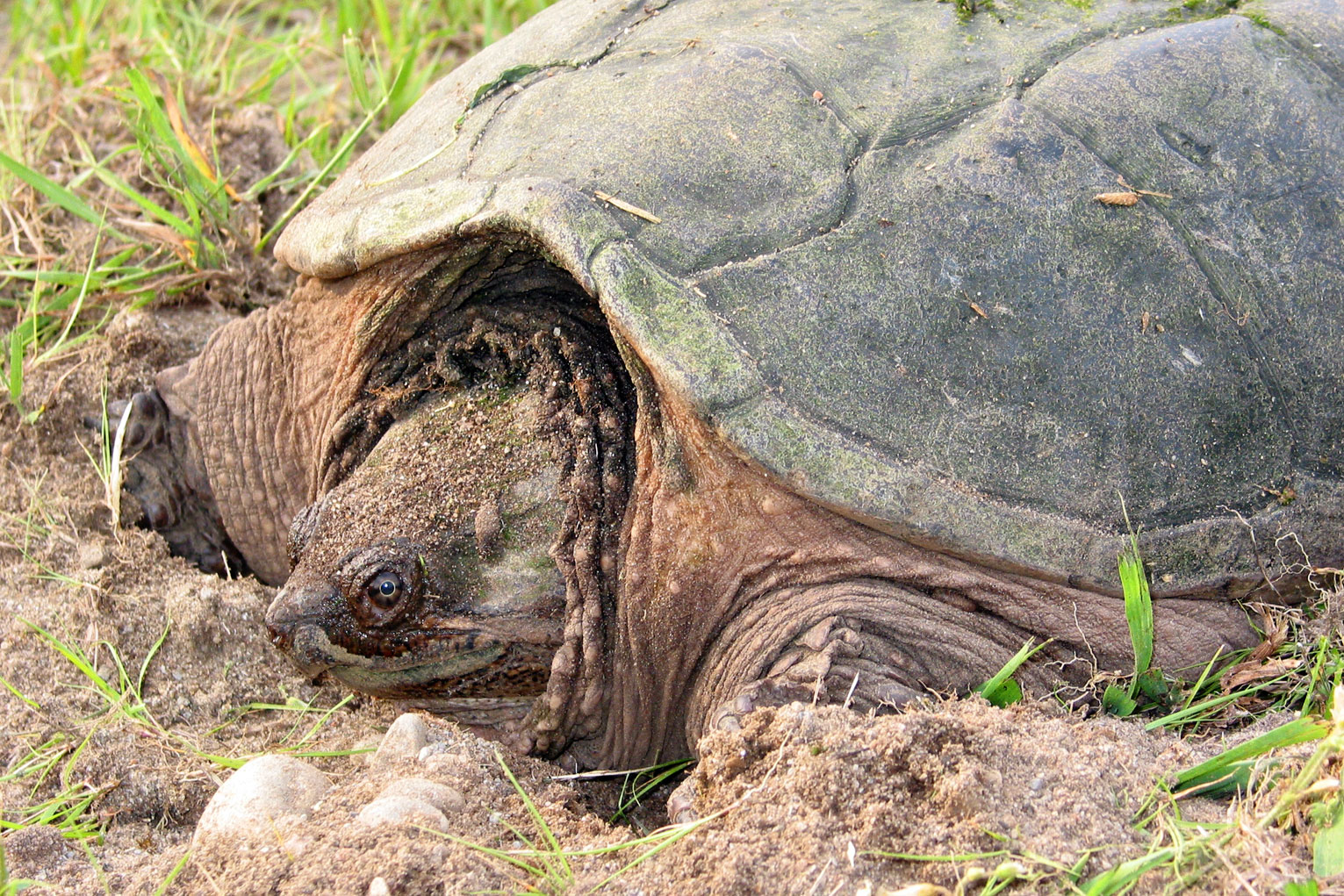
| The common snapping turtle (Chelydra serpentina) | |
Scientific classification 
| |
| Kingdom: | Animalia |
| Phylum: | Chordata |
| Class: | Reptilia |
| Order: | Testudines |
| Suborder: | Cryptodira |
| Clade: | Chelydroidea |
| Family: | Chelydridae Gray, 1831[2] |
| Genera | |
| Synonyms[3] | |
The Chelydridae is a family of turtles that has seven extinct and two extant genera. The extant genera are the snapping turtles, Chelydra and Macrochelys. Both are endemic to the Western Hemisphere. The extinct genera are Acherontemys, Chelydrops, Chelydropsis, Emarginachelys, Macrocephalochelys, Planiplastron, and Protochelydra.
Fossil history
[edit]
The Chelydridae have a long fossil history, with extinct species reported from North America as well as all over Asia and Europe, far outside their present range. The earliest described chelydrid is Emarginachelys cretacea, known from well-preserved fossils from the Maastrichtian stage of the Late Cretaceous of Montana.[1] Another well-preserved fossil chelydrid is the Late Paleocene Protochelydra zangerli from North Dakota.[6] The carapace of P. zangerli is higher-domed than that of the recent Chelydra, a trait conjectured to be associated with the coexistence of large, turtle-eating crocodilians. Another genus, Chelydropsis, contains several well-known Eurasian chelydrid species that existed from the Oligocene to the Pliocene.[7] In South America, chelydrids (C. acutirostris) only occupy the northwestern corner of the continent, reflecting their recent arrival from Central America as part of the Great American Interchange.
Gallery
[edit]-
 Common snapping turtle at Taum Sauk Mountain State Park
 -
 Two-year-old captive-raised snapping turtle from Pennsylvania
 -
 Female next to can to show size
 -
 Skeleton of alligator snapping turtle at the Museum of Osteology
 -
 Female snapping turtle laying eggs (not visible), Pleasant Valley Wildlife Sanctuary, Lenox, Massachusetts
 -
 Female laying eggs


See also
[edit]
References
[edit]- ^ a b Emarginachelys cretacea, Paleobiology Database
- ^ a b Gray, John Edward. (1831). Synopsis Reptilium; or Short Descriptions of the Species of Reptiles. Part I.—Cataphracta. Tortoises, Crocodiles, and Enaliosaurians. London: Treuttel, Wurz, and Co., 85 pp. [Published May 1831].
- ^ Turtle Taxonomy Working Group [van Dijk, P.P., Iverson, J.B., Shaffer, H.B., Bour, R., and Rhodin, A.G.J.]. (2012). Turtles of the World, 2012 update: annotated checklist of taxonomy, synonymy, distribution, and conservation status. Chelonian Research Monographs No. 5, pp. 000.243–000.328, doi:10.3854/crm.5.000.checklist.v5.2012, "Archived copy" (PDF). Archived from the original (PDF) on 2013-06-16. Retrieved 2014-04-19.
{{cite web}}: CS1 maint: archived copy as title (link) - ^ Swainson, William. (1839). On the natural history and classification of fishes, amphibians, and reptiles. Vol. II. In: Lardner, D. (Ed.). The Cabinet Cyclopaedia. Natural History. London: Longman, 452 pp.
- ^ Gray, John Edward. (1869). Notes on the families and genera of tortoises (Testudinata), and on the characters afforded by the study of their skulls. Proceedings of the Zoological Society of London 1869:165–225.
- ^ Danilov G. and J. F. Parham. (2008). A reassessment of some poorly known turtles from the Middle Jurassic of China, with comments on the antiquity of extant turtles. Journal of Vertebrate Paleontology 28(2):306-318
- ^ Böhme, M. (2008). Ectothermic vertebrates (Teleostei, Allocaudata, Urodela, Anura, Testudines, Choristodera, Crocodylia, Squamata) from the Upper Oligocene of Oberleichtersbach (Northern Bavaria, Germany). Courier Forschungsinstitut Senckenberg 260:161-183
Further reading
[edit]- de Broin, F. (1969). Contribution a l'etude des cheloniens. Cheloniens continentaux du Cretace Superieur et du Tertiaire de France. Memoires du Muséum National d'Histoire Naturelle. Vol. C, No. XXVIII.
- Ericson, B.R. (1973). A new chelydrid turtle (Protochelydra zangerli), from the late Paleocene of North Dakota. Scientific Publications of the Science Museum of Minnesota, New Series. 2(2):1-16.
- Gaffney, E.S. (1975). Phylogeny of the chelydrid turtles: a study of shared derived characters in the skull. Fieldiana Geology 33:157-178.
- Parham, J.F., C.R. Feldman, and J.R. Boore (2006). The complete mitochondrial genome of the enigmatic bigheaded turtle (Platysternon): description of unusual genomic features and the reconciliation of phylogenetic hypotheses based on mitochondrial and nuclear DNA. BMC Evol Biol. 6: 11. Published online February 7, 2006. doi:10.1186/1471-2148-6-11.
- Whetstone, K.N. (1978). A new genus of cryptodiran turtles (Testudinoidea, Chelydridae) from the Upper Cretaceous Hell Creek Formation of Montana. The University of Kansas Science Bulletin 51(17):539-563.
External links
[edit] Media related to Chelydridae at Wikimedia Commons
 Data related to Chelydridae at Wikispecies


Chelydridae
View on GrokipediaTaxonomy
Classification
Chelydridae is a family of turtles classified within the order Testudines, suborder Cryptodira, and superfamily Chelydroidea.[3] Members of this family are primarily aquatic or semi-aquatic species characterized by a large head relative to body size, a powerful bite enabled by a kinetic lower jaw that allows for a wide gape, a reduced and often incomplete plastron, an elongated tail, and a non-retractile neck, all adaptations for an ambush predatory strategy involving rapid snapping at prey.[4][5] The family was first described by John Edward Gray in 1825 in his Synopsis of the genera of reptiles and Amphibia, with a description of some new species, with Chelydra designated as the type genus; the genus itself was established by August Friedrich Schweigger in 1812 based on Testudo serpentina Linnaeus, 1758.[6][7] No major synonyms exist for the family name, though historical classifications occasionally proposed subfamilies such as Chelydrinae (encompassing extant snapping turtles) and a separate grouping for larger forms like the alligator snapping turtle.[8]Extant genera and species
The family Chelydridae comprises two extant genera: Chelydra and Macrochelys, both endemic to the Americas and characterized by robust freshwater turtles with powerful jaws adapted for snapping prey. The genus Chelydra, derived from the Greek chelydros meaning "water snake" or "tortoise," encompasses common snapping turtles known for their aggressive defensive behavior and broad distribution across North American freshwater systems. This genus includes a single species, Chelydra serpentina (Linnaeus, 1758), the common snapping turtle, with no currently recognized subspecies.[9][10] In contrast, the genus Macrochelys, meaning "large turtle" from Greek makros (large) and chelys (turtle), includes the larger alligator snapping turtles, distinguished from Chelydra by their greater size, more pronounced dorsal ridges on the carapace, and a unique worm-like lingual lure on the tongue used to attract fish prey through aggressive mimicry. This lure, a fleshy appendage resembling a wriggling worm, is extended within the open mouth to entice prey close enough for a rapid snap. A taxonomic revision in 2014 (Thomas et al.) proposed elevating phylogeographic lineages within Macrochelys to full species status based on molecular, morphological, and geographic evidence from southeastern U.S. populations. While the study initially recognized three species, subsequent analyses (e.g., Folt & Guyer 2015; Turtle Taxonomy Working Group 2017) synonymized the central lineage (M. apalachicolae) with the western Macrochelys temminckii (originally described by Troost, 1835), distributed in rivers from Texas to Illinois and including central drainages. The eastern lineage, M. suwanniensis (Thomas et al., 2014), is confined to the Suwannee River system in Florida and Georgia. This split highlights distinct evolutionary histories shaped by Pleistocene drainage patterns, with each species facing conservation challenges due to habitat loss and historical overharvest; M. suwanniensis was listed as threatened by the U.S. Fish and Wildlife Service in 2024.[11][12][13][14][2]| Genus | Species | Common Name | Distribution Notes |
|---|---|---|---|
| Chelydra | C. serpentina | Common snapping turtle | Eastern and central North America |
| Macrochelys | M. temminckii | Alligator snapping turtle | Western and central drainages (e.g., Mississippi River basin to Apalachicola) |
| M. suwanniensis | Suwannee alligator snapping turtle | Eastern southeastern U.S. (Suwannee River) |