


Community hub
Recent from talks
Contribute something
Nothing was collected or created yet.
Sudirman
View on Wikipedia
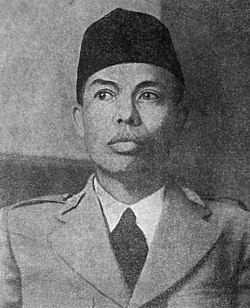
Sudirman (Old Spelling: Soedirman; 24 January 1916[a] – 29 January 1950) was an Indonesian military officer and revolutionary during the Indonesian National Revolution and the first commander of the Indonesian National Armed Forces.
Key Information


Born in Purbalingga, Dutch East Indies, Sudirman moved to Cilacap in 1916 and was raised by his uncle. A diligent student at a Muhammadiyah-run school, he became respected within the community for his devotion to Islam. After dropping out of teacher's college, in 1936 he began working as a teacher, and later headmaster, at a Muhammadiyah-run elementary school. After the Japanese occupied the Indies in 1942, Sudirman continued to teach, before joining the Japanese-sponsored Defenders of the Homeland (PETA) as a battalion commander in Banyumas in 1944. In this position he put down a rebellion by his fellow soldiers, but was later interned in Bogor. After Indonesia proclaimed its independence on 17 August 1945, Sudirman led a break-out then went to Jakarta to meet President Sukarno. Tasked with overseeing the surrender of Japanese soldiers in Banyumas, he established a division of the People's Safety Body there. On 12 November 1945, at an election to decide the military's commander-in-chief in Yogyakarta, Sudirman was chosen over Oerip Soemohardjo in a close vote. While waiting to be confirmed, Sudirman ordered an assault on British and Dutch forces in Ambarawa. The ensuing battle and British withdrawal strengthened Sudirman's popular support, and he Was ultimately confirmed on 18 December.
During the following three years Sudirman saw negotiations with the returning Dutch colonial forces fail, first after the Linggadjati Agreement – which Sudirman participated in drafting – and then the Renville Agreement; he was also faced with internal dissent, including a 1948 coup d'état attempt. He later blamed these issues for his tuberculosis, which led to his right lung collapsing in November 1948. On 19 December 1948, several days after Sudirman's release from the hospital, the Dutch launched an assault on the capital. Sudirman and a small contingent escaped Dutch forces and left the city, making their headquarters at Sobo, near Mount Lawu. There Sudirman commanded military activities throughout Java, including a show of force in Yogyakarta on 1 March 1949. When the Dutch began withdrawing, in July 1949 Sudirman was recalled to Yogyakarta and forbidden to fight further. In late 1949 Sudirman's tuberculosis relapsed, and he retired to Magelang, where he died slightly more than a month after the Dutch recognised Indonesia's independence. He is buried at Semaki Heroes' Cemetery in Yogyakarta.
Sudirman's death was mourned throughout Indonesia, with flags flown at half-mast and thousands gathering to see his funeral convoy and procession. He continues to be highly respected in Indonesia. His guerrilla campaign has been credited with developing the army's esprit de corps, and the 100-kilometre (62 mi) long route he took must be followed by Indonesian cadets before graduation. Sudirman featured prominently on the 1968 series of rupiah banknotes, and has numerous streets, museums, and monuments named after him. On 10 December 1964, he was declared a National Hero of Indonesia.
Early life
[edit]Sudirman was born to Karsid Kartawiraji (father) and Siyem while they lived with Siyem's sister Tarsem, one of three women married to the sub-district head Raden Cokrosunaryo, in Rembang, Bodas Karangjati, Purbalingga, Dutch East Indies.[b][c][1][2] According to the family's records, Sudirman – named by his uncle – was born on a pon Sunday in the month of Maulud in the Javanese calendar; the Indonesian government later established 24 January 1916 as Sudirman's birthday. As Cokrosunaryo was in a better financial situation, he adopted Sudirman and gave him the title Raden, reserved for Javanese nobility;[1] however, Sudirman was not told that Cokrosunaryo was not his birth father until he was eighteen.[3] When Cokrosunaryo retired from his position as chief in late 1916, Sudirman went with the family to Manggisan, Cilacap, where he was raised.[1] In Cilacap Karsid and Siyem had another son, Muhammad Samingan. Karsid died when Sudirman was six, at which time Siyem left the boys with her brother-in-law and went back to her village at Parakan Onje, Ajibarang.[1][4][5]
Sudirman was raised with stories of heroic deeds and taught the etiquette and ways of the priyayi, or noble caste,[6] as well as the work ethic and simplicity of the wong cilik, or commoners.[7] For his religious education, he studied Islam under Kyai Hajji Qahar with his brother; Sudirman was a religious child, and always prayed on time. He was soon entrusted with performing both the adhan and iqama, or calls to prayer.[8] When he was seven years old, Sudirman was enrolled at a school for natives (hollandsch inlandsche school), where he was an average student.[6][9] The family, although it had enough to live by, was not rich. During his tenure as sub-district head, Cokrosunaryo had not accumulated much wealth, and in Cilacap he became a distributor of Singer sewing machines.[4]
In his fifth year of school, Sudirman asked to leave his studies, concerned with the ridicule he faced at the government-run school;[d] this request was at first refused, but Sudirman was transferred to a junior high school run by Taman Siswa in his seventh year of school.[6][9][10] In his eighth year, Sudirman transferred to Wirotomo Junior High School[e] after the Taman Siswa School was found to be unregistered and closed under the Wild School Ordinance.[10][11][12] Many of Soedirman's teachers at Wirotomo were Indonesian nationalists, which influenced his views of the Dutch colonists.[11] Sudirman studied diligently at school; his teacher Suwarjo Tirtosupono later recalled that Sudirman would already be studying second-term lessons while the class was still in term one. Although he performed poorly in Javanese calligraphy, Soedirman was strong in mathematics, science, and writing in both Dutch and Indonesian.[13] Sudirman also became more religious under the guidance of his teacher Raden Mohamad Kholil; his classmates named him "hajji" because of his devotion to his prayers, and Sudirman took up preaching to other students.[14] Aside from his studies and religious activities, Sudirman also served in the school's musical troupe and on the football team, on which he was a defender.[15] Although Cokrosunaryo's death in 1934 left the family poor, Sudirman was allowed to continue his studies without paying until he graduated later that year;[14][16] after his step-father's death, Sudirman also devoted more time to studying the Sunnah and prayer.[17] By age 19, Sudirman had become a pupil teacher at Wirotomo.[11]
Muhammadiyah
[edit]While at Wirotomo, Sudirman was a member of the Wirotomo Student Union, drama club, and band.[18] He helped establish a branch of the Hizboel Wathan, an organisation similar to the Boy Scouts, which was run by the Islamic establishment Muhammadiyah. Sudirman became the leader of the Cilacap division after graduating from Wirotomo;[19][20] he was tasked with deciding and planning his groups' activities. He emphasised the need for religious studies, insisting that the contingents from Cilacap attend Muhammadiyah conferences throughout Java.[21] He taught the younger members[f] about the history of Islam and the importance of morality, while with older members he enforced near-military discipline.[22]
Teaching
[edit]
After graduating from Wirotomo, Sudirman spent a year at a Muhammadiyah-run teacher's college in Surakarta, but later dropped out owing to a lack of funds.[23] In 1936 he returned to Cilacap to teach at a Muhammadiyah-run elementary school, having been trained by his teachers at Wirotomo; that year he married Alfiah, a former schoolmate and the daughter of the rich batik merchant Raden Sastroatmojo.[24][25] After the marriage Sudirman lived at his father-in-law's house in Cilacap so he could save money for his own home.[24] The couple went on to have three sons, Ahmad Tidarwono, Muhammad Teguh Bambang Tjahjadi, and Taufik Effendi, and four daughters, Didi Praptiastuti, Didi Sutjiati, Didi Pudjiati, and Titi Wahjuti Satyaningrum.[25][26]
As a teacher, Sudirman taught his students lessons on morality using examples from the lives of the prophets and traditional wayang stories.[24] One of his students later recalled that Sudirman was an even-handed and patient teacher who would mix humour and nationalism in his lessons; this made him popular with the students.[27] A hard-working teacher despite poor pay, within several years Sudirman had become headmaster despite not having a teacher's certificate.[28] As a result, his monthly wages quadrupled from three gulden to twelve and a half. As headmaster, Sudirman worked on numerous administrative duties, including finding middle ground between feuding teachers. A coworker later recalled that Sudirman was a moderate, democratic leader.[29] He was also active in fundraising, both for the needs of his school and the construction of others.[30]
During this time Sudirman also continued to serve as a member of the Muhammadiyah Youth Group. Within the group he was known as a keen negotiator and mediator, working to resolve issues between members; he also preached at the local mosque.[31] He was elected as Chair of the Banyumas District of the Muhammadiyah Youth Group at the end of 1937. In this role he enacted policies facilitating members' studies and activities, both religious and secular. He was later put in charge of Youth Group activities throughout Central Java[24][32] and spent much of his free time travelling and preaching Islam, putting an emphasis on self-awareness.[33] Alfiah was also active in Muhammadiyah-sponsored activities through the group's branch for women, Nasyiatul Aisyiyah.[34]
Japanese occupation
[edit]
When World War II broke out in Europe, it was expected that the Japanese, who had already made aggressive moves against mainland China, would try to invade the Indies. In response, the Dutch colonial government – which had previously limited military training for native Indonesians – began teaching the populace how to deal with air raids. To co-ordinate the preparations, the Dutch formed Air Raid Preparation teams. Sudirman, respected in the community, was asked to lead the Cilacap chapter. Aside from teaching local citizens the safety procedures for dealing with an air raid, Sudirman established watchposts throughout the area. He and the Dutch would also have passing aircraft drop materials to simulate a bombing run; this was intended to improve response time.[35]
After the Japanese began occupying the Indies in early 1942, winning several battles against Dutch and Dutch-trained forces of the Royal Netherlands East Indies Army (Koninklijk Nederlands Indisch Leger, or KNIL), on 9 March 1942 Governor-General Tjarda van Starkenborgh Stachouwer and head of the KNIL General Hein ter Poorten capitulated. This brought drastic changes in the governance of the archipelago and reduced the quality of life for non-Japanese in the Indies, many of whom suffered from widespread human rights violations at the hands of the Japanese.[36] In Cilacap, Sudirman's school had been closed and turned into a military outpost;[37] this was part of a widespread effort to close private schools.[g][38] After Sudirman convinced the Japanese to reopen the school, he and the other teachers were forced to use substandard supplies. Sudirman was also involved in several social and humanitarian organisations during this period, including as chair of the Indonesian People's Cooperative.[37] This brought him greater recognition among the people of Cilacap.[39]
Pembela Tanah Air
[edit]In early 1944, after a year as a representative at the Japanese-run regency council board (Syu Sangikai),[40] Sudirman was asked to join the Defenders of the Homeland (PETA; Pembela Tanah Air); the Japanese occupation government had established PETA in October 1943 to help repel any Allied invasion,[40][41] and were focused on recruiting younger men, those who had "not yet been 'contaminated'" by Dutch rule.[42] After a few days of hesitance, caused in part by a knee injury he had occurred as a youth, Sudirman agreed to begin training in Bogor. Owing to his standing in the community, Sudirman was made a commander (daidanco) and trained with other persons of that rank. Trained by Japanese officers and soldiers, the cadets were armed with confiscated Dutch equipment. After four months of training Sudirman was put in charge of the battalion stationed at Kroya, Banyumas, Central Java, not far from Cilacap.[h][40][41][43][44]
Sudirman's time as a PETA commander passed uneventfully until 21 April 1945, when PETA troops under the command of Kusaeri began to rebel against the Japanese. Ordered to stop the rebellion, Sudirman agreed to do so only if the PETA rebels would not be harmed, and places harbouring them not razed; this condition was accepted by the Japanese commander, and Sudirman and his troops began searching for the rebels.
Although Kusaeri's men initially shot at the commander, after Sudirman used a loudspeaker to tell them they would not be harmed, they backed down.[45] Kusaeri surrendered on 25 April.[i] This garnered support for Sudirman within the occupation forces, although several high-ranking Japanese officers expressed concern over Sudirman's support for Indonesian independence. Sudirman and his men were soon sent to a camp in Bogor, ostensibly for training; however, they were tasked with hard labour as a way to prevent a further uprising, and rumours circulated that the PETA officers would be killed.[46]
National revolution
[edit]Commander of the Armed Forces
[edit]
After news of the atomic bombings of Hiroshima and Nagasaki reached the Indies in early August 1945, followed by the proclamation of Indonesian independence on 17 August,[46] it was evident that Japanese control was weakening. Sudirman led a break out from the camp in Bogor. Although his fellow internees wanted to attack the Japanese soldiers, Sudirman convinced them against it. After ordering the others to their hometowns, Sudirman made his way to Jakarta and met with President Sukarno, who asked him to lead resistance against Japanese forces in the city. Unfamiliar with Jakarta, Sudirman refused, instead offering to lead forces in Kroya. He left for his former command on 19 August 1945.[47][48] At the same time, Allied forces were in the process of retaking the Indonesian archipelago for the Netherlands.[j] The first British forces arrived on 8 September 1945.[49]
In late August,[k] Sukarno established the People's Safety Bureau (Badan Keamanan Rakjat, or BKR), which united troops from the former PETA, Heiho, and KNIL. The BKR served mostly as a police organisation,[50] partly because the political leadership were intent on using diplomacy to garner international recognition of the new country and partly to avoid appearing overly aggressive to the Japanese forces still in the archipelago.[51] Sudirman and several of his fellow PETA soldiers formed a BKR branch in Banyumas in late August, after stopping at Kroya and discovering that his battalion had been disbanded. In a meeting with the Japanese commander for the region, Saburo Tamura, and the resident of Banyumas, Iwashige, Sudirman and Iskaq Tjokrohadisurjo forced the Japanese to surrender and hand over their weapons while a crowd of armed Indonesians encircled the Japanese camp. Many of these weapons were later used by Sudirman's BKR unit, making it one of the best equipped in the country; surplus weapons were distributed to other battalions.[52][53][54][55]
As the newly independent nation did not yet have a professional military, on 5 October 1945 Sukarno passed a decree establishing the People's Security Army (Tentara Keamaanan Rakjat or TKR, now known as the Tentara Nasional Indonesia). Most officers were former KNIL officers, while rank-and-file soldiers were mostly PETA and Heiho personnel.[56] As the decreed Commander of the Armed Forces, Soeprijadi, failed to come forward,[l] chief of staff Lieutenant General Oerip Soemohardjo served as an interim leader.[57] That October British-led forces, tasked with disarming Japanese troops and repatriating Dutch prisoners of war, arrived in Semarang, then made their way south to Magelang. When the British began rearming repatriated Dutch prisoners and seemed to be preparing a military base in Magelang, Sudirman – now a colonel – sent some of his troops under Lieutenant Colonel Isdiman to drive them away; the mission was successful, and the European soldiers withdrew to Ambarawa, midway between Magelang and Semarang.[58] On 20 October Sudirman was put in command of the Fifth Division,[m] after Oerip began dividing Java into different military commands.[59]
On 12 November 1945, at the first general meeting of Army leadership, Sudirman was elected Commander of the Armed Forces (Panglima Besar) following two deadlocked votes. In the third round, Oerip had 21 votes to Sudirman's 22; the division commanders from Sumatra voted unanimously for Sudirman and swayed the ballot in his favour.[n][60][61][62] Sudirman, aged 29 at the time, was surprised at his selection and offered to relinquish the leadership position to Oerip, but the meeting did not allow it. Oerip himself, who had lost control of the meeting prior to the vote, was glad to no longer be in charge of the entire Army. Sudirman kept Oerip to serve as chief of staff under him. In accordance with his new role, Sudirman was promoted to general.[63][64][65] After the meeting, Sudirman returned to Banyumas to await confirmation as leader of the TKR and began developing strategies on how repel Allied advances.[64][66] The Indonesians feared that the Dutch, through the Netherlands Indies Civil Administration (Nederlandsch Indië Civil Administratie, or NICA), would attempt to retake the archipelago; soldiers of the Dutch-British alliance had landed in Java in September, and a large battle had occurred in Surabaya during late October and early November.[67] This instability, as well as Sukarno's uncertainty about Sudirman's qualifications,[o] led to a delay in Sudirman's confirmation.[68]
While waiting for his appointment to be confirmed, in late November Sudirman ordered the Fifth Division to attack Allied forces stationed in Ambarawa, once again with Isdiman in charge; the city was considered strategically important owing to its military barracks and training facilities dating from the colonial period. This assault was countered by an air strike and the use of tanks, which forced the division to retreat; Isdiman died in the battle, killed by a strafing P-51 Mustang[69][70] Sudirman then led the Division in another assault against Allied forces; the Indonesian troops were armed with a variety of weapons, ranging from bamboo spears and confiscated katanas to rifles, while the British were armed with modern equipment. Sudirman led from the front, wielding a katana.[71] The Allies, whose air support had been cut off when guerrilla soldiers attacked Kalibenteng Airfield in Semarang, were forced onto the defensive and holed up in Willem Fortress. On 12 December Sudirman led a four-day siege, which resulted in the Allied force withdrawing to Semarang.[p][66][72]

The Battle of Ambarawa brought Sudirman greater attention at a national level,[53] and generally silenced whispers that he was unfit for military command because of his lack of military experience and previous employment as a schoolteacher.[73] Ultimately, Sudirman was chosen as his loyalty was undoubted, while Oerip's former pledge of loyalty to the Dutch led to him being viewed with suspicion. Sudirman was confirmed as commander of the Armed Forces on 18 December 1945.[68] He was replaced as head of the Fifth Division by Colonel Sutiro,[59] and began to focus on strategic problems.[74] This was done partly by establishing a board of advisors, which gave the general advice on both political and military issues.[q] Oerip handled many of the military matters.[75]
Together, Sudirman and Oerip were able to reduce the differences and mistrust between former KNIL and PETA troops, although some troops were reluctant to be subordinated to a central command, instead choosing to follow their popularly selected battalion commanders. The government renamed the Army twice in January 1946, first to the Peoples' Salvation Armed Forces (Tentara Keselamatan Rakjat), then to the Republic of Indonesia Military Forces (Tentara Repoeblik Indonesia, or TRI/RIMF).[76][77][78] This was followed by the formal establishment of a navy and air force in early 1946.[77] In the meantime, the Indonesian government had moved from Jakarta – now under Dutch control – to Yogyakarta in January; delegates led by Prime Minister Sutan Sjahrir spent much of April and May unsuccessfully negotiating for Dutch recognition of Indonesian sovereignty.[79] On 25 May Sudirman was reconfirmed as commander of the expanded military,[77] after its reorganisation.[76][80] At the ceremony, Sudirman swore to protect the republic "until he shed his last drop of blood."[r][81]
The leftist Minister of Defence Amir Sjarifuddin, who had received greater power in the reorganisation, began collecting socialist and communist troops under his direct control, as well as leftist paramilitary units (laskar) that were funded by and loyal to the various political parties.[s] The minister instituted political education programmes in the army, which were meant to spread leftist ideology. This use of the military for political manoeverings disappointed both Sudirman and Oerip, who were at the time busy ensuring equal treatment for soldiers from different military backgrounds.[82][83][84] However, rumours among the populace had spread that Sudirman was preparing for a coup d'état;[85] although an attempt did occur in early July 1946, Sudirman's role, if any, is not certain.[t][86] In July Sudirman addressed these rumours through a speech broadcast on Radio Republik Indonesia (RRI), stating that he, like all Indonesians, was a servant of the State,[85] and that, if he were offered the presidency, he would refuse it.[87] In his later career he stated that the military had no place in politics, and vice versa.[88]
Negotiations with the Dutch
[edit].jpg)
Meanwhile, Sjahrir continued to work on negotiations with the Allied forces. On 7 October 1946, Sjahrir and the former Dutch Prime Minister, Wim Schermerhorn, agreed to work towards a ceasefire. The discussions were to be moderated by the British diplomat Lord Killearn and involved Sudirman. He took a specially commissioned train to Jakarta, departing on 20 October. However, he ordered it to return to Yogyakarta when Dutch troops refused to allow him and his men to enter the city with their weapons, feeling that such an order violated his sense of honour; the Dutch apologised, construing the events as a misunderstanding. Sudirman took another train in late October, arriving at Gambir Station in Jakarta on 1 November, where he was greeted by large crowds.[89][90] The discussions in Jakarta resulted in the drafting of the Linggadjati Agreement on 15 November; the agreement was ratified on 25 March 1947, despite heavy opposition from Indonesian nationalists.[91][92] Sudirman was vocally against the agreement, which he found to be detrimental to Indonesian interests,[93] but considered himself obliged to follow his orders.[94]
In early 1947, with the Linggadjati Agreement granting relative peace, Sudirman began work on consolidating the TKR with various laskar. As part of a committee, Sudirman began reorganising the military; they reached an agreement in May 1947, and on 3 June 1947 the Indonesian National Armed Forces (Tentara Nasional Indonesia, or TNI) was formalised; it consisted of TKR forces and various laskar groups,[93] which Sudirman had included only after realising the extent of their manipulation by the political parties.[95] However, the ceasefire obtained through the Linggadjati Agreement was not long lasting. On 21 July 1947 the Dutch forces – which had occupied areas left by the British during their withdrawal – launched Operation Product, and quickly gained control of large swaths of Java and Sumatra; the national government in Yogyakarta remained untouched.[96] Sudirman called the army to fight, using the code "Ibu Pertiwi is calling! Ibu Pertiwi is calling!",[u][97] and later delivered several speeches over RRI in an attempt to encourage soldiers to fight against the Dutch.[98] However, the Indonesian soldiers were unprepared and their lines crumbled quickly.[99]

Pressured by the United Nations, which had looked at the situation in the former East Indies with disdain, on 29 August 1947 the Dutch established the Van Mook Line, which divided Dutch and Indonesian-controlled areas. Along this line a ceasefire was called.[101] Sudirman recalled the Indonesian guerrillas hiding in Dutch-held lands, ordering them to return to Indonesian-held areas. To keep their spirits up, he referred to the withdrawal as a hijrah, reminiscent of Muhammad's migration to Medina in 622 AD, implying that they would return.[102] Over 35,000 troops left western Java at this order, travelling to Yogyakarta by train and ship.[103] This boundary was formalised by the Renville Agreement on 17 January 1948; among the signatories was Amir Sjarifuddin, by then also serving as prime minister.[101] Meanwhile, Sjarifuddin began rationalising the army, cutting back on the number of troops.[104] At the time the regular army consisted of 350,000 men, with a further 470,000 in the laskar.[105]
In this programme, by presidential decree Sudirman was no longer commander-in-chief of the military starting on 2 January 1948. He was demoted to lieutenant general, while Chief of the Air Force Soerjadi Soerjadarma was intended to be commander-in-chief.[106] Shortly afterwards, Sjarifuddin was ousted in a vote of no confidence for his involvement in the Renville Agreement, and the new prime minister, Mohammad Hatta, worked to implement the rationalisation programme.[107][104][108] This led to a several months-long debate between pro- and anti-rationalisation groups. Sudirman served as a rallying point and driving force for soldiers, including numerous older commanders, who were against the programme. Sudirman was formally reinstated on 1 June 1946, upon which he effectively rescinded the command to rationalise. He chose Colonel Abdul Haris Nasution as his deputy,[106] but remained a lieutenant general.[108]
As the rationalisation programme was winding down, Sjarifuddin began gathering soldiers from the Socialist Party, Communist Party, and members of the All Indonesia Centre of Labour Organizations for a would-be proletarian revolution in Madiun, East Java, which occurred on 18 September 1948. Sudirman, ill at the time, sent Nasution to deal with the revolution;[109] Sudirman also sent two other officers as peace feelers before the attacks. Although the revolutionary leader Muso was amenable to peace,[110] Nasution and his soldiers had quashed the uprising by 30 September.[v][109] Sudirman visited Madiun not long after the battle, later telling his wife that he had been unable to sleep there for all the bloodshed.[111]

This rebellion, and ongoing political instability, sapped Sudirman of much of his remaining strength. On 5 October 1948, after celebrations of the military's third anniversary, Sudirman collapsed. After being examined by numerous doctors, he was diagnosed with tuberculosis. At the end of the month he was brought to Panti Rapih Hospital and had his right lung collapsed, in hope that it would stop the spread of the disease. During his time at the hospital, he delegated most of his duties to Nasution. However, the two continued to discuss plans for the war against the Dutch, and Sudirman continued to receive status reports. They agreed that guerrilla warfare, which had been applied on raids into Dutch-held territory since May, would be best suited for their needs; towards this goal, Sudirman issued a general order on 11 November,[112][113] with Nasution handling most of the preparations.[w][114] Sudirman was released from the hospital on 28 November 1948.[112][113]
Although he continued to issue orders, Sudirman only returned to active duty on 17 December; in light of the growing tension between the Dutch and Indonesian forces, he ordered the TNI soldiers to maintain an increased level of awareness;[115] he also ordered large-scale military exercises as a in an unsuccessful attempt to convince the Dutch that the TNI was too strong to be attacked.[116] Two days later, after a nighttime announcement that they were no longer bound by the Renville Agreement, on 19 December the Dutch launched Operation Kraai, an attempt to capture the capital at Yogyakarta. By 07:10 local time (UTC+7), the airfield at Maguwo had been taken by paratroopers under the command of Captain Eekhout. Sudirman, upon becoming aware of the attack, had an order read over RRI which stated that soldiers should fight as they had been trained – as guerrillas.[117]
No. 1/PB/D/48
- We have been attacked.
- On 19 December 1948 the Dutch Military attacked the city of Yogyakarta and the Maguwo airfield.
- The Dutch government has negated the Ceasefire.
- All soldiers are to deal with the Dutch attack as previously agreed.[x]
He then went to the Presidential Palace in central Yogyakarta, where the government leaders were discussing an ultimatum which stated that the city would be stormed unless the leadership accepted colonial rule. Sudirman urged that the president and vice-president leave the city and fight as guerrillas, actions they had previously promised, but this suggestion was rejected. Although his doctors forbade it, Sudirman received permission from Sukarno to join his men. The central government evacuated to the Kraton Ngayogyakarta Hadiningrat at the urging of Sultan Hamengkubuwana IX, but were captured and exiled.[118][119]
Guerrilla warfare
[edit]Sudirman first went to his official home and gathered sensitive documents, which he burned to prevent them falling into Dutch hands.[120] His convoy, consisting of Sudirman, a small group of soldiers, and his personal doctor, then made their way south, towards Kretek, Parangtritis, Bantul. There they were received by the district head at 18:00. After several days in Kretek, during which time Sudirman sent undercover troops into the Dutch-occupied city for reconnaissance and to ask his wife for jewellery to sell and help fund the guerrilla movement, he and his group travelled east along the south coast to Wonogiri.[121] Before the Dutch attack it had already been decided that Sudirman would be able to better control the guerrillas from eastern Java, where there were still several bases.[122] Meanwhile, Alfiah and the children were ordered to stay in the Kraton.[107] Aware that he was being pursued by the Dutch, on 23 December Sudirman ordered his troops to continue to Ponorogo, where they stopped at the home of Mahfuz, a kyai and Islamic religious leader; Mahfuz gave the general a cane to help him walk, although Sudirman was, and continued to be, carried on a litter. They then continued east.[123]

Outside of Trenggalek, Sudirman and his group were stopped by TNI soldiers belonging to 102 Battalion.[124] These soldiers, who were told that Sudirman – who was in civilian clothes and unrecognised by the troops holding them – had been taken prisoner, refused to allow the group to pass;[125] they were suspicious as Sudirman's convoy carried maps and notes on Indonesian military movements, things which may have belonged to spies.[126] When the group's commander, Major Zainal Fanani, came to check the situation, he realised that Sudirman was with them and apologised. Told that his men were right to guard their areas diligently, Fanani called a post in Kediri and ordered that a car be sent to pick up the general and his troops. After a time in Kediri, they continued further east; as they left the city on 24 December, Dutch planes attacked Kediri.[125]
The constant Dutch attacks led Sudirman, perhaps at the suggestion of one of his men, to change his clothes and give his old outfit to one of his soldiers, Second Lieutenant Heru Kesser – who bore a resemblance to Sudirman.[125][127][128] Kesser was ordered to head south with a large company of soldiers, remove the clothes, and furtively return north, while Sudirman waited in Karangnongko. The diversion was successful, and on 27 December Sudirman and his men made their way to Jambu Village. Arriving on 9 January 1949, Sudirman met with several government ministers who had not been present during the Dutch attack on Yogyakarta: Supeno, Susanto Tirtoprojo, and Susilowati. With the politicians, Sudirman made his way to Banyutuwo, ordering some of his soldiers to linger back and hold off Dutch ground troops. In Banyutuwo, they held for over a week. However, on 21 January, when Dutch forces approached the village, Sudirman and his entourage were forced to leave, fighting their way out in heavy rain.[125]
Sudirman and his troops continued to make their way through the jungles and forests, eventually arriving at Sobo, near Mount Lawu, on 18 February. During the journey, Sudirman used a radio set to convey orders to local TNI troops if he believed that the region was secure. Feeling weaker because of the physical hardships he had faced, including malnutrition, and believing the area to be safe, Sudirman decided that Sobo would serve as his guerrilla headquarters.[129][130] The local commander, Lieutenant Colonel Wiliater Hutagalung, served as his go-between with the other TNI leaders. Aware that international opinion, which was beginning to condemn Dutch actions in Indonesia, could bring Indonesia greater recognition, Sudirman and Hutagalung discussed possible terms of action before agreeing on a large-scale assault.[131] Meanwhile, the Dutch began to spread propaganda claiming that they had captured Sudirman; this claim was intended to break the morale of the guerrillas.[53][132]
Sudirman ordered Hutagalung to begin planning a full-scale assault, in which TNI soldiers – in uniform – would attack the Dutch and show their strength in front of foreign reporters and United Nations investigative teams. Hutagalung, together with officers under his commander Colonel Bambang Sugeng and government officials under Governor Wongsonegoro, spent several days discussing ways to ensure the attack could be successful.[131] The discussion may have resulted in the General Offensive of 1 March 1949, which saw TNI soldiers attack Dutch outposts throughout central Java. Troops under Lieutenant Colonel Suharto retook Yogyakarta for six hours before withdrawing, a successful show of force which caused the Dutch to lose face internationally; they had previously declared the TNI eradicated.[131][133] However, who truly ordered the offensive remains uncertain: Suharto and Hamengkubuwana IX claimed responsibility, while Bambang Sugeng's brother reportedly overheard him ordering the assault.[134]

Under increased pressure from the United Nations, on 7 May 1949 Dutch–Indonesian negotiations resulted in the Roem–Van Roijen Agreement, a controversial measure which guaranteed Dutch withdrawal from Yogyakarta, among other points;[y][135] The Dutch withdrawal commenced in late June, and the Indonesian leadership began returning to Yogyakarta from exile in early July. Sukarno ordered Sudirman to return to Yogyakarta as well, but Sudirman refused to let the Dutch withdraw without a fight; he considered the TNI to now be strong enough to defeat the dispirited Dutch. Although he was promised medicine and support in Yogyakarta, Sudirman refused to return to the political leadership, whom he considered acquiescent to the Dutch. He only agreed to return after receiving a letter, although sources disagree on its sender.[z] On 10 July, Sudirman and his group returned to Yogyakarta, where they were greeted by thousands of civilians and warmly received by the political elite there.[136][137] The reporter Rosihan Anwar, who was present when the letter was delivered, wrote in 1973 that "Sudirman had to return to Yogyakarta to avoid any perceptions of a rift among the republic's top leaders".[138]
Post-war and death
[edit]In early August Sudirman approached Sukarno and asked him to continue the guerrilla war; Sudirman did not expect the Dutch to abide by the Roem-Royen Agreement, based on the failings of the previous agreements. Sukarno disagreed, which was a blow to Sudirman. When Sudirman threatened to resign his post, blaming the government's inconsistency for his tuberculosis and Oerip's death in November 1948, Sukarno threatened to do so as well.[107][139][140] As he thought that such a resignation would have a destabilising effect, Sudirman stayed his hand,[141] and a Java-wide cease fire came into effect on 11 August 1949.[142]
Continuing to suffer from tuberculosis, Sudirman was checked into Panti Rapih hospital,[141] where he stayed until October, when he was transferred to a sanatorium in nearby Pakem.[143] As a result of his illness, Sudirman made few public appearances.[144][145][146] Sudirman was transferred to a home in Magelang in December.[147] In the meantime, the Indonesian and Dutch governments held a several-month-long conference which resulted in Dutch recognition of Indonesian sovereignty on 27 December 1949.[148] Sudirman, despite his illness, was reconfirmed that day as commander-in-chief of the TNI, now serving the newly established Republic of the United States of Indonesia. On 28 December, Jakarta once again became the nation's capital.[143]

Sudirman died in Magelang at 18:30 on 29 January 1950; this was reported in a special broadcast over RRI.[144] Upon receiving news of his death, the Sudirman family home received numerous visitors, including the entirety of the 9th Brigade, which was stationed nearby.[147] The following morning Sudirman's body was brought to Yogyakarta. As the funeral convoy passed, led by four tanks and consisting of eighty motor vehicles,[146] thousands of mourners stood at the sides of the streets. The convoy was organised by members of the 9th Brigade.[147]
The viewing, held at the Great Mosque of Yogyakarta in the afternoon, was attended by numerous political and military elite from both Indonesia and foreign countries; this included Prime Minister Abdul Halim, Minister of Defence Hamengkubuwana IX, Minister of Health Johannes Leimena, Minister of Justice Abdoel Gaffar Pringgodigdo, Minister of Information Arnold Mononutu, Chief of the Air Force Soerjadi Soerjadarma, Colonel Paku Alam VIII, and Suharto. The viewing was closed with a 24-gun salute.[146] Sudirman's body was brought to Semaki Heroes' Cemetery on foot, with a crowd of mourners 2 kilometres (1.2 mi) long trailing behind.[146] He was interred next to Oerip, after another gun salute. His wife filled in the first scoop of dirt,[149] followed by the government ministers.[146] The national government ordered flags to be flown at half-mast throughout the country,[145] and Sudirman was promoted to full general.[53] Major General Tahi Bonar Simatupang was selected as the new leader of the armed forces.[146] Sudirman's memoirs were published later that year; a series of his speeches were also published in 1970.[150]
Legacy
[edit]
An obituary in the Yogyakarta-based daily Kedaulatan Rakjat wrote that Indonesia had lost a "brave and true hero".[aa][145] Colonel Paku Alam VIII, in charge of the Yogyakarta area, told the national news agency Antara that all Indonesians, especially the armed forces, had "lost a father figure who did uncountable deeds for his country".[ab][53] The Indonesian Muslim leader Haji Abdul Malik Karim Amrullah, writing soon after Sudirman's death, described the general as a "symbol of the strength of spirit shown by Indonesian heroes,"[ac][88] while the Muslim politician Muhammad Isa Anshary described Sudirman as a "son of the revolution, as he was born in the revolution, and raised by the revolution."[ad][151] In a radio speech, Hatta described Sudirman as impossible to control and hard-headed, but ultimately intent on doing what was right for the country; Hatta noted that, although Sudirman often did not like the government's position, he would generally obey his orders.[53]
Modern opinions in Indonesia tend to be laudatory. Sardiman, a professor of history at Yogyakarta State University, writes that Sudirman was as lively a speaker as Sukarno, who was known for his fiery speeches,[152] and a devoted, incorruptible leader.[153] The Indonesian historian and former Minister of Education and Culture Nugroho Notosusanto described Sudirman as "his only idol", citing the general's guerrilla period as the origin of the army's esprit de corps.[154] The general's guerrilla campaign is emphasised in biographies of him because, during that period, the army had a greater role than the exiled political leadership;[154] beginning in the 1970s, all military cadets had to retrace the 100-kilometre (62 mi) long route prior to graduation, a "pilgrimage" meant to instill a sense of struggle.[155] Sudirman's grave is also a pilgrimage destination, both for the military and general public.[156] According to Katharine McGregor of the University of Melbourne, the Indonesian military has elevated Sudirman to a saint-like status.[157]
Sudirman received numerous awards from the national government posthumously, including the Bintang Sakti, Bintang Gerilya,[158] Bintang Mahaputera Adipurna,[159] Bintang Mahaputera Pratama,[160] Bintang Republik Indonesia Adipurna,[161] and Bintang Republik Indonesia Adipradana.[ae][162] On 10 December 1964 Sudirman was declared a National Hero of Indonesia by Presidential Decree 314 of 1964. Oerip was declared a National Hero by the same decree.[163] He was posthumously promoted to General of the Army in 1997.[164]

According to McGregor, the military increasingly used Sudirman's image as a symbol of leadership as it gained more political power.[150] An image of Sudirman was featured on every denomination of the 1968 series of rupiah.[af][165] He featured as a major character in several war films, including Janur Kuning (Yellow Coconut Leaf; 1979) and Serangan Fajar (Dawn Attack; 1982).[150]
Numerous museums have been dedicated to Sudirman. His childhood home in Purbalingga is now the Sudirman Museum,[166] while his official home in Yogyakarta is now the Sasmitaloka Museum to General Sudirman.[150] The house in Magelang where he died is also now the Sudirman Museum, established on 18 May 1967 and containing artefacts belonging to the general.[167] Other museums, including the Monument Yogya Kembali in Yogyakarta and the Satriamandala Museum in Jakarta have rooms dedicated to him.[150] Numerous streets are named after Sudirman, including a major street in Jakarta;[107] McGregor states that nearly every city in the country has a General Sudirman Street. Statues and monuments to him are spread throughout the archipelago, most of which were built after 1970.[150] Jenderal Sudirman University in Banyumas, established in 1963, is named after him.[168] On January 14, 2011, the Japanese Ministry of Defense in Tokyo officially decided to place a statue of Sudirman in the back garden of the office.[169]
Notes
[edit]- ^ a b 24 January 1916 is the date recognised by the Indonesian government. The actual date may be different (Adi 2011, pp. 1–2). The historian Solichin Salam, for example, gives 7 February 1912 as Sudirman's date of birth, while fellow historian Yusuf Puar gives 7 September 1912 (quoted in Said 1991, p. 80).
- ^ Karsid and his wife had moved to Rembang in 1915, after Karsid left his job on a Dutch-owned sugarcane plantation in Purbalingga (Sardiman 2008, p. 8); other sources suggest he was fired (Adi 2011, pp. 1–2). The journey was 145 kilometres (90 mi) by land, which Siyem made while pregnant (Sardiman 2008, p. 8).
- ^ Cokrosunaryo had no children (Imran 1980, p. 2).
- ^ Adi (2011, p. 3) writes that Sudirman was teased for his background, as most of his classmates would have been from old noble families or ones which had strong ties to the Dutch.
- ^ Wirotomo literally translates as "main gate" (Sardiman 2008, p. 19).
- ^ Hizboel Wathan was open to children as young as seven (Sardiman 2008, p. 37).
- ^ Sources differ on who closed the school, either the Dutch (Sardiman 2008, p. 108) or the Japanese (Imran 1980, p. 17).
- ^ The rank of an officer was based on his standing in society. The lowest-level officers, platoon leaders known as shodanco, were recent graduates. Company commanders, known as cudanco, were established members of society. The battalion commanders were drawn from respected members of society (Sardiman 2008, p. 109). Said (1991, p. 56) writes that the daidanco served mainly as father figures and motivators, and as such received little military training. Sudirman would continue to serve as a father figure throughout the revolution.
- ^ For his role in the rebellion Kusaeri was sentenced to death by the Japanese military court. However, owing to pressures against the Japanese home islands by Allied forces he was not executed (Adi 2011, p. 32).
- ^ Australian and United States forces, for example, had fought extensive campaigns in New Guinea and Borneo through 1945 (Coates 2006, pp. 278–280, 282), and the British retook Singapore in September 1945 (Bayly & Harper 2007, p. 194).
- ^ Said (1991, p. 23) gives the date as 22 August, while Anderson (2005, pp. 103–106) gives the date as 23 August.
- ^ Soeprijadi, a PETA soldier who had led an uprising against Japanese forces in Blitar in February 1945, was thought dead. The historian Amrin Imran suggests that Soeprijadi's appointment may have been a way to see if he was still alive; it may have been thought that he would have certainly contacted the government in Jakarta to take over this post if he were (Imran 1983, pp. 71–72). Meanwhile, Said (1991, p. 28) suggests that Soeprijadi's selection was an indication of Sukarno's hesitancy to establish an army.
- ^ The Fifth Division covered the Kedu and Banyumas areas. It was one of ten divisions established by Oerip (Sardiman 2008, pp. 126–127).
- ^ Said (1991, p. 3) writes that the lack of political guidance while Oerip was commander-in-chief had led to the military choosing its own leader, rather than have one appointed. This meeting also saw the selection of Hamengkubuwana IX as minister of defence; his selection was not recognised by the government, which chose Amir Sjarifuddin (Said 1991, p. 41).
- ^ Sudirman at the time had but two years military experience (Adi 2011, p. 50) The other leading candidate, Oerip, had been a military officer since before Sudirman was born (Imran 1983, p. 27).
- ^ The historian Richard McMillan, writing in 2005, suggests the withdrawal was not in response to the attack, but as the British mandate to repatriate prisoners of war had been completed (quoted in Setiadi & Yuliawati 2012, p. 22).
- ^ Said (1991, pp. 59–61) notes that numerous Indonesian government and military leaders from after the war have stated that they served on this board.
- ^ Original: "... sampai titi' darah jang penghabisan."
- ^ The Socialist Party of Indonesia, for example, had Pesindo, while the Masyumi Party had Hisbollah (Said 1991, p. 24).
- ^ Prime Minister Sjahrir and several other government ministers were kidnapped on 27 June 1946 but released shortly afterwards. On 3 July Major General Sudarsono Reksoprodjo arrived at the presidential palace in Yogyakarta with a note, purportedly from Sudirman, that Sudirman was now president and had dismissed the cabinet. Sudarsono and his followers, many of whom were known to support the communist Tan Malaka, were arrested. Sudirman denied any involvement, telling Sukarno that his orders were always handwritten (Said 1991, pp. 63–65).
- ^ Original: "Iboe Pertiwi memanggil! Iboe Pertiwi memanggil!" Ibu Pertiwi is a personification of the country.
- ^ This led to a purge against leftists over several months. Sjarifuddin was among those executed for their involvement in the rebellion (Adi 2011, pp. 82–84).
- ^ In the event the central government was captured, this plan allowed for the creation of a military-dominated government in Java that was led by the central headquarters. This plan was ultimately put in motion after Operation Kraai (Said 1991, pp. 102–105).
- ^ Original:
Perintah Kilat
No. 1/PB/D/48- Kita telah diserang.
- Pada tanggal 19 Desember 1948 Angkatan Perang Belanda menjerang kota Jogjakarta dan lapangan terbang Magoewo.
- Pemerintah Belanda telah membatalkan persetoedjoean Gentjatan Sendjata.
- Semoea Angkatan Perang mendjalankan rentjana jang telah ditetapkan oentoek menghadapi serangan Belanda.
- ^ This agreement was initially opposed by both the Dutch and Indonesian militaries but ultimately passed (Said 1991, pp. 116–118).
- ^ Said (1991, p. 119) writes that the letter was sent by Hamengkubuwana IX and delivered by Suharto, while Imran (1980, pp. 75–80) credits a letter from Sudirman's subordinate and close friend, Colonel Gatot Soebroto.
- ^ Original: "... seorang pahlawan jang djudjur dan berani"
- ^ Original: "... seluruh rakjat Indonesia umumnja dan angkatan perang chususnja, kehilangan seorang bapak jg tidak ternilai djasa2nja kepada tanah air ..."
- ^ Original: " ... lambang dari kebangunan djiwa pahlawan Indonesia."
- ^ Original: "Putera revolusi, karena dia lahir dalam revolusi, dan dibesarkan oleh revolusi."
- ^ The Bintang Sakti is a high-level military award for showing bravery above and beyond the call of duty (UU No. 20/2009, pp. 4, 10, 23). The Bintang Mahaputera is a high-level award for persons who have aided Indonesia's development, become experts in a certain field, or are widely recognised for their sacrifices for the country (UU No. 20/2009, pp. 4, 9, 23). The Bintang Republik Indonesia is the highest award available for civilians (Saragih 2012, SBY bestows honors).
- ^ This included the 1, 2.5, 5, 10, 25, 50, 100, 500, and 1000 rupiah bills (Cuhaj 2012, pp. 501–502).
References
[edit]- ^ a b c d Adi 2011, pp. 1–2.
- ^ Imran 1980, p. 1.
- ^ Imran 1980, p. 3.
- ^ a b Imran 1980, p. 4.
- ^ Sardiman 2008, p. 7.
- ^ a b c Adi 2011, p. 3.
- ^ Sardiman 2008, p. 12.
- ^ Sardiman 2008, pp. 14–15.
- ^ a b Sardiman 2008, pp. 16–17.
- ^ a b Imran 1980, p. 10.
- ^ a b c Adi 2011, p. 4.
- ^ Sardiman 2008, p. 18.
- ^ Sardiman 2008, pp. 20–21.
- ^ a b Adi 2011, p. 6.
- ^ Adi 2011, p. 5.
- ^ Sardiman 2008, p. 73.
- ^ Sardiman 2008, p. 28.
- ^ Sardiman 2008, p. 22.
- ^ Adi 2011, pp. 7–9.
- ^ Sardiman 2008, p. 39.
- ^ Sardiman 2008, p. 46.
- ^ Sardiman 2008, pp. 48–49.
- ^ Sardiman 2008, p. 74.
- ^ a b c d Adi 2011, pp. 10–13.
- ^ a b Imran 1980, p. 15.
- ^ Tjokropranolo 1992, p. 326.
- ^ Sardiman 2008, p. 76.
- ^ Adi 2011, p. 14.
- ^ Sardiman 2008, pp. 80–83.
- ^ Sardiman 2008, p. 84.
- ^ Sardiman 2008, pp. 53–54.
- ^ Sardiman 2008, p. 56.
- ^ Sardiman 2008, pp. 87–88.
- ^ Sardiman 2008, p. 66.
- ^ Sardiman 2008, p. 98.
- ^ Adi 2011, pp. 18–24.
- ^ a b Adi 2011, pp. 26–27.
- ^ Imran 1980, p. 17.
- ^ Imran 1980, p. 20.
- ^ a b c Imran 1980, pp. 21–22.
- ^ a b Adi 2011, pp. 28–30.
- ^ Said 1991, p. 6.
- ^ Sardiman 2008, pp. 109–112.
- ^ Setiadi & Yuliawati 2012, p. 36.
- ^ Adi 2011, p. 31.
- ^ a b Adi 2011, p. 32.
- ^ Adi 2011, pp. 33–34.
- ^ Sardiman 2008, pp. 121–122.
- ^ Adi 2011, p. 36.
- ^ Anderson 2005, pp. 103–106.
- ^ Said 1991, p. 11.
- ^ Adi 2011, pp. 42–43.
- ^ a b c d e f KR 1950, Djenderal Sudirman Wafat.
- ^ Sardiman 2008, p. 123.
- ^ Said 1991, p. 13.
- ^ Anderson 2005, pp. 232–234.
- ^ Imran 1983, pp. 71–72.
- ^ Imran 1980, p. 28.
- ^ a b Sardiman 2008, pp. 126–127.
- ^ Nasution 2011, p. 196.
- ^ Imran 1980, p. 30.
- ^ Sardiman 2008, p. 132.
- ^ Imran 1983, pp. 74–79.
- ^ a b Adi 2011, p. 46.
- ^ Setiadi & Yuliawati 2012, p. 20.
- ^ a b Imran 1980, p. 32.
- ^ Ricklefs 1993, p. 217.
- ^ a b Adi 2011, p. 50.
- ^ Sardiman 2008, p. 136.
- ^ Setiadi & Yuliawati 2012, p. 22.
- ^ Sardiman 2008, pp. 214–215.
- ^ Sardiman 2008, p. 137.
- ^ Sardiman 2008, p. 216.
- ^ Sardiman 2008, p. 142.
- ^ Said 1991, pp. 59–61.
- ^ a b Anderson 2005, pp. 372–373.
- ^ a b c Adi 2011, p. 51.
- ^ Said 1991, p. 44.
- ^ Adi 2011, p. 53.
- ^ Imran 1983, pp. 80–81.
- ^ Imran 1980, p. 35.
- ^ Imran 1983, pp. 82–84.
- ^ Adi 2011, pp. 56–57.
- ^ Sardiman 2008, p. 145.
- ^ a b Adi 2011, p. 58.
- ^ Said 1991, pp. 63–65.
- ^ Sardiman 2008, p. 146.
- ^ a b Sardiman 2008, p. 218.
- ^ Adi 2011, pp. 60–61.
- ^ Sardiman 2008, p. 151.
- ^ Britannica, Linggadjati Agreement.
- ^ Adi 2011, p. 66.
- ^ a b Imran 1980, pp. 38–40.
- ^ Sardiman 2008, p. 155.
- ^ Said 1991, p. 67.
- ^ Adi 2011, p. 71.
- ^ Sardiman 2008, p. 157.
- ^ Adi 2011, p. 73.
- ^ Said 1991, p. 68.
- ^ Kahin 1952, p. 223.
- ^ a b Kahin 1952, pp. 218–221.
- ^ Adi 2011, pp. 77–78.
- ^ Adi 2011, pp. 79–80.
- ^ a b Imran 1980, pp. 42–45.
- ^ Setiadi & Yuliawati 2012, p. 24.
- ^ a b Said 1991, pp. 69–75.
- ^ a b c d Jakarta City Government, Sudirman.
- ^ a b Sardiman 2008, p. 160.
- ^ a b Adi 2011, pp. 82–84.
- ^ Said 1991, p. 77.
- ^ Setiadi & Yuliawati 2012, p. 25.
- ^ a b Adi 2011, pp. 85–87.
- ^ a b Sardiman 2008, p. 164.
- ^ Said 1991, p. 101.
- ^ Adi 2011, p. 88.
- ^ Sardiman 2008, p. 179.
- ^ Adi 2011, pp. 90–91.
- ^ Adi 2011, pp. 92–95.
- ^ Said 1991, p. 99.
- ^ Imran 1980, p. 57.
- ^ Adi 2011, pp. 97–99.
- ^ Imran 1980, p. 58.
- ^ Adi 2011, pp. 100–101.
- ^ Imran 1980, p. 61.
- ^ a b c d Adi 2011, pp. 102–105.
- ^ Imran 1980, p. 62.
- ^ Imran 1980, p. 64.
- ^ Setiadi & Yuliawati 2012, p. 28.
- ^ Adi 2011, pp. 106–107.
- ^ Imran 1980, p. 65.
- ^ a b c Adi 2011, pp. 108–110.
- ^ McGregor 2007, p. 138.
- ^ Imran 1980, p. 74.
- ^ Said 1991, pp. 126–127.
- ^ Said 1991, pp. 116–118.
- ^ Imran 1980, pp. 75–80.
- ^ Sardiman 2008, p. 199.
- ^ Setiadi & Yuliawati 2012, p. 47.
- ^ McGregor 2007, p. 129.
- ^ Jakarta City Government, Oerip Soemohardjo.
- ^ a b Imran 1980, pp. 82–83.
- ^ Said 1991, p. 122.
- ^ a b Sardiman 2008, p. 203.
- ^ a b Imran 1980, p. 84.
- ^ a b c KR 1950, Pak Dirman Istirahat.
- ^ a b c d e f KR 1950, Perdjalanan Terachir.
- ^ a b c KR 1950, Magelang Berkabung.
- ^ Imran 1980, p. 83.
- ^ Imran 1980, p. 86.
- ^ a b c d e f McGregor 2007, p. 127.
- ^ Sardiman 2008, p. 219.
- ^ Sardiman 2008, p. 93.
- ^ Sardiman 2008, p. 174.
- ^ a b McGregor 2007, p. 128.
- ^ McGregor 2007, p. 130.
- ^ McGregor 2007, p. 133.
- ^ McGregor 2007, p. 220.
- ^ Tjokropranolo 1992, p. 327.
- ^ Indonesian State Secretariat, Bintang Mahaputera Adipurna.
- ^ Indonesian State Secretariat, Bintang Mahaputera Pratama.
- ^ Indonesian State Secretariat, Bintang Republik Indonesia Adipurna.
- ^ Indonesian State Secretariat, Bintang Republik Indonesia Adipradana.
- ^ Indonesian State Secretariat, Daftar Nama Pahlawan.
- ^ McGregor 2007, p. 139.
- ^ Cuhaj 2012, pp. 501–502.
- ^ Sardiman 2008, p. 8.
- ^ Magelang City Government, Museum Sudirman.
- ^ Jenderal Soedirman University, About UNSOED.
- ^ Yasyi, Dini Nurhadi. "Di Balik Cerita Patung Jenderal Soedirman yang Berdiri di Jepang". Good News From Indonesia (in Indonesian). Archived from the original on 1 December 2023. Retrieved 2 March 2025.
Bibliography
- "About UNSOED". Jenderal Soedirman University. Archived from the original on 3 June 2012. Retrieved 17 June 2012.
- Adi, A. Kresna (2011). Soedirman: Bapak Tentara Indonesia [Soedirman: Father of the Indonesian Military] (in Indonesian). Yogyakarta: Mata Padi Pressindo. ISBN 978-602-95337-1-2.
- Anderson, Benedict Richard O'Gorman (2005). Java in a Time of Revolution: Occupation and Resistance, 1944–1946. Jakarta: Equinox. ISBN 978-979-3780-14-6.
- Bayly, Christopher Alan; Harper, Timothy Norman (2007). Forgotten Wars: Freedom and Revolution in Southeast Asia. Cambridge: Belknap Press. ISBN 978-0-674-02153-2.
- "Bintang Mahaputera Adipurna". Awards of the Republic of Indonesia (in Indonesian). Indonesian State Secretariat. Retrieved 17 May 2012.
- "Bintang Mahaputera Pratama". Awards of the Republic of Indonesia (in Indonesian). Indonesian State Secretariat. Retrieved 17 May 2012.
- "Bintang Republik Indonesia Adipradana". Awards of the Republic of Indonesia (in Indonesian). Indonesian State Secretariat. Retrieved 17 May 2012.
- "Bintang Republik Indonesia Adipurna". Awards of the Republic of Indonesia (in Indonesian). Indonesian State Secretariat. Retrieved 17 May 2012.
- Coates, John (2006). An Atlas of Australia's Wars. Melbourne: Oxford University Press. ISBN 978-0-19-555914-9.
- Cuhaj, George S (2012). 2013 Standard Catalog of World Paper Money – Modern Issues: 1961–Present. Iola. ISBN 978-1-4402-2956-5.
{{cite book}}: CS1 maint: location missing publisher (link) - "Daftar Nama Pahlawan Nasional Republik Indonesia" [List of Names of National Heroes of the Republic of Indonesia]. Awards of the Republic of Indonesia (in Indonesian). Indonesian State Secretariat. Archived from the original on 14 April 2012. Retrieved 9 May 2012.
- "Djenderal Sudirman Wafat" [General Sudirman Dies]. Kedaulatan Rakjat (in Indonesian). 30 January 1950. p. 1.
- Imran, Amrin (1980). Panglima Besar Jenderal Soedirman [Commander-in-Chief General Soedirman] (in Indonesian). Jakarta: Mutiara. OCLC 220643587.
- Imran, Amrin (1983). Urip Sumohardjo (in Indonesian). Jakarta: Department of Education and Culture. OCLC 10945069.
- Kahin, George McTurnan (1952). Nationalism and Revolution in Indonesia. Ithaca: Cornell University Press. ISBN 978-0-8014-9108-5.
{{cite book}}: ISBN / Date incompatibility (help) - "Linggadjati Agreement". Encyclopædia Britannica. Archived from the original on 8 March 2012. Retrieved 12 June 2012.
- "Magelang Berkabung" [Magelang Grieves]. Kedaulatan Rakjat (in Indonesian). 31 January 1950. p. 1.
- McGregor, Katharine E (2007). History in Uniform: Military Ideology and the Construction of Indonesia's Past. Honolulu: University of Honolulu Press. ISBN 978-9971-69-360-2.
- "Museum Sudirman" (in Indonesian). Magelang City Government. Archived from the original on 20 June 2012. Retrieved 16 June 2012.
- Nasution, A. H. (2011) [1982]. Roem, Mohamad; Lubis, Mochtar; Mochtar, Kustiniyati; S., Maimoen (eds.). Takhta untuk Rakyat: Celah-celah Kehidupan Sultan Hamengku Buwono IX [Serving the People: The Life Story of Sultan Hamengku Buwono IX] (in Indonesian) (Revised ed.). Jakarta: Gramedia Pustaka Utama. ISBN 978-979-22-6767-9.
- "Oerip Soemohardjo". Encyclopedia of Jakarta. Jakarta City Government. Archived from the original on 17 February 2013. Retrieved 9 May 2012.
- "Pa' Dirman Istirahat" [Father Sudirman Rests]. Kedaulatan Rakjat (in Indonesian). 30 January 1950. p. 1.
- "Perdjalanan Terachir Dj. Sudirman" [Last Journey of General Sudirman]. Kedaulatan Rakjat (in Indonesian). 31 January 1950. p. 1.
- Ricklefs, M.C. (1993). A History of Modern Indonesia Since c.1200 (2nd ed.). London: MacMillan. ISBN 978-0-333-57689-2.
- Said, Salim (1991). Genesis of Power: General Sudirman and the Indonesian Military in Politics, 1945–49. Singapore: Institute of Southeast Asian Studies. ISBN 978-981-3035-90-4.
- Saragih, Bagus BT (13 August 2012). "SBY bestows honors to late Cabinet members". The Jakarta Post. Archived from the original on 15 August 2012. Retrieved 26 August 2012.
- Sardiman (2008). Guru Bangsa: Sebuah Biografi Jenderal Sudirman [Teacher of the People: A Biography of General Sudirman] (in Indonesian). Yogyakarta: Ombak. ISBN 978-979-3472-92-8.
- Setiadi, Purwanto; Yuliawati (18 November 2012). "Sudirman: A Soldier's Story". Tempo English (1312). Jakarta: Arsa Raya Perdana: 14–51. ISSN 1411-6065.
- "Sudirman". Encyclopedia of Jakarta (in Indonesian). Jakarta City Government. Archived from the original on 18 February 2013. Retrieved 16 June 2012.
- Tjokropranolo (1992). Arifin, Marzuki (ed.). Panglima Besar TNI Jenderal Soedirman: Pemimpin Pendobrak Terakhir Penjajahan di Indonesia: Kisah Seorang Pengawal [General Sudirman: The Leader who Finally Destroyed Colonialism in Indonesia]. Jakarta: Surya Persindo. ISBN 978-979-8329-00-5.
- Undang-Undang Republik Indonesia Nomor 20 Tahun 2009 tentang Gelar, Tanda Jasa, dan Tanda Kehormatan [Law of the Republic of Indonesia Number 20 of 2009 Regarding Titles, Awards, and Recognition]. Jakarta: Government of Indonesia. 18 June 2009.
| International | |
|---|---|
| National | |
| People | |
| Other | |

Sudirman
View on GrokipediaSudirman (24 January 1916 – 29 January 1950) was an Indonesian military commander who served as the first Panglima Besar (Commander-in-Chief) of the Tentara Nasional Indonesia (TNI), leading the armed struggle against Dutch reoccupation during the Indonesian National Revolution from 1945 until the recognition of sovereignty in 1949.[1] Born in Purbalingga, Central Java, to modest origins, he transitioned from a teaching career and involvement in local defense militias under Japanese occupation to national military leadership, earning his position through decisive victories such as the Battle of Ambarawa against Allied and Dutch forces.[2][1] Despite advanced tuberculosis that required the surgical removal of a lung and confined him to a stretcher for much of the conflict, Sudirman orchestrated prolonged guerrilla campaigns across Java, personally traversing over 1,000 kilometers through rugged terrain to maintain troop morale and evade Dutch encirclement.[1] His insistence on uncompromising resistance, even as civilian leaders pursued diplomatic agreements like the Linggajati and Renville accords, underscored a strategy rooted in total military defiance that prolonged the revolution and contributed causally to the Dutch withdrawal, cementing his legacy as a symbol of sacrificial patriotism.[3]
Early Life
Birth and Family Background
Sudirman was born on January 24, 1916, in the village of Rembang, Purbalingga Regency, Central Java, then part of the Dutch East Indies.[4][5][6] His parents were Karsid Kartawiraji, a worker at the Kalibagor Sugar Factory in Banyumas, and Siyem, who lived with her sister Tarsem—one of three women married to the local sub-district head.[7][4] The family came from modest circumstances, reflecting the socioeconomic conditions of rural Javanese laborers under colonial rule.[7] Sudirman was adopted and raised by his uncle, R.M. Cokrosunaryo, the wedana (sub-district head) of Rembang, which provided him access to better opportunities despite his biological parents' humble status.[4][1] This arrangement was common in Javanese priyayi (noble) families but highlighted Sudirman's non-aristocratic origins, as his adoptive family held administrative roles without deep elite ties.[1]Religious and Educational Influences
Sudirman's early religious upbringing was deeply rooted in Islamic traditions, as he studied under Kyai Hajji Qahar alongside his brother, fostering a profound commitment to the faith from childhood. He exhibited exceptional piety, performing prayers punctually and earning the responsibility of delivering the adhan at a young age, which underscored his emerging role as a community spiritual leader.[4] This foundation in traditional Islamic scholarship complemented his later involvement with Muhammadiyah, Indonesia's prominent reformist Islamic organization, where he internalized values of moral discipline, community service, and anti-colonial nationalism through activities like preaching and education.[1] His formal education blended colonial-era schooling with Muhammadiyah influences, beginning with enrollment in a Hollandsch-Inlandsche School (HIS) around 1930, which provided basic literacy and arithmetic skills under Dutch oversight.[8] Sudirman then advanced to Meer Uitgebreid Lager Onderwijs (MULO) at Parama Wiworotomo, graduating in 1934 or 1935, where he honed analytical thinking amid a curriculum emphasizing practical subjects like mathematics and history.[9] Subsequently, he attended a Hoogere Inlandsche Kweekschool (HIK) for teacher training, likely affiliated with Muhammadiyah in Surakarta or Cilacap, completing it by 1937 and qualifying him to teach at elementary levels.[10] Participation in Hizbul Wathan, Muhammadiyah's youth scouting movement established in 1918, profoundly shaped Sudirman's character, instilling military-like discipline, physical fitness, and patriotic ethos through drills and moral instruction; he later taught younger members Islamic ethics and led older ones in rigorous training akin to paramilitary exercises.[11] This experiential learning bridged religious piety with practical leadership, evident in his pre-independence role as a Muhammadiyah school educator, where he applied Islamic principles to foster student resilience against colonial oppression.[12] Overall, these influences cultivated a worldview prioritizing faith-driven service, self-reliance, and national awakening, free from dogmatic traditionalism yet anchored in scriptural reformism.[1]Pre-Independence Career
Teaching and Community Leadership
Sudirman completed his teacher training at the Kweekschool voor Inlandsche Onderwijzeren (School for Native Teachers) in Purworejo in 1936, following his graduation from Meer Uitgebreid Lager Onderwijs (MULO) at Parama Wiworotomo in 1934.[9] He then returned to Cilacap, Central Java, where he began teaching at a Muhammadiyah-operated elementary school (Hollandsch-Inlandsche School or HIS), emphasizing Islamic values and discipline in his instruction.[9] [1] Over time, he advanced to the role of school principal at the Muhammadiyah HIS in Cilacap, where he was known for his rigorous approach to education and gained popularity as a community preacher (da'i) who interpreted religious teachings accessibly to local audiences.[1] [5] In parallel with his teaching, Sudirman demonstrated early leadership in community organizations affiliated with Muhammadiyah, Indonesia's prominent Islamic reformist movement. He actively participated in Hizbul Wathan, the organization's scouting branch, instilling values of physical fitness, moral discipline, and national awareness among youth members during the Dutch colonial period.[13] [14] His involvement extended to protecting Muhammadiyah educational assets amid the Japanese occupation starting in 1942, including efforts to safeguard the Cilacap school from requisition or disruption, which underscored his commitment to preserving Islamic educational institutions as centers of community resilience.[11] These roles positioned him as a respected figure in local society, bridging education, religious propagation, and preparatory civic training that later informed his military contributions.[1]Military Training Under Japanese Occupation
During the Japanese occupation of the Dutch East Indies, which began with the invasion in early 1942 and lasted until Japan's surrender in August 1945, the Imperial Japanese Army organized paramilitary training programs to bolster local defenses against potential Allied counteroffensives. One such initiative was the Pembela Tanah Air (PETA), or Defenders of the Homeland, established in October 1943 as a volunteer auxiliary force comprising Indonesian recruits under Japanese command. PETA units were designed to provide auxiliary support, with training emphasizing infantry drills, marksmanship, and loyalty to the Japanese war effort, often using seized Dutch colonial weaponry such as rifles and light machine guns.[15] Sudirman, previously employed as a teacher in Banyumas, Central Java, enlisted in PETA in 1944 at age 28, seeking to acquire formal military skills amid the occupation's disruptions to civilian life. He underwent officer training at a facility in Bogor, West Java, where Japanese instructors delivered rigorous instruction in tactics, discipline, and unit command over several months. This program transformed civilian recruits into structured military personnel, though it prioritized Japanese ideological indoctrination and subservience to occupation authorities over independent Indonesian nationalism.[16][6] Upon completion of training, Sudirman was commissioned as a daidancho (battalion commander), taking charge of the Purwokerto-based battalion in the Banyumas residency, which numbered approximately 500 to 900 men. In this position, he enforced strict training regimens, including field exercises and defensive preparations, while navigating the constraints of Japanese oversight that limited operational autonomy. His effective leadership in PETA, marked by emphasis on troop morale and physical fitness despite scarce resources, built a foundation of experience that later informed his revolutionary command, though the force's primary allegiance remained tied to Japanese directives until the empire's collapse.[1][6]Role in the National Revolution
Appointment as Commander-in-Chief
On November 12, 1945, at the first congress of Tentara Keamanan Rakyat (TKR, People's Security Army) leaders held at the TKR headquarters in Yogyakarta, Sudirman was elected as Panglima Besar (Supreme Commander) of the emerging Indonesian armed forces.[17] The vote followed two rounds of balloting among division commanders, initially contested closely against Lieutenant General Oerip Soemohardjo, a more senior officer with pre-war experience in the Dutch colonial KNIL (Royal Netherlands Indies Army).[18] Sudirman's selection, at age 29, underscored the revolutionary context where loyalty to the independence struggle outweighed formal military pedigree; Oerip's colonial ties raised doubts about his commitment among rank-and-file officers trained under Japanese occupation.[4] The election occurred amid chaotic post-proclamation efforts to unify disparate youth militias, pemuda groups, and PETA (Pembela Tanah Air) remnants into a national force, following the TKR's formal establishment by presidential decree on October 5, 1945. Sudirman had already demonstrated command effectiveness as leader of the Ambarawa Division after seizing Japanese armaments in Central Java and quelling internal disorders, earning broad support from field commanders who prioritized a figure untainted by foreign allegiances.[1] President Sukarno, initially favoring Oerip for his expertise, acquiesced to the military's decision to preserve unity, confirming Sudirman's role and retaining Oerip as chief of staff.[6] This grassroots election marked an early assertion of military autonomy from civilian oversight during the revolution, reflecting causal dynamics where combat-tested leaders from non-colonial backgrounds gained precedence in a nascent republic facing Dutch reoccupation threats. Sudirman's piety and identification with Islamic organizations like Muhammadiyah further bolstered his appeal in Java's predominant Muslim military units.[19] By December 18, 1945, the position was formalized under the reorganized structure, solidifying his command over approximately 100,000 irregular troops.[20]Strategic Conflicts with Civilian Authorities
Sudirman's commitment to uncompromising guerrilla warfare frequently positioned him against the Republican government's diplomatic overtures toward the Dutch, particularly under Presidents Sukarno and Mohammad Hatta, who prioritized negotiations to garner international support and mitigate economic collapse. During the drafting and signing of the Linggadjati Agreement in March 1947, which recognized Indonesian sovereignty over Java, Sumatra, and Madura but stipulated military cooperation and a future federal union with the Netherlands, Sudirman aligned with radical factions in opposing its concessions, viewing them as a betrayal of the revolution's martial momentum despite his initial involvement in discussions.[21][22] Tensions escalated with the Renville Agreement in January 1948, mediated by the United States, which mandated Indonesian withdrawal from contested areas in western Java and reduced the size of Republican forces to avert escalation; Sudirman resisted these terms, arguing they would dismantle effective combat units and expose vulnerabilities to Dutch advances, though he reluctantly acquiesced under civilian pressure to preserve unity. His advocacy for sustained irregular tactics stemmed from a belief that only persistent attrition could force Dutch capitulation, contrasting the government's strategy of balancing armed resistance with concessions to secure United Nations involvement. The sharpest rift emerged during the Dutch "Police Action" on December 19, 1948, when forces overran Yogyakarta and captured Sukarno and Hatta; prior to the assault, Sudirman, despite advanced tuberculosis, rejected the leadership's orders to consolidate troops for urban defense, instead dispersing units into remote guerrilla formations to ensure the revolution's survival beyond any single territorial loss.[23] From jungle bases, he broadcast declarations of total war, operating semi-autonomously while the captive government pursued talks, a divergence that underscored his distrust of diplomacy without battlefield leverage. Even after the leaders' release in 1949, Sudirman urged Sukarno in August to prolong hostilities rather than accept the Hague Round Table Conference terms, fearing premature cessation would invite reoccupation, though he ultimately deferred to civilian authority to avoid fracturing the Republic.[4] These frictions highlighted Sudirman's prioritization of military autonomy over political expediency, fostering a dual-track approach that prolonged Dutch occupation costs but strained civil-military cohesion.Guerrilla Warfare Campaigns
Following the Dutch launch of Operation Kraai on December 19, 1948, which captured Yogyakarta and arrested Republican leaders including Sukarno and Hatta, General Sudirman evaded capture despite his advanced tuberculosis and relocated his command to the countryside.[24] On December 22, 1948, he issued Directive No. 1, ordering the Indonesian National Army to shift to perang gerilya semesta (universal guerrilla warfare), emphasizing mobility, surprise attacks, and integration with civilian populations across Java and Sumatra to avoid decisive battles with superior Dutch forces.[25] This strategy leveraged Indonesia's rugged terrain, including volcanic highlands, dense forests, and rural villages, to conduct hit-and-run ambushes, sabotage supply lines, and disrupt Dutch communications, forcing the allocation of troops to secure garrisons rather than pursue offensive operations.[25] Sudirman's personal leadership exemplified the campaign's demands; carried in a bamboo litter by soldiers due to his frail health, he traversed approximately 700 kilometers over seven months, from the Wukir mountains to areas near Blitar, maintaining operational control and boosting troop morale through direct presence.[23] His forces, numbering around 25,000 regulars supplemented by irregular militias, focused on asymmetric tactics such as night raids and feigned retreats, which inflicted steady attrition on Dutch units while minimizing Republican losses.[25] These efforts transformed the conflict into a protracted insurgency, eroding Dutch political will amid international pressure from the United States and United Nations.[24] The campaign's climax was the General Offensive of March 1, 1949, coordinated from Sudirman's jungle headquarters, involving roughly 8,000 troops in coordinated assaults on Dutch positions surrounding Yogyakarta.[26] Republican forces briefly seized key sites, including the capital's radio station, to broadcast messages asserting governmental continuity before withdrawing after several hours, a maneuver designed to demonstrate resilience rather than hold territory.[24] This operation, repeated in subsequent assaults until July 1949, captured international attention and contributed to the Dutch agreement to negotiate at the Round Table Conference, culminating in recognition of Indonesian sovereignty on December 27, 1949.[23] Sudirman's insistence on field command, despite doctors' warnings and his worsening condition requiring frequent medical halts, underscored the campaign's reliance on personal resolve amid logistical hardships like food shortages and disease.[6]Suppression of Communist Insurrection
The Madiun Affair erupted on September 18, 1948, when elements of the Indonesian Communist Party (PKI) and the People's Democratic Front (FDR), led by Musso who had recently returned from the Soviet Union, seized control of Madiun and surrounding areas in East Java, declaring a rival "Soviet Republic of Indonesia" and denouncing the Republican government under Presidents Sukarno and Prime Minister Hatta as capitulating to Dutch imperialists.[27] This internal rebellion posed an existential threat to the fragile Republic amid its ongoing war for independence, as communist forces, including mutinous TNI units, rapidly expanded control over key towns like Ponorogo and Magetan, killing Republican officials and rallying under anti-government slogans.[28] General Sudirman, as Commander-in-Chief of the TNI, responded decisively despite his deteriorating tuberculosis and ongoing guerrilla campaigns against Dutch forces, prioritizing the suppression of the communist challenge to maintain national unity and military discipline.[29] He commanded loyal TNI strike units, including elements of the Siliwangi and Diponegoro Divisions, to launch counteroffensives, recapturing Madiun by early October 1948 after intense fighting that routed rebel positions and resulted in the capture or elimination of key FDR-PKI leaders.[29] Sudirman's orders emphasized swift restoration of Republican authority, framing the operation as a defense against subversion that could invite Dutch exploitation of divisions within the independence struggle.[30] The suppression culminated in the execution of Musso on October 31, 1948, near Sleman, and subsequent trials and killings of other PKI figures, including Njoto and M.H. Lukman, effectively dismantling the FDR by December 1948 and purging communist sympathizers from TNI ranks.[28] Estimates of rebel and civilian deaths ranged from several thousand to tens of thousands, with purges extending beyond Madiun to eliminate perceived threats, actions that Sudirman endorsed as necessary to prevent broader fragmentation during the revolution.[28] This episode reinforced Sudirman's commitment to a unified, non-ideological military loyal to the Republic's proclaimed ideals, though it drew later communist narratives portraying the crackdown as a reactionary purge rather than a legitimate counter to armed insurrection.[27] The Affair's resolution bolstered TNI cohesion against external foes but sowed long-term anti-communist precedents in Indonesian military doctrine.[30]Post-Revolution Period
Health Struggles and Return to Duty
Following Dutch recognition of Indonesian sovereignty on 27 December 1949, Sudirman returned to Jakarta from guerrilla operations in rural Java, resuming formal duties as Commander-in-Chief of the Tentara Nasional Indonesia (TNI).[31] His tuberculosis, which had first been diagnosed during the revolution and exacerbated by prolonged exposure in the field, relapsed severely in late 1949, rendering him increasingly debilitated and requiring medical consultations.[7] Despite his deteriorating condition, Sudirman was reconfirmed in his role as TNI commander-in-chief on 27 December 1949, serving the newly formed Republic of the United States of Indonesia, though effective control shifted to subordinates like Colonel Abdul Haris Nasution due to his frailty. He briefly engaged in administrative and symbolic military oversight from Jakarta, prioritizing army unification and loyalty to the republican government amid post-independence tensions. However, persistent pulmonary complications, including lung damage from the untreated disease, compelled him to withdraw from active command by early January 1950, relocating to Magelang for rest and treatment.[3] Sudirman's insistence on duty despite medical advice reflected his commitment to stabilizing the nascent armed forces, but the lack of effective antibiotics—streptomycin was available but not widely accessible in Indonesia at the time—limited interventions to symptomatic care, hastening his decline.[32] He died of tuberculosis on 29 January 1950 in a Magelang hospital, aged 34, after less than a month of formal post-revolution service.[32]Death and Immediate Legacy
Sudirman's tuberculosis, which had worsened during his guerrilla campaigns, relapsed severely in late 1949 following Indonesia's recognition of sovereignty by the Dutch on December 27.[19] He retreated to Magelang in Central Java for treatment, where his condition deteriorated rapidly despite medical care at a local hospital. On January 29, 1950, at approximately 6:30 PM, the 34-year-old general succumbed to the disease.[32][33] His body was transported from Magelang to Yogyakarta for burial, with a funeral procession involving soldiers carrying the casket through crowds on January 31.[34] Interment occurred on January 30 at Semaki Heroes' Cemetery in Yogyakarta, where soldiers honored him by casting flowers over the coffin before sealing the grave.[35][36] The event drew significant attendance, reflecting his stature as a wartime leader. Sudirman's passing elicited nationwide mourning, with flags flown at half-mast across Indonesia and thousands gathering to pay respects, highlighting his embodiment of resilience against colonial forces.[31] His death, mere weeks after formal independence, cemented his immediate role as a martyr figure in the young republic's military tradition, influencing perceptions of leadership as tied to personal sacrifice amid ongoing internal challenges like communist insurgencies.[19]Overall Legacy
Achievements in Military Unification and Resistance
Sudirman's election as Commander-in-Chief of the Tentara Keamanan Rakyat (TKR, People's Security Army) on 12 November 1945 marked a critical step in centralizing command over Indonesia's disparate paramilitary groups, including remnants of the Japanese-era PETA auxiliary forces and youth militias formed amid the chaos following the 17 August proclamation of independence.[1] Under his leadership, these fragmented units—numbering in the tens of thousands but lacking cohesion—were progressively integrated into a national structure, with Sudirman issuing foundational directives to enforce discipline and loyalty to the Republic, culminating in the TKR's reorganization into the Tentara Republik Indonesia (TRI) in January 1946 and the full Tentara Nasional Indonesia (TNI) by 3 June 1947 after a restructuring committee agreement in May.[18] This unification effort transformed a patchwork of local fighters into a disciplined force capable of coordinated operations, preventing factional collapse during early Dutch incursions and laying the institutional foundation for the modern TNI.[1] In resistance against Dutch reoccupation, Sudirman's strategic insistence on protracted guerrilla warfare preserved Republican sovereignty amid territorial losses. Following the Dutch "Police Action" (Agresi Militer I) in July 1947, he coordinated defensive retreats and hit-and-run tactics across Java, avoiding decisive engagements that could decimate under-equipped forces while disrupting Dutch supply lines.[6] The pinnacle of this resistance came during the Second Dutch Military Aggression on 19 December 1948, when Dutch forces overran Yogyakarta and captured Republican leaders; Sudirman, despite advanced tuberculosis requiring lung surgery earlier that year, evaded capture and spearheaded a seven-month guerrilla campaign from jungle bases, covering over 1,000 kilometers on foot or litter to rally dispersed TNI units.[1] This effort included the General Offensive of 1 March 1949, a coordinated nationwide assault on Dutch positions that, though costly in lives, demonstrated the Republic's unbroken control and mobilized international pressure via United Nations scrutiny, contributing directly to the Dutch concessions at the Round Table Conference in August–September 1949 and the transfer of sovereignty on 27 December.[7] His refusal to endorse civilian-negotiated ceasefires, such as the Renville Agreement in January 1948, sustained military morale and operational continuity, ensuring the TNI emerged intact as a symbol of national resilience rather than capitulation.[37] Sudirman's achievements thus embodied a fusion of organizational reform and asymmetric warfare, where unified command enabled sustained attrition against a superior conventional adversary; by mid-1949, Dutch estimates acknowledged over 500,000 Indonesian fighters actively resisting, with guerrilla actions inflicting disproportionate logistical strain—destroying bridges, ambushing convoys, and isolating garrisons—far beyond the Republic's formal troop strength of around 100,000.[38] This approach not only forestalled total Dutch consolidation but also validated indigenous military doctrine rooted in mobility and popular support, influencing post-independence TNI strategy.[6]Criticisms and Debates on Tactical Choices
Sudirman's insistence on guerrilla warfare over negotiated ceasefires generated significant tensions with Indonesia's civilian leadership, who prioritized diplomatic agreements to mitigate Dutch military superiority. During the first Dutch "police action" in 1947, Sudirman opposed the Linggajati Agreement's territorial concessions, arguing that partial accommodations undermined the revolutionary commitment to total sovereignty and encouraged further Dutch encroachments. This stance nearly prompted his resignation as commander-in-chief, highlighting a core debate: whether military intransigence bolstered resolve or jeopardized political gains by alienating international mediators. Historians note that Sudirman's position reflected a first-principles assessment of Dutch intentions—evidenced by repeated violations of pacts like Linggajati and Renville in 1948—but civilian authorities, including Sukarno, viewed it as risking annihilation of nascent Republican institutions.[19][39] The second Dutch aggression in December 1948 intensified these debates, as Sudirman rejected the captured Republican government's conditional surrender and broadcast orders for continued resistance from jungle bases, mobilizing fragmented units for hit-and-run operations across Java. Critics, including some post-independence analysts, contend this approach prioritized symbolic defiance over pragmatic consolidation, leading to disorganized engagements that inflicted high casualties—Dutch records indicate over 1,400 Republican fighters killed in early 1949 alone—without recapturing key cities like Yogyakarta until the March 1 general offensive. Sudirman's tactics, emphasizing mobility in Java's varied terrain (volcanic highlands and dense forests), exploited Dutch supply vulnerabilities but were faulted for lacking centralized logistics, resulting in troop attrition from disease and starvation during the 800-kilometer "long march."[3][25] Empirical data counters this by showing guerrilla persistence eroded Dutch morale and finances, with operations costing the Netherlands over 200 million guilders by mid-1949 and prompting U.S. economic sanctions that accelerated the Round Table Conference.[24] Debates persist on whether Sudirman's irregular tactics represented adaptive realism against a conventionally superior foe or an over-romanticized deviation from building a professional army. Proponents credit the strategy with unifying disparate militias into a national force, as Dutch failure to suppress resistance—despite deploying 220,000 troops—forced sovereignty recognition on December 27, 1949. Detractors, drawing from military histories, argue his inspirational leadership masked tactical shortcomings, such as inadequate training for sustained operations, which prolonged civilian hardships (estimated 80,000-100,000 non-combatant deaths) and delayed state-building. These views reflect broader causal realism: while guerrilla warfare causally contributed to victory by denying Dutch consolidation, its decentralized nature sowed seeds for post-revolutionary army factionalism.[3][40][19]References
- https://commons.wikimedia.org/wiki/File:Sudirman%2527s_funeral_procession_31_January_1950_KR.jpg
- https://commons.wikimedia.org/wiki/File:The_burial_of_Sudirman.JPG