Hubbry Logo
PaperbackPaperbackMain
Open search
Paperback
Community hub
Paperback
logo
8 pages, 0 posts
0 subscribers
Be the first to start a discussion here.
Paperback
Paperback
from Wikipedia

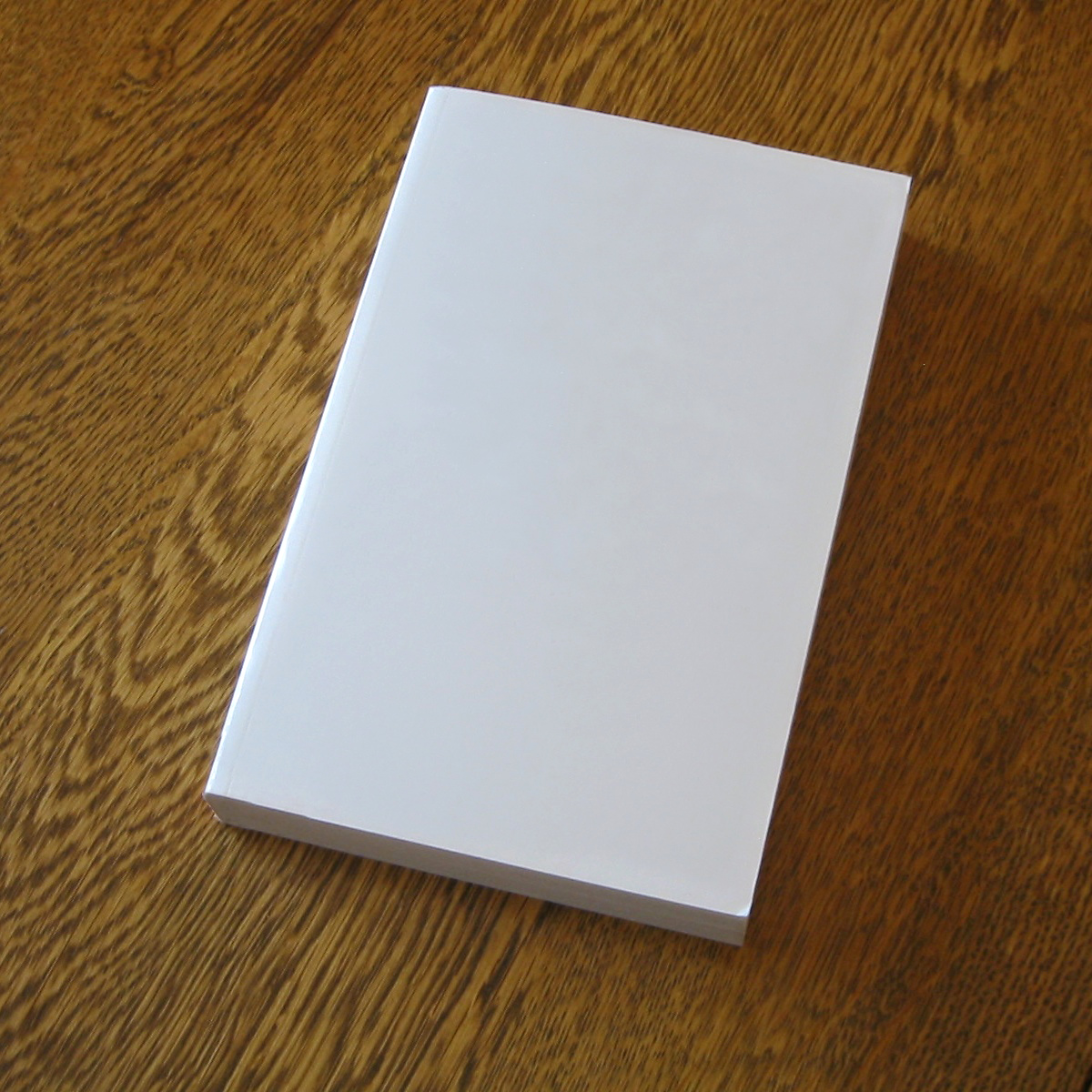
A blank paperback book
Glued binding

A paperback (softcover, softback) book is one with a thick paper or paperboard cover, also known as wrappers, and often held together with glue rather than stitches or staples. In contrast, hardback (hardcover) books are bound with cardboard covered with cloth, leather, paper, or plastic.

Inexpensive books bound in paper have existed since at least the 19th century in such forms as pamphlets, yellowbacks and dime novels.[a] Modern paperbacks can be differentiated from one another by size. In the United States, there are "mass-market paperbacks" and larger, more durable "trade paperbacks". In the United Kingdom, there are A-format, B-format, and the largest C-format sizes.[1]

Paperback editions of books are issued when a publisher decides to release a book in a low-cost format. Lower-quality paper, glued (rather than stapled or sewn) bindings, and the lack of a hard cover may contribute to the lower cost of paperbacks. In the early days of modern paperbacks, the 1930s and 1940s, they were sold as a cheaper, less permanent, and more convenient alternative to traditional hardcover books, as the name of the first American paperback publisher, Pocket Books, indicates. In addition, the Pocket Books edition of Wuthering Heights, one of the first ten books it published in 1939, emphasized the impermanence of paperbacks by telling readers: "if you enjoyed it so much you may wish to own it in a more permanent edition", they could return the 25 cent book to Pocket Books with an additional 70 cents and it would send them a copy of the 95 cent Modern Library edition "substantially bound in durable cloth."[2]

Since the mid-20th century, paperbacks can also be the preferred medium when a book is not expected to be a major seller and the publisher wishes to release the book without a large investment. Examples include many novels and newer editions or reprintings of older books.

Because paperbacks tend to have smaller profit margins, many publishers try to balance the profit to be made by selling fewer hardcovers against the potential profit to be made by selling more paperbacks with a smaller profit per unit. First editions of many modern books, especially genre fiction, are issued in paperback. Best-selling books, on the other hand, may maintain sales in hardcover for an extended period to reap the greater profits that the hardcovers provide.[citation needed]

History

[edit]
Piles of paperback novels

The early 19th century saw numerous improvements in the printing, publishing and book-distribution processes, with the introduction of steam-powered printing presses, pulp mills, automatic type setting, and a network of railways.[3] These innovations enabled the likes of Simms and McIntyre of Belfast,[4] Routledge & Sons (founded in 1836) and Ward & Lock (founded in 1854) to mass-produce cheap uniform yellowback or paperback editions of existing works, and distribute and sell them across the British Isles, principally via the ubiquitous W. H. Smith & Sons newsagent found at most urban British railway stations. These paper bound volumes were offered for sale at a fraction of the historical cost of a book, and were of a smaller format, 110 mm × 178 mm (4+38 in × 7 in),[1] aimed at the railway traveller.[5] The Routledge's Railway Library series of paperbacks remained in print until 1898, and offered the traveling public 1,277 unique titles.[6]

The Continental market also supported examples of cheap paper-bound books: Bernhard Tauchnitz started the Collection of British and American Authors in 1841.[7] These inexpensive, paperbound editions, a direct precursor to mass-market paperbacks, eventually ran to over 5,000 volumes. Reclam published Shakespeare in this format from October 1857[8] and went on to pioneer the mass market paperbound Universal-Bibliothek series[9] from 10 November 1867.

The early years: 1930–1950

[edit]

The German publisher Albatross Books revised the 20th-century mass-market paperback format in 1931, but the approach of World War II cut the experiment short. Albatross' innovations included a standardized size, use of new sans-serif fonts, use of logo and type on the cover without an illustration, and color-coding the covers by genre.[10][11]

In 1935, British publisher Allen Lane, investing his own capital, initiated the paperback revolution in the English-language book market by releasing ten reprint titles to launch the Penguin Books imprint. They adopted many of Albatross's innovations, including a conspicuous logo, using only type on the cover, and color-coded covers for different genres.

The first book on Penguin's 1935 list was André Maurois' Ariel.[12]

Lane intended to produce inexpensive books. He purchased paperback rights from publishers, ordered large print runs (such as 20,000 copies—large for the time) to keep unit prices low, and looked to non-traditional book-selling retail locations. Booksellers were initially reluctant to buy his books, but when Woolworths placed a large order, the books sold extremely well. After that initial success, booksellers showed more willingness to stock paperbacks, and the name "Penguin" became closely associated with the word "paperback" in Great Britain.[citation needed]

In the United States, Robert de Graaf created the Pocket Books label in 1939, partnering with Simon & Schuster to issue a similar line of reprints. Because at first Pocket Books was the only publisher of paperbacks, the term "pocket book" became synonymous with paperback in English-speaking North America. (In France, the term livre de poche, which translates as "pocket book", was used and is still in use today.) De Graaf, like Lane, negotiated paperback rights from other publishers, and produced many runs. His practices contrasted with those of Lane by his adoption of illustrated covers aimed at the North American market. To reach an even broader market than Lane, he used distributors of newspapers and magazines to distribute his books because they had a lengthy history of being aimed (in format and distribution) at mass audiences.[13] Pocket Books were not available in book stores because they did not carry magazines.

Pocket Books established the format for all subsequent paperback publishers in the 1940s. The books measured 6.5" by 4.25" (16.5 cm by 10.8 cm), had full-color covers, and cost 25 cents. Eventually in the 1950s the height increased by 0.5" (1.4 cm) to 7" (18 cm). The width remained the same because wire display racks used in many locations could not hold wider books. With the larger size came a higher price, first 35 cents and then 50 cents.

Because of its number-one position in what became a very long list of pocket editions, James Hilton's Lost Horizon is often cited as the first American paperback book. However, the first mass-market, pocket-sized, paperback book printed in the U.S. was an edition of Pearl Buck's The Good Earth, produced by Pocket Books as a proof-of-concept in late 1938, and sold in New York City.[14]

The first ten Pocket Book titles published in May 1939 with a print run of about 10,000 copies each were:

  1. Lost Horizon (1933) by James Hilton
  2. Wake Up and Live (1936) by Dorothea Brande
  3. Five Great Tragedies by William Shakespeare
  4. Topper (1926) by Thorne Smith
  5. The Murder of Roger Ackroyd (1926) by Agatha Christie
  6. Enough Rope (1926) by Dorothy Parker
  7. Wuthering Heights (1847) by Emily Brontë
  8. The Way of All Flesh (1903) by Samuel Butler
  9. The Bridge of San Luis Rey (1927) by Thornton Wilder
  10. Bambi (1928 English translation) by Felix Salten[15]

This list includes seven novels, the most recent being six year old (Lost Horizons, 1933), two classics (Shakespeare and Wuthering Heights, both out of copyright), one mystery novel, one book of poetry (Enough Rope), and one self-help book.

The success of Pocket Books led to others entering the market. In 1941, American News Company, a magazine distributor, bought a dime novel publisher partially owned by brother and sister Joseph Meyers and Edna Meyers Williams and hired them to organize a new company called "Avon Publications". Avon copied the basic format established by Pocket Books but differentiated itself by emphasizing, as a book on collecting paperbacks says, "popular appeal rather than loftier concepts of literary merit."[16] In 1953, Time magazine summarized its books as "westerns, whodunits, and the kind of boy-meets-girl story that can be illustrated by a ripe cheesecake jacket [cover]".[17]

The next year Dell Publishing, which was founded in 1921 by George T. Delacorte Jr. to publish pulp magazines, joined with Western Publishing to publish Dell Books. Like Avon, Dell followed the basic format established by Pocket Books. But within that format, "Dell achieved more variety than any of its early competitors [with its] . . . instantly identifiable format of vibrant airbrushed covers for its predominantly genre fiction", specialized logos and special features like maps and lists of characters.

World War II brought both new technology and a wide readership of men and women serving in the military or employed as shift workers; paperbacks were cheap, readily available, and easily posted and carried. Furthermore, people found that restrictions on travel gave them time to read more paperbacks. Four-color printing (invented in 1906[18]) and lamination (invented in 1936[19]) developed for military maps made the paperback cover eye catching and kept ink from running as people handled the book. A revolving metal rack (invented in 1906), designed to display a wide variety of paperbacks in a small space, found its way into drugstores, dimestores, and markets.

During World War II, the U.S. military distributed some 122 million "Armed Services Editions" [20] paperback novels to the troops. After the war, the former servicemembers' familiarity with paperbacks helped popularize the format.[21]

Two new developments changed the nature of the mass-market paperback business. One was the decision by publishers to publish more recent best selling books than the older books originally published by Pocket Book. They sought reprint rights on new books and soon found themselves in competition for the biggest sellers, leading to bidding against each other for the rights and costing them more money.

The second development was the spinner rack, a metal pole with a four-sided wire frame designed to vertically hold rows of racks of paperback books. Retail store owners no longer had to devote feet of valuable counter space to low-profit paperbacks. Dozens of paperbacks could be displayed vertically in five or six square feet of floor space. (Similar racks were available for magazines and comic books.) By the late 1940s, paperback spinner racks were ubiquitous in large and small towns across the United States, in every local grocery store, drug store, dime store, and bus and train station, displaying everything from best sellers and mysteries and westerns to classics and Shakespeare. In 1955, in William Inge's Broadway play Bus Stop, it did not seem unbelievable that a long-distance bus traveller stranded by a snowstorm in an out-of-the-way cafe walks to a shelf and picks up a paperback copy of Four Tragedies of Shakespeare. "Sometimes one can find Shakespeare on these shelves among the many lurid novels of juvenile delinquents," he comments.[22]

In 1945, Bantam Books was formed by Walter B. Pitkin Jr., Sidney B. Kramer, and husband and wife Ian and Betty Ballantine as a mass-market paperback publisher.

The fifth major 1940s publisher of mass-market paperbacks was New American Library. Originally Penguin USA, it became a separate publisher in 1948 as the New American Library of World Literature when it separated from Penguin and Victor Weybright and Kurt Enoch took over. Its original focus was classics and scholarly works as well as popular and pulp fiction. Eventually it shortened its name to New American Library and published books in the Mentor and Signet lines.[23]

New paperback publishers continued to enter the market - Lion Books and Pyramid Books (both 1949), Fawcett Gold Medal Books (1950), Ace Books and Ballantine Books (both 1952), and Berkley Books (1955).

U.S. paperbacks quickly entered the Canadian market. Canadian mass-market paperback initiatives in the 1940s included White Circle Books, a subsidiary of Collins (UK.); it was fairly successful but was soon outstripped by the success of Harlequin which began in 1949 and, after a few years of publishing undistinguished novels, focused on the romance genre and became one of the world's largest publishers.

The 1950s—The paperback original (fiction) revolution

[edit]

At first, paperbacks consisted entirely of reprints, but in 1950, Fawcett Publications' Gold Medal Books began publishing original fiction in mass–market paperback. The term paperback original applies to paperback original publications of fiction. It is not usually applied to original non–fiction publications, although paperback publishers also began issuing original non–fiction titles.

Fawcett, an independent newsstand distributor, in 1945, negotiated a contract with New American Library to distribute its Mentor and Signet titles. That contract prohibited Fawcett from becoming a competitor by publishing its own paperback reprints. Roscoe Kent Fawcett wanted to establish a line of Fawcett paperbacks, and he felt original works would not be a violation of the contract. To challenge the contract, Fawcett published two anthologies—The Best of True Magazine and What Today's Woman Should Know About Marriage and Sex—reprinting material from Fawcett magazines not previously published in books.

After these books were successfully published, Fawcett announced in December 1949 that in February 1950 it would publish "original fiction including westerns and mysteries at 25 cents in a pocket-sized format" in a series called Gold Medal Books. Publishers Weekly reported in May 1950 that Fawcett books were "similar in appearance and cover allure to many of the paperback reprints, but the story material [was] original and not reprinted from regular editions." It also said the authors would be paid a $2,000 advance with a guaranteed first printing of 200,000 copies.[24]

That same month Fawcett released the first four Gold Medal books, original novels by W. R. Burnett, Sax Rohmer, Richard Himmel, and John Flagg – one western and three mysteries/adventure novels.

Fawcett's action led to immediate controversy, with an executive Vice president of Pocket Books attacking the whole idea, a literary agent reporting that one hardcover publisher threatened to boycott his agency if he dealt with mass market publishers, and Doubleday's LeBaron R. Barker claiming that paperback originals could "undermine the whole structure of publishing."[24]

Sales soared, prompting Gold Medal editorial director Ralph Daigh to comment later, "In the past six months we have produced 9,020,645 books, and people seem to like them very well." In 1950 Gold Medal published 35 titles, in 1952, 66 titles.[25]

Other paperback publishers saw Gold Medal's success and began to emulate it. Publishers Weekly reported in May 1952 that Avon had included three originals in its April releases and was seeking more. It added that Dell was "'thinking about' some systematic programs of original publishing," Lion Books had "a definite original publishing program in the works", and that Graphic had begun publishing originals about a year earlier. Bantam, Pocket Books, and New American Library said they were not going to publish originals.[24]

Also in 1952, Ace began publishing Ace Double Novel Books, two books printed in one volume for 35 cents, one a reprint and one original, with two covers and two title pages.[24]

In 1952, husband and wife publishers Ian and Betty Ballantine left Bantam Books and founded their own publishing house, Ballantine Books, to publish paperbacks simultaneously with their publication in hardcover by traditional publishers. Their first book, Cameron Hawley's Executive Suite, published January 1, 1952 at 35 cents in the 7" height simultaneously with Houghton Mifflin's $3.00 hardcover edition, was a success for both publishers.[25] Of their next nine novels, two were published simultaneously by Houghton Mifflin and one by Farrar, Straus & Young, and six were stand-alone originals.

In 1953, Dell announced its line of originals, Dell First Editions, and published its first novels by Walt Grove, Frederic Brown, and Charles Einstein.[24]

Genre categories began to emerge, and mass-market book covers reflected those categories. Mass-market paperbacks influenced slick and pulp magazines. The market for cheap magazines diminished when buyers began to buy cheap books instead. Authors also found themselves abandoning magazines and writing for the paperback market. The leading paperback publishers often hired experienced pulp magazine cover artists, including Rudolph Belarski and Earle K. Bergey, who helped create the look and feel of paperbacks and set an appealing visual standard that continues to this day. Scores of well-known authors were published in paperback, including Arthur Miller and John Steinbeck.

McClelland and Stewart entered the Canadian mass-market book trade in the early 1960s, with its "Canadian best seller library" series, at a time when Canadian literary culture was beginning to be popularized, and a call for a Canadian author identity was discussed by the Canadian people.

Types

[edit]

Mass-market

[edit]

The mass-market paperback is a small, usually non-illustrated, inexpensive bookbinding format. This includes the A-format books of 110 mm × 178 mm (4+38 in × 7 in),[1] in the United Kingdom, and the "pocketbook" format books of a similar size, in the United States. Mass-market paperbacks usually are printed on cheap paper.[26] They are commonly released after the hardback edition and often sold not only at bookstores, but also where books are not the main business, such as at airports, drugstores, and supermarkets.

In 1982, romance novels accounted for at least 25% of all paperback sales.[27] In 2013, 51% of paperback sales were romance.[28] Many titles, especially in genre fiction, have their first editions in paperback and are never published in hardcover; this is particularly true of first novels by new authors.[29]

The mass-market paperbacks sold in airport newsstands have given rise to the vaguely defined literary genre of the "airport novel", bought by travelers to read while they sit and wait. Mass-market paperbacks also have offered collections of comic strips and magazine cartoon series, such as Ernie Bushmiller's Nancy and Chon Day's Brother Sebastian.

B-format

[edit]

The term B-format indicates a medium-sized paperback of 129 mm × 198 mm (5+18 in × 7+34 in). This size has been used to distinguish literary novels from genre fiction.[1] In the U.S., books of this size are thought of as smaller trade paperbacks (see below).

Trade paperback

[edit]

A trade paperback (also called trade paper edition and trade) is a higher-quality paperback book.[30] If it is a softcover edition of a previous hardcover edition and is published by the same house as the hardcover, the text pages are normally identical with those of the hardcover edition, and the book is almost the same size as the hardcover edition. The pagination is the same, so that references to the text will be unchanged: this is particularly important for reviewers and scholars. The only difference is the soft binding; the paper is usually of higher quality than that of a mass-market paperback, often being acid-free paper.[31] In the United States, the term trade paperback also encompasses the medium-sized paperbacks described as B-format, above. British trade paperbacks are 135 mm × 216 mm (5+38 in × 8+12 in).[1]

Trade paperbacks did not enter the American market until around 1960. Unlike mass-market paperbacks they are distributed by their original hard-cover publishers directly to book stores, not through magazine distributors to other retailers.

Trade comics

[edit]

Trade paperbacks are often used to reprint several issues of a comic series in one volume, usually an important storyline or the entire series, and the name trade paperback has become synonymous with a collection of reprinted material. Graphic novels may also be printed in trade paperback form. Publishers sometimes release popular collections first in a hardback form, followed by a trade paperback months later. Examples include Marvel Comics' Secret War and DC Comics' Watchmen.

Japanese manga, when they are collected into volumes, are published in the tankōbon format, approximately the size of a trade-sized book. The most common tankōbon sizes are Japanese B6 (128 × 182 mm) and ISO A5 (148 × 210 mm).

Major publishers

[edit]

See also

[edit]

Footnotes

[edit]

References

[edit]

Further reading

[edit]
[edit]
Revisions and contributorsEdit on WikipediaRead on Wikipedia
from Grokipedia
A paperback, also known as a softcover, is a printed book bound with a flexible cover made from paper or thin cardboard, typically attached to the spine using glue or another adhesive, distinguishing it from the rigid board covers of hardcovers and enabling greater portability and lower production costs. The modern mass-market paperback format emerged in Europe with the founding of Albatross Press in 1932 by Max Christian Wegner, John Holroyd-Reece, and Kurt Enoch, which published affordable English-language editions for continental readers, building on earlier cheap bindings like 19th-century Tauchnitz editions but introducing standardized, high-volume production. In the United Kingdom, Allen Lane established Penguin Books in 1935 after struggling to find engaging reads during a trip, launching the first ten titles—including works by Agatha Christie and Ernest Hemingway—at a price of sixpence, equivalent to a packet of cigarettes, and distributing them through non-traditional outlets like railway stations and department stores to democratize access to quality literature. This model crossed the Atlantic when Pocket Books was created in 1939 by Robert de Graff in the United States, releasing its inaugural title, The Good Earth by Pearl S. Buck, in a pocket-sized format sold for 25 cents via racks in drugstores, newsstands, and Woolworth's, which propelled the paperback into mainstream American culture and boosted readership during the Great Depression and World War II. Over time, paperbacks have evolved into two primary subtypes: trade paperbacks, which are larger (often around 5.5 x 8.5 inches), higher-quality editions targeted at bookstores and priced between $10 and $20, and mass-market paperbacks, smaller (typically 4.25 x 6.75 inches) and more economical at $5 to $10, optimized for impulse buys in diverse retail settings. This innovation transformed the publishing industry by reducing costs through cheaper materials and printing techniques, expanding global literacy rates, and fostering genres such as , mysteries, and romances that shaped 20th-century popular entertainment. Today, paperbacks remain a dominant format, accounting for the majority of due to their accessibility, though they face competition from digital alternatives.

Overview

Definition and Characteristics

A paperback book, also referred to as a softcover, is a type of book binding in which the cover consists of a flexible sheet of thick or cardstock, typically glued directly to the spine of the text block, rather than using rigid boards covered in cloth, , or other materials as in hardcovers. Key characteristics of paperbacks include their lightweight and bendable covers, which contribute to greater portability compared to more rigid formats; common sizes range from compact dimensions like 4.25 by 6.87 inches for or mass-market editions to larger sizes, allowing for easier handling and storage. The binding method is usually perfect binding, where the pages are gathered, trimmed, and secured to the cover with a flexible applied to the spine, resulting in a square-backed appearance without sewn signatures in most cases. Unlike hardcovers, paperbacks generally lack a removable and feature unsewn pages glued at the spine, prioritizing affordability in production over long-term durability. This design makes paperbacks suitable for at lower costs, often using economical stocks for both interior pages and covers. Precursors to the modern paperback format, such as inexpensive paper-bound books like yellowbacks, emerged in the mid-19th century as affordable alternatives to traditional bindings.

Advantages and Disadvantages

Paperbacks offer several practical advantages over s, primarily in terms of affordability and convenience. Trade paperbacks typically range from $10 to $20, while mass-market paperbacks are $5 to $10, both significantly lower than the $20 to $30 or more for hardcovers, making them more accessible to casual readers and broadening book ownership. Their lighter weight and flexible construction enhance portability, allowing easier carrying during travel or commuting without the bulk of rigid hardcover boards. Additionally, paperbacks require less storage space due to their slimmer profile, facilitating collection for readers with limited shelving. From a production standpoint, paperbacks benefit from simpler processes that omit costly materials like cloth covers and rigid boards, resulting in savings for publishers and faster turnaround times compared to hardcovers, which demand more intricate binding. This efficiency supports wider distribution and quicker market entry, enhancing accessibility for diverse audiences. However, paperbacks have notable disadvantages, particularly regarding and perceived value. Their soft covers and thinner pages make them prone to creasing, spine wear, and overall damage from regular use, leading to shorter lifespans than hardcovers. In libraries, this reduced results in limited shelf life, as paperbacks wear out faster under circulation. Aesthetically, they often lack the premium appeal of hardcovers, which diminishes their desirability for collectors and can contribute to lower perceived value, potentially affecting author royalties due to reduced per-unit pricing. Comparatively, while paperbacks yield manufacturing savings through minimal materials, they experience higher return rates in the publishing industry—around 16% as of 2024 overall—partly due to damage during handling and shipping. Environmentally, paperbacks generally use less paper and fewer resources than hardcovers, though both formats rely on pulp production, underscoring a brief note on material efficiency without offsetting broader industry impacts. From user perspectives, paperbacks excel for on-the-go reading like or vacations, where flexibility and lightness are key, but they are less suitable for long-term reference or frequent handling compared to more robust hardcovers.

History

Early Development

The origins of the paperback book trace back to the , with German publisher Christian Bernhard Tauchnitz pioneering affordable paperbound editions in starting in 1841. Known as the "Collection of British and American Authors," these volumes targeted English-speaking travelers across , offering authorized reprints of popular works at low prices to bypass strict British laws by restricting sales outside the and . Tauchnitz's innovation emphasized portability and accessibility, laying foundational groundwork for modern paperbacks through simple glued bindings and modest production costs. By the 1930s, European publishers built on this model with greater ambition. Albatross Books, established in 1931 in by John Holroyd-Reece, Kurt Enoch, and Max Christian Wegner, introduced the first standardized mass-market paperbacks with color-coded covers denoting genres, distributing over 500 titles in English for the continental market before . This format emphasized uniform design and broad appeal, influencing subsequent ventures. Meanwhile, in the UK, founded in 1935 as an imprint of , launching with ten titles in distinctive orange-and-white covers priced at sixpence—equivalent to a pack of cigarettes—to democratize access to literature. Penguin's early success stemmed from reprinting classics and contemporary works with publisher permissions, with Woolworths placing an initial order for 63,000 copies, confirming viability despite initial skepticism. These innovations encountered significant hurdles, including fierce resistance from traditional booksellers who worried that inexpensive paperbacks would erode sales and disrupt established pricing structures. Legal challenges around further complicated reprints, requiring negotiated rights or reliance on texts to avoid infringement suits. In the , adoption lagged behind Europe due to the economic fallout of the , which stifled publishing risks until 1939, when partnered with Robert Fair de Graff to launch —the first American mass-market paperback line. debut focused on reprints, including classics like Emily Brontë's Wuthering Heights and Shakespeare's tragedies, achieving 1.5 million sales in its inaugural year and signaling paperbacks' viability stateside.

Postwar Expansion and Revolution

The Armed Services Editions (ASEs), small paperback books distributed to U.S. troops during , played a pivotal role in popularizing among soldiers, with nearly 123 million copies of 1,322 titles produced between 1943 and 1947. These portable, inexpensive volumes, provided free to boost morale, exposed millions to diverse genres from classics to mysteries, fostering a postwar surge in and reading as veterans returned home with a for affordable books. The success of ASEs shifted publishers' attitudes, transforming paperbacks from perceived threats to sales into a viable mass-market medium that capitalized on the era's and expanded consumer culture. The marked a revolutionary shift with the rise of "paperback originals," fiction written directly for the format, particularly in pulp genres like crime, romance, and . Publishers such as Fawcett's Gold Medal Books, launched in 1949, pioneered this approach by issuing original works starting in 1950, increasing from 35 titles that year to 66 in 1951 and revolutionizing the industry by bypassing editions altogether. Similarly, , founded by A. A. Wyn in 1952, specialized in original and double novels, drawing from the tradition to produce affordable, genre-driven content that appealed to a broad audience. This innovation exploded the market, with U.S. paperback production reaching 214 million copies in 1950 alone, generating $46 million in revenue, and by 1949, softcovers outselling hardcovers by 10 percent. The proliferation challenged literary elitism by democratizing access to entertainment, turning reading into a form of mass leisure that reflected postwar optimism and . Key events underscored paperbacks' cultural impact, including 1950s censorship battles that paved the way for bolder content. The 1960 British trial of Penguin Books for publishing an unexpurgated edition of D. H. Lawrence's Lady Chatterley's Lover tested the Obscene Publications Act; after a six-day trial, the jury acquitted Penguin in three hours, a landmark victory for free expression that liberalized publishing and propelled sales of over 2 million copies in six weeks. In the U.S., paperbacks proliferated through drugstore racks and newsstands, where revolving displays made them impulse buys for everyday consumers, fueling a boom in mass entertainment. Meanwhile, in the UK, publishers like Penguin emphasized quality reprints of classics, maintaining a focus on educational value amid the originals-driven U.S. surge. By the mid-1950s, this dual trajectory had cemented paperbacks as a dominant force, outselling hardcovers overall by 1960 and reshaping global reading habits.

Contemporary Developments

During the and , the paperback industry underwent significant consolidation as multinational conglomerates acquired established houses, with Pearson purchasing Penguin in and Penguin subsequently acquiring in 1975. This era marked the beginning of widespread mergers, transforming independent publishers into subsidiaries of larger media corporations, which aimed to streamline operations and expand distribution amid growing market demands. By the , the industry had matured into a conglomerate-dominated landscape, with further acquisitions like Penguin's purchase of Putnam, fostering but also raising concerns about reduced diversity in editorial voices. In response to the rising "bestseller culture" of the period, publishers shifted toward larger trade paperback formats, which offered a premium alternative to mass-market editions while remaining more affordable than hardcovers, thereby capturing mid-tier sales for high-profile titles. This innovation, peaking in the 1980s, fueled bookstore expansions and appealed to readers seeking durable yet accessible versions of popular fiction and non-fiction bestsellers. The and presented challenges for paperbacks as audiobooks gained traction, with the format establishing itself as a viable segment through cassette and releases, particularly for commuters and multitasking listeners. Early e-books emerged in the late , accelerating with devices like the Kindle in 2007, which disrupted traditional print sales by offering instant access to digital content. Despite these pressures, paperbacks retained dominance in such as romance, , and thrillers, where tactile reading experiences and affordable pricing continued to drive mass-market consumption. From the onward, paperback publishing adapted through hybrid models that bundled print editions with e-book tie-ins, allowing publishers to cater to diverse reader preferences while leveraging . Eco-friendly initiatives gained prominence, with increased use of recycled papers and sustainable inks to reduce environmental impact, aligning with consumer demands for greener production. Independently published paperbacks surged via print-on-demand technologies, enabling authors to produce small runs without inventory risks and democratizing access to the market. Recent innovations include enhanced cover designs like French flaps, which add a premium feel to trade paperbacks by extending the inward for better protection and aesthetics. Paperbacks have also integrated with graphic novels, adopting for collected editions that blend narrative text with visuals, appealing to younger demographics. Globally, the paperback market expanded in non-Western regions like , where rising and in countries such as and boosted demand for affordable imported and local titles. The from 2020 onward provided a boost to home reading, with U.S. print book sales rising 9.27% in 2020 compared to 2019 and continuing to grow, reaching 778.3 million units in 2023. Trade paperbacks saw particular gains, up significantly in unit sales during 2020, while mass-market formats dipped slightly by 5.5%, reflecting a shift toward more durable home-bound reading options. Sales continued to rise, reaching 782.7 million units in 2024. By 2025, this sustained print resurgence amid digital alternatives underscored paperbacks' resilience, with overall industry revenue projected at $142.72 billion globally.

Types and Formats

Mass-Market Paperbacks

Mass-market paperbacks represent the compact, low-cost iteration of the paperback format, optimized for widespread distribution and high-volume . These books typically measure 4.25 by 6.75 inches, earning them the nickname "pocket-sized" due to their portability for on-the-go reading. They commonly contain 250 to 400 pages, with pricing set affordably between $7 and $10 to encourage impulse purchases. This format prioritizes economy in production, using thinner, lower-quality that is often not acid-free, which can lead to yellowing and reduced longevity over time compared to higher-end bindings. The primary target audience for mass-market paperbacks consists of readers of , including romance, thrillers, , and mysteries, who seek quick, engaging reads. These books are frequently sold as impulse buys in non-traditional outlets such as supermarkets, newsstands, drugstores, and airports, where their small size and low facilitate casual acquisition. Design elements are tailored for visibility in retail racks, featuring narrow spines optimized for upright display in spinner racks or shelves, alongside bold, sensational intended to catch the eye amid competing titles. Since their rise in the , mass-market paperbacks have played a pivotal role in democratizing access to in the United States, with sales surging from under 200,000 units in 1939 to 270 million by 1952, transforming reading habits through affordable availability. They became dominant in fiction markets, particularly for genre titles; for instance, by the late , romance novels like those from accounted for roughly half of all mass-market paperback sales, capturing a substantial share of the U.S. fiction sector. , founded in 1949, exemplified this trend by dominating the subgenre and achieving approximately one in every six mass-market paperback sales in . In contemporary usage, mass-market paperbacks remain a vehicle for backlist titles and staples but have seen a marked decline due to the rise of e-books and shifting retail landscapes. As of , they represent only about 3% of total units sold in the U.S., with revenues for mass-market formats dropping 29.8% year-over-year in mid-2025 amid broader print category challenges. Major distributors like Readerlink have announced plans to cease mass-market distribution by the end of , signaling further contraction in this once-ubiquitous format.

Trade Paperbacks

Trade paperbacks, also known as quality or original paperbacks, are higher-quality softcover editions designed for bookstore display and longer-term ownership, typically measuring 5.5 x 8.5 inches or larger to accommodate substantial content such as novels, memoirs, and works often exceeding 300 pages. These books are priced between $12 and $20, positioning them as an accessible yet premium alternative to hardcovers, with features like deckled edges on the pages and matte covers enhancing their aesthetic appeal and perceived durability. Targeted at general trade readers interested in , , and titles, trade paperbacks often follow the release of a edition by about a year, allowing publishers to extend a book's lifecycle to midlist authors and enduring works. elements contribute to their appeal, including durable perfect binding for repeated use, full-color laminated covers for visual impact, and occasional French flaps that provide additional protection and space for blurbs or author . These formats are particularly suited to midlist and titles that benefit from sustained rather than high-volume, short-term distribution. The format gained significant popularity in the 1980s as a "quality paperback" option, offering a cost-effective alternative to hardcovers while maintaining higher production standards than mass-market editions, which helped reshape publishing economics by capturing a growing segment of discerning readers. Academic presses have long utilized trade paperbacks for scholarly yet accessible works, such as historical analyses and cultural studies, exemplified by titles from university publishers like Oxford University Press that blend rigorous content with trade-friendly formatting. In 2025, trade paperbacks continue to bridge the gap between mass-market affordability and hardcover prestige, accounting for approximately 30% of U.S. print book sales and serving as a key driver in the trade publishing sector's steady growth.

Specialized Formats

B-format paperbacks, prevalent in the UK and Europe, measure approximately 129 mm × 198 mm and serve as a standard for , offering a size that bridges the compactness of mass-market editions and the larger dimensions of full trade paperbacks. This format is widely used for contemporary novels, providing a portable yet readable option that accommodates denser text without the premium pricing of hardcovers. Trade paperbacks for and graphic novels typically feature larger trim sizes, such as 6.75 × 10.375 inches, to preserve the visual impact of artwork in collected editions from publishers like DC Comics or series. These softcover volumes, often perfect-bound, collect multiple issues into single books, appealing to fans seeking archival-quality reproductions that maintain the original panel layouts. Common examples include DC's trade paperback collections of Batman arcs or Viz Media's omnibuses, which prioritize high-quality paper stock for color reproduction. Other specialized variants include paperbacks, measuring 5.5 × 8.5 inches, which adapt formats into book compilations for genres like short stories or puzzles, enhancing portability for on-the-go reading. paperbacks address needs by employing fonts of 16 point or larger, with increased line spacing and high-contrast paper, enabling readers with visual impairments to engage with independently. Eco-paper editions utilize post-consumer recycled content, reducing environmental impact while maintaining standard paperback durability, as seen in imprints from publishers like Milkweed Editions that prioritize sustainable sourcing. Regionally, A-format paperbacks in , sized at 111 × 181 mm, function as a larger mass-market variant suited to local distribution channels and genres like romance, offering greater in a pocketable form. In , bunkobon pocket editions adhere to A6 dimensions of 105 × 148 mm, designed for affordability and space efficiency in high-volume fiction markets, including light novels and reprints. These formats target niche demographics, such as enthusiasts, accessibility-focused readers, or international consumers, with adoption growing in the amid rising demand for genre diversity and sustainable options in global .

Production and Materials

Binding and Construction

Perfect binding is the predominant method used in paperback production, where the text block's pages are gathered, trimmed, and glued directly to the spine of a flexible paper cover using a that provides both strength and flexibility. This process involves milling or roughening the spine edge of the text block to enhance , applying the in a heated state, and then pressing the cover onto the spine while the glue sets, resulting in a seamless, square-backed without sewn signatures. Alternative binding techniques are employed for specific paperback applications, particularly when perfect binding's thickness limitations or needs are not ideal. Saddle-stitching, suitable for thinner such as pamphlets or short novels, involves folding printed sheets in half and securing them with wire staples driven through to form the spine, offering a cost-effective option for page counts under 100. Notch binding, an enhancement to perfect binding for greater , creates small incisions along the spine of the folded signatures to allow deeper penetration, improving the bond strength and resistance to page pull-out in medium-thickness paperbacks. These methods evolved from earlier adhesive-based approaches but prioritize mechanical enhancements for modern production efficiency. reactive (PUR) adhesives are also commonly used as an alternative to standard hot-melt glues, offering stronger bonds and greater flexibility, particularly for trade paperbacks. Paperback covers are typically constructed from cardstock weighing between 60 and 100 pounds (), providing sufficient rigidity while maintaining flexibility for handling. This is often laminated with a thin , usually 1.5 to 3 mils thick, to add protection against , , and fingerprints, enhancing without adding bulk. The spine area is creased during to facilitate opening and prevent cracking, ensuring the cover wraps evenly around the text block. Quality variations in binding distinguish mass-market paperbacks from trade paperbacks, reflecting differences in intended use and production scale. Mass-market editions often employ thinner stocks around 40-50 pounds and standard hot-melt glues with moderate strength to keep costs low, resulting in bindings that prioritize portability over long-term . In contrast, trade paperbacks use thicker , typically 55-70 pounds, paired with higher-grade adhesives for superior glue penetration and resistance to spine fatigue, supporting larger formats and extended reading sessions. The assembly of paperbacks relies on specialized machinery adapted for soft-cover production, bypassing hardcover elements like rigid boards and endpapers. Perfect binding lines, such as those from manufacturers like Duplo or Standard Horizon, automate the gluing, nipping, and trimming processes at speeds up to 5,000 books per hour, with the cover fed from rolls or sheets and wrapped around the text block via automated folding and pressing stations. For alternatives like saddle-stitching, high-speed saddle stitchers use rotary feeders and wire inserters to handle folded signatures efficiently, while notch binding incorporates spine-notching saws integrated into perfect binders to prepare the text block before adhesion.

Printing and Sustainability

Paperback printing primarily relies on offset for interior pages in large-volume runs, where ink is transferred from plates to rubber blankets and then to , enabling high-quality reproduction at scale. This method is the most common for printed s due to its efficiency in producing consistent results across thousands of copies. For shorter runs, typically under 500 copies, is preferred, as it uses computer-generated images directly applied via or inkjet , allowing faster turnaround without the need for plates. Paperback covers are generally printed using CMYK process colors for full-color designs, often supplemented with spot colors—premixed inks applied directly from dedicated plates—to achieve precise hues for branding elements like logos. Interior pages of paperbacks are typically printed on wood-pulp or recycled paper weighing 60-80 gsm, providing a lightweight yet opaque sheet suitable for text-heavy content. Soy-based inks, derived from soybeans, are increasingly used for both interiors and covers due to their lower volatile organic compound emissions compared to petroleum-based alternatives, enhancing print vibrancy on coated surfaces. Cover stocks, often 240-300 gsm coated card, are sourced from sustainable forests certified by the Forest Stewardship Council (FSC), ensuring responsible harvesting practices that maintain biodiversity and prevent deforestation. Sustainability challenges in paperback production stem from substantial paper consumption, with global print book output exceeding 2 billion units annually, the majority being paperbacks that contribute to and resource depletion. Recycling remains difficult, as mixed inks, adhesives, and covers often contaminate paper streams, leading many books to landfills and complicating efficient recovery processes. In the 2020s, publishers have shifted toward paper, with options now including up to 100% recycled content to reduce virgin fiber demand and lower energy use in production. Recent trends emphasize waste reduction through print-on-demand technologies, which produce books only upon order, minimizing overstock and excess inventory in the . Biodegradable adhesives, such as water-based and natural formulations, are gaining adoption in binding processes to replace synthetic glues, allowing easier and recyclability without toxic residues. By 2025, initiatives for carbon-neutral printing have expanded, with printers investing in energy-efficient presses and offsets to neutralize emissions across the production lifecycle. These material choices keep paperbacks affordable, as lower-cost recycled papers and soy inks reduce raw input expenses compared to premium alternatives. However, stricter eco-standards, including FSC certification and carbon tracking, elevate compliance costs, potentially compressing publisher margins by up to 36% without efficiency gains. After printing, sheets proceed to binding assembly for final construction.

Publishing and Market

Major Publishers

, formed by the 2013 merger of and , stands as one of the dominant forces in the paperback industry. originated in 1935 with the launch of affordable paperbacks in the UK, revolutionizing access to literature through imprints like , which continue to specialize in classic and contemporary titles in paperback formats. The company maintains a significant presence in the market, holding approximately 23.8% share as of 2024, driven by a diverse portfolio of mass-market and trade paperbacks across genres. HarperCollins has played a pivotal role in mass-market paperbacks, particularly through its ownership of imprints Avon and , which focus on romance and . Avon Books, established in 1941, pioneered the category and has since expanded to publish original genre works in paperback editions. , acquired by in 2014, bolsters this segment with its extensive catalog of women's fiction and series romances, emphasizing affordable paperback originals that trace back to innovations in the . Simon & Schuster pioneered the paperback revolution in the United States through its imprint, launched in 1939 as the country's first dedicated paperback publisher. The company, now owned by private equity firm KKR following its 2023 acquisition from , remains strong in trade paperback formats, offering a wide range of titles in genres such as , , and . Independent publishers have carved out niches in the paperback market, particularly for specialized genres. Corp., founded in , operates as the largest independent publisher of mass-market paperbacks, with a focus on romance, mystery, and women's fiction through diverse imprints. Sourcebooks, an entrepreneurial independent based in , publishes paperbacks across fiction, nonfiction, and young adult categories, championing diverse voices and innovative formats since its inception in 1987. The rise of platforms has further diversified the landscape, with IngramSpark enabling print-on-demand () paperbacks that allow authors to produce and distribute niche titles globally without traditional intermediaries. Globally, France-based Hachette Livre, the world's third-largest trade publisher, exerts significant influence through its international subsidiaries that adapt paperbacks for non-English markets, including extensive French-language editions and distributions in over 150 countries. , with a heritage dating to 1843, maintains a broad global reach via imprints like Pan Macmillan, producing paperbacks tailored for markets in , , and , often translating and localizing content to meet regional demands. The global physical books market, dominated by paperbacks, is projected to generate approximately $70.19 billion in revenue in 2025, representing a significant portion of the overall books industry valued at $94.94 billion. Paperbacks accounted for 60-70% of print worldwide, driven by their affordability and compared to hardcovers. In the United States, print reached approximately $15.6 billion in 2024, with paperbacks and mass-market editions comprising about $7.9 billion (50.6% of print sales). However, US paperback sales faced challenges in 2025, with adult fiction paperbacks declining 13.9% in the first half of the year amid a broader print market dip of 0.9% through the first nine months. As of the first nine months of 2025, US print unit dipped 0.9% year-over-year, indicating potential stabilization or slight contraction for the full year. Distribution channels for paperbacks vary by format, with mass-market editions traditionally sold through and big-box retailers for impulse buys, while trade paperbacks are primarily available via independent bookstores, chains like , and platforms. Amazon holds a dominant position, capturing over 50% of new book sales and approximately 80% of overall book distribution in the by 2025. sales have surged, accounting for nearly 80% of total book transactions globally by mid-2025, fueled by convenience and rapid fulfillment. Economically, paperbacks have democratized access to reading materials, making more affordable and contributing to higher rates in developing regions by reducing barriers to book ownership. Authors typically earn royalties of 7-10% on paperback sales, lower than the 10-15% for hardcovers due to the formats' price differential, which influences publishing strategies toward mass-market releases for broader reach. Paperbacks face competition from e-books, which captured about 20% of the overall book market in 2024 while print held 76%, though paperbacks maintain around 50% share in categories due to tactile appeal. Rising paper costs from , exacerbated by disruptions, increased production expenses by up to 10-15% in 2024-2025, pressuring margins. Following a post-2020 rebound where print sales surged 8-10% annually during lockdowns, the market stabilized with hybrid models combining physical and digital formats to diversify revenue. Looking ahead, initiatives are promoting eco-friendly paperbacks using recycled materials, expected to grow 5-7% annually through 2030 as publishers respond to for products. AI tools are increasingly integrated into cover , reducing costs by 20-30% and enabling personalized visuals for niche markets. Regional expansion in emerging markets like is accelerating, with the local book sector projected to rise 4-6% in 2025, boosting global paperback through affordable local printing and digital hybrids.

References

Add your contribution
Related Hubs
User Avatar
No comments yet.