


Community hub
Recent from talks
Contribute something
Nothing was collected or created yet.
Solanum muricatum
View on Wikipedia
| Solanum muricatum | |
|---|---|

| |
| Plant with flowers and ripening fruit | |
Scientific classification 
| |
| Kingdom: | Plantae |
| Clade: | Tracheophytes |
| Clade: | Angiosperms |
| Clade: | Eudicots |
| Clade: | Asterids |
| Order: | Solanales |
| Family: | Solanaceae |
| Genus: | Solanum |
| Species: | S. muricatum
|
| Binomial name | |
| Solanum muricatum | |
| Synonyms[1][2] | |
| |
Solanum muricatum is a species of evergreen shrub native to South America and grown for its sweet edible fruit.
It is known as pepino dulce ("sweet cucumber" in English, in order to differentiate it from cucumber which is also called "pepino" in Spanish) or simply pepino. The pepino dulce fruit resembles a melon (Cucumis melo) in color, and its flavor recalls a succulent mixture of honeydew and cucumber, and thus it is also sometimes called pepino melon or melon pear. Another common name, tree melon, is more often used for the papaya (Carica papaya) though the pepino dulce plant generally does not look much like a tree; it looks more like a ground cover, trailing plant. The present species is, however, a close relative of other nightshades cultivated for their fruit, including the tomato (S. lycopersicum) and the eggplant/aubergine (S. melongena), which its own fruit closely resembles.
The fruit is common in markets in Colombia, Chile, Bolivia, Peru and Kenya,[citation needed] but less often overseas because it is quite sensitive to handling and does not travel well. Attempts to produce commercial cultivars and to export the fruit have been made in New Zealand, Turkey, Mauritius and Chile.[3]
Distribution and habitat
[edit]The pepino dulce is presumed to be native to the temperate Andean regions of Colombia, Peru and Chile though it is not known in the wild and the details of its domestication are unknown.[4]
Cultivation
[edit]Pepinos are not often found archaeologically as they are soft and pulpy and not easy to preserve, while their tough seeds are small and easily lost among debris. But they were already described by early Spanish chroniclers as being cultivated on the coast; the Moche Valley in Peru was particularly famous for them. They were a popular decorative motif in Moche art.[5]

In the United States the fruit is known to have been grown in San Diego before 1889 and in Santa Barbara by 1897. More commercially viable cultivars were introduced from New Zealand and elsewhere towards the end of the 20th century, leading to its introduction into up-scale markets in Japan, Europe and North America.[4]
The pepino dulce is relatively hardy. In its native range it grows at altitudes ranging from close to sea level up to 3,000 m (10,000 ft.). However, it performs best in a warm, relatively frost-free climate. The plant can survive a low temperature of -2.5 °C (27 to 28 °F) if the freeze is not prolonged, though it may drop many of its leaves.[4] The species is a perennial, but its sensitivity to chilling, pests, and diseases force the growers to replant the crop every year. The crop also adapts well to greenhouse cultivation, training the plants up to 2 m tall, and obtaining yields that are 2-3 times larger than those obtained outdoors.
They are propagated by cuttings since they are established easily without rooting hormones. It is grown in a manner similar to its relatives such as the tomato, though it grows naturally upright by habit and can thus be cultivated as a free-standing bush, though it is sometimes pruned on . Additionally, supports are sometimes used to keep the weight of the fruit from pulling the plant down. It has a fast growth rate and bears fruit within 4 to 6 months after planting. It is a perennial, but is usually cultivated as an annual. Seedlings are intolerant of weeds, but it can later easily compete with low growing weeds. Like their relatives tomatoes, eggplants, tomatillos and tamarillos, pepinos are extremely attractive to beetles, aphids, white flies and spider mites. Pepinos are tolerant of most soil types, but require constant moisture for good fruit production. Established bushes show some tolerance to drought stress, but this typically affects yield. The plants are parthenocarpic, meaning it needs no pollination to set fruit, though pollination will encourage fruiting.[3]

The plant is grown primarily in Chile, New Zealand and Western Australia. In Chile, more than 400 hectares are planted in the Longotoma Valley with an increasing proportion of the harvest being exported. Colombia, Peru, and Ecuador also grow the plant, but on a more local scale. Outside of the Andean region, it has been grown in various countries of Central America, Morocco, Spain, Israel, and the highlands of Kenya. In the United States several hundred hectares of the fruit are grown on a small scale in Hawaii and California. More commercially viable cultivars have been introduced from New Zealand and elsewhere in more recent times. As a result, the fruit has been introduced into up-scale markets in Japan, Europe and North America and it is slowly becoming less obscure outside of South America.[3]
The study of the molecular variation of this pepino is of interest for several reasons. Although the seeds of pepino plants are fertile and produce vigorous offspring, this crop is primarily propagated by cuttings (Heiser, 1964; Anderson, 1979; Morley-Bunker, 1983), and as a consequence, its genetic structure could be different from that of seed-propagated crops.[6]
-
 Flower and flower buds
 -
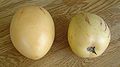
-
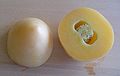 Cut in half
 -
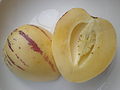 Cut in half
 -
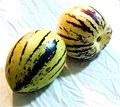 Ripe fruits.
.jpg)


Culinary use
[edit]Delicate and mild-flavored, pepinos are often eaten as a fresh snack fruit. They combine very well with a number of other fruits as well.
References
[edit]Footnotes
[edit]- Berrin, Katherine & Larco Museum (1997): The Spirit of Ancient Peru: Treasures from the Museo Arqueológico Rafael Larco Herrera. New York: Thames and Hudson.
- Blanca, JM; Prohens, J; Anderson, GJ; Zuriaga, E; Cañizares, J; Nuez, F (2007). "AFLP and DNA sequence variation in an Andean domesticate, pepino (Solanum muricatum, Solanaceae): implications for evolution and domestication". American Journal of Botany. 94 (7): 1219–1229. doi:10.3732/ajb.94.7.1219. PMID 21636488.
- California Rare Fruit Growers, Inc. (CRFG) (1996): Pepino Dulce Archived 2009-01-21 at the Wayback Machine. Version of 1996. Retrieved 2008-SEP-27.
- Hermann, Michael (1988): Beiträge zur Ökologie der Frucht- und Ertragsbildung von Solanum muricatum Ait. PDF fulltext Google Books
- Popenoe, Hugh (ed.) (1989): Lost Crops of the Incas: Little-known Plants of the Andes with Promise for Worldwide Cultivation. National Academy Press. ISBN 0-309-04264-X
- Solanaceae Source [2008]: Solanum muricatum. Retrieved 2008-SEP-27.
| Authority control databases: National |
|---|

Solanum muricatum
View on GrokipediaTaxonomy and etymology
Scientific classification
Solanum muricatum belongs to the kingdom Plantae, subkingdom Tracheobionta (vascular plants), superdivision Spermatophyta (seed plants), division Magnoliophyta (flowering plants), class Magnoliopsida (dicotyledons), subclass Asteridae, order Solanales, family Solanaceae (potato family), genus Solanum, and species S. muricatum Aiton.[11] Within the genus Solanum, S. muricatum is placed in section Lasiocarpa, a group primarily distributed in northern South America that includes about a dozen species centered in the New World tropics.[12][13] This section is characterized by phylogenetic studies using chloroplast DNA, which highlight its evolutionary relationships among tropical Solanum taxa.[14] The species is closely related to other edible members of the genus Solanum, such as the tomato (S. lycopersicum) and potato (S. tuberosum), sharing a common ancestry within the diverse nightshade family Solanaceae.[7] Historically, S. muricatum has undergone taxonomic revisions, including its recognition as distinct from some synonyms.[7][15] Phylogenetically, S. muricatum is part of the large and diverse genus Solanum, which comprises approximately 1,500 species and represents the largest genus in the Solanaceae family, encompassing economically important crops and a wide array of ecological adaptations.[16]Common names and synonyms
Solanum muricatum is widely known by the Spanish name pepino dulce, translating to "sweet cucumber," a designation used to differentiate it from the common cucumber (Cucumis sativus), which shares the simpler name pepino in Spanish.[17] In English-speaking regions, it is referred to as pepino melon, melon pear, pear melon, melon shrub, tree melon, or sweet cucumber, reflecting its fruit's melon-like appearance and flavor.[18] Other Spanish vernacular names include pepino silvestre, pepinito redondo, pepino morado, and pepino blanco, with variations occurring across Andean cultures.[18] Regional names highlight its cultural significance in South America.[7] In botanical nomenclature, Solanum muricatum has several synonyms, including the heterotypic synonyms Solanum guatemalense (Anon., 1856), Solanum hebephorum (Humb. & Bonpl.), Solanum longifolium (Sessé & Moc.), and Solanum melaniferum (Moric.).[18] Varietal synonyms encompass Solanum muricatum var. popayanum, var. papillosistylum, and f. glaberrimum. The species was first described by William Aiton in 1789 in Hortus Kewensis, based on cultivated specimens, leading to early misclassifications due to its superficial resemblance to other Solanaceae members.[17] The etymology of the binomial reflects its characteristics: the genus Solanum derives from Latin solamen, meaning "comfort" or possibly from sol ("sun"), alluding to the plant's sunny habitats, though derivations vary in historical texts.[19] The specific epithet muricatum stems from Latin muricatus, meaning "warty" or "rough-pointed," describing the fruit's textured, spiny surface in some varieties.[20]Description
Plant morphology
Solanum muricatum is an evergreen perennial shrub or subshrub with a highly branching habit, typically reaching 1 to 2 meters in height, though it can grow up to 3 meters in some conditions. It exhibits an upright to sprawling or scandent growth form, often developing a woody base in mature plants, while younger stems are soft and woolly, covered in sparse to dense strigose hairs. The plant is unarmed or occasionally bears short prickles on stems, and its sympodial structure supports plurifoliate units, allowing for bushy development that responds well to pruning.[17][21][22] The leaves are simple, arranged alternately on the stems, though juvenile branches may show ternate or pinnatifid forms. They are ovate to lanceolate or narrowly elliptic, measuring 5 to 13 cm in length and 2 to 5 cm in width, with a dark green, membranous texture and entire margins. The leaf surfaces are sparsely to densely pubescent, particularly on the underside, with appressed antrorse hairs 0.2 to 1 mm long, and petioles range from 2 to 7 cm. Primary veins, numbering 8 to 12 pairs, are impressed on the upper surface, with the leaf base attenuate and apex acute.[17][23][22] The root system is fibrous and shallow, concentrating in the upper soil layers to support the plant's adaptation to well-drained Andean environments. This structure facilitates vegetative propagation via stem cuttings, as roots develop readily from nodal sections.[7][21]Flowers and fruit
The flowers of Solanum muricatum are small and hermaphroditic, typically measuring 1.5-2.5 cm in diameter, with five petals arranged in a star-shaped corolla. Petal color varies among cultivars from white to pale purple or bright blue, often with whitish margins and prominent purple anthers that form a central cone.[7][24] The flowers are borne in cymose inflorescences, usually consisting of 5-10 blooms per cluster arising from leaf axils, and are primarily pollinated by insects such as bees, though self-pollination can occur.[6] Following pollination, fruit set occurs in S. muricatum, resulting in berries that mature in 30-80 days. The fruits are oval to fusiform or elongated, typically 7-15 cm long and 6-12 cm in diameter, with individual weights ranging from 200-400 g depending on cultivar and growing conditions.[6][7][25] The skin is smooth to slightly rough, initially green and ripening to a pale yellow or cream background overlaid with longitudinal purple stripes, which become more pronounced at maturity.[26] Internally, the ripe fruit features juicy, melting flesh that ranges from pale green to yellow or orange, surrounding numerous small, flat, edible seeds embedded in a central placenta. Aroma compounds contributing to the characteristic cucumber-melon scent develop primarily during the final ripening stages, enhancing the fruit's mild, sweet flavor profile.[26][6] Varietal differences in S. muricatum fruits are notable, with wild types often exhibiting more elongated, fusiform shapes and intense purple striping, while cultivated varieties tend toward rounded or oval forms with varying degrees of purple pigmentation on yellow skins, such as solid yellow or purple-skinned selections.[27][28]Distribution and habitat
Native range
Solanum muricatum is native to the Andean region of South America. It is a domesticated species, known primarily from cultivation since pre-Hispanic times, with no confirmed truly wild populations. Its cultivated native range spans southern Colombia, Ecuador, Peru, Bolivia, and Chile.[6][23] The species is cultivated at elevations ranging from near sea level to 3,000 meters above sea level, thriving in the diverse microclimates of the inter-Andean valleys and western Andean slopes.[23][3] In its native habitats, Solanum muricatum is grown in subtropical to temperate montane areas, disturbed sites, and along riverbanks, often in subtropical dry forests or low dry mountain forests.[6][23] It prefers mild temperatures between 15 and 25°C and moderate annual rainfall of 500 to 1,000 mm, conditions typical of its highland environments that support its growth without extreme seasonal fluctuations.[3][23] It is commonly associated with other Solanaceae species in these ecosystems, contributing to the family's prominence in Andean flora.[6] Cultivated populations and landraces display high genetic diversity, especially in centers like southern Colombia, Ecuador, and northern Peru, offering valuable germplasm for breeding to enhance fruit quality and resilience in cultivated forms.[6][29] As of 2025, Solanum muricatum has not been formally assessed for the IUCN Red List; however, local populations face pressures from habitat loss driven by agricultural expansion and urbanization in the Andes.[30][31]Introduced regions
Solanum muricatum, originating from the Andean region of South America, has been introduced to various parts of the world primarily as a food crop and ornamental plant.[7] It adapts well to subtropical and Mediterranean climates similar to its native highland conditions, thriving in USDA hardiness zones 9-11 where frost is minimal.[6] Major introduced regions include New Zealand, where commercial production began in the 1980s with cultivars developed for export markets such as Japan.[32] In the United States, it is cultivated in California for local markets and home gardens.[7] Australia, particularly Western Australia, supports small-scale production due to suitable coastal climates. In Mediterranean Europe, Spain and Portugal have seen introductions since the 18th century, with limited commercial cultivation in greenhouses.[33] Introductions also occur in parts of Africa, including Kenya and Israel, and Asia, such as China and Turkey, often for experimental or niche farming.[2][34] Naturalization is rare, with occasional escapees forming feral populations in subtropical zones, such as coastal areas of Chile where it was introduced during the colonial period.[23] Its invasive potential remains low, limited by sensitivity to frost and competition in non-native habitats.[35] Global production is modest, concentrated mainly in New Zealand and Chile, reflecting its niche status beyond domestic Andean markets.[7][36]Cultivation
History
Solanum muricatum, commonly known as pepino or pepino dulce, was domesticated by indigenous Andean peoples during pre-Columbian times, with evidence of its cultivation dating back at least 2,000 years. Archaeological findings, including depictions of the fruit on pre-Inca ceramics from Peru, indicate its significance as a food and medicinal crop among ancient cultures in the region.[6] During the Inca era (approximately 1000–1500 AD), it held considerable importance, as noted in historical accounts and represented in artifacts, serving as a valued resource for nutrition and traditional healing practices in the Andean highlands.[37] The plant's center of diversity in southern Colombia and northern Ecuador further underscores its deep roots in indigenous agriculture. In recent years (as of 2023), cultivation has expanded in China, particularly on the Yunnan-Guizhou Plateau and Loess Plateau, where it is grown in areas above 1000 m altitude.[38] Following the Spanish conquest in the 16th century, Solanum muricatum was introduced to Europe, though initial attempts at cultivation were largely unsuccessful, possibly due to challenges with fruit set and adaptation to new climates.[15] The first formal scientific description came in 1789 by William Aiton in Hortus Kewensis, naming it _Solanum muricatum* based on specimens from the Andes.[37] Adoption remained limited until the 18th and 19th centuries, when it gained entry into European botanical gardens, such as those in Spain and the Canary Islands, through shipments of plants and seeds from South America, facilitating gradual dissemination and study.[15] In the 20th century, interest revived with commercial cultivation emerging in New Zealand during the 1980s, where it was developed as an export crop, particularly to Japan, due to its appealing fruit qualities.[39] Varietal development in California during the 1990s focused on improving fruit characteristics, with cultivars like 'New Yorker' promoting wider adoption in mild climates.[5] Genetic studies in the 2010s, including analyses of AFLP markers and DNA sequences, confirmed the Andean region as the primary center of diversity, supporting breeding efforts to enhance traits like yield and disease resistance.[40] Post-2020, renewed attention has centered on its potential in sustainable agriculture, with research highlighting its drought tolerance and role in low-input systems amid climate challenges.[41]Growing conditions
Solanum muricatum requires a frost-free, warm temperate to subtropical climate for successful cultivation, with optimal daytime temperatures ranging from 18°C to 25°C and nighttime temperatures above 18°C to ensure proper fruit set.[5] While it can tolerate brief light frosts down to -2.5°C, prolonged exposure below 10°C may damage growth or cause flower abortion.[8] The plant demands full sun exposure of 6 to 8 hours daily for vigorous development and fruit production, and it must be positioned in wind-protected sites to safeguard foliage and stems from mechanical damage.[5][24] Well-drained loamy or sandy soils are ideal, with a pH between 6.0 and 7.5 to support root health and nutrient uptake.[5][8] It exhibits moderate tolerance to soil salinity but is highly sensitive to waterlogging, which can lead to root rot; mounding soil can improve drainage in heavier types.[5] Incorporating organic amendments like well-rotted manure boosts fertility without excess richness, which might reduce fruit quality.[24] Consistent irrigation is essential to keep soil evenly moist, providing about 25-50 mm of water weekly through drip systems to minimize foliage wetting and disease risk.[42] During establishment and dry periods, more frequent watering may be needed, but it should be reduced near harvest to enhance flavor.[42] Fertilization follows tomato-like protocols, using a balanced NPK (e.g., 5-10-10) during vegetative stages and increasing potassium for fruiting to improve yield and quality, while avoiding over-application that promotes excessive foliage.[5][24] Spacing plants 0.6 to 1.5 meters apart facilitates air circulation and maximizes light penetration.[42][5] Due to its sprawling habit and heavy fruit loads, staking or trellising is advised to prevent lodging and support upright growth, particularly in fertile conditions.[42][5]Propagation and varieties
Solanum muricatum can be propagated by seeds or vegetatively through stem cuttings, with the latter being the preferred method for commercial production to maintain uniformity and avoid genetic variability associated with seed-grown plants. Seeds germinate in 15-20 days at soil temperatures of 21-27°C, but plants from seed take longer to reach fruiting maturity compared to vegetative methods.[5][43] Stem cuttings of 7.5-12.5 cm (3-5 inches) with several nodes are taken in spring, treated with rooting hormone, and planted in a well-drained medium under mist or high humidity, rooting in 2-4 weeks with bottom heat to promote uniformity and stronger root development.[8][5] Key cultivars include 'Kendall Gold', which produces yellow, parthenocarpic fruits that develop without pollination and offer improved sweetness and aroma even in cooler climates; 'El Camino', a widely grown selection with elongated, striped fruits; and 'New Yorker', favored in California for its prolific yield and medium-sized, golden fruits with purple stripes.[44][5] Selected varieties exhibit higher sweetness levels, with soluble solids content (Brix) ranging from 12-16° in bred lines, compared to wild types at 7-8° Brix.[45] Seed propagation introduces variability due to the outcrossing nature of the species, potentially leading to loss of hybrid vigor and inconsistent fruit quality in offspring, which is why cuttings are favored in commercial settings for clonal uniformity.[46][5] In the 2020s, breeding programs have focused on introducing Andean genebank accessions to develop lines with enhanced heat tolerance and higher yields, addressing limitations in subtropical cultivation through targeted selection for abiotic stress resistance.[47]Uses
Culinary applications
The fruit of Solanum muricatum, commonly known as pepino dulce or pepino melon, is most often consumed fresh when fully ripe, with its skin either peeled or left intact depending on preference, to enjoy its juicy, mildly sweet flesh reminiscent of a blend between melon and cucumber.[10] Ripe fruits are commonly sliced and added to fruit salads, juiced to create refreshing beverages, or pureed into bases for desserts such as sorbets, where it pairs well with complementary flavors like mint, yogurt, or tropical fruits such as mango.[48] Unripe fruits, which have a firmer texture, can be treated similarly to cucumbers by incorporating them into salads or even baking them like squash for savory dishes.[49] Although the fruit can be cooked, this process softens its texture while reducing its subtle flavor, making fresh preparations preferable.[5] In traditional Andean recipes, pepino dulce features prominently in Peru and Chile, where it serves as a staple in local diets, often prepared in fresh dishes like lime-marinated ceviche-style preparations or as a simple side with grilled meats.[49] It is also transformed into preserves such as jams (mermelada) or marmalades through cooking with sugar, highlighting its versatility in both savory and sweet applications.[12] In introduced regions like New Zealand, it appears in fruit salads and modern fusions, including smoothies and cocktails that leverage its low acidity and juiciness for balanced drinks.[48] For optimal culinary quality, fruits are harvested at the color break stage, when the skin shifts from green to yellow with purple stripes, ensuring peak flavor development.[10] Post-harvest, they store well for 4-6 weeks at 7.5-10°C under 90-95% relative humidity, maintaining firmness and taste without chilling injury.[10]Nutritional profile
The fruit of Solanum muricatum, commonly known as pepino or melon pear, exhibits a high water content of approximately 92% by fresh weight, which accounts for its refreshing texture and low caloric value of 25–35 kcal per 100 g serving. Carbohydrates constitute 6–8% of the fruit's composition, predominantly as simple sugars including glucose and fructose, while protein levels are modest at around 1% and fat content remains below 0.5%. Dietary fiber is present at 1–2 g per 100 g, supporting digestive health.[7][9][50] In terms of micronutrients, S. muricatum fruit provides significant amounts of vitamin C (20–35 mg per 100 g) and vitamin A precursors, particularly beta-carotene (ranging from 0.56–10.23 mg per 100 g across varieties and studies), contributing to immune support and vision health. Potassium is abundant at 200–300 mg per 100 g, aiding electrolyte balance, alongside smaller quantities of minerals such as phosphorus, iron, and calcium. These values align with analyses from Andean landraces and modern cultivars.[7][51][52][53] The fruit's antioxidant profile includes polyphenols and flavonoids, which enhance its free radical scavenging capacity and contribute to a low glycemic index of approximately 40, making it suitable for blood sugar management. Nutritionally, S. muricatum resembles a hybrid of cucumber and melon in its hydrating, low-energy profile, as evidenced by compositional studies from the 2010s and 2020s in Andean regions.[40][9][54]| Nutrient | Amount per 100 g (approximate) |
|---|---|
| Water | 90–93 g |
| Calories | 25–35 kcal |
| Carbohydrates | 6–8 g (sugars: glucose, fructose) |
| Protein | 1 g |
| Fat | <0.5 g |
| Fiber | 1–2 g |
| Vitamin C | 20–35 mg |
| Beta-carotene (Vitamin A precursor) | 0.56–10.23 mg |
| Potassium | 200–300 mg |