Hubbry Logo
Solidago canadensisSolidago canadensisMain
Open search
Solidago canadensis
Community hub
Solidago canadensis
logo
8 pages, 0 posts
0 subscribers
Be the first to start a discussion here.
Solidago canadensis
Solidago canadensis
from Wikipedia

Solidago canadensis
Secure
Secure  (NatureServe)
Scientific classification Edit this classification
Kingdom: Plantae
Clade: Tracheophytes
Clade: Angiosperms
Clade: Eudicots
Clade: Asterids
Order: Asterales
Family: Asteraceae
Genus: Solidago
Species:
S. canadensis
Binomial name
Solidago canadensis
Synonyms[1]
  • Aster canadensis (L.) Kuntze
  • Doria canadensis (L.) Lunell
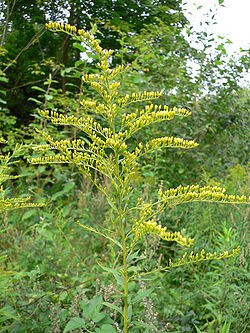
The inflorescences of this species form racemes with tiny yellow flowers.
Inflorescence in bloom

Solidago canadensis, known as Canada goldenrod or Canadian goldenrod, is an herbaceous perennial plant of the family Asteraceae.[2] It forms colonies of upright growing plants, with many small yellow flowers in a branching inflorescence held above the foliage. It is native to northeastern and north-central North America and is an invasive plant in other parts of the continent and several areas worldwide, including Eurasia.

Description

[edit]

Solidago canadensis is a herbaceous perennial plant with stems that grow 2–4 feet (60–120 centimeters) and sometimes to 6 ft (180 cm) tall. It has a wide distribution with several varieties,[3] which have significant variability.[4] The lanceolate to broadly linear shaped leaves are alternately arranged on the stems.[5] The leaves are 4–6 inches (10–15 centimeters) long and 1 in (2.5 cm) wide. The stems have lines of white hairs, while the undersides of the leaves are pubescent. The leaves are often prominently toothed.[6] The flowers have yellow rays and are arranged into small heads on branched pyramidal shaped inflorescences,[7] flowering occurs from July to October.[8] It has a rhizomatous growth habit, which can produce large colonies of clones.[9]

Distribution, habitat and ecology

[edit]

Solidago canadensis is native to northeastern and north-central North America.[10] It is winter hardy in USDA hardiness zones 3–9.[11] It is found in a variety of habitats. It typically is one of the first plants to colonize an area after a disturbance (such as fire) and rarely persists once shrubs and trees become established. It is found in very dry locations (e.g. road sides) and also waterlogged ones (e.g. moist thickets).[12][13]

Canada goldenrod is visited by a wide variety of insects for its pollen and nectar, including bees, wasps, flies, beetles, butterflies, and moths. It is especially strongly favored as a nectar source by bumblebees and paper wasps, such as Polistes parametricus and P. fuscatus.[14][15] Aside from wasps, it is also visited frequently by honeybees and some butterflies, such as monarchs.[15]

Solidago canadensis is sometimes browsed by deer and is good to fair as food for domestic livestock such as cattle or horses.[12]

It can be extremely aggressive and tends to form monocultures and near-monocultures in parts of its native range, such as in southwest Ohio clay loam.[16] It not only seeds a great deal, but also spreads rapidly via running rhizomes. Its root system is very tough, and plants that have been pulled out of the ground prior to freezing and left exposed atop soil have survived winter temperatures down to -26 °C (-14 °F).

Galls

[edit]

Many wasps form parasitic galls inside the stem of goldenrod. There are stem, flower, and bud galls.[17] This species is host to the following insect induced galls:

As an invasive species

[edit]
left
Growing in Japan

It is established as an invasive weed in many parts of Europe, Japan and China.[4][19][20][21]

In eastern and southeastern China, particularly the provinces of Zhejiang, Jiangsu, Jiangxi and Shanghai, its invasion has caused widespread concern. Local news reported that the spread of invasive plants including Canada goldenrod has caused the local extinction of 30 native plants in Shanghai, as of 2004.[22] According to the CCTV program Jiaodian Fangtan [zh], it has reduced orange harvests in Ningbo.[23] It is still spreading across China, and sightings have been reported in as far as Yunnan province.[24] Eradication attempts are still underway as of 2021. Confusion with native Solidago species is a concern.[25]

Use and importance

[edit]

It is grown as an ornamental plant in flower gardens.[26]

It is sometimes blamed for causing hay fever, which is actually caused by simultaneously blooming ragweed plants.[27]

References

[edit]
[edit]
Revisions and contributorsEdit on WikipediaRead on Wikipedia
from Grokipedia
Solidago canadensis, commonly known as Canada goldenrod, is a rhizomatous in the family, characterized by erect stems reaching 0.5 to 2 meters in height, lanceolate serrate leaves 5 to 15 cm long, and dense clusters of small yellow flower heads that bloom from to . It reproduces both vegetatively through rhizomes 5 to 12 cm long and by wind-dispersed seeds, forming extensive clonal colonies, and is primarily pollinated by while being self-incompatible. Native to , S. canadensis is widely distributed across most of the (except Hawaii, , , Georgia, , and ) and most of (except ), thriving in diverse habitats such as open meadows, prairies, roadsides, disturbed areas, abandoned farmlands, and moist woodlands. It prefers full sun and well-drained, moist soils but tolerates a range of conditions, avoiding extremely dry or waterlogged sites, and acts as an early successional that colonizes post-disturbance environments like those following fire or clearing. Ecologically, S. canadensis plays a notable role as a late-season and source for pollinators including honeybees and other , supports wildlife through its seeds for birds like goldfinches, though it exhibits allelopathic properties that can inhibit the growth of nearby like sugar maple seedlings. The species has been introduced and become invasive in parts of and , where it outcompetes native flora in unmanaged areas, and it has traditional uses in for urinary and inflammatory conditions and as a , but is rarely planted ornamentally due to its aggressive spreading.

Taxonomy

Classification

Solidago canadensis is classified within the kingdom , phylum Tracheophyta (vascular ), class Magnoliopsida (dicotyledons), order , family (the daisy family), genus (goldenrods), and S. canadensis. The genus comprises approximately 100-120 , most of which are native to . S. canadensis is one of over 100 in this genus, distinguished by its rhizomatous growth and structure; its closest relatives include S. altissima and S. gigantea, with which it forms part of the "Canada goldenrod complex" due to morphological similarities and overlapping ranges. Historical synonyms for S. canadensis include Aster canadensis L. and Doria canadensis (L.) Lunell, reflecting taxonomic reclassifications from earlier systems that placed it in different genera before its stabilization in Solidago. The of S. canadensis is secure, with a NatureServe global rank of G5, indicating it is not threatened in its native range but is monitored for invasive potential in introduced regions.

Etymology and synonyms

The genus name Solidago derives from the Latin verb solidare, meaning "to make whole" or "to consolidate," alluding to the plant's historical use in folk medicine for healing wounds and staunching blood. The specific epithet canadensis is New Latin for "of ," reflecting the species' prominence in the flora of and the where it was first documented. Linnaeus formally described the species as Solidago canadensis in his in 1753, based on specimens from . Common names for Solidago canadensis include Canada goldenrod and Canadian goldenrod in English, with regional variants such as meadow goldenrod, common goldenrod, tall goldenrod, and giant goldenrod. In French, it is known as verge d'or du Canada, translating to "Canada's golden rod," a name shared with other goldenrods in Francophone regions. Historically, Solidago canadensis has been known under several synonyms, particularly as classifications evolved in the 18th and 19th centuries. Prior to Linnaean standardization, it was sometimes classified under the genus Aster as Aster canadensis (L.) Kuntze, reflecting broader circumscriptions of that genus before the separation of goldenrods into Solidago. Other heterotypic synonyms include Doria canadensis (L.) Lunell and Solidago salebrosa Piper, the latter a rough-stemmed variant from early 20th-century American floras that is now often treated as the distinct species Solidago altissima L. These nomenclatural shifts arose from 19th-century botanical surveys, such as those by Asa Gray and others, which refined distinctions within the Solidago canadensis complex based on morphology and geography.

Varieties

Solidago canadensis exhibits significant intraspecific variation, leading to the recognition of multiple varieties, though taxonomic treatments differ across authorities. The of recognizes two varieties based on stem pubescence and subtle leaf differences: var. canadensis, characterized by mid to proximal stems that are glabrous or sparsely hairy, with narrowly ovate-lanceolate leaves measuring 50–190 × 5–30 mm and serrate margins; and var. hargeri, distinguished by moderately hairy mid to proximal stems, with similarly shaped but slightly broader leaves. These varieties often overlap in range and can be challenging to distinguish morphologically. Historically, up to 14 varieties have been proposed for S. canadensis, reflecting high variability driven by and hybridization, which contribute to diverse cytotypes ranging from diploid (2n=18) to hexaploid forms. Genetic studies in the , including cytogeographic analyses, confirm predominantly diploid populations for var. canadensis and var. hargeri, with variation suggesting some variants warrant species-level distinction; for instance, var. salebrosa (a western form with rougher stems), now often treated as Solidago lepida var. salebrosa due to genetic and morphological divergence in the S. canadensis complex, distinct from the eastern rough-stemmed S. altissima. Recent studies (as of ) highlight and morphological variation leading to ongoing taxonomic debates, such as proposals to treat broader elements of the complex under S. lepida. Distributionally, var. canadensis predominates in the northeastern United States and , var. hargeri occurs in coastal and mid-Atlantic regions, and overlaps with hybrids are common in the area. As of 2024, and the Flora of North America emphasize limited varietal recognition, prioritizing ecological adaptations over strict taxonomic separation amid ongoing debates.

Description

Morphology

Solidago canadensis is an herbaceous, rhizomatous that typically grows to heights of 30–150 cm, though it can reach up to 200 cm under optimal conditions, forming dense clonal colonies via creeping 5–12 cm deep. The plant produces 1–20+ erect stems per rhizome, which are glabrate or sparsely strigose-villous proximally and more densely hairy distally, often appearing green to reddish in color. Leaves are alternate along the stems, with basal leaves absent and proximal to mid-cauline leaves narrowly ovate-lanceolate, measuring 50–190 mm long by 5–30 mm wide, featuring sharply serrate margins, three prominent nerves, and acuminate tips; they are glabrous or sparsely hairy abaxially and slightly scabrous adaxially. Mid- to distal leaves are smaller, 30–120 mm long by 8–12 mm wide, often serrulate or entire, and sessile or with short petioles, decreasing in size upward along the stem. The is a terminal, pyramidal 20–60 cm long, comprising 150–1300+ secund heads arranged on divergent, recurved, hairy branches. Each head is 3–5 mm across, with 8–14 ray florets having laminae 0.5–1.5 mm long by 0.15–0.5 mm wide, and 3–6 disc florets with corollas 2.2–3 mm long; flowering occurs from to October. Fruits are narrowly obconic achenes, 1–1.5 mm long, ribbed and sparsely strigose, topped by a white pappus of 1.8–2.2 mm for wind dispersal, while the consists of fibrous roots supported by extensive rhizomes that facilitate vegetative spread. Morphological variability includes greater heights in moist soils compared to drier conditions, with a 2022 survey reporting average heights of approximately 168 cm in heavily invaded stands and noting as a key identifying trait distinguishing it from similar .

Reproduction

Solidago canadensis employs both sexual and asexual reproductive strategies, enabling its persistence and spread as a perennial herb. Sexual reproduction primarily occurs through the production of numerous small achenes equipped with a pappus, which facilitates wind dispersal. A single plant can produce up to 20,000 seeds annually, contributing to its potential for long-distance colonization. The species is self-incompatible, requiring cross-pollination by insects such as bees and flies to ensure fertilization, with flowers blooming from late summer to fall to align with pollinator activity. Seed germination is optimal under light exposure and in disturbed or bare soils, where competition is low and conditions favor establishment, though viability typically ranges from 40-90% depending on storage and environmental factors. Asexual reproduction dominates local population expansion and is achieved mainly through rhizomes, which produce new vegetative shoots annually from . These rhizomes allow the formation of dense clonal colonies that can persist for decades, with vegetative spread rates reaching 2-4 meters per year in favorable habitats through ramet and patch expansion. This mode of propagation ensures rapid colonization of available space without reliance on pollinators or . The life cycle of S. canadensis is that of a rhizomatous , with overwintering buds on rhizomes surviving harsh conditions to produce basal rosettes in the first year. Flowering and production typically commence in the second year or later, as mature and allocate resources to reproduction. The species exhibits , with numbers of 2n=18 (diploid), 36 (tetraploid), and 54 (hexaploid) across populations, which enhances and adaptability to diverse environments. Reproductive success is influenced by environmental factors. Recent studies indicate that simulated warming can increase sprouting and overall vegetative growth, potentially exacerbating spread under future warming scenarios by 1-2°C, though effects vary by population origin and availability.

Distribution and habitat

Native range

Solidago canadensis is native to northeastern and north-central , ranging from westward to and , and southward to , though it is absent from , , Georgia, , , and . It occurs throughout all Canadian provinces except . Within its native range, the species thrives in disturbed open areas, including meadows, prairies, roadsides, old fields, pastures, and forest edges, as well as along waterways, ditches, and in open woods. It tolerates a variety of types from clay to sandy, with a preferred range of 5 to 7, and adapts to moist soils of medium texture with moderate , though it avoids waterlogged or extremely dry conditions. The grows best in full sun to partial shade and is hardy in USDA zones 3 through 9. In its native habitats, S. canadensis is common in successional environments, such as abandoned agricultural fields, where it can form dense colonies. The species has been documented since Linnaean times, with its description first published by Carl Linnaeus in 1753, and its native distribution remains stable with no major range contractions reported in recent botanical assessments.

Introduced range

Solidago canadensis was first introduced to in 1645 in as an , with subsequent spread to central and eastern regions including and by the . In , it arrived in around 1930 and in shortly thereafter, also initially for ornamental purposes, while introductions to occurred via similar horticultural pathways in the . Accidental introductions have been documented through contaminated , wool shipments, and , facilitating its establishment beyond intentional plantings. The species now occupies introduced ranges across more than 20 countries, with extensive coverage in , , , and other regions. In , it has become particularly dominant, covering approximately 6.7 million hectares as of recent assessments, primarily in eastern and southeastern provinces. Its rapid dispersal is driven by prolific seed production—up to 10,000 per annually, dispersed by —and vegetative spread via rhizomes extending up to 1 meter per year, enabling colonization rates of several kilometers annually along linear habitats such as roadsides and riverbanks. Establishment success stems from its high adaptability to disturbed environments, including urban edges, roadsides, abandoned fields, and rural wastelands. Pathways remain a mix of intentional releases in gardens and unintentional transport via global trade, contributing to its status as an listed on the European and Mediterranean Plant Protection Organization (EPPO) A2 alert list since 2004.

Ecology

Interactions with pollinators and herbivores

Solidago canadensis is primarily entomophilous, relying on insect pollinators for reproduction rather than wind dispersal. Its heavy, sticky pollen grains are transported by a variety of insects, including bees such as bumblebees (Bombus spp.) and honeybees (Apis mellifera), like monarchs (Danaus plexippus) and skippers, as well as wasps and other . This adaptation debunks the common myth associating the plant with hay fever, as its pollen does not become airborne like that of anemophilous species such as (Ambrosia spp.). The plant forms mutualistic relationships with pollinators by serving as a significant late-season source, particularly beneficial when other floral resources are scarce. In its native North American range, S. canadensis supports over 100 of , including specialist bees and a diversity of moths and that rely on it for and . Regarding herbivory, S. canadensis is browsed by (Odocoileus virginianus) and rabbits (Sylvilagus floridanus), though it is considered only fair forage for livestock such as and sheep. The seeds provide a valuable food source for birds, including American goldfinches (Spinus tristis) and house finches (Haemorhous mexicanus). In introduced ranges, S. canadensis experiences fewer specialist pollinators and herbivores compared to its native range, contributing to the enemy release hypothesis that facilitates its invasiveness. Studies indicate lower pollinator diversity and abundance in invaded sites, with reduced visitation to native plants by bees and hoverflies.

Galls and parasitoids

Solidago canadensis hosts several types of induced by , primarily on stems, buds, and flowers. Stem include ball-shaped structures formed by larvae of the tephritid Eurosta solidaginis, which create spherical swellings up to 5 cm in diameter, and elliptical induced by the gelechiid moth Gnorimoschema gallaesolidaginis or the cecidomyiid Rhopalomyia solidaginis, resulting in elongated distortions. Bud and flower are produced by other cecidomyiid midges, such as species in the Rhopalomyia, which cause bunch-like rosette formations at shoot tips. In native populations, gall incidence typically ranges from 10% to 38% of stems, varying with local conditions like patch connectivity. The primary inducers follow distinct life cycles synchronized with the host plant. Adult Eurosta solidaginis emerge in spring and females oviposit into young, actively growing stems of S. canadensis; the hatching larvae burrow inward, secreting chemicals that stimulate and form protective over summer, reaching 2-5 cm in size by late season. Larvae overwinter within the gall, pupate in spring, and adults emerge to restart the cycle; these galls enhance larval survival against environmental stresses but limit plant . Similarly, Rhopalomyia solidaginis is bivoltine, with spring and summer generations inducing different gall forms—stem swellings or bud rosettes—where larvae feed on modified plant tissues before pupating. Galls on S. canadensis serve as microhabitats attracting numerous natural enemies, with over 20 arthropod species documented as parasitoids, inquilines, or predators across the community. Key parasitoids include the eulophid wasps Eurytoma gigantea and Eurytoma obtusiventris, which oviposit through the gall wall to target Eurosta larvae, often achieving 20-50% attack rates; E. gigantea favors small galls, while E. obtusiventris attacks early instars. Predators such as downy woodpeckers (Dryobates pubescens) peck open larger galls to consume larvae, exerting size-selective pressure. A 2024 study across urban gradients in the Greater Toronto Area found lower overall predation and parasitism rates in urban sites compared to rural ones, linked to reduced bird activity and habitat fragmentation, with attack frequencies varying by neighborhood socioeconomic factors. Gall formation diverts plant resources, reducing size and output, with variable effects on vegetative growth depending on type (e.g., ball show no significant impact on stem height or lateral branching, while elliptical reduce height but increase branching). However, attacked ramets show increased stem production in subsequent seasons, potentially enhancing clonal via despite short-term reductions in biomass. These dynamics make the -Eurosta system a longstanding model for studying tri-trophic interactions, host manipulation, and , as explored in foundational 1980s research by Weis, Abrahamson, and colleagues.

Invasiveness

Ecological impacts

Solidago canadensis invasions often lead to by outcompeting native plants through rapid growth and allelopathic effects, resulting in reduced plant richness and community stability, particularly in subtropical coastal forests of . In approximately 44% of invaded sites, the species decreases native , with effects influenced by factors such as , microbes, and native community evenness. Allelopathic compounds from S. canadensis inhibit seed germination and early growth of native , further suppressing and contributing to monospecific stands. communities experience indirect negative impacts, with lower abundances of detritivores and predators due to reduced subdominant plant under S. canadensis dominance. The invader alters properties through root exudates and litter leachates, modifying microbial communities by shifting bacterial genera such as increasing and Acidobacteriales while correlating rarer genera with elevated nitrogen, pH, and . decomposition of S. canadensis proceeds faster in the presence of diverse fungal morphotypes and orders like Orbiliales and Mortierellales, achieving up to 41% mass loss over six months compared to lower rates with fewer fungi, thereby accelerating release in invaded meadows. These changes, including enhanced accumulation and cycling rates via increased aboveground productivity, disrupt dynamics and favor further . Recent studies as of 2025 indicate that co-invasions with other alien plants exacerbate in European grasslands. Regarding ecosystem services, S. canadensis provides nectar resources that benefit some generalist in disturbed invaded areas, potentially increasing seed production by up to 35% through larger pollinator visits, though this often comes at the expense of native pollinator diversity and abundance. Overall, impacts remain predominantly negative, as the species alters nutrient cycling and reduces native resistance. In introduced ranges like and , invasions are intensified by the enemy release hypothesis, where reduced herbivory and pressure enhances competitive ability. Shading further weakens native plant resistance to S. canadensis, particularly at low to moderate invasion levels, by decreasing native biomass and increasing the invader's relative dominance in and understories.

Control methods

Mechanical control methods for Solidago canadensis primarily involve mowing or cutting to deplete reserves and prevent production. Repeated mowing, particularly two to three times per before set, can reduce aboveground by 58-77% and overall stand density by up to 68%. Digging out s is effective for eradicating small infestations, as complete removal of the extensive underground network prevents regrowth, though this approach is highly labor-intensive and impractical for larger areas. Chemical control relies heavily on foliar applications of , which exhibits 80-90% efficacy in reducing plant cover and biomass when applied during active growth stages. A 2024 field study demonstrated that winter applications of on the photosynthetically active green leaves of S. canadensis achieve up to 95% mortality, offering greater selectivity over due to phenological differences that limit native plant exposure. Broadleaf herbicides should be avoided in areas with desirable to minimize non-target damage. Biological control options remain limited but promising, drawing from natural enemies in the native range such as stem-boring flies (e.g., Eurosta solidaginis) that damage stems and reduce vigor. Fungal isolates like Sclerotium rolfsii SC64, when combined with mechanical methods, can kill over 90% of ramets. Competitive planting with species like Sorghum bicolor suppresses S. canadensis biomass by up to 80% through allelopathic root exudates, particularly under low to medium invasion levels in nitrogen-variable conditions, as shown in a 2024 trial. by goats has been used to browse and weaken stands in pastoral settings, though it requires targeted to avoid . Integrated management combines these approaches for optimal results, such as pairing mowing with applications or competitive planting to enhance long-term suppression while restoring native . Monitoring invasion spread via technologies, including UAV-based and , enables early detection and targeted interventions. S. canadensis is regulated as an in several member states, prohibiting its sale, transport, and planting (e.g., in since 2016), under national implementations of the Invasive Alien Species framework.

Uses and cultivation

Ornamental and horticultural applications

Solidago canadensis is valued in ornamental gardening for its late-season display of bright yellow blooms, which add vibrant color to borders, wildflower meadows, and naturalized areas from late summer into fall. The plume-like flower clusters serve well as cut flowers in arrangements, providing long-lasting accents, and the plant attracts pollinators such as bees and butterflies, enhancing garden biodiversity. While the species itself is often used in informal settings due to its vigorous growth, select cultivars offer more compact forms suitable for structured landscapes. Cultivation of S. canadensis requires full sun exposure for optimal blooming, though it tolerates partial shade, and well-drained soils ranging from sandy to loamy, with adaptability to average or poor conditions. It thrives in USDA hardiness zones 3 to 9, where it grows 1 to 6 feet tall, and plants should be spaced 18 to 24 inches (45 to 60 cm) apart to allow for air circulation and prevent overcrowding. Once established, the demonstrates strong , requiring minimal supplemental watering except in extreme dry periods. A 2025 study on found that supplementation with essential oils like neem at 400 mg L⁻¹ extended life to up to 22 days, compared to 9–10 days in controls, by reducing microbial growth and improving water uptake. Propagation is straightforward and can be achieved through , which benefit from 30 days of cold stratification at 4 °C before surface in spring; division of rhizomes in early spring or fall; or basal stem cuttings taken in early , which root easily in moist medium. These methods allow gardeners to expand plantings efficiently in suitable sites. Despite its ornamental appeal, S. canadensis spreads aggressively via rhizomes, potentially becoming weedy in manicured gardens, so it is best suited to contained areas like meadows or large borders where is desired. For controlled growth in smaller spaces, gardeners are advised to select sterile hybrid cultivars of related species, which maintain the aesthetic benefits without prolific seeding or spreading.

Medicinal and ecological uses

Solidago canadensis, commonly known as Canadian , has been employed in primarily for its properties, helping to alleviate urinary tract infections by increasing urine flow and flushing the system. It is also used as an agent to treat conditions such as and , reducing joint pain and swelling. For , preparations like teas or poultices made from the leaves and flowers have been applied topically to promote tissue repair and soothe minor injuries. The German Commission E has approved the use of goldenrod herb for supportive in inflammatory diseases of the lower urinary tract, including and disorders. A 2022 study demonstrated the hepatorenal protective effects of hydroalcoholic extract from S. canadensis against paracetamol-induced toxicity in mice, suggesting potential benefits for liver and health. The aerial parts of the plant, harvested during the flowering stage, are the primary material used in medicinal preparations such as teas, tinctures, and extracts. These contain active compounds including like , which contribute to the plant's , , and effects. Historically, the flowers and leaves of S. canadensis have been used to produce dyes for textiles. Ecologically, S. canadensis serves as a vital habitat for pollinators, providing essential late-season nectar and pollen that supports bees, butterflies, and other insects when few other flowers are available. In native ranges, its extensive root systems aid in erosion control, stabilizing soil in meadows and disturbed areas. Contrary to common misconceptions, S. canadensis does not cause hay fever, as it is insect-pollinated with heavy, sticky pollen that does not travel by wind. Recent studies, including those from 2023, highlight its promotion in native restoration projects for creating pollinator-friendly meadows and enhancing biodiversity. S. canadensis is generally considered safe for most adults when used appropriately, but it should be avoided during due to insufficient safety data. Individuals sensitive to plants in the family may experience allergic reactions, though such cases are rare.

References

Add your contribution
Related Hubs
User Avatar
No comments yet.