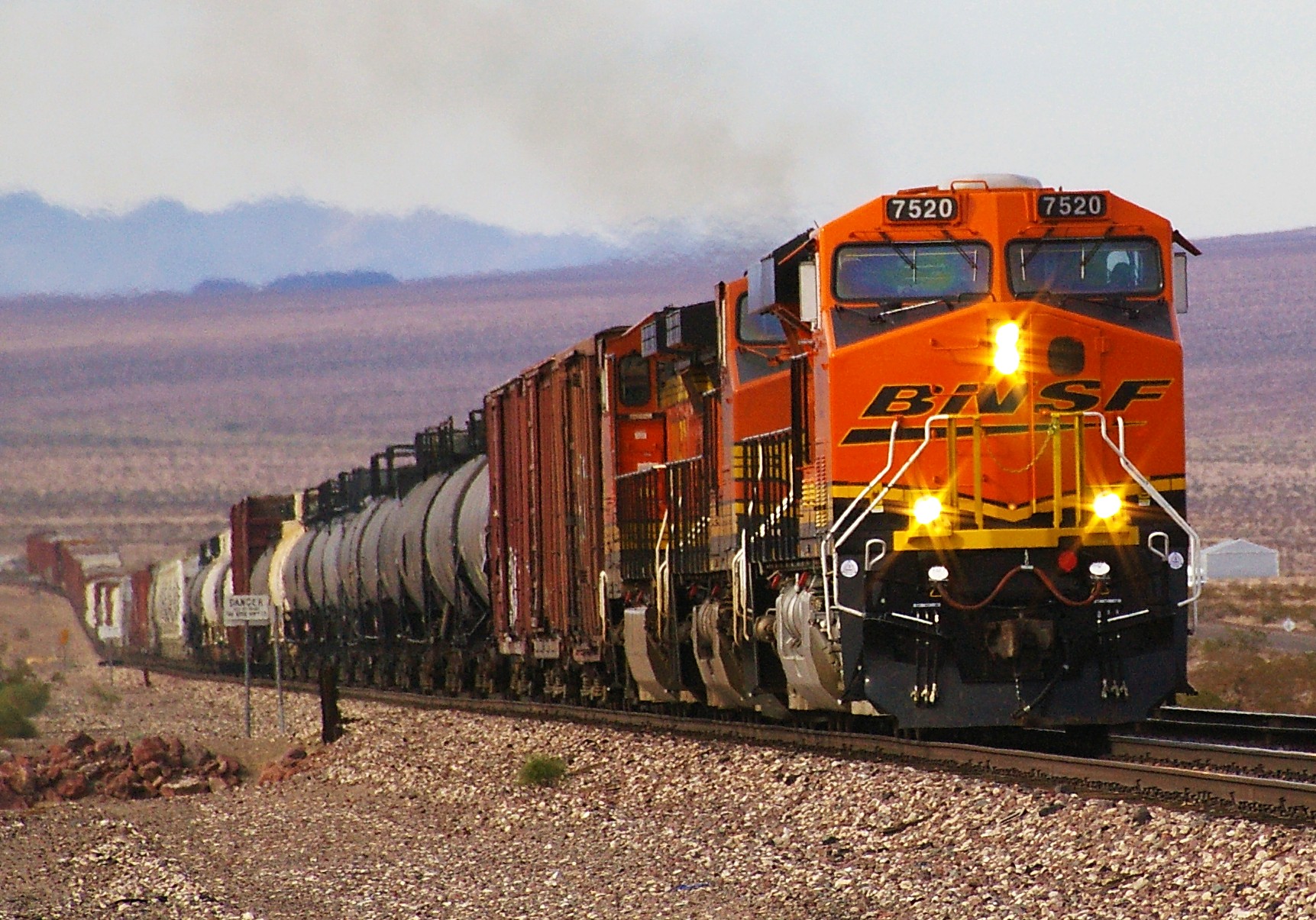
The Transcon is one of the most heavily trafficked rail corridors in the western United States: as of 2006[update], an average of almost 90 trains daily (over 100 trains on peak days) passed over the section between Belen and Clovis, New Mexico, with each train typically 6,000 to 8,000 feet (1,800 to 2,400 m) long.[1]
The route was less than ideal, especially where it crossed Raton Pass and Glorieta Pass. The steep grades posed operational problems, including congestion, slow speeds, and the need for helper engines. As an interim solution, a second track, with a longer tunnel, was opened at Raton in 1908, but this simply added capacity, and the grades remained. In 1902 the Santa Fe began surveying a new cutoff that would bypass this segment entirely.
To complete the line between Texico and a point northwest of Belen, New Mexico, the Santa Fe incorporated the Eastern Railway of New Mexico in October 1902, and began construction of the Belen Cutoff the next January. The entire line was completed on July 1, 1908, allowing through freight trains to bypass the 3–3.5% grades of the old line for the maximum grade of 1.25% (at Abo Canyon) on the new line. (Most passenger trains continued to use Raton Pass so as to serve Colorado.) The Pecos Valley and Northeastern (but not its Texas subsidiaries, because of Article X of the Texas Constitution) was consolidated into the Eastern in March 1907, and in January 1912, the property of the Eastern was conveyed to the Santa Fe.[4]
To connect central Texas to this line, the Pecos and Northern Texas Railway completed the Coleman Cutoff, running southeast from Texico to the Santa Fe subsidiary Gulf, Colorado and Santa Fe Railway at Coleman, in 1914. A third line was almost completed in the 1920s and 1930s, when the Santa Fe built the majority of the planned Dodge City– Colmor, NM (Colmor Cutoff), which would provide a second bypass of Raton (but not Glorieta), but construction stopped at Farley, and the line was torn up west of Boise City in 1942.[5]: 18–31
The completion of the Belen Cutoff did not end improvements to the transcontinental route. The 47-mile (76 km) Ellinor Cutoff opened in 1924, cutting through the Flint Hills from the original main line at Ellinor, Kansas, southwest to El Dorado on the main line to Texas. This allowed trains bound for the Belen Cutoff to cut directly to Mulvane, bypassing Wichita to the southeast.[5]: 36–37 To the west, in Arizona, the Santa Fe constructed a new line between Williams and Crookton, bypassing the sharp curves and steep grades of the line via Ash Fork built by the Atlantic and Pacific Railroad in the 1880s.[4] The $19.3-million realignment opened on December 19, 1960, and the old line was abandoned west of the Phoenix connection at Ash Fork.[5]: 53 Smaller improvements included installation of centralized traffic control on the Belen Cutoff in the 1940s.[5]: 29 Also, by October 2018, the entire Southern Transcon was double-tracked, except for two bridges: over the Missouri River at Sibley, Missouri, and crossing the Salt Fork Arkansas River at Alva, Oklahoma.[6]
Projects were underway to add triple- and even quadruple-track along the busiest parts.[7][8]
The Southern Transcon railroad corridor is made up of the following BNSF rail lines which are referred to as subdivisions, in order from west to east.[9]
Parts of the route are utilized by passenger rail services — BNSF does not operate regular passenger trains outside of the Chicago Subdivision.
Amtrak's Southwest Chief runs once daily in each direction on the Transcon, but via the Glorieta, Raton, La Junta Subdivision and Topeka between Albuquerque and Kansas City. The Pacific Surfliner also operates between Los Angeles and Fullerton. Until its cancellation in 1997, Amtrak's Desert Wind used the Southern Transcon between Los Angeles and Barstow. The proposed Coachella Valley Rail train from RCTC, which is anticipated to be operated by Amtrak, would initially run two roundtrips a day over the Transcon from LA Union Station to the Colton Crossing.
The Southern Transcon is a principal mainline corridor of the BNSF Railway, extending approximately 2,200 miles from Southern California, near Los Angeles, to Chicago, Illinois, and consisting of 11 operational subdivisions that traverse California, Arizona, New Mexico, Texas, Oklahoma, Kansas, Missouri, Iowa, and Illinois.[1][2][3] This route, nearly entirely double-tracked with recent expansions to triple and quadruple tracks in key sections, functions as the backbone for BNSF's intermodal operations, handling high-priority container and trailer shipments that account for about one-third of North America's intermodal volume.[1][4]Historically, the Southern Transcon originated in the 1880s under the Atchison, Topeka and Santa Fe Railway (AT&SF), which constructed the line as a key east-west artery across the American Southwest, with significant enhancements like the 1908 Belen Cutoff in New Mexico to avoid the steep grades of Raton Pass.[1] Following the 1995 merger that formed BNSF from the AT&SF and Burlington Northern, the route has undergone multibillion-dollar investments, including over $1 billion in 2018 alone for capacity expansions, to support surging freight demands.[1][3] As of 2018, it sustained around 300 trains in motion at any time, equivalent to the freight of 280 trucks per train, underscoring its role as one of the busiest and most efficient rail lines in the United States.[1][5]Beyond freight, the corridor holds potential for sustainable initiatives, passing through regions rich in solar and wind energy resources, as identified by the National Renewable Energy Laboratory, which could integrate renewable power generation along its right-of-way to reduce emissions and enhance grid reliability.[2] The completion of double-tracking on the Emporia Subdivision in Kansas on November 18, 2024, has eliminated most single-track segments, leaving only short portions near major bridges (1.5 miles at Sibley, Missouri, and 3 miles at Alva, Oklahoma), thereby boosting reliability for intermodal services connecting West Coast ports to Midwest hubs.[4][6]
Route Overview
Description and Significance
The Southern Transcon is a major mainline route of the BNSF Railway, spanning approximately 2,200 miles (3,540 km) from San Bernardino in Southern California to Chicago, Illinois.[1][7] This corridor serves as BNSF's primary east-west artery, traversing nine states: California, Arizona, New Mexico, Texas, Oklahoma, Kansas, Missouri, Iowa, and Illinois.[2] Originally developed as part of the Atchison, Topeka and Santa Fe Railway network in the late 19th century, it has evolved into a critical infrastructure for modern freight transport.[1]As the backbone of intermodal freight operations on BNSF's network, the Southern Transcon handles more than 200 trains daily, facilitating the efficient movement of containers and trailers between Pacific Coast ports and Midwestern markets.[8] It accounts for about 70% of BNSF's intermodal volume, underscoring its economic significance in connecting global trade hubs like the Ports of Los Angeles and Long Beach to industrial centers in the Midwest and beyond.[9] Recent infrastructure upgrades, including expanded double-tracking completed in 2024, have increased the route's overall train capacity by roughly 30%, enhancing reliability and throughput for this high-volume corridor.[9][10] The completion of double-tracking on the Emporia Subdivision in November 2024 marked the achievement of nearly full double-tracking along the route, except for short portions near major bridges.[4]Technically, the route is now nearly entirely double-tracked throughout its length, except for short portions near major bridges, with select segments featuring triple or quadruple tracks to accommodate surging demand.[5] Operations rely on diesel-powered locomotives, reflecting the standard for U.S. freight rail without widespread electrification.[11] This configuration supports high-speed, reliable service, positioning the Southern Transcon as one of North America's busiest rail lines.[1]
Constituent Subdivisions
The Southern Transcon route is segmented into 11 operational subdivisions managed by the BNSF Railway, each handling distinct geographic stretches from Southern California eastward to Illinois. These subdivisions facilitate the continuous flow of freight across diverse terrains, with key junctions enabling interchanges and yard operations. The following table summarizes their names, spanning states, approximate lengths, primary endpoints, notable terrain challenges, and major junction points, based on rail infrastructure data.
Subdivision
States
Length (miles)
Endpoints
Terrain Challenges
Key Junctions/Interchanges
San Bernardino
CA
68
San Bernardino to Barstow Yard
Urban congestion transitioning to desert foothills; mild grades under 0.5%.
Barstow Yard for maintenance and crew changes.
Needles
CA-AZ
186
Barstow to Needles
Arid Mojave Desert with extreme heat causing rail expansion; sparse water sources and sand drift.
Barstow Yard (west); Arizona state line near Topock (east).[12]
Seligman
AZ
300
Needles to Winslow
High desert plateaus and canyons; elevations up to 7,300 ft near Flagstaff with steep grades and wind exposure.
Kingman for regional connections; Williams Junction for Phoenix Subdivision access.[13]
Gallup
NM-AZ
309
Winslow to Albuquerque
Mesas, arroyos, and semi-arid scrubland; occasional flash flood risks in washes.
Gallup Yard for crew changes; Albuquerque for major intermodal hub.[13]
Belen
NM
206
Albuquerque to Clovis
Flat desert valleys with low vegetation; dust storms and alkali flats affecting visibility.
Belen Cutoff origin, bypassing Raton Pass (7,834 ft elevation historically); Clovis for Texas state line interchange.[14]
Clovis
NM-TX
192
Clovis to Amarillo
Transition to high plains with short grasses; minimal grades but occasional severe weather like thunderstorms.
Clovis Yard for district boundary; Amarillo for Panhandle connections.[14]
Panhandle
TX-OK-KS
210
Amarillo to Liberal
Vast open prairies with expansive views; wind erosion and tornado risks in spring.
Amarillo Yard, a major classification facility; Oklahoma state line near Texola; Kansas state line near Liberal.
Hutchinson
KS
140
Liberal to Hutchinson
Rolling Great Plains with wheat fields; frost heaves in winter and soil subsidence.
Flat to gently undulating farmlands; flooding potential from Missouri River tributaries.
Emporia Junction for northern branches; Kansas City intermodal terminal.[4]
La Plata
MO-IA
220
Kansas City to Ottumwa
Midwest prairies with corn and soy crops; heavy snow and ice in winter impacting traction.
La Plata for crew base; Iowa state line near Birmingham.[15]
Galesburg
IA-IL
150
Ottumwa to Galesburg
Level agricultural lowlands; high humidity and agricultural debris on tracks.
Galesburg Yard for sorting; connection to Chicago mainlines.[15]
These subdivisions collectively span approximately 2,200 miles, with double-tracking predominant to support high-volume freight movement. Terrain varies from the water-scarce deserts of the West, where aridity demands specialized maintenance to prevent track distortion, to the expansive flatlands of the central U.S., which allow higher speeds but introduce weather-related vulnerabilities like blizzards or droughts. Junctions such as Barstow and Albuquerque serve as critical nodes for integrating with ancillary lines, enhancing the route's connectivity without delving into operational metrics.[2]
Historical Development
Origins and Early Construction
The origins of the Southern Transcon trace back to the mid-19th century, when the Atchison, Topeka and Santa Fe Railway (AT&SF) was chartered on February 11, 1859, to connect Atchison, Kansas, with Santa Fe, New Mexico, as part of broader ambitions to establish a transcontinental rail link to the Pacific Coast.[16] Construction commenced on October 30, 1868, in Topeka, Kansas, under the direction of Chief Engineer Thomas J. Peter, with initial segments reaching Emporia by 1870 and extending westward through Kansas to the Colorado state line by December 1872.[16] By the 1880s, these efforts intensified amid competition with other railroads like the Union Pacific and Southern Pacific, driving the AT&SF to push toward California while integrating supporting lines to form a cohesive network.[17]Phased construction unfolded rapidly in the 1880s, beginning with the Chicago-to-Kansas City segment, which opened on April 29, 1888, via the Chicago, Santa Fe & California Railway, providing direct eastern access to the AT&SF mainline.[16] In California, extensions advanced through the California Southern Railroad, a AT&SF-backed subsidiary formed in 1880, which completed the line from National City to San Bernardino by September 1883 and drove the final spike in Cajon Pass on November 9, 1885, linking to the eastbound Atlantic & Pacific Railroad at Barstow.[18] Further progress included the San Bernardino-to-Los Angeles line finished in May 1887 and the "Surf Line" from San Diego to Los Angeles opened on August 12, 1888.[16] In the Southwest, lines through Arizona and New Mexico progressed via the Raton Pass, where construction began in February 1878 and reached Albuquerque by April 1880, followed by extensions to Deming, New Mexico, and connections with the Southern Pacific on March 8, 1881.[16] These phases culminated in the full through route from Chicago to California by 1888, with subsequent integrations of predecessor lines like the Chicago, Santa Fe & California Railway solidifying the network by 1908.[19]Early construction faced significant challenges, including rugged terrain in mountain passes like Raton, where steep grades exceeding 3% required extensive grading and tunneling, and desert crossings in Arizona and California's Mojave region, which demanded innovative water supply solutions amid arid conditions.[16] Financial strains and competitive pressures from the Southern Pacific, including discriminatory routing practices, further complicated progress, yet the AT&SF overcame these to establish operational viability.[17]Upon completion, the route quickly assumed a vital role in both freight and passenger services, hauling cattle, grain, and goods as precursors to modern intermodal transport while fostering economic growth in the Southwest.[16]Passenger operations highlighted luxury travel with the introduction of the California Limited on November 27, 1892, a premier all-Pullman train from Chicago to Los Angeles that underscored the line's prestige and spurred tourism and migration.[16]
Key Engineering Improvements
The Belen Cutoff, completed in 1908 by the Atchison, Topeka and Santa Fe Railway, fundamentally transformed the Southern Transcon by rerouting the line across the plains of eastern New Mexico, bypassing the steep Raton and Glorieta passes to the north. This 259-mile segment from near Texico to Belen featured a ruling grade of 0.6 percent, with maximum grades reaching only 1.25 percent in Abo Canyon, a sharp reduction from the original route's average of about 3 percent (158 feet per mile). While the overall Chicago-to-Los Angeles distance was shortened by just six miles, the lower grades enabled faster train speeds and greater efficiency, saving several hours on transcontinental runs. Construction through the rugged Abo Canyon required seven bridges spanning the Abo River, with spans up to 500 feet long and piers as high as 135 feet, facilitating smoother passage without extensive tunneling.[20][21][22]Subsequent pre-1950s improvements further straightened and optimized the route. The Ellinor Cutoff, opened in 1924 in central Kansas, comprised a 47-mile realignment that eliminated hilly terrain and curves between Ellinor and connections near Bazar, enhancing alignment for higher speeds. In Arizona, the Santa Fe completed the 44-mile Crookton Cutoff in 1960 from Williams to Crookton, bypassing the original Peavine route's loops and steep grades to reduce curvature and elevation changes.[23] These efforts collectively minimized operational delays and improved freight handling on the transcontinental corridor.[24]Mid-20th-century double-tracking initiatives responded to surging wartime freight demands during the 1940s and continued into the 1960s, with partial implementations adding capacity along key stretches of the Southern Transcon. For instance, sections from Belen westward to San Bernardino were double-tracked by the late 1920s and expanded during World War II to accommodate military cargo and postwar growth, allowing bidirectional traffic without frequent meets on sidings. These upgrades, often combined with extended passing tracks, boosted throughput amid rising intermodal and bulk shipments.[25]The 1995 merger forming BNSF Railway (effective operations in 1996) from the Atchison, Topeka and Santa Fe and Burlington Northern prompted initial post-merger signaling upgrades on the Southern Transcon to integrate disparate systems and enhance reliability. These included modernization of block signals and interlockings to standardize operations across the unified network, reducing delays at junctions and supporting increased traffic volumes.[26]Pre-2000 capacity projects featured the progressive installation of Centralized Traffic Control (CTC) along the route during the 1970s and 1980s, building on earlier implementations from the 1930s. CTC allowed dispatchers to remotely control signals and switches over long distances, such as the 110-mile segment between Waynoka, Oklahoma, and Canadian, Texas, which was upgraded in phases to enable more fluid train dispatching and higher densities without manned towers. By the late 1980s, much of the transcon benefited from this technology, marking a shift toward automated management that bridged historical engineering to contemporary operations.[27]
Freight Operations
Traffic and Capacity
The Southern Transcon primarily handles intermodal freight, with containers and trailers originating from West Coast ports such as Los Angeles and Long Beach destined for Chicago-area hubs, handling approximately 70% of BNSF's intermodal volume.[9] This dominance of trailer-on-flatcar (TOFC) and container-on-flatcar (COFC) movements reflects the corridor's role as a key artery for international trade goods, including consumer products, electronics, and apparel imported via the San Pedro Bay port complex.[1]In 2024, BNSF moved 5.3 million intermodal units systemwide, with the Southern Transcon handling approximately 70% of this volume.[10][9] Daily operations typically involve 80 to 100 trains, with segments like the Belen yard in New Mexico handling up to 80 trains per day for crew changes, inspections, and fueling.[28] Train types include priority intermodal Z-trains for time-sensitive shipments, alongside merchandise trains carrying commodities such as automobiles, grain, and coal in specific subdivisions.[29]Operations are managed through 24/7 dispatching from BNSF's National Operations Center in Fort Worth, Texas, enabling coordinated flow across the 2,200-mile corridor.[30] Average freight train speeds range from 40 to 50 miles per hour, optimized for efficiency on largely double-tracked mainlines that have alleviated prior single-track bottlenecks.[5] The route's capacity underpins a substantial share of the approximately $370 billion in annual cargo value processed at the San Pedro Bay ports (as of 2024), where rail transports roughly 30% of containerized imports.[31]
Recent Infrastructure Upgrades
Since the formation of BNSF in 1996, the railroad has invested billions in capital improvements along the Southern Transcon to enhance capacity and reliability, with a particular emphasis on multi-tracking projects in the 21st century.[32] These efforts, building on initial double-tracking segments completed between 1993 and 1999 totaling over 300 miles, have progressively eliminated bottlenecks and supported growing intermodal traffic.[5] By 2018, BNSF had allocated approximately $1 billion specifically to the route, contributing to broader annual capital expenditures of $3.3 billion that year.[1]Key multi-tracking expansions from 2018 to 2021 included the addition of nearly 10 miles of triple track on the Gallup Subdivision in New Mexico, between Belen and Dalies, to address steep grades and improve fluid operations on this challenging segment.[33] In Kansas, BNSF completed about 50 miles of new double track on the Emporia Subdivision in 2024, marking the final major push to double-track this 134-mile corridor and resolving long-standing single-track limitations that previously constrained train meets.[4] Further advancements came in 2024 with the ongoing Needles Subdivision third main track project in California, adding approximately 30 miles of triple track from Needles to Goffs through the Mojave Desert to alleviate congestion on ascending grades.[34]A significant 2024 initiative was the completion of a multi-year mainline improvement project near Becker, New Mexico, adjacent to the Belen fueling facility—the largest in North America—which introduced a new mainline, extended sidings, and upgraded signaling to increase capacity by 30% in this critical terminal area.[35] Complementing these structural upgrades, BNSF fully implemented Positive Train Control (PTC) across the entire route by late 2018, installing infrastructure on over 11,500 route miles network-wide to enhance safety and prevent collisions, overspeed, and misaligned switches.[36] In the 2020s, additional resilience measures included multiple bridge replacements, such as a 350-foot double-track concretebeam bridge near Fenner, California, completed in February 2025, and two structures on the route managed from 2022 to 2024 using advanced piling techniques to withstand flooding and extreme weather.[37][38] In August 2025, BNSF and CSX announced new intermodal services offering seamless coast-to-coast rail solutions, enhancing connectivity via the Southern Transcon.[39]As of 2025, the Southern Transcon is almost entirely double-, triple-, or quadruple-tracked, achieving near-complete multi-tracking and positioning BNSF to handle over 90 trains daily on key segments like Cajon Pass while supporting overall route growth.[5][40]
The primary Amtrak service utilizing the full length of the Southern Transcon is the daily Southwest Chief, which operates between Chicago Union Station and Los Angeles Union Station over approximately 2,256 miles.[41] This route follows the BNSF Railway's Southern Transcon, including the Belen Cutoff in New Mexico, and maintains a scheduled travel time of about 43 hours, with eastbound Train 4 departing Chicago in the afternoon and arriving in Los Angeles the following evening, and westbound Train 3 following a similar pattern. As of 2025, Amtrak has confirmed no changes to the Southwest Chief's frequency or alignment, despite ongoing discussions of alternative private proposals that do not affect current operations.[42]Regional Amtrak services leverage shorter segments of the Southern Transcon, such as the Heartland Flyer, which provides daily round-trip service between Oklahoma City and Fort Worth, Texas, covering 206 miles on BNSF tracks through central Oklahoma.[43] This route, operational since 1999 and funded jointly by Oklahoma and Texas, connects to the Texas Eagle for broader national linkages but remains a standalone regional offering on the Transcon corridor. Proposed extensions include the Coachella Valley Rail project in California, which aims to introduce new Amtrak service from the Coachella Valley (Indio or Coachella) to Los Angeles Union Station along the desert segment of the Transcon, potentially adding two daily round trips; as of late 2025, the initiative is advancing through environmental reviews and funding pursuits by the Riverside County Transportation Commission, with construction not yet underway.[44]Commuter rail operations on the Southern Transcon are limited but include the Metrolink San Bernardino Line, which operates weekday service with up to 44 trains daily (22 round trips) between Los Angeles Union Station and San Bernardino on BNSF tracks that form part of the Southern Transcon, facilitating commuter travel in the Inland Empire region.[45][46] In New Mexico, the New Mexico Rail Runner Express provides commuter service along the Transcon corridor from Belen to Bernalillo, with 28 weekday trains (14 round trips), connecting Albuquerque to surrounding areas and integrating with Amtrak at Albuquerque Union Station.[47] Potential expansions in New Mexico and Texas include studies for enhanced commuter or regional services on Transcon segments; for instance, New Mexico's 2025 State Rail Plan identifies opportunities for short-haul passenger improvements around Albuquerque, while Texas legislative discussions in 2025 explore extensions of services like the Heartland Flyer to support commuter needs in the Dallas-Fort Worth area.[48][49]Passenger services on the Southern Transcon integrate with dominant freight operations under federal law (49 U.S.C. § 24312), which mandates that Amtrak trains receive preference over freight on shared tracks to minimize delays, enforced through agreements with BNSF that prioritize passenger schedules.[50][51] This results in passenger trains occupying roughly 3-5% of track slots on high-volume segments, where daily traffic exceeds 60 trains, primarily freight, allowing Amtrak to maintain reliability despite the corridor's freight focus.Ridership on the Southwest Chief reached 261,485 passengers in fiscal year 2024 (October 2023–September 2024), reflecting a 3% increase from the prior year and ongoing recovery from COVID-19 impacts that reduced service to minimal levels in 2020.[52] Pre-pandemic figures were higher, with 338,180 riders in fiscal year 2019, indicating potential for further growth as infrastructure upgrades and demand trends support post-recovery expansion.[53]
Historical Passenger Trains
The Atchison, Topeka and Santa Fe Railway (AT&SF) pioneered luxury transcontinental passenger service on the Southern Transcon route with the introduction of the California Limited in 1892, an all-Pullman train offering first-class accommodations exclusively from Chicago to Los Angeles.[54] This heavyweight service emphasized comfort through sleeping cars and dining facilities, establishing the route's reputation for high-end travel that persisted into the mid-20th century.[55] The train operated until 1954, when it was discontinued amid shifting travel preferences.[54]The Super Chief, launched on May 12, 1936, became the AT&SF's flagship streamlined diesel-powered passenger train, renowned for its 39-hour 45-minute schedule between Chicago and Los Angeles.[54] Featuring Native American-themed interiors with exotic woods, a Pleasure Dome observation lounge added in 1951, and Electro-Motive diesel locomotives from E1s to F7s, it symbolized elegance and speed, often called the "Train of the Stars" for carrying Hollywood celebrities.[54] The service ran until April 30, 1971, when operations transferred to Amtrak.[54]Complementing the Super Chief, the El Capitan debuted on February 22, 1938, as the AT&SF's premier all-coach transcontinental train, focusing on affordable yet deluxe seating without sleeping cars.[56] It provided high levels of service, including full-length dome cars introduced in 1954 for panoramic views, and later combined with the Super Chief in the 1960s to optimize resources.[56] Like its sibling, it ended on April 30, 1971.[56]Another notable service was the Grand Canyon Limited, inaugurated in 1901 to connect Chicago with Williams, Arizona, for access to Grand Canyon National Park via a branch line.[57] This train catered to tourists with observation cars and ties to the Fred Harvey Company's hospitality along the route, operating until 1954 when it was absorbed into other services.[57]During the peak era from the 1920s to the 1950s, the AT&SF operated over 10 daily passenger trains on the Southern Transcon, including luxury named services and secondary routes, supported by strong ridership that persisted into the early 1950s.[58] Innovations marked this period, such as the Hi-Level bilevel cars introduced on July 15, 1956, aboard the El Capitan, which included 47 coaches, lounges, and diners built by the Budd Company to enhance capacity and views.[59] These cars, costing $13 million for five full sets, boosted passenger appeal through double-deck design.[59] Additionally, the AT&SF tested experimental technologies like the General Motors Aerotrain prototype in 1956, a gas turbine-powered streamliner trialed on the route to explore faster, lighter rail options.[60]Post-World War II competition from automobiles and airlines led to a sharp decline in AT&SF passenger volumes, prompting the railroad to consolidate services despite its commitment to luxury travel.[61] By the late 1960s, economic pressures forced the end of private operations, with the final AT&SF passenger train departing on April 30, 1971, and services handed to Amtrak the next day.[62]The Super Chief, in particular, left a lasting cultural legacy as a symbol of transcontinental glamour, frequently depicted in 1930s-1950s films, novels, and media as the preferred transport for celebrities and evoking the romance of rail travel across the American Southwest.[63]