Space Shuttle Pathfinder
Main page
2178556

Space Shuttle Pathfinder

logo
Community Hub0 subscribers
Read side by side
from Wikipedia

Pathfinder
Pathfinder at the U.S. Space & Rocket Center in Alabama sits atop MPTA-ET in 2010. The SRB forward assemblies have changed over the years.
TypeSpace Shuttle test simulator
Construction numberOV-098
CountryUnited States
StatusRetired; on display at the U.S. Space & Rocket Center, Huntsville, Alabama
No. of missions6 tests

The Space Shuttle Pathfinder (unofficial Orbiter Vehicle Designation: OV-098) is a Space Shuttle replica. It originated as STA-098, a test article constructed by NASA in 1977 out of wood and steel to test ground clearances and handling. It was purchased in the early 1980s by the America-Japan Society, Inc. which had it refurbished, named it, and placed it on display in the Great Space Shuttle Exhibition in Tokyo.[1] The mockup was later returned to the United States and placed on permanent display at the U.S. Space & Rocket Center in Huntsville, Alabama, in May 1988.

Activities as test article

[edit]
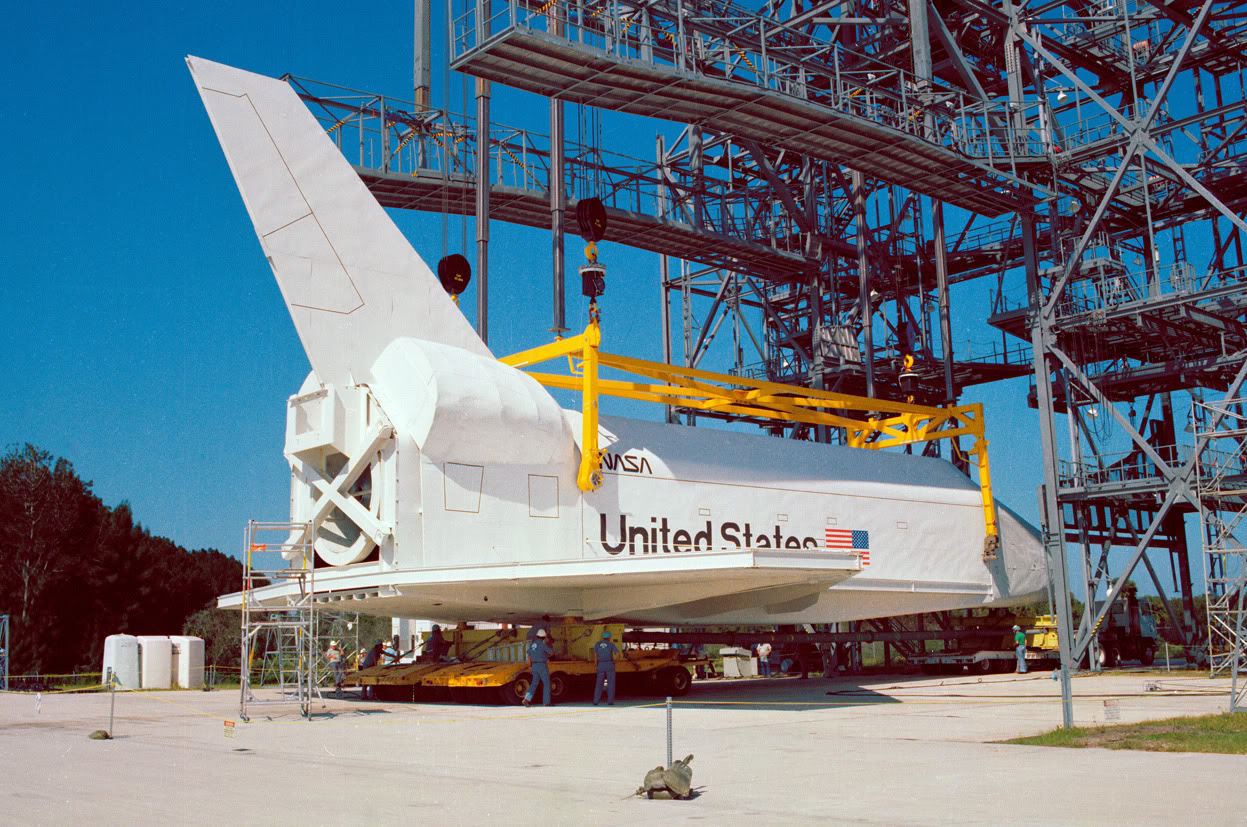
STA-098 on the Mate-Demate Device at the Shuttle Landing Facility in 1978
The orbiter boilerplate is hoisted into the Saturn V Dynamic Test Stand at NASA's Marshall Space Flight Center.

Originally unnamed, the simulator was built at the Marshall Space Flight Center in 1977 for use in activities such as checking roadway clearances, crane capabilities and fits within structures.[2] It was later shipped by barge to the Kennedy Space Center and was used for ground crew testing in the Vehicle Assembly Building, Orbiter Processing Facility, and Shuttle Landing Facility. Pathfinder is approximately the same size, shape and weight of an actual orbiter. Using Pathfinder allowed for facilities testing without requiring use of the more delicate and expensive Enterprise.[2]

Refurbishment

[edit]

After sitting in storage for many years, the America-Japan Society, Inc. obtained the wood and steel mockup at a cost of US$1 million and hired Teledyne Brown Engineering to refurbish it to more closely resemble an actual Space Shuttle.[3] It was named Pathfinder and displayed at the Great Space Shuttle Exposition in Tokyo from June 1983 to August 1984.[1] Teledyne Brown contracted RTS Laboratories, Inc., which had previously built a replica of the shuttle cockpit for training purposes at the Marshall Space Flight Center, to design and reconstruct the nose cone and cockpit section of the shuttle's hull.[4]

U.S. Space & Rocket Center

[edit]

After the exhibit, Pathfinder returned to the United States. The U.S. Space & Rocket Center in Huntsville, Alabama designed the display and built a stand. NASA provided MPTA-ET, an external tank which had been used for propulsion tests with the MPTA-098 engine testing rig, and two filament-wound Solid Rocket Booster casings, which had been designed for polar-orbit launches from Vandenberg Air Force Base.[5][6] The tank, not having been designed to hold the weight of an orbiter at an angle, required reinforcements. NASA installed I-beam spokes in the tank at Marshall, in building 4705. Pathfinder's weight is concentrated in the tail, though, and the tank required further reinforcements.[6] In May 1988, the 89-ton Pathfinder was installed atop the display at the Space & Rocket Center.[7]

In 1999, NASA removed the forward assemblies from each SRB attached to the Pathfinder stack. Although the SRBs are recovered and reused after each flight, several of the forward assemblies had been damaged or lost over the history of the Space Shuttle program necessitating requisition of those attached to the Pathfinder stack as spares.[5][8]

In 2008, repairs were made to the forward part of the mockup after decades of exposure to the weather had corroded the floor section near the vehicle's nose. This corrosion caused the "belly pan" to drop from a mounting bracket onto the external tank. The damaged area was part of the fiberglass and plywood added to the mockup before its exhibition in Japan.[2]

The Space Shuttle Pathfinder frame awaits restoration in 2021, beside its home for the preceding 30 years.
Official unveiling of the finished Pathfinder in 2025

In 2020 the center received a "Save America's Treasures" grant for $500,000 from the National Park Service.[9] The project began with the wings and tail section temporarily removed between January and February 2021. On February 8, the Pathfinder was lowered from its mounting points atop the fuel tank for the first time since May 5, 1988. The restoration project is proceeding alongside cooperation with the Marshall Space Flight Center, who will assist in assessing the structural integrity of the test shuttle.[10]

On August 28, 2024, two cranes lifted the body of Pathfinder back into position on the shuttle stack in the first phase of a multi-day reassembly process. The reattachment of the wings and engine bells followed, completing the restoration of the display. The refurbishment also updated Pathfinder's markings from its pre-1982 markings to the 1998 markings with the NASA meatball logo.[11]

See also

[edit]

References

[edit]
[edit]
Revisions and contributorsEdit on WikipediaRead on Wikipedia
from Grokipedia
The Space Shuttle Pathfinder is a full-scale, non-flight mockup of a Space Shuttle orbiter, constructed in 1977 at NASA's Marshall Space Flight Center in Huntsville, Alabama, to simulate the vehicle's size, weight, and center of gravity for ground testing and facilities verification.[1][2] Built primarily from steel and wood at NASA's Marshall Space Flight Center, it weighs approximately 89 tons and measures 122 feet in length, matching the dimensions of operational orbiters like Columbia and Challenger.[3][4] Designated as Orbital Vehicle-098 (OV-098), Pathfinder served as an early test article for the Space Shuttle program, undergoing fit-checks, lift tests, and handling simulations at NASA's Kennedy Space Center in Florida starting in May 1978, including entry into the Vehicle Assembly Building on May 15 and a key lift test on May 31.[1][2] These activities verified assembly procedures, transportation methods, and equipment compatibility for the actual shuttle fleet, contributing to the program's development without risking flight hardware.[5] Later, it played a role in qualifying the first external tank at NASA's Stennis Space Center.[6] In 1983, the mockup was named Pathfinder and loaned to the America-Japan Society for display at the Great Space Shuttle Exposition in Tokyo, where it was refurbished with plywood and fiberglass exteriors to more closely resemble a flight-ready orbiter.[6][4] Returned to the United States in 1984, it was mounted atop a full shuttle stack—including the Multi-Processing Test Article External Tank (MPTA-ET), the program's first-ever external tank, and modified solid rocket boosters—totaling 222 tons, and installed as a permanent outdoor exhibit at the U.S. Space & Rocket Center in Huntsville in May 1988.[3][4] The display, the world's only complete Space Shuttle stack open to the public, features engine nozzles from the Space Shuttle Columbia's 1981 maiden flight.[4] After decades of exposure to the elements, Pathfinder underwent a multi-year restoration starting in 2021, involving structural repairs, concrete pillar reconstruction, and protective coverings at a cost of $6.7 million, funded in part by a $500,000 grant.[3] The refurbished stack was reinstalled atop its external tank and boosters on August 28, 2024, and fully reassembled by September 2024, restoring its iconic presence along Huntsville's "Rocket City" skyline.[7][8] Today, it remains a key educational exhibit at the U.S. Space & Rocket Center, symbolizing the engineering achievements of NASA's Space Shuttle era.[9]

Design and Construction

Development and Purpose

The Space Shuttle Pathfinder, designated OV-098, originated as an unnamed facilities test article constructed by NASA in 1977 at the Marshall Space Flight Center (MSFC) in Huntsville, Alabama.[10] Although never officially assigned an orbiter vehicle number by NASA, the OV-098 designation was retroactively applied to reflect its role as a simulator for the emerging Space Shuttle program.[10] This mockup served as a crucial precursor to flight-capable vehicles like Enterprise, enabling early validation of ground support systems without risking prototype hardware.[3] The primary purpose of Pathfinder was to simulate the Space Shuttle orbiter for comprehensive ground infrastructure testing, ensuring that facilities could accommodate the vehicle's size, weight, and handling requirements before production orbiters became available.[10] It was specifically designed to evaluate roadway clearances, crane lifting capacities, and overall fit within assembly and processing buildings, such as those at MSFC and later sites, to identify and resolve potential logistical issues in the Shuttle's operational pipeline.[3] By replicating the orbiter's mass and configuration, Pathfinder allowed engineers to perform realistic load tests on support equipment and structures, safeguarding the integrity of the program's multi-billion-dollar infrastructure investments.[10] Pathfinder was built using steel and aluminum to accurately mimic the dimensions, weight, and structural loads of a production orbiter, providing a durable yet cost-effective test platform.[3] Upon completion in 1977, it was immediately deployed at MSFC for initial fit checks and hoisting evaluations, marking the start of its role in certifying ground facilities for the Space Shuttle era.[10]

Physical Specifications and Components

Space Shuttle Pathfinder was constructed as a full-scale mockup of the Space Shuttle orbiter, measuring approximately 121 feet (37 meters) in length to replicate the dimensions of operational orbiters.[11] The forward cockpit section spans the first 30 feet (9.1 meters) of the fuselage, providing a simulated crew compartment for testing purposes.[10] Originally, Pathfinder weighed about 75 short tons (68 metric tons or 150,000 pounds), designed to mimic the mass distribution and center of gravity of a flight-ready orbiter for structural evaluations; after later refurbishments for static display, the weight increased to about 89 short tons (80.7 metric tons).[12][3] The structure consists primarily of a steel framework derived from a repurposed Titan solid rocket motor case as its core nucleus, augmented with additional steel frames, collars, and support elements.[10] The original exterior used aluminum sheeting for the outer skin over the steel skeleton to achieve the orbiter's aerodynamic shape without the need for pressurization, heat shielding, or flight-grade materials; wood and fiberglass panels were added during a 1983 refurbishment for the Japan exhibition.[3][10] Key components include a basic fuselage mockup lacking operational engines, avionics, or propulsion systems, focusing instead on geometric fidelity for ground handling tests.[10] The cockpit serves as an emulator for crew interface simulations, integrated into the nose section and later refurbished to enhance its utility in non-flight evaluations.[3] Wings and tail structures were added using simplified framing to complete the full-scale representation, with no functional landing gear or payload bay mechanisms.[10]

Testing and Use

Facilities Fit Checks

In 1977, NASA constructed the Pathfinder as a full-scale, weight-matched mockup of the Space Shuttle orbiter at the Marshall Space Flight Center (MSFC) in Huntsville, Alabama, to serve as a facilities test article without risking flight hardware.[10] Initially used at MSFC to verify roadway clearances, crane capacities, and structural fits, it was then shipped by barge to the Kennedy Space Center (KSC) in April 1978 for more extensive ground-based integration testing.[10] This transport allowed Pathfinder to simulate orbiter handling in operational environments, paving the way for the actual flight vehicles.[1] At KSC, Pathfinder underwent fit checks in key facilities, including the Vehicle Assembly Building (VAB), Orbiter Processing Facility (OPF), and Shuttle Landing Facility, to confirm adequate clearances, access platforms, and procedural workflows for orbiter movements.[10] On May 15, 1978, it entered the VAB for initial fit verification, followed by a lift test on May 31 to assess hoisting and positioning capabilities.[1] Additional tests at the OPF evaluated processing bay configurations and worker access, while operations at the Shuttle Landing Facility included a fit check with the Mate/Demate Device (MDD) on October 19, 1978, ensuring safe orbiter transfers between ground transport and the 747 carrier aircraft.[10] These activities simulated critical logistics, such as towing, lifting, and positioning the orbiter relative to support structures, without the complexities of actual mating to the External Tank (ET) or Solid Rocket Boosters (SRBs), which were reserved for later vehicle-specific validations.[13] Through these tests, conducted until early 1979, Pathfinder identified necessary facility modifications, such as adjustments to work platforms in the VAB and OPF, enhancing ground operations efficiency and safety.[10] This groundwork directly supported the Space Shuttle program's readiness, enabling the arrival of the Enterprise orbiter for approach and landing tests and subsequent pad checkouts starting in April 1979.[13] By validating infrastructure without exposing delicate prototypes to wear, Pathfinder played a pivotal role in mitigating risks during the early phases of shuttle development.[10]

Crew Training Simulator

A cockpit emulator associated with Pathfinder was constructed using a foam-fiberglass composite shell designed from Rockwell International's offset tables. Built by RTS Laboratories, Inc., at the Marshall Space Flight Center around 1981, this non-flightworthy simulator provided familiarization with the orbiter's cockpit layout for ground crew and astronauts. It served as a standalone training tool for procedural practice in a controlled environment, supporting early program development before advanced simulators at other centers. The emulator was not integrated into Pathfinder's structure but contributed to overall shuttle training efforts.

Display and Exhibitions

Japan Exhibition

In the early 1980s, following its use in NASA testing, the Space Shuttle Pathfinder mockup was acquired by the America-Japan Society, Inc., for $1 million to support promotional efforts aimed at enhancing U.S.-Japan relations through space technology outreach.[3] The society sponsored the refurbishment of the simulator by Teledyne Brown Engineering, which modified it with plywood and fiberglass to more closely resemble an operational orbiter, including adaptations for disassembly and packing to facilitate international transport.[3][6] Pathfinder was then shipped to Japan, where it served as a standalone orbiter mockup in the Great Space Shuttle Exposition held in Tokyo from June 1983 to August 1984.[14][3] The exhibition highlighted U.S. advancements in space shuttle technology, drawing public interest to the capabilities of the program during a period of growing international collaboration in space exploration.[6] This display represented an early effort in international public engagement with Space Shuttle hardware, underscoring the America-Japan Society's role in fostering bilateral cooperation on scientific and technological initiatives between the two nations.[14][6]

Installation at U.S. Space & Rocket Center

Following its display at the Great Space Shuttle Exposition in Tokyo, Japan, from 1983 to 1984, Pathfinder was returned to the United States and donated to the U.S. Space & Rocket Center in Huntsville, Alabama.[14] This marked the end of its international tour and the beginning of its transition to a permanent exhibit in its home country.[15] In May 1988, Pathfinder was installed atop a full Space Shuttle stack configuration, consisting of the Main Propulsion Test Article External Tank (MPTA-ET) and two Solid Rocket Booster (SRB) casings.[3] The 89-ton orbiter was hoisted into position to complete the assembly, creating one of the earliest public displays of a complete Shuttle stack.[3] The components, including the external tank, had been transported over land to the site prior to stacking.[3] The initial assembly process involved on-site engineering to position and secure the elements for outdoor viewing, drawing on procedures developed during Pathfinder's earlier testing phases.[16] Since its erection, the stack has stood as a prominent feature along the Center's "spaceline," serving as a key attraction that highlights the Space Shuttle program's engineering legacy.[6]

Maintenance and Restoration

Initial Refurbishment

Following its use in ground testing and prior to its first public exhibition, Pathfinder underwent initial refurbishment in the early 1980s to prepare it for display as a more realistic representation of a Space Shuttle orbiter. The America-Japan Society, Inc. obtained the mockup on loan from NASA and contracted Teledyne Brown Engineering to perform the work, which included applying fiberglass and plywood coverings over the original steel and wood framework to improve its visual fidelity to operational orbiters. The overall project, including acquisition and refurbishment, cost US$1 million.[3][17] The modifications transitioned Pathfinder from a functional test article to a static exhibit, prioritizing aesthetic accuracy and structural robustness without altering its core non-flightworthy design.[3]

Later Modifications and Restorations

In 1999, NASA removed the forward assemblies from each Solid Rocket Booster (SRB) attached to the Pathfinder stack to serve as spares for the operational Space Shuttle program, as several assemblies had been damaged or lost during flights.[3] By 2008, after two decades of outdoor exposure, corrosion had severely damaged the forward section of the orbiter mockup, causing the fiberglass and plywood "belly pan" to detach and fall onto the external tank below; repairs were promptly undertaken to stabilize and restore this structural element.[3] In 2020, the U.S. Space & Rocket Center secured a $500,000 grant from the National Park Service's Save America's Treasures program to support a comprehensive restoration effort aimed at preserving the aging artifact against further environmental degradation. The total project cost $6.7 million and included repairs to the external tank foam, repainting of the boosters, and rust fixes to the orbiter frame.[3] The major restoration project commenced in 2021 with a meticulous dismantling process: crews removed the wings, vertical stabilizer, and engines from the orbiter in January and February, followed by the full lowering of the main fuselage to the ground on February 8, allowing access for detailed inspections and repairs of deteriorated wood and fiberglass components.[3][18] This multi-phase initiative reached completion in 2024, when on August 28, the refurbished orbiter was hoisted back atop the external tank and boosters using heavy-lift cranes, with wings reinstalled on August 29 and engines on August 30 to fully reassemble the display and mitigate over 30 years of weathering.[15] These ongoing modifications and restorations have been essential in maintaining the structural integrity of the approximately 222-ton Pathfinder stack, ensuring its continued role as a prominent educational exhibit at the U.S. Space & Rocket Center in Huntsville, Alabama.[3][4]
User Avatar
No comments yet.