


Community hub
0 subscribers8 pages, 0 posts
Recent from talks
All channels
Be the first to start a discussion here.
Be the first to start a discussion here.
Be the first to start a discussion here.
Be the first to start a discussion here.
Contribute something
Welcome to the community hub built to collect knowledge and have discussions related to Firefly squid.
Nothing was collected or created yet.
Firefly squid
View on Wikipediafrom Wikipedia
Not found
Firefly squid
View on Grokipediafrom Grokipedia
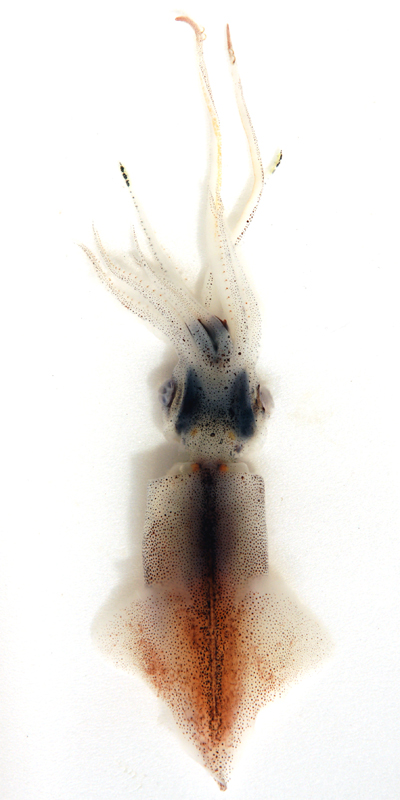
The firefly squid (Watasenia scintillans) is a small bioluminescent cephalopod belonging to the family Enoploteuthidae, endemic to the northwestern Pacific Ocean around Japan and Korea.[1] Adults typically reach a mantle length of 7–8 cm, featuring a streamlined body with eight arms and two longer tentacles armed with hooks and suckers for capturing prey, as well as a dark-pigmented mouth cavity.[2] This species is renowned for its photophores—specialized light-emitting organs distributed across the ventral surface, tentacles, and around the eyes—that produce vivid blue flashes through an ATP-dependent bioluminescent reaction involving coelenterazine luciferin and a membrane-bound luciferase system.[3] Inhabiting pelagic-oceanic environments, firefly squid occupy depths of 200–600 m during the day, performing diel vertical migrations to 0–200 m at night to feed and avoid predators.[1]
Firefly squid exhibit fascinating behaviors tied to their bioluminescence, which serves multiple functions including counter-illumination for camouflage, prey attraction, predator deterrence, and intraspecific communication such as mating signals.[2] They are carnivorous, preying primarily on planktonic crustaceans like copepods and shrimp, small fish, and other squid, often using patterned light flashes to lure victims.[2] The species has a semelparous life cycle with a lifespan of about one year; reproduction peaks during mass spawning aggregations from March to May, when large schools migrate to shallow coastal areas like Toyama Bay in Japan, where females release buoyant eggs that hatch in 6–14 days depending on water temperature.[2][4] These spawning events create mesmerizing surface displays of synchronized glowing, drawing fisheries and ecotourism, while adults typically perish post-spawning.[5]
Ecologically, firefly squid play a key role as both predators of small marine organisms and prey for larger species, including northern fur seals (Callorhinus ursinus), contributing to the food web dynamics of the western Pacific mesopelagic zone.[2] Their unique visual system, featuring three types of photoreceptor cells sensitive to different wavelengths, enhances adaptation to low-light deep-sea conditions and the blue spectrum of their own bioluminescence.[6] The species supports a culturally significant fishery in Japan, particularly around Toyama Bay, where seasonal catches highlight its economic and biodiversity value.[5]
Taxonomy
Classification
The firefly squid, scientifically known as Watasenia scintillans (Berry, 1911), is the sole species within the monotypic genus Watasenia.[7][8] This classification places it firmly within the cephalopod lineage, reflecting its shared evolutionary traits with other squids such as advanced nervous systems and jet propulsion.[7] The full taxonomic hierarchy of W. scintillans is as follows: Kingdom Animalia, Phylum Mollusca, Class Cephalopoda, Subclass Coleoidea, Superorder Decapodiformes, Order Oegopsida, Family Enoploteuthidae, Genus Watasenia Ishikawa, 1914, Species W. scintillans.[7][9] The order Oegopsida encompasses mostly oceanic squids characterized by large eyes lacking a corneal covering, adaptations suited to their pelagic lifestyles.[10] The family Enoploteuthidae comprises small to medium-sized oceanic squids, typically with mantle lengths of 3–13 cm, inhabiting upper mesopelagic waters in tropical and temperate regions worldwide.[11] Members of this family are distinguished by their tentacles, which feature clubs armed with one to two rows of hooks on the manus, and all arms bear hooks as well.[11] A defining feature is the presence of complex photophores—bioluminescent organs—distributed ventrally on the mantle, head, funnel, and eyeballs, often in a single line with the largest at the ends, though absent from tentacles and most fins.[11] These adaptations support counter-illumination and communication in low-light conditions.[11] Historically, W. scintillans was first described by S. S. Berry in 1911 under the name Abraliopsis scintillans in the journal The Nautilus.[7] The genus Watasenia was subsequently established by C. Ishikawa in 1914 to accommodate this species, recognizing its distinct morphological traits within the Enoploteuthidae.[9] This reclassification has remained stable, with no additional species assigned to the genus.[7]Etymology and naming
The firefly squid, scientifically known as Watasenia scintillans, bears common names that highlight its bioluminescent traits. In English, it is called the firefly squid or sparkling enope squid, while in Japanese, it is referred to as hotaru-ika, translating to "firefly squid" or "firefly cuttlefish," with hotaru meaning firefly and ika denoting squid.[12][13] The genus name Watasenia was established by Japanese zoologist Masuzo Ishikawa in 1914, honoring Shozaburo Watase, a prominent University of Tokyo professor who researched the species and coined its Japanese common name hotaru-ika in the early 20th century.[14][7] The specific epithet scintillans derives from the Latin participle scintillāns, meaning "sparkling" or "flashing," alluding to the squid's distinctive bioluminescent displays.[15] In Japanese culture, the name hotaru-ika stems from the squid's glowing appearance, which mimics fireflies, especially evident in the mass spawning events where thousands illuminate coastal waters.[13] No synonyms are currently recognized for W. scintillans, though 20th-century taxonomic revisions clarified historical misclassifications, such as placements under Abralia japonica or Abraliopsis scintillans, integrating them as junior synonyms.[7]Description
Anatomy and morphology
The firefly squid, Watasenia scintillans, is a small cephalopod with a mantle length of 5–7 cm, with mature females reaching up to 7 cm and males up to 6 cm.[16] Its body features a slender, conical shape that is broadest anteriorly and tapers to a pointed posterior, with the anterior portion cylindrical for about two-sevenths of the mantle length.[17] The mantle is soft-bodied and supported by a chitinous internal gladius, or pen, which is of the Loligo type and measures about one-fifth the breadth of its length in females.[18][17] Externally, the firefly squid possesses relatively large eyes, two longer tentacles equipped with hooks and a single series of suckers, and eight shorter arms lined with hooks and suckers (absent on the tips of the fourth pair of arms).[18][2][19] The tentacles are retractable into pockets on the head, and the arms bear hooks arranged in two series.[18] The skin exhibits a reddish-brown coloration, aiding in camouflage within its deep-sea environment, while the posterior fins form a broad, heart-like shape that spans about two-thirds of the mantle length in females.[20][17] Internally, the firefly squid is equipped with a chitinous beak for grasping and consuming prey, an ink sac that discharges through the siphon for defense, and a digestive system featuring a stomach and intestines adapted for processing small prey items like copepods and fish rapidly.[21] Females possess nidamental glands arranged in an inverted V-shape near the oviducts, which produce gelatinous egg masses, along with accessory oviducal glands.[17] Sexual dimorphism is evident in size and reproductive structures, with females slightly larger (mantle length up to 7 cm) than males (up to 6 cm).[16][17] Males have a specialized hectocotylus on the right ventral arm, modified for sperm transfer and featuring two small semilunar membranes at the terminal portion, while females have broader posterior fins relative to their body size.[17]Bioluminescence and vision
The firefly squid, Watasenia scintillans, possesses approximately 800–1,000 small ventral photophores distributed across the mantle and head, in addition to five photophores surrounding each eye and three larger ones located at the tips of the fourth arm pair.[22] These photophores emit blue-green light with a peak wavelength of 470 nm, spanning a spectrum from 400 to 580 nm, primarily through a luciferin-luciferase reaction involving coelenterazine disulfate as the luciferin substrate.[23] The reaction is ATP-dependent and occurs within crystalline structures in the photocytes, where luciferase is membrane-bound, enabling efficient light emission.[24] Neural signals control the activation of these photophores, allowing for rapid flashing patterns that can be synchronized or asynchronous depending on environmental conditions. The bioluminescent system is complemented by specialized vision adaptations suited to the deep-sea environment. The squid's large eyes feature three distinct visual pigments with maximum absorption peaks at approximately 471 nm, 484 nm, and 501 nm, based on retinal (A1), 3-dehydroretinal (A2), and 4-hydroxyretinal (A4) chromophores, respectively.[6] These pigments enhance sensitivity to blue-green wavelengths prevalent in the mesopelagic zone, facilitating low-light detection and potential color discrimination. The retina is organized in a banked structure, with the outer layers containing the A4-based pigment for short-wavelength sensitivity, optimizing visual acuity in dim conditions.[25] Bioluminescence serves multiple functions, including counter-illumination camouflage to match downwelling light and avoid silhouette detection by predators, as well as potential roles in mating signals and predator deterrence through disruptive flashing. A 2025 study has elucidated the differential use of photophore types: under dim overhead illumination, all three types (abdominal blue, abdominal green, and ocular) activate synchronously for crypsis, while in darkness, they operate asynchronously, suggesting additional signaling functions such as conspecific communication. This controlled modulation underscores the adaptive versatility of the system in the squid's pelagic habitat.[26]Habitat and distribution
Geographic range
The firefly squid (Watasenia scintillans) is endemic to the western North Pacific Ocean, with its primary range concentrated in coastal and shelf waters around Japan, encompassing the Sea of Japan and the Pacific coast from Hokkaido in the north to Kyushu in the south.[21] This distribution spans latitudes approximately from 32°N to 46°N and longitudes from 127°E to 146°E, favoring temperate to subtropical environments over continental shelves and warm current-influenced areas.[1] The species is particularly abundant in Toyama Bay along Japan's central coast, where massive spawning aggregations draw commercial fisheries each spring.[21] Its range extends beyond Japan to adjacent regions, including the coasts of South Korea, North Korea, China, and Taiwan in the East China Sea and Yellow Sea, as well as southern Russian waters near the South Kuril Islands and Sea of Okhotsk.[21][18] Firefly squid typically occupy depths of 200–400 m in mesopelagic to epipelagic zones, though they range from the surface to 600 m overall, with seasonal variations tied to reproductive cycles that bring them closer to shore.[1][2] During spawning migrations, adults ascend to shallow coastal waters, often less than 50 m, in areas like Toyama Bay.[21] As a single species, W. scintillans exhibits no recognized subspecies.[27]Vertical migration and behavior
The firefly squid (Watasenia scintillans) performs diel vertical migration, descending to depths of 300–500 m during the day to avoid visual predators in well-lit waters and ascending to the upper 100 m at night, where it feeds on plankton and small fish in the dimmer epipelagic zone. This behavior, observed in the transition region of the western North Pacific, allows the species to exploit different ecological niches while minimizing energy expenditure, with some individuals classified as semi-migrants that remain partially in deeper layers even at night. The migration amplitude can span several hundred meters, enabling access to nutrient-rich layers near the surface after dusk.[28] In oceanic and neritic zones of the western Pacific, particularly around Japan, the firefly squid prefers water temperatures between 5–15°C and salinities of 33–35 ppt, conditions typical of its temperate habitat that support its metabolic and reproductive needs.[29] It forms dense schools during these migrations, facilitating coordinated movement and bioluminescent displays for communication or predator deterrence, though it is generally solitary outside aggregation periods.[21] Mass strandings occasionally occur when schools rush toward shorelines, driven by tidal currents and environmental cues, leading to large die-offs in shallow bays.[21] The species relies on its large, asymmetrically placed eyes—adapted for low-light detection—and ventral photophores for navigation during vertical migrations through the mesopelagic twilight zone.[28] These organs enable precise orientation and brief counterillumination to blend with downwelling light, reducing silhouette visibility against the surface. Recent 2025 research has revealed that the firefly squid employs synchronous and asynchronous flashing patterns from three photophore types, fine-tuning counterillumination timing to match varying light intensities encountered during diel migrations.[26]Ecology
Diet
The firefly squid (Watasenia scintillans) exhibits ontogenetic shifts in its diet, reflecting changes in size, mobility, and habitat use across life stages. During the paralarval stage, individuals primarily consume calanoid copepods and other small zooplankton, which serve as abundant, accessible prey in the epipelagic zone where early development occurs.[30] As juveniles and adults mature, the diet diversifies to include larger crustaceans such as shrimp and euphausiids, small fish like anchovies, and occasionally other squid, establishing the species as an opportunistic carnivore. Stomach content analyses from specimens in Toyama Bay reveal that crustaceans dominate the diet volumetrically, comprising over 50% of identifiable prey, followed by fish and minor cephalopod contributions, with variations tied to seasonal prey availability.[31][2] Firefly squid employ an ambush predation strategy, extending tentacles to capture prey in sudden strikes, after which the chitinous beak tears and processes food items for ingestion. Feeding is predominantly nocturnal, coinciding with diel vertical migrations to shallower depths (200–600 m during the day to 0–200 m at night), where bioluminescent photophores on the tentacles may flash to lure prey, enhancing capture efficiency in low-light conditions.[2][31] Positioned as a mid-level predator in the marine food web, W. scintillans sustains higher trophic levels through its consumption patterns, with annual prey intake estimated via stomach content studies indicating substantial biomass processing in productive coastal upwelling areas like the Japan Sea.[31]Predators and threats
The firefly squid (Watasenia scintillans) faces predation from a variety of larger marine organisms throughout its life stages. Adults are targeted by piscivorous fish such as salmon (Oncorhynchus spp.), sea-run trout, and larger predatory fish including tuna (Thunnus spp.), which patrol coastal waters during spawning migrations.[30] Marine mammals, including northern fur seals (Callorhinus ursinus), sperm whales (Physeter macrocephalus), and killer whales (Orcinus orca), prey on adult and subadult squid in offshore and pelagic habitats.[32][33] Seabirds opportunistically consume squid near the surface during vertical migrations and spawning events. Eggs and paralarvae, which remain planktonic for several weeks after hatching, are vulnerable to predation by smaller planktonic predators in the epipelagic zone.[34] To counter these threats, firefly squid employ several behavioral and physiological defenses. Their bioluminescent photophores produce synchronized blue flashes that enable counter-illumination, blending the squid's silhouette with downwelling light to evade visual detection by predators below. In close encounters, individuals eject ink to create a smokescreen, disorienting pursuers and allowing escape via rapid jet propulsion and fin-assisted swimming, which can reach speeds sufficient for short bursts in open water.[35] Schooling behavior during migrations further dilutes individual risk by confusing predators through collective motion.[36] Environmental factors pose additional non-human threats to firefly squid populations. Ocean acidification affects planktonic prey like copepods through metabolic stress and reduced reproductive success, potentially limiting food resources for the squid.[37][38] Warming surface waters associated with climate change have led to variable migration patterns and spawning aggregations in sites like Toyama Bay, Japan; while pre-2025 observations noted delays and reductions, the 2024 season saw a record-high catch exceeding 4,000 tons, more than triple the typical yield, highlighting fluctuations.[39][40] Parasitic infections represent another biotic threat, particularly during early life stages. Larvae of nematodes in the genus Crassicauda (family Tetrameridae) commonly infest firefly squid paralarvae, encysting in tissues and potentially impairing development or increasing susceptibility to predation.[41] A 2023 study revealed that these larval nematodes complete their life cycle by maturing into adults in beaked whales (Ziphiidae), establishing a parasite-host link between the squid and cetacean predators off Japan's coast.[42]Reproduction
Mating and spawning
The firefly squid (Watasenia scintillans) exhibits a predominantly monogamous mating system, with approximately 95% of females mating with a single male, though rare instances of polyandry involving up to three males have been documented.[43] During copulation, males use their specialized hectocotylized fourth arm to transfer spermatophores—packets containing sperm—directly into the female's mantle cavity.[43] Females store these spermatophores as spermatangia in bilateral seminal receptacles located under the nuchal cartilage, enabling long-term sperm viability for up to several months, often spanning the entire reproductive period.[43] Bioluminescent displays may facilitate mate attraction and courtship, as the species possesses specialized photoreceptors sensitive to the green wavelengths of conspecific light emissions, allowing discrimination from ambient blue light in deep-sea environments.[43] This visual signaling likely aids in locating partners during the brief mating window, given the high predation risks that limit interaction time.[43] Spawning occurs semelparously, with adults dying shortly after reproduction, typically from March to May in the coastal waters of Toyama Bay, Japan.[43][2] Females release several thousand fertilized eggs in long, gelatinous strings at or near the surface during each spawning event, with the potential for multiple spawnings; the eggs are buoyant and drift at the ocean's surface.[20][43] These egg masses, each containing numerous small eggs roughly half the size of a sesame seed, hatch after 1 to 2 weeks depending on water temperature.[20] Prior to spawning, mature adults undertake a mass migration from depths exceeding 200 meters to shallow coastal areas, aggregating in dense schools that produce spectacular bioluminescent blooms visible at night.[20] This upward migration, peaking in spring, synchronizes mating and egg-laying, driven by environmental cues such as currents in Toyama Bay.[20]Life cycle
The life cycle of the firefly squid (Watasenia scintillans) is characterized by a short lifespan of approximately one year, with rapid development from egg to reproductive adult. Eggs are broadcast in gelatinous strings or masses offshore at the ocean surface, measuring about 1–2 mm in diameter. These eggs typically hatch in 6–14 days, with the incubation period varying based on water temperature (shorter at higher temperatures between 6 and 16°C).[2][20][44] Newly hatched paralarvae emerge at around 1.4 mm mantle length and enter a planktonic phase, during which they experience high mortality rates common to early cephalopod stages due to predation and environmental factors. This stage lasts several weeks, with the small, weakly armed paralarvae developing key structures such as eyes, arms, mantle, and funnel within the first 8–9 days post-hatching; they grow to approximately 10 mm before transitioning to the juvenile phase.[2][44][45] Juveniles and subadults undergo rapid growth in deeper mesopelagic waters, reaching sexual maturity at 6–8 months of age and full adult size of 7–8 cm mantle length. The overall lifespan is about 1 year, after which adults migrate inshore for spawning.[20][2] Following spawning, adults exhibit senescence and die shortly thereafter, exhibiting no parental care toward the eggs or offspring, consistent with the semelparous reproductive strategy of many cephalopods.[2][20]Human interactions
Commercial fishing and use
The firefly squid (Watasenia scintillans) is commercially harvested primarily in Toyama Bay, Japan, where fixed net systems, often including traditional straw leader nets known as kakiami, are deployed 2 to 3 kilometers offshore to intercept spawning aggregations.[40][46] These methods exploit the squid's seasonal migration to shallow waters, with fishing peaking from March to June each year.[13] Although light attraction is sometimes employed in other regions, Toyama Bay fisheries rely mainly on the squid's natural bioluminescence and predictable spawning behavior rather than artificial lures or jigging.[47] Historical annual catches in Toyama Bay during the 1990s ranged from 4,800 to 6,800 tons, supporting a local industry with around 130 vessels.[48] More recent data show stable production, with the 2024 season yielding over 1,200 tons in the first month alone—a record haul—and no major declines reported through 2025, though underreporting persists due to small-scale operations.[13][49] In Japanese cuisine, firefly squid is valued for its intense umami flavor and tender texture, commonly prepared raw as sashimi, lightly grilled on skewers, boiled and dressed in sumiso (vinegared miso) sauce, or stir-fried into pasta dishes.[50][51] The species also drives tourism in Toyama Bay, where night boat tours allow visitors to witness the glowing schools during harvest, enhancing the region's appeal as a seasonal spectacle.[52] Culturally, firefly squid holds significance in Japan, inspiring festivals and light shows in Toyama that celebrate the "fireflies of the sea" phenomenon, with events drawing crowds to ports like Namerikawa for communal viewing and feasting.[30][47] Exports remain limited owing to the squid's short shelf life of about 60 days under refrigeration, though improved cold-chain logistics have enabled modest international distribution of processed products.[53]Conservation status
The firefly squid (Watasenia scintillans) is classified as Least Concern on the IUCN Red List of Threatened Species, an assessment originally conducted in 2010 and retained in the 2025 version without indication of elevated risk.[1] This status reflects stable global populations, supported by the species' high fecundity and semelparous reproduction, where females produce thousands of eggs per spawning event, enabling rapid recovery from potential pressures.[48] No significant population declines have been documented, though local strandings during spawning aggregations are routinely monitored in key areas like Toyama Bay, Japan.[54] Primary threats to the firefly squid include overfishing during vulnerable spawning periods, which risks recruitment overfishing if unregulated, and incidental bycatch in trawl and other fisheries targeting co-occurring species in the western North Pacific.[48] Emerging concerns involve potential climate change impacts, such as warmer ocean waters altering diel vertical migration patterns or spawning timing, though research from 2023–2025 remains limited and inconclusive on direct effects. Management efforts are primarily national, led by Japan through catch quotas and seasonal closures in prime fishing grounds like Toyama Bay to prevent overexploitation during peak spawning from March to June.[54] There are no binding international agreements specifically for the species, but its populations are indirectly monitored through the North Pacific Fisheries Commission (NPFC), which conducts surveys and assessments in the region as part of broader cephalopod stock evaluations. These measures have helped maintain sustainable yields, with annual landings fluctuating but showing no long-term downward trend.[48]References
- https://en.wiktionary.org/wiki/scintillans