Hubbry Logo
DecapodiformesDecapodiformesMain
Open search
Decapodiformes
Community hub
Decapodiformes
logo
8 pages, 0 posts
0 subscribers
Be the first to start a discussion here.
Decapodiformes
Decapodiformes
from Wikipedia

Decapodiformes
Temporal range: Early Devonian – Recent[1]
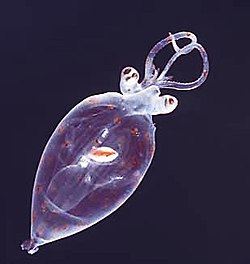
Planktonic cranch squid paralarva; Antarctica
Scientific classification Edit this classification
Kingdom: Animalia
Phylum: Mollusca
Class: Cephalopoda
Division: Neocoleoidea
Superorder: Decapodiformes
Leach, 1817[2]
Synonyms
  • Decembrachiata Winckworth, 1932

Decapodiformes is a superorder of Cephalopoda comprising all cephalopod species with ten limbs, specifically eight short arms and two long tentacles. It is hypothesized that the ancestral coleoid had five identical pairs of limbs, and that one branch of descendants evolved a modified arm pair IV to become the Decapodiformes, while another branch of descendants evolved and then eventually lost its arm pair II, becoming the Octopodiformes.

Taxonomy

[edit]

The following orders are recognised in the superorder Decapodiformes:[3]

Phylogeny

[edit]

Molecular analyses consistently showed that the order Teuthida is invalid as its two constituent subgroups do not form a clade that did not exclude other decapodiform orders. Thus, Teuthida is presently considered an invalid order due to lack of monophyly.[4]

Maximum Likelihood (ML) cladogram from Uribe & Zardoya 2017, based on complete mt genomes (protein-coding genes analysed at nucleotide level plus rRNA genes):[5]

Sepiida (outgroup)

The following cladogram is based on a RAxML maximum likelihood phylogram from Anderson & Lindgren 2021:[6]

References

[edit]

Further reading

[edit]
[edit]
Revisions and contributorsEdit on WikipediaRead on Wikipedia
from Grokipedia
Decapodiformes is a superorder of mollusks within the class and subclass , distinguished by the possession of ten appendages consisting of eight shorter arms and two longer tentacles specialized for prey capture. The name derives from the Greek deka (ten) and pous (foot), reflecting this limb configuration. This diverse group includes squids, , and bobtail squids, encompassing approximately 500 known species distributed across seven major extant orders: Bathyteuthoidea, Idiosepiida, , , Sepiida, Sepiolida, and . Taxonomically, Decapodiformes was established by Young, Vecchione, and in 1998 as part of the subclass , separating it from the eight-limbed Octopodiformes. The superorder comprises around 31 families and 95 genera, with phylogenetic relationships among the orders remaining somewhat unresolved despite advances in molecular analyses. For instance, Idiosepiida (pygmy ) is often positioned as sister to the remaining decapodiforms, while (oceanic squids) represents one of the most speciose and ecologically varied clades. These taxa exhibit a range of internal shell structures, from the rigid in Sepiida to the flexible in most squids, aiding and support in marine environments. Biologically, decapodiforms are predominantly marine predators with highly developed nervous systems, complex behaviors, and remarkable adaptations for locomotion via through a siphonal funnel. They display , rapid growth rates, and semelparous life cycles in many species, often reaching maturity within one to two years. Notable examples include the (Mesonychoteuthis hamiltoni), which can attain mantle lengths of up to 3 meters and weights exceeding 500 kg, and the smaller Idiosepiidae, maturing at just 8 mm mantle length. Their habitats span coastal shallows to the deep ocean, with some species venturing into brackish waters, and they employ , , and schooling for survival and hunting. Ecologically and economically, Decapodiformes play pivotal roles in marine food webs as both predators and prey, supporting fisheries that yielded around 3 million metric tons of squid alone in 2010. Key commercial species, such as loliginid squids and sepiid cuttlefish, are harvested globally for food, bait, and biomedical research due to their unique muscle fibers and neural tissues. Their diversity and adaptability highlight their evolutionary success, originating in the Mesozoic era alongside the broader coleoid lineage.

Overview

Definition and Characteristics

Decapodiformes is a superorder within the class , specifically part of the subclass , encompassing all species characterized by ten limbs: eight shorter arms and two longer tentacles equipped with suckers for prey capture. This limb configuration sets them apart from the eight-armed species in the superorder Octopodiformes, such as octopuses. The name "Decapodiformes" derives from the Greek for "ten-footed," reflecting this defining trait. Key morphological features of Decapodiformes include the presence of an internal shell remnant providing within : a chitinous forming a slender, feather-like pen in most squids, and a calcified (primarily ) in for . Males are distinguished by a , a specialized modified with papillae or grooves for transferring spermatophores during . Fin morphology varies across groups, with broad, triangular fins in facilitating precise maneuvering and undulating, muscular fins in squids contributing to sustained swimming propulsion. Decapodiformes display a broad size range, from diminutive bobtail squids (Euprymna spp.) with mantle lengths of 1-2 cm to the giant squid (Architeuthis dux), which can attain mantle lengths up to 2.25 m and total lengths up to 13 m, or the colossal squid (Mesonychoteuthis hamiltoni) with mantle lengths up to 2.5 m and weights exceeding 500 kg. These organisms rely on chromatophores—pigment cells in the skin—for rapid color changes enabling camouflage against predators and prey, and they possess an ink sac for ejecting dark fluid as a defensive smokescreen during escape.

Diversity and Distribution

Decapodiformes encompasses approximately 534 known species (as of 2025), distributed across seven major orders: Bathyteuthida (~3 species), Idiosepida (~5 species), (~48 species), (~259 species), Sepiida (~120 species, ), Sepiolida (~89 species, bobtail squids), and (1 species). These species are predominantly marine and occur in all major basins, ranging from polar regions to tropical waters and spanning depths from coastal shallows to the . Diversity is highest in the , where environmental complexity supports a greater variety of habitats and ecological niches. For instance, the (Dosidicus gigas) thrives in the nutrient-rich zones of the eastern Pacific. Endemism is notable in certain genera, such as Sepia cuttlefish, many of which are restricted to coastal waters of the Indo-West Pacific. Deep-sea oegopsid squids, like those in the family Cranchiidae, exhibit high endemism in abyssal environments, adapted to extreme depths beyond 2,000 meters. Current distributions have been shaped by historical range expansions following the Pleistocene, when glacial cycles and sea-level fluctuations facilitated migrations and recolonizations of post-glacial habitats, particularly influencing Indo-Pacific and temperate assemblages.

Anatomy and Physiology

Body Structure

Decapodiformes exhibit a distinctive external adapted for agile , characterized by a muscular mantle that forms the primary body cavity, housing most internal organs and enabling powerful contractions for locomotion. The mantle is typically elongated and cylindrical, varying in robustness across taxa—for instance, robust and warty in some onychoteuthids like Onykia , or slender and pointed in ancistroteuthids. Ventral to the head, a (or ) serves as a hydrostatic tube for expelling water during , often featuring locking cartilages and valves that differ taxonomically, such as a deeply recessed groove in ommastrephids. The head bears eight arms arranged in a circle, each with biserial suckers for grasping and manipulation, typically shorter than the body and triangular in cross-section; these may include protective membranes or, in some like gonatids, hooks for enhanced prey retention. Additionally, two longer tentacles, often retractable into specialized pockets, extend from between the eyes and terminate in clubbed ends equipped with enlarged suckers or hooks for precise prey capture, with lengths ranging from 30% to over 200% of mantle length depending on the . Internally, the digestive system is efficient and adapted for rapid processing of prey, beginning with a chitinous in the buccal mass that functions like a parrot's bill to tear , complemented by a —a chitinous, toothed —for scraping and grinding. passes to an expandable lined with cuticular ridges for mechanical breakdown, featuring a sorting apparatus that separates digestible material from indigestible debris, which is then directed to the intestine via the caecum; relative size varies by lifestyle, smaller (0.33–0.46% body weight) in pelagic species like Todarodes pacificus for quick , and larger (0.51–0.54% body weight) in benthic forms like Sepia lycidas for storage. The is closed and unique among molluscs, comprising : two branchial hearts that pump deoxygenated through the gills, and a single systemic heart that circulates oxygenated to the body, with blue hemocyanin-based supporting high metabolic demands. Respiration occurs via a single pair of ctenidial gills within cavity, facilitating countercurrent oxygen exchange as water is drawn in anteriorly and expelled through the , supplemented by minor in some taxa. Shell remnants in Decapodiformes provide structural support without the external shells of ancestral molluscs; in sepiids (), a porous composed of supports and pH regulation through gas-filled chambers, while teuthids (squids) possess a chitinous or pen—a thin, internal rod or feather-shaped structure—that reinforces the dorsal mantle for rigidity during swimming. These internal skeletons vary morphologically, such as sword-shaped with ribs in ommastrephids or needle-like in taoniids, aiding in muscle attachment and body shape maintenance. The is centralized and advanced, featuring a large encased in a cartilaginous with approximately 38 lobes dedicated to , including prominent optic and vertical lobes for visual integration and learning capabilities, though integration with other sensory inputs occurs peripherally via ganglia and giant axons that enable rapid escape responses through coordinated mantle contractions.

Locomotion and Sensory Systems

Decapodiformes employ a versatile locomotion system dominated by , where rhythmic contractions of the muscular mantle cavity expel water through a directional to generate . This mechanism allows for rapid and escape responses, with the 's vectored orientation enabling precise control over direction and braking. The efficiency of is enhanced by aperture reduction during mantle contraction, which increases propulsive force across various body sizes, though smaller individuals experience higher drag. Complementary to jet bursts, undulation of the lateral fins provides sustained cruising at lower speeds, producing hydrodynamic forces for lift, , and stability, particularly in species like the brief squid Lolliguncula brevis. Arms and tentacles further aid maneuvering, with the eight shorter arms offering stability and fine adjustments during , while the two longer tentacles extend for or prey-directed in oegopsid squids. Sensory systems in Decapodiformes are highly adapted for their predatory lifestyle, featuring complex camera-like eyes that converge evolutionarily with vision but lack a to minimize light loss in dim environments. These eyes possess a spherical lens and adjustable pupils—often crescent- or W-shaped in coastal species like Sepioteuthis lessoniana—which dynamically modulate light entry to optimize contrast and acuity under varying illumination. Statocysts, paired fluid-filled organs within the cephalic cartilage, function as balance receptors analogous to vestibular systems, detecting linear acceleration, , and via hair cells and a statolith to maintain orientation during agile maneuvers. Chemoreceptors distributed across the arms and tentacles enable chemotactile sensation, allowing detection of taste and olfactory cues through direct contact with environmental chemicals. These receptors, including cephalopod-specific ion channels in sucker epithelia, respond to amino acids, bitter compounds, and prey-derived molecules, facilitating foraging and mate recognition without reliance on distant olfaction. In deep-sea oegopsid species, bioluminescence via ventral photophores supports sensory integration by providing counter-illumination, matching downwelling light to reduce silhouette visibility and enhance stealth during hunting. Metabolic rates in Decapodiformes underpin these active traits, with species like Illex illecebrosus achieving burst speeds up to 11 m/s through elevated oxygen consumption during intense jet propulsion.

Taxonomy and Evolution

Classification

Decapodiformes is a superorder within the subclass Coleoidea of the class Cephalopoda, encompassing cephalopods characterized by eight arms and two longer tentacles, distinguishing them from the eight-armed Octopodiformes. The superorder comprises approximately 450–550 known species across seven extant orders: Bathyteuthida, Idiosepida, Myopsida, Oegopsida, Sepiida, Sepiolida, and Spirulida. Myopsida and Oegopsida were formerly grouped under the obsolete order Teuthida, but molecular and morphological evidence now supports their separation, along with recognition of the other orders. These groupings are based on morphological and anatomical features, with families under each order further delineated by shell structures, fin morphology, and appendage arrangements. Diagnostic traits define the orders within Decapodiformes. Sepiida (cuttlefishes; ~120 ) are identified by their internal for control and broad, undulating fins that span much of length, along with retractile s and an to diamond-shaped body. Sepiolida (bobtail squids; ~70 ) feature short s, a reduced or absent internal shell (often a thin ), and adaptations for burrowing in soft sediments, including small size (typically under 90 mm mantle length) and frequently bioluminescent light organs. Idiosepida (pygmy cuttlefish; ~5 ) are small, with a cuttlebone-like shell and brief s. (ram's horn squid; 1 , Spirula spirula) possess a unique coiled internal shell for . Myopsida (inshore squids; ~50 ) have covered eyes and a , with families like . (oceanic squids; ~300 ) include diverse pelagic forms with open eyes and varied fin shapes. Bathyteuthida (deep-sea squids; ~5 ) are bathypelagic with distinctive fin and morphologies. These traits facilitate ecological roles ranging from benthic to pelagic lifestyles across the orders. Recent taxonomic revisions, based on molecular phylogenetic analyses of mitochondrial and nuclear genes since the , have confirmed the seven-order structure. For example, Bathyteuthida is supported as a distinct deep-sea , often sister to , while Idiosepida is positioned basal to other decapodiforms. Such updates reflect ongoing integration of genomic data to refine boundaries traditionally set by alone. The nomenclatural history of Decapodiformes traces to its original description by in 1819, who established the group to classify decapod-like cephalopods, with Onychoteuthis banksii as an early exemplifying the superorder's tentacled form. The modern superordinal rank, separating it from Octopodiformes within , was formalized by Young, Vecchione, and Donovan in 1998. Subsequent refinements, including those in FAO catalogues, have stabilized the taxonomy while incorporating synonymies and family-level adjustments.

Phylogenetic Relationships

Decapodiformes diverged from Octopodiformes in the , approximately 240–247 million years ago, within the subclass Neocoleoidea of coleoid cephalopods. This divergence is supported by recent analyses using multiple genes, including mitochondrial and nuclear markers, which place the common ancestor of modern Decapodiformes and Octopodiformes in the era, with coleoids emerging around the Middle Triassic. The fossil record corroborates this timeline, with early coleoid remains appearing in the late , though definitive neocoleoid fossils, including potential decapodiform precursors, are documented from the onward. Molecular phylogenetic studies have robustly confirmed the monophyly of Decapodiformes as a clade sister to Octopodiformes within Neocoleoidea, based on multi-gene datasets such as 18S rRNA, cytochrome c oxidase subunit I (COI), and 28S rRNA. For instance, analyses of over 10 nuclear and mitochondrial loci across decapodiform taxa, including squids and cuttlefish, recover strong support (bootstrap values >90%) for this topology, resolving internal relationships among orders with Idiosepida often as the sister group to the remaining decapodiforms. Complete mitochondrial genome sequencing further reinforces this, showing Decapodiformes as a distinct lineage with shared synapomorphies in gene arrangement and tRNA structure, distinct from octopodiforms. These studies highlight convergent evolution in arm and tentacle morphology between Decapodiformes and Octopodiformes, where both groups independently developed sucker-bearing appendages for prey capture despite differing arm counts. A major radiation of Decapodiformes occurred during the , particularly with the diversification of oegopsid and myopsid squids in the oceans around 100 million years ago, driven by ecological opportunities in expanding marine habitats. This event is evidenced by fossil beaks and soft-body impressions indicating rapid among oceanic squids, coinciding with global ocean anoxic events and biotic turnovers. Key fossil highlights include early decapodiform-like forms such as Proteroteuthis from the , which exhibit structures and arm arrangements linking them to modern lineages, and Jurassic belemnites as stem-group precursors with and pro-ostraca resembling those in extant and squids. These fossils, combined with phylogenomic data, illustrate a progression from ancestors to the dominant decapodiform faunas of the .

Ecology and Behavior

Habitat Preferences

Decapodiformes exhibit a wide range of depth preferences adapted to their diverse lifestyles, with sepiids (cuttlefishes) and sepiolids (bobtail squids) primarily inhabiting coastal neritic zones from 0 to 200 meters, where they interact closely with the seafloor. In contrast, many oegopsid squids occupy deeper waters, extending into mesopelagic (200–1,000 m) and bathypelagic (1,000–4,000 m) zones, allowing them to exploit vertical migrations for and avoiding predators. These depth distributions reflect physiological adaptations to pressure and oxygen levels, with shallower species relying on benthic or demersal habits and deeper ones on pelagic lifestyles. Water conditions for Decapodiformes generally favor temperate to tropical regions, with optimal temperatures ranging from 15–30°C depending on the family; for instance, sepiids thrive in warmer coastal waters around 20–30°C. Salinity tolerance typically spans 30–35 parts per thousand (ppt), aligning with normal marine conditions, though some species show flexibility in estuarine-influenced areas. Substrate preferences vary markedly: burrowing sepiolids favor soft sand or mud bottoms for concealment and symbiosis with luminescent bacteria, while pelagic squids like those in Oegopsida inhabit open water columns without reliance on substrates. Zonal adaptations further diversify their habitats, with epipelagic squids such as the flying squids of (e.g., Ommastrephes bartramii) concentrated in surface layers (0–200 m) over oceanic depths greater than 200 m, facilitating high-speed and aerial leaps. Demersal cuttlefish, including Sepia officinalis, prefer benthic environments in shallow coastal zones, often over sandy or substrates for and egg-laying. These preferences link to locomotion strategies, where aids pelagic species in open water navigation. Climate influences are increasingly evident, with ocean warming driving distributional shifts; for example, the European cuttlefish (Sepia officinalis) has shown poleward migration along the Atlantic façade, with its shifting northward by up to 2.0° latitude under high-emission scenarios (RCP8.5) by the end of the century, as suitability decreases in southern regions like the Mediterranean and increases in northern seas like the . Recent studies as of 2023 confirm potential low declines in habitat suitability for S. officinalis but increased suitability at higher latitudes under similar scenarios. Such changes highlight vulnerabilities to temperature rises of 2–4°C in preferred habitats.

Reproduction and Life Cycle

Decapodiformes exhibit characterized by , where males transfer —elongated packets containing sperm—using a specialized arm known as the . This arm, typically one of the ventral arms modified with suckers or papillae, inserts the spermatophore into the female's mantle cavity or buccal membrane, where it attaches and releases sperm upon contact with seawater or the female's tissues. Reproductive strategies vary across taxa: many squids, such as those in , display semelparity, spawning once in a mass event before dying shortly thereafter, while like Sepia pharaonis exhibit iteroparity through intermittent multiple spawning over their lifespan. Mating behaviors in Decapodiformes are diverse and often involve visual cues, chemical signals, and agonistic interactions. In species like the (Sepia officinalis), males perform dynamic visual displays, such as the Intense Zebra Display—alternating black and white stripes across the body—to attract females or intimidate rivals during male-male competition. Pheromones also play a key role; females release a complex set of polypeptides into the water, aggregating mature males and guiding , while similar chemical cues may coat eggs to influence post-hatching behaviors. These behaviors facilitate and , with males guarding females or using alternative tactics like sneaking to increase fertilization success. Following fertilization, females lay eggs in species-specific patterns: sepiolids and sepiids deposit clutches of 50–200 eggs attached to substrates such as or rocks, often camouflaged with sand, ink, or opaque casings to deter predators, whereas oegopsid squids release large, gelatinous, neutrally buoyant pelagic masses containing thousands of eggs that float in the . Incubation periods range from a few days in warm-water species to several months in colder environments, influenced by temperature and egg size. The life cycle of Decapodiformes includes distinct developmental stages, with squids as planktonic paralarvae that serve as a dispersal phase, featuring a more octopus-like body form with prominent fins and reserves for initial . In contrast, some sepiids undergo direct development, as miniature benthic juveniles resembling adults. Growth is rapid post-, enabling short lifespans of 1–2 years; for example, the jumbo flying squid (Dosidicus gigas) achieves daily mantle length increments of up to 0.2 cm during peak phases, supporting maturation within months. These stages culminate in reproductive , aligning with the semelparous or iteroparous strategies that define their .

Human Interactions

Economic and Cultural Significance

Decapodiformes, particularly squids within the order, play a significant role in global commercial fisheries, with species such as Todarodes pacificus () being among the most harvested. Annual catches of T. pacificus in the Northwest Pacific peaked at over 600,000 metric tons in the late 20th century, primarily through and trawl methods, supporting major fishing operations in , , Korea, and , though recent catches have declined to under 200,000 metric tons as of 2023 due to environmental variability. Other prominent species include those in the genus , such as Loligo vulgaris and Loligo pealeii, which are widely targeted for calamari production in the Atlantic and Mediterranean fisheries. The global squid market, encompassing Decapodiformes species, was valued at approximately USD 12.2 billion in 2024, reflecting its substantial contribution to international trade and representing about 7% of the total value of marine captures worldwide. Aquaculture efforts for Decapodiformes focus mainly on species in , where farming provides and for both local consumption and export markets. Countries like and have developed cuttlefish aquaculture systems, rearing species such as Sepia pharaonis in coastal ponds and tanks, though production remains limited compared to capture fisheries. A key challenge in these operations is the high mortality of paralarval stages, which require live prey and optimal environmental conditions for survival, hindering large-scale commercialization. In cultural contexts, Decapodiformes feature prominently in global cuisines, valued for their versatility and nutritional profile. Cuttlefish ink is a traditional ingredient in Mediterranean dishes like Spanish paella, adding a distinctive flavor and color, while squid (ika) is central to Japanese sushi and grilled preparations, consumed fresh or dried in various regional recipes. Historically, squids and cuttlefish appear in mythology and art across cultures; for instance, in Polynesian lore, giant squids symbolize the mysteries of the deep sea and are depicted in navigational tales and carvings as embodiments of oceanic power. Byproducts from Decapodiformes processing offer additional economic value, particularly derived from squid pens, which is processed into β-chitin nanofibers for biomedical applications such as wound dressings, systems, and tissue scaffolds due to its and structural properties. Furthermore, squids like Doryteuthis pealeii serve as key model organisms in neurobiology research, prized for their giant axons that facilitated pioneering studies on impulse transmission and continue to inform investigations into neural signaling and .

Conservation Status

Decapodiformes populations face several anthropogenic threats, primarily overfishing in commercial fisheries targeting species such as the Japanese flying squid (Todarodes pacificus), Argentine shortfin squid (Illex argentinus), and jumbo flying squid (Dosidicus gigas), which has led to declining stocks in some regions due to high exploitation rates and environmental variability, including sharp catch reductions for T. pacificus in 2022–2025. Bycatch in trawl nets targeting finfish or shrimp also contributes to unintended mortality, particularly for smaller or less commercialized species within the superorder. Climate change induces habitat shifts by altering ocean temperatures and currents, potentially disrupting migration patterns and prey availability for these mobile cephalopods. Additionally, ocean acidification impairs the early development of squid paralarvae, resulting in reduced mantle length, increased metabolic stress, and altered swimming behavior that may lower survival rates in the wild. Global cephalopod supply has remained tight into 2025, exacerbating pressures on stocks. Assessments of Decapodiformes on the reveal a high proportion categorized as , underscoring gaps in population data, with only around 300–400 cephalopods formally assessed out of approximately 800 and no comprehensive evaluation at the superorder level. Notable exceptions include endemic like the giant Australian (Sepia apama), listed as Near Threatened due to localized declines from pressure and habitat degradation in aggregation sites. These vulnerabilities are compounded by the superorder's reliance on coastal and shelf habitats sensitive to warming and their reproductive strategies, where paralarval stages are particularly susceptible to environmental perturbations. Conservation measures include regulatory quotas for in the , such as the 2025 Cuttlefish Action Plan for fisheries, which aims to enhance monitoring, data collection, and voluntary practices to prevent in non-quota fisheries. Marine protected areas protect key spawning grounds, for instance, seasonal closures off Island for northern shortfin squid (Illex illecebrosus) to allow and . initiatives employ , including pop-up satellite archival tags on jumbo flying squid (Dosidicus gigas) to map migrations and inform , though applying such methods to elusive species like the (Architeuthis dux) remains limited by technical challenges; recent efforts include the NOAA Shortfin Squid Project in 2025 for improved stock assessments. Looking ahead, expanded adoption of sustainable certification programs like the Marine Stewardship Council (MSC) offers promise, with recent approvals for California market (Doryteuthis opalescens) fisheries in 2023 and MSC commitments of €5.6 million to bolster global sustainable fishing efforts by 2030, potentially covering more Decapodiformes stocks.

References

Add your contribution
Related Hubs
User Avatar
No comments yet.