



Community hub
Recent from talks
Contribute something
Nothing was collected or created yet.
Reduction potential
View on WikipediaRedox potential (also known as oxidation / reduction potential, ORP, pe, , or ) is a measure of the tendency of a chemical species to acquire electrons from or lose electrons to an electrode and thereby be reduced or oxidised respectively. Redox potential is expressed in volts (V). Each species has its own intrinsic redox potential; for example, the more positive the reduction potential (reduction potential is more often used due to general formalism in electrochemistry), the greater the species' affinity for electrons and tendency to be reduced.


Measurement and interpretation
[edit]In aqueous solutions, redox potential is a measure of the tendency of the solution to either gain or lose electrons in a reaction. A solution with a higher (more positive) reduction potential than some other molecule will have a tendency to gain electrons from this molecule (i.e. to be reduced by oxidizing this other molecule) and a solution with a lower (more negative) reduction potential will have a tendency to lose electrons to other substances (i.e. to be oxidized by reducing the other substance). Because the absolute potentials are next to impossible to accurately measure, reduction potentials are defined relative to a reference electrode. Reduction potentials of aqueous solutions are determined by measuring the potential difference between an inert sensing electrode in contact with the solution and a stable reference electrode connected to the solution by a salt bridge.[1]
The sensing electrode acts as a platform for electron transfer to or from the reference half cell; it is typically made of platinum, although gold and graphite can be used as well. The reference half cell consists of a redox standard of known potential. The standard hydrogen electrode (SHE) is the reference from which all standard redox potentials are determined, and has been assigned an arbitrary half cell potential of 0.0 V. However, it is fragile and impractical for routine laboratory use. Therefore, other more stable reference electrodes such as silver chloride and saturated calomel (SCE) are commonly used because of their more reliable performance.[citation needed]
Although measurement of the redox potential in aqueous solutions is relatively straightforward, many factors limit its interpretation, such as effects of solution temperature and pH, irreversible reactions, slow electrode kinetics, non-equilibrium, presence of multiple redox couples, electrode poisoning, small exchange currents, and inert redox couples. Consequently, practical measurements seldom correlate with calculated values. Nevertheless, reduction potential measurement has proven useful as an analytical tool in monitoring changes in a system rather than determining their absolute value (e.g. process control and titrations).[citation needed]
Explanation
[edit]Similar to how the concentration of hydrogen ions determines the acidity or pH of an aqueous solution, the tendency of electron transfer between a chemical species and an electrode determines the redox potential of an electrode couple. Like pH, redox potential represents how easily electrons are transferred to or from species in solution. Redox potential characterises the ability under the specific condition of a chemical species to lose or gain electrons instead of the amount of electrons available for oxidation or reduction.[citation needed]
The notion of pe is used with Pourbaix diagrams. pe is a dimensionless number and can easily be related to EH by the following relationship:

where, is the thermal voltage, with R, the gas constant (8.314 J⋅K−1⋅mol−1), T, the absolute temperature in Kelvin (298.15 K = 25 °C = 77 °F), F, the Faraday constant (96 485 coulomb/mol of e−), and λ = ln(10) ≈ 2.3026.

In fact, is defined as the negative logarithm of the free electron concentration in solution, and is directly proportional to the redox potential.[1][2] Sometimes is used as a unit of reduction potential instead of , for example, in environmental chemistry.[1] If one normalizes of hydrogen to zero, one obtains the relation at room temperature. This notion is useful for understanding redox potential, although the transfer of electrons, rather than the absolute concentration of free electrons in thermal equilibrium, is how one usually thinks of redox potential. Theoretically, however, the two approaches are equivalent.[citation needed]
![{\displaystyle pe=-\log[e^{-}]}](https://wikimedia.org/api/rest_v1/media/math/render/svg/e26e524de25ff6405613eec07ac3d67bcfdf0dbc)


Conversely, one could define a potential corresponding to pH as a potential difference between a solute and pH neutral water, separated by porous membrane (that is permeable to hydrogen ions). Such potential differences actually do occur from differences in acidity on biological membranes. This potential (where pH neutral water is set to 0 V) is analogous with redox potential (where standardized hydrogen solution is set to 0 V), but instead of hydrogen ions, electrons are transferred across in the redox case. Both pH and redox potentials are properties of solutions, not of elements or chemical compounds themselves, and depend on concentrations, temperature etc.[citation needed]
The table below shows a few reduction potentials, which can be changed to oxidation potentials by reversing the sign. Reducers donate electrons to (or "reduce") oxidizing agents, which are said to "be reduced by" the reducer. The reducer is stronger when it has a more negative reduction potential and weaker when it has a more positive reduction potential. The more positive the reduction potential the greater the species' affinity for electrons and tendency to be reduced. The following table provides the reduction potentials of the indicated reducing agent at 25 °C. For example, among sodium (Na) metal, chromium (Cr) metal, cuprous (Cu+) ion and chloride (Cl−) ion, it is Na metal that is the strongest reducing agent while Cl− ion is the weakest; said differently, Na+ ion is the weakest oxidizing agent in this list while Cl2 molecule is the strongest.
| Oxidizing agent | Reducing agent | Reduction Potential (V) | |
|---|---|---|---|
| Li+ + e− | ⇌ | Li | −3.04 |
| Na+ + e− | Na | −2.71 | |
| Mg2+ + 2 e− | Mg | −2.38 | |
| Al3+ + 3 e− | Al | −1.66 | |
| 2 H2O (l) + 2 e− | H2 (g) + 2 OH− | −0.83 | |
| Cr3+ + 3 e− | Cr | −0.74 | |
| Fe2+ + 2 e− | Fe | −0.44 | |
| 2 H+ + 2 e− | H2 | 0.00 | |
| Sn4+ + 2 e− | Sn2+ | +0.15 | |
| Cu2+ + e− | Cu+ | +0.16 | |
| Ag+ + e− | Ag | +0.80 | |
| Br2 + 2 e− | 2 Br− | +1.07 | |
| Cl2 + 2 e− | 2 Cl− | +1.36 | |
| MnO−4 + 8 H+ + 5 e− | Mn2+ + 4 H2O | +1.49 | |
| F2 + 2 e− | 2 F− | +2.87 |
Some elements and compounds can be both reducing or oxidizing agents. Hydrogen gas is a reducing agent when it reacts with non-metals and an oxidizing agent when it reacts with metals.
- 2 Li (s) + H2 (g) → 2 LiH (s)[a]
Hydrogen (whose reduction potential is 0.0) acts as an oxidizing agent because it accepts an electron donation from the reducing agent lithium (whose reduction potential is −3.04), which causes Li to be oxidized and Hydrogen to be reduced.
- H2 (g) + F2 (g) → 2 HF (g)[b]
Hydrogen acts as a reducing agent because it donates its electrons to fluorine, which allows fluorine to be reduced.
Standard reduction potential
[edit]The standard reduction potential is measured under standard conditions: T = 298.15 K (25 °C, or 77 °F), a unity activity (a = 1) for each ion participating into the reaction, a partial pressure of 1 atm (1.013 bar) for each gas taking part into the reaction, and metals in their pure state. The standard reduction potential is defined relative to the standard hydrogen electrode (SHE) used as reference electrode, which is arbitrarily given a potential of 0.00 V. However, because these can also be referred to as "redox potentials", the terms "reduction potentials" and "oxidation potentials" are preferred by the IUPAC. The two may be explicitly distinguished by the symbols and , with .


Half cells
[edit]The relative reactivities of different half cells can be compared to predict the direction of electron flow. A higher means there is a greater tendency for reduction to occur, while a lower one means there is a greater tendency for oxidation to occur.

Any system or environment that accepts electrons from a normal hydrogen electrode is a half cell that is defined as having a positive redox potential; any system donating electrons to the hydrogen electrode is defined as having a negative redox potential. is usually expressed in volts (V) or millivolts (mV). A high positive indicates an environment that favors oxidation reaction such as free oxygen. A low negative indicates a strong reducing environment, such as free metals.
Sometimes when electrolysis is carried out in an aqueous solution, water, rather than the solute, is oxidized or reduced. For example, if an aqueous solution of NaCl is electrolyzed, water may be reduced at the cathode to produce H2(g) and OH− ions, instead of Na+ being reduced to Na(s), as occurs in the absence of water. It is the reduction potential of each species present that will determine which species will be oxidized or reduced.
Absolute reduction potentials can be determined if one knows the actual potential between electrode and electrolyte for any one reaction. Surface polarization interferes with measurements, but various sources[citation needed] give an estimated potential for the standard hydrogen electrode of 4.4 V to 4.6 V (the electrolyte being positive).
Half-cell equations can be combined if the one corresponding to oxidation is reversed so that each electron given by the reductant is accepted by the oxidant. In this way, the global combined equation no longer contains electrons.
Nernst equation
[edit]The and pH of a solution are related by the Nernst equation as commonly represented by a Pourbaix diagram ( – pH plot). For a half cell equation, conventionally written as a reduction reaction (i.e., electrons accepted by an oxidant on the left side):

The half-cell standard reduction potential is given by
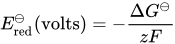
where is the standard Gibbs free energy change, z is the number of electrons involved, and F is Faraday's constant. The Nernst equation relates pH and :[citation needed]


where curly brackets indicate activities, and exponents are shown in the conventional manner.
This equation is the equation of a straight line for as a function of pH with a slope of volt (pH has no units).
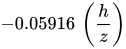
This equation predicts lower at higher pH values. This is observed for the reduction of O2 into H2O, or OH−, and for reduction of H+ into H2:
- O2 + 4 H+ + 4 e− ⇌ 2 H2O
- O2 + 2 H2O + 4 e− ⇌ 4 OH−
- 2 H+ + 2 e− ⇌ H2
In most (if not all) of the reduction reactions involving oxyanions with a central redox-active atom, oxide anions (O2−
) being in excess are freed-up when the central atom is reduced. The acid-base neutralization of each oxide ion consumes 2 H+ or one H2O molecule as follows:
- O2− + 2 H+ ⇌ H2O
- O2− + H2O ⇌ 2 OH−
This is why protons are always engaged as reagent on the left side of the reduction reactions as can be generally observed in the table of standard reduction potential (data page).
If, in very rare instances of reduction reactions, the H+ were the products formed by a reduction reaction and thus appearing on the right side of the equation, the slope of the line would be inverse and thus positive (higher at higher pH).
An example of that would be the reductive dissolution of magnetite (Fe3O4 ≈ Fe2O3·FeO with 2 Fe3+
and 1 Fe2+
) to form 3 HFeO−
2(aq) (in which dissolved iron, Fe(II), is divalent and much more soluble than Fe(III)), while releasing one H+:[4]
- Fe3O4 + 2 H2O + 2 e− ⇌ 3 HFeO−2 + H+
where:
- Eh = −1.1819 − 0.0885 log [HFeO−
2]3 + 0.0296 pH
Note that the slope 0.0296 of the line is −1/2 of the −0.05916 value above, since h/z = −1/2. Note also that the value −0.0885 corresponds to −0.05916 × 3/2.
Biochemistry
[edit]Many enzymatic reactions are oxidation–reduction reactions, in which one compound is oxidized and another compound is reduced. The ability of an organism to carry out oxidation–reduction reactions depends on the oxidation–reduction state of the environment, or its reduction potential ().
Strictly aerobic microorganisms are generally active at positive values, whereas strict anaerobes are generally active at negative values. Redox affects the solubility of nutrients, especially metal ions.[5]
There are organisms that can adjust their metabolism to their environment, such as facultative anaerobes. Facultative anaerobes can be active at positive Eh values, and at negative Eh values in the presence of oxygen-bearing inorganic compounds, such as nitrates and sulfates.[citation needed]
In biochemistry, apparent standard reduction potentials, or formal potentials, (, noted with a prime ' mark in superscript) calculated at pH 7 closer to the pH of biological and intra-cellular fluids are used to more easily assess if a given biochemical redox reaction is possible. They must not be confused with the common standard reduction potentials () determined under standard conditions (T = 298.15 K = 25 °C = 77 °F; Pgas = 1 atm = 1.013 bar) with the concentration of each dissolved species being taken as 1 M, and thus [ H+] = 1 M and pH = 0.

Environmental chemistry
[edit]In the field of environmental chemistry, the reduction potential is used to determine if oxidizing or reducing conditions are prevalent in water or soil, and to predict the states of different chemical species in the water, such as dissolved metals. pe values in water range from −12 to 25; the levels where the water itself becomes reduced or oxidized, respectively.[1]
The reduction potentials in natural systems often lie comparatively near one of the boundaries of the stability region of water. Aerated surface water, rivers, lakes, oceans, rainwater and acid mine water, usually have oxidizing conditions (positive potentials). In places with limitations in air supply, such as submerged soils, swamps and marine sediments, reducing conditions (negative potentials) are the norm. Intermediate values are rare and usually a temporary condition found in systems moving to higher or lower pe values.[1]
In environmental situations, it is common to have complex non-equilibrium conditions between a large number of species, meaning that it is often not possible to make accurate and precise measurements of the reduction potential. However, it is usually possible to obtain an approximate value and define the conditions as being in the oxidizing or reducing regime.[1]
In the soil there are two main redox constituents: 1) anorganic redox systems (mainly ox/red compounds of Fe and Mn) and measurement in water extracts; 2) natural soil samples with all microbial and root components and measurement by direct method.[6]
Water quality
[edit]The oxido-reduction potential (ORP) can be used for the systems monitoring water quality with the advantage of a single-value measure for the disinfection potential, showing the effective activity of the disinfectant rather than the applied dose.[7] For example, E. coli, Salmonella, Listeria and other pathogens have survival times of less than 30 seconds when the ORP is above 665 mV, compared to more than 300 seconds when ORP is below 485 mV.[7]
A study was conducted comparing traditional parts per million (ppm) chlorination reading and ORP in Hennepin County, Minnesota. The results of this study presents arguments in favor of the inclusion of ORP above 650 mV in the local health regulation codes.[8]
Geochemistry and mineralogy
[edit]Eh–pH (Pourbaix) diagrams are commonly used in mining and geology for assessment of the stability fields of minerals and dissolved species. Under the conditions where a mineral (solid) phase is predicted to be the most stable form of an element, these diagrams show that mineral. As the predicted results are all from thermodynamic (at equilibrium state) evaluations, these diagrams should be used with caution. Although the formation of a mineral or its dissolution may be predicted to occur under a set of conditions, the process may practically be negligible because its rate is too slow. Consequently, kinetic evaluations at the same time are necessary. Nevertheless, the equilibrium conditions can be used to evaluate the direction of spontaneous changes and the magnitude of the driving force behind them.
See also
[edit]- Electrochemical potential
- Electrolytic cell
- Electromotive force
- Fermi level
- Galvanic cell
- Oxygen radical absorbance capacity
- Pourbaix diagram
- Redox
- Redox gradient
- Solvated electron
- Standard electrode potential
- Table of standard electrode potentials
- Standard apparent reduction potentials in biochemistry at pH 7
References
[edit]- ^ a b c d e f vanLoon, Gary; Duffy, Stephen (2011). Environmental Chemistry -(*Gary Wallace) a global perspective (3rd ed.). Oxford University Press. pp. 235–248. ISBN 978-0-19-922886-7.
- ^ Stumm, W. and Morgan, J. J. (1981). Aquatic Chemistry, 2nd Ed., John Wiley & Sons, New York.
- ^ "Standard Electrode Potentials". hyperphysics.phy-astr.gsu.edu. Retrieved 29 March 2018.
- ^ Garrels, R. M.; Christ, C. L. (1990). Minerals, Solutions, and Equilibria. London: Jones and Bartlett.
- ^ Chuan, M.; Liu, G. Shu. J. (1996). "Solubility of heavy metals in a contaminated soil: Effects of redox potential and pH". Water, Air, & Soil Pollution. 90 (3–4): 543–556. Bibcode:1996WASP...90..543C. doi:10.1007/BF00282668. S2CID 93256604.
- ^ Husson O. et al. (2016). Practical improvements in soil redox potential (Eh) measurement for characterisation of soil properties. Application for comparison of conventional and conservation agriculture cropping systems. Analytica Chimica Acta 906, 98–109.
- ^ a b Trevor V. Suslow, 2004. Oxidation-Reduction Potential for Water Disinfection Monitoring, Control, and Documentation, University of California Davis, http://anrcatalog.ucdavis.edu/pdf/8149.pdf Archived 2004-12-06 at the Wayback Machine
- ^ Bastian, Tiana; Brondum, Jack (2009). "Do Traditional Measures of Water Quality in Swimming Pools and Spas Correspond with Beneficial Oxidation Reduction Potential?". Public Health Rep. 124 (2): 255–61. doi:10.1177/003335490912400213. PMC 2646482. PMID 19320367.
External links
[edit]Notes
[edit]- ^ Half reactions: 2 Li (s) → 2 Li+ (s) + 2 e− combined along with: H2 (g) → 2 H+ (g) + 2 e−
- ^ Half reactions: H2 (g) → 2 H+ (g) + 2 e− combined along with: F2 (g) + 2 e− → 2 F− (g)
Additional notes
[edit]Onishi, j; Kondo W; Uchiyama Y (1960). "Preliminary report on the oxidation-reduction potential obtained on surfaces of gingiva and tongue and in interdental space". Bull Tokyo Med Dent Univ (7): 161.
External links
[edit]Reduction potential
View on GrokipediaBasic Concepts
Definition and Explanation
Reduction potential, denoted as , is the electromotive force (voltage) measured for a reduction half-reaction relative to the standard hydrogen electrode (SHE) under standard conditions of 25°C, 1 M concentrations for solutes, and 1 atm pressure for gases; it quantifies the tendency of a chemical species to acquire electrons and thereby act as an oxidizing agent.[5] The SHE serves as the universal reference point, assigned a potential of exactly 0 V for the half-reaction .[6] Thermodynamically, the standard reduction potential relates to the Gibbs free energy change () of the corresponding half-reaction via the equation where is the number of moles of electrons transferred, is the Faraday constant (96,485 C/mol), and is the standard reduction potential; a positive value thus corresponds to a negative , signifying a spontaneous reduction process under standard conditions.[7] By sign convention, positive values indicate that the reduction half-reaction is favored over the SHE reduction (i.e., the species is more likely to gain electrons than hydrogen ions), while negative values imply the reverse, with the species preferring oxidation.[8] The concept of reduction potential emerged in 19th-century electrochemistry, with foundational work by Walther Nernst in 1888–1889, who provided atomistic explanations for electrode potentials and liquid junction potentials, laying the groundwork for quantitative electrochemistry.[9] Systematic tabulation of standard reduction potentials began in the early 20th century, culminating in comprehensive compilations such as those in Wendell M. Latimer's 1938 book The Oxidation States of the Elements and Their Potentials in Aqueous Solutions, which critically evaluated and standardized values for numerous half-reactions.[10] Representative examples illustrate the range of reduction potentials: the oxygen reduction half-reaction, demonstrates strong oxidizing power suitable for applications like fuel cells, whereas the sodium reduction, highlights sodium's role as a potent reducing agent in reactions like metal production.Measurement and Interpretation
The primary method for measuring reduction potentials is potentiometry, which involves determining the potential difference of an electrochemical cell under static conditions with negligible current flow, typically using a high-impedance voltmeter connected to an indicator electrode and a reference electrode.[11] In this setup, a galvanic cell is constructed where the indicator electrode is immersed in the solution containing the redox couple of interest, and the reference electrode provides a stable potential for comparison, allowing the measured cell potential to be attributed to the reduction potential of the indicator half-cell.[12] Interpretation of the measured potentials requires understanding that , so the reduction potential of the indicator electrode is obtained by adding the known reference potential to the observed ; this difference arises because the total cell potential reflects the relative driving force between the two half-cells. To ensure accuracy, a salt bridge containing an electrolyte like KCl connects the two half-cells, minimizing liquid junction potentials that could otherwise distort the measurement by introducing diffusion-based voltage offsets at the solution interface.[13] Common pitfalls in these measurements include irreversible reactions at the electrode surface, which fail to establish a stable equilibrium potential and lead to drifting or inaccurate readings, as the system does not reach the reversible conditions required for thermodynamic validity. Additionally, measurements must be conducted at equilibrium with no net current, as even small currents can polarize the electrodes and alter the observed potential. Reduction potentials are expressed in volts (V), conventionally reported versus the standard hydrogen electrode (SHE), which is assigned a potential of 0 V under standard conditions.[11] When using alternative references like the saturated calomel electrode (SCE), potentials must be converted by adding +0.244 V to the measured value relative to SCE to obtain the value versus SHE at 25°C.[14] A typical experimental apparatus for measuring reduction potentials in inert systems consists of a glass cell divided into two compartments connected by a salt bridge; one compartment holds the reference electrode (e.g., SHE), while the other contains the analyte solution with an inert platinum wire electrode serving as the indicator, where the redox species adsorb and exchange electrons without the platinum participating in the reaction. The voltmeter leads are attached to these electrodes, and the system is allowed to equilibrate before recording the potential.[15]Electrochemical Principles
Standard Reduction Potential
The standard reduction potential, denoted as , refers to the electrode potential of a half-reaction under standardized conditions: a temperature of 25°C (298.15 K), concentrations of 1 M for solutes, a pressure of 1 atm (or 1 bar) for gases, and unit activity (conventionally 1) for pure solids and liquids.[16] These conditions ensure consistency and comparability across different redox couples, allowing for the establishment of a universal reference scale.[17] The reference point for all standard reduction potentials is the standard hydrogen electrode (SHE), which consists of a platinum electrode in contact with a solution of 1 M H⁺ ions and bubbled with hydrogen gas at 1 atm pressure.[18] The half-reaction for the SHE is , assigned a potential of exactly 0 V by convention.[19] This setup serves as the zero point on the electrochemical scale, against which other electrodes are measured using potentiometric methods.[16] Standard reduction potentials provide the basis for predicting the spontaneity of redox reactions in electrochemical cells.[17] For a given cell, if the standard potential of the cathode (reduction) exceeds that of the anode (oxidation), the overall cell potential is positive, indicating a spontaneous reaction under standard conditions.[16] Common values are tabulated below for selected half-reactions, drawn from critically evaluated thermodynamic data (values in volts vs. SHE at 25°C).[19]| Half-Reaction | (V) |
|---|---|
| +2.87 | |
| +1.23 | |
| +1.76 | |
| +0.77 | |
| +0.80 | |
| +0.34 | |
| 0.00 | |
| -0.13 | |
| -0.25 | |
| -0.28 | |
| -0.74 | |
| -0.76 | |
| -1.66 | |
| -1.18 | |
| -2.37 |