Hubbry Logo
Statute of RhuddlanStatute of RhuddlanMain
Open search
Statute of Rhuddlan
Community hub
Statute of Rhuddlan
logo
8 pages, 0 posts
0 subscribers
Be the first to start a discussion here.
Statute of Rhuddlan
Statute of Rhuddlan
from Wikipedia

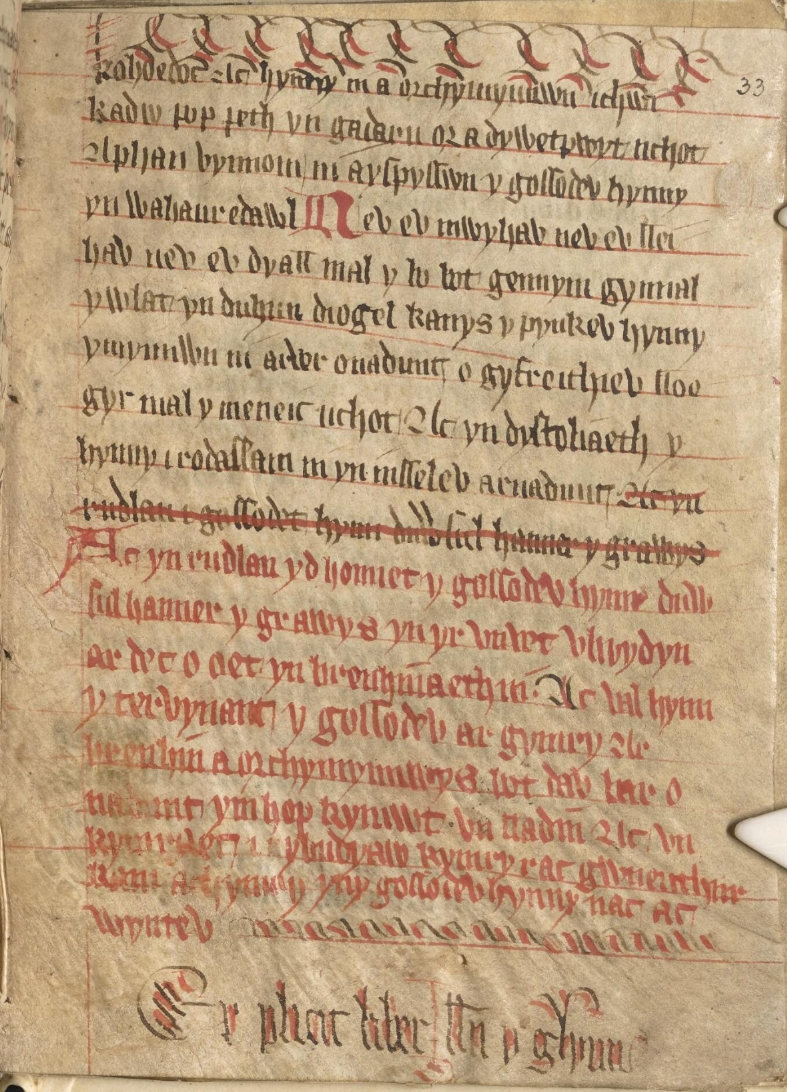
Page from Peniarth MS 41, a 15th-century manuscript of the Statute of Rhuddlan in Welsh
Statuta Wallie
Act of Parliament
Long titleNone
Territorial extent 
Dates
Royal assent1284
Commencement1284
Repealed16 September 1887
Other legislation
Repealed byStatute Law Revision Act 1887
Relates to
Status: Repealed
Text of statute as originally enacted

The Statute of Rhuddlan[a] (Welsh: Statud Rhuddlan), also known as the Statutes of Wales (Latin: Statuta Walliae[2] or Valliae) or as the Statute of Wales (Latin: Statutum Walliae[3] or Valliae), was a royal ordinance by Edward I of England, which gave the constitutional basis for the government of the Principality of Wales from 1284 until 1536.

The statute followed the Conquest of Wales by Edward I and the killing of the last Welsh prince to rule the whole Principality, Llywelyn ap Gruffudd in 1282. The statute introduced English common law to Wales, but also permitted the continuance of Welsh legal practices within the Principality. The statute also introduced the English shire system to the Principality of Wales. Prior to the statute, the Welsh principalities were ruled by Welsh law and the native Princes of Wales.

Background

[edit]
Rhuddlan Castle

The Prince of Gwynedd had been recognised by the English Crown as Prince of Wales in 1267, holding his lands with the king of England as his feudal overlord. It was thus that the English interpreted the title of Llywelyn ap Gruffudd, Lord of Aberffraw, which was briefly held after his death by his successor Dafydd ap Gruffudd. This meant that when Llywelyn rebelled, the English interpreted it as an act of treason. Accordingly, his lands escheated to the king of England, and Edward I took possession of the Principality of Wales by military conquest from 1282 to 1283. By this means the principality became "united and annexed" to the Crown of England.[4][page needed]

Following his conquest Edward I erected four new marcher lordships in northeast Wales: Chirk (Chirkland), Bromfield and Yale (Powys Fadog), Ruthin (Dyffryn Clwyd) and Denbigh (Lordship of Denbigh); and one in South Wales, Cantref Bychan.[5] He restored the principality of Powys Wenwynwyn to Gruffydd ap Gwenwynwyn who had suffered at the hands of Llewelyn, and he and his successor Owen de la Pole held it as a marcher lordship. Rhys ap Maredudd of Dryslwyn would have been in a similar position in Cantref Mawr, having adhered to the king during Llewelyn's rebellion, but he forfeited his lands by rebelling in 1287. A few other minor Welsh nobles submitted in time to retain their lands, but became little more than gentry.[6]

The English Crown already had a means of governing South Wales in the honours of Carmarthen and Cardigan, which went back to 1240. These became counties under the government of the Justiciar of South Wales (or of West Wales), who was based in Carmarthen. The changes of the period made little difference in the substantial swathe of land from Pembrokeshire through South Wales to the Welsh Borders which was already in the hands of the marcher lords.[7] Nor did they alter the administration of the royal lordships of Montgomery and Builth, which retained their existing institutions.[8]

Statute

[edit]

The statute also divided Wales into administrations of government via shires which were essentially provinces of the English crown.[9] Prior to the statute, the Welsh principalities were ruled by Welsh law and the native Princes of Wales, the last prince to rule the whole Principality being Llywelyn ap Gruffudd, killed in an ambush by the English in 1282.[9]

The statute was not an act of Parliament, but rather a royal ordinance made after careful consideration by Edward I on 3 March 1284.[10] It takes its name from Rhuddlan Castle in Denbighshire where it was first promulgated on 19 March 1284.[11] The Statute was superseded by the Laws in Wales Acts 1535 and 1542 when Henry VIII made Wales unequivocally part of the "realm of England".[12]

The statute was formally repealed by section 1 of, and the schedule to, the Statute Law Revision Act 1887 (50 & 51 Vict. c. 59).[13]

Counties

[edit]
Map of Wales after the Statute of Rhuddlan.
  Former principality of Gwynedd with counties created by the Statute of Rhuddlan
  Counties created by the Statute of Rhuddlan
  Lordships of the Marcher barons

The Statute of Rhuddlan was issued from Rhuddlan Castle in North Wales, one of the "iron ring" of fortresses built by Edward I to control his newly conquered lands.[14] It provided the constitutional basis for the government of what was called "The Land of Wales" or "the king's lands of Snowdon and his other lands in Wales", but subsequently called the "Principality of North Wales".[15] The Statute divided the principality into the counties of Anglesey, Merionethshire, Caernarfonshire, and Flintshire, which were created out of the remnants of the Kingdom of Gwynedd in North Wales.[16] Flintshire was created out of the lordships of Tegeingl, Hopedale, and Maelor Saesneg. It was administered with the Palatinate of Cheshire by the Justiciar of Chester.[17]

The other three counties were overseen by a Justiciar of North Wales and a provincial exchequer at Caernarfon, run by the Chamberlain of North Wales, who accounted to the Exchequer at Westminster for the revenues he collected. Under them were royal officials such as sheriffs, coroners, and bailiffs to collect taxes and administer justice.[18][19] The king had ordered an inquiry into the rents and other dues to which the princes had been entitled, and these were enforced by the new officials. At the local level, commotes became hundreds, but their customs, boundaries and offices remained largely unchanged.[citation needed]

Law

[edit]

The Statute introduced the English common law system to Wales,[20] but the law administered was not precisely the same as in England. The criminal law was much the same, with felonies such as murder, larceny and robbery prosecuted before the justiciar, as in England. The English writs and forms of action, such as novel disseisin, debt and dower, operated, but with oversight from Caernarfon, rather than the distant Westminster. However, the Welsh practice of settling disputes by arbitration was retained. The procedure for debt was in advance of that in England, in that a default judgment could be obtained. In land law, the Welsh practice of partible inheritance continued, but in accordance with English practice:

  • Daughters could inherit their father's lands if there was no son.
  • Widows were entitled to dower in a third of their late husband's lands.
  • Bastards were excluded from inheriting.[21]

Building

[edit]
Edward I Parliament House, Rhuddlan, 1238

The Parliament House of Edward III in Rhuddlan where it was thought that the Statute of Rhuddlan was promulgated. Thomas Pennant remarks in 1778, "A piece of antient building called the Parlement is still to be seen in Rhuddlan: probably where the king sat in council."[22] Pennant was to get John Ingleby to provide a watercolour of the building.[23] Today the building still partially stands in Parliament Street, with a late 13th-century doorway and a 14th-century cusped ogee door head.[24]

Notes

[edit]

References

[edit]

Sources

[edit]

Primary

  • Bowen, Ivor (1908). The statutes of Wales. London: T. Fisher Unwin. pp. 2–27
  • Ruffhead, Owen, ed. (1765). "Statutum Wallie". The Statutes at Large (in Latin). Vol. 9. London: Mark Basket; Henry Woodfall & William Stratham. Appendix pp. 3–12.

Secondary

Revisions and contributorsEdit on WikipediaRead on Wikipedia
from Grokipedia
The Statute of Rhuddlan, promulgated by King Edward I of in March 1284 at , formalized the administrative and legal integration of the conquered —primarily the former —into the English crown's domain following the military defeat and death of in 1282. The statute replaced native Welsh with English in these territories, while permitting certain customary Welsh civil laws to persist, thereby imposing a hybrid legal system designed to consolidate royal authority over the subjugated region. This legislative act divided the core of into shires—Anglesey, Caernarvonshire, , and —each governed by appointed English sheriffs and bailiffs, marking the inception of formalized English-style county administration in and distinguishing it from the semi-autonomous Marcher lordships in the south and west. By establishing boroughs, courts, and fiscal mechanisms aligned with English practices, the statute facilitated direct control, resource extraction, and settlement, underpinning the long-term anglicization of Welsh governance without fully eradicating indigenous structures. Its provisions laid essential groundwork for subsequent acts, such as the Laws in Wales Acts of 1535–1542, which completed the statutory annexation of .

Historical Context

Edward I's Conquest of Wales

Edward I initiated his first major campaign against in 1277, prompted by Llywelyn ap Gruffudd's refusal to perform homage and attacks on English border holdings. English armies advanced from , , and , converging on and forcing Llywelyn's capitulation without a . The resulting Treaty of Aberconwy, signed on 9 November 1277, confined to his heartland, stripped him of overlordship over other Welsh lords, imposed a 50,000-mark payable in installments, and required to . 's brother Dafydd ap Gruffudd was exiled to , though tensions persisted due to ongoing disputes over territorial concessions and English encroachments. War resumed in 1282 when Dafydd launched a surprise uprising, seizing castles in and prompting to join the rebellion. Edward responded with a multi-pronged offensive, capturing key strongholds and isolating Welsh forces. was killed on 11 December 1282 in an ambush near Cilmeri, close to Builth Wells, effectively decapitating the resistance. Dafydd briefly assumed leadership but was captured in 1283 and executed on 3 October 1283 in , subjected to hanging, drawing, and quartering—the first recorded instance of this punishment for a noble. To secure the conquest, Edward I pursued a deliberate of and demographic control, constructing or refurbishing castles at strategic coastal and riverine sites to dominate north and . Initiated during the 1277 campaign with sites like Flint and , this escalated post-1283 with the "" including (begun 1283), (1283), and (1283), designed by Master James of St George to house English garrisons and administer justice. English settlers were incentivized to occupy new boroughs around these fortresses, diluting Welsh influence and ensuring logistical support for ongoing military presence.

Welsh Principalities Prior to 1284

Prior to 1284, Wales comprised several fragmented principalities lacking unified governance, with power concentrated in regional kingdoms such as in the northwest, straddling the eastern borders, and in the southwest. These entities emerged from earlier post-Roman divisions, with tracing its origins to the 5th or 6th century under rulers like , evolving into the most enduring and militarily assertive realm by the . , often split into northern and southern branches after the , served as a buffer against Anglo-Saxon and later Norman incursions but suffered repeated subdivisions due to inheritance disputes. , consolidated around 920 from and , faced chronic instability following the death of its founder in 950, leading to its fragmentation into smaller lordships by the 13th century. Inter-princely warfare exacerbated this disunity, as rival dynasties vied for dominance through alliances, betrayals, and succession struggles, preventing any lasting hegemony. For instance, in the , Gruffudd ap Llywelyn briefly unified much of by conquering , , and between 1039 and 1055, only for his realm to collapse into civil strife after his death in 1063, with his sons slain in battles against Powysian rulers. Such conflicts, often triggered by among kin, fostered weak central authority reliant on personal oaths rather than institutional structures, rendering the principalities vulnerable to external exploitation. By the 13th century, even ambitious princes like Llywelyn ap Iorwerth of could not sustain broader coalitions amid persistent feuds with and southern lords. Governance rested on , a customary legal tradition attributed to codification under King around 945, which prioritized ties, compensatory payments like galanas (blood money for homicides), and oral precedents over fixed statutes or severe punishments. This system, preserved in over 40 manuscripts from the 13th century onward, exhibited regional variations—northern versions emphasizing territorial oaths, southern ones incorporating more ecclesiastical influences—lacking the uniformity of written Roman or English codes and thus complicating adjudication across principalities. Socially, communities organized around extended kin groups (cynyd) in rural trefi settlements, where disputes were settled by local judges (ynad) without a centralized . Economically, these societies depended on , with as the primary measure of wealth; raiding for served both as economic strategy and retaliatory justice, but chronic insecurity from internal raids and external threats undermined surplus production and stability.

Immediate Antecedents

Following the death of on December 11, 1282, and the capture and execution of his brother Dafydd ap Gruffudd on October 3, 1283—after trial by at convened on June 28, 1283, to deliberate his punishment and Welsh governance issues—Edward I confronted a power vacuum in the former Principality of and adjacent territories. Provisional rule was imposed via royal appointees, including justiciars and sheriffs, who operated amid ongoing construction and to maintain order. This interim administration exposed persistent disarray in judicial processes under traditional Welsh laws, derived from the codes of but applied with princely discretion that contemporaries described as prone to arbitrariness, favoritism, and overreach by native rulers—issues that had fueled internal Welsh divisions even before the . Reports from Edward's inquiries and Welsh submissions post-1283 highlighted these flaws, with some native elites expressing preference for English legal predictability in criminal matters to curb abuses and facilitate stability. The parliament's discussions underscored the urgency of reform to consolidate royal authority without granting full autonomy to Marcher lords in the heartlands, avoiding a patchwork of semi-independent franchises. These antecedents directly precipitated the Statute's promulgation on March 19, 1284, at , formalizing and targeted legal overhaul to secure the conquest's gains through centralized English oversight tempered by selective retention of Welsh civil customs.

Provisions of the Statute

Territorial Division into Counties

The Statute of Rhuddlan, enacted in 1284 following I's conquest of , divided the principality's territories into four counties designed to mirror the administrative structure of English shires: (sir Môn), (sir Gaernarfon), (sir Fflint), and (sir Meirionnydd). These divisions integrated the former Welsh commotes and cantrefs of into a unified administrative unit under royal control, with forming a distinct island county, and covering the core mainland areas west of the River , and incorporating northeastern territories including former lordships like Tegeingl. Sheriffs (shirrefs in English, sirwyr in Welsh) were appointed to govern each , serving as the king's primary local representatives responsible for tax collection, summonsing juries, enforcing royal decrees, and upholding public order. These officials operated under direct oversight, rendering accounts to designated auditors and collaborating with newly established roles such as justices and chamberlains to ensure efficient administration. The introduction of sheriffs marked a shift from native Welsh governance to an English-model system, facilitating centralized fiscal and judicial control without immediate extension to all of . This territorial reconfiguration applied exclusively to the in the north and west, annexing Gwynedd's lands "unto the Crown of the aforesaid Realm of for ever," while preserving the of Marcher lordships to the south and east, where baronial privileges remained intact. The delineation prevented wholesale incorporation of border regions, maintaining a hybrid feudal structure that deferred fuller anglicization until later statutes.

Introduction of English Common Law

The Statute of Rhuddlan, promulgated on 3 March 1284 by King Edward I, replaced Welsh with English in the conquered territories of , including felonies such as , , , and ./Introduction) This shift aimed to impose uniform royal justice, supplanting indigenous Welsh codes that often relied on collective sureties, compensation payments like galanas for , and customary fines such as sarhaed for personal insults, in favor of standardized English penalties and procedures. English judicial processes, including trial by presentment of a jury of twelve good and lawful men for serious offenses, were extended to these regions, with cases heard before royal justices itinerant or appointed officials akin to those in English ./Introduction) The thirteenth article of the Statute explicitly mandated adherence to in criminal matters, ensuring that pleas of —encompassing capital crimes and major trespasses—followed precedents from , thereby centralizing authority under the king and reducing local Welsh lords' discretionary powers in ./Introduction) This adaptation sought uniformity while adapting to territorial realities, as the designated counties like and were integrated into the English legal framework without fully replicating shire systems elsewhere. At the local level, the reorganized Welsh territorial divisions known as cymydau into English-style , establishing courts within them to handle minor criminal and civil disputes under principles, mirroring the hundred courts of for presentments and petty sessions. These courts facilitated enforcement of English penalties, prohibiting Welsh practices like arbitrary fines and instead applying fixed amercements and corporal punishments, though implementation initially depended on appointed sheriffs and bailiffs to bridge linguistic and customary gaps. This judicial restructuring marked a foundational step toward anglicizing governance in the , prioritizing empirical consistency in law application over pre-conquest traditions.

Retention of Select Welsh Customs

The Statute of Rhuddlan (1284) pragmatically preserved select elements of in civil domains, particularly where offered no direct equivalent or where abrupt imposition risked administrative disruption in . This approach reflected I's strategy to integrate the while accommodating entrenched local practices, thereby promoting stability and voluntary compliance among the Welsh elite. Civil retained Welsh rules on and , allowing continuity in familial property arrangements that underpinned . In matters of succession, the statute explicitly upheld the pre-existing Welsh custom of cyfran or , dividing a deceased father's lands equally among all legitimate sons, excluding daughters unless no male heirs existed—a modification aligning with English rights for widows but preserving the core egalitarian division among males "from the time whereof the memory of man runneth not to the contrary." This retention contrasted with English , prioritizing the Welsh system's emphasis on kinship equity over concentrated estate ownership, which facilitated smoother transition to royal oversight without alienating landholders. customs, including gavelkind-like divisions and status-based holdings, similarly persisted in civil disputes, ensuring that disputes over freehold or customary tenures were adjudicated under familiar norms rather than wholly alien principles. For homicide and related offenses, where emphasized felony prosecution and execution, the permitted the continuance of galanas—the traditional Welsh system of blood money compensation paid by the killer's kin-group to the victim's —to supplement or address gaps in English provisions, maintaining social reconciliation mechanisms rooted in tribal liability. This allowance operated as a civil remedy alongside criminal sanctions, drawing on (extending to relatives in the fourth degree or beyond) to deter feuds, though it gradually eroded under English judicial dominance. Administrative practicality extended to linguistic and personnel accommodations: the statute included clauses authorizing the use of the in local court proceedings and pleadings, recognizing the demographic reality of a monoglot Welsh-speaking populace in the . It further mandated the appointment of indigenous rheos (reeves or local bailiffs) from Welsh communities to oversee townships and hundred courts, embedding cultural continuity by entrusting minor civil and fiscal duties to figures versed in native customs, thereby bridging English sheriffs with grassroots enforcement. These provisions underscored a calibrated assimilation, subordinating Welsh elements to royal authority while averting the inefficiencies of total legal uprooting.

Administrative and Fiscal Reforms

The Statute of Rhuddlan (1284) centralized administrative authority in by establishing royal offices modeled on English precedents, including the Justice of to govern the newly defined counties of , , and , thereby supplanting residual princely powers with direct oversight./Introduction) This justice, appointed by the king, coordinated with sheriffs in each county to enforce royal directives, ensuring administrative uniformity while curtailing the autonomy of former Welsh lords who had held lands through hereditary or customary claims. Fiscal management was similarly reformed through the creation of a provincial at , overseen by the Chamberlain of , who handled revenue collection, sheriffs' audits, and disbursement of royal funds, effectively integrating Welsh fiscal operations into the English system./Introduction) Sheriffs were required to render accounts at this , which processed customary dues, fines, and other incomes previously managed locally, thereby enhancing royal control over economic resources and reducing opportunities for fiscal evasion by native elites. These measures facilitated the imposition of standardized taxation practices akin to those in , such as levies consented to in local assemblies, without fully displacing existing Welsh tenurial customs that generated revenue. Further bureaucratic integration involved the deployment of escheators to investigate and seize lands reverting to through or forfeiture, validating holdings via inquiries that prioritized over disputed local titles. Justiciars and escheators reported directly to the king, fostering to by embedding English administrative personnel who operated independently of marcher lords, thus minimizing risks of divided in the post-conquest landscape. This framework balanced integration with pragmatic retention of fiscal mechanisms that avoided immediate widespread alienation, as evidenced by the statute's provision for from Welsh freeholders on taxation matters./Introduction)

Implementation and Enforcement

Role of Rhuddlan Castle

Rhuddlan Castle's construction began in 1277 under King Edward I of England immediately following his victory in the First Welsh War, replacing an earlier Norman motte-and-bailey fortification established around 1073 by Robert of Rhuddlan. The new stone fortress, designed to dominate the strategic crossing at the mouth of the River Clwyd, facilitated English control over the fertile Clwyd Valley and its approaches from the Irish Sea. Edward I's engineers canalized the river northward by approximately three miles to enable direct supply by sea, bypassing potential Welsh blockades and underscoring the castle's role in projecting sustained military power. By 1282, the castle's core defenses were substantially complete, transforming it into a formidable bastion with concentric walls, gatehouses, and inner wards capable of housing royal administration. This development positioned as a key forward base for governance in conquered , where English officials could operate under the protection of a permanent stone stronghold rather than vulnerable timber structures. The Statute of Rhuddlan was promulgated within the castle's precincts on 19 March 1284, shortly after the death of Llywelyn ap Gruffudd and the suppression of the final Welsh resistance in 1282–1283. This location choice symbolized the fusion of military conquest with legal imposition, as Edward I's council convened amid the castle's artillery and garrison to extend English administrative frameworks over Welsh territories. The fortress thus served not merely as a defensive outpost but as the epicenter for enacting policies that reorganized land tenure, justice, and taxation, embedding royal authority through visible demonstrations of overwhelming force.

Establishment of Courts and Officials

Following the promulgation of the Statute of Rhuddlan on 3 March 1284, county courts were promptly established in the newly delineated shires of , with fixed sessions held at administrative centers such as for . These courts handled civil and criminal matters under English , replacing prior Welsh judicial assemblies and ensuring standardized procedures for pleas, inquisitions, and executions./Introduction) English-appointed officials dominated the judiciary, including the Justice of , who supervised the counties of , , and , alongside individual sheriffs for each shire tasked with summoning jurors, executing writs, and maintaining order./Introduction) Sheriffs, selected from loyal English administrators, convened the courts at least twice yearly and collected royal revenues, with initial appointments occurring during I's oversight in 1284 to embed centralized control. Local Welsh participation was incorporated to facilitate practical administration and local acceptance, with qualified natives serving as jurors in county assizes—drawn from freeholders familiar with land tenures—and as minor officials like bailiffs, provided they demonstrated competence in English legal forms. This selective integration leveraged indigenous knowledge for verdicts on customary issues while subordinating them to English justices, minimizing outright rejection of the system. In September 1284, Edward I conducted a royal progress across to audit the rollout, appointing officials on-site, resolving nascent disputes, and verifying compliance with the statute's mandates before departing for ./Introduction) Subsequent oversight involved itinerant justices conducting periodic eyres to review accounts and judicial records, enforcing through fines or removals for malfeasance, thereby sustaining the framework's integrity into the late 1280s.

Initial Resistance and Compliance

In March 1287, ap Maredudd, lord of Dryslwyn in southwest , launched a revolt against the newly imposed English administration under the Statute of Rhuddlan, capturing and overrunning parts of Ystrad Tywi while Edward I was in . The uprising exploited grievances over land forfeitures and administrative changes but gained limited traction beyond , with expelling the bishop of St David's and ravaging territories up to Llanbadarn Fawr. Royal forces, led by figures like John de Kirkby, swiftly mobilized, besieging rebel strongholds; Dryslwyn Castle fell on 8 September 1287 after heavy bombardment, and surrendered on 20 January 1288, marking the revolt's effective suppression despite 's temporary escape. In , the core region of the Statute's application, initial disturbances were contained by the network of fortified castles established post-conquest, including , Flint, and , which housed garrisons totaling thousands of troops to enforce compliance and deter unrest. These bastions served as administrative hubs and military deterrents, with sheriffs and bailiffs empowered under the Statute to collect revenues and administer oaths of , minimizing organized resistance in and . Edward I's strategy emphasized rapid response capabilities, as seen in the prepositioning of supplies and engineers for sieges, ensuring that sporadic acts of defiance—such as localized raids—were quelled without escalating into widespread rebellion. Pacification efforts included pragmatic incentives, such as the Statute's selective retention of Welsh customs in and to mitigate cultural disruption, alongside assurances of equitable justice through English courts, positioned as superior to the arbitrary rule of prior native princes. While no broad exemptions for are recorded, exemptions from certain feudal dues were granted to cooperative uchelwyr (Welsh nobles) who submitted petitions, fostering allegiance by preserving some estates in exchange for homage. By the late 1280s, evidence of growing compliance emerged through Welsh participation in nascent shire courts and eyres, where locals brought suits under the hybrid legal framework, indicating pragmatic adaptation to the stabilized order over continued instability.

Long-term Consequences

Stabilization of Governance in North Wales

The 's division of into shires—, , , and —introduced a structured administrative hierarchy modeled on English counties, with appointed s overseeing justice, taxation, and local order. This replaced the decentralized power of Welsh uchelwyr (free lords) with royal officials enforcing through itinerant justices and county courts, thereby curbing endemic inter-clan vendettas that had characterized pre-conquest society. The impartial adjudication of land disputes and criminal matters under sheriff supervision diminished reliance on private retribution, as evidenced by the relative pacification following the 1294 revolt of , after which no major native uprisings disrupted the region for decades. These reforms promoted economic stability by securing trade routes and markets; for instance, the establishment of regulated boroughs like facilitated commerce without the interruptions of localized warfare, leading to population recovery and agricultural expansion in the late 13th and 14th centuries. Integration into broader English governance followed, with barons from the new North Welsh shires receiving summons to Westminster parliaments by 1295, marking the Principality's alignment with national assemblies and further embedding royal authority. The shire system's longevity until its formal abolition by the Laws in Wales Acts of 1535–1542 underscores its success in stabilizing rule; despite occasional tensions, the framework endured over 250 years, providing consistent governance that outlasted transient revolts and supported the transition to full incorporation under . This practical imposition of centralized law demonstrated the Statute's efficacy in transforming anarchic tribal structures into a viable provincial administration.

Influence on Subsequent English Policies

The Statute of Rhuddlan established a model of partial legal assimilation for conquered territories, blending with retained local customs, which influenced English administrative strategies in Ireland during the late 13th and 14th centuries. In Ireland, English statutes, including those akin to Rhuddlan's provisions, were selectively applied to address local governance needs while asserting royal authority, mirroring the Statute's approach of introducing shire-based administration and without fully eradicating indigenous practices. This template informed I's reforms in Ireland, where parliamentary consent was limited, and royal ordinances extended English legal frameworks to stabilize lordships amid ongoing conflicts. The reinforced the principle of in for subjugated regions, explicitly affirming the king's sole to enact laws in the without parliamentary involvement, a stance that carried into Edward's broader legislative program. Issued as a royal ordinance in 1284, it bypassed English parliamentary processes, setting a evident in the subsequent of Westminster II (1285), which advanced reforms across England and echoed Rhuddlan's emphasis on royal initiative in legal uniformity. This approach underscored Edward's view of legislative power as an extension of , applicable to territories under direct control. Economically, the Statute's reforms facilitated the integration of Welsh lands into English fiscal systems, promoting stability that boosted production and from north Welsh estates, thereby augmenting royal revenues through established export duties first imposed in 1275. These revenues, derived from a that increasingly contributed to post-conquest, helped underwrite Edward's expensive Scottish campaigns in the 1290s, as the pacified Welsh territories yielded taxable agricultural output without the disruptions of prior native rule. By , such economic consolidation exemplified how Rhuddlan's governance model supported sustained military expansion elsewhere.

Path to the Laws in Wales Acts

The Statute of Rhuddlan of 1284 applied English selectively to the conquered Principality of Gwynedd and adjacent territories in northern and western , establishing four shires—Anglesey, (including the of Rhos as ), , and —under direct administration, while exempting southern and the Marcher lordships from full incorporation. This partial extension preserved a fragmented legal landscape, with Marcher lordships retaining autonomous jurisdictions, private courts, and feudal privileges immune to parliamentary oversight, alongside pockets of retained Welsh customs in the shired north. Over the subsequent two and a half centuries, royal initiatives incrementally narrowed these disparities through targeted extensions of authority, military consolidations, and parliamentary interventions, though comprehensive uniformity eluded until the Tudor era. The Laws in Wales Acts—enacted as 26 Hen. VIII c. 26 in 1535 and 34 & 35 Hen. VIII c. 26 in 1542—finally abolished the Marcher lordships, shired the remaining southern territories (including , , , , and others), and mandated the universal application of , language in official proceedings, and parliamentary representation for . These measures built directly on Rhuddlan's precedent of and legal anglicization, extending shiring to the entire and marches to eliminate dual zones. The territorial framework originating in 1284 endured as the foundational template for Welsh counties, with the original northern shires' boundaries substantially preserved until the Local Government Act 1972 reorganized them into eight preserved counties in 1974, and later unitary authorities in 1996; for instance, modern incorporates much of historic and , while Flintshire's core aligns with the delimited in 1284.

Assessments and Debates

The Statute of Rhuddlan, promulgated on 19 March 1284, supplanted key elements of native Welsh with English in the conquered Principality of , establishing uniform procedures for offenses such as , , and that previously relied on variable compensation systems like galanas (blood money). This shift imposed fixed penalties and evidentiary standards, curtailing the discretionary authority of local Welsh princes and kin groups that had perpetuated cycles of vendetta and irregular . The ordinance's creation of shires—such as , , and —under English-style sheriffs and justices of the peace enabled centralized enforcement, with royal writs now running throughout the principality to initiate proceedings and summon juries, replacing opaque native tribunals with documented, appealable processes. Inquisitio post mortem records, systematically applied post-1284, provided verifiable inquiries into land tenures and sudden deaths, fostering and reducing opportunities for fabricated claims or unchecked seizures that characterized pre-conquest . Over succeeding decades, the adoption of English and tenure under the Statute stabilized property transmission, preventing the fragmentation inherent in Welsh partwyrth () and enabling Welsh families to accumulate and retain estates across generations, which underpinned the rise of a contributing to agricultural and commercial expansion. enforcement through remedies, such as debet et detinet for debts, promoted predictable commercial relations, yielding measurable gains in regional output as secure holdings incentivized long-term improvements over the insecurity of native tenurial customs. These mechanisms, grounded in evidentiary procedures rather than personal , demonstrably enhanced societal order by aligning incentives toward productive investment rather than defensive fragmentation.

Criticisms of Cultural Imposition

The replacement of —the traditional Welsh legal code—with English under the Statute of Rhuddlan was decried by Welsh chroniclers as a tyrannical erasure of and cultural , fundamentally altering the principality's governance to favor English overlordship. Sources such as Brut y Tywysogion, a key medieval Welsh annal, frame the broader Edwardian conquest culminating in the 1284 statute as a catastrophic diminishment of native princely authority, portraying the imposition of foreign laws as an act of subjugation that dismantled centuries-old customs of inheritance and . This shift permitted only selective retention of Welsh practices, such as inheritance, but subordinated them to English oversight, effectively prioritizing assimilation over preservation. Edward I's policies following the statute extended to the suppression of bardic traditions, which served as custodians of Welsh , , and national memory, viewing them as potential incitements to resistance. After the 1282-1283 military defeats, the king targeted bards through restrictions on gatherings and patronage, recognizing their role in fostering cultural cohesion and opposition; this cultural complemented the statute's legal framework by undermining the intellectual and artistic frameworks that reinforced Welsh distinctiveness. Such measures aimed to dilute indigenous narratives, replacing them with narratives of English "civilization," as echoed in contemporary accounts likening Welsh subjugation to historical conquests of unruly peripheries. The statute's elevation of English as the administrative and judicial language further entrenched cultural dilution, marginalizing Welsh in official proceedings and courts, which eroded its status as a vehicle for identity and . This linguistic imposition, while not outright banning Welsh, systematically favored English in shire administrations and legal records, contributing to a gradual Anglicization that disadvantaged native speakers in accessing justice and administration. Economic mechanisms embedded in the , including purpresture fines for encroachments on royal domains and heavy taxation on Welsh commotes, were perceived as exploitative tools to extract wealth from subjugated holdings, exacerbating resentment over lost autonomy. These levies, administered through English exchequers like that in , imposed burdens that fueled revolts, such as the 1294-1295 uprising triggered by overzealous fiscal demands, underscoring the statute's role in economic dependency rather than equitable integration.

Historiographical Perspectives

Early English chroniclers and Tudor-era historians often portrayed the Statute of Rhuddlan as a civilizing endeavor that imposed order on a fractious Welsh society prone to internecine strife. Figures such as those in depicted Edward I's interventions, including the 1284 statute, as extending rational governance and legal uniformity to regions previously dominated by princely feuds and customary practices lacking centralized enforcement. This perspective aligned with a broader of English expansion as a progressive force, emphasizing the statute's role in curtailing endemic violence among Welsh lords, though such accounts typically overlooked native agency and the coercive military prelude. Modern scholarship, exemplified by R.R. Davies in The Age of : Wales 1063–1415, tempers this view by recognizing the statute's administrative achievements in establishing shire-based while highlighting the underlying of . Davies argues that the measure formalized 's annexation as a "member of the body" of the English crown, fostering long-term stability through English-style courts and officials, yet it disrupted indigenous legal traditions without equivalent benefits in native . Subsequent analyses debate the balance between imposed order and cultural erosion, with from administrative indicating reduced princely fragmentation post-1284, contrasted against periodic revolts like those in 1287 and 1294 that underscore lingering resistance. Central to historiographical contention is the issue of , as the 's professed reforms for the "peace and quiet of our Welsh subjects," yet operated as a unilateral royal ordinance devoid of consultative assemblies involving Welsh elites. Gwilym Dodd's examination of Plantagenet legislative practices reveals that while the preserved select Welsh to mitigate alienation, the king's superseded communal input, reflecting a pattern in peripheral dominions where purported benevolence masked sovereign assertion. Empirical indicators of efficacy—such as the 's endurance as Wales's constitutional framework until 1536 and the relative pacification of compared to pre-conquest divisions among figures like ap Gruffudd's rivals—suggest practical governance gains over romanticized notions of autonomous Welsh harmony, though without ignoring the asymmetrical power dynamics.

References

  1. https://www.exploring-castles.com/uk/[england](/page/England)/edward_i_of_england/
Add your contribution
Related Hubs
User Avatar
No comments yet.