


Community hub
Recent from talks
Contribute something
Nothing was collected or created yet.
Streeter–Phelps equation
View on Wikipedia

.JPG)
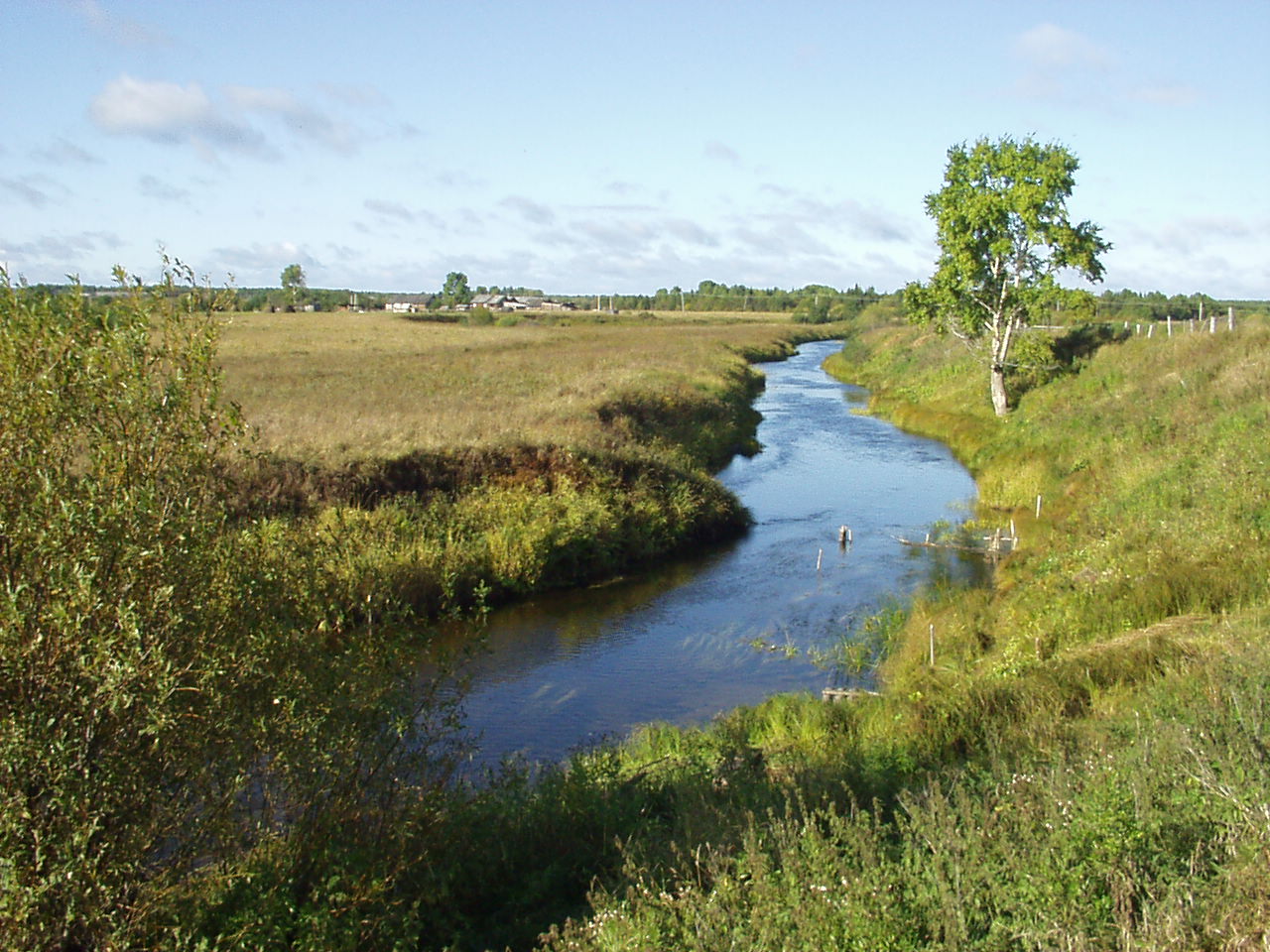
The Streeter–Phelps equation is used in the study of water pollution as a water quality modelling tool. The model describes how dissolved oxygen (DO) decreases in a river or stream along a certain distance by degradation of biochemical oxygen demand (BOD). The equation was derived by H. W. Streeter, a sanitary engineer, and Earle B. Phelps, a consultant for the U.S. Public Health Service, in 1925, based on field data from the Ohio River. The equation is also known as the DO sag equation.
Streeter–Phelps equation
[edit]The Streeter–Phelps equation determines the relation between the dissolved oxygen concentration and the biological oxygen demand over time and is a solution to the linear first order differential equation[1]
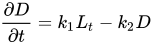
This differential equation states that the total change in oxygen deficit (D) is equal to the difference between the two rates of deoxygenation and reaeration at any time.
The Streeter–Phelps equation, assuming a plug-flow stream at steady state is then


where
- is the saturation deficit, which can be derived from the dissolved oxygen concentration at saturation minus the actual dissolved oxygen concentration (). has the dimensions .
- is the deoxygenation rate, usually in .
- is the reaeration rate, usually in .
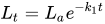
- is the initial oxygen demand of organic matter in the water, also called the ultimate BOD (BOD at time t=infinity). The unit of is .
- is the oxygen demand remaining at time t, .
- is the initial oxygen deficit .
- is the elapsed time, usually .





![{\displaystyle [{\tfrac {\mathrm {g} }{\mathrm {m} ^{3}}}]}](https://wikimedia.org/api/rest_v1/media/math/render/svg/1a846316b184fac08cedc66c32bd4ceb071ddaae)

![{\displaystyle [d]}](https://wikimedia.org/api/rest_v1/media/math/render/svg/ef4f4d84e860f2ffd5b55eec14cfbf735dd01689)
lies typically within the range 0.05-0.5 and lies typically within the range 0.4-1.5 .[2]
The Streeter–Phelps equation is also known as the DO sag equation. This is due to the shape of the graph of the DO over time.

Critical oxygen deficit
[edit]On the DO sag curve a minimum concentration occurs at some point, along a stream. If the Streeter–Phelps equation is differentiated with respect to time, and set equal to zero, the time at which the minimum DO occurs is expressed by
![{\displaystyle t_{crit}={\frac {1}{k_{2}-k_{1}}}\ln {\left[{\frac {k_{2}}{k_{1}}}\left({1-{\frac {D_{a}(k_{2}-k_{1})}{L_{a}k_{1}}}}\right)\right]}}](https://wikimedia.org/api/rest_v1/media/math/render/svg/fb0a3829bfc0a64c2d3916fd686ed3761aeb1114)
To find the value of the critical oxygen deficit, , the Streeter–Phelps equation is combined with the equation above, for the critical time, . Then the minimum dissolved oxygen concentration is



Mathematically it is possible to get a negative value of , even though it is not possible to have a negative amount of DO in reality.[3]

The distance traveled in a river from a given point source pollution or waste discharge downstream to the (which is the minimum DO) is found by

Surface plot depicting the dissolved oxygen (DO) concentration in a river. DO is shown on the vertical axis, with the along-stream and cross-stream directions on the x and y axes, respectively. A continuous input of biological material is added to the river at x = 75 m, y = 15 m, beginning at t = 0.


where is the flow velocity of the stream. This formula is a good approximation as long as the flow can be regarded as a plug flow (turbulent).

Estimation of reaeration rate
[edit]Several estimations of the reaeration rate exist, which generally follow the equation
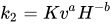
where
- is a constant.
- is the flow velocity [m/s].
- is the depth [m].
- is a constant.
- is a constant.


The constants depend on the system to which the equation is applied, i.e. the flow velocity and the size of the stream or river. Different values are available in the literature.
The software "International Hydrological Programme" applies the following equation derived on the basis of values used in published literature[4]

where
- .
- is the average flow velocity [m/s].
- is the average depth of flow in the river [m].
![{\displaystyle [d^{-1}]}](https://wikimedia.org/api/rest_v1/media/math/render/svg/70f7a7f8b6420c8da2a11bd52e64c99a5c68aef1)
Temperature correction
[edit]Both the deoxygenation rate, and reaeration rate, can be temperature corrected, following the general formula.[2]
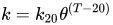
where
- is the rate at 20 degrees Celsius.
- θ is a constant, which differs for the two rates.
- is the actual temperature in the stream in degC.


Normally θ has the value 1.048 for and 1.024 for . An increasing temperature has the most impact on the deoxygenation rate, and results in an increased critical deficit (), and decreases. Furthermore, a decreased concentration occurs with increasing temperature, which leads to a decrease in the DO concentration.[2]


Mixing of rivers
[edit]When two streams or rivers merge or water is discharged to a stream it is possible to determine the BOD and DO after mixing assuming steady state conditions and instantaneous mixing. The two streams are considered as dilutions of each other thus the initial BOD and DO will be [4]
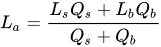
and
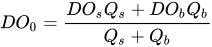
where
- is the initial concentration of BOD in the river downstream of the mixing, also called BOD(0). The unit of is .
- is the background BOD of the concentration in the river .
- is the BOD of the content of the merging river .
- is the initial concentration of the dissolved oxygen in the river downstream of the conjoining point .
- is the background concentration of the dissolved oxygen content in the river .
- is the background concentration of the dissolved oxygen content in the merging river .
- is the flow in the river upstream from the mixing point .
- is the flow in the merging river upstream from the mixing point .


![{\displaystyle [{\tfrac {m^{3}}{s}}]}](https://wikimedia.org/api/rest_v1/media/math/render/svg/6e1c4d695d346d5825d718a419c5f822231758ed)

Numerical approach
[edit]Nowadays it is possible to solve the classical Streeter–Phelps equation numerically by use of computers. The differential equations are solved by integration.
History
[edit]In 1925, a study on the phenomena of oxidation and reaeration in the Ohio River in the US was published by the sanitary engineer, Harold Warner Streeter and the consultant, Earle Bernard Phelps (1876–1953). The study was based on data obtained from May 1914 to April 1915 by the United States Public Health Service under supervision of Surg. W.H. Frost.[1]
More complex versions of the Streeter–Phelps model were introduced during the 1960s, where computers made it possible to include further contributions to the oxygen development in streams. At the head of this development were O'Connor (1960) and Thomann (1963).[5] O'Connor added the contributions from photosynthesis, respiration and sediment oxygen demand (SOD).[6] Thomann expanded the Streeter–Phelps model to allow for multi segment systems.[7]
Applications and limitations
[edit]The simple Streeter–Phelps model is based on the assumptions that a single BOD input is distributed evenly at the cross section of a stream or river and that it moves as plug flow with no mixing in the river.[8] Furthermore, only one DO sink (carbonaceous BOD) and one DO source (reaeration) is considered in the classical Streeter–Phelps model.[9] These simplifications will give rise to errors in the model. For example the model does not include BOD removal by sedimentation, that suspended BOD is converted to a dissolved state, that sediment has an oxygen demand and that photosynthesis and respiration will impact the oxygen balance.[8]
Expanded model
[edit]In addition to the oxidation of organic matter and the reaeration process, there are many other processes in a stream which affect the DO.[8] In order to make a more accurate model it is possible to include these factors using an expanded model.
The expanded model is a modification of the traditional model and includes internal sources (reaeration and photosynthesis) and sinks (BOD, background BOD, SOD and respiration) of DO. It is not always necessary to include all of these parameters. Instead relevant sources and sinks can be summed to yield the overall solution for the particular model.[2] Parameters in the expanded model can be either measured in the field or estimated theoretically.
Background BOD
[edit]Background BOD or benthic oxygen demand is the diffuse source of BOD represented by the decay of organic matter that has already settled on the bottom. This will give rise to a constant diffuse input thus the change in BOD over time will be

where
- is the rate for oxygen consumption by BOD, usually in .
- is the BOD from organic matter in the water .
- is the background BOD input .

Sedimentation of BOD
[edit]Sedimented BOD does not directly consume oxygen and this should therefore be taken into account. This is done by introducing a rate of BOD removal combined with a rate of oxygen consumption by BOD. Giving a total rate for oxygen removal by BOD [2]

where
- is the rate of oxygen consumption by BOD, usually in .
- is the rate of settling of BOD, usually in .

The change in BOD over time is described as

where is the BOD from organic matter in the water .
is typically in the range of 0.5-5 .[2]

Sediment oxygen demand
[edit]
Oxygen can be consumed by organisms in the sediment. This process is referred to as sediment oxygen demand (SOD). Measurement of SOD can be undertaken by measuring the change of oxygen in a box on the sediment (benthic respirometer).
The change in oxygen deficit due to consumption by sediment is described as
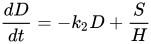
where
- is the depth of the river [m]
- is the SOD
- D is the saturation deficit .
- is the reaeration rate [].

![{\displaystyle [{\tfrac {g}{m^{2}d}}]}](https://wikimedia.org/api/rest_v1/media/math/render/svg/c3e7fa46a186240ccb9e63217dddcc2dc3b05404)
The range of the SOD is typically in the range of 0.1 – 1 for a natural river with low pollution and 5 – 10 for a river with moderate to heavy pollution.[2]

Nitrification
[edit]Ammonium is oxidized to nitrate under aerobic conditions
- NH4+ + 2O2 → NO3− + H2O + 2H+
Ammonium oxidation can be treated as part of BOD, so that BOD = CBOD + NBOD, where CBOD is the carbonaceous biochemical oxygen demand and NBOD is nitrogenous BOD. Usually CBOD is much higher than the ammonium concentration and thus NBOD often does not need to be considered. The change in oxygen deficit due to oxidation of ammonium is described as
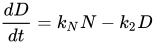
where
- D is the saturation deficit.
- is the nitrification rate .
- is ammonium-nitrogen concentration.


The range of is typically 0.05-0.5 .[2]
Photosynthesis and respiration
[edit]Photosynthesis and respiration are performed by algae and by macrophytes. Respiration is also performed by bacteria and animals. Assuming steady state (net daily average) the change in deficit will be
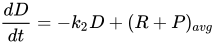
where
- is the respiration .
- is the photosynthesis .

![{\displaystyle [{\tfrac {mg}{Ld}}]}](https://wikimedia.org/api/rest_v1/media/math/render/svg/24972a26ea02b83de31e0501a81e20741158ed9b)

Note that BOD only includes respiration of microorganisms e.g. algae and bacteria and not by macrophytes and animals.
Due to the variation of light over time, the variation of the photosynthetic oxygen can be described by a periodical function over time, where time is after sunrise and before sunset[2]

where
- is the photosynthesis at a given time .
- is the daily maximum of the photosynthesis .
- is the fraction of day with sunlight, usually day.
- is the time at which sun rises .


The range of the daily average value of primary production is typically 0.5-10 .[2]


See also
[edit]References
[edit]- ^ a b Streeter H. W., Phelps E. B., 1925, A Study of the pollution and natural purification of the Ohio river. III. Factors concerned in the phenomena of oxidation and reaeration, Public Health Bulletin no. 146, Reprinted by U.S. Department of Health, Education and Welfare, Public Health Service, 1958, ISBN B001BP4GZI, http://dspace.udel.edu:8080/dspace/bitstream/handle/19716/1590/C%26EE148.pdf?sequence=2
- ^ a b c d e f g h i j Schnoor J., 1996, Environmental Modeling, Fate and Transport of Pollutants in Water, Air and Soil, Wiley-Interscience, ISBN 978-0-471-12436-8
- ^ Gotovtsev A.V., 2010, Modification of the Streeter–Phelps System with the Aim to Account for the Feedback between Dissolved Oxygen Concentration and Organic Matter Oxidation Rate, ISSN 0097-8078, Water Resources, Vol. 37, No. 2, pp. 245–251. Pleiades Publishing, Ltd.
- ^ a b Jolánkai G., 1997, Basic river water quality models, Computer aided learning (CAL) programme on water quality modelling (WQMCAL version 1.1), International Hydrological Programme, Technical Documents in Hydrology, No. 13
- ^ Russell C. S., Vaughan W. J., Clark C. D., Rodriguez D. J., Darling A. H., 2001, Investing in water quality: measuring benefits, costs and risks, Inter-American Development Bank, Washington D. C.
- ^ Lung W. S., 2001, Water quality modeling for wasteload allocations and TMDLs, John Wiley & Sons, Inc.
- ^ Wurbs R. A., 1994, Computer Models for Water-Resources Planning and Management, Texas A & M University.
- ^ a b c Lin SD, Lee CC (2001). Water and Wastewater Calculations Manual. McGraw Hill Professional. pp. 13–. ISBN 978-0-07-137195-7.
- ^ Schnoor J., 1986, Environmental Modeling, Fate and Transport of Pollutants in Water, Air and Soil, Wiley-Interscience
External links
[edit]- O'Connor D. J., 1960, Oxygen Balance of an Estuary, Journal of the Sanitary Engineering Division, ASCE, Vol. 86, No. SA3, Proc. Paper 2472, May, 1960
- Schnoor J. (1996). Environmental Modeling, Fate and Transport of Pollutants in Water, Air and Soil. Wiley-Interscience. ISBN 978-0-471-12436-8.
- Thomann R. V.,1963, Mathematical model for dissolved oxygen, Journal of the Sanitary Engineering Division, American Society of Civil Engineers, Volume 89, No. SA5
Streeter–Phelps equation
View on GrokipediaOverview
Purpose and Basic Concepts
The Streeter–Phelps equation serves as a foundational steady-state, one-dimensional model for predicting dissolved oxygen (DO) concentrations in rivers and streams receiving organic waste discharges, enabling the assessment of wastewater impacts on aquatic ecosystems.[4] Developed in 1925 by H. W. Streeter and E. B. Phelps through their analysis of the Ohio River, it provides a mathematical framework to evaluate how pollution influences water quality by balancing oxygen-consuming processes against natural replenishment mechanisms.[4] At its core, the model focuses on the oxygen deficit (D), defined as the difference between the saturation DO concentration and the actual DO in the water, typically measured in mg/L. Key variables include the initial biochemical oxygen demand (BOD, denoted as L or L_0), which quantifies the oxygen required for microbial decomposition of organic matter (mg/L); stream velocity (u, in units like ft/s or m/s); distance downstream from the discharge point (x, in miles or km); deoxygenation rate constant (k_d, in 1/day), representing the rate of oxygen consumption; reaeration rate constant (k_r, in 1/day), indicating the rate of oxygen transfer from the atmosphere; initial oxygen deficit (D_0, mg/L); and the saturation DO concentration (often related to D_s, the deficit corresponding to full saturation, mg/L). These elements collectively describe the interplay between oxygen depletion due to BOD exertion and restoration via surface aeration in a flowing water body.[4] The equation is renowned for characterizing the oxygen sag curve, a hallmark profile of DO variation downstream of a pollution source where organic waste induces a temporary imbalance in the oxygen budget. As water travels downstream, DO initially declines sharply because deoxygenation from BOD outstrips reaeration, creating a "sag" that threatens aquatic life; beyond the point of minimum DO, reaeration dominates, allowing levels to recover toward saturation. The critical oxygen deficit marks this lowest point on the sag curve, serving as a key indicator for regulatory compliance. Conceptually, the sag curve can be visualized as a smooth, asymmetric dip: DO begins near equilibrium upstream, plunges to a nadir at the critical distance (often several miles downstream), and then rises gradually, approaching but rarely reaching full saturation due to residual influences.[4][5]Assumptions and Scope
The Streeter–Phelps equation relies on several foundational assumptions to simplify the modeling of dissolved oxygen (DO) dynamics in rivers. These include steady-state flow conditions, where river discharge and velocity remain constant over time, ensuring that the system can be analyzed as a snapshot without temporal variations. Additionally, the model assumes complete vertical and lateral mixing of the wastewater effluent with the river water immediately upon discharge, resulting in uniform concentrations across the river cross-section. Constant temperature and flow velocity are also presupposed, as these factors influence reaction rates and transport but are treated as invariant to facilitate analytical solutions.[6][7] A key premise is the presence of a single point source of biochemical oxygen demand (BOD), typically from municipal or industrial wastewater, which represents the primary oxygen sink through microbial decomposition following first-order kinetics. Reaeration, the transfer of oxygen from the atmosphere to the water surface, is modeled as a first-order process with a constant rate coefficient, independent of DO levels. The equation further assumes no other significant oxygen sources or sinks, such as algal photosynthesis, benthic oxygen demand from sediments, or nitrification, focusing solely on carbonaceous BOD decay. Oxygen deficit is defined as the difference between saturation DO and actual DO, providing a metric for assessing impairment. These assumptions stem from empirical observations in the original study of the Ohio River.[6][8] The scope of the Streeter–Phelps equation is limited to river systems characterized by low turbulence, uniform channels, and organic pollution primarily from a discrete discharge point, making it suitable for predicting the DO "sag" curve downstream of such inputs. It is not applicable to lentic systems like lakes, tidally influenced estuaries, or scenarios with highly variable flows, multiple discharges, or significant non-BOD influences, as these would violate the mixing and steady-state premises. Standardization typically employs days for time, kilometers for distance, and milligrams per liter (mg/L) for concentrations, aligning with common water quality monitoring practices. For valid application, users must have a foundational understanding of water chemistry concepts, including DO saturation and BOD measurement. Limitations, such as neglect of benthic processes or distributed pollution, are addressed in extended models but fall outside this basic framework.[7][6][9]Mathematical Model
Core Equation
The Streeter–Phelps equation models the temporal and spatial variation in dissolved oxygen (DO) deficit in a river following the introduction of organic pollution, based on a mass balance of oxygen sources and sinks. The fundamental derivation begins with the rate of change of the oxygen deficit , defined as the difference between the saturation DO concentration and the actual DO concentration , i.e., . The differential equation for the deficit is derived from the oxygen consumption due to biochemical oxygen demand (BOD) decay and the oxygen replenishment via atmospheric reaeration: where is the deoxygenation rate constant (day⁻¹), is the remaining BOD concentration (mg/L), is the reaeration rate constant (day⁻¹), and is time since pollution introduction (days).[10][2] The BOD itself decays exponentially according to first-order kinetics: with the solution , where is the initial BOD concentration (mg/L) at . Substituting this into the deficit equation yields a linear first-order ordinary differential equation: This is solved using an integrating factor , leading to the general solution for the oxygen deficit as a function of time: assuming , where is the initial oxygen deficit at (mg/L).[10][11][12] To express the model spatially along the river, time is related to downstream distance via , where is the stream velocity (length/day). Substituting this relation gives the full Streeter–Phelps equation for the deficit as a function of distance: [10][2] In the common simplified form, assuming no initial deficit () and initial BOD at , the equation reduces to: The first term in the general equation represents the exponential decay of any pre-existing initial deficit due to reaeration, while the second term captures the buildup of deficit from BOD-induced deoxygenation followed by its decay through reaeration. The actual DO concentration is then obtained as .[10][11]Oxygen Deficit Dynamics
The oxygen deficit dynamics in the Streeter–Phelps model describe how the difference between saturated dissolved oxygen (DO_s) and actual dissolved oxygen evolves downstream in a water body following organic pollutant discharge, resulting in the characteristic oxygen sag curve. This curve captures the competing processes of deoxygenation from biochemical oxygen demand (BOD) and reaeration from the atmosphere, leading to temporal and spatial variations in oxygen levels that are critical for assessing stream health.[4] The sag curve unfolds in distinct phases. In the initial phase, known as Zone 1, BOD exerts dominant influence shortly after the discharge point, causing the oxygen deficit to increase rapidly as microbial decomposition consumes oxygen faster than it can be replenished by reaeration. This zone reflects heavy organic loading, where dissolved oxygen levels plummet, often resulting in turbid, anaerobic conditions near the bottom. As distance from the source grows, the curve transitions to Zone 2, where residual BOD diminishes and reaeration takes precedence, leading to a peak deficit followed by a gradual decrease toward saturation. Beyond this, full recovery occurs, with the deficit approaching zero far downstream, restoring aerobic conditions suitable for aquatic life. These phases illustrate the self-purification capacity of streams, provided reaeration eventually outpaces deoxygenation.[12] Graphically, the oxygen deficit is depicted as a function of downstream distance , forming a skewed bell-shaped curve that highlights the interplay of exponential decay terms representing deoxygenation and reaeration. The curve's inflection point, where the second derivative , marks the shift from Zone 1 to Zone 2 and signifies the point of maximum curvature, or where deoxygenation and reaeration rates are equal. A key condition for the formation of this recoverable sag is that the reaeration rate constant exceeds the deoxygenation rate constant , preventing indefinite deficit growth and enabling eventual recovery to DO_s.[4][12] To illustrate, consider a hypothetical uniform river with initial BOD mg/L, day, day, and velocity km/day (so time ). At km ( day), the deficit is approximately 2.8 mg/L; it rises to a peak of about 4.3 mg/L near km; and by km, it falls to roughly 1.7 mg/L, exemplifying the progression through the zones and recovery.[4] Environmentally, elevated oxygen deficits pose significant risks; when DO_s minus the minimum allowable DO (often 4–5 mg/L to support fish and invertebrates), hypoxic conditions emerge, stressing or killing aquatic organisms and disrupting ecosystems.Critical Oxygen Deficit
The critical oxygen deficit is the maximum value of the oxygen deficit in the dissolved oxygen (DO) sag curve, marking the lowest point of DO concentration downstream of a pollutant discharge. It occurs where the rate of oxygen consumption due to deoxygenation equals the rate of oxygen supply from reaeration, found by setting the derivative of the oxygen deficit with respect to time (or distance ) to zero in the Streeter–Phelps model. Assuming zero initial oxygen deficit, the expression for is where is the deoxygenation rate constant (day), is the reaeration rate constant (day), and is the initial BOD loading (mg/L).[13] The time to reach the critical point, , is given by and the corresponding downstream distance is , where is the stream velocity (e.g., km/day). These allow prediction of the location of minimum DO, essential for assessing pollution impacts along a watercourse.[13] The significance of lies in its use to evaluate whether the minimum DO level, calculated as saturation DO minus , complies with water quality standards protecting aquatic life. For instance, U.S. Environmental Protection Agency criteria recommend DO levels above 5 mg/L to avoid stress to warmwater fish species and above 6 mg/L for coldwater species, with levels below 2 mg/L potentially lethal; if causes DO to fall below these thresholds, it indicates impaired water quality requiring mitigation.[14][15] As an illustrative example, consider a stream with mg/L, day, day, initial deficit mg/L (adjusted in full model), saturation DO of 9.2 mg/L, and velocity mi/h (72 mi/day). The resulting days, mi, and mg/L yield a minimum DO of 3.1 mg/L, violating the 5 mg/L standard and signaling non-compliance for aquatic habitats.[16] Sensitivity analysis shows that increases with higher (faster BOD decay amplifying oxygen demand) or higher (greater pollutant load), while it decreases with higher (enhanced atmospheric oxygen transfer); for instance, doubling can reduce by over 30% in typical river conditions, underscoring the importance of flow and turbulence in mitigation strategies.[13][17]Parameter Determination
Deoxygenation and BOD
Biochemical oxygen demand (BOD) quantifies the amount of dissolved oxygen required by aerobic microorganisms to decompose organic matter in water, serving as a key indicator of organic pollution levels in wastewater and receiving streams.[18] The standard measurement, known as 5-day BOD (BOD5), is conducted in laboratory bottle tests at 20°C over five days, capturing the initial rapid phase of microbial oxygen consumption.[18] In the deoxygenation process modeled by the Streeter–Phelps equation, BOD decay follows first-order kinetics, where the remaining BOD at time t is expressed as: Here, L0 denotes the ultimate BOD (the total oxygen demand if decomposition proceeds to completion), and kd is the deoxygenation rate constant, typically ranging from 0.1 to 0.40 day−1 at 20°C, with values of 0.25–0.35 day−1 common for sewage and treated effluents.[18] This exponential decay reflects the proportional rate of organic matter breakdown by microbes, assuming sufficient dissolved oxygen availability. To estimate kd and L0, laboratory BOD bottle tests provide BOD5 data, from which the ultimate BOD is derived using the relation: This method requires an initial assumption or measurement of kd, often refined through iterative fitting to observed decay curves over extended periods (e.g., 20–30 days).[18] The value of kd is influenced by temperature, which accelerates microbial activity and thus increases the rate constant, and by waste type, with raw sewage exhibiting higher rates (around 0.35 day−1) compared to advanced treated effluents (around 0.25 day−1).[18] For instance, industrial wastes may yield lower kd values due to more recalcitrant organics. BOD exertion can be fractionated into carbonaceous BOD, arising from the oxidation of organic carbon compounds, and nitrogenous BOD, stemming from the microbial conversion of ammonia to nitrate, which demands approximately 4.57 g O2 per g N oxidized.[18] Carbonaceous demand dominates early in the process and is typically measured using nitrification inhibitors in BOD5 tests to isolate it from nitrogenous contributions.Reaeration Rate Estimation
The reaeration process in the Streeter–Phelps equation represents the transfer of dissolved oxygen from the atmosphere into the water body, primarily driven by surface turbulence generated by wind, flow velocity, and channel characteristics. This physical mechanism replenishes oxygen depleted by biochemical oxygen demand and other sinks, with the rate governed by the reaeration coefficient (often denoted ), which quantifies the mass transfer efficiency across the air-water interface. The process follows Fick's law of diffusion, modulated by the oxygen deficit and hydraulic conditions, ensuring that reaeration contributes to oxygen recovery downstream of pollutant inputs.[6] Empirical formulas provide practical means to estimate based on measurable stream parameters such as velocity (m/s), depth (m), and wind speed (m/s). A widely adopted model is the O'Connor-Dobbins equation, derived from turbulent diffusion theory, which predicts (day^{-1}) as: (with in m/s, in m), applicable to rivers with depths between 0.3 and 9 m and velocities from 0.15 to 0.5 m/s; it originates from small-eddy surface renewal assumptions and has been validated against field data from natural streams.[19][6] Wind effects can be incorporated in extensions, such as modified forms including a denominator factor like . Another influential empirical approach is the Owens, Edwards, and Gibbs (1964) formula, which emphasizes velocity and depth dependencies (with in m/s, in m, dimensionless): This model was developed from reaeration studies in British streams and performs well for low-gradient rivers.[20][6] Software tools like GPS-X incorporate these and other empirical relations within integrated water quality simulations, allowing users to select formulas based on site-specific hydraulics for riverine applications.[21] Field methods for determining rely on direct measurements to calibrate models, often combining dissolved oxygen (DO) profiling with hydraulic data. The DO balance technique monitors temporal and spatial DO changes along a river reach, isolating reaeration from other sources and sinks by solving the oxygen mass balance equation; this approach requires multiple sampling points and accounts for travel time.[6] Tracer studies enhance accuracy by quantifying flow dynamics: conservative tracers like Rhodamine WT dye are injected to measure travel time and dispersion, which inform calculations via the DO sag curve, while gas tracers (e.g., SF6 or krypton-85) directly assess gas exchange rates with root-mean-square errors around 15%. These methods are particularly useful in turbulent rivers where empirical predictions may deviate.[6][22] Typical values for rivers range from 0.2 to 1.0 day⁻¹ at 20°C, varying with flow velocity and depth—higher in shallow, fast-flowing streams (up to 75 day⁻¹) and lower in deep, sluggish ones (as low as 0.1 day⁻¹). These rates reflect site-specific conditions; for instance, pool-and-riffle streams often exhibit 0.25–2.0 day⁻¹, while large rivers may fall below 0.5 day⁻¹.[6][23] Estimating presents challenges due to its high spatial and temporal variability, influenced by unmodeled factors like wind shear, surfactants, and benthic oxygen demands, which can introduce errors up to 50% in predictions. Field measurements are labor-intensive and sensitive to sampling errors in DO deficits or travel times, while empirical formulas often over- or underpredict in non-ideal conditions, such as steep gradients or vegetated channels. Recent efforts leverage GIS and remote sensing to map hydraulic parameters (e.g., velocity and depth from satellite-derived bathymetry), improving spatial estimates of in data-sparse regions, as demonstrated in post-2020 studies on river metabolism modeling. In the Streeter–Phelps framework, accurate values are essential for simulating deficit recovery and maintaining DO above critical thresholds.[6][24][25]Temperature and Other Corrections
The saturation concentration of dissolved oxygen (DO_s) in water decreases as temperature increases, primarily due to reduced solubility of gases in warmer water. At sea level and standard atmospheric pressure, DO_s is approximately 14.6 mg/L at 0°C but drops to about 9.1 mg/L at 20°C and 7.6 mg/L at 30°C. This relationship is nonlinear, but for rough estimates in the Streeter–Phelps model, linear approximations such as DO_s ≈ 14.65 - 0.41T (where T is in °C) have been used, though more accurate computations rely on polynomial equations like that from Benson and Krause (1980): where t is temperature in °C, P is barometric pressure in mm Hg, C is a pressure correction term, and A_i are empirical coefficients fitted for fresh water. The U.S. Geological Survey (USGS) provides tables and software (DOTABLES) based on this formulation for precise values across temperatures from 0–40°C. Temperature also affects the rate constants in the Streeter–Phelps equation. Both the deoxygenation rate (k_d) and reaeration rate (k_r) increase with temperature, as biochemical reactions and gas transfer accelerate. The standard correction follows the Arrhenius-like form: where k_{20} is the rate at 20°C, T is the actual temperature in °C, and θ is the temperature coefficient. For deoxygenation, θ_d ≈ 1.047 is commonly applied, reflecting the temperature sensitivity of microbial BOD decay. For reaeration, θ_r ≈ 1.024 is typical, accounting for enhanced oxygen transfer at higher temperatures, though values can vary slightly by stream conditions (e.g., 1.021 in some USGS models). These adjustments ensure the model reflects field conditions beyond the standard 20°C reference. Other environmental factors require corrections to DO_s, though their impacts are generally smaller. Altitude reduces DO_s due to lower atmospheric pressure; the correction is DO_s,alt = DO_s,sea × (P_alt / 760), where P_alt is the local barometric pressure in mm Hg (approximately decreasing by 1.2% per 300 m elevation gain). Salinity further lowers DO_s by about 20% in seawater compared to freshwater at the same temperature, with a correction factor of roughly DO_s,sal = DO_s,fresh × [1 - 0.209 (S/1000)^{0.5}], where S is salinity in mg/L; pH effects are minor in neutral ranges (pH 6–9) but can slightly alter saturation via chemical equilibria, often neglected in basic applications. In practice, these corrections allow normalization of field data to a 20°C standard for consistent parameter estimation and model calibration in the Streeter–Phelps framework. Recent studies highlight implications of climate change-driven temperature variability, showing that projected warming (e.g., +2–4°C by 2100 in many rivers) exacerbates DO deficits by reducing saturation and amplifying k_d relative to k_r, potentially increasing hypoxia risks by 20–50% in polluted reaches. For instance, analyses in tropical rivers using modified Streeter–Phelps models predict diminished self-purification capacity under higher temperatures and variable flows.Analytical Solutions
Location and Time of Critical Deficit
The location and time of the critical oxygen deficit in the Streeter–Phelps model represent the point along a river reach where the dissolved oxygen concentration reaches its minimum, determined analytically by setting the derivative of the oxygen deficit equation with respect to time to zero. This occurs when the rates of deoxygenation and reaeration balance, transitioning the dominance from biochemical oxygen demand (BOD) exertion to atmospheric oxygen replenishment. The model assumes steady-state conditions, constant velocity, and complete lateral mixing, with an initial oxygen deficit of zero at the pollution source for the basic derivation.[11] The time to the critical point, , is derived as follows: start with the oxygen deficit function , where is the initial BOD, is the deoxygenation rate constant, and is the reaeration rate constant (all in day). Differentiate with respect to , yielding . Set , which simplifies to , or . Taking the natural logarithm gives , assuming .[11][26] The corresponding downstream location of the critical point, , follows from the travel time under uniform stream velocity (m/day), such that . Substituting the expression for yields the direct formula: This position indicates the spatial extent of the oxygen sag curve, with the critical deficit occurring there (as referenced in prior analysis of deficit magnitude). Upstream of , deoxygenation exceeds reaeration, causing DO to decline; downstream, reaeration prevails, enabling recovery toward saturation levels.[11][27] For scenarios involving multiple point sources of BOD, an approximate critical location can be estimated by aggregating the total BOD load into an equivalent single source at a flow-weighted average position upstream, then applying the standard formula relative to that point; this assumes rapid mixing and neglects intermediate reaches, with more precise assessments requiring sequential application of the model between sources. As a representative example, consider a river segment 50 km long with stream velocity km/day, day, and day (typical values for a moderately polluted temperate river at 20°C). Then days, and km downstream from the source. Since this falls well within the 50 km reach, monitoring stations should be prioritized around 3 km and beyond to capture the sag minimum and recovery, informing targeted sampling for compliance.[11][26] These analytical expressions guide practical water quality management by identifying the critical zone for potential hypoxia, enabling optimal placement of monitoring stations to verify model predictions and assess regulatory thresholds without exhaustive simulations.[27]River Mixing Effects
In rivers, incomplete mixing of pollutants from point or non-point sources creates distinct mixing zones where contaminants spread unevenly before achieving full cross-sectional uniformity, influencing the accuracy of dissolved oxygen (DO) predictions in the Streeter-Phelps framework. These zones are characterized by longitudinal, lateral, and vertical dispersion processes, which can be modeled by incorporating the advection-dispersion equation into the basic Streeter-Phelps structure to account for non-ideal mixing conditions. Longitudinal dispersion dominates over long reaches due to velocity shear, while lateral and vertical components arise from turbulent diffusion and secondary flows, often quantified using dispersion coefficients derived from tracer studies.[28][29] For multiple waste sources, the superposition principle allows deficits from individual inputs to be linearly added if complete mixing occurs downstream of all discharges, enabling straightforward extension of the Streeter-Phelps model to predict cumulative oxygen sag. However, when mixing is incomplete—common in wide or meandering rivers—dilution factors must be applied to adjust initial BOD loads (L_0) and DO deficits (D_0) for each source, accounting for partial plume overlap and reduced effective concentrations. This approach prevents overestimation of deoxygenation in near-field zones where pollutants remain segregated.[30][31] Tributary inflows introduce additional complexity by altering flow volumes and pollutant loads at confluences, requiring re-initialization of model parameters downstream. Here, the initial BOD (L_0) and deficit (D_0) are recalculated by mass-balancing the main stem and tributary contributions, effectively resetting the oxygen sag curve at the junction while propagating upstream effects. This adjustment ensures the model reflects hydrological connectivity in branched river systems.[32] Common methods for handling initial mixing include Gaussian plume models, which describe near-field pollutant concentration profiles as Gaussian distributions across the river cross-section, facilitating estimation of dilution until full mixing is approached. Empirical dilution ratios, derived from field measurements or regulatory guidelines, provide practical corrections for waste assimilation in mixing zones, often integrated into one-dimensional models for regulatory compliance assessments.[33][34] Recent advancements address stochastic mixing in urban rivers, where intermittent non-point sources and variable flows amplify uncertainty; hydrodynamic models coupled with Streeter-Phelps extensions simulate these dynamics by incorporating probabilistic dispersion and urban-specific turbulence from infrastructure. For instance, integrations with tools like QUAL2K in urban settings, such as the Zayandehrud River, reveal enhanced predictive fidelity for episodic pollution events through coupled advection-dispersion and water quality modules.Numerical Implementation
Numerical solutions to the Streeter–Phelps equation are essential for handling non-ideal conditions, such as variable flow velocities, non-uniform channel geometries, or additional sources and sinks of oxygen that preclude closed-form analytical solutions. The model consists of coupled ordinary differential equations (ODEs): for BOD decay and for oxygen deficit, where is the biochemical oxygen demand, is the oxygen deficit, is the downstream distance, is the deoxygenation rate, is the reaeration rate, and is the flow velocity (all rates in day, in distance per day). These are typically discretized using finite difference methods or integrated stepwise with ODE solvers, allowing simulation of the oxygen sag curve over extended distances or under transient conditions.[35] For improved accuracy, higher-order schemes like the fourth-order Runge–Kutta method are employed, which evaluate the right-hand side of the equations at intermediate points within each integration step to reduce truncation errors.[35] Specialized software packages facilitate practical numerical implementation of the Streeter–Phelps model. QUAL2K, a one-dimensional steady-state water quality model developed by the U.S. Environmental Protection Agency, solves the coupled equations numerically to simulate dissolved oxygen dynamics, incorporating non-uniform steady flow and diel heat budgets for realistic river conditions.[36] It divides the river into multiple reaches or segments, enabling the modeling of distributed pollutant inputs and variable hydraulics. Similarly, extensions in HEC-RAS (Hydrologic Engineering Center's River Analysis System) integrate a simplified Streeter–Phelps formulation within its water quality module, using the Generalized Constituent Simulation Library to couple oxygen and BOD kinetics with unsteady hydrodynamic simulations.[37] Custom implementations in programming environments like MATLAB and Python are also common, with open-source scripts available for solving the ODEs via built-in solvers such asode45 in MATLAB or scipy.integrate in Python, supporting rapid prototyping and sensitivity analyses.[38][39]
These numerical approaches provide key advantages over analytical methods, particularly in accommodating variable flow regimes, multi-segment river networks, and interactions with other water quality processes like nutrient cycling.[36] For example, they can simulate scenarios with fluctuating discharge or point-source discharges at specific locations, yielding more robust predictions for water quality management. To illustrate a basic Runge–Kutta integration for the coupled system, the following pseudocode implements a fourth-order scheme for advancing both and over a step size :
function [L_next, D_next] = rk4_streeter_phelps(L_current, D_current, Delta_x, k_d, k_r, u)
    % k1 for L and D
    k1_L = -(k_d / u) * L_current;
    k1_D = (k_d * L_current - k_r * D_current) / u;

    % k2
    k2_L = -(k_d / u) * (L_current + 0.5 * Delta_x * k1_L);
    k2_D = (k_d * (L_current + 0.5 * Delta_x * k1_L) - k_r * (D_current + 0.5 * Delta_x * k1_D)) / u;

    % k3
    k3_L = -(k_d / u) * (L_current + 0.5 * Delta_x * k2_L);
    k3_D = (k_d * (L_current + 0.5 * Delta_x * k2_L) - k_r * (D_current + 0.5 * Delta_x * k2_D)) / u;

    % k4
    k4_L = -(k_d / u) * (L_current + Delta_x * k3_L);
    k4_D = (k_d * (L_current + Delta_x * k3_L) - k_r * (D_current + Delta_x * k3_D)) / u;

    L_next = L_current + (Delta_x / 6) * (k1_L + 2*k2_L + 2*k3_L + k4_L);
    D_next = D_current + (Delta_x / 6) * (k1_D + 2*k2_D + 2*k3_D + k4_D);
end
function [L_next, D_next] = rk4_streeter_phelps(L_current, D_current, Delta_x, k_d, k_r, u)
    % k1 for L and D
    k1_L = -(k_d / u) * L_current;
    k1_D = (k_d * L_current - k_r * D_current) / u;

    % k2
    k2_L = -(k_d / u) * (L_current + 0.5 * Delta_x * k1_L);
    k2_D = (k_d * (L_current + 0.5 * Delta_x * k1_L) - k_r * (D_current + 0.5 * Delta_x * k1_D)) / u;

    % k3
    k3_L = -(k_d / u) * (L_current + 0.5 * Delta_x * k2_L);
    k3_D = (k_d * (L_current + 0.5 * Delta_x * k2_L) - k_r * (D_current + 0.5 * Delta_x * k2_D)) / u;

    % k4
    k4_L = -(k_d / u) * (L_current + Delta_x * k3_L);
    k4_D = (k_d * (L_current + Delta_x * k3_L) - k_r * (D_current + Delta_x * k3_D)) / u;

    L_next = L_current + (Delta_x / 6) * (k1_L + 2*k2_L + 2*k3_L + k4_L);
    D_next = D_current + (Delta_x / 6) * (k1_D + 2*k2_D + 2*k3_D + k4_D);
end