Hubbry Logo
search
logo
2130458

String vibration

logo
Community Hub0 Subscribers
Read side by side
from Wikipedia
Vibration, standing waves in a string. The fundamental and the first 5 overtones in the harmonic series.

A vibration in a string is a wave. Initial disturbance (such as plucking or striking) causes a vibrating string to produce a sound with constant frequency, i.e., constant pitch. The nature of this frequency selection process occurs for a stretched string with a finite length, which means that only particular frequencies can survive on this string. If the length, tension, and linear density (e.g., the thickness or material choices) of the string are correctly specified, the sound produced is a musical tone. Vibrating strings are the basis of string instruments such as guitars, cellos, and pianos. For a homogeneous string, the motion is given by the wave equation.

Wave

[edit]

The velocity of propagation of a wave in a string () is proportional to the square root of the force of tension of the string () and inversely proportional to the square root of the linear density () of the string:

This relationship was discovered by Vincenzo Galilei in the late 1500s. [citation needed]

Derivation

[edit]
Illustration for a vibrating string

Source:[1]

Let be the length of a piece of string, its mass, and its linear density. If angles and are small, then the horizontal components of tension on either side can both be approximated by a constant , for which the net horizontal force is zero. Accordingly, using the small angle approximation, the horizontal tensions acting on both sides of the string segment are given by

From Newton's second law for the vertical component, the mass (which is the product of its linear density and length) of this piece times its acceleration, , will be equal to the net force on the piece:


Dividing this expression by and substituting the first and second equations obtains (we can choose either the first or the second equation for , so we conveniently choose each one with the matching angle and )

According to the small-angle approximation, the tangents of the angles at the ends of the string piece are equal to the slopes at the ends, with an additional minus sign due to the definition of and . Using this fact and rearranging provides
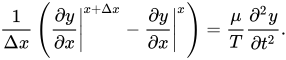
In the limit that approaches zero, the left hand side is the definition of the second derivative of ,

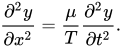
this equation is known as the wave equation, and the coefficient of the second time derivative term is equal to ; thus

Where is the speed of propagation of the wave in the string. However, this derivation is only valid for small amplitude vibrations; for those of large amplitude, is not a good approximation for the length of the string piece, the horizontal component of tension is not necessarily constant. The horizontal tensions are not well approximated by .

Frequency of the wave

[edit]

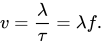
Once the speed of propagation is known, the frequency of the sound produced by the string can be calculated. The speed of propagation of a wave is equal to the wavelength divided by the period , or multiplied by the frequency :

If the length of the string is , the fundamental harmonic is the one produced by the vibration whose nodes are the two ends of the string, so is half of the wavelength of the fundamental harmonic. Hence one obtains Mersenne's laws:

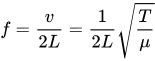
where is the tension (in Newtons), is the linear density (that is, the mass per unit length), and is the length of the vibrating part of the string. Therefore:

  • the shorter the string, the higher the frequency of the fundamental
  • the higher the tension, the higher the frequency of the fundamental
  • the lighter the string, the higher the frequency of the fundamental

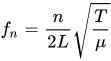
Moreover, if we take the nth harmonic as having a wavelength given by , then we easily get an expression for the frequency of the nth harmonic:

And for a string under a tension T with linear density , then
Observing string vibrations

[edit]

One can see the waveforms on a vibrating string if the frequency is low enough and the vibrating string is held in front of a CRT screen such as one of a television or a computer (not of an analog oscilloscope). This effect is called the stroboscopic effect, and the rate at which the string seems to vibrate is the difference between the frequency of the string and the refresh rate of the screen. The same can happen with a fluorescent lamp, at a rate that is the difference between the frequency of the string and the frequency of the alternating current. (If the refresh rate of the screen equals the frequency of the string or an integer multiple thereof, the string will appear still but deformed.) In daylight and other non-oscillating light sources, this effect does not occur and the string appears still but thicker, and lighter or blurred, due to persistence of vision.

A similar but more controllable effect can be obtained using a stroboscope. This device allows matching the frequency of the xenon flash lamp to the frequency of vibration of the string. In a dark room, this clearly shows the waveform. Otherwise, one can use bending or, perhaps more easily, by adjusting the machine heads, to obtain the same, or a multiple, of the AC frequency to achieve the same effect. For example, in the case of a guitar, the 6th (lowest pitched) string pressed to the third fret gives a G at 97.999 Hz. A slight adjustment can alter it to 100 Hz, exactly one octave above the alternating current frequency in Europe and most countries in Africa and Asia, 50 Hz. In most countries of the Americas—where the AC frequency is 60 Hz—altering A# on the fifth string, first fret from 116.54 Hz to 120 Hz produces a similar effect.

See also

[edit]

References

[edit]
[edit]
Revisions and contributorsEdit on WikipediaRead on Wikipedia
from Grokipedia
String vibration refers to the transverse oscillatory motion of a taut string under tension, which generates standing waves characterized by fixed nodes and points of maximum displacement known as antinodes.[1] This phenomenon is a cornerstone of classical physics, illustrating the propagation of mechanical waves along a medium with linear mass density, and it underpins the production of sound in stringed musical instruments such as guitars and violins.[2] The vibrations of a string are governed by the one-dimensional wave equation, where the speed of the wave $ v = \sqrt{T / \mu} $, with $ T $ representing the tension in the string and $ \mu $ the linear mass density.[1] In the fundamental mode, the wavelength is twice the length of the string $ L $, yielding the lowest frequency $ f_1 = \frac{1}{2L} \sqrt{T / \mu} $.[1] Higher modes, or harmonics, occur at integer multiples of this fundamental frequency, $ f_n = n f_1 $ for $ n = 1, 2, 3, \dots $, producing a harmonic series of overtones that determine the timbre of the sound.[3] These standing wave patterns arise from the interference of waves traveling in opposite directions along the string, with nodes at the endpoints and additional interior points dividing the string into equal segments for each harmonic.[3] Factors such as string stiffness can cause deviations from ideal harmonic behavior in real-world applications, though the ideal model suffices for most introductory analyses.[1] Understanding string vibrations extends to broader wave mechanics, influencing fields from acoustics to engineering.[2]

Fundamentals of String Waves

Transverse Wave Motion

In transverse waves on a string, the particles of the medium oscillate perpendicular to the direction of wave propagation, resulting in a displacement that is vertical or horizontal relative to the string's length.[4] This perpendicular motion distinguishes transverse waves from longitudinal waves, where particle displacement aligns with the propagation direction.[5] Waves on a string are typically initiated by plucking, which displaces a portion of the string transversely, or by bowing, which applies frictional force to sustain oscillation and propagate the disturbance along the string. Once initiated, the disturbance travels as a series of connected oscillations, with each segment of the string passing the motion to its neighbors through tension forces. The propagation relies on the string's tension, which provides the restoring force, and its linear density, the mass per unit length; qualitatively, waves propagate faster on highly taut strings with low linear density, as the reduced inertia allows quicker response to tension.[6] The energy carried by these transverse waves alternates between kinetic energy, arising from the transverse velocity of string particles, and potential energy, stored in the slight stretching of the string beyond its equilibrium length under tension.[7] This energy transfer occurs without net displacement of the string material along the propagation direction, conserving the wave's form as it moves.[8] Early observations of string vibrations trace back to Pythagoras around 500 BCE, who experimented with a monochord—a single-string instrument—to relate vibrating string lengths to musical harmonies, laying foundational insights into wave behavior in musical contexts.[9] These experiments highlighted how transverse vibrations produce audible tones, influencing later studies in acoustics and wave physics.[10]

Factors Influencing Wave Propagation

The linear mass density, denoted as μ and defined as the mass per unit length of the string, plays a crucial role in determining the speed of wave propagation, with higher values of μ leading to slower wave speeds due to increased inertia resisting the motion.[11] This inverse relationship arises because denser strings require more force to accelerate segments during vibration, thereby reducing the overall propagation velocity.[12] Tension, represented as T, serves as the primary restoring force in string vibrations, pulling displaced segments back toward equilibrium and directly influencing wave speed.[13] Increasing the tension, such as by tightening a string, accelerates the restoring action, resulting in faster wave propagation; for instance, doubling the tension can increase the speed proportionally to the square root of two.[11] The combined influence of tension and linear mass density governs wave speed through a qualitative scaling proportional to the square root of T/μ, where higher tension boosts speed while greater density diminishes it.[12] In practical applications like guitar strings, this scaling explains why thin, high-tension strings produce faster waves and higher pitches compared to thicker, looser ones, allowing musicians to tune instruments by adjusting tension to alter propagation characteristics.[1] Damping mechanisms, including air resistance and internal friction within the string material, cause the wave amplitude to decay exponentially over distance, dissipating energy and limiting propagation.[13] Air damping arises from viscous drag on the oscillating string, while internal friction involves material hysteresis that converts vibrational energy to heat, with both effects more pronounced in higher-frequency modes.[13] Environmental factors further modulate wave propagation, with temperature affecting the string's elasticity through changes in Young's modulus, which can alter tension and damping rates in fixed-length setups.[13] Gravity plays a minor role, primarily negligible in horizontal taut strings where tension dominates, though in horizontal configurations it may introduce slight sagging that subtly impacts equilibrium shape, and in vertical configurations it creates a tension gradient along the length, without significantly altering speed.[14][15]

Mathematical Modeling

Derivation of the Wave Equation

The derivation of the wave equation for string vibrations begins with key assumptions about the physical system. The string is modeled as uniform and flexible, with constant linear mass density μ\mu (mass per unit length) and under constant tension TT, while neglecting gravity and friction. Transverse displacements are assumed to be small, allowing a linear approximation where the tension direction remains nearly horizontal and the string's length does not change significantly.[16] To derive the equation, consider a small segment of the string between positions xx and x+Δxx + \Delta x at time tt, with transverse displacement y(x,t)y(x, t). The net transverse force on this segment arises from the difference in the vertical components of tension at its ends. The slope at xx is y/x\partial y / \partial x, and at x+Δxx + \Delta x it is y/x+(2y/x2)Δx\partial y / \partial x + (\partial^2 y / \partial x^2) \Delta x. For small angles, the vertical force components are approximately Ty/xT \partial y / \partial x at xx (downward if positive) and T(y/x+(2y/x2)Δx)-T (\partial y / \partial x + (\partial^2 y / \partial x^2) \Delta x) at x+Δxx + \Delta x (upward). The net upward force is thus T(2y/x2)ΔxT (\partial^2 y / \partial x^2) \Delta x. By Newton's second law, this equals the mass of the segment μΔx\mu \Delta x times its transverse acceleration 2y/t2\partial^2 y / \partial t^2. Dividing by Δx\Delta x and taking the limit as Δx0\Delta x \to 0 yields the one-dimensional wave equation:
2yt2=Tμ2yx2. \frac{\partial^2 y}{\partial t^2} = \frac{T}{\mu} \frac{\partial^2 y}{\partial x^2}.
Here, y(x,t)y(x, t) represents the transverse displacement as a function of position xx and time tt; the second spatial derivative 2y/x2\partial^2 y / \partial x^2 captures the curvature of the string, which determines the restoring force, while the second temporal derivative 2y/t2\partial^2 y / \partial t^2 represents the acceleration of the segment. The coefficient T/μT / \mu defines the square of the wave speed v=T/μv = \sqrt{T / \mu}, where higher tension increases speed and higher density decreases it.[16][17] This equation predicts non-dispersive waves, meaning the propagation speed vv is constant and independent of frequency or wavelength, allowing arbitrary wave shapes to travel without distortion. Solutions of the form y(x,t)=f(xvt)+g(x+vt)y(x, t) = f(x - v t) + g(x + v t) represent right- and left-propagating waves, respectively, confirming uniform speed for all components.[16] The linear wave equation has limitations, as it neglects longitudinal waves along the string and assumes small amplitudes where nonlinear effects—such as amplitude-dependent tension variations or geometric stiffening—do not arise. For large displacements, these nonlinearities lead to coupled equations for transverse and longitudinal motion, altering wave behavior.[18]

Standing Waves and Boundary Conditions

The general solution to the one-dimensional wave equation describing transverse vibrations on a string consists of the superposition of two arbitrary traveling waves propagating in opposite directions along the string:
y(x,t)=f(xvt)+g(x+vt), y(x,t) = f(x - vt) + g(x + vt),
where $ f(x - vt) $ represents a wave traveling to the right, $ g(x + vt) $ a wave to the left, and $ v $ is the speed of propagation determined by the string's tension and linear mass density.[19] This form arises from the linearity of the wave equation, allowing any solution to be decomposed into forward and backward components.[20] Standing waves emerge on a finite string when an incident traveling wave reflects from the boundaries and superposes with the reflected wave, resulting in a stationary interference pattern where the shape of the wave does not propagate but oscillates in place.[21] For a string of length $ L $ fixed at both ends, the boundary conditions impose $ y(0,t) = 0 $ and $ y(L,t) = 0 $ for all times $ t $, ensuring zero transverse displacement at these points.[19] These constraints quantize the possible wave patterns, yielding sinusoidal spatial modes of the form $ \sin\left(\frac{n\pi x}{L}\right) $ for positive integers $ n $, which satisfy the boundary conditions exactly.[20] The full standing wave solution for the $ n $-th mode is then
yn(x,t)=Bnsin(nπxL)cos(ωnt+ϕn), y_n(x,t) = B_n \sin\left(\frac{n\pi x}{L}\right) \cos(\omega_n t + \phi_n),
where $ B_n $ is the mode amplitude, $ \omega_n $ the angular frequency, and $ \phi_n $ a phase constant.[19] In these standing wave modes, nodes—points of zero displacement—occur at the fixed ends ($ x = 0 $ and $ x = L $) and at intermediate positions $ x = \frac{m L}{n} $ for integers $ m = 0, 1, \dots, n $, dividing the string into $ n $ equal segments.[21] Antinodes, where the displacement reaches maximum amplitude, are located midway between consecutive nodes; for the fundamental mode ($ n=1 ),thisoccursatthestringscenter(), this occurs at the string's center ( x = L/2 $).[19] Higher modes feature more nodes and antinodes, creating increasingly complex spatial patterns while maintaining the boundary-imposed zeros.[20] The standing wave solutions correspond to normal modes of vibration, which are orthogonal in the spatial domain because the functions $ \sin\left(\frac{n\pi x}{L}\right) $ form a complete orthogonal set over the interval $ [0, L] $.[19] This orthogonality ensures that each mode can be excited independently, with vibrations in one mode not coupling to others under free evolution.[20] The temporal evolution of each mode is purely harmonic, governed by the cosine term with its associated frequency and phase.[21] Due to the linearity and orthogonality of the normal modes, the total energy of the string's vibration is distributed among the modes such that each mode's energy remains constant over time, with no exchange between modes absent external perturbations like driving forces.[19] This modal energy conservation arises from the absence of nonlinear terms in the wave equation, preserving the integrity of individual mode contributions to the overall motion.[20]

Vibrational Frequencies

Fundamental and Harmonic Frequencies

The fundamental frequency of a vibrating string, denoted as $ f_1 $ for the first mode ($ n=1 $), represents the lowest oscillation rate and is given by the formula
f1=12LTμ, f_1 = \frac{1}{2L} \sqrt{\frac{T}{\mu}},
where $ L $ is the length of the vibrating string, $ T $ is the tension, and $ \mu $ is the linear mass density (mass per unit length).[22] This mode corresponds to a standing wave with a wavelength $ \lambda_1 = 2L $, featuring nodes at both fixed ends and a single antinode in the middle.[22] In ideal strings assumed to be perfectly flexible, higher modes produce harmonic frequencies $ f_n = n f_1 $ for integer values of $ n \geq 2 ,formingaharmonicserieswhereeachovertoneisanintegermultipleofthefundamental.[](https://www.physicsclassroom.com/class/sound/lesson4/fundamentalfrequencyandharmonics)Theseovertonescontributetothetimbreofthesound,withthesecondharmonic(, forming a harmonic series where each overtone is an integer multiple of the fundamental.[](https://www.physicsclassroom.com/class/sound/lesson-4/fundamental-frequency-and-harmonics) These overtones contribute to the timbre of the sound, with the second harmonic ( n=2 $) at twice the fundamental frequency, the third at three times, and so on.[23] In real strings, stiffness introduces slight deviations from perfect harmonicity, known as inharmonicity, which causes the observed frequencies to stretch upward, particularly in higher modes.[24] The frequency for the $ n $-th mode is
fn=nf11+Bn2, f_n = n f_1 \sqrt{1 + B n^2},
with the approximation for small $ B n^2 $ given by
fnnf1(1+Bn22), f_n \approx n f_1 \left(1 + \frac{B n^2}{2}\right),
where $ B $ is the inharmonicity coefficient, a small positive value that depends on the string's material stiffness, radius, and length, with larger $ B $ for shorter and thicker strings.[25] This effect is more pronounced in instruments with wound or stiff strings, altering the perceived timbre but typically remaining subtle enough not to disrupt musical harmony.[24] These frequencies directly relate to pitch perception in musical contexts, where the fundamental determines the note's identity, and overtones enrich the tone.[26] For example, the open A string on a standard guitar is tuned to A4 at 440 Hz, the internationally adopted concert pitch reference.[27] String properties significantly influence $ f_1 $: decreasing $ L $ or increasing $ T $ raises the frequency, as seen in violins with shorter strings (~32.5 cm) producing higher pitches like A4 at 440 Hz under moderate tension, compared to double basses with much longer strings (~110 cm) yielding lower fundamentals like E1 at ~41 Hz despite similar or higher tensions to maintain playability.[28]

Wavelength and Mode Relationships

In the ideal case of a vibrating string fixed at both ends, the wavelength λn\lambda_n of the nnth mode is given by λn=2Ln\lambda_n = \frac{2L}{n}, where LL is the string length and nn is a positive integer representing the mode number. This relation arises because the boundary conditions require nodes at both ends, allowing exactly nn half-wavelengths to fit along the string length.[29][30] The mode shapes correspond to distinct spatial displacement patterns. For the fundamental mode (n=1n=1), the string forms a single smooth arch with an antinode at the center and nodes only at the ends, representing half a wavelength along the full length. In the second harmonic (n=2n=2), the pattern consists of two arches separated by a node at the midpoint, with antinodes on either side of the central node.[31][23] Higher modes exhibit increasingly intricate shapes, with n1n-1 interior nodes dividing the string into nn oscillating segments or loops. These configurations produce complex patterns of antinodes and nodes, which can be visualized experimentally through methods such as high-speed imaging or stroboscopic illumination, revealing the progressive fragmentation of the vibration as nn increases.[31][23] In standing wave modes, the phase relationship ensures that displacements on opposite sides of any node are 180 degrees out of phase, causing adjacent segments to oscillate in antiphase. When two or more modes are excited simultaneously, their superposition results in a combined waveform where the phase differences and frequency separations produce amplitude modulations known as beat frequencies, with the beat rate equal to the difference in the mode frequencies.[29][32] For non-ideal strings, material properties introduce dispersive effects, particularly from bending stiffness, which alters the wavelength-frequency relation for higher modes. At high frequencies, this stiffness dominates tension, causing wave speed to increase with frequency (proportional to the square root of frequency), resulting in slightly shorter wavelengths than predicted by the ideal formula and an inharmonic overtone series observable in instruments like pianos.[33][34]

Experimental Observation

Visual and Stroboscopic Techniques

One of the earliest advancements in visualizing string vibrations occurred in the 19th century with the development of indirect methods, such as Rudolph Koenig's manometric flames, which captured acoustic pressure variations from the sound produced by a vibrating string, allowing observation of waveform patterns through flame distortions. These techniques, refined in the 1860s, provided a means to study vibrational harmonics indirectly by linking string motion to audible outputs, though they required controlled acoustic environments to isolate effects.[35] Melde's experiment, devised by German physicist Franz Melde in 1862, offers a direct classical approach to observing standing waves on a taut string driven by a tuning fork.[36] In the setup, one end of the string is attached to a prong of the tuning fork, while the other passes over a pulley to a hanging weight that provides tension; the fork is oriented either transversely, with prong motion perpendicular to the string length (resulting in the string vibrating at the same frequency as the fork), or longitudinally, with prong motion parallel to the string (resulting in the string vibrating at half the frequency of the fork, completing one full vibration for every two fork cycles and forming plectrum loops).[37] By adjusting tension via weights, resonant modes become visible as distinct loops between nodes, enabling measurement of frequency relationships and wave propagation without complex instrumentation. This method highlights how boundary conditions influence mode shapes, such as the formation of multiple loops corresponding to higher harmonics.[38] Stroboscopic illumination provides another foundational technique for capturing the dynamic motion of vibrating strings, originating from inventions in the 1830s by Simon von Stampfer and Joseph Plateau.[39] A strobe light with adjustable flash frequency is directed at the string; when the flash rate matches or is a submultiple of the vibration frequency, the motion appears frozen, clearly delineating node positions (stationary points) and antinodes (maximum displacement points) along the string.[40] For instance, at half the fundamental frequency, the string may appear to vibrate in a single loop, revealing the central node, while higher submultiples expose multiple nodal patterns. This approach is particularly effective in laboratory settings for demonstrating wave superposition and has been used since the late 19th century to verify theoretical mode structures experimentally.[41] Despite their accessibility, these visual and stroboscopic techniques have notable limitations, including motion blurring at high frequencies due to the human eye's persistence of vision, which obscures fine nodal details. Stroboscopic methods often necessitate darkened rooms to enhance contrast from the flashing light, potentially causing visual discomfort or seizures in sensitive observers.[42] High-tension setups, common in Melde's experiment to achieve clear resonances, carry safety risks, as excessive weights can cause the string to snap violently, injuring nearby users; precautions include gradual tension increases, protective barriers, and avoiding overload beyond the string's breaking strength, typically monitored by observing loop stability.[43]

Modern Measurement Methods

Modern measurement methods for string vibrations leverage advanced optical, acoustic, and computational technologies to achieve non-contact, high-precision quantification of motion, velocity, amplitude, and frequency content, surpassing traditional visual techniques in accuracy and scope.[44] Laser Doppler vibrometry (LDV) employs a non-contact optical approach to measure the velocity and amplitude of string vibrations by detecting the Doppler shift in laser light scattered from the string's surface, producing interference patterns that reveal motion with picometer resolution.[45] This method is particularly effective for transversal vibrations, capturing data along the string's length via scanning configurations, and supports frequency ranges up to 1 MHz, enabling analysis of high-order harmonics in musical strings.[46] For instance, scanning LDV has been used to perform modal testing on vibrating structures like guitar strings, identifying mode shapes and natural frequencies with sub-micrometer precision.[47] High-speed cameras provide full-field visualization and quantitative analysis of string mode shapes by recording motion at frame rates exceeding 10,000 frames per second, such as 44,100 fps in line-scan setups for multiphonic string vibrations.[48] Displacements are computed using optical flow algorithms, like the pyramidal Lucas-Kanade method, achieving subpixel accuracy, followed by Fourier transform to extract frequency spectra and correlate vibrations to harmonic modes.[49] This technique excels in capturing transient and nonlinear behaviors in axially moving strings, such as those in bowed instruments, where mode shapes are identified via poly-reference least-squares complex frequency-domain methods.[49] Acoustic sensors, including microphones and accelerometers, detect the sound radiated by vibrating strings or directly sense contact vibrations, allowing correlation of motion to harmonic content through fast Fourier transform (FFT) analysis.[50] Microphones capture airborne pressure waves from string oscillations, while MEMS accelerometers serve as pickups on instruments like guitars, measuring accelerations up to 21 kHz to reveal partial frequencies and inharmonicity.[51] FFT processing decomposes these signals into frequency-domain representations, identifying dominant harmonics and their amplitudes for precise tonal analysis.[50] Finite element simulations computationally model vibrations in non-uniform strings, discretizing the structure into elements to solve for dynamic responses under varying tension, stiffness, and geometry.[52] This method addresses complexities like winding in piano strings, predicting mode shapes and frequencies for irregular cross-sections where analytical solutions fail.[52] Widely adopted in acoustics, finite element analysis (FEA) integrates material nonlinearity and boundary conditions to simulate realistic instrument behaviors.[52] These methods find key applications in musical instrument design, such as using MATLAB-based Simscape models to analyze piano string inharmonicity, where flexural stiffness causes partial frequencies to deviate as $ f_n \approx f_1 (n + \alpha n^3) $ with α1\alpha \ll 1, guiding tuning adjustments for tonal balance.[53]

References

User Avatar
No comments yet.