Hubbry Logo
Blue lawBlue lawMain
Open search
Blue law
Community hub
Blue law
logo
8 pages, 0 posts
0 subscribers
Be the first to start a discussion here.
Blue law
Blue law
from Wikipedia

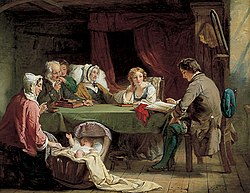
Sabbath Eve, painting by Alexander Johnston

Blue laws (also known as Sunday laws, Sunday trade laws, and Sunday closing laws) are laws restricting or banning certain activities on specified days, usually Sundays in the western world. The laws were adopted originally for religious reasons, specifically to promote the observance of the Christian day of worship. Since then, they have come to serve secular purposes as well.

Blue laws commonly ban certain business and recreational activities on Sundays, and impose restrictions on the retail sale of hard goods and consumables, particularly alcoholic beverages.[1][2] The laws also place limitations on a range of other endeavors—including travel, fashions, hunting, professional sports, stage performances, movie showings, and gambling.[3][4] While less prevalent today, blue laws continue to be enforced in parts of the United States and Canada as well as in European countries, such as Austria, Germany, Norway, and Poland, where most stores are required to close on Sundays.[3][5][6][7][8]

In the United States, the Supreme Court has upheld blue laws as constitutional despite their religious origins if supported by secular justifications. This has resulted to the provision of a day of rest for the general population.[9][10] Meanwhile, various state courts have struck down the laws as either unenforceable or in violation of their states' constitutions. In response, state legislators have re-enacted certain Sunday laws to satisfy the rulings while allowing some of the other statutes to remain on the books with no intention to enforce them.[11][failed verification]

History

[edit]

The Roman Emperor Constantine promulgated the first known law regarding prohibition of Sunday labour for apparent religion-associated reasons in A.D. 321:

On the venerable Day of the Sun let the magistrates and people residing in cities rest, and let all workshops be closed.

— Codex Justinianus, lib. 3, tit. 12, 3

The earliest laws in North America addressing Sunday activities and public behavior were enacted in the Jamestown Colony in 1619 by the first General Assembly of Virginia. Among the 70 laws passed by the assembly was a mandate requiring attendance by all colonists at both morning and afternoon worship services on Sundays. The laws adopted that year also included provisions addressing idleness, gambling, drunkenness, and excessive apparel.[12] Similar laws aimed at keeping the Sabbath holy and regulating morals were soon adopted throughout the colonies.[13]

The first known example of the phrase "blue laws" in print was in the March 3, 1755, edition of the New-York Mercury, in which the writer imagines a future newspaper praising the revival of "our [Connecticut's] old Blue Laws".[14] In his 1781 book General History of Connecticut, the Reverend Samuel Peters (1735–1826) used the phrase to describe numerous laws adopted by 17th-century Puritans that prohibited various activities on Sunday, recreational as well as commercial.[15] Beyond that, Peters' book is regarded as an unreliable account of the laws and probably was written to satirize their puritanical nature.[16]

While the historical roots of Sunday trade laws in the United States are generally known, the origin of the term "blue laws" remains a mystery. According to a Time magazine editorial in 1961, the year the Supreme Court heard four cases on the issue, the color blue came to be associated with colonial laws in opposition to the red emblem of British royalty.[17] Other explanations have been offered. One of the most widely circulated is that early blue laws adopted in Connecticut were printed on blue paper. However, no copies have been found that would support this claim and it is not deemed credible.[18] A more plausible explanation, one that is gaining general acceptance, is that the laws adopted by Puritans were aimed at enforcing morality and thus were "blue-nosed", though the term "blue" may have been used in the vernacular of the times as a synonym for puritanism itself, in effect, overly strict.[16][2]

As Protestant moral reformers organized the Sabbath reform in 19th-century America, calls for the enactment and enforcement of stricter Sunday laws developed. Numerous Americans were arrested for working, keeping an open shop, drinking alcohol, traveling, and engaging in recreational activities on Sundays. Erwin Fahlbusch and Geoffrey William Bromiley write that throughout their existence, organizations advocating first-day Sabbatarianism, such as the Lord's Day Alliance in North America and the Lord's Day Observance Society in the British Isles, were supported by labor unions in lobbying "to prevent secular and commercial interests from hampering freedom of worship and from exploiting workers".[19]

In Canada, the Ligue du Dimanche, a Roman Catholic Sunday league, supported the Lord's Day Act in 1923 and promoted first-day Sabbatarian legislation.[20][failed verification][21] Beginning in the 1840s, workers, Jews, Seventh Day Baptists, freethinkers, and other groups began to organize opposition. Throughout the century, Sunday laws fueled church–state controversy, and as an issue that contributed to the emergence of modern American minority-rights politics.[22] On the other hand, the more recent Dies Domini, written by Pope John Paul II in 1998, advocates Sunday legislation in that it protects civil servants and workers; the North Dakota Catholic Conference in 2011 likewise maintained that blue laws, in accordance with the Compendium of the Social Doctrine of the Church, "ensure that, for reasons of economic productivity, citizens are not denied time for rest and divine worship".[23] Similarly, Chief Justice Earl Warren, while recognizing the partial religious origin of blue laws, acknowledged the "secular purpose they served by providing a benefit to workers at the same time that they enhanced labor productivity".[24]

Laws by jurisdiction

[edit]

Europe

[edit]
A map of Europe providing an overview of Sunday shopping laws in each country:

Green: Large supermarkets and shopping centers are generally open on Sundays.
Blue: Large supermarkets are allowed to be open for no more than 6 hours on Sundays.
Red: Large supermarkets are generally closed on Sundays.

Germany

[edit]

The Ladenschlussgesetz ("shop closing law") on Sundays and public holidays have been in effect since 1956.

Denmark

[edit]

In Denmark the closing laws restricting retail trade on Sundays were effectively abolished on October 1, 2012. Retail trade is only restricted on public holidays (New Year's Day, Maundy Thursday, Good Friday, Easter Sunday, Easter Monday, Day of Prayer, Ascension Day, Whit Sunday, Whit Monday, Christmas Day and Boxing Day) and on Constitution Day, Christmas Eve and New Year's Eve (on New Year's Eve from 3 pm only). On these days almost all shops will remain closed. Exempt are bakeries, DIYs, garden centres, gas stations and smaller supermarkets.[25]

England and Wales

[edit]
Before 1994
[edit]

Prior to 1994, trading laws forbade sale of certain products on a Sunday; the distinction between those that could and could not be sold was increasingly seen as arbitrary, and the laws were inadequately enforced and widely flouted. For example, some supermarkets would treat the relatively modest fines arising as a business cost and open nonetheless.[26]

Since 1994
[edit]

The Sunday Trading Act 1994 relaxed restrictions on Sunday trading. This produced vocal opposition from bodies such as the Keep Sunday Special campaign, and the Lord's Day Observance Society: on religious grounds, on the grounds that it would increase consumerism, and that it would reduce shop assistants' weekend leisure time.

The legislation permits large shops (those with a relevant floor area in excess of 280 square metres; 3000 sq. ft.) to open for up to six hours on Sunday. Small shops, those with an area of below 280 square metres (3000 sq. ft.), are free to set their own Sunday trading times. Some large shops, such as off-licences, service stations and garages, are exempt from the restrictions.

Some very large shops (e.g. department stores) open for longer than six hours on a Sunday by allowing customers in to browse 30 minutes prior to allowing them to make a purchase, since the six-hour restriction only applies to time during which the shop may make sales.

Christmas Day and Easter Sunday are non-trading days. This applies even to garden centres, which earlier had been trading over Easter, but not to small shops (those with an area of below 280 square metres; 3000 sq. ft.).[27]

Netherlands

[edit]

Prior to 1996, shops were generally closed on Sundays. A new law (store time law [nl]) regarding opening times changed that and leaves that decision mostly up to local municipalities. This law was changed several times since.

The Zondagswet[28] (“Sunday law (in the Netherlands) [nl]”), a law on Sabbath desecration, is mainly to ensure that church services remain undisturbed on Sundays and Christian holidays. It forbids public festivities on a Sunday before 13:00, as well as making noise that carries farther than 200 metres (220 yd), but activities that are unlikely to disturb church services are exempt.

Northern Ireland

[edit]

Prior to 2008, no football was permitted to be played on Sundays by clubs affiliated to the Irish Football Association in Northern Ireland.[29]

Shops with a floor area of over 280 square metres (3,000 sq ft) may only open from 1 to 6pm on Sundays.[30]

In Belfast, public playgrounds were closed on Sundays until 1965. Swings in public parks were tied up and padlocked to prevent their use.[31][32] Similar laws formerly applied to cinemas, pubs and parks.[33]

Poland

[edit]

Since 2007, blue laws were enacted and resulted in stores closing on the 13 state holidays in Poland – these are both religious and secular days of rest. In 2014, an initiative by the Law and Justice party failed to pass the reading in the Sejm to ban trading on Sundays and state holidays. However, since 2018, the ruling government and the President of Poland has signed a law that restricts store trading from March 1, 2018, to the first and last Sunday of the month, Palm Sunday, the 3rd and 4th Advent Sundays, as well as trading until 14.00 for Easter Saturday and Christmas Eve.

In 2019, the restriction was extended, and trading was permitted solely on the last Sunday of the month, as well as Palm Sunday, the 3rd and 4th Advent Sundays, as well as trading until 14.00 for Easter Saturday and Christmas Eve. From 2020, stores may only be open on seven Sundays in the year: Palm Sunday, the 3rd and 4th Advent Sundays, the last Sunday of January, April, June and August as well as trading until 14.00 for Easter Saturday and Christmas Eve.[34] As a result of restrictions in connection with the COVID-19 pandemic, the 2nd Advent Sunday was later added as a shopping day.[35]

North America

[edit]

Canada

[edit]
Sunday laws in Ontario, 1911

The Lord's Day Act, which since 1906 had prohibited business transactions from taking place on Sundays, was declared unconstitutional in the 1985 case R. v. Big M Drug Mart Ltd. Calgary police officers witnessed several transactions at the Big M Drug Mart, all of which occurred on a Sunday. Big M was charged with a violation of the Lord's Day Act. A provincial court ruled that the Lord's Day Act was unconstitutional, but the Crown proceeded to appeal all the way to the Supreme Court of Canada. In a unanimous 6–0 decision, the Lord's Day Act was ruled an infringement of the freedom of conscience and religion defined in section 2(a) of the Charter of Rights and Freedoms.[36]

A Toronto referendum in 1950 allowed only team sports to be played professionally on Sunday. Theatre performances, movie screenings, and horse racing were not permitted until the 1960s.[37]

The Supreme Court later concluded, in R. v. Edwards Books and Art Ltd. [1986] (2 S.C.R. 713), that Ontario's Retail Business Holiday Act, which required some Sunday closings, did not violate the Charter because it did not have a religious purpose. Nonetheless, as of today, virtually all provincial Sunday closing laws have ceased to exist. Some were struck down by provincial courts, but most were simply abrogated,[38] often due to competitive reasons where out-of-province or foreign merchants were open.

United States

[edit]

In the United States, judges have defended blue laws "in terms of their secular benefit to workers", holding that "the laws were essential to social well-being".[39] In 1896, Supreme Court Justice Stephen Johnson Field, opined with regard to Sunday blue laws:[39]

Its requirement is a cessation from labor. In its enactment, the legislature has given the sanction of law to a rule of conduct, which the entire civilized world recognizes as essential to the physical and moral well-being of society. Upon no subject is there such a concurrence of opinion, among philosophers, moralists and statesmen of all nations, as on the necessity of periodical cessation from labor. One day in seven is the rule, founded in experience and sustained by science. ... The prohibition of secular business on Sunday is advocated on the ground that by it the general welfare is advanced, labor protected, and the moral and physical well-being of society promoted.

— Hennington v. Georgia, 163 U.S. 299 (1896)[40]

Many states prohibit selling alcohol for on and off-premises sales in one form or another on Sundays at some restricted time, under the idea that people should be in church on Sunday morning, or at least not drinking.[41][42]

Many blue laws in the United States restrict the purchase of particular items on Sundays. Some of these laws restrict the ability to buy cars, groceries, office supplies, and housewares among other things. Though most of these laws have been relaxed or repealed in most states, they are still enforced in some other states.

In Texas, for example, blue laws prohibited selling housewares such as pots, pans, and washing machines on Sunday until 1985. In Colorado, Illinois, Indiana, Iowa, Louisiana, Maine, Minnesota, Missouri, Oklahoma, New Jersey, North Dakota, Pennsylvania, and Wisconsin, car dealerships continue to operate under blue-law prohibitions in which an automobile may not be purchased or traded on a Sunday. Maryland permits Sunday automobile sales only in the counties of Charles, Prince George's, Montgomery, and Howard; similarly, Michigan restricts Sunday sales to only those counties with a population of less than 130,000. Texas and Utah prohibit car dealerships from operating over consecutive weekend days. In some cases, these laws were created or retained with the support of those whom they affected, to allow them a day off each week without fear of their competitors still being open.[43]

Blue laws may also prohibit retail activity on days other than Sunday. In Massachusetts,[44] Rhode Island, and Maine,[45] for example, blue laws prohibit most retail stores, including grocery stores, from opening on Thanksgiving and Christmas.[46]

Research regarding the effect of the repeal of blue laws has been conducted, with Professor Elesha Coffman of Baylor University writing:[47]

Regarding culture, the impact of vanishing blue laws could be larger. A study in New Mexico in 2006 found a sharp increase in drunken driving on Sundays after that state dropped its Sunday ban on packaged alcohol sales. A broader study published by MIT and Notre Dame economists in 2008 found that the repeal of blue laws led to decreased church attendance, decreased donations to churches, and increased alcohol and drug use among religious individuals. These wide-ranging effects cannot easily be pinpointed to specific causes, but one of the latter study's authors, Daniel Hungerman, suggested to Christianity Today that blue laws might have been fulfilling their original intent, to keep people pious.[47]

Court cases
[edit]

Beginning in the mid-19th century, religious and ethno-cultural minorities arrested for violating state and local blue laws appealed their convictions to state supreme courts. In Specht v. Commonwealth (Pa. 1848), for example, German Seventh Day Baptists in Pennsylvania employed attorney Thaddeus Stevens to challenge the constitutionality of Pennsylvania's Sunday law.[48] As in cases in other states, litigants pointed to the provisions of state constitutions protecting religious liberty and maintained that Sunday laws were a blatant violation. Though typically unsuccessful (most state supreme courts upheld the constitutionality of Sunday laws), these constitutional challenges helped set a pattern by which subsequent minorities would seek to protect religious freedom and minority rights.[49]

The Supreme Court of the United States held in its landmark case, McGowan v. Maryland (1961), that Maryland's blue laws violated neither the Free Exercise Clause nor the Establishment Clause of the First Amendment to the United States Constitution.[50] It approved the state's blue law restricting commercial activities on Sunday, noting that while such laws originated to encourage attendance at Christian churches, the contemporary Maryland laws were intended to serve "to provide a uniform day of rest for all citizens" on a secular basis and to promote the secular values of "health, safety, recreation, and general well-being" through a common day of rest. That this day coincides with Christian Sabbath is not a bar to the state's secular goals; it neither reduces its effectiveness for secular purposes nor prevents adherents of other religions from observing their own holy days.[51]

McGowan was but one of four Sunday closing cases decided together by the Court in May 1961. In Gallagher v. Crown Kosher Super Market of Mass., Inc.,[52] the Court ruled against a Kosher deli that closed on Saturday but was open on Sunday. The other two cases were Braunfeld v. Brown,[53] and Two Guys from Harrison-Allentown, Inc. v. McGinley.[54][55] Chief Justice Earl Warren declared that "the State seeks to set one day apart from all others as a day of rest, repose, recreation and tranquility--a day which all members of the family and community have the opportunity to spend and enjoy together, a day on which there exists relative quiet and disassociation from the everyday intensity of commercial activities, a day on which people may visit friends and relatives who are not available during working days".[24]

In March 2006, Texas judges upheld the state blue law that requires car dealerships to close either Saturday or Sunday each weekend.[56]

Oceania

[edit]

Cook Islands and Niue

[edit]

Blue laws also exist in the Polynesian islands of Cook Islands and Niue. In the Cook Islands, these were the first written legislation, enacted by the London Missionary Society in 1827, with the consent of the ariki (chiefs). Laws in Niue ban certain activities on Sunday, reflecting the country's history of observing the Christian Sabbath tradition.

Tonga

[edit]

In the Kingdom of Tonga, the Vavaʻu Code (1839) was a form of blue law inspired by the teachings of Methodist missionaries. With the inauguration of the Tongan Constitution on June 4, 1875, the sixth clause stipulates: "The Sabbath Day shall be kept holy in Tonga and no person shall practise his trade or profession or conduct any commercial undertaking on the Sabbath Day except according to law; and any agreement made or witnessed on that day shall be null and void and of no legal effect."

See also

[edit]

References

[edit]

Bibliography

[edit]
[edit]
Revisions and contributorsEdit on WikipediaRead on Wikipedia
from Grokipedia
Blue laws are statutes that restrict or prohibit specific commercial, recreational, and entertainment activities on Sundays, primarily to enforce observance of the Christian by limiting work, sales, and public amusements. Originating in early colonial America, such as Virginia's 1610 ordinance mandating rest under penalty of death for repeat violations, these laws drew from European Sabbatarian traditions to align civil order with the Fourth Commandment's proscription against labor on the . Enacted across the original to curb vice and promote moral discipline amid frontier challenges, they reflected Puritan and Protestant influences prioritizing communal piety over individual commerce, though the term "blue laws" itself—possibly alluding to printing on blue paper or somber connotations—emerged later in the without definitive . In the post-independence era, blue laws proliferated as states codified closures for retail, liquor sales, and even automobile dealerships, with every state except retaining some form by the mid-20th century to foster family time and reduce traffic hazards as secular rationales. The U.S. has consistently upheld their constitutionality when justified by non-religious purposes, such as promoting or economic equity for small businesses, despite acknowledged religious roots, as in cases distinguishing ceremonial from regulatory intent. Today, remnants persist unevenly: 13 states ban car sales to prevent competitive disadvantages for family-owned dealers, while alcohol prohibitions affect about one-third of counties, ostensibly to curb though empirical data shows mixed effects on consumption rates. Controversies endure, with critics arguing these holdovers impose economic costs—estimated in billions annually from lost retail revenue—without commensurate benefits in a pluralistic society increasingly skeptical of enforced rest days, prompting repeals in states like for groceries but resistance in "dry" regions citing traffic safety data from eras of limited enforcement. Proponents counter that selective favors large chains over local economies, underscoring tensions between historical moralism and modern market freedoms.

Etymology and Definition

Origins of the Term

The term "blue laws" first appeared in print in a 1755 New York newspaper, referring to the stringent Sabbath observance regulations of the , which were enacted in the mid-17th century under Puritan influence. These laws, rooted in theocratic governance at New Haven and Connecticut settlements, prohibited activities such as labor, commerce, and recreation on Sundays to enforce the Christian . The phrase gained wider currency through Reverend Samuel A. Peters' 1781 book A General History of Connecticut, where he cataloged Connecticut's colonial codes as "blue laws," attributing the name either to their enactment during a zealous "fit of " on a "blue Monday" or to their excessively severe nature, evoking bruising punishment. Peters, an Anglican clergyman known for embellishments and anti-Puritan bias, portrayed the laws as comically draconian, including unverified claims like for kissing one's wife on ; his account, while influential, mixes with selective history and has been critiqued for inaccuracy. The precise remains uncertain, with no definitive primary evidence. A persistent but unsubstantiated folk explanation holds that the laws were printed on paper, possibly for official documents, though archival records from show no such practice specific to these statutes. Alternative derivations suggest "" connoted moral rigidity or puritanical austerity, akin to "blue-nose" for strict Presbyterians or early uses of "" for somber severity in English. By the late , the term extended beyond to denote any analogous restrictions elsewhere in the American colonies and Britain.

Core Characteristics and Scope

Blue laws consist of statutes or ordinances that prohibit or regulate specific activities, primarily commercial and recreational, on or designated religious observance days, with the aim of enforcing a day of rest. These restrictions typically target non-essential retail sales, such as automobiles, , and hardware; alcohol and liquor distribution; and public entertainments like sporting events or theater performances, while permitting exceptions for necessities like groceries, fuel, or emergency services. Historically rooted in Christian observance, the laws' enforcement has often shifted toward secular rationales, including worker protection and traffic reduction, though their scope remains tied to state or local discretion rather than uniform federal mandate. The core scope of blue laws centers on economic curtailment rather than outright bans on all labor, distinguishing them from broader labor regulations; for instance, they may allow pharmacies or hospitals to operate but bar elective retail transactions to minimize Sunday commerce. In practice, prohibitions vary: some jurisdictions limit only "hard" liquor sales after specific hours, while others extend to all alcohol or big-ticket items like appliances, with fines for violations scaling by offense severity. This patchwork application reflects jurisdictional autonomy, where urban areas might relax rules for tourism while rural ones preserve stricter closures. Geographically, blue laws predominantly persist in the United States, where 28 states retain active versions as of 2025, often confined to alcohol sales bans or select retail restrictions rather than comprehensive Sunday shutdowns. For example, prohibits liquor sales on s and major holidays, with beer and wine sales allowed only post-noon under permits. Analogous Sunday trading restrictions operate internationally, particularly in , where regulations limit large and openings to promote rest, though compliance varies: some nations permit full operations, while others cap hours at six or less weekly.

Historical Development

Biblical and Medieval Roots

The foundational principles of blue laws derive from the Biblical commandment in Exodus 20:8–11, which requires observing the seventh day—Saturday in the Jewish tradition—as a day of rest and worship, prohibiting labor to honor God's creation and deliverance from . This Mosaic law, part of the Decalogue, prescribed cessation from servile work, with violations punishable by death under ancient Israelite civil codes (Exodus 31:14–15; Numbers 15:32–36). Early Christians, however, shifted primary observance to , termed the , to commemorate Jesus' resurrection (Acts 20:7; 1:10), viewing it as a fulfillment rather than strict continuation of the Jewish , though New Testament texts like Colossians 2:16–17 and Romans 14:5–6 indicate flexibility in mandating specific days. In the transition to institutionalized , the Roman Emperor Constantine formalized Sunday restrictions in 321 AD via an edict barring urban courts and labor on "the venerable day of the Sun," exempting farm work to sustain , marking the first civil enforcement blending pagan solar reverence with Christian practice. This set a precedent for state-church synergy in , influencing subsequent medieval statutes that expanded prohibitions on , markets, and manual labor to promote , moral order, and rest for the populace. During the medieval era, ecclesiastical councils and secular rulers intensified these measures, often analogizing to Biblical precedents while adapting to feudal economies. The Fourth Lateran Council (1215) urged Sunday as a universal rest day free from servile toil, reinforcing canonical penalties for desecration. In , Anglo-Saxon kings like (c. 871–899) enacted laws forbidding markets and unnecessary work on , with church oversight enforcing compliance through or fines. By the 15th century, urban centers like issued targeted ordinances, such as the 1444 Common Council decree prohibiting bakers, brewers, and other trades from Sunday operations to curb commercial encroachment on religious observance. These provisions reflected a causal interplay of —prioritizing divine rest—and pragmatic , aiming to mitigate social disorder from unchecked labor amid agrarian cycles, though enforcement varied by region and often prioritized clerical authority over uniform civil penalties.

Colonial Era and Early Enforcement

Blue laws emerged prominently in the British North American colonies during the , particularly in Puritan settlements where religious observance of the Christian —Sunday, as the —was enforced through civil legislation to promote moral order and communal piety. In , one of the earliest instances occurred in 1617, when the colony mandated and authorized enforcement against absentees, reflecting efforts to instill discipline amid frontier hardships. These measures drew from English precedents but intensified in , where settlers viewed Sabbath-keeping as essential to covenantal success, prohibiting servile labor, travel, recreation, and commerce to honor the Fourth Commandment. In the , the 1648 Laws and Liberties codified strict regulations, requiring attendance at public worship services held twice daily—from morning to noon and afternoon to evening—and fining absentees five shillings per missed meeting after due admonition, while banning unnecessary work, sports, or gatherings that profaned the day. similarly integrated influences into its legal framework from the 1620s onward, mandating Sunday services and penalizing idleness or irreverence, with courts applying corporal punishments like whipping for violations such as playing stoolball or selling goods on the . Connecticut's 1650 Code, compiled by Roger Ludlow and adopted by the General Court in May, explicitly ordered residents to attend ministry on the , with five-shilling fines for willful absence, and empowered constables to arrest Sabbath-breakers caught in profane acts like unnecessary travel or running; additional penalties applied to crimes like committed on the day, escalating to ear cropping or execution for repeat offenses. Early enforcement relied on local magistrates, constables, and church elders, who conducted surveillance and prosecuted via presentments or complaints, often resulting in fines equivalent to days' wages, public humiliation in stocks, imprisonment, or physical chastisement such as whipping for persistent offenders. In New Haven Colony's 1655 code, profanation warranted fines, jail, or corporal punishment, underscoring the theocratic intent to deter societal decay. While records show sporadic application—favoring community harmony over rigid uniformity—violations like trading, firing guns for sport, or hosting dances drew swift response, as in 1630s Plymouth cases where players faced fines or banishment for desecrating the day. These laws reflected a causal belief that Sabbath neglect invited divine disfavor, prioritizing empirical communal stability over individual autonomy, though southern colonies like Virginia applied lighter, attendance-focused measures without New England's comprehensive bans.

19th and 20th Century Evolution

In the , blue laws in the United States persisted from colonial origins but experienced renewed enforcement through Sabbatarian movements and the temperance crusade, which targeted Sunday alcohol sales as part of broader moral reforms. States like and New York maintained restrictions on commercial activities, sporting events, and public amusements to promote observance, with courts frequently adjudicating challenges to these statutes. Litigation over such laws occurred regularly, often pitting individual liberties against communal religious norms, though most judicial outcomes upheld the regulations as compatible with state constitutions. The late 19th century saw organized advocacy for stricter blue laws, exemplified by the formation of the Lord's Day Alliance in 1888, which lobbied legislatures to prohibit work, trade, and recreation on Sundays to foster moral and religious discipline. This group, comprising Protestant leaders, influenced laws in multiple states by framing Sunday rest as essential for social order, though opposition arose from Jewish communities and secular critics who viewed the measures as coercive. Into the early , temperance successes, including Prohibition's in 1919, temporarily bolstered Sunday restrictions on alcohol and related vices, aligning with efforts to regulate public behavior. Mid-20th-century legal developments affirmed blue laws' constitutionality under a secular rationale. In McGowan v. (1961), the U.S. ruled 8-1 that 's statutes banning most retail sales except essentials like food and drugs served a neutral purpose of mandating a common day of rest and family time, rather than advancing religion, thus not violating the First Amendment's . The companion case Braunfeld v. Brown (1961) similarly upheld Pennsylvania's laws, rejecting claims that they unduly burdened Orthodox Jewish merchants required to close both Saturdays and s, as the state could prioritize general welfare over minority exemptions. These decisions, drawing on economic data showing benefits like reduced retail competition and worker fatigue, shifted emphasis from explicit religious mandates to pragmatic justifications. By the late 20th century, economic pressures from expanding retail sectors and urbanization prompted widespread relaxation or repeal of blue laws. States like and amended statutes in the 1970s and 1980s to permit , citing consumer demand and lost revenue— for instance, a 1985 study in , estimated $100 million in annual economic leakage from strict enforcement. While some Southern and Midwestern jurisdictions retained prohibitions on alcohol sales or to preserve cultural traditions, national trends toward and free-market policies diminished comprehensive Sunday closures, reducing their prevalence from near-universal in 1900 to partial in fewer than half of states by 2000.

Rationales and Justifications

Religious and Moral Foundations

Blue laws derive their religious foundations primarily from the Christian interpretation of the Fourth Commandment in Exodus 20:8-11, which mandates remembering the day to keep it holy by ceasing from labor. In , this principle shifted from the Jewish seventh-day to , known as the , commemorating Christ's resurrection, as referenced in passages like Acts 20:7 and 1:10. This adaptation formed the theological basis for restricting secular activities on Sundays to promote worship, rest, and reverence for God, with proponents arguing it upholds divine moral order against worldly pursuits. Theological justifications emphasize the Sabbath as part of God's perpetual moral law, not merely ceremonial, intended to foster spiritual renewal and communal piety. Puritan and Reformed traditions, influential in early American enforcement, viewed Sunday closures as essential to preventing idleness-induced vice and ensuring time for family devotion and , drawing from Westminster Confession teachings on the Sabbath's abiding obligation. Historically, these laws echoed medieval and ecclesiastical decrees, such as those from the in 364 AD, which discouraged Judaizing Sabbath observance while elevating Sunday rest. Morally, blue laws aimed to cultivate societal virtue by curbing commerce and recreation that could lead to moral laxity, such as or excessive drinking, thereby reinforcing ethical norms rooted in biblical prohibitions against coveting and . Advocates posited that enforced rest preserved family bonds and worker health, aligning with first-century apostolic practices of assembling on the first day for breaking and teaching. While some theological critiques note the biblical Sabbath's original Saturday observance, Christian blue laws substantively prioritize the principle of dedicated rest over strict calendrical adherence, as defended in confessional standards like the . This moral framework extended to viewing Sunday restrictions as a bulwark against , promoting a of holiness amid material temptations.

Secular Purposes and Empirical Benefits

Blue laws have been defended on secular grounds primarily as mechanisms to ensure a uniform day of collective rest, thereby promoting , worker welfare, and social cohesion without reliance on religious observance. In the 1961 U.S. decision McGowan v. Maryland, the Court upheld such laws by emphasizing their role in fostering a common day for , interaction, and recovery from the workweek, which reduces fatigue-related risks and enhances overall societal tranquility. Similar rationales appear in European contexts, where restrictions on Sunday trading, such as Germany's Ladenschlussgesetz, aim to protect employee rest periods and mitigate the health strains of extended work hours, independent of traditions. Empirical evidence supports benefits to worker and from mandatory days. A Norwegian study of over 5,000 workers found that those scheduled for one or more s per month reported significantly higher rates of impairments, including and musculoskeletal issues, alongside elevated occupational risks compared to those with Sunday-free schedules. This aligns with broader labor research indicating that uninterrupted weekly improves recovery, reduces burnout, and sustains long-term , as disrupted circadian rhythms from weekend work correlate with diminished performance and increased . In a of French municipalities, Sunday shop-closing restrictions under mild regimes boosted retail worker compensation by approximately 3% and by 5%, while decreasing reliance on part-time labor, suggesting enhanced job quality for incumbent employees despite modest overall employment reductions. Restrictions under blue laws have also demonstrably curbed certain criminal activities, particularly those tied to alcohol availability. Repeal of Sunday liquor sales bans in U.S. states led to a 5% rise in minor crimes and a 10% increase in alcohol-involved serious offenses, per a analysis of licensing data. Another study across multiple states documented 16-23% higher Sunday violent and rates post-legalization, with effects concentrated in urban areas where alcohol access amplifies impulsivity. For traffic safety, evidence from indicates that pre-repeal Sunday alcohol bans prevented hundreds of fatalities and injuries annually by limiting impaired driving during peak social hours. On broader health metrics, repeal of blue laws in U.S. counties from 1973 to 2000 correlated with a 2-per-100,000 increase in "deaths of despair" (suicides, overdoses, ) among middle-aged non-college-educated whites, potentially explaining up to 40% of the 1990s mortality uptick through eroded communal structures and support networks fostered by shared downtime. While causal channels may involve diminished organized social activities, the secular mechanism underscores how synchronized rest days bolster resilience against isolation and substance-related harms, yielding net societal gains in and stability.

Criticisms and Controversies

In the United States, blue laws faced significant constitutional scrutiny in the mid-20th century, primarily under the First Amendment's , which prohibits laws respecting an establishment of religion, and the , which protects religious practice from undue government burdens. In McGowan v. Maryland (1961), the upheld Maryland's Sunday closing laws requiring businesses to cease operations, ruling that despite historical religious roots, the statutes served a secular purpose of promoting a common day of rest and recreation for all citizens, thereby avoiding an impermissible establishment of religion. The Court applied a three-pronged test from Lemon v. Kurtzman precursors, finding no primary religious effect and a valid non-religious objective, even as plaintiffs argued the laws advanced Christian observance. Companion cases reinforced this precedent. In Braunfeld v. Brown (1961), an Orthodox Jewish retailer challenged Pennsylvania's laws on free exercise grounds, claiming they forced a choice between religious observance and economic viability by closing stores on both () and ; the rejected this, holding that neutral, generally applicable laws do not violate free exercise absent intent to target religion. Similarly, Gallagher v. Crown Kosher Super Markets (1961) dismissed claims by kosher markets that exemptions for food sales undermined uniformity, affirming that legislative accommodations for necessity did not invalidate the secular framework. These rulings established that blue laws' religious origins do not render them unconstitutional if supported by empirical rationales like worker health and family time, though dissenting justices, such as Warren in McGowan, contended the laws inherently favored by enforcing rest on its traditional holy day. Subsequent developments have tested these holdings amid evolving doctrine. (1990) further solidified that neutral laws of general applicability, like blue laws, need not accommodate religious exceptions under free exercise, even if incidentally burdensome, shifting burdens to legislatures rather than courts. State courts have occasionally struck down specific provisions under state constitutions; for instance, Texas courts invalidated certain Sunday sales bans in the 1980s as violating equal protection by arbitrarily exempting goods like groceries while prohibiting others like hardware. Recent enforcement actions, such as the 2025 lawsuit against New Jersey's mall for violating Paramus's Sunday closing ordinance by selling apparel, illustrate ongoing local challenges but uphold the laws' facial constitutionality without federal intervention. Internationally, challenges in Europe have invoked free movement and human rights frameworks rather than religious establishment. The European Court of Justice in Stoke-on-Trent City Council v. B&Q plc (1992) ruled that the United Kingdom's Sunday Trading Act ban did not unduly restrict intra-EU trade, as it applied equally to domestic and imported goods without discriminatory effects exceeding those inherent to national labor protections. Germany's Federal Constitutional Court has similarly sustained Sunday rest mandates under Article 1 of the Basic Law (human dignity), viewing them as essential for physical and mental recovery, rejecting economic liberty claims in decisions like the 1996 Ladenschlussurteil. No major European Court of Human Rights cases have invalidated such laws under Article 9 (freedom of thought), as restrictions are deemed proportionate to public health interests. Critics, including law review analyses, argue these precedents rest on outdated assumptions of uniform societal rest needs, potentially vulnerable to modern equal protection or substantive due process scrutiny given diverse work schedules and declining religious adherence.

Economic and Individual Liberty Objections

Critics argue that blue laws impose economic costs by limiting retail operations on Sundays, thereby reducing overall consumer spending and business revenue. Empirical studies indicate that repealing such restrictions leads to measurable increases in ; for instance, Connecticut's 2012 elimination of Sunday blue laws for alcohol resulted in higher alcohol retail without significantly harming among stores. Similarly, analyses of shop-closing regulations across jurisdictions show that these laws constrain market , shifting to fewer days and potentially elevating prices while forgoing incremental revenue from extended hours. These restrictions also affect and labor markets, often to the detriment of workers and firms. on blue law repeals demonstrates positive effects on retail in affected sectors, as extended hours allow for additional shifts and hiring without of widespread job displacement. Proponents of blue laws claim they protect employees from mandatory Sunday work, but reveal hidden costs—such as increased time and forgone purchases—even in areas with alternative days, suggesting the policies yield net welfare losses rather than broad labor benefits. From the perspective of individual liberty, blue laws represent governmental by coercing private business owners to forgo lawful activities on a specific day, infringing on property rights and . Legal scholars contend that such mandates frustrate voluntary economic exchanges absent compelling externalities, echoing broader critiques of regulations that prioritize collective norms over personal autonomy. Early challenges, such as those in (1905), highlighted liberty interferences, though courts often deferred to state police powers; modern objections emphasize that these laws compel conformity to majority preferences, undermining the principle that individuals should decide their labor and leisure without state dictation. This view aligns with economic reasoning that unrestricted markets better allocate resources, as blue laws distort incentives and reduce entrepreneurial discretion.

Cultural and Social Critiques

Critics argue that blue laws impose a historically Christian framework of observance on increasingly secular and religiously diverse societies, rendering them culturally obsolete. With religious affiliation declining—Pew Research indicating that 29% of U.S. adults were religiously unaffiliated as of 2021—many view these laws as an anachronistic enforcement of Protestant norms that privilege rest over other faiths' holy days, such as for or for . This imposition is seen as particularly discordant in pluralistic contexts, where non-Christian minorities face compounded restrictions; for instance, Orthodox Jewish merchants, already closed on Saturdays, are barred from Sunday operations, exacerbating economic disadvantages without providing equivalent accommodations. Such critiques highlight how blue laws fail to adapt to modern , fostering resentment among those who prioritize personal rituals or leisure over legislated uniformity. Socially, blue laws are faulted for constraining individual autonomy and recreational freedoms in a consumer-driven era, where Sunday activities like , dining, or sports have become normalized. Public sentiment often favors , with surveys showing ratios as high as 2:1 against restrictions, reflecting frustration over barriers to activities such as , , or outings that align with contemporary lifestyles. These laws are criticized for disrupting work-life balance unevenly, prohibiting hundreds of thousands of workers from voluntary Sunday employment—e.g., 420,000 in alone—while exempting favored sectors, thus prioritizing coerced rest over choice in a 24/7 bolstered by that circumvents physical closures. Detractors contend this not only stifles social dynamism but also perpetuates a of rules that undermines cohesion by favoring entrenched interests over broad accessibility. A recurring social critique centers on in enforcement and rationale, where "day of rest" justifications mask economic favoritism and selective exemptions driven by rather than principled consistency. Courts have noted "hodgepodge" regulations that allow niche sales (e.g., flowers or small stores) while banning others, violating equal protection by discriminating among similar enterprises based on political influence rather than uniform benefit. This arbitrariness is evident in amendments like Connecticut's 1978 holiday loophole, which permits retail openings for profit motives under secular pretexts, eroding credibility and exposing blue laws as tools for private gain rather than genuine social welfare. In diverse populations, such inconsistencies disproportionately burden non-exempt workers and minority proprietors, reinforcing perceptions of laws as relics of majoritarian that alienate rather than unite.

Europe

In Europe, blue laws primarily enforce restrictions on Sunday retail trading and commercial activities, originating from Christian traditions designating Sunday as a day of rest and worship, though secular rationales like worker protection and family time have gained prominence. These laws vary significantly by country, with some maintaining strict closures while others have liberalized operations since the late 20th century, often in response to economic pressures and consumer demand. Enforcement typically prohibits most shops from opening, with exceptions for essentials like bakeries, pharmacies, or tourist areas, and recent debates focus on balancing economic growth against social rest.

Germany and Central Europe

Germany's Ladenschlussgesetz (Shop Closing Law), enacted in its modern form in 1956 and upheld through constitutional rulings, mandates closure of retail stores on Sundays and public holidays nationwide, with limited municipal exceptions for up to 10 designated shopping Sundays per year. This applies even to automated or unmanned stores, as affirmed in a 2024 court decision against a robotic chain, emphasizing the law's intent to protect workers' rest irrespective of staffing. In , enforces similar nationwide Sunday closures for non-essential retail under its 1991 Shop Opening Hours Act, permitting openings only in designated tourist zones or for necessities, while Switzerland's cantonal regulations generally prohibit Sunday trading except in major cities like Zurich on a limited basis, reflecting federal protections for the weekly rest day.

Nordic and Western Europe

Nordic countries exhibit mixed approaches: strictly bans retail operations over 100 square meters on under its 2005 Working Environment Act amendments, with unions actively enforcing closures to safeguard employee downtime, though smaller kiosks and fuel stations operate limited hours; deregulated in 1972, allowing full openings for supermarkets without mandated restrictions. In , the liberalized trading via the 1994 Sunday Trading Act, permitting large stores (over 280 square meters) to operate for six hours (typically 10 a.m. to 4 p.m.) while smaller shops enjoy unrestricted hours, a shift from the prohibitive Shops Act 1950 that boosted retail sales by 7-10% on Sundays post-reform. maintains a general ban on openings under Article L. 3132-1 of the Labor , rooted in 1906 legislation, but allows up to 12 voluntary Sundays annually with municipal approval and worker compensation, plus exemptions for sectors like zones representing about 3% of retail.

Other European Nations

In Southern and Eastern , blue laws persist variably: Italy's framework under the 1990s regional laws restricts trading to five days per year in most areas, with national overrides for tourist-heavy regions like ; Poland enforces closures for most retail since a 2018 amendment limiting them to the first and last of the month, reversing prior liberalizations amid public support for rest. allows autonomous communities to regulate, resulting in widespread openings in commercial hubs like since 1990s deregulations, though some regions retain partial restrictions. These patterns reflect a broader trend where member states retain sovereignty over shop hours, with no harmonized directive, leading to cross-border disparities in enforcement.

Germany and Central Europe

In , the Ladenschlussgesetz (Shop Closing ), originally enacted on November 28, 1956, under pressure from trade unions, prohibits most retail stores from operating on and public holidays to preserve a day of . This federal framework delegates implementation to the 16 states (), allowing limited exceptions such as a few designated "shopping Sundays" per year (typically 4-8, varying by state) for events like markets or tourist areas, but general Sunday trading remains barred as of 2025. Constitutional protections for Sunday rest, rooted in Article 140 of the incorporating Sabbath observance traditions, have upheld these restrictions despite reform debates; a 2004 ruling affirmed state-level flexibility but rejected full deregulation. Public opinion supports continuity, with a 2025 survey of over 2,000 respondents showing 59% opposing expanded Sunday openings, citing benefits for family time and worker recovery. Austria maintains similarly stringent rules under the Gewerbeordnung (Trade Regulation Act), closing non-essential retail on Sundays nationwide, with exemptions limited to bakeries, gas stations, and tourist zones in or ; enforcement persists into 2025, reflecting cultural emphasis on Ruhetag (day of rest). Switzerland's cantonal laws vary but generally prohibit Sunday retail except in urban centers like Zurich for up to 13 hours annually, prioritizing rest over commerce as upheld by federal precedents. In , a 2018 law phased in near-total Sunday closures for large stores, restricting openings to 7 Sundays in 2018, 4 in 2019, and none thereafter except holidays, driven by labor unions and advocacy to curb overwork; compliance reduced retail activity by an estimated 20-30% on affected days without significant spikes. The tightened regulations in 2015, banning Sunday operations for stores over 200 square meters while permitting smaller outlets, a policy sustained amid debates over economic impacts versus social rest. reinforced its ban in 2020, prohibiting most Sunday trading except for pharmacies and fuel stations, aligning with regional trends favoring empirical worker health gains over marginal sales increases. These Central European policies, often justified by data showing reduced stress and higher productivity from mandated rest, contrast with liberalized Western neighbors and face minimal repeal pressure due to entrenched public approval.

Nordic and Western Europe

In the , trading regulations vary significantly, reflecting a mix of historical religious influences and modern economic considerations. maintains some of the strictest restrictions, where general retail stores are prohibited from operating on s under national , with exemptions limited to small grocery shops under 100 square meters, petrol stations, and certain tourist-related outlets. In September 2025, became the first city to receive local permission for broader openings, marking a potential shift amid ongoing debates over labor protections and consumer demand. Denmark abolished most Sunday closing laws effective October 1, 2012, allowing retail establishments to determine their own opening hours without national mandates, though some local variations persist for public holidays. Sweden has imposed no national restrictions on Sunday trading since 1972, permitting shops to operate freely, with typical hours from 10 a.m. to 5 p.m. on Sundays in urban areas. Finland similarly lacks regulated opening hours, enabling even large retailers to remain open on Sundays since deregulation in the 1990s. Iceland follows a pattern akin to Norway, with most shops closed on Sundays except for limited exceptions like convenience stores and tourist sites. Western European nations exhibit diverse approaches to blue laws, often balancing worker rest with commercial flexibility. In the , the permits shops larger than 280 square meters to trade for a maximum of six continuous hours between 10 a.m. and 6 p.m. on Sundays, while smaller shops face no such limits; this framework remains unchanged as of 2025 despite periodic calls for reform. enforces a general prohibition on Sunday openings under labor laws dating to 1906, but allows exceptions for up to 12 designated Sundays per year with municipal approval, as well as in tourist zones, airports, and specific sectors like bakeries; these provisions were expanded in a 2015 law to accommodate voluntary worker participation and compensatory pay. The Netherlands grants municipalities authority over Sunday openings, resulting in widespread availability in cities where local ordinances permit it, with shops often operating from noon to 6 p.m. on designated "shopping Sundays." Belgium has traditionally restricted Sunday retail but enacted reforms in July 2025 allowing shops to extend hours until 9 p.m. daily, including Sundays, though implementation varies by region and requires adherence to weekly rest mandates. These policies in generally prioritize a day of rest while accommodating economic pressures through targeted exemptions, contrasting with the more uniform closures in parts of the Nordic region.

Other European Nations

In Poland, legislation effective from March 1, 2018, bans nearly all Sunday retail trading, initially applying to two Sundays per month and expanding to a full prohibition by 2020, with exceptions limited to specific dates such as the last Sunday in January, April, and June, the Sunday preceding Easter, and the two Sundays before Christmas, alongside allowances for pharmacies, gas stations, and certain small outlets. This policy, justified by proponents as enhancing worker rest and family cohesion, has led to widespread store closures, though online and exempted sales persist. Italy lacks a nationwide Sunday trading ban, with retail operations generally unrestricted on Sundays, particularly in major cities and tourist zones where stores often open from morning to evening; however, a 2018 proposal by the Five Star Movement-led government to curb openings—citing family disruption—met fierce retail sector resistance forecasting up to 50,000 job losses, and was not enacted. In , Sunday retail regulations devolve to autonomous communities, mandating closures for most establishments but authorizing large stores to operate on a capped number of Sundays and holidays—ranging from a minimum of 8 nationally to 40 or more in tourism-heavy regions like or —reflecting a balance between rest mandates and economic needs in varied locales. Hungary briefly enforced a shop closure from March 2015, enacted by in December 2014 to promote rest, but repealed it after six months amid protests and economic concerns, reverting to no federal prohibition, with closures now largely customary rather than legally compelled.

North America

In the United States and Canada, blue laws restricting Sunday commerce originated in colonial-era statutes promoting religious observance but have largely been curtailed through court challenges and legislative reforms emphasizing secular purposes like public rest. While comprehensive bans on retail activity have been repealed in most jurisdictions, residual restrictions persist on specific activities such as alcohol and sales, varying by state or . These laws now often serve purported non-religious aims, including reduction and family time, though empirical evidence on benefits remains mixed.

United States

Blue laws in the U.S. are primarily state and local enactments, with federal involvement limited. As of 2025, 28 states retain some blue laws, though enforcement focuses on targeted prohibitions rather than broad closures. For instance, 13 states, including Connecticut, New Jersey, and Rhode Island, prohibit automobile sales on Sundays to discourage commercial pressures on the day of rest. In Massachusetts, state blue laws restrict certain retail operations on Sundays and holidays but include 55 exemptions for businesses like groceries, pharmacies, and restaurants. New Jersey's Bergen County enforces stringent local ordinances barring Sunday sales of clothing, furniture, building materials, and appliances, a holdover defended in 2025 litigation against expanded mall operations. Alcohol sales face Sunday restrictions in several states; for example, bans on off-premises sales of spirits apply in places like , where stores must close by 6 p.m. on Sundays, and , which prohibits most Sunday liquor sales except at coastal casinos. Eleven states, including , , and , maintain near-total bans on Sunday hunting, citing safety and tradition. These provisions have withstood challenges under the First Amendment, as courts have upheld secular rationales in cases like McGowan v. Maryland (1961), though critics argue they indirectly coerce religious conformity.

Canada

Canada's federal Lord's Day Act, which criminalized Sunday work and commerce to enforce Christian Sabbath observance, was invalidated by the Supreme Court in R. v. Big M Drug Mart Ltd. (1985), which ruled the law violated section 2(a) of the Charter of Rights and Freedoms by compelling religious observance and infringing freedom of conscience. Following this, provinces enacted secular retail holiday laws, leading to widespread deregulation of by the early 1990s; , the last holdout, permitted it in 1995. Today, Sunday retail operations are generally allowed across provinces, with typical hours from noon to 6 p.m. for major stores to balance commerce and rest, though no uniform federal mandate exists. New Brunswick's Days of Rest Act requires Sunday closures province-wide but permits municipal opt-outs; in 2025, Miramichi amended its by-law to let retailers set their own hours, easing prior limits. Quebec maintains stricter holiday rules but allows Sunday openings outside designated closing days like for non-grocery retail. Residual local variations persist, such as limited hours in some municipalities, but comprehensive blue laws have been supplanted by employment standards prioritizing worker premiums over outright bans.

United States

In the United States, blue laws originated during the colonial era to enforce religious observance of the , with enacting the earliest known such measure in 1610, mandating and prohibiting unnecessary Sunday labor under penalty of fines or whipping. These statutes proliferated in Puritan strongholds like , where Connecticut's 1650 code imposed sweeping prohibitions on work, travel, recreation, and commerce to preserve the day for worship and rest. By the , as states secularized the rationale to emphasize , family cohesion, and a uniform weekly respite from labor, blue laws expanded nationwide, often targeting retail, , and . The constitutionality of blue laws faced scrutiny under the First Amendment's , but in 1961, the U.S. upheld them in McGowan v. (366 U.S. 420), ruling that 's statutes—barring Sunday sales of most goods except essentials like and —served a legitimate secular purpose of promoting a common day of rest, notwithstanding their historical religious roots. The Court, in a 8-1 decision authored by Chief Justice Earl Warren, determined that any incidental burden on non-Christian minorities did not invalidate the laws, as their contemporary effect advanced general welfare over religious favoritism; companion cases like Braunfeld v. Brown reinforced this by rejecting free exercise claims from affected merchants. Post-1961, economic growth and consumer demand prompted widespread repeals, with most states dismantling broad retail closures by the 1980s, rendering comprehensive blue laws largely vestigial except in niche applications. As of 2025, twelve states maintain outright bans on Sunday motor vehicle sales by licensed dealers, including , , , , , , , , and , often justified as protecting employee rest or curbing aggressive sales tactics. Sunday alcohol restrictions remain prevalent, varying by beverage type and premises; Indiana enforces the nation's sole statewide ban on off-premise sales of all alcoholic beverages (beer, wine, spirits) on Sundays, while Texas prohibits liquor store operations entirely that day, though beer and wine sales commence at 10 a.m. following 2021 reforms. Other states impose temporal limits, such as no off-premise sales before noon, reflecting lingering Sabbatarian influences tempered by local referendums and revenue considerations. Notably, , preserves among the most stringent local blue laws, prohibiting Sunday retail of clothing, electronics, furniture, building supplies, and appliances under N.J.S.A. 2A:171-5.8, a regime voters upheld in 1994 and 2005 referendums despite economic critiques, citing benefits like alleviated traffic and preserved quietude. Challenges persist, including 2025 lawsuits against partial violations at malls like , underscoring tensions between tradition and commerce.

Canada

In Canada, the federal Lord's Day Act of 1906 prohibited most secular work, business, and entertainment on Sundays, reflecting Christian observance traditions imported from Britain. The struck down the Act on April 24, 1985, in R. v. Big M Drug Mart Ltd., ruling its religious purpose violated section 2(a) of the Charter of Rights and Freedoms guaranteeing freedom of conscience and religion. This decision shifted authority to provinces, which responded with secular legislation aimed at ensuring a "common pause day" for rest and family time, rather than religious mandate. Ontario's Retail Business Holidays Act of 1986 restricted Sunday retail operations but included exemptions for businesses closing on Saturdays, such as those accommodating Jewish observance. The upheld the Act in R. v. Edwards Books and Art Ltd. (1986), finding its non-religious objective of uniform worker holidays proportionate and minimally impairing rights. Economic pressures and public demand for convenience led to repeal; general became legal province-wide on June 7, 1992, ending an 85-year ban on broad retail activity. Most provinces liberalized Sunday retail post-1985, with , , , and the territories imposing no general restrictions, allowing 24-hour operations where desired. retains the strictest regime under the Act respecting hours and days of admission to commercial establishments, confining most non-exempt retailers (e.g., excluding pharmacies and groceries) to 8:00 a.m.–5:00 p.m. on Sundays to promote work-life balance. In 2025, launched one-year pilot projects in , Laval, and Saint-Georges-de-Beauce, permitting optional extensions to 8:00 p.m. for non-food stores to assess economic impacts. Local variations persist in ; for instance, New Brunswick's Days of Rest Act empowers municipalities to enforce closures, though Miramichi amended its bylaw in August 2025 to allow retailers flexible Sunday hours. expanded hours in 2020 to include more statutory holidays without Sunday limits. Nationally, blue laws now emphasize secular rest over , with Quebec's timed restrictions as the primary outlier amid widespread .

Oceania and Other Regions

In Australia, historical restrictions on Sunday activities, enacted as early as 1833 in to limit pub hours and prohibit Sunday drinking during religious services, have largely been repealed across states, allowing general retail trading on Sundays in most jurisdictions. , Victoria, , the Australian Capital Territory, and the impose no statewide limits on Sunday hours for non-exempt shops, while restricts non-exempt shops in certain areas from opening Sundays. Public holidays like Sunday remain restricted in states such as , where most retail must close except for exempt categories like pharmacies and supermarkets. New Zealand permits routine Sunday trading since deregulation in 1989, ending prior Sabbatarian closures, but enforces restrictions under the Shop Trading Hours Act 1990 requiring most shops to close on , , Christmas Day, and until 1 p.m. on . Exemptions apply to specific outlets such as dairies, service stations, and restaurants, with local councils able to authorize openings in designated areas. These rules aim to preserve family and religious observance on key Christian holidays without broader weekly prohibitions. Among Pacific island nations, maintains some of the strictest observance laws globally, enshrined in its 1875 , which designates as a sacred prohibiting trade, work, games, sports, and recreational activities except for like hospitals, police, and utilities. Exemptions require approval for sectors such as hotels and restaurants, with violations punishable by fines up to 1,000 pa'anga (about $430) or imprisonment; enforcement has intensified amid pressures, though debates in 2025 called for relaxation to boost the without undermining cultural . In contrast, emphasizes cultural rest for church and family through norms rather than comprehensive statutes, with no equivalent blanket bans on commerce, though past proposals for stricter closures faced opposition on religious freedom grounds. Outside traditional Christian spheres in , analogous restrictions are rare; in and , where predominant faiths like observe or other days, no widespread equivalents to blue laws exist, though isolated alcohol sale curbs on Sundays persist in some southern African jurisdictions for public order reasons rather than Sabbatarian mandates.

Recent Developments

Reforms and Repeals

In the United States, several jurisdictions have enacted reforms to blue laws in recent years, primarily targeting restrictions on Sunday alcohol sales to accommodate consumer demand and economic activity. In June 2025, lawmakers and restaurant owners in Ingham County, Michigan, advanced efforts to repeal a local blue law prohibiting liquor and mixed drink sales for on-premises consumption from 7 a.m. Sunday until 2 a.m. Monday, arguing it hindered brunch service and competitiveness. Similarly, in August 2025, a Massachusetts state representative introduced the "A Beautiful Brunch Act" to repeal a colonial-era restriction barring alcohol sales before 10 a.m. on Sundays, aiming to align with modern dining patterns while maintaining public safety limits. In Michigan's Hillsdale County, a 2025 legislative panel approved accelerating the repeal of a ban on Sunday bar sales, expediting the process from a multi-year timeline to immediate effect upon local approval. These U.S. reforms reflect a broader trend of eroding blue law remnants, often justified by secular rationales such as boosting local economies and , though empirical studies on prior repeals show mixed outcomes, including potential increases in alcohol-related incidents without corresponding benefits from mandated rest days. In , significant Sunday trading reforms occurred earlier, with all provinces deregulating restrictions between 1980 and 1998, enabling widespread retail openings; no major national repeals have emerged since, though provincial variations persist in liquor sales hours. In , deregulation has been more piecemeal, driven by amid debates over worker protections. France's 2016 Macron law permitted Sunday retail operations in approximately 30 designated zones, covering about 3% of national retail trade, which empirical analysis linked to employment gains for flexible workers but losses for those with family constraints. In 2025, Jersey's announced plans to permit and fee requirements for shop openings, simplifying access for retailers and potentially expanding consumer options on the island. saw state-level trading hour deregulations accelerate in the 2000s and 2010s, with achieving full liberalization by 2008; a 2014 push by business groups sought further extensions, citing shopper support exceeding 70% in surveys, though enforcement varies by state to balance commerce and rest.

Revival and Enforcement Efforts

In the United States, recent legislative proposals have sought to reinstate aspects of blue laws repealed in prior decades. In , House Bill 1423, introduced in January 2025, aimed to restore Sunday morning restrictions on alcohol sales from 12:01 a.m. to noon, reversing a 2019 repeal that had liberalized such sales. The bill reflected arguments from proponents that the restrictions promote public safety and family time, though it faced opposition from retailers citing economic impacts; its status remained under consideration amid the state's 2025 . Nationally, the Heritage Foundation's policy blueprint, released in 2023 and updated through 2024, proposed amending the Fair Labor Standards Act to mandate time-and-a-half pay for work on Sundays, framing it as a means to encourage "communal rest" and accommodate religious observance without direct business closures. This approach, advocated by conservative policymakers, drew criticism from secular groups as an indirect revival of blue law principles, potentially burdening employers and favoring Christian traditions over market freedoms. Supporters countered that it addresses culture empirically linked to declining family cohesion, citing studies on mandatory rest days' correlations with lower stress levels in jurisdictions retaining partial blue laws. Enforcement of existing blue laws has also intensified in select areas. In August 2025, , officials filed a lawsuit against the megamall in East Rutherford, alleging over 120 retailers violated Bergen County's longstanding blue laws by selling restricted items like furniture, apparel, and building materials on Sundays since January 2025. The suit, seeking fines up to $1,000 per violation, underscores local commitments to preserving Sunday rest amid commercial pressures, with county laws upheld by state courts as serving secular purposes like traffic reduction and employee respite. Such actions highlight ongoing tensions between economic interests and traditional restrictions in the 28 states maintaining some form of blue laws. In , efforts to bolster Sunday closing laws have centered on resisting deregulation rather than outright revivals. Trade unions and church groups in and have lobbied against expansions of Sunday trading hours, citing EU Working Time Directive interpretations that prioritize rest days, though no major national reinstatements occurred in the . These campaigns emphasize empirical data on reduced workplace accidents from mandated downtime, contrasting with retailer pushes for liberalization.

Societal and Economic Impacts

Health and Community Effects

Blue laws, by mandating closures and on Sundays, have been associated with improved quality and stability among observant populations, as evidenced by a 2025 study on Jewish practices showing reduced sleep disturbances and through weekly disconnection from work and technology. Similarly, research on -keeping links higher frequency of observance to better outcomes, including lower depressive symptoms and enhanced , mediated by factors such as religious coping and . These effects stem from enforced periods that counteract chronic overwork, which empirical data correlates with elevated risks of and burnout; for instance, regular weekly aligns with findings that structured improves overall physiological recovery. Restrictions under blue laws, particularly on Sunday alcohol sales, demonstrate varied impacts on public safety. A analysis of state-level bans found they reduced fatal vehicle accidents by approximately 8-11% on Sundays, attributing this to lower impaired driving prevalence, with stronger effects in states lacking prior restrictions. Conversely, repealing such bans in led to a 12-15% rise in alcohol-related traffic fatalities post-1994, underscoring a causal link between sales prohibitions and decreased highway crashes. However, broader reviews indicate these benefits may diminish in contexts with alternative access, such as cross-border purchases, yielding no net reduction in overall fatalities in some jurisdictions. On mortality from "deaths of despair" (, overdose, ), blue law repeals serve as natural experiments revealing religiosity's protective role; a 2023 NBER study using such policy shifts confirmed that diminished religious participation correlates with 5-10% higher rates of these deaths, implying that laws fostering communal worship and indirectly bolster resilience against . Community-wise, blue laws correlate with reduced alcohol-fueled crime, as repeal in increased burglaries by 12-15% and motor vehicle thefts by up to 17% in affected areas, likely due to heightened Sunday consumption and opportunistic offenses. By synchronizing days, these regulations mitigate parental work-school desynchronization, preserving family interaction time and potentially lowering child welfare strains, though consumer inconvenience from closures imposes indirect social costs like travel burdens. Historically, such laws reinforced shared civic rhythms, enhancing social cohesion through collective downtime, but modern enforcement varies, with weaker effects in diverse or secular communities where voluntary observance predominates.

Commercial and Labor Consequences

Blue laws restrict commercial operations, particularly retail sales, on Sundays, leading to reduced overall revenue in affected sectors as consumers defer purchases or seek alternatives, such as cross-border . In , prior to the 2019 repeal of Sunday morning retail bans, closures imposed consumer welfare losses equivalent to an extra 1.4 miles (2.25 km) of travel per shopping trip, with local stores like experiencing fewer visits until boosted on-site traffic. Empirical evaluations of European deregulations from 1999 to 2013 show that lifting Sunday trading restrictions increased total expenditure, notably in food retail by 12.5%, without corresponding price reductions, indicating expanded market activity rather than mere substitution. Labor consequences include suppressed job creation in retail due to limited operating hours, with deregulations consistently demonstrating net gains. Across 30 European countries, Sunday trading yielded a 7-9% rise in retail jobs (approximately 59,685 positions) and a 1% increase in firm numbers, concentrated in sectors like food and non-specialized stores. In , deregulation of retail hours raised by 2.4% and the number of shops by 1.8%, alongside a shift toward permanent contracts and larger firms, though without specified changes in total sales. Strict enforcement, as in Croatia's 2024 trading ban, has prompted retailer warnings of small business closures and layoffs, underscoring potential in regulated environments. While blue laws aim to preserve worker rest, evidence from repeals suggests they constrain labor demand more than they protect against , as retailers respond to extended hours primarily by hiring additional staff rather than solely extending shifts. In , longstanding Sunday protections have even curtailed automated operations, such as robotic supermarkets, limiting gains and potential part-time roles. These patterns hold across contexts, with no robust data indicating sustained losses from .

References

Add your contribution
Related Hubs
User Avatar
No comments yet.