Recent from talks
Nothing was collected or created yet.
Flea market
View on Wikipedia

A flea market (or swap meet) is a type of street market that provides space for vendors to sell (generally previously owned) goods.[1][2] This type of market is often seasonal. However, in recent years there has been the development of 'formal' and 'casual' markets[3] which divides a fixed-style market (formal) with long-term leases and a seasonal-style market with short-term leases. Consistently, there tends to be an emphasis on sustainable consumption[citation needed] whereby items such as used goods, collectibles, antiques and vintage clothing can be purchased, in an effort to combat climate change[citation needed] and fast fashion.[1][4]
Flea market vending is distinguished from street vending in that the market alone, and not any other public attraction, brings in buyers. There are a variety of vendors: some part-time who consider their work at flea markets a hobby due to their possession of an alternative job; full-time vendors who dedicate all their time to their stalls and collection of merchandise and rely solely on the profits made at the market.[3] Vendors require skill in following retro and vintage trends, as well as selecting merchandise which connects with the culture and identity of their customers.[4]
In the United States, the National Association of Flea Markets was established in 1998, which provides various resources for sellers, suppliers and buyers and also provides a means for suppliers and sellers to communicate and form affiliations.[1]
Origin of the term
[edit]
Flea market is a common English calque from the French marché aux puces, which literally translates to "market with fleas", labelled as such because the items sold were previously owned and worn, likely containing fleas.[1][5] The first reference to this term appeared in two conflicting stories about a location in Paris in the 1860s which was known as the "marché aux puces".
The traditional and most-publicized story is in the article "What Is a Flea Market?" by Albert LaFarge in the 1998 winter edition of Today's Flea Market magazine:
There is a general agreement that the term 'Flea Market' is a literal translation of the French marché aux puces, an outdoor bazaar in Paris, France, named after those pesky little parasites of the order Siphonaptera (or "wingless bloodsucker") that infested the upholstery of old furniture brought out for sale.
The second story appeared in the book Flea Markets, published in Europe by Chartwell Books, reading in its introduction:
In the time of the Emperor Napoleon III, the imperial architect Haussmann made plans for the broad, straight boulevards with rows of square houses in the center of Paris, along which army divisions could march with much pompous noise. The plans forced many dealers in second-hand goods to flee their old dwellings; the alleys and slums were demolished. These dislodged merchants were, however, allowed to continue selling their wares undisturbed right in the north of Paris, just outside the former fort, in front of the gate Porte de Clignancourt. The first stalls were erected in about 1860. The gathering together of all these exiles from the slums of Paris was soon given the name "marché aux puces", meaning "flea market", later translation.[6]
The Paris Flea Market is the world's largest concentration of antique dealers and second-hand dealers, totaling more than 5 million visitors per year.[7]
Regional names
[edit]In the United States, an outdoor swap meet is the equivalent of a flea market. However, an indoor swap meet is the equivalent of a bazaar, a permanent, indoor shopping center open during normal retail hours, with fixed booths or storefronts for the vendors.[8][9][10]
Different English-speaking countries use various names for flea markets. In Australian English, they are also called 'trash and treasure markets', while the term 'swap meet' is used for a market held primarily to sell car- and motorcycle parts and automobilia. In Philippine English, the word is tianggê from the word tianguis via Mexican Spanish coming from Nahuatl. Despite common misconception, it is not derived from Hokkien.[11] The word supplants the indigenous term talipapâ.[12] In India, it is known as gurjari or shrukawadi bazaar or even as juna bazaar in Pune.
In the United Kingdom, they are known as car boot sales if the event takes place in a field or car park, as the vendors will sell goods from the boot (or 'trunk' in American English) of their car. If the event is held indoors, such as a school or church hall, then it is usually known as either a jumble sale, or a bring and buy sale. In Quebec and France, they are often called Marché aux puces (literally "flea market"), while in French-speaking areas of Belgium, the name brocante or vide-grenier is normally used.
In German, there are many words in use but the most common word is "Flohmarkt", meaning literally "flea market". The same applies to Dutch "vlooienmarkt", Swedish "loppmarknad" and Finnish "kirpputori". In the predominantly Cuban/Hispanic areas of South Florida, they are called [el] pulguero ("[the] flea store") from pulga, the Spanish word for fleas. In the Southern part of Andalusia, due to the influence of Gibraltar English, they are known as "piojito", which means "little louse". In Chile they can be called persas or mercados persa ("persian market") and ferias libres, if mostly selling fruit and vegetables. In Argentina they are most likely called "feria artesanal" (artisan's or street fair) or "feria americana" (American fair), the latter name is due to have taken the idea from their United States counterpart.

In Moroccan Darija, the term for "flea market" is جوطية juṭiyya, which either derives from French jeter or jetable (throwable),[13] or is an older term derived from جوقة juqa meaning "gathering of people". An ancient village on the bank of Sebou River by the name جوطة "Juta" may have been a big medieval market.[14]
In the Philippines "Tiangges" or bazaar shopping is famous in spacious markets like Divisoria, Greenhills, and Baclaran. It features rows of stalls with displays for sale of variety items like clothes, accessories, gadgets at incredibly low prices.[15]
Gallery
[edit]-
A vintage travel gear seller at Marché Dauphine, Saint-Ouen, the home of Paris' flea market
-
A flea market in Germany
-
Flea market in Seppälä, Jyväskylä, Finland
-
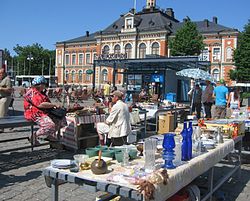
A flea market on the Kuopio Market Square in Finland
-
Vendor display at the Brooklyn Flea
-
The Chor Bazaar in Mumbai, India
-
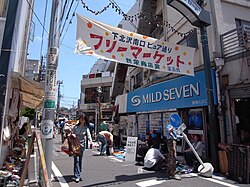
In Shimokitazawa, Japan
-
Flea market (Leiden, end of the 19th century)
-
A large swap meet held in Beaudesert, Queensland, Australia
-
Flea market in Malaysia
See also
[edit]References
[edit]- ^ a b c d LaFarge, A. (2000). "Introduction". U.S. Flea Market Directory, 3rd Edition: A Guide to the Best Flea Markets in All 50 States. US Flea Market Directory. St. Martin's Press. ISBN 978-0-312-26405-5. Retrieved July 23, 2019.
- ^ "flea market | Definition of flea market in English by Oxford Dictionaries". Oxford Dictionaries | English. Archived from the original on March 24, 2019. Retrieved 2019-03-24.
- ^ a b L., D. (2006). "Editorial Perspectives: Flea Markets". Science & Society. 70 (3): 301–307. doi:10.1521/siso.70.3.301. ISSN 0036-8237. JSTOR 40404837.
- ^ a b Appelgren, Staffan (2015). "Introduction: Circulating Stuff through Second-hand, Vintage and Retro Markets" (PDF). Culture Unbound. 7: 11. doi:10.3384/cu.2000.1525.15713. Archived from the original (PDF) on August 11, 2017.
- ^ "What is the origin of the term 'flea ... | Oxford Dictionaries". Oxford Dictionaries | English. Archived from the original on April 11, 2017. Retrieved 2019-03-24.
- ^ Prieto, J. (2007). "Flea Market History Archived 2023-04-19 at the Wayback Machine". Hollis Flea Market. Retrieved February 12, 2012.
- ^ "Paris Flea Market. Hours. Map. Metro". Paris Digest.
- ^ "Las Vegas' epic secondhand shops, antique stores and swap meets are a thrifter's paradise". Las Vegas Sun. 28 February 2019.
- ^ "Tensions, Bargains Share Space at Indoor Swap Meets : Bazaars: Businesses that survived riots are prospering. But some say they sell shoddy goods and stir racial strife". Los Angeles Times. 8 July 1992.
- ^ "Young businesses thrive in indoor swap meets". 17 August 2014.
- ^ Hernández, Paloma Albalá (2007). Americanismos en las Indias del Poniente: Voces de origen indígena Americano en las lenguas del Pacífico. Lingüística Iberoamericana. Vol. IX. Vervuert. p. 171. ISBN 9788495107527.
- ^ "Tagalong Lang". Tagaloglang.com. Retrieved 2013-02-09.
- ^ "Rabat flea market" (in Arabic). 24 March 2013. Archived from the original on 22 October 2014.
- ^ "Ministry of Habous and Islamic Affairs, Morocco, Qisariyya and its sister terms" (in Arabic). Archived from the original on 28 November 2016.
- ^ Yuvallos, Andrei (September 18, 2023). "What you need to know about tiangge shopping in the Philippines". Philippine Daily Inquirer. Retrieved June 18, 2024.
Further reading
[edit]- Rodrigues, Sarah (8 November 2025). "'There is bounty almost everywhere': why you'll always find me in the flea market on my travels". The Guardian. Retrieved 11 November 2025.
- ———————— (9 November 2025). "Continental thrift: five of the best cities in Europe for vintage shopping". The Guardian. Retrieved 11 November 2025.
External links
[edit]- National Flea Market Association (United States)
Flea market
View on GrokipediaDefinition and Characteristics
Definition
A flea market is a type of market, typically held outdoors but sometimes indoors, where individual vendors rent spaces to sell a variety of second-hand goods, antiques, collectibles, and occasionally new items at low, bargain prices.[6] These markets provide an informal venue for direct sales, often involving haggling or negotiation between buyers and sellers in a casual, loosely regulated atmosphere that fosters social interaction and browsing. Flea markets differ from auctions, which use structured bidding processes to determine item values, by emphasizing fixed or negotiable pricing for eclectic merchandise sourced from personal collections, estate sales, or surplus inventory.[7] They also stand apart from farmers' markets, which primarily feature fresh produce, homemade foods, and artisanal products from local growers, whereas flea markets focus on pre-owned and vintage articles.[8] While similar to swap meets—temporary gatherings for exchanging or selling used items—and bazaars, which can be more permanent indoor setups with diverse wares, flea markets uniquely highlight affordable, second-hand treasures in an open, accessible format.[9] Over time, flea markets have evolved from informal trading spots, often initiated by immigrant communities for economic survival, into more organized events that attract diverse shoppers seeking unique finds and cultural experiences.[10] This progression reflects their role as adaptable community hubs, though they retain a core emphasis on accessibility and variety over formality.Key Features
Flea markets are typically characterized by their informal physical setups, featuring individual stalls, booths, or simple tables arranged in rows across expansive open areas. These venues are frequently outdoors in parking lots, fields, or fairgrounds, though some operate indoors within warehouses to accommodate varying weather conditions. Vendors often use portable tables, racks, and signage to display goods, creating a makeshift marketplace that emphasizes accessibility and low overhead. Communal zones for food vendors, such as trucks or shared seating areas, add to the self-contained environment, allowing shoppers to graze while browsing.[11][12] The atmosphere of a flea market evokes a lively, carnival-like energy, with crowded pathways filled by diverse crowds of bargain hunters, families, and collectors drawn to the thrill of discovery. This treasure-hunt vibe is amplified by the eclectic assortment of items on offer, ranging from clothing and tools to vintage collectibles and household goods, often secondhand or repurposed. Haggling is a central cultural element, where buyers and sellers negotiate prices in a social, interactive manner that fosters a sense of community and excitement. Many markets operate seasonally or on weekends, peaking during fair weather to maximize attendance, which can reach hundreds or thousands.[11][13][14] Practical accessories like tarps for weather protection, portable shelving for displays, and flexible transaction systems further define the flea market experience, prioritizing simplicity and mobility. Tarps shield stalls from rain or sun, while cash remains common to avoid processing fees, though many vendors now accept credit cards and digital payments as of 2025.[12][15] These elements contribute to the market's approachable, improvisational charm, distinguishing it from more structured retail environments.History and Etymology
Origin of the Term
The term "flea market" derives from the French phrase marché aux puces, literally translating to "market of fleas," a name given to open-air markets in 19th-century Paris where second-hand clothing, furniture, and bedding were sold. These goods, often stored in unsanitary conditions, were believed to harbor fleas, leading to the evocative moniker. The earliest such market, in the Montreuil district, opened around 1860 and became synonymous with the concept, drawing vendors and bargain hunters to its stalls near the city gates.[16] The phrase entered English as a calque in the late 19th century, with the first documented usage appearing on May 29, 1887, in a New York Sun article describing Copenhagen's loppemarked (Danish for "flea market"), an outdoor bazaar ending sales at 3 p.m. daily. By the early 1920s, "flea market" had become more widely adopted in American English, entering the Oxford English Dictionary in 1922 as a generic term for similar second-hand venues. This timing aligned with post-World War I economic shifts that popularized informal trading spaces in urban areas.[16] As the concept spread globally, linguistic adaptations emerged in other languages, often mirroring the French original while shedding early associations with infestation. In German, Flohmarkt appeared as a calque in the 1920s, denoting rummage sales in cities like Berlin, and evolved into a neutral descriptor for vibrant, community-oriented markets. Similar terms, such as Dutch vlooienmarkt and Swedish loppmarknad, followed suit, transforming the once pejorative flea reference into a standard label for affordable, eclectic shopping experiences worldwide.[17][18]Historical Development
The roots of flea markets trace back to informal trading practices in ancient civilizations, where open-air markets facilitated the exchange of both new and used goods. In ancient Rome, bustling marketplaces like the Forum Romanum and Trajan's Markets served as hubs for vendors selling a mix of commodities, including second-hand items recovered from households or trade routes, reflecting early forms of thrift-oriented commerce amid urban growth.[19] These venues laid foundational precedents for periodic gatherings that combined economic necessity with social interaction.[20] During the medieval period in Europe, large-scale fairs emerged as key precursors, evolving from local barter systems into organized events that promoted regional and international trade. The Champagne Fairs in northern France, held from the 12th to 14th centuries, exemplified this development, drawing merchants from across Europe to trade textiles, spices, and household goods in a semi-permanent setup that fostered economic networks.[21] By the 19th century, thrift markets gained prominence in urban centers, particularly in Europe, where jumble sales and second-hand stalls addressed growing populations' needs for affordable clothing and wares amid industrialization. These informal venues, such as those in Paris, marked a shift toward dedicated spaces for recycled goods, bridging medieval traditions with modern consumer practices.[22] The 20th century witnessed significant expansion, particularly in the United States following World War II, where postwar consumerism and suburbanization fueled a boom in flea markets as households divested surplus items from expanding garages and attics. This era's economic prosperity, coupled with a cultural embrace of disposable goods, transformed casual yard sales into structured outdoor markets, with the Rose Bowl Flea Market in Pasadena, California—launched in 1968 by promoters R.G. Canning and Bill Tunnell—becoming a landmark event that drew over 2,000 vendors and 40,000 visitors at its peak, symbolizing the scale of this growth.[23] In Europe, economic recoveries after the war revived traditional markets in various cities.[24] Flea markets spread globally during the 1970s and 1980s, influenced by migration, urbanization, and economic downturns such as the oil crises and recessions, which encouraged widespread adoption of second-hand sales as a cost-saving measure. In regions like North America and parts of Asia, these conditions amplified the appeal of flea markets as accessible outlets for affordable goods, leading to a proliferation of venues that adapted local trading customs to the format.[25] By the late 20th century, urbanization in developing areas further disseminated the model, turning informal street trading into organized events that mirrored European and American styles.[26] In recent decades up to 2025, flea markets have increasingly incorporated digital integration to adapt to technological shifts and the COVID-19 pandemic, evolving into hybrid online-offline models that blend physical gatherings with virtual platforms for vendor listings, live streams, and e-sales. Post-2020, many markets enhanced online advertising via social media and apps to maintain engagement during lockdowns, allowing consumers to preview items remotely while preserving the tactile appeal of in-person bargaining; as of 2025, digital adoption includes platforms attracting online customers for pre-market reservations.[27][28] This fusion has sustained their relevance, with examples including apps facilitating pre-market reservations and post-event shipping, ensuring resilience amid global disruptions.[29]Regional Variations
Europe
European flea markets distinguish themselves through a strong emphasis on antiques and vintage goods, particularly in France and the United Kingdom, where collectors seek out historical artifacts ranging from fine art and jewelry to period furniture. These markets often blend commerce with cultural heritage, fostering an atmosphere of discovery that appeals to both locals and international visitors. Unlike more casual second-hand venues elsewhere, European variants prioritize curated, high-quality items that reflect regional aesthetics and histories. A premier example is Paris's Marché aux Puces de Saint-Ouen, originating in the 1870s when ragpickers settled outside the city walls and formalizing as a major antiques hub by the early 20th century; it remains the world's largest such market, covering nearly 20 acres with over 2,000 stalls across 15 sections and attracting about 5 million visitors annually. In London, Portobello Road Market exemplifies the UK's antiques focus, with stalls and arcades specializing in items from the Georgian era to Art Deco, bustling on Saturdays when UK traders line the streets with ceramics, textiles, books, and silverware. Berlin's Mauerpark Flea Market, established in the early 2000s on the site of the former Berlin Wall death strip opened to the public after German reunification in 1990, embodies a post-reunification creative vibe, offering vintage clothing, records, and eclectic finds amid a lively, alternative community atmosphere every Sunday. These markets integrate closely with tourism, serving as key attractions that draw travelers to explore local culture while shopping, as seen in Paris and London's high visitor numbers tied to guided tours and seasonal events. Vendors must comply with EU-wide regulations, such as the General Product Safety Regulation (EU) 2023/988, which requires second-hand goods to be safe for consumers by prohibiting risks to health and ensuring compliance with essential safety standards before resale. Historically, many European flea markets trace roots to post-World War II reconstruction efforts, reviving as essential outlets for reusing scarce materials and supporting economic recovery, exemplified by Lille's Braderie de Lille, which resumed operations amid the era's challenges to promote thrift and trade. In Scandinavia, contemporary adaptations highlight sustainability, with flea markets aligning with national zero-waste goals through circular economy practices that encourage reuse and reduce landfill contributions, such as Sweden's widespread "loppis" (flea markets) promoting longer product lifecycles and community-driven recycling initiatives.North America
In North America, flea markets have evolved into large-scale, commercial events that attract bargain hunters seeking antiques, vintage items, and everyday goods, often held on expansive outdoor lots or in covered venues to accommodate vehicular access. These markets emphasize accessibility and volume, with events drawing tens of thousands of visitors over weekends or extended periods, fostering a culture of discovery tied to the pursuit of affordable treasures reflective of the "American dream" of opportunity through savvy shopping.[30][31] Prominent examples include the Brimfield Antique Show in Massachusetts, which began in 1959 as an open-air auction organized by local auctioneer Gordon Reid and has grown into one of the largest outdoor antiques events in the United States, occurring three times annually in May, July, and September with thousands of dealers spread across fields in the town of Brimfield.[30][32] In Chicago, the Swap-O-Rama Flea Market on West 26th Street in the Little Village neighborhood operates as a drive-in venue where vendors sell a mix of new and used items, including furniture, electronics, and clothing, catering to local communities with easy car-based access.[33] Canada's Granville Island Public Market in Vancouver, established in 1979, features around 50 permanent vendors alongside rotating artisan stalls offering crafts and artisanal products made by local artists in an indoor-outdoor setting that blends market traditions with modern appeal.[34] In Mexico, La Lagunilla Market in Mexico City traces its roots to colonial times, with records of vendors operating as early as 1590, and now spans multiple sections as one of the largest covered markets in the country, specializing in antiques, furniture, and household items during its bustling Sunday bazaar.[35][36] A distinctive feature of North American flea markets is their scale and integration with car culture, enabling drive-in formats where attendees park directly at vendor spaces, as seen in events hosting hundreds to thousands of sellers across vast lots that encourage family outings and spontaneous purchases.[33] This vehicular emphasis supports the bargain-hunting ethos, where shoppers navigate rows of booths by car or on foot, often discovering unique items like restored furniture or rare collectibles amid the open-air chaos.[32] Following the COVID-19 pandemic in 2020, many North American flea markets adapted by implementing health protocols such as mandatory reservations, capacity limits, and enhanced sanitization to resume operations safely, with venues like Swap-O-Rama requiring pre-booking for entry to control crowds.[37] This shift has persisted, contributing to the rise of pop-up flea markets—temporary, outdoor events that offer flexibility and lower overheads, gaining popularity in urban areas across the U.S., Canada, and Mexico for their nimble response to fluctuating attendance and vendor needs.[38][39]Asia and Other Regions
In Asia, flea markets often integrate seamlessly into daily life, serving as vibrant social hubs where locals and tourists alike engage in shopping, dining, and community interactions, particularly through night markets that extend commerce into the evening hours to accommodate cooler temperatures and work schedules.[40][41] One prominent example is Thailand's Chatuchak Weekend Market in Bangkok, which spans 35 acres with over 15,000 stalls offering a vast array of goods from clothing and antiques to street food, drawing around 200,000 visitors each weekend and exemplifying the scale of these embedded marketplaces.[42] In Japan, the Oedo Antique Market at Tokyo International Forum operates seasonally on the first and third Sundays of each month, featuring approximately 250 vendors specializing in traditional antiques, vintage wares, and handicrafts, highlighting a more curated, event-based approach amid urban settings.[43][44] India's Chor Bazaar in Mumbai blends new and second-hand items, including antiques, vintage furniture, electronics, and Bollywood memorabilia, functioning as a bustling informal trading ground that reflects the city's diverse consumer needs.[45][46] Beyond Asia, flea markets in other regions adapt to local contexts, often emphasizing artisanal elements and informal economic structures that support livelihoods in developing areas. In Africa, South Africa's Neighbourgoods Market in Johannesburg's Braamfontein neighborhood runs weekly on Saturdays, showcasing over 100 stalls with speciality street food, bespoke design goods, vintage clothing, and crafts, providing a platform for local entrepreneurs in an informal economy that absorbs economic shocks and fosters community exchange.[47][48][49] In Oceania, Australia's Glebe Markets in Sydney operate every Saturday, focusing on handmade crafts, recycled fashion, accessories, and artisanal products across more than 200 stalls, attracting shoppers seeking unique, sustainable items in a temperate climate.[50] In Latin America, Mexico's tianguis represent itinerant flea markets that travel to different neighborhoods weekly, selling a mix of fresh produce, household goods, clothing, and second-hand items from mobile stalls, integral to informal economies where such markets account for a significant portion of urban employment and daily provisioning.[51][52] These markets frequently incorporate adaptations to regional climates, such as covered or shaded stalls in tropical areas to mitigate heat and rain, ensuring year-round viability; for instance, Bangkok's Chatuchak features divided sections with roofing for protection against monsoons and humidity.[42] In developing regions across Africa and Latin America, the informal nature of these markets—often unregulated and community-driven—plays a crucial role in economic resilience, with vendors relying on low-barrier entry to trade essentials and crafts amid limited formal job opportunities.[49]Operations and Vendors
Market Setup and Logistics
Flea market organizers initiate operations with meticulous planning to ensure viability and attendance. Site selection prioritizes accessible, spacious locations such as fairgrounds, parking lots, or community fields that can handle high foot traffic and vehicle access. Scheduling typically occurs on weekends or public holidays to align with consumer availability, often spanning several hours from morning to afternoon. Promotion efforts leverage local flyers, newspaper ads, and social media platforms to recruit vendors and notify potential shoppers, fostering community engagement in advance of the event.[53][54][55] Infrastructure setup focuses on practical elements to support vendors and visitors efficiently. Vendor spaces are allocated in standardized booths, commonly 10x10 feet, with daily fees ranging from $20 to $100 USD based on market size, location, and amenities provided. Essential utilities include portable toilets for sanitation and limited electricity hookups, often incurring extra charges of $10 to $20 per booth for power needs like lighting or small appliances. Crowd management entails designating ample parking areas to prevent congestion, implementing directional signage, and occasionally charging nominal entry fees of $1 to $5 for buyers to regulate influx and generate additional revenue.[56][57][58] Flea market operations must comply with local laws, including obtaining business permits for organizers, vendor licenses, and sales tax reporting. In the US, some states mandate record-keeping of sellers; in Europe, stall permits are required from municipal authorities. Food vendors often need additional health permits.[59][60] Running a flea market presents logistical challenges that require proactive measures. Weather contingencies are critical for outdoor events, with organizers preparing rain plans such as providing tent covers, securing displays with weights or anchors, or establishing cancellation policies based on forecasts to minimize disruptions. Security in theft-vulnerable settings involves deploying surveillance cameras, encouraging open booth layouts for visibility, and advising vendors on tethering high-value items to deter shoplifting. In the aftermath of the 2020 COVID-19 pandemic, many flea markets implemented enhanced hygiene protocols, such as hand sanitization stations and promotion of contactless payments. As of 2025, strict measures like mandatory masking and six-foot spacing have largely been discontinued, though some markets maintain voluntary health precautions.[61][62]Vendor Profiles and Goods
Flea market vendors encompass a diverse array of participants, ranging from individual hobbyists who sell personal items from their collections to professional antique dealers specializing in rare finds. Hobbyists often include weekend warriors turning personal passions into side hustles, while dealers focus on curated selections of vintage or collectible goods.[63][64] Resellers typically source inventory from estate sales or liquidation auctions, acting as intermediaries for second-hand merchandise. Occasional craftspeople contribute handmade or personalized items, such as custom decor or consumables like soaps and baked goods, filling niche market gaps.[65][66] Demographically, vendors frequently include retirees supplementing fixed incomes, immigrants leveraging cultural connections for community-based sales, and young entrepreneurs pursuing flexible side hustles. This mix reflects the low-barrier entry to vending, allowing participants from varied backgrounds to engage in informal commerce without significant upfront investment.[64] The merchandise at flea markets primarily consists of second-hand categories like clothing and furniture, alongside collectibles such as stamps, vinyl records, and quirky knick-knacks. Other common goods include tools and hardware, used electronics, books, magazines, and niche items like militaria or retro home decor. Handmade crafts and upcycled pieces, such as repurposed furniture or accessories, are also prevalent, appealing to shoppers seeking unique, budget-friendly options.[67][68][69] Vendors source goods through multiple channels, including personal collections, retail liquidations of customer returns, estate sales, and auctions for bulk lots like storage units. Donations and imports provide additional inventory, particularly for clothing and electronics, enabling low-cost acquisition for resale.[63][65][70] By 2025, trends show a rise in upcycled items, driven by eco-friendly consumer preferences for sustainable, handmade products that reduce waste and promote ethical consumption. Pricing strategies often involve marking up items to allow for haggling, fostering an interactive atmosphere where buyers negotiate for better deals on multiples or end-of-day stock.[71][72][73]Cultural and Economic Role
Social and Cultural Significance
Flea markets serve as dynamic social hubs where vendors and buyers engage in casual networking, bargaining, and personal storytelling, cultivating a sense of community and shared experience. These interactions often revolve around the histories of individual items, allowing participants to exchange anecdotes that connect personal narratives to broader cultural contexts. For example, the Queens Night Market's Vendor Stories Oral History Project captures audio testimonials from immigrant entrepreneurs, preserving their journeys and culinary traditions as integral to local identity.[74] Through such oral traditions and the sharing of artifacts like vintage heirlooms, flea markets contribute to safeguarding local history, transforming everyday transactions into opportunities for cultural transmission and collective memory.[3] Beyond community building, flea markets exert a significant cultural influence by championing sustainability through the reuse of second-hand goods, discouraging the "buy new" consumerism model and extending product lifecycles to minimize environmental waste. This ethos supports circular economy practices, as evidenced by markets dedicated to upcycled fashion that reduce textile production's ecological footprint.[75] Flea markets have also permeated pop culture, symbolizing serendipitous discovery and nostalgia; in Woody Allen's Midnight in Paris (2011), a pivotal scene at the Saint-Ouen flea market underscores themes of artistic inspiration and temporal enchantment, drawing global attention to these spaces as emblems of cultural allure.[76] Complementing this, many flea markets organize festivals and themed events—such as vintage fairs or artisan showcases—that amplify their role in celebrating creativity and heritage.[77] Flea markets enhance social inclusivity by drawing participants from varied socioeconomic strata, offering equitable access to commerce and leisure that unites affluent collectors with budget-conscious families. This diversity fosters intergenerational exchanges, as elders pass down knowledge of haggling or item valuation to younger relatives amid the market's lively atmosphere.[10] In contemporary iterations, flea markets increasingly adopt family-friendly formats with child-oriented activities and inclusive themes, accommodating multigenerational outings while embracing ethnic and cultural pluralism. Initiatives like the Rockwood Flea Market exemplify this shift, intentionally featuring vendors from underrepresented groups to promote belonging and cross-cultural dialogue.[78][79]Economic Impact
Flea markets provide a substantial boost to local economies by generating revenue through vendor stall fees, sales taxes, and increased tourism spending. In the United States, the industry encompasses over 1,100 markets that collectively produce more than $30 billion in annual sales, while supporting around 2.25 million vendors—many of whom operate as small businesses or in informal employment sectors—and attracting approximately 150 million customers each year.[80] These markets also contribute to state and federal revenues via real estate, food, and use taxes, fostering economic activity in often underserved communities.[80] On a broader scale, flea markets promote environmental sustainability by facilitating the resale of second-hand goods, thereby diverting items from landfills and supporting circular economy principles. For instance, by extending the lifecycle of products like clothing and household items, they reduce waste generation and the demand for new manufacturing.[81] However, challenges persist in unregulated settings, including the proliferation of counterfeit goods, as evidenced by a 2025 U.S. Immigration and Customs Enforcement seizure of $1.3 million in fakes at one of the nation's largest flea markets, and instances of tax evasion that undermine formal economic oversight.[82] Following the COVID-19 pandemic, flea markets have experienced a resurgence, driven by consumer interest in sustainable shopping and local experiences. U.S. flea market revenue, valued at $3.43 billion in 2024, is projected to reach $5.76 billion by 2033, reflecting a compound annual growth rate of 6.2% amid broader recovery trends.[83] This growth positions physical flea markets as complementary to e-commerce rivals like eBay, offering direct, low-cost sales channels that enhance local economic resilience rather than competing solely on digital scale.[84]References
- https://en.wiktionary.org/wiki/Flohmarkt