

Symmetric space
View on Wikipedia
| Lie groups and Lie algebras |
|---|
 |
In mathematics, a symmetric space is a Riemannian manifold (or more generally, a pseudo-Riemannian manifold) whose group of isometries contains an inversion symmetry about every point. This can be studied with the tools of Riemannian geometry, leading to consequences in the theory of holonomy; or algebraically through Lie theory, which allowed Cartan to give a complete classification. Symmetric spaces commonly occur in differential geometry, representation theory and harmonic analysis.
In geometric terms, a complete, simply connected Riemannian manifold is a symmetric space if and only if its curvature tensor is invariant under parallel transport. More generally, a Riemannian manifold (M, g) is said to be symmetric if and only if, for each point p of M, there exists an isometry of M fixing p and acting on the tangent space as minus the identity (every symmetric space is complete, since any geodesic can be extended indefinitely via symmetries about the endpoints). Both descriptions can also naturally be extended to the setting of pseudo-Riemannian manifolds.

From the point of view of Lie theory, a symmetric space is the quotient G / H of a connected Lie group G by a Lie subgroup H that is (a connected component of) the invariant group of an involution of G. This definition includes more than the Riemannian definition, and reduces to it when H is compact.
Riemannian symmetric spaces arise in a wide variety of situations in both mathematics and physics. Their central role in the theory of holonomy was discovered by Marcel Berger. They are important objects of study in representation theory and harmonic analysis as well as in differential geometry.
Geometric definition
[edit]Let M be a connected Riemannian manifold and p a point of M. A diffeomorphism f of a neighborhood of p is said to be a geodesic symmetry if it fixes the point p and reverses geodesics through that point, i.e. if γ is a geodesic with then It follows that the derivative of the map f at p is minus the identity map on the tangent space of p. On a general Riemannian manifold, f need not be isometric, nor can it be extended, in general, from a neighbourhood of p to all of M.


M is said to be locally Riemannian symmetric if its geodesic symmetries are in fact isometric. This is equivalent to the vanishing of the covariant derivative of the curvature tensor. A locally symmetric space is said to be a (globally) symmetric space if in addition its geodesic symmetries can be extended to isometries on all of M.
Basic properties
[edit]The Cartan–Ambrose–Hicks theorem implies that M is locally Riemannian symmetric if and only if its curvature tensor is covariantly constant, and furthermore that every simply connected, complete locally Riemannian symmetric space is actually Riemannian symmetric.
Every Riemannian symmetric space M is complete and Riemannian homogeneous (meaning that the isometry group of M acts transitively on M). In fact, already the identity component of the isometry group acts transitively on M (because M is connected).
Locally Riemannian symmetric spaces that are not Riemannian symmetric may be constructed as quotients of Riemannian symmetric spaces by discrete groups of isometries with no fixed points, and as open subsets of (locally) Riemannian symmetric spaces.
Examples
[edit]Basic examples of Riemannian symmetric spaces are Euclidean space, spheres, projective spaces, and hyperbolic spaces, each with their standard Riemannian metrics. More examples are provided by compact, semi-simple Lie groups equipped with a bi-invariant Riemannian metric.
Every compact Riemann surface of genus greater than 1 (with its usual metric of constant curvature −1) is a locally symmetric space but not a symmetric space.
Every lens space is locally symmetric but not symmetric, with the exception of , which is symmetric. The lens spaces are quotients of the 3-sphere by a discrete isometry that has no fixed points.

An example of a non-Riemannian symmetric space is anti-de Sitter space.
Algebraic definition
[edit]Let G be a connected Lie group. Then a symmetric space for G is a homogeneous space G / H where the stabilizer H of a typical point is an open subgroup of the fixed point set of an involution σ in Aut(G). Thus σ is an automorphism of G with σ2 = idG and H is an open subgroup of the invariant set

Because H is open, it is a union of components of Gσ (including, of course, the identity component).
As an automorphism of G, σ fixes the identity element, and hence, by differentiating at the identity, it induces an automorphism of the Lie algebra of G, also denoted by σ, whose square is the identity. It follows that the eigenvalues of σ are ±1. The +1 eigenspace is the Lie algebra of H (since this is the Lie algebra of Gσ), and the −1 eigenspace will be denoted . Since σ is an automorphism of , this gives a direct sum decomposition


with
![{\displaystyle [{\mathfrak {h}},{\mathfrak {h}}]\subset {\mathfrak {h}},\;[{\mathfrak {h}},{\mathfrak {m}}]\subset {\mathfrak {m}},\;[{\mathfrak {m}},{\mathfrak {m}}]\subset {\mathfrak {h}}.}](https://wikimedia.org/api/rest_v1/media/math/render/svg/db0a4b7805ed1d11244a435410d60f144cbd8d6b)
The first condition is automatic for any homogeneous space: it just says the infinitesimal stabilizer is a Lie subalgebra of . The second condition means that is an -invariant complement to in . Thus any symmetric space is a reductive homogeneous space, but there are many reductive homogeneous spaces which are not symmetric spaces. The key feature of symmetric spaces is the third condition that brackets into .
Conversely, given any Lie algebra with a direct sum decomposition satisfying these three conditions, the linear map σ, equal to the identity on and minus the identity on , is an involutive automorphism.
Riemannian symmetric spaces satisfy the Lie-theoretic characterization
[edit]If M is a Riemannian symmetric space, the identity component G of the isometry group of M is a Lie group acting transitively on M (that is, M is Riemannian homogeneous). Therefore, if we fix some point p of M, M is diffeomorphic to the quotient G/K, where K denotes the isotropy group of the action of G on M at p. By differentiating the action at p we obtain an isometric action of K on TpM. This action is faithful (e.g., by a theorem of Kostant, any isometry in the identity component is determined by its 1-jet at any point) and so K is a subgroup of the orthogonal group of TpM, hence compact. Moreover, if we denote by sp: M → M the geodesic symmetry of M at p, the map

is an involutive Lie group automorphism such that the isotropy group K is contained between the fixed point group and its identity component (hence an open subgroup) see the definition and following proposition on page 209, chapter IV, section 3 in Helgason's Differential Geometry, Lie Groups, and Symmetric Spaces for further information.


To summarize, M is a symmetric space G / K with a compact isotropy group K. Conversely, symmetric spaces with compact isotropy group are Riemannian symmetric spaces, although not necessarily in a unique way. To obtain a Riemannian symmetric space structure we need to fix a K-invariant inner product on the tangent space to G / K at the identity coset eK: such an inner product always exists by averaging, since K is compact, and by acting with G, we obtain a G-invariant Riemannian metric g on G / K.
To show that G / K is Riemannian symmetric, consider any point p = hK (a coset of K, where h ∈ G) and define

where σ is the involution of G fixing K. Then one can check that sp is an isometry with (clearly) sp(p) = p and (by differentiating) dsp equal to minus the identity on TpM. Thus sp is a geodesic symmetry and, since p was arbitrary, M is a Riemannian symmetric space.
If one starts with a Riemannian symmetric space M, and then performs these two constructions in sequence, then the Riemannian symmetric space yielded is isometric to the original one. This shows that the "algebraic data" (G, K, σ, g) completely describe the structure of M.
Classification of Riemannian symmetric spaces
[edit]The algebraic description of Riemannian symmetric spaces enabled Élie Cartan to obtain a complete classification of them in 1926.
For a given Riemannian symmetric space M let (G, K, σ, g) be the algebraic data associated to it. To classify the possible isometry classes of M, first note that the universal cover of a Riemannian symmetric space is again Riemannian symmetric, and the covering map is described by dividing the connected isometry group G of the covering by a subgroup of its center. Therefore, we may suppose without loss of generality that M is simply connected. (This implies K is connected by the long exact sequence of a fibration, because G is connected by assumption.)
Classification scheme
[edit]A simply connected Riemannian symmetric space is said to be irreducible if it is not the product of two or more Riemannian symmetric spaces. It can then be shown that any simply connected Riemannian symmetric space is a Riemannian product of irreducible ones. Therefore, we may further restrict ourselves to classifying the irreducible, simply connected Riemannian symmetric spaces.
The next step is to show that any irreducible, simply connected Riemannian symmetric space M is of one of the following three types:
- Euclidean type: M has vanishing curvature, and is therefore isometric to a Euclidean space.
- Compact type: M has nonnegative (but not identically zero) sectional curvature.
- Non-compact type: M has nonpositive (but not identically zero) sectional curvature.
A more refined invariant is the rank, which is the maximum dimension of a subspace of the tangent space (to any point) on which the curvature is identically zero. The rank is always at least one, with equality if the sectional curvature is positive or negative. If the curvature is positive, the space is of compact type, and if negative, it is of noncompact type. The spaces of Euclidean type have rank equal to their dimension and are isometric to a Euclidean space of that dimension. Therefore, it remains to classify the irreducible, simply connected Riemannian symmetric spaces of compact and non-compact type. In both cases there are two classes.
A. G is a (real) simple Lie group;
B. G is either the product of a compact simple Lie group with itself (compact type), or a complexification of such a Lie group (non-compact type).
The examples in class B are completely described by the classification of simple Lie groups. For compact type, M is a compact simply connected simple Lie group, G is M×M and K is the diagonal subgroup. For non-compact type, G is a simply connected complex simple Lie group and K is its maximal compact subgroup. In both cases, the rank is the rank of G.
The compact simply connected Lie groups are the universal covers of the classical Lie groups SO(n), SU(n), Sp(n) and the five exceptional Lie groups E6, E7, E8, F4, G2.
The examples of class A are completely described by the classification of noncompact simply connected real simple Lie groups. For non-compact type, G is such a group and K is its maximal compact subgroup. Each such example has a corresponding example of compact type, by considering a maximal compact subgroup of the complexification of G that contains K. More directly, the examples of compact type are classified by involutive automorphisms of compact simply connected simple Lie groups G (up to conjugation). Such involutions extend to involutions of the complexification of G, and these in turn classify non-compact real forms of G.
In both class A and class B there is thus a correspondence between symmetric spaces of compact type and non-compact type. This is known as duality for Riemannian symmetric spaces.
Classification result
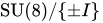
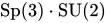
[edit]Specializing to the Riemannian symmetric spaces of class A and compact type, Cartan found that there are the following seven infinite series and twelve exceptional Riemannian symmetric spaces G / K. They are here given in terms of G and K, together with a geometric interpretation, if readily available. The labelling of these spaces is the one given by Cartan.
| Label | G | K | Dimension | Rank | Geometric interpretation |
|---|---|---|---|---|---|
| AI | Space of real structures on that leave the complex determinant invariant | ||||
| AII | Space of quaternionic structures on compatible with the Hermitian metric | ||||
| AIII | Grassmannian of complex p-dimensional subspaces of | ||||
| BDI | Grassmannian of oriented real p-dimensional subspaces of | ||||
| DIII | Space of orthogonal complex structures on | ||||
| CI | Space of complex structures on compatible with the inner product | ||||
| CII | Grassmannian of quaternionic p-dimensional subspaces of | ||||
| EI | 42 | 6 | |||
| EII | 40 | 4 | Space of symmetric subspaces of isometric to | ||
| EIII | 32 | 2 | Complexified Cayley projective plane | ||
| EIV | 26 | 2 | Space of symmetric subspaces of isometric to | ||
| EV | 70 | 7 | |||
| EVI | 64 | 4 | Rosenfeld projective plane over | ||
| EVII | 54 | 3 | Space of symmetric subspaces of isomorphic to | ||
| EVIII | 128 | 8 | Rosenfeld projective plane | ||
| EIX | 112 | 4 | Space of symmetric subspaces of isomorphic to | ||
| FI | 28 | 4 | Space of symmetric subspaces of isomorphic to | ||
| FII | 16 | 1 | Cayley projective plane | ||
| G | 8 | 2 | Space of subalgebras of the octonion algebra which are isomorphic to the quaternion algebra |











![{\displaystyle [n/2]}](https://wikimedia.org/api/rest_v1/media/math/render/svg/c00c7c3e69060d3dafc2527c65ac26009d65eaff)













As Grassmannians
[edit]A more modern classification (Huang & Leung 2010) uniformly classifies the Riemannian symmetric spaces, both compact and non-compact, via a Freudenthal magic square construction. The irreducible compact Riemannian symmetric spaces are, up to finite covers, either a compact simple Lie group, a Grassmannian, a Lagrangian Grassmannian, or a double Lagrangian Grassmannian of subspaces of for normed division algebras A and B. A similar construction produces the irreducible non-compact Riemannian symmetric spaces.

General symmetric spaces
[edit]An important class of symmetric spaces generalizing the Riemannian symmetric spaces are pseudo-Riemannian symmetric spaces, in which the Riemannian metric is replaced by a pseudo-Riemannian metric (nondegenerate instead of positive definite on each tangent space). In particular, Lorentzian symmetric spaces, i.e., n dimensional pseudo-Riemannian symmetric spaces of signature (n − 1,1), are important in general relativity, the most notable examples being Minkowski space, De Sitter space and anti-de Sitter space (with zero, positive and negative curvature respectively). De Sitter space of dimension n may be identified with the 1-sheeted hyperboloid in a Minkowski space of dimension n + 1.
Symmetric and locally symmetric spaces in general can be regarded as affine symmetric spaces. If M = G / H is a symmetric space, then Nomizu showed that there is a G-invariant torsion-free affine connection (i.e. an affine connection whose torsion tensor vanishes) on M whose curvature is parallel. Conversely a manifold with such a connection is locally symmetric (i.e., its universal cover is a symmetric space). Such manifolds can also be described as those affine manifolds whose geodesic symmetries are all globally defined affine diffeomorphisms, generalizing the Riemannian and pseudo-Riemannian case.
Classification results
[edit]The classification of Riemannian symmetric spaces does not extend readily to the general case for the simple reason that there is no general splitting of a symmetric space into a product of irreducibles. Here a symmetric space G / H with Lie algebra
is said to be irreducible if is an irreducible representation of . Since is not semisimple (or even reductive) in general, it can have indecomposable representations which are not irreducible.
However, the irreducible symmetric spaces can be classified. As shown by Katsumi Nomizu, there is a dichotomy: an irreducible symmetric space G / H is either flat (i.e., an affine space) or is semisimple. This is the analogue of the Riemannian dichotomy between Euclidean spaces and those of compact or noncompact type, and it motivated M. Berger to classify semisimple symmetric spaces (i.e., those with semisimple) and determine which of these are irreducible. The latter question is more subtle than in the Riemannian case: even if is simple, G / H might not be irreducible.
As in the Riemannian case there are semisimple symmetric spaces with G = H × H. Any semisimple symmetric space is a product of symmetric spaces of this form with symmetric spaces such that is simple. It remains to describe the latter case. For this, one needs to classify involutions σ of a (real) simple Lie algebra . If is not simple, then is a complex simple Lie algebra, and the corresponding symmetric spaces have the form G / H, where H is a real form of G: these are the analogues of the Riemannian symmetric spaces G / K with G a complex simple Lie group, and K a maximal compact subgroup.

Thus we may assume is simple. The real subalgebra may be viewed as the fixed point set of a complex antilinear involution τ of , while σ extends to a complex antilinear involution of commuting with τ and hence also a complex linear involution σ∘τ.
The classification therefore reduces to the classification of commuting pairs of antilinear involutions of a complex Lie algebra. The composite σ∘τ determines a complex symmetric space, while τ determines a real form. From this it is easy to construct tables of symmetric spaces for any given , and furthermore, there is an obvious duality given by exchanging σ and τ. This extends the compact/non-compact duality from the Riemannian case, where either σ or τ is a Cartan involution, i.e., its fixed point set is a maximal compact subalgebra.
Tables
[edit]The following table indexes the real symmetric spaces by complex symmetric spaces and real forms, for each classical and exceptional complex simple Lie group.
| Gc = SL(n,C) | Gc / SO(n,C) | Gc / S(GL(k,C)×GL(ℓ,C)), k + ℓ = n | Gc / Sp(n,C), n even |
|---|---|---|---|
| G = SL(n,R) | G / SO(k,l) | G / S(GL(k,R)×GL(l,R)) or G / GL(n/2,C), n even |
G / Sp(n,R), n even |
| G = SU(p,q), p + q = n | G / SO(p,q) or SU(p,p) / Sk(p,H) |
G / S(U(kp,kq)×U(lp,lq)) or SU(p,p) / GL(p,C) |
G / Sp(p/2,q/2), p,q even or SU(p,p) / Sp(2p,R) |
| G = SL(n/2,H), n even | G / Sk(n/2,H) | G / S(GL(k/2,H)×GL(ℓ/2,H)), k,ℓ even or G / GL(n/2,C) |
G / Sp(k/2,ℓ/2), k,ℓ even, k + ℓ = n |
| Gc=SO(n,C) | Gc / SO(k,C)×SO(ℓ,C), k + ℓ = n | Gc / GL(n/2,C), n even |
|---|---|---|
| G=SO(p,q) | G / SO(kp,kq)×SO(ℓp,lq) or SO(n,n) / SO(n,C) |
G / U(p/2,q/2), p,q even or SO(n,n) / GL(n,R) |
| G = Sk(n/2,H), n even | G / Sk(k/2,ℓ/2), k,ℓ even or G / SO(n/2,C) |
G / U(k/2,ℓ/2), k,ℓ even or G / SL(n/4,H) |
| Gc = Sp(2n,C) | Gc / Sp(2k,C)×Sp(2ℓ,C), k + ℓ = n | Gc / GL(n,C) |
|---|---|---|
| G = Sp(p,q), p + q = n | G / Sp(kp,kq)×Sp(ℓp,ℓq) or Sp(n,n) / Sp(n,C) |
G / U(p,q) or Sp(p,p) / GL(p,H) |
| G = Sp(2n,R) | G / Sp(2k,R)×Sp(2l,R) or G / Sp(n,C) |
G / U(k,ℓ), k + ℓ = n or G / GL(n,R) |
For exceptional simple Lie groups, the Riemannian case is included explicitly below, by allowing σ to be the identity involution (indicated by a dash). In the above tables this is implicitly covered by the case kl = 0.
| G2c | – | G2c / SL(2,C)× SL(2,C) |
|---|---|---|
| G2 | – | G2 / SU(2)×SU(2) |
| G2(2) | G2(2) / SU(2)×SU(2) | G2(2) / SL(2,R)× SL(2,R) |
| F4c | – | F4c / Sp(6,C)×Sp(2,C) | F4c / SO(9,C) |
|---|---|---|---|
| F4 | – | F4 / Sp(3)×Sp(1) | F4 / SO(9) |
| F4(4) | F4(4) / Sp(3)×Sp(1) | F4(4) / Sp(6,R)×Sp(2,R) or F4(4) / Sp(2,1)×Sp(1) |
F4(4) / SO(5,4) |
| F4(−20) | F4(−20) / SO(9) | F4(−20) / Sp(2,1)×Sp(1) | F4(−20) / SO(8,1) |
| E6c | – | E6c / Sp(8,C) | E6c / SL(6,C)×SL(2,C) | E6c / SO(10,C)×SO(2,C) | E6c / F4c |
|---|---|---|---|---|---|
| E6 | – | E6 / Sp(4) | E6 / SU(6)×SU(2) | E6 / SO(10)×SO(2) | E6 / F4 |
| E6(6) | E6(6) / Sp(4) | E6(6) / Sp(2,2) or E6(6) / Sp(8,R) |
E6(6) / SL(6,R)×SL(2,R) or E6(6) / SL(3,H)×SU(2) |
E6(6) / SO(5,5)×SO(1,1) | E6(6) / F4(4) |
| E6(2) | E6(2) / SU(6)×SU(2) | E6(2) / Sp(3,1) or E6(2) / Sp(8,R) |
E6(2) / SU(4,2)×SU(2) or E6(2) / SU(3,3)×SL(2,R) |
E6(2) / SO(6,4)×SO(2) or E6(2) / Sk(5,H)×SO(2) |
E6(2) / F4(4) |
| E6(−14) | E6(−14) / SO(10)×SO(2) | E6(−14) / Sp(2,2) | E6(−14) / SU(4,2)×SU(2) or E6(−14) / SU(5,1)×SL(2,R) |
E6(−14) / SO(8,2)×SO(2) or Sk(5,H)×SO(2) |
E6(−14) / F4(−20) |
| E6(−26) | E6(−26) / F4 | E6(−26) / Sp(3,1) | E6(−26) / SL(3,H)×Sp(1) | E6(−26) / SO(9,1)×SO(1,1) | E6(−26) / F4(−20) |
| E7c | – | E7c / SL(8,C) | E7c / SO(12,C)×Sp(2,C) | E7c / E6c×SO(2,C) |
|---|---|---|---|---|
| E7 | – | E7 / SU(8) | E7 / SO(12)× Sp(1) | E7 / E6× SO(2) |
| E7(7) | E7(7) / SU(8) | E7(7) / SU(4,4) or E7(7) / SL(8,R) or E7(7) / SL(4,H) |
E7(7) / SO(6,6)×SL(2,R) or E7(7) / Sk(6,H)×Sp(1) |
E7(7) / E6(6)×SO(1,1) or E7(7) / E6(2)×SO(2) |
| E7(−5) | E7(−5) / SO(12)× Sp(1) | E7(−5) / SU(4,4) or E7(−5) / SU(6,2) |
E7(−5) / SO(8,4)×SU(2) or E7(−5) / Sk(6,H)×SL(2,R) |
E7(−5) / E6(2)×SO(2) or E7(−5) / E6(−14)×SO(2) |
| E7(−25) | E7(−25) / E6× SO(2) | E7(−25) / SL(4,H) or E7(−25) / SU(6,2) |
E7(−25) / SO(10,2)×SL(2,R) or E7(−25) / Sk(6,H)×Sp(1) |
E7(−25) / E6(−14)×SO(2) or E7(−25) / E6(−26)×SO(1,1) |
| E8c | – | E8c / SO(16,C) | E8c / E7c×Sp(2,C) |
|---|---|---|---|
| E8 | – | E8 / SO(16) | E8 / E7×Sp(1) |
| E8(8) | E8(8) / SO(16) | E8(8) / SO(8,8) or E8(8) / Sk(8,H) | E8(8) / E7(7)×SL(2,R) or E8(8) / E7(−5)×SU(2) |
| E8(−24) | E8(−24) / E7×Sp(1) | E8(−24) / SO(12,4) or E8(−24) / Sk(8,H) | E8(−24) / E7(−5)×SU(2) or E8(−24) / E7(−25)×SL(2,R) |
Weakly symmetric Riemannian spaces
[edit]In the 1950s Atle Selberg extended Cartan's definition of symmetric space to that of weakly symmetric Riemannian space, or in current terminology weakly symmetric space. These are defined as Riemannian manifolds M with a transitive connected Lie group of isometries G and an isometry σ normalising G such that given x, y in M there is an isometry s in G such that sx = σy and sy = σx. (Selberg's assumption that σ2 should be an element of G was later shown to be unnecessary by Ernest Vinberg.) Selberg proved that weakly symmetric spaces give rise to Gelfand pairs, so that in particular the unitary representation of G on L2(M) is multiplicity free.
Selberg's definition can also be phrased equivalently in terms of a generalization of geodesic symmetry. It is required that for every point x in M and tangent vector X at x, there is an isometry s of M, depending on x and X, such that
- s fixes x;
- the derivative of s at x sends X to −X.
When s is independent of X, M is a symmetric space.
An account of weakly symmetric spaces and their classification by Akhiezer and Vinberg, based on the classification of periodic automorphisms of complex semisimple Lie algebras, is given in Wolf (2007).
Properties
[edit]Some properties and forms of symmetric spaces can be noted.
Lifting the metric tensor
[edit]The metric tensor on the Riemannian manifold M can be lifted to a scalar product on G by combining it with the Killing form. This is done by defining

Here, is the Riemannian metric defined on , and is the Killing form. The minus sign appears because the Killing form is negative-definite on this makes positive-definite.




Factorization
[edit]The tangent space can be further factored into eigenspaces classified by the Killing form.[1] This is accomplished by defining an adjoint map taking as



where is the Riemannian metric on and is the Killing form. This map is sometimes called the generalized transpose, as corresponds to the transpose for the orthogonal groups and the Hermitian conjugate for the unitary groups. It is a linear functional, and it is self-adjoint, and so one concludes that there is an orthonormal basis of with


These are orthogonal with respect to the metric, in that

since the Killing form is symmetric. This factorizes into eigenspaces

with
![{\displaystyle [{\mathfrak {m}}_{i},{\mathfrak {m}}_{j}]=0}](https://wikimedia.org/api/rest_v1/media/math/render/svg/73d09acef41784a0470bf9d42e2075aa3ffb6f10)
for . For the case of semisimple, so that the Killing form is non-degenerate, the metric likewise factorizes:


In certain practical applications, this factorization can be interpreted as the spectrum of operators, e.g. the spectrum of the hydrogen atom, with the eigenvalues of the Killing form corresponding to different values of the angular momentum of an orbital (i.e. the Killing form being a Casimir operator that can classify the different representations under which different orbitals transform.)
Classification of symmetric spaces proceeds based on whether or not the Killing form is definite.
Applications and special cases
[edit]Symmetric spaces and holonomy
[edit]If the identity component of the holonomy group of a Riemannian manifold at a point acts irreducibly on the tangent space, then either the manifold is a locally Riemannian symmetric space, or it is in one of 7 families.
Hermitian symmetric spaces
[edit]A Riemannian symmetric space that is additionally equipped with a parallel complex structure compatible with the Riemannian metric is called a Hermitian symmetric space. Some examples are complex vector spaces and complex projective spaces, both with their usual Riemannian metric, and the complex unit balls with suitable metrics so that they become complete and Riemannian symmetric.
An irreducible symmetric space G / K is Hermitian if and only if K contains a central circle. A quarter turn by this circle acts as multiplication by i on the tangent space at the identity coset. Thus the Hermitian symmetric spaces are easily read off of the classification. In both the compact and the non-compact cases it turns out that there are four infinite series, namely AIII, BDI with p = 2, DIII and CI, and two exceptional spaces, namely EIII and EVII. The non-compact Hermitian symmetric spaces can be realized as bounded symmetric domains in complex vector spaces.
Quaternion-Kähler symmetric spaces
[edit]A Riemannian symmetric space that is additionally equipped with a parallel subbundle of End(TM) isomorphic to the imaginary quaternions at each point, and compatible with the Riemannian metric, is called quaternion-Kähler symmetric space.
An irreducible symmetric space G / K is quaternion-Kähler if and only if isotropy representation of K contains an Sp(1) summand acting like the unit quaternions on a quaternionic vector space. Thus the quaternion-Kähler symmetric spaces are easily read off from the classification. In both the compact and the non-compact cases it turns out that there is exactly one for each complex simple Lie group, namely AI with p = 2 or q = 2 (these are isomorphic), BDI with p = 4 or q = 4, CII with p = 1 or q = 1, EII, EVI, EIX, FI and G.
Bott periodicity theorem
[edit]In the Bott periodicity theorem, the loop spaces of the stable orthogonal group can be interpreted as reductive symmetric spaces.
See also
[edit]References
[edit]- ^ Jurgen Jost, (2002) "Riemannian Geometry and Geometric Analysis", Third edition, Springer (See section 5.3, page 256)
- Akhiezer, D. N.; Vinberg, E. B. (1999), "Weakly symmetric spaces and spherical varieties", Transf. Groups, 4: 3–24, doi:10.1007/BF01236659
- van den Ban, E. P.; Flensted-Jensen, M.; Schlichtkrull, H. (1997), Harmonic analysis on semisimple symmetric spaces: A survey of some general results, in Representation Theory and Automorphic Forms: Instructional Conference, International Centre for Mathematical Sciences, March 1996, Edinburgh, Scotland, American Mathematical Society, ISBN 978-0-8218-0609-8
- Berger, Marcel (1957), "Les espaces symétriques noncompacts", Annales Scientifiques de l'École Normale Supérieure, 74 (2): 85–177, doi:10.24033/asens.1054
- Besse, Arthur Lancelot (1987), Einstein Manifolds, Springer-Verlag, ISBN 0-387-15279-2 Contains a compact introduction and many tables.
- Borel, Armand (2001), Essays in the History of Lie Groups and Algebraic Groups, American Mathematical Society, ISBN 0-8218-0288-7
- Cartan, Élie (1926), "Sur une classe remarquable d'espaces de Riemann, I", Bulletin de la Société Mathématique de France, 54: 214–216, doi:10.24033/bsmf.1105
- Cartan, Élie (1927), "Sur une classe remarquable d'espaces de Riemann, II", Bulletin de la Société Mathématique de France, 55: 114–134, doi:10.24033/bsmf.1113
- Flensted-Jensen, Mogens (1986), Analysis on Non-Riemannian Symmetric Spaces, CBMS Regional Conference, American Mathematical Society, ISBN 978-0-8218-0711-8
- Helgason, Sigurdur (1978), Differential geometry, Lie groups and symmetric spaces, Academic Press, ISBN 0-12-338460-5 The standard book on Riemannian symmetric spaces.
- Helgason, Sigurdur (1984), Groups and Geometric Analysis: Integral Geometry, Invariant Differential Operators, and Spherical Functions, Academic Press, ISBN 0-12-338301-3
- Huang, Yongdong; Leung, Naichung Conan (2010). "A uniform description of compact symmetric spaces as Grassmannians using the magic square" (PDF). Mathematische Annalen. 350 (1): 79–106. doi:10.1007/s00208-010-0549-8.
- Kobayashi, Shoshichi; Nomizu, Katsumi (1996), Foundations of Differential Geometry, Volume II, Wiley Classics Library edition, ISBN 0-471-15732-5 Chapter XI contains a good introduction to Riemannian symmetric spaces.
- Loos, Ottmar (1969), Symmetric spaces I: General Theory, Benjamin
- Loos, Ottmar (1969), Symmetric spaces II: Compact Spaces and Classification, Benjamin
- Nomizu, K. (1954), "Invariant affine connections on homogeneous spaces", Amer. J. Math., 76 (1): 33–65, doi:10.2307/2372398, JSTOR 2372398
- Selberg, Atle (1956), "Harmonic analysis and discontinuous groups in weakly symmetric riemannian spaces, with applications to Dirichlet series", J. Indian Math. Society, 20: 47–87
- Wolf, Joseph A. (1999), Spaces of constant curvature (5th ed.), McGraw–Hill
- Wolf, Joseph A. (2007), Harmonic Analysis on Commutative Spaces, American Mathematical Society, ISBN 978-0-8218-4289-8
Symmetric space
View on GrokipediaDefinitions
Geometric definition
A symmetric space is defined as a connected Riemannian manifold $ (M, g) $ equipped with an involutive isometry $ s_p: M \to M $ at every point $ p \in M $, such that $ s_p(p) = p $ and $ s_p^2 = \mathrm{id}_M $.[1] This isometry reverses the direction of all geodesics passing through $ p $, meaning that for any geodesic $ \gamma: (-\epsilon, \epsilon) \to M $ with $ \gamma(0) = p $, the composition $ s_p \circ \gamma $ is a geodesic that satisfies $ (s_p \circ \gamma)(t) = \gamma(-t) $ for small $ t $.[1] The differential of this involution at $ p $ satisfies $ ds_p|p = -\mathrm{id}{T_p M} $, ensuring that the tangent vectors at $ p $ are negated, which geometrically enforces the reversal property.[2] This structure implies that the manifold exhibits symmetry around every point, with geodesics behaving as straight lines reflected through $ p $, analogous to how Euclidean space is symmetric at each point.[3] The Levi-Civita connection on $ M $, which is the unique torsion-free connection compatible with the metric $ g $, plays a central role: parallel transport along any curve is an isometry of the tangent spaces, preserving the inner product and thus the geometric structure.[1] In symmetric spaces, this connection is canonical in the sense that the symmetries $ s_p $ align with the metric's compatibility, leading to a space where local geometry is invariant under these reflections.[2] The concept originated in the work of Élie Cartan during the 1920s, who initially developed it in the context of spaces of constant curvature, such as spheres and hyperbolic spaces, to generalize their symmetric properties.[1] Cartan's geometric approach emphasized the intrinsic symmetries of the manifold without initially relying on group actions, laying the foundation for broader classifications in Riemannian geometry.[3]Algebraic definition
A symmetric space is defined algebraically as a homogeneous space $ G/K $, where $ G $ is a Lie group acting transitively on the space, and $ K $ is a closed subgroup serving as the isotropy subgroup at a base point, such that there exists an involutive automorphism $ \theta $ of $ G $ whose fixed-point set is precisely $ K $.[4] This involution satisfies $ \theta^2 = \mathrm{id} $, and its differential $ \mathrm{d}\theta $ at the identity element $ e \in G $ acts as the identity on the Lie algebra $ \mathfrak{k} $ of $ K $ but as $ -\mathrm{id} $ on a complementary subspace $ \mathfrak{p} $, yielding the direct sum decomposition of the Lie algebra $ \mathfrak{g} $ of $ G $ known as the Cartan decomposition:Basic Properties
Geodesic symmetry
In symmetric spaces, the geodesic symmetry at a point $ p $, denoted $ s_p $, is an involutive isometry that fixes $ p $ and reverses the direction of any geodesic passing through it. Specifically, for a geodesic $ \gamma(t) $ with $ \gamma(0) = p $, the symmetry satisfies $ s_p(\gamma(t)) = \gamma(-t) $, ensuring that geodesics are mapped onto themselves but with reversed orientation.[6] More generally, along any geodesic $ \gamma(t) $, the symmetry $ s_{\gamma(t)} $ at $ \gamma(t) $ acts to reverse the geodesic such that $ s_{\gamma(t)}(\gamma(t + u)) = \gamma(t - u) $ for parameters $ t, u $, and the velocity satisfies $ \gamma'(t) = - d s_{\gamma(t)} (\gamma'(t)) $.[6] This property arises directly from the local isometry condition in the geometric definition of symmetric spaces.[7] The geodesic symmetry implies that symmetric spaces are complete Riemannian manifolds. By reflecting geodesics across points using $ s_x $, any geodesic defined on a half-interval can be extended indefinitely in both directions, invoking the Hopf-Rinow theorem to confirm metric completeness.[6] Furthermore, symmetric spaces contain totally geodesic submanifolds, which are themselves symmetric spaces; these arise as images under the exponential map of Lie subtriples in the tangent space.[7] The exponential map $ \exp_p: T_p M \to M $ at any point $ p $ is a local diffeomorphism, mapping a neighborhood of the zero vector in $ T_p M $ diffeomorphically onto a normal neighborhood of $ p $ in $ M $. This follows from the absence of conjugate points near $ p $, as the symmetries prevent Jacobi fields from vanishing prematurely along radial geodesics. In simply connected non-compact symmetric spaces, the exponential map extends to a global diffeomorphism $ \exp_p: T_p M \to M $, reflecting the non-positive curvature and lack of conjugate points along any geodesic.[7] Parallel transport along geodesics in symmetric spaces is uniquely determined by the symmetries. Since the geodesic symmetries preserve the Levi-Civita connection, the parallel transport of a vector along a geodesic $ \gamma $ from $ \gamma(0) $ to $ \gamma(t) $ coincides with the differential of the transvection isometry generated by the initial velocity, making it path-independent along homotopic paths.[7] In a symmetric space, any two points within a sufficiently small neighborhood (e.g., the injectivity radius) are joined by a unique minimizing geodesic, a consequence of the local symmetry properties.Curvature and involutions
In symmetric spaces, the sectional curvature is intrinsically linked to the underlying Lie algebra structure. For a Riemannian symmetric space , the Riemann curvature tensor at the base point is given byExamples
Compact Riemannian examples
Compact Riemannian symmetric spaces are homogeneous manifolds equipped with a Riemannian metric that is invariant under the action of a compact Lie group and admits geodesic symmetries at every point. These spaces exhibit non-negative sectional curvature and serve as fundamental examples in differential geometry. The canonical metric on such a space is typically induced from a bi-invariant metric on the ambient Lie group, ensuring the symmetry properties.[1] A prototypical example is the -dimensional sphere , realized as the quotient space . This space carries the round metric of constant positive sectional curvature , making it a rank-one symmetric space where geodesics are great circles. The isotropy representation at the base point corresponds to the standard action of on .[1] Real projective spaces provide another classical instance, given by the quotient . The canonical metric here has constant positive sectional curvature , and it doubles the sphere as a covering space. These spaces are also rank one and compact, with the metric invariant under the orthogonal group action.[1] Complex projective spaces are Hermitian symmetric spaces, expressed as . They admit the Fubini-Study metric, which induces constant holomorphic sectional curvature and positive sectional curvature overall. Of dimension and rank , these spaces are Kähler manifolds with rich geometric structure from the unitary group.[1] Grassmannians generalize projective spaces and parametrize subspaces. The real Grassmannian of -planes in is the quotient , equipped with a canonical invariant metric of non-negative curvature. Similarly, the complex Grassmannian has dimension and rank , with the metric preserving the Hermitian structure. These spaces embed totally geodesically into projective spaces and illustrate higher-rank examples.[1] An exceptional compact example is the Cayley plane , the projective plane over the octonions, realized as . This 16-dimensional space has rank 2 and admits a canonical metric with positive curvature, arising from the exceptional Lie group . It stands out due to its non-associative algebraic underpinnings and limited automorphism group compared to classical cases.[1]Non-compact Riemannian examples
Non-compact Riemannian symmetric spaces provide essential examples in differential geometry, often featuring negative sectional curvature or flat metrics, and serve as models for spaces of constant curvature. These spaces are typically realized as quotients of semisimple Lie groups by maximal compact subgroups, yielding infinite-volume manifolds with rich symmetry structures.[1] A fundamental example is hyperbolic space $ \mathbb{H}^n $, the unique simply connected complete Riemannian manifold of constant sectional curvature . It arises as the quotient $ \mathbb{H}^n = \mathrm{SO}(n,1)/\mathrm{SO}(n) $, where $ \mathrm{SO}(n,1) $ is the Lorentz group preserving the Minkowski metric of signature $ (n,1) $, and $ \mathrm{SO}(n) $ is its maximal compact subgroup acting by rotations. This realization endows $ \mathbb{H}^n $ with the hyperbolic metric, making it geodesically complete and diffeomorphic to $ \mathbb{R}^n $, with isometry group $ \mathrm{SO}^+(n,1) $. Hyperbolic spaces model negatively curved geometries in various applications, including Teichmüller theory and spectral geometry.[8] Euclidean space $ \mathbb{R}^n $ exemplifies a flat non-compact symmetric space, equipped with the standard Euclidean metric of zero curvature. It is symmetric under translations, realized as the quotient of the affine group or, in Lie-theoretic terms, as $ \mathbb{R}^n = \mathrm{E}(n)/\mathrm{O}(n) $, where $ \mathrm{E}(n) $ is the Euclidean motion group and $ \mathrm{O}(n) $ its orthogonal subgroup. The geodesic symmetries correspond to point reflections through the origin in each tangent space, preserving distances and highlighting its abelian structure. This flat case contrasts with curved examples by lacking bounded geodesics, yet it shares the involutive symmetry property defining the category.[1] The Siegel upper half-space, particularly in low dimensions, provides another key instance. For genus one, it coincides with the Poincaré upper half-plane $ \mathcal{H} = { z \in \mathbb{C} : \Im(z) > 0 } $, realized as the symmetric space $ \mathrm{SL}(2,\mathbb{R})/\mathrm{SO}(2) $. Here, $ \mathrm{SL}(2,\mathbb{R}) $ acts transitively via Möbius transformations, with $ \mathrm{SO}(2) $ stabilizing the point $ i $, and the invariant hyperbolic metric $ ds^2 = \frac{dx^2 + dy^2}{y^2} $ induces constant negative curvature. This space underlies modular forms and automorphic representations, connecting to number theory through its quotient by discrete subgroups like $ \mathrm{SL}(2,\mathbb{Z}) $. Higher-genus analogs extend to $ \mathrm{Sp}(2g,\mathbb{R})/\mathrm{U}(g) $, generalizing the structure.[9] Non-compact symmetric spaces often appear as duals to their compact counterparts via Cartan duality, which interchanges the roles of compact and non-compact factors in the Lie algebra decomposition. For instance, hyperbolic space $ \mathbb{H}^n $ dualizes to the sphere $ S^n $, transforming negative curvature to positive while preserving the root system and rank. This duality, rooted in the Cartan decomposition $ \mathfrak{g} = \mathfrak{k} \oplus \mathfrak{p} $, pairs spaces like $ \mathrm{SL}(n,\mathbb{R})/\mathrm{SO}(n) $ with $ \mathrm{SU}(n)/\mathrm{SO}(n) $, facilitating analytic continuations in representation theory and harmonic analysis.[1][10]Riemannian Symmetric Spaces
Lie-theoretic characterization
A complete, simply-connected Riemannian symmetric space admits a Lie-theoretic characterization as a homogeneous space , where is a connected Lie group acting transitively by isometries, is a closed subgroup, and the associated Lie algebra decomposes as with Ad()-invariant and satisfying the bracket relations , , and .[11] This structure arises from Cartan's theorem, which equates the geometric notion of a space with geodesic symmetries at every point to the algebraic condition of an involutive automorphism on with -eigenspace and -eigenspace .[1] The equivalence follows from the action of symmetries: each geodesic symmetry at a base point lifts to an involution on fixing , whose differential yields the decomposition ; the isometry property ensures the bracket relations, as the adjoint action preserves the metric on .[11] Equivalently, the space is homogeneous with the isotropy representation of on being polar, meaning there exists a subspace (section) that intersects all -orbits orthogonally and whose normalizer in acts as a Weyl group. Such spaces are reductive homogeneous manifolds, where the complementary subspace to in is Ad()-invariant, allowing a canonical -invariant connection defined by projecting the Lie bracket onto .[11] On a Riemannian symmetric space, the Levi-Civita connection coincides with this canonical connection, given explicitly for horizontal vector fields byClassification scheme
The classification of irreducible Riemannian symmetric spaces, which are those not expressible as Riemannian products of smaller symmetric spaces, is governed by the Cartan-Helgason scheme. This framework, originally developed by Élie Cartan and refined by Sigurdur Helgason, categorizes such spaces according to the types of their Cartan decompositions of the associated Lie algebras. There are three primary types: Euclidean spaces, which are flat and correspond to abelian Lie algebras; compact semisimple spaces, where the Killing form is negative definite on the orthogonal complement $ p $ of the maximal compact subalgebra $ \mathfrak{k} $; and non-compact semisimple spaces, where the Killing form is positive definite on $ p $.[1] For non-compact irreducible Riemannian symmetric spaces $ G/K $, with Lie algebra decomposition $ \mathfrak{g} = \mathfrak{k} \oplus \mathfrak{p} $, the classification hinges on the restricted root system $ \Sigma \subset \mathfrak{a}^* $, where $ \mathfrak{a} $ is a maximal abelian subspace of $ \mathfrak{p} $ (the Cartan subalgebra in this context) and $ \mathfrak{a}^* $ is its dual. The restricted roots arise from the adjoint action of $ \mathfrak{a} $ on $ \mathfrak{p} $, yielding the root space decompositionRelation to Grassmannians
Many Riemannian symmetric spaces of non-compact type can be realized as Grassmann manifolds parametrizing certain subspaces of a vector space equipped with a suitable inner product or bilinear form. In particular, the classical irreducible symmetric spaces arise as quotients of Lie groups by centralizers, which geometrically correspond to Grassmannians of isotropic or Lagrangian subspaces over division algebras such as the reals , complexes , or quaternions . This realization provides a uniform geometric interpretation, linking algebraic structures like root systems to concrete subspace geometries.[15] The classical series includes the Hermitian symmetric spaces, which are bounded symmetric domains in the complex setting. For instance, the complex projective space is the Grassmannian of 1-dimensional subspaces (lines) in , realized as the quotient . More generally, the complex Grassmannian of -planes in is the symmetric space . Orthogonal Grassmannians over the reals, such as , parametrize oriented -planes in . In the quaternionic case, the symplectic Grassmannian is , representing -dimensional quaternionic subspaces in . These structures extend to Lagrangian Grassmannians, where subspaces are maximal isotropic with respect to a symplectic form, such as for complex Lagrangians in .[15][16] Invariant metrics on these Grassmannians are induced by the group actions, preserving the symmetric space structure. The Fubini-Study metric on the complex Grassmannian arises from the canonical -invariant Kähler metric, making it a Hermitian symmetric space of rank . Similarly, the orthogonal and symplectic Grassmannians carry canonical Riemannian metrics invariant under their respective isometry groups, such as or , which are positive definite on the tangent spaces identified with homomorphisms between subspaces. These metrics ensure the Grassmannian inherits the geodesic symmetry property of symmetric spaces.[15][17] Exceptional cases fit into this framework via the octonions , though only for low dimensions due to non-associativity. The 27-dimensional Hermitian symmetric space is the Cayley plane or , realized as the Grassmannian of 2-dimensional subspaces in (or pure octonionic 2-planes). Duality relates compact and non-compact forms: the non-compact dual of a Grassmannian like is the space of spacelike -planes in Minkowski space with , such as the Siegel upper half-space as the dual of the symplectic Grassmannian. This duality preserves the symmetric space structure, with non-compact realizations as unbounded domains.[15][17]General Symmetric Spaces
Definition and structure
A general symmetric space is defined as a pair , where is a topological space and is a continuous map satisfying the following axioms: (S1) for all ; (S2) for all ; (S3) for all ; and (S4) if , then for all .[18] The map induces a family of symmetries given by for each fixed . By axiom (S1), each fixes ; by (S2), is an involution (); axiom (S3) ensures that these symmetries are compatible in the sense that left multiplication by preserves the symmetries at other points; and (S4) implies that has no fixed points other than . This structure generalizes the notion of point symmetries without requiring a metric, allowing for settings over arbitrary fields or rings where associativity may fail. In the affine case, symmetric spaces arise as affine manifolds equipped with parallel translations, where the symmetries are affine transformations satisfying when is viewed as a vector space over a field . This equation captures the reflection property at , and the parallel transport is compatible with the affine connection induced by the symmetries. More generally, over a field , a symmetric -space is a homogeneous space under a group acting affinely, with an involution on such that the fixed-point subgroup stabilizes a base point, and the space is with the induced multiplication .[6] The homogeneous structure reveals that every symmetric space is a quotient , where is a group acting transitively on , is the stabilizer of a base point, and the involution on restricts to the symmetries on . This Lie-theoretic perspective holds even in non-associative settings. For instance, the octonionic projective plane , which is non-associative due to the underlying octonion algebra, forms a symmetric space as the homogeneous space , where the symmetries arise from the exceptional Lie group structure without requiring associativity in the multiplication.[19] In the special Riemannian case, the multiplication corresponds to geodesic symmetries that preserve the metric.Classification results
The classification of irreducible symmetric spaces, established by Élie Cartan in the 1920s, associates each such space with a pair , where is a semisimple real Lie algebra and is the subalgebra fixed by an involutive automorphism of order 2.[1] This automorphism decomposes into -eigenspaces, with and , realizing the symmetric space as where is the connected subgroup with Lie algebra .[11] The involutions are classified using modifications to the Dynkin diagram of the complexification , incorporating the action of via painted nodes (indicating compact roots) and arrows (for non-trivial action on roots); the Dynkin index of such an involution, defined for a simple ideal as the ratio where denotes the Killing form normalized appropriately, further distinguishes real forms and embedding types in the classification.[20] Irreducible symmetric spaces over the reals fall into four classes based on the structure of : (I) compact semisimple, the +1-eigenspace of an involutive automorphism ; (II) (isotropic case, corresponding to compact Lie groups); (III) non-compact semisimple, the +1-eigenspace of an involutive automorphism ; (IV) the real form of a complex semisimple Lie algebra, the +1-eigenspace of an involution .[1] These classes extend analogously over the complex numbers , quaternions , and octonions , yielding complete classifications for all finite-dimensional cases, with octonionic examples limited to exceptional types like the Cayley plane .[11] Cartan's labeling scheme uses Roman numerals and subscripts (e.g., AI, AIII for series derived from type ), with real forms predominant; complex analogs treat as complex Lie algebras with involutions, while quaternionic and octonionic cases arise from real forms of higher-rank groups over division algebras.[1] For the Riemannian case, the non-compact irreducible types reduce to 14 families (seven classical infinite series and seven exceptional), dual to the compact ones via Cartan involution; these extend to general symmetric spaces by relaxing the invariant metric condition, but retain the same Lie-theoretic pairs. The classical types are summarized below, with exceptional types including EI (), EII (), EV (), EVIII (), FI (), and G ().[1]| Cartan Type | Lie Algebra Pair | Field/Division Algebra |
|---|---|---|
| AI | ||
| AIII | ||
| BDI | ||
| BI | ||
| CII | ||
| CI | ||
| DIII |
Generalizations
Affine symmetric spaces
Affine symmetric spaces constitute a class of flat manifolds in affine geometry, where the underlying model is the vector space equipped with the affine group acting transitively by linear transformations and translations.[4] These spaces are defined as connected smooth manifolds endowed with a torsion-free affine connection such that, for every point , there exists a geodesic symmetry satisfying , , and .[21] The symmetries are affine diffeomorphisms preserving , ensuring that geodesics through are invariant under reflection across .[22] The structure arises from an involutive automorphism on the automorphism group , with fixed points corresponding to the isotropy subgroup at . Specifically, for a base point , the involution takes the form , which induces parallelism along geodesics and decomposes the tangent space into eigenspaces of under .[4] This setup yields a canonical flat connection, characterized by vanishing torsion and a zero curvature tensor:Weakly symmetric spaces
A weakly symmetric Riemannian space is defined as a connected Riemannian manifold in which, for every point , there exists a neighborhood of and a diffeomorphism that is a local isometry fixing and reversing all geodesics emanating from within . This local symmetry satisfies the condition that its differential at is , ensuring that nearby geodesics are inverted while preserving the metric locally. Unlike globally symmetric spaces, where such symmetries extend to the entire manifold as global isometries, in weakly symmetric spaces these symmetries need not extend globally, allowing for more general geometric structures.[26] Examples of weakly symmetric spaces include certain homogeneous manifolds that are not globally symmetric.[27] The local condition formalizes the geodesic reversal: for any geodesic with , the map satisfies for small , but remains defined only locally and may not be extendable to an isometry of the entire . This differential equation ensures the preservation of the exponential map up to sign in a neighborhood of .[26] Tricerri and Vanhecke provided a classification of weakly symmetric spaces into three types, distinguished by their behavior under the Weyl tube formula, which computes volumes of tubular neighborhoods around submanifolds and reveals intrinsic geometric invariants like scalar curvature distributions. Type I spaces exhibit full Weyl symmetry in tube volumes akin to symmetric spaces; Type II show partial symmetries with modified polynomial terms; and Type III display the most general form with additional curvature dependencies, aiding in distinguishing homogeneous examples.[26]Structural Properties
Metric lifting and connections
In symmetric spaces, which are homogeneous under the action of a Lie group, the Riemannian metric defined on the base space lifts naturally to associated bundles such as the tangent bundle or the frame bundle via the bundle projection. Consider a symmetric space equipped with a -invariant Riemannian metric , and let be a principal bundle over , such as the orthogonal frame bundle. The lifted metric on is induced by the pullback, ensuring that horizontal lifts preserve lengths and angles from the base.[4][1] Specifically, for the projection , the lifted metric is given byDecomposition and factorization
Symmetric spaces admit a canonical decomposition into simpler components, reflecting the structure of their underlying Lie algebras. Specifically, every simply-connected Riemannian symmetric space is isometric to a Riemannian product of an Euclidean space and a finite number of irreducible symmetric spaces.[1] This product decomposition arises from the corresponding orthogonal involution Lie (OIL) algebra , where the complementary subspace decomposes into -orthogonal, -invariant subspaces such that for , and each forms an ideal in .[1] In this case, the symmetric space splits as , where each is the symmetric space associated to . This factorization occurs, for instance, when the subgroup is the centralizer of commuting actions of subgroups and in , leading to and , so that .[30] The condition being orthogonal with respect to the invariant bilinear form ensures the Riemannian metric on the product is the direct sum of the induced metrics on each factor.[1] In non-irreducible cases, flat factors may appear as Euclidean components, corresponding to OIL-algebras where (semi-direct product), with acting on and acting as on and on , using the standard inner product on .[1] These flat tori or Euclidean spaces contribute to the overall geometry without curvature. The decomposition into irreducible factors is unique up to ordering and permutation of isomorphic components, as the irreducible representations of the isotropy representation on are inequivalent under the adjoint action.[1][30]Special Cases and Applications
Hermitian symmetric spaces
A Hermitian symmetric space is a Riemannian symmetric space equipped with a holomorphic structure compatible with its Riemannian metric. More precisely, it is a symmetric space where is a semisimple Lie group acting transitively, is the isotropy subgroup at the base point with a one-dimensional center (isomorphic to ), and the adjoint action of on the orthogonal complement of in the Lie algebra preserves a complex structure satisfying and for the invariant metric , with parallel under the canonical connection. This ensures the space is a Kähler manifold, as the symmetries preserve both the metric and the complex structure.[6][31] The metric on a Hermitian symmetric space is a Kähler-Einstein metric, invariant under the full automorphism group , which acts holomorphically. The associated Kähler form is defined by- Type AIII: for ,
- Type BDI: for ,
- Type CI: for ,
- Type DIII: for .