


Community hub
Recent from talks
Contribute something
Nothing was collected or created yet.
Pistacia terebinthus
View on Wikipedia
| Pistacia terebinthus | |
|---|---|

| |
Scientific classification 
| |
| Kingdom: | Plantae |
| Clade: | Tracheophytes |
| Clade: | Angiosperms |
| Clade: | Eudicots |
| Clade: | Rosids |
| Order: | Sapindales |
| Family: | Anacardiaceae |
| Genus: | Pistacia |
| Species: | P. terebinthus
|
| Binomial name | |
| Pistacia terebinthus | |

| |
| Distribution | |
| Synonyms[1] | |
| |

_2601.jpg)
Pistacia terebinthus also called the terebinth /ˈtɛrəˌbɪnθ/ and the turpentine tree, is a deciduous shrub species of the genus Pistacia, native to the Mediterranean region from the western regions of Morocco and Portugal to Greece and western and southeastern Turkey. At one time terebinths growing on the eastern shores of the Mediterranean Sea (in Syria, Lebanon and Israel) were regarded as a separate species, Pistacia palaestina,[2] but these are now considered to be a synonym of P. terebinthus.
Description
[edit]The terebinth is a deciduous flowering plant belonging to the cashew family, Anacardiaceae; a small tree or large shrub, it grows to 10 m (33 ft) tall. The leaves are compound, 10–20 cm (3.9–7.9 in) long, odd pinnate with five to eleven opposite glossy oval leaflets, the leaflets 2–6 cm (0.79–2.36 in) long and 1–3 cm (0.39–1.18 in) broad. The flowers are reddish-purple, appearing with the new leaves in early spring. The fruit consists of small, globular drupes 5–7 mm (0.20–0.28 in) long, red to black when ripe. All parts of the plant have a strong resinous smell.[citation needed]
The terebinth is a dioecious tree, i.e. it exists as male and female specimens. For a viable population both sexes must be present. The oblong leaf is bright green, leathery, with 10 cm (3.9 in) long or more with three to nine leaflets. Leaves alternate, leathery and compound paripinnate (no terminal leaflet) with three or six deep green leaflets. They are generally larger and rounder than the leaves of the mastic, reminiscent of the leaves of carob tree. The flowers range from purple to green, the fruit is the size of a pea and turns from red to brown, depending on the degree of maturation. The whole plant emits a strong smell: bitter, resinous, or medicinal. In the vegetative period they develop "galls" shaped like a goat's horn (from which the plant gets the name "cornicabra", the common name in Spanish), that occur on the leaves and leaflets which have been bitten by insects.
The species propagates by seeds and shoots. Although marred by the presence of galls, it is a very strong and resistant tree which survives in degraded areas where other species have been eliminated. Pistacia terebinthus is related to Pistacia lentiscus, with which it hybridizes frequently in contact zones. Pistacia terebinthus is more abundant in the mountains and inland and the mastic is usually found more frequently in areas where the Mediterranean influence of the sea moderates the climate. The mastic tree does not reach the size of the Pistacia terebinthus, but the hybrids are very difficult to distinguish. The mastic has winged stalks to its leaflets, i.e., the stalks are flattened and with side fins, whereas these stems in Pistacia terebinthus are simple. On the west coast of the Mediterranean, Canary Islands and Middle East, P. terebinthus can be confused with P. atlantica.[citation needed]
Habitat
[edit]

The terebinth prefers relatively moist areas, up to 600 m (2,000 ft) in elevation. It tolerates more intense frost and summer drought than mastic can. The plant is common in the garrigue and maquis. It appears in deciduous oak wood. It has a gray trunk that is very aromatic, and may have multiple trunks or stems when grown as a shrub. Usually reaching 5 m (16 ft) in height, although in rare cases can reach 10 m (33 ft). P. terebinthus is one of the European species of Anacardiaceae, a family of about 600 mostly tropical species. It can be found to 1,500 m (4,900 ft) above sea level. P. terebinthus is more moisture demanding than the mastic and more resistant to cold. It requires a sunny exposure and average soils, tolerating lime and some salt, often grows near the sea, deep ravines and near salt-lakes and streams.
History
[edit]Historian of Mycenae John Chadwick believes that the terebinth is the plant called ki-ta-no in some of the Linear B tablets. He cites the work of a Spanish scholar, J. L. Melena, who had found "an ancient lexicon which showed that kritanos was another name for the turpentine tree, and that the Mycenaean spelling could represent a variant form of this word."[3]
The Latin name is underlain by the Ancient Greek name τερέβινθος which, in turn, is underlain by a pre-Greek Pelasgian word, marked by the characteristic consonant complex νθ.
Terebinth from Oricum is referred to in Virgil's Aeneid, by Robin Lane Fox in Alexander the Great, and in the Hebrew Scriptures (or Old Testament), where the Hebrew word elah (plural elot) is used, although the word is sometimes translated as 'oak'.[4]
Uses
[edit]The word "turpentine" was originally used for the exudate of terebinth trees (P. terebinthus and related species such as P. atlantica), now called Chian, Chios, or Cyprian turpentine,[5] and it was later transferred to the crude turpentine (oleoresin) and the oil of turpentine (essential oil) of conifer trees.[6] The word turpentine derives (via Old French and Latin) from the Greek word τερεβινθίνη (terebinthínē), the feminine form (to go with the feminine Greek word for resin) of an adjective τερεβίνθινος (terebínthinos), derived from the Greek noun τερέβινθος (terébinthos), the name for the terebinth tree.[7] However, the main source of the terebinth turpentine is P. atlantica which produces abundant resin instead of P. terebinthus of which the amount of resin is limited.[6][8]
The fruits are used in Cyprus for baking of a specialty village bread. In Crete, where the plant is called tsikoudia, it is used to flavor the local variety of pomace brandy, also called tsikoudia. In the Northern Sporades the shoots are used as a vegetable (called tsitsíravla). The plant is rich in tannins and resinous substances and was used for its aromatic and medicinal properties in classical Greece. A mild sweet scented gum can be produced from the bark, and galls often found on the plant are used for tanning leather. A triterpene has been extracted from these galls.[9] In Turkey, it is known as menengiç or bıttım. A coffee-like beverage, Kurdish coffee or menengiç kahvesi,[10] is made from the roasted fruit, and a soap is made from the oil. Terebinth resin was used as a wine preservative in the entire ancient Near East, as proven by many findings in areas such as the foot of the Zagros Mountains[11] and Middle Bronze Age Galilee.[12]
Gallery
[edit]-
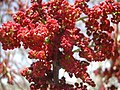 Inflorescence
 -
 Pistacia adds red to the landscape Mount Meron, Israel.
 -
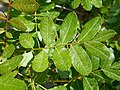 Leaves and stalk
 -
 Pistacia terebinthus in Kythira
 -
 Pistacia terebinthus at Sounion


See also
[edit]References
[edit]- ^ "The Plant List: A Working List of All Plant Species". Retrieved 21 November 2014.
- ^ "Palestine Terebinth - Pistacia terebinthus subsp. Palaestina". Archived from the original on 2021-07-01.
- ^ John Chadwick, The Mycenaean World (Cambridge: University Press, 1976), p. 120; Jose Melena, Durius v. 2 "ki-ta-no en las tabillas de Cnoso" (1974), p. 45-55
- ^ ""Terebinth Definitions and Meaning - Bible Dictionary"". Retrieved 3 Mars 2022
- ^ Skeat, Walter W. (1882). A Concise Etymological Dictionary of the English Language. Oxford, UK: Oxford University Press. p. 579.
- ^ a b Mills, John S.; White, Raymond (1977). "Natural Resins of Art and Archaeology Their Sources, Chemistry, and Identification". Studies in Conservation. 22 (1): 12–31. doi:10.2307/1505670. ISSN 0039-3630. JSTOR 1505670.
- ^ Barnhart, R. K. (1995). The Barnhart Concise Dictionary of Etymology. New York: Harper Collins. ISBN 0-06-270084-7.
- ^ Beckmann, Sabine (2012). "Resin and Ritual Purification: Terebinth in Eastern Mediterranean Bronze Age Cult". In Stampolidēs, Nikolaos Chr.; Kanta, Athanasia; Giannikourē, Angelikē (eds.). Athanasia: The Earthly, the Celestial and the Underworld in the Mediterranean from the Late Bronze and the Early Iron Age. International Archaeological Conference, Rhodes 2009. Hērakleio: Panistēmio Krētēs. pp. 29–42. ISBN 978-960-7143-40-2.
- ^ Giner-Larza, E. M; Máñez, S; Giner, R. M; et al. (2002). "Anti-inflammatory triterpenes from Pistacia terebinthus galls". Planta Medica. 68 (4): 311–5. Bibcode:2002PlMed..68..311G. doi:10.1055/s-2002-26749. PMID 11988853. S2CID 1565390.
- ^ "Menengiç Kahvesi Nedir? (Turkish)". harbiyiyorum.com. 14 November 2017.
- ^ Ayala, Francisco J. (March 1, 2011). "Elixir of life: In vino veritas". PNAS. 108 (9): 3457–3458. Bibcode:2011PNAS..108.3457A. doi:10.1073/pnas.1019729108. PMC 3048131. PMID 21292988. Retrieved 2 May 2011.
- ^ Ilan Ben Zion (28 August 2014). "Canaanite wine stash found in Galilee unearths ancient flavors". The Times of Israel.
External links
[edit]

Pistacia terebinthus
View on GrokipediaTaxonomy and morphology
Taxonomy
Pistacia terebinthus is a species within the genus Pistacia in the family Anacardiaceae. Its taxonomic classification follows the standard hierarchy for angiosperms: Kingdom Plantae, Phylum Streptophyta, Class Equisetopsida, Subclass Magnoliidae, Order Sapindales, Family Anacardiaceae, Genus Pistacia L., Species Pistacia terebinthus L.[5] Several synonyms have been recognized for this species, including Pistacia palaestina Boiss., Pistacia crassifolia Salisb., Lentiscus terebinthus (L.) Kuntze, and Pistacia terebinthina St.-Lag., reflecting historical taxonomic variations based on regional populations and morphological interpretations.[6] Within the genus Pistacia, which comprises approximately 12 accepted species, P. terebinthus belongs to section Terebinthus, characterized by deciduous species with imparipinnate leaves and larger seeds, distinguishing it from the evergreen section Lentiscus.[7][8][9] Phylogenetic analyses using chloroplast DNA support this sectional division and place P. terebinthus in a clade with close relatives such as Pistacia atlantica and Pistacia vera, highlighting shared evolutionary adaptations like dioecy and resilience to Mediterranean xeric conditions.[8][10]Morphology
Pistacia terebinthus is a deciduous shrub or small tree that typically grows to 2–6 meters in height, occasionally reaching up to 12 meters under optimal conditions, with a slow growth rate and a spreading, rounded crown featuring dense, symmetrical branching.[3][2][11] The leaves are compound and pinnate, measuring 10–20 cm in length, with 5–11 opposite, oblong to ovate-lanceolate leaflets that are 2–6 cm long and 1–3 cm wide, glossy dark green above and paler beneath, turning vibrant red in autumn. The rachis is generally unwinged, though winged forms occur in some variants. All parts of the plant emit a strong resinous aroma.[4][12][13] The plant is dioecious, with unisexual flowers that are small and reddish-purple, emerging in early spring alongside the new leaves in axillary panicles; male panicles measure 5–10 cm long, while female ones are shorter, and pollination is anemophilous (wind-mediated).[14][4][2] The fruits are small drupes, 5–7 mm in diameter, initially green and maturing to red before turning black, each enclosing a single seed. The bark is grayish-brown, fissured, and yields resin when incised on the stems. Galls, often induced by aphids such as Baizongia pistaciae, commonly form on the leaves and leaflets.[12][14][15][16][17]Distribution and ecology
Geographic distribution
Pistacia terebinthus is native to the Mediterranean Basin, where it spans southern Europe, North Africa, and the Middle East, with extensions into the Caucasus region and Crimea. In southern Europe, the species occurs across Spain (including the Balearic Islands), France (including Corsica), Italy (including Sicily and Sardinia), Greece (including Crete), Albania, Bulgaria, Cyprus, and the European portion of Turkey. Its North African distribution includes Morocco, Algeria, Tunisia, and Libya, while in the Middle East it ranges through Lebanon, Syria, Palestine, Israel, Jordan, Iran, Egypt, and Saudi Arabia.[5][3] The tree inhabits elevations from sea level up to 1,500–1,800 meters, thriving in diverse topographic conditions within its range. It is adapted to the Mediterranean climate, featuring hot, dry summers and mild, wet winters, which supports its resilience in semi-arid environments.[18][19] Outside its native range, Pistacia terebinthus has been introduced and cultivated in California, primarily for ornamental purposes and as a rootstock for the cultivated pistachio.[20][21] The conservation status of Pistacia terebinthus is assessed as Least Concern by the IUCN, indicating no global endangerment due to its wide distribution and population stability. However, local populations face threats from habitat loss in overgrazed regions, particularly in fragmented Mediterranean landscapes, prompting monitoring efforts in vulnerable areas.[22][23]Habitat and ecological role
Pistacia terebinthus thrives in Mediterranean dry woodlands, garrigue, maquis shrublands, and open oak or pine forests, particularly on calcareous, rocky, or sandy soils that provide good drainage.[3][19] It is commonly found on slopes and in degraded areas at elevations from sea level up to 1,500–1,850 meters, favoring sunny aspects and avoiding waterlogged conditions.[24][3] The species exhibits strong adaptations to harsh Mediterranean conditions, including high drought tolerance once established, facilitated by its root system and resin-rich tissues that help conserve moisture.[3][25] It withstands short-lived frosts down to -5 to -8°C during dormancy and shows greater frost resistance compared to related species like Pistacia lentiscus.[3][26] Additionally, P. terebinthus is salt-tolerant, enabling growth in coastal or low-salt to moderately saline soils, and requires full sun exposure for optimal development.[27] Ecologically, Pistacia terebinthus acts as a pioneer species in secondary succession on rocky or disturbed sites, contributing to vegetation recovery in maquis and garrigue formations.[19][24] It supports biodiversity by hosting insects such as aphids that induce galls on its leaves and stems, and its drupes serve as a food source for birds and other wildlife during late summer to autumn.[3] The tree's presence in shrub communities enhances habitat structure, often associating positively with species like Pinus brutia and Quercus coccifera.[19] However, P. terebinthus faces threats from overgrazing, which reduces regeneration, and frequent fires that can damage stands, though it shows some resilience through resprouting.[24] It aids in soil stabilization on slopes by binding rocky substrates and mitigating erosion, particularly in vulnerable Mediterranean landscapes.[24][19] Local populations may decline due to habitat degradation, though the species remains classified as Least Concern globally.History and etymology
Etymology
The scientific name Pistacia terebinthus consists of the genus Pistacia, derived from the Ancient Greek word πιστάκη (pistákē), referring to the pistachio tree due to morphological similarities among species in the genus.[28] The specific epithet terebinthus originates from the Latin terebinthus, which in turn comes from the Ancient Greek τερέβινθος (terébinthos), the name for the tree and its resin; this Greek term is considered of pre-Greek origin, likely from a Pelasgian substrate language, characterized by the consonant cluster νθ and possibly denoting a tree or resin-producing plant.[29][30] Common names for Pistacia terebinthus reflect its linguistic history and properties across cultures. In English, it is known as the terebinth, directly from the Greek and Latin roots described above, or as the turpentine tree, owing to the resin (terebinthine) extracted from its trunk, which was a primary source of turpentine—a volatile oil used since antiquity.[29][31] The Hebrew name elah (אלה) stems from a root meaning "to protrude" or signifying strength and might, evoking the tree's sturdy, enduring form akin to oaks.[32] In Arabic, it is called butm, a term highlighting its regional prominence in the Mediterranean and Near East.[33] The name's linguistic evolution traces back to the Bronze Age, with the earliest known reference appearing in Mycenaean Greek Linear B tablets as ki-ta-no, likely denoting the tree, its nuts, or resin in administrative records from sites like Knossos and Pylos.[34] This term connects to broader ancient Mediterranean nomenclature for resinous trees, influencing words like Latin terebinthina for the resin, which evolved into modern terms for turpentine across Indo-European languages, underscoring the plant's role in early trade and material culture.[35]Historical significance
Pistacia terebinthus, known as the terebinth, appears in ancient texts as a significant tree associated with ritual and sacred contexts. In the Hebrew Bible, the term "elah" in Genesis 35:4 refers to the terebinth under which Jacob buried the idols of his household, highlighting its role as a site for religious purification.[36] Mycenaean Linear B tablets from around 1600 BCE record "ki-ta-no" as a term for terebinth resin, indicating its use in perfumery and possibly ritual offerings in Bronze Age palace economies.[37] The tree is also referenced in classical literature, such as in Virgil's Aeneid (Book 10, line 136), where "Orician terebinth" appears in a simile comparing the beauty of Ascanius to ivory inlaid in terebinth wood.[12] Archaeological evidence underscores the terebinth's prominence in ancient practices. Residues of Pistacia resin, primarily from P. terebinthus, were discovered in over 130 Canaanite amphorae aboard the Late Bronze Age Uluburun shipwreck (c. 1300 BCE) off the coast of Turkey, comprising nearly one ton of cargo and evidencing extensive maritime trade in the eastern Mediterranean.[38] In ancient Egypt, chemical analyses of mummification balms from the New Kingdom, including those on high-status individuals like the official Nebiri (c. 1400 BCE), confirm the use of Pistacia resin for its preservative and aromatic properties during embalming rituals.[39] Similarly, terebinth resin has been identified in Minoan contexts on Crete, linked to purification rites in Bronze Age cult practices, where it served as incense or an offering substance in religious ceremonies.[40] Symbolically, the terebinth held cultural importance in the ancient Mediterranean, often representing endurance due to its ability to thrive in arid, rocky soils where other vegetation struggles.[41] In Greco-Roman traditions, it was revered as a sacred tree in woodland shrines, evoking themes of divine presence and natural resilience in folklore.[42] Its resin was a valuable commodity in historical trade networks, including routes connecting the Levant to Anatolia and beyond, facilitating exchanges that prefigured later Silk Road pathways for aromatics and medicinals.[43]Uses and cultural importance
Traditional uses
The resin of Pistacia terebinthus, known as terebinth, has been extracted historically for the production of turpentine, a volatile oil used in varnishes and as an adhesive in ancient Egyptian and Mediterranean crafts.[44] In Bronze Age Eastern Mediterranean cultures, the resin served ritual purposes, including as incense for purification.[40] In ancient Greek medicine, as documented in Hippocratic texts, terebinth resin was employed as a purgative to treat various ailments, often administered for its laxative effects.[45] Across Mediterranean folk traditions, the resin acted as an expectorant for respiratory disorders in Cyprus and Greece, a treatment for peptic ulcers in Turkey when mixed with pine resin or formed into pills, and in ointments for hemorrhoids and as a diaphoretic and analgesic in Italy.[46][47] The fruits and seeds of P. terebinthus have long been incorporated into traditional cuisines, particularly in the eastern Mediterranean. In Cyprus, the fruits are roasted with salt as a snack or ground into flour for baking tremithopittes, a specialty village pie or bread.[46] On Crete, the fruits flavor tsikoudia, a local distilled spirit akin to raki, and yield a cold-pressed oil called tsikoudolado or agiolado used in cooking for its aromatic profile.[48] In Turkey, the fruits are consumed raw or spread on bread at breakfast, with oil extracted for general culinary purposes, and the roasted seeds serve as a coffee substitute among Kurdish communities.[49][50] Folk medicine in Turkey also employs the fruits to alleviate stomachaches and diarrhea.[46] Leaves and bark of P. terebinthus provided tannins essential for industrial applications in Mediterranean societies. The leaves, containing up to 22% tannins, were used as an adulterant for sumac in tanning processes, while tannins from stem galls facilitated leather production.[46] In Turkish folk medicine, leaf decoctions mixed with garlic and yogurt treated sunstroke, and both leaves and bark addressed injuries, wounds, and inflammation.[46] Greek and Cypriot traditions utilized leaf preparations for general therapeutic purposes, including anti-inflammatory remedies.[46][1] Other parts of the plant contributed to daily and artisanal practices. In Greece, particularly the Northern Sporades and Pelion region, young shoots known as tsitsíravla were pickled in brine as a vegetable meze to accompany tsipouro or ouzo.[51] The wood served as fuel for cooking and heating in Italy, valued for bread ovens due to its slow-burning properties, and occasionally for crafting small tools and furniture.[46] Galls induced on the plant yielded tannins for ancient dyes and inks; a red dye was derived from them in historical contexts, and the material supported ink production in Mediterranean and Egyptian traditions.[52]Modern applications
Recent studies have highlighted the antioxidant and antimicrobial properties of Pistacia terebinthus resin, fruits, and leaves, attributing these effects to rich phenolic and flavonoid contents.[1] Fruit oil extracts exhibit strong free radical scavenging and inhibit bacterial growth, positioning them as potential functional ingredients in food preservation.[48] Leaf essential oils from various bioclimatic zones demonstrate comparable antimicrobial activity against pathogens, supporting their evaluation for pharmaceutical applications since the early 2000s.[53] Research into antidiabetic potential focuses on fruit extracts and compounds like luteolin, which enhance glucose metabolism and inhibit alpha-amylase in vitro, suggesting benefits for managing type 2 diabetes.[54] Anti-inflammatory effects, particularly from gall-derived triterpenes, reduce chronic and acute inflammation in animal models, with NIH reviews in the 2020s noting promise for treating inflammatory disorders without significant toxicity.[55][56] Essential oils, rich in α-pinene and limonene, are explored for aromatherapy due to their balsamic scent and mild sedative properties, though clinical trials remain limited.[1] Commercially, the resin serves as a natural component in varnishes for wood preservation and adhesives, valued for its durability in Mediterranean craft industries.[57] Fruits contribute to niche products like terebinth-based supplements for antioxidant support and terebinth honey, a specialty from pollinated hives in arid regions.[48] In agriculture, P. terebinthus acts as a rootstock for Pistacia vera grafts, improving scion tolerance to salinity and water stress in Mediterranean orchards.[58] Its deep root system supports agroforestry systems for soil erosion control on slopes, while post-2020 studies confirm its resilience to climate-induced droughts, aiding sustainable pistachio production.[59] As of 2025, emerging research explores further food applications, including ultrasound-assisted leaf and fruit extracts incorporated into yogurt to enhance probiotic viability (>7 log CFU/g) and extend shelf life, and leaf polyphenolics as natural preservatives outperforming some commercial antioxidants against microbial spoilage.[1][60][61] Conservation initiatives promote P. terebinthus in Mediterranean reforestation via EU-funded projects like NATIVE ROOTSTOCK, which integrate it into agroecosystems to enhance biodiversity. It features in Natura 2000 protected sites for habitat restoration, with bioprospecting efforts targeting bioactive compounds through non-destructive sampling to prevent overexploitation.[62][1]References
- https://en.wiktionary.org/wiki/terebinth