Hubbry Logo
Texas tortoiseTexas tortoiseMain
Open search
Texas tortoise
Community hub
Texas tortoise
logo
8 pages, 0 posts
0 subscribers
Be the first to start a discussion here.
Texas tortoise
Texas tortoise
from Wikipedia

Texas tortoise
CITES Appendix II (CITES)[2]
Scientific classification Edit this classification
Kingdom: Animalia
Phylum: Chordata
Class: Reptilia
Order: Testudines
Suborder: Cryptodira
Family: Testudinidae
Genus: Gopherus
Species:
G. berlandieri
Binomial name
Gopherus berlandieri
(Agassiz, 1857)
Synonyms[3]
  • Xerobates berlandieri
    Agassiz, 1857
  • Testudo berlandieri
    Strauch, 1862
  • Xerobates gopher berlandieri
    Gray, 1873
  • Testudo tuberculata
    Berlandier, 1882 (nomen nudum)
  • Gopherus berlandieri
    Stejneger, 1893
  • Gopherus polyphemus berlandieri
    Mertens & Wermuth, 1955
  • Gopherus berlandierii [sic]
    Reeves, 1975 (ex errore)
  • Scaptochelys berlandieri
    — Bramble, 1982
  • Gopherus berlanderi [sic]
    Rogner, 1996 (ex errore)

The Texas tortoise (Gopherus berlandieri) is a species of tortoise in the family Testudinidae. The species G. berlandieri is one of six species of tortoises that are native to North America.

Geographic range

[edit]

G. berlandieri (Texas Tortoise) is found in the southern third of Texas (roughly parallel to Houston) southward into the Mexican states of Coahuila, Nuevo León, and Tamaulipas. Within its range, it inhabits semi-arid regions characterized by mesquite shrub and cactus dominated landscapes.

Etymology

[edit]

The specific epithet, berlandieri, is in honor of naturalist Jean Louis Berlandier, who worked for the Mexican government on one of the first biological surveys of Texas.[1][4] As such, some sources refer to it as Berlandier's tortoise.[4][5]

Biology

[edit]

The Texas tortoise, unlike other species of gopher tortoise, is not an adept burrower. It uses the thick vegetation for cover and thermoregulation.[6] Succulent plants, a preferred food of the Texas tortoise, are common in these areas. It especially likes the fruit of cacti such as the prickly pear. The Texas Tortoise is oviparous. Female clutch sizes typically range anywhere from 1 to 5 eggs. The success of these clutches dramatically rely climatic conditions and habitat quality. A major ecological role Texas Tortoises play is in the dispersal of seeds throughout its range. By consuming fruit and excreting its seeds, the Texas Tortoise plays a pivotal role in the structure of the plant community that the tortoise inhabits. Study on this species population genetics suggest limited gene flow and potential regional isolation.[7] Population studies using mark-recapture methods have shown low dispersal rate and a somewhat limited contiguous home range. The Texas Tortoise is threatened by fragmentation, habitat loss, and illegal collection/trade.[8]

Conservation status

[edit]

Texas tortoises used to be very common, with densities of around 15–16 tortoises/ha, which were recorded in 1975. By 2001 the number of tortoises has drastically declined to an estimated 0.26 tortoises/ha and their distribution has become sporadic.[9]

The Texas tortoise is still considered an animal of low concern by the IUCN Red List, where it has not been evaluated since 1996 though. It is listed as a threatened species in the state of Texas, and thus protected by state law. It is illegal to collect or possess them. The Mexican federal government lists Gopherus berlandieri as A (= Threatened) in Mexico.[10] Likewise, using Environmental Vulnerability Scores, Gopherus berlandieri scored 18, a high vulnerability species on a scale of 0–20, in evaluations of both Tamaulipas and Nuevo Leon herpetofauna.[11][12] In 2018, the IUCN Tortoise and Freshwater Turtle Specialist Group recommended a re-assessment and re-classification of all six Gopherus species.[13] This reclassification would move G. berlandieri from Near Endangered (NE) to Near Threatened (NT).[13]

[edit]

References

[edit]
[edit]
Revisions and contributorsEdit on WikipediaRead on Wikipedia
from Grokipedia
The Texas tortoise (Gopherus berlandieri) is a small, terrestrial species belonging to the family Testudinidae, native to southern in the United States and northeastern . It is distinguished by its dome-shaped covered in yellowish-orange scutes with prominent, horn-like growths, and sturdy, cylindrical hind legs adapted for digging, resembling those of an . As the smallest tortoise in the United States, adults typically reach a carapace length of 20–22 cm (8–9 inches), with hatchlings measuring about 3–4 cm. This tortoise inhabits arid and semi-arid environments, including dry scrublands, grasslands, thornscrub thickets, and open brushy areas with sandy, well-drained soils, primarily at elevations from to about 884 m. Its range extends across south-central south of the cities of Del Rio, , and Rockport, into the Mexican states of , , and . Primarily herbivorous, the Texas tortoise feeds on grasses, weeds, flowers, succulent plants like prickly pear , and occasionally or grubs, though it may consume meat in . It is a burrower, excavating shallow burrows or using natural shelters under vegetation for protection from predators and extreme temperatures, and it hibernates during winter. Behaviorally docile and long-lived—potentially up to 50–60 years in the wild or —the Texas exhibits a low reproductive rate, with individuals reaching around 15 years and producing few offspring. Males are solitary and territorial, occasionally engaging in , while females lay 1–5 eggs per in nests dug near bushes. evidence indicates that relatives of this species have existed in since the epoch, approximately 5 million years ago. Conservation efforts focus on this species due to regional declines, though it is classified as Least Concern globally by the (as of 1996), reflecting its relatively stable overall population. In , however, it is listed as threatened since under state law, prohibiting its collection, possession, or sale, with violations punishable by fines typically of $273.50 per tortoise, up to $4,000 for repeat offenses. Primary threats include from urban development, , and brush clearing; historical exploitation for the pet trade; and incidental mortality from strikes or entanglement in . Monitoring programs, such as radio-tracking in national parks like Palo Alto Battlefield, aim to assess populations and support habitat restoration to mitigate these risks.

Taxonomy and Nomenclature

Taxonomic Classification

The Texas tortoise (Gopherus berlandieri) belongs to the family Testudinidae, which encompasses all , and is placed within the Gopherus, a group of North American fossorial known for their burrowing adaptations. This currently includes six extant : G. agassizii (), G. morafkai (Sonoran desert tortoise), G. polyphemus (), G. flavomarginatus (yellow-margined tortoise), G. evgoodei (Goode's tortoise), and G. berlandieri. The is monotypic, with no recognized , reflecting its relatively uniform morphology and genetic cohesion across its range. Phylogenetically, G. berlandieri is closely related to other members of the genus Gopherus, forming part of a monophyletic clade of North American gopher tortoises that diverged during the Miocene, approximately 4-8 million years ago. Molecular analyses of mitochondrial DNA, such as cytochrome b sequences, confirm its sister relationship to species like G. agassizii within the Agassizii-berlandieri group, highlighting shared evolutionary adaptations for arid and semi-arid environments, including enhanced osmoregulation and burrowing behaviors that facilitate survival in xeric habitats. The species was first described by in 1857, based on syntypic specimens (USNM 60, consisting of two individuals) collected in southern by the French naturalist Jean Louis Berlandier during his expeditions in the region. This description, published in Contributions to the Natural History of the United States of America, established G. berlandieri as distinct from other gopher tortoises due to its smaller size and specific shell characteristics, solidifying its taxonomic placement.

Etymology

The common name "Texas tortoise" derives from the species' primary distribution within the , which is limited to southern , serving to distinguish it from other burrowing tortoises in the genus , such as the more widespread () of the southeastern U.S. The is berlandieri. The genus name , established by in 1832, originates from the English term "," referring to burrowing , which itself stems from the French word "gaufre" meaning honeycomb; this alludes to the tortoise's habits and the complex burrow systems it constructs, resembling the interconnected tunnels of gophers. The species epithet berlandieri is a patronym honoring Jean Louis Berlandier (1803–1851), a French naturalist who extensively collected botanical and zoological specimens in and during expeditions in the 1820s on behalf of the Mexican government; Berlandier tragically drowned while crossing the in 1851. The species was originally described by as Xerobates berlandieri in 1857, based on specimens from . It was subsequently reassigned to the genus by Leonhard Stejneger in 1893 to reflect its close affinities with other North American burrowing tortoises. The Texas tortoise is occasionally referred to as Berlandier's tortoise in recognition of the naturalist it commemorates.

Distribution and Habitat

Geographic Range

The Texas tortoise (Gopherus berlandieri) is native to southern in the United States and northeastern . In , its range encompasses the Valley northward to areas around Victoria and , generally south of a line connecting Del Rio, , and Rockport, including counties such as Val Verde, Bexar, Karnes, Refugio, and all counties southward. In , the species occurs in the states of , , and , with some records extending into eastern . The overall geographic extent of the Texas tortoise's range is approximately 141,500 km², closely aligning with the boundaries of the Tamaulipan Biotic Province, though populations are now fragmented due to habitat loss. Historically, the distribution was more continuous across brushlands and adjacent Mexican thornscrub ecosystems, but current ranges are restricted by and , particularly in the where brushland has declined by about 90% since the early 1900s. The species occupies lowlands up to elevations of around 884 m, primarily in semi-arid subtropical regions characterized by annual rainfall of 460–760 mm. Within this range, tortoises are associated with thornbrush areas that provide suitable conditions for their survival.

Habitat Preferences

The tortoise (Gopherus berlandieri) primarily inhabits arid grasslands, thornbrush savannas, and oak mottes characterized by sandy or loamy soils that facilitate burrowing activities. These environments, often referred to as coastal prairies and Tamaulipan thornscrub, provide the open, semi-arid conditions essential for the species' thermoregulation and shelter needs. Microhabitat preferences include open-canopied areas allowing high light penetration to the ground level, sparse cover that supports mobility, and locations near seasonal or moisture-retaining features in otherwise dry landscapes. Such features enable access to occasional hydration sources while maintaining for predator avoidance and navigation. The tortoise's burrowing behavior is closely tied to these choices, with individuals excavating shallow pallets, typically up to 10 cm deep and 30-40 cm long, in well-drained, deep sandy substrates to escape extreme temperatures. The exhibits tolerance to moderate brush encroachment, adapting to early successional stages where remains low, but populations decline in dense woodlands or heavily grazed pastures that compact soils or reduce availability. Recent 2025 highlights a strong preference for habitats with high light intensity at ground level, such as , where tortoise densities reach up to 4.4 individuals per , compared to lower use in thornscrub or shrub-dominated areas.

Physical Characteristics

Morphology and Appearance

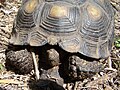
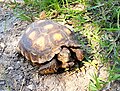
The Texas tortoise (Gopherus berlandieri) exhibits a compact, oblong body with a distinctly high-domed that provides structural support and protection, complemented by robust limbs adapted for digging and a hinged plastron that allows partial enclosure of the body for defense. The overall build emphasizes durability in arid environments, with the forming a rigid, arched shield and the plastron featuring an anterior hinge for enhanced retraction. The shell is characterized by a high, oval up to 24 cm long, marked by growth rings on its rough, ridged surface; the are dark brown to black with yellow or tan areolae and borders, while the plastron is pale yellow with elongated, forked gular that project anteriorly. The is flat-topped and highest behind the center, dropping abruptly to a serrated rear margin with 11 marginal per side and an undivided, downturned supracaudal ; the bridge is broad, typically bearing two axillary . The head is small and wedge-shaped, with a weak, slightly hooked , non-projecting pointed , and large irregular dorsal scales; the limbs are sturdy, with forelimbs flattened and covered in large, overlapping scales arranged in 7–8 longitudinal rows for burrowing efficiency, and hind limbs cylindrical and columnar, resembling an elephant's. The tail is short and unremarkable in both sexes. Sexual dimorphism is pronounced, with males possessing a concave plastron, longer and more divergent gular projections, a longer , and a longer , while females have a flatter plastron and shorter . Coloration aids in within arid landscapes, featuring a brown with areolae, yellowish plastron, and yellowish-brown on the head, limbs, and ; juveniles display brighter tones that subdue to darker browns in adults. The scutes often appear yellowish-orange and "horned," contributing to the ' distinctive appearance.

Size and Growth

Adult Texas tortoises typically reach a carapace length of 18 to 24 cm and weigh between 0.9 and 2.3 kg, with males generally slightly larger than females. Hatchlings measure 3 to 4 cm in carapace length at emergence and weigh approximately 21 g. Growth is rapid during the first 5 years, with annual increments in length averaging 11 to 12 mm for immatures, before slowing as individuals approach adulthood. is attained slowly, around 12 to 15 years of age, often based on reaching a minimum length of about 140 mm for females. Annual growth rings on the scutes can indicate age up to 20 to 25 years, though accuracy diminishes thereafter. In the wild, Texas tortoises have a lifespan of 50 to 70 years. Maximum size is influenced by nutrition and habitat quality, with better conditions supporting larger individuals; size shows geographic variation, decreasing with distance from the Gulf of Mexico.

Behavior and Ecology

Activity Patterns

The Texas tortoise (Gopherus berlandieri) exhibits diurnal activity patterns, emerging primarily in the mornings and late afternoons during warmer months to avoid midday heat, while shifting to midday activity in spring and fall when temperatures are milder. This bimodal pattern in summer helps mitigate thermal stress, with tortoises retreating to burrows or shaded refuges during peak daytime temperatures exceeding 37°C. Burrow use also supports thermoregulation, as inactive individuals maintain body temperatures correlated with substrate conditions in these shelters. Seasonally, the Texas tortoise is active from mid-April to mid-October, aligning with favorable temperatures and rainfall in its thornscrub , and enters a period of brumation () from mid-October to mid-April, remaining in burrows or soil depressions to conserve energy during cooler months. Activity peaks bimodally with rainfall events in May–June and September, though overall levels can vary annually based on and conditions. Texas tortoises are largely solitary, with minimal home range overlap between individuals, though males tend to have larger ranges (mean 2.57 ha) than females (mean 1.42 ha), typically spanning 1–10 ha overall. They display to specific burrows or pallets, maintaining multiple refuges (up to several dozen per individual) within their home range for shelter and overwintering. Daily movements average around 267 m, with occasional longer nomadic excursions, but locomotion remains slow at a maximum speed of approximately 0.3 km/h. Social interactions are infrequent and asocial in nature, with rare aggregations observed near limited resources like or shade, but no evidence of colonial living. Vocalizations are uncommon, limited primarily to defensive hissing produced by rapid air expulsion when threatened. In response to predators or disturbances, individuals withdraw into their shells for protection, relying on this passive defense due to their deliberate pace and cryptic coloration.

Diet and Foraging

The Texas tortoise (Gopherus berlandieri) is primarily herbivorous, consuming a diet dominated by forbs, cacti, grasses, and occasional woody vegetation, with forbs comprising the largest portion at approximately 37% of fecal fragments analyzed, followed by cacti at 28% and grasses at 21%. Specific foods include prickly pear cactus pads (Opuntia spp.) and fruits (tunas), as well as a variety of native forbs and grasses that provide essential nutrients. Animal matter appears in about 6% of samples but is likely incidental, such as through coprophagy or accidental ingestion, and is rare in the wild. As opportunistic grazers, Texas tortoises exhibit selective , preferring high-protein, low-fiber plants like forbs and cacti over more fibrous grasses, which they consume less than available in their habitat. This selectivity is evident across study sites, where cacti are over-consumed relative to availability (Manly's α > 0.25), while grasses are avoided (Manly's α < 0.25). occurs primarily during cooler parts of the day, with seasonal shifts toward more fruits and succulents in summer to capitalize on availability. Juveniles tend to favor forbs more than adults, supporting faster growth rates. Nutritionally, the diet emphasizes calcium-rich forbs and cacti to support shell development and overall growth, as these plants contain higher levels of nitrogen, phosphorus, calcium, and magnesium compared to grasses, which may even inhibit mass gain if over-relied upon. Water intake is minimal and primarily obtained from the moisture content in succulent foods like prickly pear, with free-standing water rarely consumed in the arid habitats where the species occurs. In their and scrub ecosystems, Texas tortoises play a key ecological role by aiding through the consumption and subsequent excretion of fruits and vegetation, promoting native plant diversity, while their grazing helps control vegetation density.

Reproduction

The mating season for the Texas tortoise (Gopherus berlandieri) typically spans June to September, with peak activity in late summer. During , males pursue females, bobbing their heads and circling while biting at the female's legs and shell to stimulate mounting. Copulation occurs during the mating season from June to September. Nesting takes place from April to July, when gravid females excavate shallow depressions (approximately 10-15 cm deep) in loose, sandy soil to deposit eggs. Each clutch contains 1–3 eggs on average, and females may produce 1–2 clutches annually, though clutch frequency averages about 1.34 per year based on ultrasound monitoring. Eggs incubate for 90-120 days under natural conditions, with optimal temperatures ranging from 28-32°C. Sex is determined by incubation temperature, a pattern common in gopher tortoises where warmer conditions (above approximately 30°C) produce females and cooler ones yield males. Hatchlings emerge independently and are immediately vulnerable, facing high rates of nest predation from mammals and invertebrates, which contributes to low overall survival. Juveniles also risk desiccation in arid environments due to their small size and limited burrowing ability shortly after hatching. The Texas tortoise exhibits a low reproductive rate, characterized by small clutch sizes and infrequent breeding, which necessitates long adult lifespans for population stability. Females reach sexual maturity at 10–15 years of age, typically at a carapace length of about 155 mm, after which breeding may not occur annually.

Conservation Status

The primary threats to the Texas tortoise (Gopherus berlandieri) include driven by agriculture, urbanization, and brush clearing, particularly in , as well as illegal collection for the pet trade. These activities have reduced and isolated suitable thornscrub and habitats, limiting tortoise movement and increasing vulnerability to local extinctions. Additional risks encompass vehicle mortality on roads, which causes significant direct deaths, and predation by such as coyotes, foxes, and bobcats, alongside invasive fire ants that particularly target eggs and hatchlings. Diseases, including upper infections caused by agassizii, further threaten populations, especially during translocation or in stressed habitats. The Texas tortoise is classified as Least Concern on the , with the last assessment in , though a re-assessment was recommended in 2018 by the IUCN Tortoise and Freshwater Turtle Specialist Group; it is listed as threatened under Texas state law due to ongoing declines. reflecting a roughly 98% decline from historical densities of up to 35 individuals per to current levels around 0.25 per hectare. Populations in have declined due to land conversion, leading to fragmented distributions, while some protected areas in northeastern maintain relative stability. Recent studies indicate substantial loss in the [Rio Grande](/page/Rio Grande) Valley, a key stronghold, exacerbating isolation in remaining patches. , through prolonged droughts, intensifies for the Texas tortoise, which relies on seasonal moisture for and burrowing, potentially worsening degradation in arid regions.

Protection and Management

The Texas tortoise (Gopherus berlandieri) receives legal protection as a threatened species under Texas state law, administered by the Texas Parks and Wildlife Department (TPWD) since 1977, prohibiting its collection, possession, or sale without permits. Internationally, it is listed under Appendix II of the Convention on International Trade in Endangered Species (CITES), regulating trade to prevent overexploitation. In Mexico, where much of its range occurs, the species is classified as threatened (category A: Amenazada) under the Norma Oficial Mexicana NOM-059-SEMARNAT-2010, providing safeguards against habitat alteration and exploitation. Conservation initiatives include translocation programs led by TPWD and partners, such as Texas A&M University-Kingsville, which relocate from development-threatened sites to suitable while monitoring post-release survival and movement. restoration efforts focus on the Tamaulipan thornscrub , with TPWD and the U.S. Fish and Wildlife Service (USFWS) planting native vegetation and controlling on public lands like national refuges to enhance and availability. Key management practices encompass installing exclusion around construction zones and roadsides, with specifications including 6-inch buried mesh and 24-inch height to deter tortoises from high-risk areas and reduce vehicle collisions. campaigns, including TPWD's 2025 Texas Tortoise Turn-In event, promote awareness of pet trade risks and encourage voluntary surrender of illegally held individuals, resulting in over 180 rescues and rehabs. In protected areas like Palo Alto Battlefield National Historical Site, long-term mark-recapture monitoring has documented stable populations of 150–200 individuals since 2012, indicating localized recovery through these interventions. However, challenges persist with enforcement in U.S.- border regions, where illegal pet trade smuggling undermines protections despite increased customs seizures. Ongoing research priorities include genetic analyses to evaluate population connectivity and across fragmented habitats, as studies reveal weak but present differentiation between northern and southern groups. Monitoring protocols, updated in the by the National Park Service's Gulf Coast Network, emphasize standardized surveys to track trends and inform adaptive management.

References

Add your contribution
Related Hubs
User Avatar
No comments yet.