Hubbry Logo
The HoundThe HoundMain
Open search
The Hound
Community hub
The Hound
logo
8 pages, 0 posts
0 subscribers
Be the first to start a discussion here.
The Hound
The Hound
from Wikipedia

"The Hound"
Short story by H. P. Lovecraft
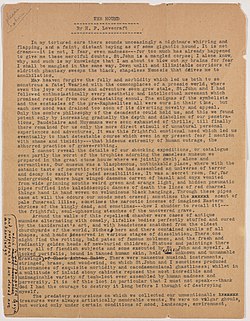
First page of the manuscript The Hound.
Text available at Wikisource
CountryUnited States
LanguageEnglish
GenreHorror
Publication
Published inWeird Tales
Publication typePeriodical
Media typePrint (magazine)
Publication dateFebruary 1924

"The Hound" is a short story written by H. P. Lovecraft in September 1922 and published in the February 1924 issue of Weird Tales. It contains the first mention of Lovecraft's fictional text the Necronomicon.[1]

Plot

[edit]

The story opens with the unnamed narrator preparing to commit suicide. Lamenting his fate, he reflects upon the events which led him to this moment.

Illustration from Weird Tales (William Fred Heitman)

The narrator and his friend, St. John, are a pair of loners who both have a deranged interest in robbing graves. They constantly defile crypts and often keep souvenirs of their nocturnal expeditions. Since they reside in the same house, they have the opportunity to set up a sort of morbid museum in their basement. Using the objects collected from the various graves they have robbed, the two men organize a private exhibition. The collection consists of headstones, preserved bodies, skulls, and several heads in different phases of decomposition. It also includes statues, frightful paintings, and a locked portfolio bound in tanned human skin.

One day, the two learn of a particular grave, which sparks a profound interest in them: an old grave in a Holland cemetery which holds a legendary tomb raider within, one who is said to have stolen, many years ago, a "potent thing from a mighty sepulchre." They travel to the old cemetery where the man was buried. The thought of exhuming the final resting place of a former grave robber is irresistibly appealing to them. That, and the fact that the body had been buried several centuries before, drives them to travel such long distances to reach the site. Upon reaching the old cemetery, they notice the distant baying of a giant hound. They ignore it and begin their excavation. After some time, they hit a solid object in the ground. Clearing the last of the dirt from it, the two men unearth a strange and elaborately made casket. Upon opening the casket, they see that several places on the skeletal remains appear torn and shattered, as if attacked by a wild animal, yet the whole of the skeleton is still completely distinguishable. At that moment, they notice a jade amulet hanging from the skeleton's neck. They examine it and, after some observation, they recognize the amulet as one mentioned in "the forbidden Necronomicon of the mad Arab Abdul Alhazred." They immediately know they must have the amulet at all costs. They remove it from the skeleton and flee into the night. As they do, they notice once again the continuous sound of a baying hound in the distance.

After they return home to England, strange events begin to occur. Odd sounds can be heard within and around their house, including the distant howling they heard in the cemetery. One night, St. John is violently attacked and killed by a mysterious creature, which the narrator claims the amulet had brought unto him. He destroys the macabre museum he and his friend made before fleeing from the house and traveling to London. Still plagued by bizarre occurrences, he decides that he must return the amulet to its rightful owner. He travels to Holland, but the amulet is stolen from him before he can return it. The next day, he reads in the newspaper about a band of thieves savagely killed by an unknown creature. Slowly going insane, he returns to the churchyard and exhumes the coffin once more, only to find the skeleton within covered in caked blood and bits of flesh and hair, holding the lost amulet in its hand. Suddenly, the skeleton begins howling, the same howl that had tormented him since he first stole the amulet. The narrator flees the graveyard, succumbing to madness and despair. He states that he intends to kill himself with a revolver, believing death to be his only refuge from the crawling horror which grows within him.

Cthulhu Mythos

[edit]

"The Hound" contains several references to the body of lore known as the Cthulhu Mythos that Lovecraft shared with other horror writers. Most notably, it marks the first appearance of one of Lovecraft's most famous literary creations—the forbidden book known as the Necronomicon. Lovecraft had mentioned its author a year earlier, in "The Nameless City", but here for the first time named the book. Referring to an amulet found on a grave-robbing expedition, the narrator relates:

Alien it indeed was to all art and literature which sane and balanced readers know, but we recognized it as the thing hinted of in the forbidden Necronomicon of the mad Arab Abdul Alhazred; the ghastly soul-symbol of the corpse-eating cult of inaccessible Leng, in Central Asia. All too well did we trace the sinister lineaments described by the old Arab daemonologist; lineaments, he wrote, drawn from some obscure supernatural manifestation of the souls of those who vexed and gnawed at the dead.

The reference to "Leng" is one of the first mentions of Lovecraft's imaginary plateau, having only appeared before in "Celephais" (1920). Here placed in Central Asia, Leng is also associated in Lovecraft's writings with Antarctica and his imaginary Dreamlands.

Lovecraftian scholar Will Murray, pointing to the "semi-canine face" on the amulet as well as the "corpse-eating cult" of Leng, suggests that the titular creature of "The Hound" "probably represents an early form of the ghoul as Lovecraft would develop it."[2]

Inspiration

[edit]

On September 16, 1922, Lovecraft toured the Flatbush Reformed Church in Brooklyn with his friend Rheinhart Kleiner, writing about the visit in a letter:

Around the old pile is a hoary churchyard, with internments [sic?] dating from around 1730 to the middle of the nineteenth century.... From one of the crumbling gravestones--dated 1747--I chipped a small piece to carry away. It lies before me as I write--and ought to suggest some sort of horror-story. I must place it beneath my pillow as I sleep... who can say what thing might not come out of the centuried earth to exact vengeance for his desecrated tomb? And should it come, who can say what it might not resemble?[3]

Lovecraft wrote "The Hound" shortly afterwards, using as the name of one of the main characters his nickname for his companion Kleinhart, "St. John".[4] The grave that is fatefully robbed in the story is in a "terrible Holland churchyard"—perhaps a reference to Flatbush church being part of the Dutch Reformed Church (although the story is actually set in the Netherlands, as well as in England).

Critic Steven J. Mariconda suggests that the story is a tribute to the Decadent literary movement in general and in particular Joris-Karl Huysmans' A rebours, an 1884 novel that Lovecraft greatly admired. (Huysmans is mentioned by name in the story, along with Baudelaire.) Like "The Hound"'s protagonists, victims of a "devastating ennui", the main character of A rebours suffers from an "overpowering tedium" that leads him to "imagine and then indulge in unnatural love-affairs and perverse pleasures."[5] Mariconda also points to the heavy debt the story owes to Edgar Allan Poe, an influence acknowledged by several borrowed phrases:

The "oblong box" exumed, the mysterious "knock on my chamber door", and the "red death" brought by the Hound all echo Poe's phraseology.[6]

Reception

[edit]
Cover of Weird Tales, February 1924 (first publication of The Hound)

Though Lovecraft chose "The Hound" as one of the five stories he initially submitted to Weird Tales, his main professional outlet, he later dismissed it as "a dead dog"[7] and "a piece of junk".[8]

Some critics have shared Lovecraft's deprecation; Lin Carter called it "a minor little tale" that is "slavishly Poe-esque in style".[9] But the story has its defenders; Steven J. Mariconda says it is "written in a zestful, almost baroque style which is very entertaining",[7] while Peter Cannon, saying that it must have been written "with tongue at least partly in cheek", credits it with a certain "naive charm".[10]

The plot of the Poppy Z. Brite short story "His Mouth Will Taste of Wormwood" bears a strong resemblance to this Lovecraft story, albeit transplanted to a modern Southern Gothic Louisiana setting.

Audio adaptations

[edit]
  • Roddy McDowall was the narrator of the story on a 1966 LP release (Lively Arts 30003) that also included the Lovecraft story "The Outsider".
  • The story was produced as a 1930s-style radio drama on November 7, 2019 in episode 5 of the Tales from Beyond the Pale podcast.

References

[edit]

Sources

[edit]
  • Lovecraft, Howard P. (1999) [1920]. "The Hound". In S. T. Joshi; Peter Cannon (eds.). More Annotated Lovecraft (1st ed.). New York City, NY: Dell. ISBN 0-440-50875-4. With explanatory footnotes.
[edit]
Revisions and contributorsEdit on WikipediaRead on Wikipedia
from Grokipedia
"The Hound" is a short story in the horror genre written by American author H. P. Lovecraft in September 1922 and first published in the February 1924 issue of Weird Tales. The narrative centers on two wealthy, jaded companions who, bored with conventional thrills, turn to grave-robbing and the collection of macabre artifacts as a means of excitement. Their pursuits lead them to desecrate an ancient burial site in the Netherlands, where they unearth a cursed jade amulet, awakening a spectral hound that relentlessly pursues them with supernatural ferocity. This encounter results in tragedy for one protagonist and drives the narrator toward madness, underscoring the story's exploration of decadence, forbidden knowledge, and retribution from beyond the grave. "The Hound" marks an early entry in Lovecraft's Cthulhu Mythos, incorporating references to the fictional Necronomicon grimoire and the corpse-devouring ghouls associated with the dreamland of Leng, elements that would recur in his later works. The tale exemplifies Lovecraft's signature style of cosmic horror, blending gothic atmosphere with psychological dread to evoke the insignificance of humanity against incomprehensible forces.

Publication and Background

Publication History

"The Hound" was written by in September 1922 during his residence in . The story marked one of Lovecraft's early submissions to the nascent Weird Tales, reflecting his growing involvement in professional fiction markets amid personal financial struggles. It first appeared in print in the February 1924 issue of Weird Tales (volume 3, number 2, pages 50–52, 78), under the editorship of Edwin Baird. The publication occurred without notable editorial interventions, as the surviving typescript aligns closely with the printed version, indicating minimal changes by the magazine staff. Following its debut, "The Hound" was included in several posthumous collections that helped establish Lovecraft's literary legacy. Notable editions feature The Outsider and Others (Arkham House, 1939), edited by and Donald Wandrei; The Best Supernatural Tales of H. P. Lovecraft (World Publishing Company, 1945), selected by Derleth; and the modern anthology The Call of Cthulhu and Other Weird Stories (, 1999), edited by . These compilations preserved the original text and introduced the story to broader audiences, contributing to its enduring presence in Lovecraftian literature.

Biographical Context

In 1922, resided in his family home in , with his surviving aunts following the death of his mother, Susie Phillips Lovecraft, on May 24, 1921, after a prolonged illness and institutionalization that had deepened his sense of familial isolation. This period marked a phase of emotional recovery for Lovecraft, who had been profoundly affected by the loss, leading to a reclusive lifestyle focused on writing and correspondence amid financial strain from reduced inheritance. His longstanding fascination with the , rooted in childhood readings of and gothic literature, found expression in the supernatural and decadent themes of his fiction during this time of personal seclusion. Lovecraft's extensive letter-writing with friends, particularly Frank Belknap Long—a young poet and amateur journalist with whom he first corresponded in 1921 through the United Amateur Press Association and met in person in April 1922 during a visit to —provided crucial support and influenced the development of early drafts. Long, living in , offered enthusiastic feedback on Lovecraft's emerging , encouraging him to pursue professional markets beyond amateur circles and helping refine his stylistic experiments with horror and the . "The Hound," composed in September 1922, stood as one of Lovecraft's initial forays into paid professional publication when it was submitted to and accepted by magazine, which had launched in March 1923; its appearance in the February 1924 issue signified a pivotal shift from unpaid journalism to the nascent industry. This sale occurred shortly before Lovecraft's marriage to on March 3, 1924, and his subsequent relocation to , where he immersed himself further in press activities while grappling with urban alienation. In later correspondence, Lovecraft voiced strong self-criticism of the story, dismissing it as "a dead " in a letter to the Gallomo group (including Long, Alfred Galpin, and James F. Morton), reflecting his growing dissatisfaction with its overwrought gothic elements and viewing it as an immature effort compared to his later cosmic horror.

Narrative Elements

Plot Summary

The story is narrated by an unnamed first-person protagonist who, along with his companion St. John, seeks increasingly extreme sensations to combat their boredom with conventional pleasures, leading them to engage in grave-robbing and collect artifacts in their secluded English manor. Their pursuits culminate in an expedition to a ruined in the , where they unearth an ancient burial chamber containing the intact skeleton of a man who appears to have been shot through the head centuries earlier, adorned with a loathsome jade amulet depicting a crouching winged . Recognizing the amulet as a symbol described in the forbidden , they steal it and return to . Soon after, the pair begins to hear the distant baying of a gigantic echoing through the night, accompanied by unnatural disturbances in their home. On the evening of November 18, 19—, St. John is savagely attacked and eviscerated by an unseen beast in an upper room of the manor, managing only to gasp a warning about the amulet before succumbing to his wounds. The narrator flees to with the amulet, but the spectral baying follows him, and he glimpses a massive black shape in the moonlight, prompting him to resolve to return the artifact to its tomb. Sailing back to the , the narrator arrives in , where thieves break into his hotel room and steal his luggage, including the amulet. Local reports soon emerge of a prosperous family brutally slain by an animal-like assailant, with the same unearthly baying heard nearby. Drawn irresistibly to the , the narrator discovers the now marred by fresh gore and a recent , with the amulet inexplicably restored around its neck, as the hound's cries grow louder. He retreats to , where the relentless drives him into paranoia and seclusion. In the story's climax, the narrator barricades himself in a remote house, tormented by visions and the approaching sounds of padding paws and baying just outside his door. Overcome by dread, he contemplates by as the only escape from the pursuing horror.

Characters and Setting

The story is narrated in the first person by an unnamed , an aristocratic aesthete whose decadent lifestyle includes indulgence in and a fascination with the , leading him toward psychological unraveling and madness. His voice serves as an unreliable lens, infusing the narrative with a sense of impending dread through his morbid and escalating . His companion, St. John, is depicted as a bold and intellectual figure who shares the narrator's obsessive interests in and antiquity, acting as a driving force in their shared pursuits. Though his physical description is sparse, St. John's confident demeanor contrasts with the narrator's fragility, heightening the tension through their interdependent camaraderie. The titular antagonist, the Hound, manifests as a and gigantic beast, characterized by its unearthly baying and phosphorescent eyes glowing from bony, fang-lined sockets shrouded in decayed flesh. This ghoul-like entity evokes primal terror, its ambiguous nature as a possible guardian amplifying the story's atmospheric horror without clear resolution. The primary settings enhance the gothic tension through their isolation and decay. The narrator's English estate is an ancient manor-house situated on a bleak, windswept moor, featuring a hidden underground chamber filled with artifacts such as mummified remains, jeweled amulets, and carvings of winged daemons that emit eerie green and orange light. This subterranean space underscores a sense of buried secrets and . Central to the narrative is a crumbling graveyard in a remote Dutch churchyard, marked by an ancient barrow-tomb amid , twisted trees and weathered slabs under a pale autumnal . The locale is alive with atmospheric details like fluttering bats, phosphorescent fungi, and moldy odors, creating a palpable aura of desolation and the . Broader European landscapes are evoked through foggy, fog-shrouded moors, distant swamps, and frigid seas, painting a picture of timeless, inhospitable wilderness that mirrors the characters' inner turmoil and isolates them from modern comforts.

Literary Analysis

Themes and Motifs

In "The Hound," critiques and through the protagonists' obsessive pursuit of forbidden thrills, portraying their actions as a symptom of fin-de-siècle excess and . The unnamed narrator and his companion St. John, jaded aesthetes confined to a crumbling stone house, turn to grave-robbing and study not for gain but to escape profound ennui, amassing artifacts in a bid for transcendent beauty. This reflects Lovecraft's immersion in an aesthetic decadent phase during his early professional period (1917-1927), influenced by figures like and , where art-for-art's-sake devolves into self-destructive indulgence. Their florid emotional extravagance and revolt against conventional morality symbolize the era's overripe obsession with the exotic and taboo, ultimately leading to ruin as their quests unearth uncontrollable horrors. The story underscores the inevitability of cosmic horror, where human curiosity inevitably unleashes ancient, indifferent forces that dwarf mortal significance. By disturbing a Dutch grave and stealing a amulet inscribed with eldritch symbols, the protagonists awaken a tied to pre-human entities, illustrating how probing the unknown disrupts the veil of and exposes humanity's cosmic irrelevance. As Lovecraft wrote in a 1927 letter, "common human laws and interests and emotions have no validity or significance in the vast cosmos-at-large," a that transforms the characters' thrill-seeking into a fatal encounter with an uncaring . This theme reinforces the inescapability of dread, as the hound's pursuit symbolizes the relentless intrusion of the "vast outside" into human domains, rendering evasion impossible. Central motifs of grave-robbing and evoke the violation of the dead and the certainty of retribution, serving as allegories for hubristic overreach. The protagonists' of , initially a perverse aesthetic exercise, resurrects not just physical remains but vengeful guardians, with the amulet's theft summoning the hound as an avenger from a five hundred-year-old . This act symbolizes the profane intrusion into sacred repose, mirroring broader Gothic concerns with desecration's consequences, where the dead rise to punish the living's arrogance. The motif culminates in inevitable , as the hound's baying heralds doom, critiquing the protagonists' moral decay through cycles of disturbance and vengeful return. Lovecraft traces the narrator's psychological decay from thrill-seeking camaraderie to profound and addictive obsession, culminating in existential collapse. Initially bonded by shared pursuits, the narrator's exposure to the hound fractures his psyche, progressing to hysterical flight and auditory hallucinations of its baying, which erode his grip on . This descent manifests as an to the forbidden, where the initial excitement yields to paralyzing fear and a suicidal urge for "oblivion which is my only refuge from the unnamed and unnamable." Drawing on Kierkegaardian despair, the narrative frames this as a "," where unchecked curiosity fosters isolation, , and ultimate self-annihilation.

Style and Technique

"The Hound" employs a perspective, delivered through an unnamed narrator whose subjective account fosters intimacy and a sense of unreliability, heightening the dread of cosmic horror by immersing readers in the protagonist's psychological descent. This technique, common in Lovecraft's early works, allows for a tone that blurs the line between objective events and hallucinatory terror, as the narrator recounts grave-robbing escapades and encounters with the with a mix of clinical detachment and escalating frenzy. Lovecraft's prose in the story is characterized by an archaic, ornate style reminiscent of 18th-century Gothic literature, featuring long, winding sentences laden with archaic vocabulary such as "eviscerated" and "phosphorescent" to evoke an atmosphere of decayed grandeur and otherworldly menace. This rhetorical excess, described as "overheated" by Lovecraft scholar S.T. Joshi, draws on influences from Edgar Allan Poe and Lord Dunsany, using exaggerated, poetic phrasing—like "pale winter moon cast hideous shadows" or "curse and whine"—to amplify emotional intensity and surreal visuals, such as the "unwholesome churchyard" where "leafless trees drooped sullenly." The language prioritizes atmospheric immersion over straightforward narration, embedding abbreviated, generalized descriptions that prioritize mood over precise detail, marking an early phase in Lovecraft's stylistic evolution before his shift to more naturalistic prose in later tales. The story's structure builds pacing through a deliberate slow accumulation of descriptive layers, cataloging artifacts and pursuits to create mounting tension, before accelerating into a frantic climax of pursuit and revelation that underscores the protagonists' doom. This contrast between languid exposition and rapid denouement mirrors Gothic conventions, using the narrator's retrospective voice to retrospectively heighten the horror of gleaned from texts like the . Intertextual references are seamlessly woven into the narrative to enhance authenticity and decadent , with allusions to Poe's Gothic motifs, as well as to authors like , , and , integrated as props in the protagonists' collection of forbidden lore. These nods, such as evocations of Poe's lurid imagery in descriptions of the undead hound, serve not merely as homage but as structural elements that ground the tale's elements in a tradition of literary horror, while subtly critiquing the excesses of .

Cthulhu Mythos Connections

Key Mythos Introductions

In H.P. Lovecraft's short story "The Hound," published in 1924 but written in 1922, the makes its debut as a pivotal forbidden text within the emerging . The protagonists, avid collectors of macabre artifacts, consult this "forbidden of the mad Arab Alhazred" to identify a mysterious amulet unearthed from a Dutch grave. The tome is described as containing esoteric knowledge of ancient horrors, specifically detailing the amulet as "the ghastly soul-symbol of the corpse-eating cult of inaccessible Leng, in ." This initial reference establishes the not merely as a book of lore but as a repository of cosmic and supernatural secrets that transcend human understanding, setting a template for its recurring role in Lovecraft's later works. Closely tied to the Necronomicon's introduction is the first evocation of the Plateau of Leng, portrayed as a remote, dreamlike realm steeped in ancient malevolence. Within the story, Leng is invoked as the inaccessible Central Asian origin of a corpse-devouring , whose soul-symbol is embodied in the stolen amulet that unleashes retribution. This depiction frames Leng as an otherworldly plateau shrouded in primal evil, evoking a sense of forbidden that blends the mythical with the cosmically alien, distinct from earthly locales yet accessible through occult means. The plateau's introduction here predates its more elaborate explorations in subsequent tales, serving as a foundational element of the Mythos's expansive, interconnected of dread. "The Hound" also implies the presence of ghoulish entities through the hound itself, which functions as a proto-—a guardian tied to necrophagic rites and . The creature is linked to the "corpse-eating " of Leng, with its form drawn from "some obscure manifestation of the souls of those who vexed and gnawed at the dead," suggesting an or being that punishes grave-robbers by embodying the vengeful essence of disturbed remains. This hound predates Lovecraft's more explicit depictions, such as in "," by establishing a motif of flesh-craving horrors that haunt the boundaries between the living and the buried, rooted in the story's themes of morbid curiosity leading to cosmic reprisal. Central to these Mythos introductions is the jade amulet, presented as a cursed artifact that bridges the protagonists' profane pursuits with ancient cultic horrors. Discovered around the neck of a centuries-old corpse in a churchyard, the amulet depicts "the oddly conventionalised figure of a crouching winged , or sphinx with a semi-canine face," carved in antique Oriental style from green . Its awakens the hound, implying the amulet's role as a talismanic link to Leng's , capable of summoning or binding otherworldly guardians. As the story's inciting object, it exemplifies early Mythos artifacts that embody and invite inevitable doom upon their desecrators. "The Hound" foreshadows the expansive dream-realm of Leng introduced in "The Dream-Quest of Unknown Kadath" (1927), where the barren plateau, first depicted as a remote Himalayan wasteland inhabited by a cannibalistic cult, evolves into a multifaceted dreamland region fraught with eldritch perils and lunar connections. This initial portrayal in "The Hound" (1924) establishes Leng as a nexus of forbidden antiquity, later integrated into the Dreamlands' cosmology, highlighting Lovecraft's iterative world-building across his oeuvre. The story's depiction of proto-ghouls—dog-like, grave-haunting entities that devour corpses—prefigures similar subterranean, corpse-eating horrors in "Pickman's Model" (1927), where ghouls emerge as anthropophagic beings tied to artistic depictions of decay, and "The Lurking Fear" (1923), featuring degenerate, rat-like familial remnants that embody buried cannibalistic legacies. These entities in "The Hound" serve as early iterations of Lovecraft's recurring motif of atavistic, flesh-consuming aberrations, influencing the fleshed-out ghoul taxonomy in subsequent tales. The Necronomicon's invocation in "The Hound" as a catalyst for occult curiosity and demonic summoning echoes its amplified role in "The Dunwich Horror" (1929), where it functions as a practical containing spells to summon and counter eldritch entities like Yog-Sothoth, expanding from mere atmospheric dread to a tool of cosmic invocation. Similarly, in "" (1928), the tome's prophetic couplets foretelling ancient awakenings build on its introductory menace, transforming it into a mythological that underscores humanity's vulnerability to extraterrestrial incursions. Thematic parallels to "The Rats in the Walls" (1924) manifest in shared explorations of hereditary decay, where "The Hound"'s protagonists unearth ancestral graves unleashing buried familial horrors, mirroring the Delapore lineage's revelation of cannibalistic subterranean rites and atavistic reversion in the later story. Both narratives intertwine personal legacy with entombed abominations, emphasizing inevitable degeneration through inherited sins and the resurfacing of primal terrors.

Inspirations and Influences

Literary Sources

"The Hound" draws heavily from the gothic traditions established by Edgar Allan Poe, particularly in its portrayal of decaying environments and psychological torment. Poe's "The Fall of the House of Usher" (1839) exemplifies gothic decay through its crumbling mansion mirroring the protagonists' mental collapse, a motif echoed in the story's desolate Dutch graveyard and the protagonists' descent into morbid obsession. Similarly, "The Tell-Tale Heart" (1843) explores guilt-driven madness, where the narrator's confession reveals inner turmoil, paralleling the unnamed narrator's haunted remorse after desecrating the ghoulish tomb. These elements underscore Poe's profound impact on Lovecraft's early weird fiction, as acknowledged in Lovecraft's own essay "Supernatural Horror in Literature," where he credits Poe with perfecting the unified atmospheric dread central to supernatural tales. The decadent aesthetic of ' À rebours (Against Nature, 1884) shapes the protagonists' characterization as jaded aesthetes pursuing ever more exotic sensations to combat ennui. In the novel, the reclusive Des Esseintes embodies fin-de-siècle excess through artificial refinements and sensory indulgence, much like the narrator and St. John, who collect artifacts and turn to grave-robbing for thrill. This influence manifests in the story's decadent tone and the protagonists' pursuit of morbid thrills, alluding to Huysmans' legacy of aesthetic excess blended with the . Lovecraft's incorporation highlights the decadent movement's role in , blending with horror. Arthur Machen's "The Great God Pan" (1894) contributes motifs of ancient pagan horrors awakened by human intrusion, informing the unearthly hound as a relic of primordial evil. Machen's novella depicts a scientific experiment unleashing a satanic entity from Celtic lore, leading to moral and existential dread, akin to the protagonists' encounter with the grave guardian tied to a medieval knight's . Lovecraft lauds Machen in "" as a master of cosmic fear, praising his ability to evoke the terror of hidden, pre-human forces that pervade reality. This connection emphasizes themes of forbidden antiquity disrupting modern sensibilities. Algernon Blackwood's "The Willows" (1907) influences the atmospheric depiction of supernatural pursuit in isolated, desolate settings, heightening the story's sense of inevitable doom. Blackwood's tale unfolds along the , where intangible presences from another dimension stalk the protagonists amid natural vastness, mirroring the relentless hound's chase across foggy moors and shadowed landscapes. In "Supernatural Horror in Literature," Lovecraft extols "The Willows" for its masterful blend of awe and terror in evoking the unknown, a technique that elevates "The Hound" beyond mere gothic tropes to profound cosmic unease.

Personal and Historical Influences

The inspiration for the grave-robbing episode in "The Hound" stemmed directly from H.P. Lovecraft's visit to the Reformed Church graveyard in on September 16, 1922, accompanied by Rheinhart Kleiner and other friends. During the outing, Lovecraft, an avid collector of oddities, chipped a fragment from an old gravestone as a , an act that mirrored the story's of ancient tombs and directly influenced its macabre tone. He even named one protagonist, St. John, after a or of Kleiner, Randolph St. John, incorporating personal elements into the narrative. The story's motifs of forbidden artifacts and vengeful curses also echoed the broader post-World War I cultural preoccupation with the and . Lovecraft's own passions, cultivated from childhood through voracious reading in , , and , profoundly shaped the story's evocation of decayed nobility and forgotten lore. His aversion to the encroachments of modernity—evident in his disdain for industrialized and preference for 18th-century —manifested in the protagonists' escapist immersion in gothic relics, creating an archaic atmosphere that rejected contemporary progress. Financially strained in following his mother's institutionalization and the prior year, Lovecraft subsisted on meager revision work for while living frugally in Providence, a period of deepening isolation that resonated in the tale's portrayal of bored, decadent grave-robbers haunted by existential ennui. This personal alienation, compounded by his reliance on an aunt's support, infused the characters' aimless pursuit of with an undercurrent of desperate disconnection from a changing .

Adaptations

Audio Adaptations

One of the earliest audio adaptations of "The Hound" is a 1966 LP record titled Reads the Horror Stories of H.P. Lovecraft, narrated by actor and released by Lively Arts (). This production featured McDowall's dramatic narration of the story alongside "The Outsider," enhanced by atmospheric sound effects and music to emphasize the tale's gothic horror and supernatural tension. In the years following, several audiobook versions emerged, often as part of broader Lovecraft collections. More recent narrated editions include the 2023 recording by HorrorBabble, a popular YouTube channel specializing in public-domain horror, which delivered a solo performance with subtle ambient sounds to underscore the narrative's descent into madness. Dramatized audio productions have been less common but notable for their voice acting and effects. A 2019 episode of the podcast Stories, Fables, Ghostly Tales presented a dramatized reading of the story, with guest narrator Cliff Rekart portraying the unnamed protagonist's tormented confession in a style evoking old-time radio thrillers. In 2024, an independent audio drama series adapted "The Hound" as its inaugural episode, employing multiple voice actors to portray the grave-robbing duo and incorporating sound design for the story's climactic pursuit scenes, aiming to modernize Lovecraft's prose while preserving its unsettling atmosphere. By 2025, additional dramatizations appeared, such as the October episode of Midnight Weird Radio Theater, a full-cast audio play that emphasized the relic's curse through layered voice performances and immersive foley effects, positioning the story as a gothic radio haunting. Free public-domain readings have also proliferated on platforms like , with versions such as the 2020 inclusion in Short Ghost and Horror Collection 038 offering volunteer-narrated interpretations accessible to wide audiences, though these lack professional production elements.

Visual and Print Adaptations

Visual adaptations of H.P. Lovecraft's "The Hound" include short films such as the 1997 production that runs approximately 18 minutes and centers on the narrative's core robbery sequence, depicting two robbers who desecrate an ancient burial site on a remote island and unleash a by stealing a mysterious amulet. Another adaptation is the 2022 German production directed by Melissa Arcak, a 17-minute work focusing on the story's themes of grave-robbing and cosmic horror. In the realm of print adaptations, early comic versions appeared in 1970s underground horror anthologies, such as the complete adaptation of "The Hound" by artist Jack Jackson in Skull Comics #4, published in 1972 by Last Gasp Eco-Funnies as part of a collection featuring multiple Lovecraft-inspired tales. These minor appearances, often in black-and-white format with gritty, psychedelic illustrations, represent some of the earliest graphic interpretations but remained niche within the comix scene. Subsequent fan works and scattered comic inclusions have emerged sporadically, though none achieved widespread distribution. The most influential print adaptation to date is Gou Tanabe's version, originally serialized and collected in Japanese by in 2014 under the title Maken: Lovecraft, and released in English by in 2017 as H.P. Lovecraft's The Hound and Other Stories. This volume adapts "The Hound" alongside "The Temple" and "," employing Tanabe's intricate, shadowy linework to heighten the story's themes of decay and otherworldly terror, with particular emphasis on visceral depictions of the protagonists' descent into madness and the grotesque hound entity. The artwork's detailed panels and atmospheric shading have been praised for evoking Lovecraft's sense of cosmic insignificance through visual storytelling that prioritizes dread over dialogue. Print variants include subsequent Japanese reprints and collected editions, such as the 2024 Dark Horse omnibus : H.P. Lovecraft's The Hound and Other Stories, , and , which reproduces the original Japanese release with added full-color pages and silver-ink title elements for enhanced visual impact. As of 2025, no major feature-length films adapting "The Hound" have been produced, with visual media efforts largely confined to short films, comic, and manga formats that leverage illustration to convey the story's elusive horrors.

Reception and Legacy

Initial Reception

In the 1930s, Lovecraft himself reflected negatively on the tale in correspondence, dismissing it as juvenile and a "poorest jumble" riddled with "sonorous & stock imagery" lacking substance, sentiments expressed in a 1930 letter to . The story appeared in early posthumous anthologies of Lovecraft's work during the 1930s and 1940s, including (1943), edited by and Donald Wandrei.

Modern Critical Views

In the early 21st century, analyzed "The Hound" as a deliberate of the decadent literary style influenced by , , and , characterizing its verbose prose—often criticized as "wildly overwritten" with excessive adjectives—as an intentional satire rather than a stylistic failing, though he acknowledged its uneven execution in his broader assessment of Lovecraft's early career. During the 2010s, feminist interpretations examined the story's decadence motifs through a lens of gender and sexuality, highlighting the intense, isolated bond between the male protagonists—the narrator and St. John—as potentially homoerotic, with their grave-robbing escapades symbolizing an effete, thrill-seeking masculinity intertwined with a fascination for death that subverts traditional gender norms. Contemporary ecocritical scholarship has connected "The Hound" to environmental themes, interpreting the spectral hound's relentless pursuit as a form of retribution for humanity's violation of natural and ancestral boundaries, such as the desecration of graves, which echoes broader Lovecraftian motifs of indifferent cosmic forces responding to ecological hubris. Scholars regard "The Hound" as a transitional work in Lovecraft's bibliography, blending 19th-century gothic elements like haunted landscapes and psychological dread with emerging cosmic horror themes of human insignificance before vast, uncaring entities, as seen in its introduction of the and foreshadowing of later Mythos tales. Recent analyses as of 2025 continue to explore its self-parody elements and stylistic influences, with no significant controversies emerging.

References

Add your contribution
Related Hubs
User Avatar
No comments yet.