Hubbry Logo
Third Intermediate Period of EgyptThird Intermediate Period of EgyptMain
Open search
Third Intermediate Period of Egypt
Community hub
Third Intermediate Period of Egypt
logo
8 pages, 0 posts
0 subscribers
Be the first to start a discussion here.
Third Intermediate Period of Egypt
from Wikipedia

Key Information

The Third Intermediate Period of ancient Egypt began with the death of Pharaoh Ramesses XI in 1077 BC, which ended the New Kingdom, and was eventually followed by the Late Period. Various points are offered as the beginning for the latter era, though it is most often regarded as dating from the foundation of the Twenty-Sixth Dynasty by Psamtik I in 664 BC, following the departure of the Nubian Kushite rulers of the Twenty-fifth Dynasty after they were driven out by the Assyrians under King Ashurbanipal. The use of the term "Third Intermediate Period",[1] based on the analogy of the well-known First and Second Intermediate Periods, was popular by 1978, when British Egyptologist Kenneth Kitchen used the term for the title of his book on the period. While Kitchen argued that the period was 'far from being chaotic' and hoped that his work would lead to the abolishment of the term, with his own preference being the 'Post-Imperial epoch', his use of the term as a title seems only to have entrenched its use.[2]

The period was ruled by non-native Egyptians and is viewed as one of decline and political instability including division of the state, coinciding with the Late Bronze Age collapse of civilizations in the ancient Near East and Eastern Mediterranean (including the Greek Dark Ages).

History

[edit]

Twenty-first Dynasty

[edit]

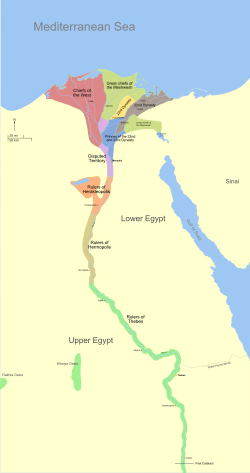
The period of the Twenty-first Dynasty is characterized by the country's fracturing kingship. Already during Ramesses XI's reign, the Twentieth Dynasty of Egypt was losing its grip on the city of Thebes, whose priests were becoming increasingly powerful. After his death, his successor, Smendes I, ruled from the city of Tanis, but was mostly active only in Lower Egypt, which he controlled. Meanwhile, the High Priests of Amun at Thebes ruled Middle and Upper Egypt in all but name.[2] However, this division was less significant than it seems, since both the priests and pharaohs came from the same family.[citation needed]

Twenty-second and Twenty-third Dynasty

[edit]

The country was firmly reunited by the Twenty-second Dynasty founded by Shoshenq I in 945 BC (or 943 BC), who descended from Meshwesh immigrants, originally from ancient Libya.[a] This brought stability to the country for well over a century, but after the reign of Osorkon II, particularly, the country had effectively split into two states, with Shoshenq III of the Twenty-second Dynasty controlling Lower Egypt by 818 BC while Takelot II and his son Osorkon (the future Osorkon III) ruled Middle and Upper Egypt. In Thebes, a civil war engulfed the city, pitting the forces of Pedubast I, who had proclaimed himself pharaoh, against the existing line of Takelot II/Osorkon B. The two factions squabbled continuously and the conflict was only resolved in Year 39 of Shoshenq III when Osorkon B comprehensively defeated his enemies. He proceeded to found the Upper Egyptian Libyan Twenty-third Dynasty of Osorkon IIITakelot IIIRudamun, but this kingdom quickly fragmented after Rudamun's death, with the rise of local city states under kings such as Peftjaubast of Herakleopolis, Nimlot of Hermopolis, and Ini at Thebes.

Twenty-fourth Dynasty

[edit]

The Nubian kingdom to the south took full advantage of this division and the ensuing political instability. Prior to Piye's Year 20 campaign into Egypt, the previous Nubian ruler – Kashta – had already extended his kingdom's influence into Thebes when he compelled Shepenupet, the serving Divine Adoratice of Amun and Takelot III's sister, to adopt his own daughter Amenirdis, to be her successor. Then, 20 years later, around 732 BC his successor, Piye, marched north and defeated the combined forces of several native Egyptian rulers: Peftjaubast, Osorkon IV of Tanis, Iuput II of Leontopolis and Tefnakht of Sais.

Twenty-fifth Dynasty

[edit]
25th Dynasty

Piye established the Twenty-fifth Dynasty and appointed the defeated rulers as his provincial governors. He was succeeded first by his brother, Shabaka, and then by his two sons Shebitku and Taharqa. The reunited Nile valley empire of the 25th Dynasty was as large as it had been since the New Kingdom. Pharaohs of the dynasty, among them Taharqa, built or restored temples and monuments throughout the Nile valley, including at Memphis, Karnak, Kawa, and Jebel Barkal.[5][6] The 25th Dynasty ended with its rulers retreating to their spiritual homeland at Napata. It was there (at El-Kurru and Nuri) that all 25th Dynasty pharaohs were buried under the first pyramids to be constructed in the Nile valley in hundreds of years.[7][8][9][10] The Napatan dynasty led to the Kingdom of Kush, which flourished in Napata and Meroe until at least the 2nd century AD.[7]

The international prestige of Egypt had declined considerably by this time. The country's international allies had fallen firmly into the sphere of influence of Assyria and from about 700 BC the question became when, not if, there would be war between the two states as Esarhaddon had realised that a conquest of Lower Egypt was necessary to protect Assyrian interests in the Levant.

Despite Egypt's size and wealth, Assyria had a greater supply of timber, while Egypt had a chronic shortage, allowing Assyria to produce more charcoal needed for iron-smelting and thus giving Assyria a greater supply of iron weaponry. This disparity became critical during the Assyrian invasions of Egypt over the period 670–663 BC.[11] Consequently, pharaoh Taharqa's reign, and that of his successor Tantamani, were filled with constant conflict with the Assyrians. In 664 BC the Assyrians delivered a mortal blow, sacking Thebes and Memphis. Following these events, and starting with Atlanersa, no Kushite ruler would ever rule over Egypt again.

End of the Third Intermediate Period

[edit]

Upper Egypt remained for a time under the rule of Taharqa and Tantamani, whilst Lower Egypt was ruled from 664 BC by the nascent 26th Dynasty, client kings established by the Assyrians. In 663 BC, Tantamani launched a full-scale invasion of Lower Egypt, taking Memphis in April of this year, killing Necho I of Sais in the process as Necho had remained loyal to Ashurbanipal. Tantamani barely had the time to receive the submission of some Delta kinglets and expel the remaining Assyrians that a large army led by Ashurbanipal and Necho's son Psamtik I came back. Tantamani was defeated north of Memphis and Thebes was thoroughly sacked shortly after. The Kushite king withdrew to Nubia while the Assyrian influence in Upper Egypt quickly waned. Permanently weakened by the sack, Thebes peacefully submitted itself to Psamtik's fleet in 656 BC. To affirm his authority, Psamtik placed his daughter in position to be the future Divine Adoratrice of Amun, thereby also submitting the priesthood of Amun and effectively uniting Egypt. Tantamani's successor Atlanersa was in no position to attempt a reconquest of Egypt as Psamtik also secured the southern border at Elephantine and may even have sent a military campaign to Napata. Concurrently, Psamtik managed to free himself from the Assyrian vassalage while remaining on good terms with Ashurbanipal, possibly owing to an ongoing rebellion in Babylon. By doing so, he brought increased stability to the country during his 54-year reign from the city of Sais beginning the Late Period of ancient Egypt.

Historiography

[edit]

The historiography of this period is disputed for a variety of reasons. Firstly, there is a dispute about the utility of a very artificial term that covers an extremely long and complicated period of Egyptian history. The Third Intermediate Period includes long periods of stability as well as chronic instability and civil conflict: its very name rather clouds this fact. Secondly, there are significant problems of chronology stemming from several areas, there are the difficulties in dating that are common to all of Egyptian chronology and are compounded by synchronisms with Biblical archaeology that also contain heavily disputed dates.

Fringe theories

[edit]

Peter James, along with several other academics, argued contra Kitchen that the period lasted less than 200 years, starting later than 850 BC but ending at the conventional date, as the five dynasties had many years of overlap.[12] Some theorists such as David Rohl have controversial theories about the family relationships of the dynasties comprising the period.

See also

[edit]

Explanatory notes

[edit]

References

[edit]
[edit]
Revisions and contributorsEdit on WikipediaRead on Wikipedia
from Grokipedia
The Third Intermediate Period of (c. 1070–664 BCE) followed the collapse of the New Kingdom and was characterized by political fragmentation, with power divided between rival centers such as in the Delta and Thebes in , alongside the emergence of foreign-influenced dynasties. This era encompassed Dynasties 21 through 25, beginning with native Egyptian rulers of the 21st Dynasty who coexisted uneasily with powerful high priests of in Thebes, transitioning to Libyan-descended pharaohs of the 22nd and 23rd Dynasties, and culminating in the Nubian conquest by the 25th Dynasty. Centralized authority weakened due to economic decline, incursions by Libyan mercenaries who settled and later seized power, and the growing of provincial elites and temple estates, leading to a patchwork of competing rulers rather than unified pharaonic control. Archaeological reveals limited large-scale monumental compared to prior periods, with focus shifting to temple donations and smaller-scale that maintained stylistic continuity amid regional variations. The period's remains debated among scholars, reliant on fragmentary king lists, stelae, and radiocarbon data, which highlight ongoing refinements in . Despite internal divisions, Egyptian culture persisted, with Libyan rulers adopting pharaonic traditions and restoring some unity before Assyrian invasions ended the era in 664 BCE.

Definition and Chronology

Establishment of the Period

The Third Intermediate Period began circa 1070 BCE with the death of , the last pharaoh of the Twentieth Dynasty, which concluded the New Kingdom's era of relatively unified central rule. 's 29-year reign (c. 1107–1078/1069 BCE) had been marked by economic decline, tomb robberies in the royal necropolis, and reliance on Theban temple authorities for stability in , reflecting the erosion of pharaonic control. Nesbanebdjed, later known as I, emerged as the founder of the Twenty-first Dynasty, establishing his capital at in the eastern and claiming succession by overseeing Ramesses XI's burial rites in . , originally a northern official possibly tied to the delta's Libyan settlers, ruled primarily over for about 26 years (c. 1070–1044 BCE), signaling a shift toward regional power bases rather than Theban-centric governance. This northern kingship coexisted uneasily with southern autonomy, as maintained nominal oversight through alliances with Theban priests but lacked full military dominance over the south. In , the at , —a former army commander—had already assumed kingly prerogatives by Year 19 of (c. 1087 BCE), including royal cartouches, regalia, and control over Theban administration and temple resources. 's de facto rule over the south, leveraging the cult's wealth and influence accumulated during the New Kingdom's temple endowments, created a parallel power structure that fragmented Egypt into northern pharaonic and southern priestly domains. This division arose from structural weaknesses: depleted treasuries from prior campaigns against and Libyans, coupled with the priesthood's growing economic independence, which empowered local elites to prioritize regional stability over national unity. The resulting dual rule persisted into subsequent Twenty-first Dynasty reigns, embedding political decentralization as a hallmark of the period.

Key Dates and Dynasty Overlaps

The Third Intermediate Period spans approximately 1070–664 BCE, commencing after the death of and concluding with the Assyrian and the unification under Psammetichus I of Dynasty 26. This era features Dynasties 21 through 25, characterized by regional fragmentation where multiple rulers claimed pharaonic titles simultaneously, leading to chronological overlaps rather than linear succession. Key dates anchor the dynasties as follows:
DynastyLocation/BaseApproximate Span (BCE)Key Rulers and Notes
21 (Lower Egypt); parallel High Priests in Thebes1086–962 (1086–1060), (1056–1010), (976–962); initial divided rule between northern kings and southern priests.
22/ (Libyan rulers)962–736 (962–941), (868–833), (774–736); longest Libyan dynasty, with campaigns into .
23Thebes/ (parallel Libyan line)828–725Pedubast I (828–803), Iuput II; ran concurrently with late Dynasty 22 in .
24Sais (western Delta)724–712 (724–717), Bakenrenef (717–712); brief resistance against Nubian expansion.
25 (Kush/), extending to Egypt770–656 (750–721), (690–664); Nubian conquest overlapping prior dynasties, ending with Assyrian invasions.
Dynastic overlaps reflect political disunity, with Dynasty 23 operating parallel to Dynasty 22 from around 828 BCE, as evidenced by contemporaneous monuments and king lists attributing rule to rival Libyan factions in Upper and . Similarly, Dynasty 25's expansion under circa 747–721 BCE intersected with the waning phases of Dynasties 22, 23, and 24, where Nubian kings asserted dominance over fragmented Libyan principalities without fully displacing them until later consolidations. These parallels, reconstructed from stelae, genealogies, and synchronisms with Near Eastern records, underscore the period's multipolar structure rather than unified kingship.

Debates on Period Boundaries

The Third Intermediate Period (TIP) is conventionally dated from approximately 1070 BCE, marking the end of the Twentieth Dynasty with the death of , to 664 BCE, when the Assyrian conquest facilitated the rise of the Twenty-Sixth Dynasty under . This periodization encompasses Dynasties 21 through 25, reflecting political fragmentation rather than unified pharaonic rule characteristic of the New Kingdom. However, the precise start date remains debated due to uncertainties in the regnal length of (29–30 years) and the transitional role of figures like and I, with some scholars, including , proposing an earlier onset around 1100 BCE based on synchronisms with Libyan and Near Eastern records. These variations stem from limited monumental inscriptions and reliance on Manetho's fragmentary king lists, which Kitchen reconstructs through primary evidence like stelae and scarabs to argue for a more continuous chronology rather than abrupt collapse. At the period's end, contention arises over whether the Nubian Twenty-Fifth Dynasty (c. 744–656 BCE) belongs to the TIP or heralds the Late Period, given its efforts at reunification under rulers like and , who restored some centralized authority before Assyrian interventions in 671–663 BCE. Mainstream , as synthesized by Dodson, includes the dynasty in the TIP owing to persistent regional divisions and foreign domination, contrasting with the Saite revival of native rule in Dynasty 26. Revisions by David Aston, using pottery typology and burial assemblages, refine internal dynastic overlaps (e.g., Twenty-Second and Twenty-Third) but uphold the broader boundaries, emphasizing archaeological correlations over textual ambiguities. Kitchen similarly integrates Assyrian to fix the terminus at c. 650 BCE, rejecting earlier terminations that exclude Nubian phases as overly narrative-driven. Fringe proposals, such as those in the New Chronology, advocate compressing the TIP by 250–350 years through parallel dynasty interpretations and biblical alignments, potentially dating to the tenth century BCE, but these lack support from stratigraphic or radiocarbon evidence and are dismissed in peer-reviewed for contradicting king list synchronisms. Such revisions prioritize external textual harmonies over Egyptian material records, underscoring the primacy of empirical artifactual in boundary delineations.

Political Fragmentation and Dynasties

Twenty-First Dynasty: Theban Dual Rule

The Twenty-First Dynasty, conventionally dated from approximately 1070 to 945 BCE, initiated the Third Intermediate Period with a distinctive pattern of divided authority between the royal court at in the northeastern Delta and the powerful High Priests of at Thebes. This arrangement arose amid the weakening of central pharaonic control at the end of the Twentieth Dynasty, under (r. ca. 1107–1070 BCE), whose long reign saw economic decline, tomb robberies, and regional autonomy. Nesbanebdjed, known as Smendes I (r. ca. 1070–1045 BCE), a northern official possibly related to the Ramesside , established himself as in , claiming sovereignty over all while relocating the administrative center from to the more defensible . However, effective control over eluded the Tanite kings, who maintained nominal overlordship through diplomatic and religious ties rather than direct governance. In Thebes, the (active ca. 1080–1070 BCE) exemplified the shift toward Theban autonomy by assuming pharaonic titles and regalia during Ramesses XI's lifetime, effectively ruling independently while acknowledging the pharaoh's nominal authority. , a military commander of Libyan descent, leveraged the temple's vast estates—which encompassed up to one-third of Egypt's —and its oracle-based to consolidate power, inaugurating a hereditary line of high priests who often adopted royal cartouches without challenging Tanite legitimacy outright. His successors, including Piankh(h) (ca. 1070 BCE), Pinudjem I (ca. 1070–1032 BCE), and Menkheperre (ca. 1045–992 BCE), perpetuated this dual structure through familial succession, with Pinudjem I notably overseeing the reburial of royal mummies in the Deir el-Bahri cache (DB320) to protect them from robbers, an action underscoring Theban custodianship of sacred traditions. These priests controlled Theban military forces, taxation, and Valley administration, fostering a semi-independent that prioritized temple interests over unified state policy. The Tanite-Theban duality remained largely peaceful, characterized by mutual recognition rather than conflict, as evidenced by Theban priests dating documents to Tanite regnal years and Tanite rulers donating to Theban temples. Tanite s like (r. ca. 1040–992 BCE) focused on Delta consolidation and foreign trade, building a royal at where intact burials, such as Psusennes I's silver coffin, attest to localized wealth amid national fragmentation. Yet this arrangement highlighted underlying centrifugal forces: the High Priests' growing influence eroded pharaonic prestige, setting precedents for further division, while limited archaeological evidence from —due to site flooding and reuse—complicates precise attributions of achievements. The dynasty's end under (r. ca. 959–945 BCE) transitioned to Libyan-dominated rule, as military leaders in the Delta asserted greater control, ending the Theban dualism.

Libyan Influence: Twenty-Second and Twenty-Third Dynasties

Libyan groups, particularly the tribe, had settled in the western Delta as mercenaries and farmers since the late New Kingdom, receiving land grants from after repelling invasions around 1178 BC. By the end of the Twenty-First Dynasty, these communities had grown influential, with Libyan chiefs holding military commands and intermarrying with Egyptian elites. This culminated in 945 BC when , a leader titled "Great Chief of the Ma," ascended as founder of the Twenty-Second Dynasty from , marking the start of Libyan rule over a reunified under pharaonic titles despite foreign origins. Shoshenq I reigned circa 943–922 BC, conducting a major campaign into Palestine around 925 BC, as recorded in temple reliefs at Karnak, which align with biblical accounts of Shishak sacking Jerusalem. His successors, including Osorkon I (circa 922–887 BC) and Takelot I (circa 889–874 BC), maintained control through Delta-based administration, funding temple restorations like those at Bubastis and Thebes with Libyan-style patronage. However, succession disputes and reliance on tribal loyalties eroded central authority; by Osorkon II's reign (circa 872–837 BC), rival Libyan factions emerged, leading to civil strife and the dynasty's fragmentation into parallel lines. The Twenty-Third Dynasty, also of Libyan origin and contemporaneous with the late Twenty-Second from circa 818–715 BC, arose in under rulers like Pedubast I, who claimed kingship from Thebes around 829 BC, challenging Tanite authority. This period saw multiple "pharaohs" coexisting, with Libyan chiefs using titles like (chief) to govern semi-autonomous territories, reflecting tribal kinship structures over traditional Egyptian bureaucracy. Administrative decentralization intensified, as evidenced by donation stelae showing land grants to Libyan warriors, fostering loyalty but weakening unified rule. Libyan rulers adopted Egyptian religious and artistic norms, commissioning statues and reliefs in styles, yet introduced elements like hierarchies that persisted in Delta governance. Military composition shifted toward Libyan contingents, influencing campaigns but contributing to internal divisions, as rival dynasties vied for legitimacy through decrees and temple control. By the mid-8th century BC, this fragmentation, depicted in contemporary boundary maps, paved the way for Nubian intervention, ending predominant Libyan dominance around 715 BC.

Twenty-Fourth Dynasty: Sais and Eastern Delta

The Twenty-Fourth Dynasty, ruling from approximately 732 to 715 BC, was a brief pharaonic line based primarily in Sais in the western , emerging amid the political fragmentation of . Its founder, Shepsesre , initially held the title Great Chief of the Libyans and Prince of Sais, leveraging local power to expand influence across the Delta and into by forming alliances with other chiefs. 's conquest of Memphis around 727 BC prompted him to adopt royal titulary, asserting pharaonic authority over significant portions of the north, though his control over the Eastern Delta remained contested by lingering Twenty-Third Dynasty elements in cities like . Tefnakht's expansion provoked intervention from the Nubian king of the Twenty-Fifth Dynasty, who invaded the Delta in 727 BC to curb the unification efforts under Sais. 's campaign forced Tefnakht to submit, though he retained nominal rule as a , with his stela at Sais recording to the Nubian conqueror while emphasizing loyalty to the goddess . This event highlighted the dynasty's limited sovereignty, as Nubian overlordship constrained further consolidation; Tefnakht's coalition included Eastern Delta princes, such as those under Osorkon at , but failed to repel the southern forces decisively. Archaeological evidence, including scarabs and stelae, attests to Tefnakht's administrative reach extending to Athribis and other Delta sites, yet true dominance eluded Sais amid rival factions. Upon Tefnakht's death circa 725 BC, his son (Wahkare) succeeded, adopting full pharaonic titles and gaining recognition in Memphis and much of the Delta for a reign of about five to seven years. 's rule, centered on Sais, involved continued patronage of Neith's cult and efforts to maintain Delta alliances, but faced escalating Nubian pressure under , Piye's successor. Egyptian priestly annals and Herodotus's later accounts describe 's capture and execution by burning in 720 or 715 BC, marking the dynasty's abrupt end and the consolidation of Twenty-Fifth Dynasty control over the north. Despite its brevity, the dynasty's resistance to Nubian expansion underscored the persistent Libyan-descended elites' role in Delta politics, with Sais later rising again in the Twenty-Sixth Dynasty.

Nubian Domination: Twenty-Fifth Dynasty

The Twenty-Fifth Dynasty marked the conquest and rule of Egypt by kings from the , originating south of the First Cataract along the . These rulers, based in , expanded northward amid Egypt's political fragmentation during the mid-8th century BC, ultimately unifying the country under Kushite authority from approximately 744 to 656 BC. The dynasty's founders leveraged military prowess, including skilled archers, to subdue rival Libyan-descended dynasties in the Delta and . Piye, the dynasty's founder, initiated the domination around 744 BC by campaigning from into to aid of Sais's opponents, culminating in the submission of key Delta princes by 727 BC as detailed in his Gebel Barkal stela. This victory stela, erected at , records tribute from defeated rulers and Piye's , emphasizing his adoption of Egyptian titles while maintaining Kushite religious ties. Piye did not reside permanently in , returning to after establishing nominal overlordship, which allowed local vassals limited autonomy. Shabaka, Piye's successor reigning circa 716–702 BC, consolidated control by relocating the royal court to Memphis and restoring traditional Egyptian administration, including the revival of building at for his burial. He promoted cultural continuity, commissioning works like the , a theological text preserving Memphite cosmology from earlier periods. Shabaka's reign saw economic recovery through trade and temple endowments, fostering loyalty among Egyptian priesthoods despite foreign origins. Shebitku (702–690 BC) and (690–664 BC) extended Kushite influence, with achieving military successes against Levantine threats before Assyrian pressures mounted. 's 26-year rule featured extensive building projects, such as temple expansions at and Kawa, and inscriptions crediting him with inundation prosperity; archaeological evidence from his Naqta pyramid and colossal statues underscores a blend of Kushite and Egyptian styles. However, Assyrian king Esarhaddon's invasion in 671 BC exploited Delta vassal revolts, sacking Memphis and forcing Taharqa's retreat southward. Tanutamani, Taharqa's successor (664–656 BC), briefly reasserted control over in 664 BC, recapturing Thebes as per his Dream Stela, but Assyrian forces under decisively defeated him in 663 BC, razing Thebes and ending Kushite rule in proper. The dynasty's fall shifted Kushite focus back to , where kings continued until Meroë's rise, while transitioned to the Saite Twenty-Sixth Dynasty under . Nubian domination revived Old and Middle Kingdom traditions, including orthographic reforms and pyramid burials, demonstrating adaptive governance that integrated foreign rulers into 's pharaonic framework.

Factors Contributing to Fragmentation

The Third Intermediate Period commenced following the death of Ramesses XI around 1077 BC, which precipitated a division of authority between the northern pharaoh Smendes I, who established rule from Tanis, and the High Priest of Amun Herihor, who exercised de facto control over Thebes and Upper Egypt. This dual governance structure marked the erosion of centralized pharaonic power, with Herihor adopting kingly regalia and titles while maintaining nominal loyalty to the Tanite kings, thereby institutionalizing regional autonomy in the south. The High Priesthood of Amun, empowered by vast temple estates and military resources accumulated during the New Kingdom, effectively operated as a theocracy, further fragmenting administrative control as priests managed local economies and justice independent of northern oversight. Economic disruptions stemming from the exacerbated this political splintering, as lost access to Levantine trade networks and tribute from Asiatic territories following invasions by and disruptions in the eastern Mediterranean around 1200–1150 BC. Reduced inflows of luxury goods, timber, and metals strained royal treasuries, evidenced by strikes among workmen under (Year 29) and due to grain shortages and delayed payments, alongside widespread tomb robberies in the royal necropolis during the late Twentieth Dynasty. Although some continuity in temple construction and wealth persisted, the of resource management to temples and local estates diminished the pharaoh's fiscal leverage, fostering reliance on provincial governors who increasingly asserted independence by the 9th–8th centuries BC. The integration of Libyan mercenaries into Egyptian society accelerated fragmentation, as these groups, initially recruited during Ramesses III's campaigns against invaders (Years 5 and 8), settled in the western Delta and formed tribal chiefdoms that evolved into rival dynasties by the Twenty-Second Dynasty (ca. 945 BC onward). Libyan leaders like leveraged military roles to claim kingship, promoting ethnic enclaves and concurrent rule in the Delta, which multiplied power centers and undermined unified command structures. Administrative adaptations, including the delegation of authority to non-royal viziers and the proliferation of local titles, reflected a shift toward segmentary , where temple bureaucracies and elite families competed for amid scarce resources, culminating in multiple contemporaneous rulers by the mid-8th century BC. This diffusion, while enabling localized stability, precluded effective national coordination against external threats like Nubian incursions.

Society, Economy, and Administration

Social Structures and Population Movements

The social hierarchy of persisted during the Third Intermediate Period (ca. 1070–664 B.C.), with pharaohs nominally at the apex, supported by viziers, priests, scribes, and military elites, though central authority weakened amid political fragmentation. High priests of in Thebes exercised substantial religious and administrative power, effectively governing as a semi-independent entity during the Twenty-First Dynasty (ca. 1070–945 B.C.), managing temple estates and providing justice in the south. This priestly dominance reflected adaptation to divided rule rather than outright decline, as evidenced by continuity in funerary practices and elite tomb constructions across regions. Under Libyan rulers of the Twenty-Second Dynasty (ca. 945–715 B.C.), military clans such as the and tribes ascended within the hierarchy, with Great Chiefs holding sway over Delta territories through systems that tolerated multiple local powers. Nubian conquerors of the Twenty-Fifth Dynasty (ca. 730–664 B.C.) reinforced traditional Egyptian norms, elevating the as a symbolic ruler in Thebes while integrating Kushite military elites into the structure. Foreign elements adapted Egyptian and Ma'at to legitimize authority, maintaining wealth concentration among royalty and temples without broadening access to elite symbols like gold. Population movements featured gradual Libyan settlement in the western Delta, initiated by late New Kingdom captives and mercenaries (over 20,000 Libyans repelled or integrated by in Years 5 and 11), evolving into entrenched tribal communities that supplied rulers by the early Tenth century B.C. These groups retained ethnic markers, such as feathers in depictions, indicating partial assimilation amid political opportunities from fragmentation. Nubian expansion northward culminated in the Twenty-Fifth Dynasty's unification, forming an Egyptian-Nubian realm by the mid-Eighth century B.C., driven by Kushite agency rather than mass displacement. Settlement evidence from tomb groups and level records suggests demographic stability, with no verifiable collapse, as rural and elite continuity persisted despite volatility.

Economic Shifts and Resource Management

The Third Intermediate Period witnessed a marked contraction in Egypt's economy following the New Kingdom's imperial expanse, as the loss of Levantine territories curtailed tribute inflows and disrupted long-distance networks previously sustained by dominance. This shift was exacerbated by environmental stressors, including persistent droughts that diminished inundation cycles, reducing agricultural yields in a system fundamentally reliant on annual floods for and . Internal factors compounded these pressures: labor strikes in the late New Kingdom transitioned into broader economic woes, with evidence of food shortages prompting riots and robberies as desperate measures to access stored wealth. Political fragmentation decentralized resource management, replacing the pharaonic state's centralized oversight with competing polities vying for control over , water rights, and mineral deposits. In the Twenty-First Dynasty's dual rule between and Thebes (c. 1070–945 BC), each center managed its regional semi-independently, with Theban high priests of accumulating vast temple estates that operated as autonomous economic units, leasing lands and collecting rents outside royal purview. This devolution fostered localized focused on staple crops like and , but lacked the coordinated of prior eras, leading to inefficient basin irrigation and vulnerability to flood variability. Under the Libyan-dominated Twenty-Second and Twenty-Third Dynasties (c. 945–715 BC), resource allocation reflected the rulers' tribal origins, with and other Libyans integrating pastoral elements into the , evidenced by increased exchanges and transactions documented in contemporary papyri. The Twenty-Fifth Dynasty's Nubian conquerors (c. 744–656 BC) introduced shifts toward exploiting southern resources more aggressively, reasserting control over Nubian gold mines and trade routes to , which bolstered royal treasuries through renewed exports of , , and precious metals. However, overall trade volumes remained subdued compared to the New Kingdom, with maritime exchanges limited to Phoenician intermediaries for cedar and metals, reflecting Egypt's diminished geopolitical leverage. Resource management under these rulers emphasized territorial consolidation to secure revenue streams, yet persistent rivalries—such as between Sais and Herakleopolis—often diverted surpluses into military expenditures rather than , perpetuating . Written records from the period, including contracts for high-value goods like slaves and , indicate emerging of assets, hinting at proto-market mechanisms amid weakened state monopolies.

Administrative Innovations and Challenges

The Third Intermediate Period marked a profound shift toward decentralized administration, as the centralized of the New Kingdom eroded, giving way to regional autonomy and divided authority among competing power centers. In the Twenty-First Dynasty (c. 1070–945 BCE), a bifurcated system emerged with pharaohs based at exercising nominal rule over , while High Priests of Amun in Thebes effectively governed , controlling temple estates and military forces independently. This division complicated unified policy-making and resource allocation, as revenues from temple lands largely remained local rather than flowing to a central treasury. Libyan rulers of the Twenty-Second and Twenty-Third Dynasties (c. 945–715 BCE) introduced administrative adaptations rooted in their tribal origins, integrating and other Libyan clans into the state apparatus through titles such as "Great Chiefs of the Ma" (Libyans). These chiefs often held hereditary governorships over nomes, creating a more feudal-like structure where loyalty was secured via military settlements and land grants, diverging from the merit-based New Kingdom system. An innovation in this era included enhanced documentation for property transfers and debt enforcement, evidenced by preserved grain loan contracts that formalized economic transactions amid instability. Administrative decisions increasingly relied on oracles, particularly of at Thebes, to legitimize appointments and resolve disputes, reflecting a blend of religious with . Challenges abounded due to persistent fragmentation, with up to five contemporary "pharaohs" claiming legitimacy by the mid-8th century BCE, undermining coordinated defense and taxation efforts. Provincial governors gained unprecedented power, often operating as semi-independent warlords who prioritized local interests, leading to inefficient revenue collection and vulnerability to internal revolts. Economic disruptions from variability and disrupted trade routes exacerbated fiscal strains, while the incorporation of foreign elements strained traditional Egyptian hierarchies. The Twenty-Fifth Dynasty (c. 744–656 BCE) under Nubian rule attempted reconcentration by installing loyal Egyptian vassals as provincial governors after conquests, as seen in Piye's (c. 747–716 BCE) campaign where defeated Delta rulers were retained in subordinate roles to administer regions. This vassalage model facilitated oversight through Egyptian intermediaries but faced resistance from entrenched local elites, highlighting ongoing tensions between central imposition and regional entrenchment. Overall, these adaptations sustained governance amid division but failed to restore New Kingdom cohesion, paving the way for Late Period unification.

Culture, Art, and Religion

Artistic Styles and

Artistic production during the Third Intermediate Period (ca. 1070–664 B.C.) maintained close adherence to established Egyptian canons, particularly New Kingdom prototypes from the Thutmoside and early Ramesside eras, though political fragmentation fostered regional variations. Sculptors and artisans produced works emphasizing continuity in and proportions, with limited until the B.C., when archaizing tendencies emerged, drawing on Old and Middle Kingdom models such as broader shoulders, narrower waists, and accentuated musculature, especially in the Delta and Memphis. This reflected deliberate emulation of earlier pharaonic ideals amid decentralization, rather than technical decline, as evidenced by the corpus of preserved artifacts. Sculpture shifted toward smaller-scale works, including a proliferation of royal, nonroyal, and divine metal statuary in bronze and other alloys, often hollow-cast and inlaid with precious metals, supporting local temple cults rather than monumental state projects. Under Libyan rulers of Dynasties 22–23 (ca. 945–730 B.C.), bronze divine statuary increased significantly, with examples like intricate inlays highlighting technical proficiency, though stone statuary dating remains challenging due to stylistic overlaps across reigns. The Nubian Dynasty 25 (ca. 730–664 B.C.) oversaw a revival in high-quality sculpture, integrating Kushite elements like enhanced royal iconography while restoring native traditions, as seen in temple dedications and private works. Architectural endeavors were constrained, with rulers largely adapting existing New Kingdom monuments rather than initiating large-scale construction; temple additions and repairs predominated, particularly in the Delta under Libyan pharaohs like (ca. 924–889 B.C.) at . Nubian kings revitalized southern temple building, emphasizing divine child motifs in reliefs and . Material culture featured shifts in burial practices toward body-centric assemblages, including painted wooden coffins, stelae, and papyri detailing rituals, especially in Dynasty 25. production persisted, yielding items like spacers and rings depicting nursing (ca. 1070–664 B.C.), while evolved with wheel-thrown forms and terracotta figurines of females, birds, and animals reflecting domestic and votive uses. Libyan and Nubian influences manifested subtly, with rulers adopting Egyptian forms but occasionally incorporating their heritage in regalia or proportions, without disrupting core stylistic norms.

Religious Practices and Temple Authority

The cult of dominated religious life in Thebes throughout the Third Intermediate Period, with daily temple rituals involving purification, offerings of food and incense, and festivals such as the Beautiful Feast of the Valley, where processions linked the temples of and . Oracles of , consulted via bark shrines carried by priests, guided political and judicial decisions, reflecting a reliance on divine sanction amid political instability. Traditional practices persisted, including mummification, funerary cults, and veneration of goddesses like and , whose roles expanded in protective and maternal , as seen in mammisi (birth house) reliefs associating rulers with divine infancy. Temple authority surged due to weakened pharaonic control, with institutions controlling up to one-third of through endowments, managing , harvests, and labor for and expansion. In Dynasty 21 (c. 1070–945 BC), High Priests of in Thebes governed de facto, from Abydos southward, parallel to Tanite kings in the north; (c. 1080–1070 BC) assumed pharaonic titles while retaining priesthood, followed by (c. 1070–1032 BC), who unified southern rule through priestly-royal intermarriage and reburial projects securing royal legitimacy via temple oversight. Oracular decrees, like Menkheperre's (c. 992–969 BC) inscribed at Karnak's temple, invoked to safeguard temple estates from royal or local seizures, exemplifying priests' use of religious mechanisms for economic . Under Libyan rulers of Dynasties 22–23 (c. 945–720 BC), temples retained influence despite military chiefdoms; Sheshonq I (r. 943–922 BC) donated estates and erected donation stelae guaranteeing revenues, integrating Berber elites into cult hierarchies without supplanting priestly power. Nubian kings of Dynasty 25 (c. 747–656 BC) amplified temple roles for legitimacy, with (r. c. 747–716 BC) receiving an oracle dream from at before his 727 BC campaign, as detailed in his Gebel Barkal stela, and subsequently restoring Theban sanctuaries while elevating the as viceregal proxy in Thebes. This priestly ascendancy stemmed from temples' self-sustaining wealth and oracle-mediated authority, compensating for fragmented kingship and enabling cultural continuity amid foreign dominations.

Literary and Intellectual Developments

The Third Intermediate Period witnessed a contraction in secular literary production compared to the New Kingdom, with surviving compositions primarily consisting of religious, funerary, and administrative texts rather than elaborate narrative tales or . One notable exception is the Report of Wenamun, a prose narrative dated to the late 11th century BCE at the transition from the New Kingdom to the Twenty-first Dynasty, depicting an official's ill-fated diplomatic mission to and around 1070 BCE. This text stands out for its realistic portrayal of Egypt's diminished international standing, humorous undertones, and absence of mythological embellishment, reflecting pragmatic administrative concerns amid political fragmentation. Funerary literature flourished in localized centers, particularly Thebes, where the evolved with increased use of script alongside hieroglyphs, featuring standardized spells and vignettes tailored to individual burials from Dynasties 21–25 (c. 1070–664 BCE). These papyri, such as those from the Twenty-first Dynasty, emphasized afterlife navigation and protection, with innovations in vignette styles adapting New Kingdom precedents to regional tastes under Libyan and Nubian influences. and other netherworld texts also appeared in funerary contexts, underscoring continuity in esoteric knowledge transmission despite reduced royal patronage. Oracular literature expanded, as evidenced by decrees from Amun's priesthood at and protective amuletic texts on strips, which proliferated from the Twenty-second Dynasty onward to address uncertainties in and personal affairs. These yes/no oracular consultations, recorded in , highlight a shift toward divine in decision-making, compensating for weakened pharaonic authority. Concurrently, biographical inscriptions on private stelae evolved to incorporate sensory and performative elements, emphasizing personal agency and embodied experience over formulaic royal praise, as seen in Third Intermediate Period elite memorials. Intellectually, knowledge preservation centered on temple institutions, where scribal traditions maintained hieroglyphic and proficiency amid foreign dynasties, fostering localized innovations like the precursors to Demotic script in the Delta during the late 8th–7th centuries BCE. This cursive derivative of abnormal hieratic enabled faster administrative recording, laying groundwork for Late Period use without disrupting core Egyptian cosmological frameworks. Overall, intellectual activity prioritized religious orthodoxy and practical adaptation over speculative innovation, with Semitic loanwords appearing in texts due to Levantine contacts but not altering foundational paradigms.

Military Affairs and Foreign Relations

Internal Conflicts and Power Struggles

The Third Intermediate Period commenced with a de facto division of authority following the death of around 1070 BC, as of the 21st Dynasty based in exercised nominal rule over while the High Priests of in Thebes wielded effective control in , creating a dual power structure that undermined centralized governance. This arrangement persisted through the dynasty's rulers, such as I (c. 1070–1040 BC) in the north and (c. 1080–1074 BC) in the south, with limited evidence of armed conflict but clear territorial fragmentation evidenced by separate administrative and religious spheres. Escalating internal strife emerged during the late 22nd Dynasty (c. 945–715 BC), dominated by Libyan Meshwesh rulers from Bubastis, as regional challengers declared independence, leading to overlapping reigns and civil wars particularly in Thebes. Takelot II (c. 850–825 BC), a son of Osorkon II, faced rebellion from Harsiese A, a high priest's descendant who proclaimed pharaonic titles around 854 BC, sparking a conflict that disrupted Theban stability and required military intervention to restore Takelot's line. This unrest intensified with Pedubast I's (c. 818–793 BC) self-proclamation as pharaoh in Thebes, challenging the authority of Shoshenq III (c. 801–785 BC) of the 22nd Dynasty in the north and contributing to a multi-factional power vacuum. Osorkon B, eldest son of Takelot II, quelled the Theban civil war through campaigns documented in the Chronicle of Prince Osorkon inscribed at , which details his restoration efforts against Pedubast I's forces and rival factions around 825–800 BC, effectively establishing the 23rd Dynasty's Upper Egyptian branch centered in Thebes and Herakleopolis. Further fragmentation ensued, with the 23rd Dynasty splitting into rival lines, including one at under Iuput I, while the 24th Dynasty emerged in Sais under (c. 732–725 BC), culminating in localized power struggles across Memphis, , and other centers by the mid-8th century BC. These conflicts, characterized by ephemeral alliances and military skirmishes among Libyan-descended warlords, eroded royal legitimacy and military cohesion, as evidenced by stelae and temple inscriptions recording sporadic victories but no lasting reunification until Nubian intervention.

External Threats and Alliances

The infiltration of Libyan groups into the Nile Delta, beginning as early as the late New Kingdom through mercenary service, evolved into a significant external influence by the 22nd Dynasty around 945 BC, when Shoshenq I, a Libyan chief, ascended as pharaoh. These Libyans, descendants of nomadic tribes from the western desert, established semi-autonomous principalities in the Delta, exploiting Egypt's fragmented authority but not through outright invasion. Their settlement introduced tribal alliances and military traditions that reshaped Egyptian governance, though internal rivalries among Libyan factions persisted. Nubian forces from Kush posed a more direct threat in the mid-8th century BC, culminating in King Piye's circa 727 BC to counter the expansion of Delta rulers like of Sais. Piye's campaign, documented in his victory stela, subdued northern coalitions through a combination of military action and diplomatic submission, establishing the 25th Dynasty and temporarily unifying under Nubian rule. This conquest reflected Kush's growing power, reversing earlier Egyptian dominance in , but Nubian pharaohs like later faced isolation as their Levantine interventions against Assyrian expansion yielded limited alliances. The Assyrian Empire emerged as the paramount external threat by the late , with Esarhaddon's invasion in 671 BC defeating and sacking Memphis, installing puppet rulers in the Delta. Ashurbanipal's subsequent campaigns in 667 BC and 663 BC exploited divisions between and local Egyptian princes, culminating in the destruction of Thebes and the expulsion of Kushite control. Alliances during these incursions were opportunistic; Delta leaders such as Necho of Sais submitted to Assyrians, gaining autonomy that facilitated Psamtik I's eventual unification post-664 BC. Egypt's weakened state precluded robust defensive coalitions, rendering it vulnerable to such sequential foreign pressures.

Military Organization under Foreign Rulers

During the Libyan-dominated 22nd and 23rd Dynasties (c. 945–730 BC), integrated tribal structures from the Libyans, who had settled in Delta military estates since the late New Kingdom as mercenaries under . These settlements supplied contingents led by tribal chiefs (wr), forming the core of forces under rulers like Sheshonq I (r. 943–922 BC), a former Great Chief of the Ma(shawash) who rose as before founding the dynasty from . Sheshonq consolidated control by appointing kin as garrison commanders and provincial leaders, creating a semi-decentralized system reliant on Libyan elites to suppress revolts and maintain order amid political fragmentation. Sheshonq I's campaign into the c. 925 BC demonstrated this hybrid force: the army divided into four divisions for coordinated assaults, comprising Libyan warriors, Egyptian , and auxiliary elements like the Sukkiyim (a Libyan subgroup), with tactics emphasizing rapid strikes on fortified sites. Later rulers faced civil wars, with 23rd Dynasty kings in drawing on similar tribal levies and local garrisons, reflecting reduced centralization compared to the New Kingdom. The Nubian 25th Dynasty (c. 744–656 BC) shifted toward a more professional, centralized army rooted in Kushite traditions, emphasizing loyalty to the king as divine ruler. (r. 744–714 BC) invaded from c. 727 BC with a core force of chariotry, archers, and infantry supported by river transports, as detailed in his victory stela: advances involved sieges at and Memphis, with slaughters of enemy troops and captures of ships, culminating in submissions from Delta princes without full conquest of . This structure highlighted Kushite archery prowess and royal oversight, integrating Egyptian vassal troops while prioritizing Nubian units. Successors like (r. 690–664 BC) maintained standing forces with levied spearmen, archers, javelin-armed infantry, and elite guards, including cavalry; Assyrian reliefs from Sennacherib's campaigns depict these with small round shields and minimal armor, underscoring mobility over heavy equipment. The dynasty's military enabled reunification but proved vulnerable to Assyrian assaults, ending with Psamtik I's c. 656 BC after Taharqa's retreats.

Historiography and Evidence

Primary Sources and Their Limitations

The primary sources for the Third Intermediate Period (c. 1070–664 BCE) consist predominantly of Egyptian monumental inscriptions, administrative and literary papyri, and private tomb texts, with supplementary evidence from foreign annals. Monumental reliefs and stelae, such as the Bubastite Portal at Karnak Temple, record military campaigns, notably those of (r. c. 943–922 BCE) of the Twenty-second Dynasty against Levantine city-states, listing over 150 toponyms as evidence of pharaonic assertion of power. These inscriptions emphasize royal legitimacy and divine favor but rarely detail administrative or economic details. Papyrus documents, including the Report of Wenamun from the late Twentieth or early Twenty-first Dynasty (c. 1070s BCE), provide rare narrative insights into diplomatic missions, depicting Egypt's envoy facing humiliation in and amid weakened international standing and reliance on intermediaries like Phoenician traders. Foreign textual records, particularly Neo-Assyrian annals from the eighth and seventh centuries BCE, offer an external corroboration for late-period events, documenting interactions with Delta principalities and the Twenty-fifth Dynasty, such as tribute payments by Egyptian rulers to Assyrian kings like (r. 745–727 BCE) and the conquests under (r. 681–669 BCE). Private sources, including genealogical inscriptions from priestly families at Thebes and Memphite tomb biographies, trace lineages and local power structures, revealing the role of high priests of and Libyan military elites in regional governance. These sources are limited by their scarcity and fragmentation, stemming from political decentralization across competing centers like Tanis, Thebes, and Heracleopolis, which reduced centralized record-keeping and monumental production compared to the New Kingdom. Texts often serve propagandistic purposes, selectively highlighting victories and royal piety while omitting defeats, internal rivalries, or economic strains, as seen in the absence of references to Libyan tribal influences or Nubian encroachments in early dynastic records. Preservation issues exacerbate gaps, with many papyri and inscriptions lost to reuse as building material or destruction during later invasions, leading to chronological ambiguities in ruler successions and overlapping reigns. Foreign annals, while valuable for objectivity on Egyptian vulnerabilities, focus on Assyrian perspectives and provide sporadic coverage, primarily for the eighth century BCE onward. Overall, the reliance on localized, elite-produced documents necessitates cross-verification with archaeological data to reconstruct broader causal dynamics, such as resource redistribution amid fragmentation.

Archaeological Contributions

Archaeological excavations have been essential for reconstructing the political fragmentation, , and foreign influences of Intermediate Period (c. 1070–664 BCE), compensating for the scarcity of contemporary monuments and detailed textual records. Major discoveries in the , particularly at , reveal the opulence of royal burials under the 21st and 22nd Dynasties, demonstrating continuity in elite practices amid Libyan migrations and divided rule. Surveys in the Delta have identified numerous settlements reflecting Libyan-style architecture and ceramics, while Nubian sites associated with the 25th Dynasty provide evidence of Kushite adoption of Egyptian pharaonic traditions. Excavations at , the 21st Dynasty capital, conducted by Pierre Montet from 1928 to the 1950s with pivotal finds in 1939, uncovered intact royal tombs that had escaped ancient looting. The tomb of (c. 1039–991 BCE) yielded a silver anthropoid coffin, gold mask, and jewelry, alongside a reused granite originally from Merenptah of the 19th Dynasty, highlighting resource reuse and technical sophistication in silverworking. Nearby, the tomb of (c. 874–850 BCE) of the 22nd Dynasty contained a granite , canopic jars, and the of Takelot I (c. 889–874 BCE), while Sheshonq IIa’s (c. 887–885 BCE) falcon-headed silver coffin with gold elements underscored dynastic intermarriages and artistic blending of Egyptian and Levantine motifs. These artifacts, including gold vessels with inscriptions, have clarified genealogies, rituals, and economic ties to the , countering narratives of uniform decline by evidencing localized prosperity. In the eastern Delta, served as the 22nd Dynasty hub, where geoarchaeological and geophysical surveys have mapped sacred canals around the Temple of and reconstructed landscapes supporting dense settlements from c. 900–800 BCE. Excavations reveal Libyan-influenced and , indicating population influxes and agricultural adaptations in marshy terrains, with the site's peak under (c. 945–924 BCE) evidenced by monumental remains competing with . Broader Delta surveys by the Egypt Exploration Society since the have documented over 100 Third Intermediate Period sites, including Tell el-Ghaba, yielding fortifications, artifacts, and evidence of networks that sustained Libyan rulers' power despite Theban . These findings illustrate decentralized urban growth and environmental resilience, refining models of settlement patterns previously reliant on sparse texts. For the 25th Dynasty, excavations at the royal cemetery in , initiated by George Reisner in 1918–1919 and continued by the International Kurru Archaeological Project since 2009, have exposed and pyramid tombs of kings like (c. 747–716 BCE), (c. 716–702 BCE), Shebitqo (c. 702–690 BCE), and (c. 690–664 BCE). Discoveries include horse burials symbolizing military prowess, invoking Egyptian deities, and bioarchaeological remains at nearby Tombos showing Nubian-Egyptian intermarriage and cultural fusion through shared from c. 1000–650 BCE. These sites, with 25 royal interments, trace Kushite origins and their imposition of unified rule over , evidenced by Egyptian-style stelae and jewelry, while recent analyses of associated pyramids at confirm architectural transitions from tumuli to stone pyramids. Such evidence underscores the dynasty's role in reviving centralized authority and artistic archaism. Multidisciplinary approaches, including of Delta ceramics and analysis from mummies peaking in this era, have bolstered chronological frameworks and revealed trade in materials from the Dead Sea, linking TIP economies to broader Near Eastern networks. Western Desert sites like Mut al-Kharab yield pottery assemblages indicating nomadic integrations, while Memphis excavations show stylistic revivals drawing from precedents. Collectively, these contributions portray a period of adaptive continuity rather than collapse, with foreign elements enriching Egyptian traditions.

Modern Interpretations and Recent Findings

Modern scholarship has revised the view of the Third Intermediate Period (c. 1070–664 BCE) as a "dark age" of collapse, highlighting instead political alongside cultural and administrative continuity. While earlier historians emphasized and foreign incursions as markers of decline, reassessments argue that the period featured adaptive governance structures, such as concurrent rule by high priests in Thebes and Libyan-descended kings in the Delta, which maintained core Egyptian institutions without total rupture from New Kingdom precedents. This perspective draws on epigraphic evidence showing sustained temple economies and scribal traditions, countering narratives of wholesale disintegration. Archaeological investigations since the early 2000s have bolstered interpretations of resilience, revealing settlement patterns that indicate localized prosperity rather than uniform decay. Excavations at Tell el-Retaba in the eastern Delta uncovered Third Intermediate Period domestic remains, including pottery and defensive features, attesting to continuity in habitation amid the New Kingdom's imperial collapse and the influx of Levantine and Libyan populations around the 11th–10th centuries BCE. Similarly, work at Mut al-Kharab in the Western Desert has documented ceramic assemblages linking TIP activities to broader oasis networks, suggesting expanded trade and pastoral adaptations that sustained communities through environmental variability. Quantitative studies of primary have provided empirical insights into environmental influences on the period's dynamics. A 2025 analysis of level inscriptions from the "quay," originally documented in 1896, applied statistical methods to 22 surviving Third Intermediate Period entries, revealing patterns of flood variability that correlated with political instability, such as lower levels during the 22nd Dynasty (c. 943–716 BCE) potentially exacerbating fragmentation. These findings support causal links between hydrological data and historical events, like the rise of Nubian influence in the 25th Dynasty (c. 744–656 BCE), without invoking unsubstantiated collapse theories. Ongoing debates persist regarding chronological precision, with high-chronology advocates like Kenneth Kitchen defending extended regnal overlaps based on synchronisms with Near Eastern , though low-chronology revisions propose compressed timelines to align with Assyrian invasions around 671 BCE.

Controversies and Alternative Perspectives

Notions of "Decline" versus Continuity

The Third Intermediate Period (c. 1070–664 BC) has traditionally been characterized by historians as a phase of marked decline from the centralized power and imperial expanse of the New Kingdom, marked by political fragmentation into multiple competing centers such as in the Delta, Thebes in , and Herakleopolis in the Middle, alongside the rise of non-native Libyan and later Nubian rulers. This view posits causal factors including the devolution of authority to high priests of in Thebes after the death of around 1070 BC, the settlement of Libyan mercenaries leading to Dynasties 22–23, and territorial losses in the and , resulting in reduced and trade revenues that strained the economy. from temple records indicate diminished inflows, with Theban treasuries reporting lower donations compared to Ramesside peaks, supporting interpretations of systemic weakening. In contrast, revisionist scholarship, notably Kenneth Kitchen's comprehensive chronological reconstruction, emphasizes elements of continuity and adaptation rather than outright collapse, arguing that administrative structures persisted through pharaonic titulary, scribal traditions, and local governance, with Dynasties 21–22 maintaining Egyptian religious and cultural norms despite divided rule. Archaeological evidence, including extensive temple renovations under Libyan pharaohs like (c. 924–889 BC), who invested in and other sites with gold and cedar imports, demonstrates fiscal capacity and ideological persistence, challenging narratives of universal impoverishment. Continuity is further evidenced by the unbroken transmission of funerary practices, such as the use of papyri, and artistic styles that evolved incrementally from New Kingdom prototypes without radical rupture. This debate reflects broader historiographical tensions, where early 20th-century assessments, limited by sparse monumental records, amplified perceptions of chaos, whereas post-1970s integrations of scarab seals, stelae, and Libyan-era inscriptions reveal parallel power structures functioning effectively in regional spheres, suggesting a transformative rather than degenerative phase driven by rather than incapacity. Empirical reassessments, including settlement surveys showing stable population levels in the Delta, indicate that while empire-scale unity eroded—irreversibly by the 8th century BC under Nubian Dynasty 25—local resilience and cultural fidelity preserved core Egyptian identity, averting the societal implosion seen in contemporaneous Near Eastern collapses. Thus, notions of decline capture real contractions in scale and cohesion, yet overlook adaptive continuities that enabled resurgence under Saite Dynasty 26.

Chronological Revisionism

The chronology of the Third Intermediate Period (TIP) has prompted revisionist proposals primarily due to sparse regnal year records, regional fragmentation allowing parallel dynasties, and dependence on later compilations like Manetho's king list, which inflate durations through sequential rather than concurrent rule. Conventional timelines span Dynasties 21–25 from c. 1070 BC (end of Ramesses XI) to 664 BC (fall of Tanutamun), anchored by external evidence such as Shoshenq I's Palestinian campaign (correlated with biblical Rehoboam, c. 925 BC) and Assyrian records of campaigns against 25th Dynasty kings like Taharqa (671 BC) and Tanutamun. Uncertainties arise especially in Dynasties 22–23, where Libyan rulers governed from the Delta (Bubastis) and Upper Egypt (Thebes) simultaneously; scholars estimate overlaps reducing the combined span from Manetho's 260+ years to c. 170–200 years. Within mainstream scholarship, revisions focus on refining overlaps and sequences; for example, Kitchen's analysis posits the Theban 23rd Dynasty (e.g., Rudamun) as contemporary with late 22nd Dynasty kings like Takelot III (c. 760–715 BC), shortening the interval by 40–50 years based on stelae and tomb evidence showing co-rulership rather than succession. Earlier proposals by Jürgen von Beckerath similarly emphasized parallelism between Dynasties 22 and 23 to resolve contradictions in stelae and Apis burial dates, yielding a compressed TIP early phase without altering absolute anchors. These adjustments, supported by artifact typologies and limited scarab chronologies, maintain overall consistency with Near Eastern records but highlight how Manetho's Ptolemaic-era list overstates lengths by treating regional lines as national successions. More contentious revisionism seeks broader compression of 100–200 years, often to synchronize TIP events with a compressed biblical timeline; proponents argue Dynasties 21–22 operated concurrently across and Thebes, eliminating gaps and aligning Shoshenq I's reign (conventionally 943–922 BC) more tightly with Solomon's death (c. 930 BC) via greater contemporaneity evidenced by shared titulary and level records. Such views, advanced in works critiquing conventional lengths, rely on reinterpreting vague king list overlaps but face empirical challenges from stratified sequences and Assyrian-Babylonian chronicles, which fix late TIP dates independently of Egyptian sources. Radiocarbon assays from TIP contexts, though few, align with conventional mid-9th century BC for Dynasty 22 artifacts, undermining major shortenings. Fringe theories like David Rohl's New Chronology propose downward shifts of 250–350 years for the TIP and preceding eras, reassigning Dynasty 22 rulers to Late Bronze Age contexts and compressing the period to fit revised synchronisms with Israelite history, such as equating directly with biblical amid a shortened dark age. This model draws on perceived mismatches in monumental scarcity but contradicts Assyrian regnal lists (anchored by 763 BC eclipse) and Levantine pottery imports datable via , rendering it incompatible with cross-regional evidence; Egyptologists reject it for lacking predictive power in archaeological correlations. Overall, while intra-scholarly revisions refine the TIP to ±20–30 years , radical alternatives prioritize narrative alignment over multifaceted data, with empirical anchors favoring the established framework.

Fringe Chronologies and External Influences

David Rohl's New Chronology proposes compressing the Third Intermediate Period by treating Dynasties 21–23 as largely contemporaneous, shortening its span from the conventional circa 1070–664 BC to roughly 300 years less, primarily to resolve perceived mismatches between Egyptian king lists and biblical timelines. This revision attributes the conventional extension to artificial sequentialization of parallel regional rulers in , Thebes, and the Delta, drawing on anomalies in royal mummy caches and scarce monumental evidence. Proponents argue it better aligns figures like with biblical Shishak's campaign circa 925 BC, without requiring the drastic displacements of earlier catastrophist models like Immanuel Velikovsky's. Such fringe adjustments, however, contradict Assyrian-Egyptian synchronisms fixed by the recorded in Assyrian at 763 BC, which anchor campaigns like those of against Dynasty 24 rulers to the 730s–720s BC. of TIP artifacts, including Libyan-era tombs and Nubian imports, further supports the longer conventional framework, with overlaps already accounted for in mainstream reconstructions but not to the extent revisionists claim. These theories prioritize narrative harmony over independent empirical anchors, lacking peer-reviewed consensus due to disruptions in Levantine pottery correlations and flood records. Fringe interpretations of external influences during the period often amplify the disruptive role of Libyan tribes and Nubian Kushites beyond archaeological evidence, positing them as vectors for unverified cultural diffusions from the Mediterranean or that conventional views attribute to gradual mercenary integration. For instance, some revisionists link retimed TIP incursions to broader "" remnants or proto-Carthaginian Phoenician networks, suggesting causal chains of technological transfer unsupported by scarab seals or ostraca, which instead indicate localized Libyan adoption of Egyptian admin and Nubian emulation of pharaonic ideology. Empirical stelae, such as those of detailing Libyan alliances, reveal pragmatic power-sharing rather than wholesale external overhauls. These claims, while highlighting real foreign agency in dynastic fragmentation, overreach by inferring causal primacy from sparse synchronisms without corroborating or migration data.

References

Add your contribution
Related Hubs
User Avatar
No comments yet.