Recent from talks
Nothing was collected or created yet.
Three Billy Goats Gruff
View on Wikipedia| The Three Billy Goats Gruff | |
|---|---|
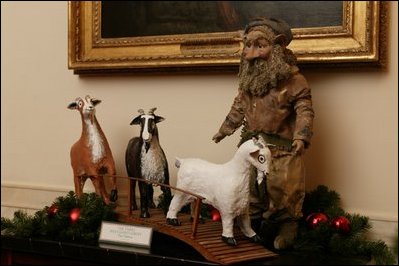
The White House 2003 Christmas decoration using "The Three Billy Goats Gruff" as the theme | |
| Folk tale | |
| Name | The Three Billy Goats Gruff |
| Aarne–Thompson grouping | 122E |
| Country | Norway |
| Published in | Norwegian Folktales |
"The Three Billy Goats Gruff" (Norwegian: De tre bukkene Bruse) is a Norwegian fairy tale[1] collected by Peter Christen Asbjørnsen and Jørgen Moe in their Norske Folkeeventyr, first published between 1841 and 1844.[2] It has an Aarne-Thompson type of 122E. The first version of the story in English appeared in George Webbe Dasent's translation of some of the Norske Folkeeventyr, published as Popular Tales from the Norse in 1859.[3] The heroes of the tale are three male goats who need to outsmart a ravenous troll to cross the bridge to their feeding ground.
Characters
[edit]The story introduces three billy goats (male goats), sometimes identified as a youngster, father and grandfather, but more often described as brothers. In other adaptations, there is a baby or child goat, mama goat and papa goat.
"Gruff" was used as their family name in the earliest English translation by Dasent and this has been perpetuated; but this has been pointed out as a mistranslation of the Norwegian name Bruse which was here employed in the sense of "tuft, clump" of hair on the forehead of domesticated livestock.[4] The word can mean "fizz" or "effervescence", but also a "frizzle (of hair)" according to Brynildsen's Norwegian-English dictionary,[5] but the secondary meaning is better explained as "a tuft/clump of hair on a horse (or buck goat)" in the Great Norwegian Encyclopedia (SNL), and Ivar Aasen's Norwegian-Danish dictionary.[6][7][a][b]
Plot
[edit]Three billy goats, all named "Gruff," live in a valley with very little grass. They must walk across a bridge to reach a mountain pasture where they can graze. However, a fearsome troll lives under the bridge and eats everyone who tries to cross.
The smallest billy goat goes first. The troll stops him and threatens to "gobble him up!" The little goat tells the troll he should wait for his big brother to cross, because he is larger and would make for a more gratifying feast. The greedy troll agrees and lets the smallest goat pass.
The medium-sized billy goat approaches the bridge. He is more cautious than his brother, but the troll stops him too. The second goat convinces the troll to wait for their eldest brother, the largest of the three, and the troll lets him pass as well.
The largest billy goat steps on to the bridge and meets the troll waiting to devour him. The goat challenges the troll to fight and then throws him into the water with his horns. The troll drowns in the stream, and from then on the bridge is safe. The three billy goats live happily ever after.
Retellings
[edit]Writer Bjørn F. Rørvik and illustrator Gry Moursund have created three books in Norwegian based on this story. The first, Bukkene Bruse på badeland (The Three Billy Goats Gruff at the Waterpark), came in 2009 and had by 2014 sold over 110,000 copies in Norway, making it one of the biggest selling picture books in the country. By March 2019, the three books had sold over 450,000 copies in Norway.[12]
The following is a list of children's book adaptions of the story into the English language, suitable for the elementary school classroom:[13][14]
- Arnold, Tim (1993) The Three Billy Goats Gruff Macmillan[14]
- Barnett, Mac (Illustr. by Jon Klassen (2022). "The Three Billy Goats Gruff." Orchard Books.[15]
- Brown, Marcia (1991) [1957] The Three Billy Goats Gruff. Harcourt[14]
- Chase, Richard (Illustr. by Berkeley Williams, Jr.) (1948), "Sody Sallyraytus" in Grandfather Tales, Houghton[14]
- Galdone, Paul (1981) [1973] The Three Billy Goats Gruff. HMH Books for Young Readers[13]
- Langley, Jonathan (1995) The Three Billy Goats Gruff. Harper Collins[14]
- Loewen, Nancy (Illustr. by Cristian Bernardini) (2018). Listen, my bridge is SO cool!: The Story of the Three Billy Goats Gruff as Told by the Troll. Picture Window Books[13]
- Mortimer, Rachel (Illustr. by Liz Pichon) (2010). The Three Billy Goats Fluff. Scholastic[13][c]
- Ottolenghi, (Illustr. by Carol Mark Clapsadle) (2009). The Three Billy Goats Gruff. Brighter Child[13]
- Palatini, Margie (Illustr. by Barry Moser)(2005). The Three Silly Billies. Simon & Schuster Books for Young Readers[13]
- Patchett, Ann (Illustr. by Robin Preiss Glasser) (2020) Escape Goat. Puffin Books[13]
- Pinkney, Jerry (2017). The Three Billy Goats Gruff. Little, Brown Books for Young Readers[13]
- Pye, Katie (Illustr. by Rodrigo Paulo) (2020). Trip Trap Trouble: A Story about the Three Billy Goats Gruff and Gratitude. Headstart Thinking[13]
- Rounds, Glen (1993). The Three Billy Goats Gruff. Holiday House[14]
- S., Svend Otto (1989) The Three Billy Goats Gruff. D. C. Heath
- Shaskan, Stephen (2013) The Three Triceratops Tuff. Beach Lane Books[13]
- Sims, Lesley (Illustr. by David Semple) (2015). Goat in a Boat. Usborne Publishing Ltd[13]
- Stevens, Janet (1987) The Three Billy Goats Gruff. Harcourt[14]
- Ziefert, Harriet (Illustr. by Laura Rader) (1994) The Three Billy Goats Gruff. Tambourine [14]
- Rudin, Ellen (Ill. Lilian Obligado) (1982) The Three Billy Goats Gruff. Western Publishing Co. (a first little golden book)
Part of the story in the children's book The Troll by Julia Donaldson is based on the tale, with a troll that lives under varying bridges and waits for goats but in this story only other animals walk over the bridges.
Neil Gaiman's "Troll Bridge" (1993) in the anthology Snow White, Blood Red is also an adaption of the fairy tale, for adults.[d][16][17]
Golden Books did a version of the story that was similar to the book. The only difference is that when the troll is washed away by the stream, he is later mentioned to have moved into a cave.
Media adaptations
[edit]Audiobooks
[edit]- Scholastic Corporation produced an audio recording in 1963, with music composed and directed by Arthur Rubinstein, narrated by Bob Thomas, and cover illustration by Susan Blair and Ellen Appleby.[18] It was first made available as a phonograph record,[19] and then on Compact Cassette.
Films
[edit]- The 3 Billy Piñatas (2015) is a version with a Spanish twist, produced by "Team Juan" at the Duncan of Jordanstone College of Art and Design at the University of Dundee
Television
[edit]- In 1995, Australian children's TV series Johnson and Friends adapted this fairy tale, with the characters 'roleplaying' and acting out the story in a humorous fashion.
- In 2004, the story is retold on Hi-5. This version has the goats replaced by sheep and instead of the troll wanting to eat them, he just wanted to sleep and was annoyed by their noise. The story ended with the biggest sheep giving him earmuffs made out of wool. In the original Australian version of the show, three sheep crossing a bridge disturb the napping bunyip underneath.[20][e]
- In 2008, the BBC created a modern adaptation for its Fairy Tales TV series. In this, the story was given a twist in that the troll was presented as a tragic, cruelly maligned victim.[21]
Music and musicals
[edit]Frank Luther wrote a version of "The Three Billy Goats Gruff" geared towards music education for elementary school grade children, published in "Singing on Our Way", Our Singing World Series by the Ginn and Company (c. 1949).[22][23] It was often played on the BBC Radio programme Children's Favourites, in the 1950s and early 1960s.[24] Some years earlier Yvonne Ravell had recorded a version she wrote in sung (1940),[26] cited as suitable education material for the theatre in one journal.[27]
James Scott Balentine composed Kinderkonzerts, a chamber music setting for string quintet and narrator, with the text adapted by Stephanie Sant'Ambrogio, recorded in the album "Klassics 4 Kids: Cactus Pear Music Festival Artists" (2010).[28]
Gwen Edwards adapted the story into a popular children's musical called Billy, Goat, Gruff: The Musical (summer 2007), at Barter Theatre in Abingdon, Virginia.[29]
A musical adaptation by British composing team George Stiles and Anthony Drewe was commissioned by the Singapore Repertory Theatre. It premiered there in 2015 and made its North American debut in 2017 at the Aurora Theatre in Lawrenceville, Georgia.
Play productions
[edit]- Lazy Bee Scripts published Billy Goat Gruff (2009), a simple play for young children.[30]
Games
[edit]- The Three Billy Goats Gruff (2013) game adaptation for tablets and mobile phones was developed by the Norwegian game studio Agens. The game was made with support from the Norwegian Film Institute.
Explanatory notes
[edit]- ^ Both SNL and Aasen agree in giving the primary meaning as "a dense bush esp. juniper"[6] or "juniper-tree, juniper".[8] whereas Hans Ross explains the word to mean a "flower cluster" or bushy inflorescence.[9]
- ^ On dialect forms and cognates: Hans Ross gives the form Brusk, in Telemark and Smaalenene dialect, corresponding to Brus in standard Norwegian, with apparently the same meaning, cognate to Icelandic brúskr meaning 'clump of hair'.[10] Cf. also Faroese brúsa (sense 2, verb) "clip.. the hair on the forehead.. of lamb"[11]
- ^ "Scholastic-Australia"
- ^ The troll approaches a young boy who has crossed his bridge and demands to "eat his life." The boy eventually persuades the troll to wait until he has lived a little more, after which he will return to the bridge. The goats in this adaptation are represented by the protagonist as a child, a teenager and finally a middle-aged man. The story was nominated for a 1994 World Fantasy Award.
- ^ "Scholastic-Australia"
References
[edit]- ^ Encyclopedia of American folklore: Facts on File library of American literature. Linda S. Watts. Infobase Publishing, 2007. ISBN 0-8160-5699-4, 978-0-8160-5699-6. p. 383.
- ^ "Answers.com: Asbjørnsen and Moe". Answers.com.
- ^ Asbjørnsen, Peter Christen; Moe, Jørgen Engebretsen. Popular tales from the Norse. Translated by Dasent, George Webbe. Forgotten Books. p. 313. ISBN 978-1-60506-787-2.
- ^ Hawes, Barbara, Curator Germanic Collections (19 October 2015). "The Goats that Got Away". European Studies Blog. Posted by Olga Kerziouk. British Library.
The story's original Norwegian title in full (a bit less snappy than the English one we know) was De tre Bukkene Bruse, som skulde gaa til Sæters og gjøre seg fede which roughly translates as 'The three Billy-Goats Gruff who were going to mountain pastures to fatten themselves up'. 'Bruse', which is the name of the goats, was translated as 'Gruff' in the first English version, and this translation has stuck ever since but in fact the word refers to the hairy tuft on a goat's forehead
- ^ Brynildsen, John, ed. (1927). "Bruse1". Norsk-engelsk ordbok. Oslo: H. Aschehoug & Company (W. Nygaard). p. 120.
- ^ a b Store Norske Leksikon s.v Bruse: "Bruse er en tett og lav busk, særlig av einer. Ordet brukes også om en hårdusk i pannen på en hest eller bukk (bukkene Bruse)"
- ^ Aasen, Ivar, ed. (1873). "Bruse2". Norsk ordbog med dansk forklaring. Christiania: P.T. Mallings boghandel. p. 85.
- ^ Aasen (1873) Norsk ordbog med dansk forklaring "Bruse 1": Enebaertræ (=Einer)
- ^ Ross, Hans [in Norwegian], ed. (1895). "Bruse". Norsk ordbok. Christiania: A. Cammermeyer (L. Swanstrøm). p. 65.
- ^ Ross (1895) Norsk ordbok, s.v. "Brusk"
- ^ Young, G. V. C., ed. (1985). "Brúsa". Føroysk-Ensk ordabók: with Faroese folk-lore and proverbs. Peel, Isle of Man: Mansk-Svenska Publishing Co. Ltd. p. 65. ISBN 9780907715221.
- ^ "The Three Billy Goats Gruff at the Water Park". norla.no. Retrieved 29 March 2019.
- ^ a b c d e f g h i j k Tussey, Jill T.; Haas, Leslie (2024), "Chapter 2. First Grade―Fairy Tales", Exploring Genre through Gamified Adventures in Elementary Classrooms, Springer Nature, p. 20, ISBN 9783031417177
- ^ a b c d e f g h McElmeel, Sharron L. (1996), "Chapter 2. Folklore", Educator's Companion to Children's Literature: Folklore, Contemporary Realistic Fiction, Fantasy, Biographies, and Tales from Here and There, Bloomsbury Publishing USA, pp. 29–30, ISBN 9780313079399
- ^ "Cover Reveal: 'The Three Billy Goats Gruff' by Mac Barnett and Jon Klassen". publishersweekly.com. Feb 3, 2022. Retrieved June 25, 2024.
- ^ Neil Gaiman, "Smoke and Mirrors"
- ^ Gaiman, Neil (2019) [1993]. "The Toll Bridge". In HDatlow les, Ellen; Windling, Terri (eds.). Snow White, Blood Red. New York: Open Road Media. ISBN 9781504055765.
- ^ Three Billy Goats Gruff on YouTube
- ^ Scholastic Records CC 0612, Long Play 33-1/3 RPM
- ^ Hi-5 Series 1, Episode 22 (Animals), segment of "Grumpy Bunyip" @ Hi 5 Official Channel
- ^ Horne, Mathew; Deacon, Michael (May 1, 2008). "Once upon a time..." Daily Telegraph. Archived from the original on March 7, 2008.
The troll character is dirty and smelly and everybody is frightened of him, and I think that heightens the pathos of the ending, because it's a witch hunt, without any evidence
- ^ Frederick, Marilyn D. (1955). Some Music Activities to Correlate with Children's Literature in the Primary Grades (Ph.D.). University of Michigan. p. 25.
Singing on Our Way " from Our Singing World . New York : Ginn and Company, ( c . 1949 )
- ^ "Front Matter". Music Educators Journal. 43 (5): 32. April–May 1957. JSTOR 3388261.
- ^ "Children's Favourites". Whirligig-tv.co.uk. 2005-11-28. Retrieved 2010-06-09.
- ^ Barton, Phyllis Settecase (1998). The Pictus Orbis® Sambo: Being a Publishing History, Checklist and Price Guide for The Story of Little Black Sambo. Pictus Orbis Press. p. 250. ISBN 9780966011791.
- ^ Ravell, Yvonne [pseud. of Yvonne Rapeer Shanley] (soprano); Leaman, Harold (piano) (1940) "Little Black Sambo"; "The Gingerbread Boy"; "The Wee Wee Woman"; "The Three Billy Goats Gruff" (3 album set, J-20, Nos. 35-651, 35-652, and 35-653).[25]
- ^ Voorhees, Lillian W.; Foster, Jacob F. (October 1949). "Recordings for Use in Teaching Theatre". Educational Theatre Journal. 1 (1): 67. JSTOR 3204109.
Music Fairy Stories, written and performed by Yvonne Ravell, the 'Singing Story Lady'
- ^ Balentine, James Scott; Sant'Ambrogio, Stephanie. "Kinderkonzerts". Cactus Pear Music Festival. Guildhian Music.
- ^ "It's curtains up on Barter's '07 season". GoTricities.com. Archived from the original on 2007-05-02.
- ^ "Billy Goat Gruff". Lazy Bee Scripts. 2009.
External links
[edit]
Media related to The Three Billy Goats Gruff at Wikimedia Commons
Works related to The Three Billy-Goats Gruff at Wikisource
Norwegian Wikisource has original text related to this article: De tre bukkene Bruse som skulde til seters og gjøre sig fete- Norwegian version, ePub and audio books in Speex format available.
- SurLaLune website: Archived 2009-08-22 at the Wayback Machine annotated Three Billy Goats Gruff in the version from Peter Christen Asbjørnsen and Jørgen Moe, Popular Tales from the Norse George Webbe Dasent, translator. Edinburgh: David Douglass, 1888.
- Three Billy Goats Gruff with other regional variations and 122E stories.
Three Billy Goats Gruff
View on GrokipediaOrigins
Authorship and Collection
The Norwegian fairy tale "Three Billy Goats Gruff," originally titled "De tre bukkene Bruse," was collected and published by Peter Christen Asbjørnsen (1812–1885) and Jørgen Engebretsen Moe (1813–1882), two pioneering folklorists who played a central role in documenting Norway's oral storytelling traditions. Their collaboration began in the mid-1830s, with the first joint field trip occurring in 1837, during which they systematically gathered tales from rural narrators across southern Norway to establish a network of informants. Inspired by the Brothers Grimm's approach to German folklore, Asbjørnsen and Moe emphasized fidelity to the original narratives ("Treue und Wahrheit") while adapting them into a literary form suitable for print, blending Danish-Norwegian written style with authentic Norwegian dialect elements to preserve cultural essence. The duo's collection methods involved extensive travels to remote rural areas, where they recorded stories directly from oral storytellers, often elderly villagers who had passed down tales through generations. Supported by government scholarships starting in 1846, they conducted multiple expeditions, transcribing narratives verbatim before editing them for coherence and accessibility without altering core folk motifs. This process was part of their broader effort to compile the Norske Folkeeventyr (Norwegian Folktales) series, which aimed to safeguard endangered oral heritage amid rapid modernization. The tale "De tre bukkene Bruse" first appeared in this collection, published as four initial booklets between 1841 and 1844.[3] Their work unfolded against the backdrop of 19th-century Norwegian nationalism, a movement spurred by the country's recent independence from Danish rule in 1814 and its ongoing union with Sweden until 1905, which fueled efforts to assert a distinct Norwegian cultural identity. Romantic nationalists like Asbjørnsen and Moe viewed folklore collection as essential to counter Danish and Swedish cultural dominance, promoting local traditions as symbols of "Norwegianness" during a period of political awakening and enlightenment. A 1840 prospectus for Norske Folkeeventyr underscored the urgency of this preservation, highlighting how vanishing rural storytelling risked the loss of national heritage.Cultural and Historical Context
The emergence of "Three Billy Goats Gruff" as a preserved Norwegian folktale occurred amid the wave of romantic nationalism that swept through Norway following its 1814 separation from Denmark, a period marked by efforts to forge a distinct national identity through the promotion of vernacular language and rural folk traditions in opposition to urban, Danish-influenced elitism. This movement, inspired by broader European romanticism, positioned folklore as a pure expression of the Norwegian spirit, countering the cultural dominance of Danish and emphasizing the egalitarian heritage of peasant life over feudal structures. Collectors like Peter Christen Asbjørnsen and Jørgen Moe contributed to this by framing their compilations as authentically Norwegian, thereby aiding the construction of a unified cultural narrative during Norway's ongoing union with Sweden until 1905.[4] In rural Norwegian communities of the 19th century, oral storytelling served as a vital cultural practice, particularly in isolated mountain valleys where tales were passed down to reflect the rhythms of pastoral life and instill communal values. Billy goat stories, such as this one, symbolized the everyday struggles and aspirations of agrarian existence, with goats representing resourcefulness in navigating harsh terrains for sustenance. Central to these narratives were figures like trolls, rooted in pre-Christian pagan mythology and embodying deep-seated fears of the unknown wilderness, often depicted as supernatural guardians of natural barriers that tested human—or animal—wit and resilience. These elements drew from ancient Norse beliefs in nature-dwelling beings, preserved through generations of verbal transmission before being documented to safeguard them against erosion.[5] While the tale shares motifs with broader European folklore classified under Aarne-Thompson-Uther type 122E ("The Troll and the Goats"), which features animals outwitting a predator awaiting the largest prey, the Norwegian iteration uniquely incorporates a bridge-dwelling troll, evoking local landscapes of fjords and waterways as sites of peril and transition. This adaptation highlights distinctly Scandinavian emphases on clever deception over brute force, setting it apart from variants in other regions. The urgency of such documentation intensified in the 1840s as early industrialization and modernization— including urban migration, emigration waves, and increasing literacy—threatened the vitality of oral traditions, prompting collectors to view their work as a "last-minute rescue" of vanishing rural heritage before enlightenment and economic shifts silenced these voices in remote areas.[6][7]Publication History
Original Norwegian Editions
The tale "De tre bukkene Bruse" debuted in the 1843 volume of Norske Folkeeventyr, the pioneering collection of Norwegian folktales assembled by Peter Christen Asbjørnsen and Jørgen Moe as part of their efforts to document and elevate national oral traditions.[8] This initial publication occurred amid a series of installments from 1841 to 1844, driven by cultural nationalism that sought to affirm Norwegian identity through preserved folklore.[8] In the 1852 expanded edition, published by Johan Dahls Forlag, Asbjørnsen and Moe revised "De tre bukkene Bruse" along with other tales to improve clarity and standardize dialects, adapting rural linguistic elements for broader urban readability while maintaining the repetitive, rhythmic cadence essential to their oral origins.[9][10] These revisions, detailed in Jørgen Moe's extensive introduction to the edition, balanced authenticity with accessibility, blending dialectal features into a proto-national literary form to appeal to educated readers across Norway's linguistic divides.[9][10] Given the modest scale of Norway's publishing sector in the mid-19th century, early editions of Norske Folkeeventyr had limited print runs and circulation, largely confined to scholarly and affluent audiences initially.[8] By the 1860s, however, the collection's acclaim led to its integration into school curricula, boosting demand and establishing it as a foundational text in Norwegian education and cultural heritage.[8] The 1879 illustrated edition of Norske folke- og huldreeventyr, featuring evocative drawings by Erik Werenskiold and Theodor Kittelsen, marked a turning point by introducing vivid visual representations of the troll and goats that became enduring icons in Norwegian folklore imagery.[8]Translations and Adaptations
The English translation of the tale by George Webbe Dasent, published in 1859 as part of Popular Tales from the Norse, marked a pivotal moment in its international dissemination, rendering it as "The Three Billy-Goats Gruff" for English readers.[11] In this version, Dasent adapted the original Norwegian title De tre bukkene Bruse by substituting "Bruse"—a term denoting a tuft of hair or forelock on an animal, common in Norwegian nomenclature for goats—with "Gruff" to enhance phonetic rhythm and avoid awkward repetition alongside "goat."[12] This linguistic shift preserved the tale's rhythmic dialogue while making it more accessible and memorable to non-Scandinavian audiences.[6] Other early translations emerged in the mid-19th century, reflecting the growing interest in Nordic folklore across Europe. A German rendition appeared in 1847 through Friedrich Bresemann's Norwegische Volksmährchen, a collection influenced by the Brothers Grimm's methodical approach to folk narrative preservation, which emphasized cultural authenticity and moral undertones in storytelling.[13] Swedish versions followed in the 1860s, such as those integrated into broader anthologies of Scandinavian tales, while Danish adaptations drew on shared regional oral traditions, underscoring the fluid cross-Scandinavian exchanges that propelled the story's regional popularity.[14] These efforts highlighted subtle linguistic variations, such as adjustments to the goats' names and the troll's dialect, to align with local phonetic and cultural nuances. Dasent's English edition played a crucial role in the tale's global spread, embedding it firmly within British and American children's literature by the late 19th century, where it appeared in numerous illustrated chapbooks and school readers as a model of cleverness triumphing over greed. This influence extended to educational materials that promoted moral lessons through folklore, fostering the story's enduring presence in Anglo-American cultural canon. In the 20th century, revisions simplified the narrative for broader accessibility, including 1920s editions tailored for English-speaking immigrant communities in the United States, which condensed the text and incorporated visual aids to aid language learners while retaining core plot elements.Story Elements
Characters
The protagonists of the tale are three male goats, collectively known in the original Norwegian as de tre bukkene Bruse, who seek to cross a bridge to reach richer grazing lands. The smallest goat, often called the Little Billy Goat Gruff in English translations, is depicted as timid and quick-witted, speaking in a thin, quavering voice and cleverly deferring the troll's hunger by promising that a larger goat will follow. The middle goat, the Medium Billy Goat Gruff, is portrayed as bolder than its younger counterpart yet still evasive, using a firmer tone to repeat the deferral tactic while emphasizing its own moderate size. The largest, the Big Billy Goat Gruff, embodies strength and confrontation, boasting an ugly, hoarse voice and using its massive horns to butt the troll into the river, thus resolving the conflict. In the source text, the goats are simply three billy goats named Bruse, without explicit familial ties, though they are frequently interpreted as siblings or representing generational stages in later retellings.[6] The name "Bruse" derives from a Norwegian term for a tuft or clump of hair, typically referring to the bearded or tufted forehead of an animal like a goat, evoking their distinctive physical feature in folklore. The antagonist is an unnamed troll who guards the bridge, characterized as enormously ugly and ravenous, with eyes like saucers, a nose like a poker, and a greedy disposition that drives it to devour passersby. Rooted in Norwegian folklore, trolls like this one are typically portrayed as chaotic, dim-witted guardians of natural barriers, embodying isolation and gluttony while posing threats to human (or animal) order through their brutish, uncivilized nature.[6][15]Plot Summary
In the traditional Norwegian folktale, three billy goats named Gruff live in a valley and seek to cross a bridge to reach the greener pastures on the hillside where they can fatten themselves up.[6] Under the bridge dwells a fearsome troll with eyes as large as saucers and a nose as long as a poker, who demands to devour any goat attempting to pass.[6] The smallest billy goat Gruff approaches first, its hooves making a light "trip-trap" on the bridge, prompting the troll to roar, "Who's that tripping over my bridge?" The little goat pleads its tiny size, begging the troll to wait for its larger brother, and is allowed to pass.[6] The middle billy goat Gruff follows, its steps louder, and employs the same tactic, promising the troll an even bigger meal in the form of the eldest brother, thus crossing safely.[6] Finally, the largest billy goat Gruff thunders across with a heavy "trip-trap," boasting of its size and strength when the troll threatens to gobble it up; it charges with its horns, goring the troll's eyes, crushing its body with curling-stone-like blows, and tossing the remains into the stream below.[6] With the troll defeated, all three goats reach the hillside, where they graze and grow fat; as the tale concludes in rhythmic formula, if the fat has not fallen from them, they remain plump to this day, and "Snip, snap, snout, this tale's told out."[6]Variations
Traditional Retellings
The tale of the three billy goats and the troll, known in Norwegian as "De tre bukkene Bruse," originated in oral traditions from various Norwegian regions, where storytellers passed down versions emphasizing cleverness over brute force to overcome obstacles. Collectors Peter Christen Asbjørnsen and Jørgen Moe documented these variants during their fieldwork in the 1830s and 1840s, drawing from rural narrators, where the core plot of progressively larger animals tricking a guardian creature was common but details varied.[6] The 1843 inclusion in Asbjørnsen and Moe's Norske Folkeeventyr marked the first formal publication, preserving a faithful oral form.[11] International folk parallels to the tale are classified under Aarne-Thompson-Uther type 122E ("Wait for the Bigger Goat"), reflecting a widespread motif of escalating challenges resolved by deception. Examples include German variants such as "How the Goats Came to Hessen," where a ram scares a wolf with fake weapons.[6]Modern Retellings
Modern retellings of "Three Billy Goats Gruff" in the 20th and 21st centuries often incorporate innovative illustrations, humor, and contemporary settings while preserving core plot elements like the goats' bridge-crossing ruse against the troll.[16] One notable example is Stephen Carpenter's 1998 illustrated adaptation, published by HarperCollins, which features vibrant artwork and repetitive phrasing to engage young readers with the classic tale of the goats outwitting the troll.[17] In 2022, Mac Barnett and Jon Klassen released a humorous reinterpretation through Orchard Books, emphasizing witty dialogue and subtle, muted illustrations that add tension and surprise to the goats' encounters with the troll.[18][16] Norwegian author Bjørn F. Rørvik and illustrator Gry Moursund launched a popular series in 2009 with Cappelen Damm, reimagining the goats in modern scenarios such as a trip to a water park in "Bukkene Bruse på badeland," where they navigate humorous obstacles including a troll-like antagonist.[19] The series, known as "The Brothers Gruff," has expanded to multiple titles blending folklore with everyday adventures, achieving over 750,000 copies sold in Norway by 2023.[20] Retellings from the 2010s frequently introduce thematic twists, such as narratives from the troll's perspective to explore empathy and misunderstanding, as seen in Alvin Granowsky's 1998 dual-story edition that pairs the traditional tale with a "friendly troll" viewpoint.[21] Rachael Mortimer's 2011 "The Three Billy Goats Fluff" is a humorous retelling featuring fluffy goats. Post-2020 releases have increasingly featured multicultural adaptations, including bilingual editions from publishers like Language Lizard, which present the story in English alongside languages such as French or Spanish to reach diverse global audiences.[22] These versions maintain the goats' clever deception while using inclusive illustrations to reflect varied cultural contexts.[23]Media Adaptations
Audiobooks and Literature
One notable early audiobook adaptation is the 1949 recording of "The Three Billygoats Gruff" narrated by Frank Luther, accompanied by organ music from Milt Herth and released on Decca Records (catalog numbers 74467 and 74468).[24] This version presents the tale in a musical storytelling format, emphasizing the rhythmic "trip-trap" sounds of the goats crossing the bridge.[25] In the modern era, dramatized audiobook editions have incorporated sound effects to engage young listeners, such as the 2012 Audible Studios production narrated by Stephen Mangan, which features immersive audio cues for the bridge-crossing and troll confrontation to heighten the adventure for children.[26] More recent digital releases include the 2022 audiobook of Mac Barnett's twist on the tale, narrated by the author himself and available on platforms like Google Play and Audible, blending humor with traditional elements.[27] Literary expansions of the story have appeared in illustrated picture books that retain the core plot while adding visual and narrative flair. Paul Galdone's 1973 edition, published by Clarion Books, offers a classic retelling with colorful illustrations that capture the goats' journey and the troll's menace, making it a staple for young readers.[28] Similarly, Janet Stevens' 1987 picture book from Harcourt Brace Jovanovich retells the folktale with humorous, expressive artwork depicting the anthropomorphic goats and troll in dynamic poses.[29] In Scandinavia, the series by Bjørn F. Rørvik and Gry Moursund, starting with "Bukkene Bruse vender tilbake" (The Three Billy Goats Gruff Return) in 2013 from Cappelen Damm, extends the original into modern adventures like water park visits and holidays, with audiobook tie-ins available on platforms such as Fabel and Audible in Norwegian and Danish editions.[30] These adaptations have enhanced the tale's popularity in the region through their humorous reinterpretations, contributing to strong sales across multiple volumes in the series.[19] Digital platforms in the 2020s have expanded access to free and subscription-based audiobooks, including Storynory's narrated version by Natasha, which delivers the traditional narrative in an accessible audio format for global audiences, though originally released earlier and still widely streamed today.[31]Films and Television
The tale of "Three Billy Goats Gruff" has been adapted into several animated shorts and television episodes, often highlighting the goats' cleverness against the troll in child-friendly formats. A notable early television adaptation appeared in the Australian stop-motion series Johnson and Friends, with the 1995 episode "Three Billy Goats Gruff," where the toy characters role-play the story to demonstrate that intelligence triumphs over size.[32] Similarly, the British anthology series Wolves, Witches and Giants featured a 1995 episode retelling the narrative, narrated by comedian Spike Milligan, emphasizing the escalating confrontations between the goats and the troll.[33] In American children's programming, the story received attention on Sesame Street, including a 1970 episode (0139) where cast member Bob reads an adaptation of the book to a group of children, integrating it into educational segments on storytelling and sequencing.[34] Later, the animated series Super Why! explored a revised perspective in its 2008 episode "The Three Billy Goats Gruff," where the protagonists enter the book and allow the troll to share his viewpoint, adding layers of empathy to the traditional conflict.[35] Direct-to-video animations emerged in the late 20th century, such as the 1989 release The Three Billy Goats Gruff and the Three Little Pigs, a short pairing the tale with another classic nursery story for young audiences.[36] More recent screen versions include the 2019 short film Gruff, a creative take where two smaller goats await their brother to confront a troll whose menacing presence is portrayed as ambiguous and potentially misunderstood, challenging the original antagonist's role.[37] In 2021, the BBC's CBeebies aired an accessible animated retelling featuring Mr. Tumble, incorporating Makaton sign language to make the story inclusive for children with communication needs.Music, Musicals, and Stage
The tale of Three Billy Goats Gruff has inspired various musical compositions aimed at young audiences, particularly for educational purposes. In 1949, American singer and storyteller Frank Luther released a recorded adaptation on Decca Records (catalog F 9051), blending narration with simple songs to recount the story, designed for elementary school music education.[38] This version emphasized rhythmic chanting and melody to engage children in retelling the goats' encounters with the troll.[39] Musical theater adaptations have brought the story to life through songs and dialogue, often incorporating folk elements. One notable example is the one-act opera The Billy Goats Gruff, produced by the Dallas Opera, which draws on classical arias by composers such as Mozart, Donizetti, and Rossini to dramatize the goats' clever outwitting of the troll.[40] Another is Gruff! The Musical, a family-oriented production staged at venues like the Long Island Children's Museum in 2018, featuring original songs that highlight themes of bravery and environmental awareness through the goats' journey.[41] British songwriting duo Stiles and Drewe created a children's musical version, with its UK premiere in 2023 at the Unicorn Theatre, featuring lively tunes like "Trip Trap Over the Bridge" that have been performed in schools and theaters, emphasizing humor and moral lessons.[42] Stage productions frequently employ puppetry to capture the story's whimsical Norwegian origins. Thistle Theatre, a Seattle-based company, has presented Bunraku-style puppet adaptations since at least 2007, where large-scale rod puppets operated by multiple performers depict the goats' escalating confrontations with the troll in intricate, synchronized movements inspired by Japanese traditional theater.[43] These performances, often touring to schools, integrate live music and sound effects to enhance the folktale's tension and resolution.[44] In the United Kingdom, the story has been adapted into pantomime formats for holiday seasons, blending comedy, audience participation, and song in family theater traditions. Productions such as those by regional repertory companies feature exaggerated characters and slapstick, with the troll as a comedic villain, continuing a lineage of fairy-tale pantomimes popular in British theaters.[45] The COVID-19 pandemic in the 2020s prompted innovative virtual stage adaptations to reach audiences remotely. The Amarillo Opera recorded a live performance of Billy Goats Gruff in 2020, distributing it online for school viewings and virtual classroom integration, allowing children to experience the musical elements without in-person attendance.[46] This approach maintained the story's interactive spirit through pre-recorded sing-alongs and discussion prompts.Video Games
The earliest known video game adaptation of "The Three Billy Goats Gruff" is an educational title released in 1995, designed for children to blend learning with interactive play based on the Norwegian fairy tale. Developed as part of early multimedia software for personal computers, likely on CD-ROM for Windows or Macintosh platforms, the game emphasizes storytelling and basic literacy skills through engagement with the goats' journey across the bridge and confrontation with the troll. It was donated to The Strong National Museum of Play by Warren Buckleitner, highlighting its role in pioneering children's educational technology during the 1990s.[47] In the 2010s, mobile platforms brought more accessible adaptations, with the 2013 release of The Three Billy Goats Gruff by Norwegian developer Agens Games, published by the Norsk Filminstitutt. This interactive storybook app for iOS and Android targets children aged 1-5, allowing players to guide the three goats past the troll via touch-based puzzles and animations that retell the tale's core narrative of clever deception and progression. The game's simple mechanics, such as tapping to advance the story or interact with characters, incorporate puzzle elements to reinforce sequencing and cause-and-effect understanding.[48][49] A notable indie platformer, Goats on a Bridge (2015), developed by Rob Lobel and published on Steam, reimagines the fairy tale as a cooperative puzzle-platformer where players control all three goats simultaneously to navigate levels inspired by the bridge-crossing dilemma. This adaptation emphasizes teamwork and timing to outmaneuver troll-like obstacles, diverging from direct retellings to focus on inventive gameplay while preserving the story's tension and resolution.[50] These digital adaptations, particularly the 2013 mobile app originating from Norway, have been integrated into educational settings in Scandinavian countries to teach narrative sequencing, problem-solving, and cultural folklore through interactive retellings of the tale. In Norwegian schools, such apps support early literacy by encouraging children to manipulate story elements, fostering comprehension of plot progression from the smallest goat's ruse to the largest's confrontation.[49]Cultural Impact
Themes and Analysis
The tale of Three Billy Goats Gruff centers on themes of cleverness prevailing over brute force, as the two smaller goats employ deception to evade the troll by promising it a larger prize in the form of their bigger brother, allowing them to cross the bridge safely. This motif underscores the strategic use of intelligence to navigate danger, a common element in Norwegian folklore where underdogs outwit stronger adversaries. The progression from weakness to strength is depicted through the goats' increasing sizes, representing stages of growth and empowerment, with the smallest goat relying on cunning, the middle on mild assertion, and the largest on physical confrontation to secure victory. The triumph of community emerges in the goats' interdependent strategy, where the collective actions enable all to access the lush pasture, highlighting solidarity against oppression. Moral lessons in the story emphasize the downfall of bullying and greed, as the troll's insatiable hunger leads him to delay gratification, ultimately resulting in his defeat by the biggest goat's horns—a cautionary note on how unchecked aggression and avarice invite retribution. Environmental harmony is subtly woven in through the goats' migration to richer grazing lands, symbolizing the pursuit of sustenance and balance in nature amid scarcity on their home hillside. These elements reinforce broader ethical teachings on perseverance, adaptability, and the rewards of non-violent resolution where possible. Scholarly interpretations classify the narrative as ATU 122E ("Wait for the Bigger Goat"), a trickster tale subtype where the antagonist's folly enables escape, often reflecting power dynamics in folklore where the oppressed manipulate the powerful through delay and misdirection. Folklorist Jack Zipes, in examinations of classical fairy tale structures, views such ATU 122 variants as subversive commentaries on social hierarchies, where the goats' ruse exposes the troll's tyrannical control over resources like the bridge, critiquing exploitative authority in oral traditions. Psychoanalytic readings occasionally frame the troll as an embodiment of primal id impulses—driven by raw hunger and territorial rage—while the goats symbolize ego maturation, progressing from avoidance to assertive integration of strength. Feminist critiques highlight the absence of female characters in the standard version, interpreting the all-male cast as reinforcing patriarchal narratives of male rivalry and dominance, though some variants introduce a female middle goat to diversify roles and challenge gender passivity.Popular Culture and Eponymy
The tale of Three Billy Goats Gruff has permeated American regional slang, particularly in Michigan, where residents of the Lower Peninsula are derogatorily called "trolls" for living "under the bridge"—a reference to the Mackinac Bridge connecting the state's two peninsulas, evoking the story's bridge-dwelling antagonist.[51] This usage parallels the fairy tale's imagery, with Upper Peninsula locals (known as "Yoopers") employing the term to highlight geographic and cultural divides.[52] In eponymy, the story has inspired product naming in the food industry, such as Catapano Dairy Farm's goat cheese variety titled The Three Billy Goats Gruff, which draws on the tale's goat protagonists to evoke whimsy and Norwegian heritage in its branding.[53] The narrative's elements have been parodied in animated television, notably in the 1993 Animaniacs episode "Take My Siblings Please," where siblings Yakko, Wakko, and Dot Warner reenact the goats' encounter with a troll under a bridge, subverting the original for comedic effect.[54] Beyond entertainment, the tale serves as an educational tool in bullying prevention programs, with adaptations like The Three Bully Goats Gruff by Leslie Kimmelman used in classroom lessons to discuss confrontation and empathy through the goats' strategy of deferring to a stronger ally.[55][56] Similarly, theatrical versions reframe the troll as a bully to teach young audiences about standing up to aggression via collaboration and wit. The SAG-AFTRA Foundation's Storyline Online provides activity guides pairing the story with prompts for children to brainstorm actions inspired by the goats' clever evasion, such as discussing lessons on avoiding conflict through intelligence.[57]References
- https://en.wikisource.org/wiki/Popular_Tales_from_the_Norse/The_Three_Billy-Goats_Gruff
