Hubbry Logo
TonypandyTonypandyMain
Open search
Tonypandy
Community hub
Tonypandy
logo
8 pages, 0 posts
0 subscribers
Be the first to start a discussion here.
Tonypandy
Tonypandy
from Wikipedia

Tonypandy (/tɒnəˈpændi/, Welsh pronunciation: [tɔnəˈpandi]) is a town, community and electoral ward located in the county borough of Rhondda Cynon Taf, within the historic county boundaries of Glamorgan, Wales, lying in the Rhondda Fawr Valley. A former industrial coal mining town, the town was the scene of the 1910 Tonypandy riots.

Key Information

The community boundaries of Tonypandy are drawn relatively tightly around the central part of the urban area. According to the 2011 UK Census, the population of the community was 3,750.[1] The Office for National Statistics defines a larger "Tonypandy built-up area" covering much of the Rhondda Fawr valley and the lower Rhondda Fach valley, which had a population of 62,545 in 2011.[2] They also define a smaller "Tonypandy built-up area sub division" which had a population of 17,789.[3]

The town is served by Tonypandy railway station on the Rhondda Line.

Toponymy

[edit]

Tonypandy means fulling mill lea, from Welsh ton (archaic tonnau) for lea, layland, pasture, grassland or unploughed land; pannu for fulling and for house (cf. pandy).[citation needed] (See also Tonna.)

History

[edit]

Pre-industrial

[edit]

The Tonypandy area contains several prehistoric sites, the main one being Mynydd y Gelli. Located to the north-west of the town, the remains of an Iron Age settlement Hen Dre'r Gelli lies on the slopes of Mynydd Y Gelli hill between Tonypandy and Gelli. Near the same location are several Bronze Age cairns.[4]: 14 

Tonypandy is also the site of one of two permanent Middle Ages fortifications found within the Rhondda Valley. Named Ynysygrug, it was a lesser motte and bailey earthwork defence consisting of a wooden tower surrounded by a small fortified courtyard.[4]: 26  Built around the 12th or early 13th century, the remains of the fortification were mostly destroyed during railway construction works in the 19th century. The fortification was for many years wrongly thought to be the burial place of Rhys ap Tewdwr or a druidic worship site.[4]: 26 

The regional library service recounts that the name 'Tonypandy' means the meadow of the fulling mill which was established there in 1838. "E. D. Lewis in his work The Rhondda Valleys provides us with an outline history of the mill that once stood in Tonypandy, and from which the town took its name".[5]

Industrial era

[edit]

In the mid-19th century, the Rhondda began its industrial transformation after the successful excavation of coal. With the extension of the Taff Vale Railway to Treherbert and Maerdy in 1856, the Rhondda grew as absentee landlords switched their interests from farming to mining.

Police officers blocking a street during the Tonypandy Riots

The Tonypandy riots of 1910 and 1911 were a series of violent confrontations between coal miners and police that took place at various locations in and around the Rhondda mines of the Cambrian Combine, a cartel of mining companies in South Wales. The riots began when miners at the Ely Pit refused to accept lower wages and the Combine began importing strikebreakers. Home Secretary Winston Churchill controversially deployed military forces including cavalry and infantry to support police, resulting in over 500 injuries and contributing to the miners' eventual defeat in August 1911. The events led to lasting bitterness towards Churchill in South Wales and significant radicalisation within the Welsh labour movement.

In 1936, Tonypandy was the site of the Battle of De Winton Field, a significant anti-fascist confrontation that took place on 11 June when Tommy Moran, propaganda officer for the British Union of Fascists, attempted to hold a rally in the town. Between 5,000 and 6,000 anti-fascist demonstrators, comprising local miners, socialists, communists, and trade unionists, mobilised to prevent the fascist meeting. After sustained opposition, the BUF was forced to abandon their rally after just thirty minutes, marking their final attempt to establish a presence in Wales.[6]

Tonypandy, unlike the surrounding villages, then grew as a financial and social hub, providing services and amenities for the neighbouring communities.

Sports and recreation

[edit]

In the early part of the 20th century, Tonypandy was home to Mid-Rhondda RLFC, one of the first Welsh rugby league teams.[7] Although surviving only one season, the club transformed into Mid-Rhondda AFC, one of the most notable association football teams the Rhondda has produced. Both Mid-Rhondda teams played at the Athletic Ground, now known as "the Mid" . The pitch is notable as having hosted the first international match between the Wales and England rugby league teams on 20 April 1908.[8] It was also used as the opening venue for the 1908–09 Kangaroo tour of Great Britain, when the visiting Australian rugby league team began its campaign with a match against Mid-Rhondda.[9]

When the Mid-Rhondda RLFC collapsed in 1909, the committee refocused on creating an association football team. In 1912 Mid Rhondda F.C. was formed, winning the South League Second Division in 1919–20.

Governance

[edit]
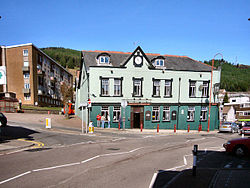
The former Tonypandy Town Hall

In 1988 Tonypandy became a county electoral ward to Mid Glamorgan County Council, electing one county councillor[10] in 1989 and 1993.[11] Tonypandy Town Hall was erected as a theatre in 1892.[12]

Since 1995 Tonypandy has been a ward, coterminous with the community boundaries,[13] which elects a county borough councillor to Rhondda Cynon Taf County Borough Council. In 2012 the electorate was 2,739.[14]

At every Rhondda Cynon Taf election the seat has been won by the Labour Party, apart from the 1999 election when then ward was won by Plaid Cymru.[14] Between 2004 and 2017 the Labour councillor was Craig Middle[14] and, since May 2017, the councillor has been Gareth Wyn Hughes.[15]

Notable people

[edit]
See Category:People from Tonypandy

References

[edit]
[edit]
Revisions and contributorsEdit on WikipediaRead on Wikipedia
from Grokipedia

Tonypandy is a former community in the Rhondda Valley, within county borough in , , with a of 3,559 as recorded in the . The town developed in the 19th century around collieries such as Nantgwyn, sunk in 1892, and Gellifaelog, established in 1845, which fueled rapid industrialization and growth in the .
Tonypandy is most notably associated with the 1910 riots, a violent escalation during a prolonged strike by miners at the nearby Cambrian Collieries in Tonypandy and Clydach Vale, where confrontations between thousands of striking workers and police resulted in property destruction, injuries to over 500 officers, and the deployment of military forces authorized by Home Secretary . These events, occurring primarily on 7-8 November, highlighted deep tensions between labor and capital in the coal industry, exacerbated by wage disputes and non-union labor, though subsequent analyses have debunked exaggerated claims of excessive military force or fatalities among civilians. The riots contributed to broader labor unrest, influencing the push for minimum wages in mining by 1912, but also underscored the miners' aggressive tactics against commercial targets and law enforcement. Post-industrial decline followed the contraction of coal mining after World War II, transforming Tonypandy into a residential and commercial hub serving the wider Rhondda area, with its economy now oriented toward services and retail amid persistent socioeconomic challenges in former mining communities.

Geography and Demographics

Location and Topography

Tonypandy is located in the Rhondda Fawr Valley of the Rhondda Cynon Taf county borough, Wales, at coordinates 51°37′N 3°27′W. The town lies within the historic boundaries of Glamorgan and forms part of the South Wales Coalfield region. The is dominated by steep, narrow valleys carved by the River Fawr, which flows through Tonypandy and shapes the local with its glacial and fluvial origins. Elevations ascend rapidly from the valley floor to encircling hills reaching over 300 meters, limiting flat land and influencing linear urban patterns along the river corridor. Tonypandy features a temperate maritime , with mild average temperatures ranging from 3–4°C in winter to 15–16°C in summer, and annual around 800–1,000 mm, often concentrated in prolonged wet periods that heighten vulnerability in the confined setting.

Population Statistics and Socioeconomic Indicators

The Tonypandy electoral ward recorded a population of 3,560 in the 2021 Census, reflecting a slight decline of 0.52% from , while the broader Tonypandy built-up area encompassed 17,203 residents. This places Tonypandy within the larger Rhondda urban area, where historical population growth was driven by influxes; the surrounding Rhondda parish expanded from 951 inhabitants in 1851 to 113,735 by 1901, as migrant labor fueled industrial expansion. Socioeconomic indicators reveal persistent deprivation linked to the post-mining economy. In the Welsh Index of Multiple Deprivation (WIMD) 2019, Tonypandy's Lower-layer Super Output Area (Tonypandy 1) ranked 481 overall out of 1,909 areas in Wales, indicating placement in the top quartile of deprivation, with particularly low standings in income (rank 426), employment (408), and health (456) domains. Economic inactivity in the encompassing Rhondda Cynon Taf county borough stood at 28.7% for working-age adults (aged 16-64) in the year to March 2025, exceeding the Welsh average of 23.9% and attributable to structural factors including skill gaps from specialized mining labor, limited local job diversification, and valley topography constraining access to external employment centers. Demographically, the ward features a age of approximately 41 years, with an aging profile resulting from out-migration of younger workers following mine closures in the and , which depleted the labor force and entrenched intergenerational cycles. Ethnic composition remains overwhelmingly (over 98%), with minimal diversity such as 1.43% Asian or Asian British/Welsh, reflecting historical patterns of Welsh heritage settlement reinforced by industrial-era migration predominantly from rural and Britain. These indicators underscore causal of , where geographic isolation and legacy dependence on extractive industries hinder adaptation to service- and knowledge-based economies without targeted retraining.

Etymology

Origin and Historical Usage

The name Tonypandy derives from the Welsh words ton ("meadow" or "lea"), y ("the"), and pandy ("fulling mill"), translating literally to "the meadow of the fulling mill." This etymology reflects the site's early association with wool processing, where fulling mills used water-powered hammers to clean and thicken cloth. The specific fulling mill referenced in the name was established in 1738 by Harri David along the Nant Clydach stream, near its confluence with the River Rhondda Fawr, marking the area's pre-industrial focus on amid agrarian settlement. Remains of this mill persist as archaeological of the nucleus around which the locality developed. Historical records indicate the name encapsulated this woollen industry hub, with no documented alternative derivations or naming disputes. Usage of Tonypandy remained tied to its Welsh roots through the 18th and early 19th centuries, denoting the pastoral and milling character before extraction transformed the region into an urban center; anglicized spelling and pronunciation emerged gradually with English-speaking influxes, but the core Welsh form endured without alteration. This linguistic persistence underscores the contrast between the site's original agrarian identity and its later industrial prominence.

History

Pre-Industrial Period

The Rhondda Valley area that would later form Tonypandy, situated within the parish of Ystradyfodwg, exhibited sparse medieval settlement characterized by small pastoral farming communities under the Welsh administrative framework of the cantref of Penychan and commotes such as Glynrhondda and Meisgyn. These included maenorau (manors) and trefi (townships), where inhabitants practiced seasonal , utilizing hafodau (summer pastures) on higher ground for livestock. The steep topography and poor soil quality constrained development, favoring pastoralism over extensive arable farming, with evidence of platform houses and early ecclesiastical sites like the 6th-century dedication of St. Tyfodwg's Church. Agriculture in the post-medieval era persisted along traditional lines, emphasizing sheep and rearing supplemented by limited cultivation of oats and on flatter valley bottoms, as documented in maps depicting irregular small-to-medium fields enclosed by walls. Freehold farmsteads and longhouses, such as those at Bodringallt and Ty’n-tyle from the , dotted the valley sides, supporting a self-sufficient agrarian economy isolated from broader markets except through routes to and . The precursor to Tonypandy centered on a post-medieval pandy ( mill), reflecting ancillary processing tied to local pastoral output rather than large-scale industry. Population density remained minimal, with Ystradyfodwg parish recording 542 residents in the 1801 and 1,363 by 1841, underscoring the lack of nucleated settlements and reliance on scattered farmsteads before systematic exploration transformed the landscape. Parish records and early indicate no significant urban or proto-industrial hubs, limited instead by geographic barriers and resource scarcity to subsistence-level agrarian pursuits.

Rise of the Coal Industry

The exploitation of coal resources in the Valley, including Tonypandy, accelerated in the mid-19th century following the geological mapping of deep coal seams, which proved exceptionally suitable for high-pressure generation due to their low content (typically 5-9%) and non-caking properties. These seams, such as the Hafod, Pentre, and deeper Four Feet and Red Vein, met surging demand from expanding steam-powered industries, locomotives, and naval fleets, where efficient fuel was critical for propulsion efficiency. poured in as entrepreneurs recognized the economic potential, transforming sparsely populated agrarian valleys into intensive districts by the 1860s. Key collieries emerged during this period, exemplified by the Naval Colliery near Tonypandy, where the Pandy Pit shaft reached viable steam coal measures in 1879 after sinking operations began earlier in the decade. This and similar pits, sunk between the 1850s and 1880s, rapidly scaled production through steam-driven winding engines and ventilation systems, employing thousands in underground extraction and surface operations by the 1890s. Output in the alone contributed significantly to ' total, with collieries like these enabling annual yields in the millions of tons by the early 1900s, driven by technological advances in seam access despite challenging geological conditions like faulting. Infrastructure developments underpinned this expansion, notably the Taff Vale Railway, which opened its main line from to in stages between 1840 and 1841, providing efficient coal transport to export ports and reducing reliance on canals. This connectivity boosted profitability by linking remote valleys to global markets, where steam coal commanded premiums for Admiralty contracts. Economic indicators reflected the boom: coal production peaked at 57 million tons in 1913, with exports forming a substantial portion amid pre-war industrial demand. Miners' nominal wages rose in tandem, from around 33 shillings weekly in the 1870s to higher rates by the 1900s, correlating with output growth and temporary labor shortages during prosperity phases. Colliery companies adopted a model of integrated settlements, constructing terraced near pits to house workers and maintain operational control, often under paternalistic oversight that included company shops and basic welfare provisions to minimize and ensure steady labor supply. However, profitability remained vulnerable to international competition from other coalfields and nascent alternatives, compelling cost efficiencies in labor and extraction methods even as production scaled. This framework sustained the industry's ascent until external market shifts intervened.

The Tonypandy Riots of 1910–1911

The Tonypandy Riots arose from an industrial dispute at the Cambrian Combine collieries, owned by D. A. Thomas, where approximately 12,000 miners in the Mid-Rhondda area went on strike starting November 1, 1910, following a lockout initiated in September over wage reductions tied to declining coal prices and the introduction of a "double-shift" system for lower-quality seams. The strike, which spread by solidarity actions to involve around 30,000 miners across south Wales by winter, was exacerbated by the employment of non-union "blackleg" labor to maintain production amid international competition, fueling grievances over job security and living standards. Syndicalist agitators, including Noah Ablett of the Plebs' League, played a role in radicalizing the workforce through advocacy for direct action and worker control, viewing the conflict as part of broader class struggle rather than mere wage negotiation. Violent clashes erupted on the evenings of November 7 and 8, 1910, as strikers and supporters attacked shops in Tonypandy, resulting in widespread looting and destruction of commercial property, with rioters targeting symbols of local commerce amid frustrations over strike hardships. Local Glamorganshire police, outnumbered and assaulted, suffered over 80 injuries, while more than 500 civilians were also hurt in the melee; one miner, Samuel Rhys, died from head injuries likely inflicted by a police baton during the unrest. The riots extended into further disturbances in 1911, including attempts to halt blackleg operations at collieries like Llwynypia, highlighting excesses such as opportunistic vandalism by younger elements disconnected from core labor demands. As local forces proved insufficient, authorized the deployment of over 1,000 and troops, including the 18th Hussars, to protect pits and infrastructure, with instructions emphasizing defensive postures and no lethal force against crowds—a policy upheld as no soldiers fired on rioters, countering later myths of a "Tonypandy Massacre." Miners and sympathizers framed the events as a defense of rights against exploitative owners, yet critics, including local tradesmen and authorities, highlighted the disproportionate property crimes and that undermined legitimate grievances, while underscoring the economic imperative of resuming production to sustain the coal industry's viability amid falling demand. This duality reflects causal tensions: structural wage pressures from market forces necessitated some concessions to non-union work for survival, even as agitators exploited unrest for ideological ends. The strike concluded in September 1911 after nearly a year, with miners returning under partial agreements but without fundamental wage reforms or elimination of the disputed shift system, yielding limited immediate gains. The events inspired the 1912 syndicalist pamphlet The Miners' Next Step, co-authored by Ablett and others, advocating revolutionary unionism and worker expropriation of mines, though it failed to translate into sustained systemic changes, as coal economics continued to dictate terms favoring owners in the pre-war era. Long-term, the riots intensified class animosities but did not alter the industry's trajectory, with narratives of police overreach persisting despite evidence of rioters' proactive violence.

Decline of Mining and Post-War Developments

The decline of in Tonypandy and the surrounding Valley began in the , driven by depleted seams, international competition, and the global shift toward alternative energy sources like oil. By the 1920s, output had peaked, but economic pressures led to initial closures, exacerbated by the , which saw male rates in the exceed 40% and reach long-term figures of up to 63% in areas like Ferndale by 1932. These conditions stemmed from exhausted high-quality reserves and falling demand, rather than solely external factors, prompting early out-migration as families sought work elsewhere. Post-World War II of the industry under the in 1947 brought improvements in safety standards and working conditions, fulfilling long-standing miners' demands for better oversight after decades of private-sector accidents. However, structural inefficiencies in the state-run system, including higher operational costs and slower adaptation to , compounded the challenges of uncompetitive Welsh against cheaper imports and substitutes like oil and . Closures accelerated in the and , with around 50 collieries shuttered in between 1957 and 1964, including several near Tonypandy such as Tydraw and Gelli by 1960, as seams thinned and extraction costs rose. The 1984–1985 miners' strike, triggered by proposed pit closures, further hastened the industry's contraction by disrupting operations and highlighting underlying economic viability issues, leading to the shutdown of remaining facilities. In the , key sites like Lewis Merthyr Colliery in Tonypandy closed in 1983, followed by Maerdy Colliery—the valley's last deep mine—in December 1990, marking the end of large-scale production. Socially, these developments spiked unemployment again in the , exceeding national averages and fostering , while out-migration reduced the Rhondda's by 36% from its mining-era peak, eroding community structures without alternative industries immediately filling the void.

Recent Regeneration Efforts

In 2021, County Borough Council unveiled plans to transform Tonypandy's , focusing on Dunraven Street with improvements to public spaces, pedestrian access, and retail viability to address vacancy rates exceeding 20% in key areas. These efforts built on earlier post-2000 initiatives, including targeted investments in infrastructure to counter following mine closures. The Tonypandy Town Centre Strategy, drafted in 2025 with funding from the Welsh Government's Transforming Towns grant, outlines ambitions to enhance connectivity, create vibrant public realms such as a proposed , and promote retail and leisure uses to attract investment. on the draft occurred from August 11 to October 3, 2025, following initial from December 2024 to February 2025, with the strategy identifying Tonypandy as a key settlement for coordinated regeneration under the local development plan. Complementing this, a proposal received support in August 2025 to levy businesses for enhanced services, potentially unlocking further Transforming Towns Fund resources requiring 25% local match funding. Housing-led regeneration includes Trivallis's 2024 demolition of Mitchell Court to enable new residential developments, alongside approval for 50 modern homes in the town centre core to increase and support mixed-use viability. Beacon Housing Association's Big Shed project on the former Co-op site aims to deliver commercial space for light industry and community uses, targeting underutilized land. Despite these initiatives, outcomes remain mixed, with Rhondda Cynon Taf's employment rate for ages 16-64 falling to 69.1% in the year ending December 2023 from higher pre-pandemic levels, reflecting localized contraction amid broader Welsh labor market pressures. Persistent deprivation indices, compounded by geographic isolation and limited skills in high-value sectors, have hindered full revitalization, though incremental gains like improved pedestrian zones show partial efficacy in stabilizing retail presence.

Economy

Historical Economic Foundations

The economy of Tonypandy originated as a commercial adjunct to the operations that dominated the Valley from the mid-19th century onward. As the valley's population surged due to industrial migration, Tonypandy emerged as a key retail and service hub, supporting workers from nearby collieries in areas like and Trealaw, where entities such as the Combine extracted high-quality coal. By the early , employed the vast majority of the male workforce in the , with 41,000 miners active across local pits by 1913. Coal output in the reached 9.5 million tons that year, contributing to ' peak production of approximately 57 million tons annually pre-World War I, driven by exports of premium anthracite and coal to European markets. Private enterprise fueled ancillary economic growth, with innovations in deep-shaft techniques enabling access to richer seams and boosting productivity. Retail establishments along Dunraven Street and transport infrastructure, including the , proliferated to handle coal shipments and serve the mining populace, creating a web of supportive trades from ironmongery to provisioning. This reflected entrepreneurial adaptation, as independent coal owners and merchants capitalized on the influx of wages to develop Tonypandy into the Rhondda's primary by the 1900s. However, the economy's foundations exposed structural frailties, with over-dependence on rendering it susceptible to international price fluctuations and export demand volatility. Pre-war booms from naval and industrial contracts alternated with slumps tied to global competition, foreshadowing chronic instability as alternative energy sources and foreign rivals eroded market share post-1918.

Current Economic Challenges and Initiatives

Tonypandy's centers on retail and service sectors, which dominate local employment amid broader stagnation in the . The area grapples with high economic inactivity, with 27.0% of the working-age (approximately 40,200 individuals aged 16-64) classified as economically inactive in the year ending March 2024, exceeding the Welsh average of 23.9%. This persists due to structural factors, including skills mismatches from the industry's collapse, limited higher-value job creation, and inadequate connectivity that hampers commuting to growth areas like . Deprivation metrics underscore these hurdles: under the Welsh Index of Multiple Deprivation (WIMD) 2019, multiple Lower Super Output Areas in Tonypandy rank in the top 10-20% most deprived nationally for access and , reflecting low rates and reliance on low-wage service roles rather than diversified industries. Local economic output has contracted relative to ' overall growth, with valley towns like Tonypandy experiencing uneven recovery post-pandemic, compounded by retail vacancies and subdued . To counter these issues, Council approved a (BID) for Tonypandy in July 2024, enabling levy-funded enhancements to infrastructure, events, and business support aimed at boosting footfall and sustainability. A draft Tonypandy , developed with stakeholder input from December 2024 to February 2025 and opened for in summer 2025, prioritizes retail revitalization, visitor routes leveraging industrial heritage for , and transitional public spaces to attract . Additional pilots include site regenerations, such as the "Big Shed" project on former commercial land and demolition works starting in 2025 at key derelict sites like Mitchell Court, intended to foster . Notwithstanding these efforts, critiques highlight limited efficacy, as Tonypandy's GDP contributions remain stagnant amid persistent viability challenges, with strategies often critiqued for insufficient focus on skills retraining or external connectivity improvements to enable broader sectoral shifts. Ongoing corporate plans through 2030 emphasize partnerships, but measurable uplift in or deprivation indices has been modest, underscoring the need for scalable private investment beyond public-led initiatives.

Governance and Politics

Local Administration Structure

Tonypandy is administered as part of , governed by the Council, a established on 1 April 1996 through the reorganization of Welsh into 22 single-tier principal councils under the Local Government (Wales) Act 1994. The council consists of 75 elected councillors who represent electoral wards across the authority, including the Tonypandy ward, and set policies on budgeting, service delivery, and devolved powers such as community infrastructure and environmental management. The unitary council holds responsibility for core local services in Tonypandy, encompassing housing provision and maintenance, primary and , social care, , and regeneration projects to support economic recovery in former communities. These functions were previously divided between county and district levels under County Council from 1974 until the 1996 reforms, tracing back to the broader administrative framework of County Council formed in 1889. Funding for these services relies substantially on grants alongside local revenues, reflecting the erosion of the tax base following the industry's collapse; for example, the has received nearly £40 million in Coal Tip Safety Grants since 2021 to address mining-related hazards like unstable spoil tips. This grant dependency underscores the fiscal constraints in post-industrial areas, where capital programs for and regeneration—totaling commitments like £11.5 million in additional priority investments in —often require central support to sustain operations.

Political History and Representation

The political landscape of Tonypandy and the surrounding area has been dominated by the Labour Party since the early 20th century, rooted in the militant unionism of the communities. The 1910–1911 miners' strike and associated unrest amplified socialist sentiments, fostering a surge in organization and affiliation with the , which translated into electoral strength as employment peaked. This tradition solidified Labour's grip, with the party securing consistent majorities in local and national elections, reflecting a constituency where working-class prioritized and state intervention over alternatives. In UK Parliamentary terms, the Rhondda constituency—encompassing Tonypandy—has been a Labour since its creation in 1918, represented uninterrupted by Labour MPs, including figures like until 1983 and since 2001, with vote shares often exceeding 50% even in national Labour setbacks, such as 58.1% in 2019. Similarly, in the (Welsh Parliament), the seat has remained Labour-held post-devolution in 1999, with the party capturing 44.5% of the vote in 2021 amid regional challenges like flooding and economic stagnation. Locally, Council, which includes Tonypandy, has been under continuous Labour control since its formation in 1996, enabling aligned policy delivery but insulating the area from competitive electoral pressures. This prolonged one-party dominance, while delivering on union-linked priorities like welfare expansion, has drawn scrutiny for contributing to inertia, particularly in addressing post-industrial decline. Empirical indicators reveal persistent underperformance: despite substantial devolution-era funding for valleys regeneration—totaling billions via programs like the Heads of the Valleys initiative—'s per head lags the average by over 20%, with rates historically double the national figure and exceeding 30% in parts of the constituency as of 2022. Critics attribute limited outcomes to a reliance on top-down, state-centric interventions influenced by union ties, which prioritize protections and subsidies over deregulatory or enterprise-driven reforms that might foster private , resulting in a cycle of dependency rather than structural diversification. Welsh economic output has grown since 1999 but at a slower rate than the , with valleys areas like exhibiting high deprivation indices despite targeted allocations, underscoring accountability gaps in uncompetitive political environments.

Culture, Sports, and Recreation

Cultural Heritage and Landmarks

Tonypandy's centers on its legacy and community institutions, with preserved structures highlighting the industrial era's impact. The Engine House of the former Colliery, constructed in the late , served as the winding facility until the colliery closed in 1945 and functioned as a until 1966, representing engineering feats that supported production in the Rhondda Valley. Nearby prehistoric and medieval sites, such as the motte-and-bailey Ynyscrug Castle with its moat, provide evidence of earlier settlement before industrialization dominated the landscape. Religious and social buildings underscore the Nonconformist chapel culture that shaped valley life, fostering community cohesion amid mining hardships. Trinity Calvinistic Methodist Church on Dunraven Street, established in the early 20th century, exemplifies the proliferation of such that hosted gatherings, , and cultural integral to Welsh identity. The Mid Rhondda Central Working Men's Institute on Primrose Street continues a tradition of workers' halls built from colliery levies, offering spaces for libraries, lectures, and that promoted self-improvement among miners. Preservation initiatives document mining achievements, such as powering global industry, alongside operational hazards, through accessible sites. The Heritage Park, encompassing the Lewis Merthyr Colliery opened in 1790, features underground tours led by former miners, interactive displays, and artifacts like coal drams, illustrating daily colliery operations. Launched in 2024, the Rhondda Heritage Trail connects 12 stations across the valleys, including Tonypandy-area landmarks, using digital markers to explore industrial history and community narratives. These efforts balance commemoration of economic output records with acknowledgment of labor conditions, drawing on local archives for factual representation.

Sports Traditions

Rugby union emerged as a cornerstone of community life in Tonypandy during the late 19th century, aligning with the sport's rapid adoption in south Wales mining valleys where it cultivated physical resilience and collective solidarity among colliers facing arduous pit conditions. Matches at local grounds drew substantial crowds from the mining workforce, reinforcing social bonds forged in the collieries and providing a outlet for the era's industrial camaraderie. An early marker of the area's sporting fervor was the hosting of Wales' 35-18 rugby league victory over England on April 20, 1908, at the Tonypandy Recreation Ground, highlighting the brief but intense professional rugby presence amid the dominant union tradition. Boxing traditions thrived in Tonypandy's working-class milieu, yielding enduring figures like (1913–1986), the "Tonypandy Terror" from nearby Clydach Vale, whose career from 1926 to 1953 yielded 86 wins, 35 losses, and 19 draws, including 24 knockouts. secured the British and Empire heavyweight title on March 16, 1937, against via unanimous decision, then challenged for the world heavyweight crown on August 30, 1937, at before 55,000 spectators, lasting all 15 rounds in a narrow points defeat that showcased his tenacity. This pugilistic heritage, emblematic of valley resilience, persisted through amateur bouts and professional aspirations tied to mining hardships. Athletics gained institutional footing with the Rhondda Athletics Club's formation in 1953, headquartered at King George V Track in Clydach Vale adjacent to , where it has sustained , cross-country, and for ages 8 and above. The club hosts graded events, including the annual Tonypandy Track Classic featuring 5000m races and age-group sprints, drawing participants across abilities and underscoring ongoing community engagement. The post-mining era, marked by colliery closures from the onward, strained club finances reliant on worker subscriptions, prompting shifts to volunteer-led models and regional affiliations like the districts. Nonetheless, amateur leagues endure, preserving traditions through participation rather than large-scale professional pursuits.

Community Recreation and Events

Rhondda Cynon Taf Council manages the Leisure for Life network, providing access to facilities such as the in nearby , which offers gym sessions, swimming pools, fitness classes, and indoor sports for Tonypandy residents through an unlimited membership scheme across 12 centres. Local parks and green spaces support informal recreation, while the surrounding features seven maintained hiking trails suitable for community walks, emphasizing natural landscapes reclaimed from former industrial sites. Community events in Tonypandy include seasonal gatherings organized by the council, such as the Halloween Spooktacular on October 29-30 and parades, alongside commemorations of local history like the 80th anniversary of held on August 15, 2025, featuring public assemblies. Annual events tied to mining heritage, including discussions on the 1910 and related labour disputes at venues like the NUM Club, draw participants to reflect on industrial past without commercial emphasis. Tourism contributes modestly to recreation through guided valley walks and visits to industrial heritage markers, such as reclaimed colliery sites, fostering minor economic activity via pedestrian exploration rather than large-scale attractions. However, high deprivation levels in the area—Rhondda ranking among ' most deprived locales per the 2019 Welsh Index of Multiple Deprivation—correlate with underutilization of facilities and youth disengagement, prompting council initiatives like the Youth Engagement and Participation Service to boost involvement in leisure programs.

Notable People

Donald Houston (6 November 1923 – 30 October 1991), a Welsh actor who appeared in films such as The Blue Lagoon (1949) and A Run for Your Money (1949), was born in Tonypandy to a family of Scottish descent. His younger brother, Glyn Houston (23 October 1926 – 1 June 2019), also an actor noted for roles in television series like Doctor Who and films including The Blue Lagoon, was likewise born in Tonypandy and began his career following military service in World War II. Sophie Evans (born 13 February 1993), a Welsh singer and actress recognized for her role as Dorothy in the West End production of (2011–2012) and runner-up on BBC's (2010), was born and raised in Tonypandy. William Morris Llewellyn (1 January 1878 – 12 March 1973), a Welsh rugby union winger who captained the national team and contributed to three Triple Crown victories, including the historic 1905 win over , was born in Tonypandy.

References

Add your contribution
Related Hubs
User Avatar
No comments yet.