Hubbry Logo
search
logo
1944094

Tractor pulling

logo
Community Hub0 Subscribers
Read side by side
from Wikipedia

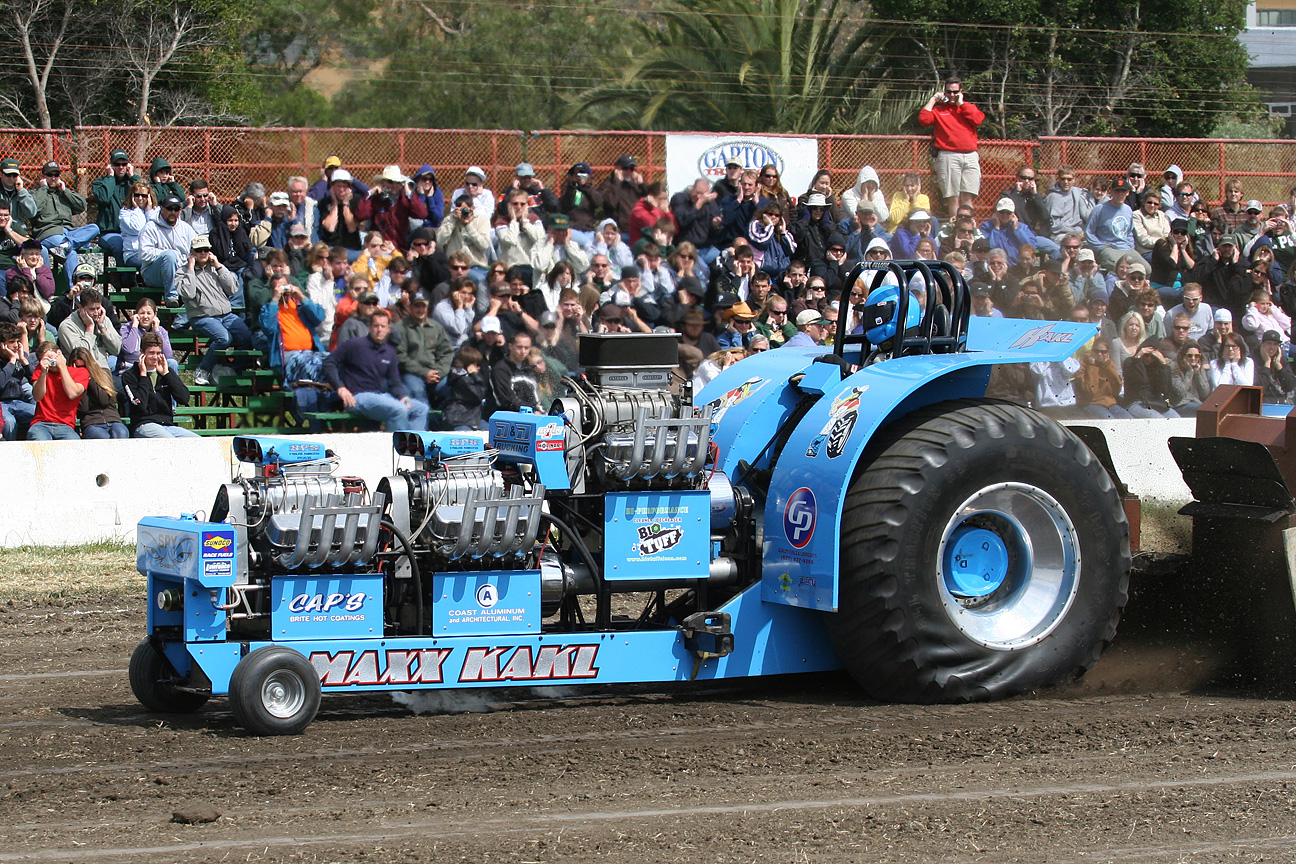
Modified tractor with three 1500 hp V8 engines
Allis Chalmers diesel pulling tractor
John Deere pulling tractor
Light Modified (5,700 lb) class tractor, Weeping Water, Nebraska
Super Stock class tractor, Fonda, New York

Truck and tractor pulling, also known as power pulling, is a form of a motorsport competition in which antique or modified tractors pull a heavy drag or sled along an 11-meter-wide (35 ft), 100-meter-long (330 ft) track, with the winner being the tractor that pulls the drag the farthest. The sport is known as the world's most powerful motorsport, due to the multi-engined modified tractor pullers.

All tractors in their respective classes pull a set weight in the drag. When a tractor gets to the end of the 100 meter track, this is known as a "full pull". When more than one tractor completes the course, more weight is added to the drag, and those competitors that moved past 91 metres (300 ft) will compete in a pull-off; the winner is the one who can pull the drag the farthest. The drag is known as a weight transfer drag. This means that, as it is pulled down the track, the weight is transferred (linked with gears to the drag’s wheels) from over the rear axles and towards the front of the drag. In front of the rear wheels, instead of front wheels, there is a "pan". This is essentially a metal plate, and as the weight moves toward it, the resistance between the pan and the ground builds. The farther the tractor pulls the drag, the more difficult it gets.[citation needed]

Tractor pulling originated from pre-Industrial Era horse pulling competitions in which farmers would compete with one another to see whose teams of draft horses could pull a heavy load over the longest distance. The first known competitions using motorized tractors were held in 1929 in Missouri and Kentucky. Tractor pulling became popular in rural areas across the Midwestern and Southern United States in the 1950s and 1960s. From there it gradually spread to Canada, Europe, and Australia and New Zealand.

History in the US

[edit]

Prior to the invention of the tractor, when farm implements were pulled by horses, farmers would boast about the strength of their teams and seek to compare and contest in teams with one another to see who had the most powerful animals. In some cases, they compared horse teams pulling large loads over distance, such as a fully loaded hay cart or wagon. In other situations, a flat board or skid would have a horse or team of horses then hitched to it; weight would be added, usually in the form of rocks, and the driver would urge his horses to pull the load, with more weight added as competitors were eliminated; the animals pulling the most weight or for the greatest distance were judged the strongest. These events became the formalized sport of horse pulling, which is still carried out today with draft horses, specially bred to have high strength for pulling heavy loads. Today, fixed weights on drags are dragged for a set distance and additional weight is added in successive rounds. While it is said that the term horsepower is derived from this event, the concept was developed earlier, in experiments and measurements performed by James Watt and Mason Worrell.

It wasn't until 1929 that motorized vehicles were put to use in the first events at Bowling Green, Missouri, and Vaughansville, Ohio.[1] Although the sport was recognized then, it did not really become popular until the '50s and '60s. It was also realized, at that time, there were no uniform set of rules. The rules varied from state to state, county to county, and competitors never knew what standards to follow. This made the sport difficult for new entrants.[according to whom?]

In 1969, representatives from eight states congregated to create a uniform book of rules to give the sport much-needed structure, and created the National Tractor Pullers Association (NTPA). The NTPA's early years were events that used standard farm vehicles, with the motto "Pull on Sunday, plow on Monday". Pulling remained basically the same through the '70s, with only stock and modified tractors. Stock tractors were commercially available tractors produced by manufacturers, and modified tractors were the basic tractor chassis with another non-tractor engine mounted on it.

Tractors remained single-engined until two Ohio brothers, Carl and Paul Bosse, introduced the crossbox, which could allow multiple engines to be attached to a single driveshaft. Other innovators during this period included Bruce Hutcherson, with his triple-Rodeck-engine–powered "Makin Bacon Special", Dave and Ralph Banter and their Chevrolet-powered tractors, and the "Mission Impossible" tractors of Tim Engler, which at one point had up to seven supercharged methanol-fueled engines.

Subsequently, modified tractors with four engines were common, while stock tractors tried to catch up by adding multiple large turbochargers, along with intercoolers, but both retained the appearance of a tractor. Soon tractors became single-use machines that were not used on the farm, making the "Pull on Sunday, plow on Monday" motto obsolete.[citation needed]

Throughout the '70s and '80s the modified division continued to thrill crowds by adding more engines, and soon the tractors lost their tractor appearance and turned into high 'spec' dragsters. The limit was reached in 1988 when a tractor with seven engines was built. As well as piston engines, turbine engines (frequently mistakenly called "jet engines") appeared in 1974, with Gardner Stone's "General" Tractor, a four-turboshaft unit hitting the hook in 1989.[citation needed]

The growing popularity of the sport caused the creation of a new four-wheel–drive division in 1976, which captured a large fan base. The engine sizes in these vehicles continued to increase, from 7,400 cubic centimeters (450 cu in) up to 11,000 cubic centimeters (700 cu in) and probably would have continued, but in 1989 the NTPA limited displacement to 10,700 cubic centimetres (650 cu in) and required natural aspiration, banning supercharging. Today the four-wheel–drive division is one of the most popular with the success of trucks like the Holman Brothers "4-Play" Chevy and Bob Boden's "Studley Studebaker".

Two-wheel-drive (2WD) truck class

[edit]

The two-wheel–drive (2WD) division was introduced in 1983.

The division imposes a weight limit of 2,800 kilograms (6,200 lb) on each competing truck, a maximum width of 2.4 meters (8 ft), and a maximum distance of 4.6 meters (15 ft) from the centerline of the rear axle to the front of the vehicle (including weight racks and tow hook). (The length restriction allows for up to 250 millimeters (10 in) of cosmetic fiberglass, however.)

Alcohol methane engines with up to eight cylinders are permitted, but diesel engines are not. Any wheelbase is permitted.[citation needed]

The National Tractor Pullers Association restricts engines to 9,420 cm3 (575 cu in) and two valves per cylinder. They permit tubular steel frames. The maximum tire size for the 2WD class is 470 mm × 410 mm (18.4 in × 16.1 in), with a maximum circumference of 3,600 mm (143 in) when mounted on an 460-millimeter (18 in) rim and inflated to 190 kilopascals (28 psi). The ground patch is not to exceed 480 millimeters (19 in) on original tread.[2]

Super stock, pro-stock, and mini-modified

[edit]

Super Stock tractor Open class uses primarily methanol fuel (some are diesel versions). The Super Stock Open machines can generate over 4,400 kilowatts (6,000 PS) and 5,400 newton-meters (4,000 lbf⋅ft) of torque, with billet or re-cast engine blocks. Super Stock Open and Super Stock Diesel tractors may use up to four turbochargers in three stages. The Diesel super stock tractors generate close to 3,700 kilowatts (5,000 PS) and 8,100 newton-metres (6,000 lbf⋅ft) of torque and are allowed to compete in the Open class, which very rarely occurs anymore. However, a true Open (methanol fuel) tractor is not allowed to compete in the Diesel class.

There is light Super Stock class which is 2,800 kilograms (6,200 lb) and the Heavy Super Stock Classes that are 3,630–3,740 kilograms (8,000–8,250 lb).

Diesel Pro Stock Tractors are limited to one turbocharger and diesel fuel is the only allowable source for power, in keeping with the 'spirit' of the original tractors. The maximum engine displacement is 11,100 cubic centimeters (680 cu in). These engines can achieve around 2,700 kilowatts (3,700 PS) and 7,500 newton-meters (5,500 lbf⋅ft) of torque.[3] In recent years, new classes have been created to appeal to different groups of pullers. There is now a class called Limited Pro Stock that is limited to 10,500 cm3 (640 cu in) engine and 100 millimeters (4.1 in) turbocharger. This class typically pulls at 4,200–4,300 kilograms (9,300–9,500 lb) and is slightly restricted, as opposed to the Pro Stock class, which can run up to 11,100 cm3 (680 cu in) engine and an unrestricted size turbocharger, along with intercoolers.

The latest addition to Pro Stocks is the Light Pro Stock Class that typically pulls 3,800–3,900 kilograms (8,300–8,600 lb) depending on location. These tractors are limited to 8,800 cm3 (540 cu in) engines but can run any size turbo. They are not allowed to run intercoolers, however these tractors are making an average of 1,800–2,100 kilowatts (2,500–2,800 PS). The light overall weight makes this a driver's class as significant skill is required to keep the tractor on the track.

The mini-modified class is a highly specialized and custom built tractor to be fitted with a naturally aspirated engine, at minimum. NTPA Minis are limited to 9,420 cm3 (575 cu in) (always an aftermarket V-8 engine block) and uses up to a 14-71 hi helix supercharger. With the driver, they weigh only 930 kilograms (2,050 lb). Today's engine is capable of a minimum of 1,800 kilowatts (2,500 PS) on methanol or ethanol. Their reputation is known as the wildest ride in pulling, as naturally it is a very high horsepower to weight ratio. Whereas, their larger counterparts, the Modifieds, will weigh 2,700, 3,400 and 3,600 kilograms (6,000, 7,500 and 8,000 lb), utilizing the same engine that a Mini has, but, with multiple powerplants per custom built tractor chassis. Usually, a maximum of five engines is all that will make the 3,600 kilograms (8,000 lb) weight limit. Nitromethane and oxidizers were outlawed in 1976.[citation needed]

Antique tractor pulling

[edit]
Oliver antique tractor

Antique tractor pulling is how tractor pulling first got started (although the tractors were just modern tractors at that time). As early as 1929, farmers began attaching their tractors to drags, and dragging it down a field to see who could pull it the furthest.[1] People who were event organizers at Bowling Green, Missouri and Vaughansville, Ohio found out farmers were doing this and that it drew spectators.[1] By 1950, county fairs across the country started featuring tractor pulls.[1] Spectators found it fascinating to see machines that would "Pull on Sunday, plow on Monday".[1] At first competitors would use a ‘Human Drag’, meaning a drag that was weighted by humans, different people would be added as the tractor made it down the track. However, organizers began to look at different ways to add weight to the drag, as spectators walking on the drag while moving proved to be a hazard.[1] In the late 60s, a weight-exchanging drag was created, the drag that was created was basically a flatbed truck trailer with wheels near the back and a drag at the front.[1] A mass that is moveable of up to 65,000 pounds or 29,000 kilograms, the mass starts at the back of the sled, slowly working its way up to the top as the drag moves down the track.[1]

The tractors are divided into different weight classes based on the tractor weight, the weight classes starting at 2,500 and ending at 14,000 pounds (1,100 to 6,400 kg). The tractors could go in any class they choose, with many adding weight for the higher weighted classes. In order to be able to compete in Antique tractor pull competitions a tractor must perform at its original speed. Some pulling competitions will have a ‘dyno’, connecting the PTO shaft on the tractor to a dynamometer to test the horsepower. If a tractor shows it has more horsepower than the original tractor is supposed to have, it is placed into an alternate class called ‘Modified Tractors’.

Most antique tractors when pulling use about 14–15 pounds (6.4–6.8 kg) in their tires. There is also a drawbar rule, it is to be a minimum of two square inches (13 cm2) in total steel at any point, as well must be rigid in all directions.[4] The hitching device can be no more than 1+12-inch (38 mm) round stock (1+12 in or 38 mm square), or less than 1+18-inch (29 mm) round stock (1 in or 25 mm square), the hole has to be 3 by 3+34 inches (76 mm × 95 mm) diameter.[4] The drawbar on a tractor should be no shorter than 18 inches (460 mm) from the center of the rear axle to the point of the hitch.[4] All the weights on a tractor must be fixed.[4] All drivers when pulling must remain seated.

History in Australia

[edit]
Tractor pull at Sheffield, Tasmania

The first Australian Tractor Pull was held at the Elmore Field Days (Victoria) in 1976. The following year saw Tractor Pulling begin in the Victorian rural town of Quambatook. It has developed over the years into a highly competitive and technical sport, where the difference between first and last place may be as small as one or two metres. Often the top tractors are separated by mere centimetres.

Down Under Modified Tractor Pulling Association (Down Under MTPA) is a non-profit organisation that governs Modified Tractor Pulling in Australia. Their events (Tractor Pulls) are held in conjunction with a promoter, often a community organisation (for example; Apex, Rotary or Lions clubs) or an agricultural show.

Down Under MTPA Tractor Pulls are held in locations throughout Australia, predominantly in Victoria, South Australia and New South Wales. In other regions, events are run by independent clubs and associations, including (South East Queensland) SEQ Pullers, (Central Queensland) CQ Pullers, the Western Australian Tractor Pullers Association (WATPA), and Tasmanian Tractor Pullers.

Australian Tractor Pulling classes include Open Modified, Super Modified, Limited Modified, Two Wheel Drive, Pro Stock / Open Pro Stock (Smoker), Open / Outlaw Mini Modified, Super Mini Modified, and Mini Modified. Each class is defined by limits on maximum weight, engine modifications, fuel type, and overall physical size.

Down Under MTPA also runs Junior Modified Pulling Mowers, a class for competitors aged 8 to 14. These Modified Mowers pull their own smaller version of the sled.

Drag pulling

[edit]
Sled
Full Pull marker

In the early days two main techniques were used. Either a dead weight of fixed mass was dragged, or the step-on method was used, where people stood at fixed positions and stepped aboard as the drag passed.[5] Another rule which has now been dropped was that a speed limit should be observed because of injuries resulting from the increased speed at which they boarded. Today's tractors can achieve theoretical speeds over 200 km/h (125 mph).

Today's drags use a complex system of gears to move weights up to 29,000 kilograms (65,000 lb). Upon starting, all the weights are over the drag's rear axles, to give an effective weight of the drag plus zero. As the tractor travels the course, the weights are pushed forward off the drag's axles, pushing the front of the drag into the ground, synthetically creating a gain in weight until the tractor is no longer able to overcome the force of friction.[5] Most drags have grouser bars that act like teeth and dig into the soil to stop the sled.[6]

Engines

[edit]

Apart from modified standard diesel tractors, a variety[7] of high power engines are used in tractor pulling, which started in the late 1970s. In the early years, mainly single, double or multiple US-made big block dragster engines were used, but nowadays, a lot of parts from discarded military machinery are in use, like Klimov TV3-117 (Isotov)[8] turboshafts from Russian helicopters, Soviet Zvezda M503[9] torpedo boat engines, Continental AV1790[10] tank engines, or World-War-2-era aircraft piston engines in V12-shape (e.g. Rolls-Royce Griffon[11]) or as radial engines (e.g. Curtiss-Wright R-3350[12]). Due to the limited number of vintage warbird engines remaining, some organisations that own them, such as the Fantasy of Flight museum in Florida, refuse to sell engines from their collection to customers that wish to use them for tractor pulling.[13] In recent years a number of agricultural engines have been converted to run on methanol with multi-stage turbocharging.

See also

[edit]

References

[edit]

Sources

[edit]
[edit]
Revisions and contributorsEdit on WikipediaRead on Wikipedia
from Grokipedia
Tractor pulling is a competitive motorsport in which modified farm tractors, custom-built pulling tractors, or trucks drag a weighted metal sled along a prescribed dirt course, typically 300 to 320 feet long and at least 30 feet wide, with the objective of achieving the greatest distance before stalling; it is widely known as the world's heaviest motorsport due to the immense power required.[1] The sport emphasizes torque and traction over speed, as vehicles must overcome progressively increasing resistance from the sled's shifting weight box, which can total up to 65,000 pounds.[1] Measurements are precise to the thousandth of an inch, and a "full pull" to the course's end results in a pull-off among qualifying competitors to determine the winner.[1] The origins of tractor pulling trace back to informal 19th-century horse-pulling contests at county fairs, evolving into motorized events in the 1920s as farmers showcased their machinery's prowess.[2] The first organized tractor pulls occurred in 1929 in locations such as Vaughansville, Missouri, and Bowling Green, Ohio, gaining momentum in the post-World War II era with vehicle modifications and standardized rules emerging in the 1950s and 1960s.[1] The National Tractor Pullers Association (NTPA), founded in 1969, became the sport's primary sanctioning body in the United States, promoting consistency across classes and events while expanding to regional, state, and national competitions.[2] Competitors are categorized into various classes based on vehicle weight, engine configuration, fuel type, and modifications to ensure fair play, including Super Stock (street-like stock tractors with limited alterations, such as 8,000-pound diesel or alcohol classes), Modified (heavily customized with multiple engines or turbos, like 7,500-pound open classes), Pro Stock (production-based with single turbos, around 10,000 pounds), and truck divisions such as Four-Wheel Drive (6,200 pounds) or Super Semi (20,000 pounds).[1] Rules strictly regulate aspects like drawbar height (often 20 inches), turbocharger size, and safety features including kill switches on sleds, with fuels ranging from diesel and gasoline to alcohol for enhanced performance.[1] Innovations like multi-engine setups and turbine-powered tractors emerged in the 1970s, pushing horsepower into the thousands while maintaining the sport's roots in agricultural machinery.[2] Tractor pulling enjoys significant popularity in rural communities across the United States and has expanded internationally to Europe and Australia, with major events such as the NTPA's National Tractor Pulling Championships in Bowling Green, Ohio—held annually since 1967—drawing thousands of spectators and competitors from multiple states.[1] Other prominent pulls include the Budweiser Dairyland Super Nationals in Tomah, Wisconsin, and the Lions Super Pull of the South in Chapel Hill, Tennessee, which highlight the sport's blend of raw power, engineering ingenuity, and family-oriented appeal.[1] Despite its grassroots origins, the sport has attracted corporate sponsorships and professional teams since the 1980s, sustaining its status as a unique test of man, machine, and mechanical limits.[2]

Fundamentals

Definition and Objective

Tractor pulling is a competitive motorsport in which modified farm tractors, trucks, and other heavy vehicles attempt to drag a weighted sled along a dirt track for the greatest distance.[1] The sport tests the limits of mechanical power and precision, with participants vying to outpull rivals in a direct measure of raw strength rather than speed or agility.[3] The primary objective is to evaluate vehicle power, torque output, and driver skill by determining how far each entry can haul the sled before stalling or reaching the track's end, typically a 97.5-meter (320-foot) course.[1] Success hinges on the machine's ability to overcome increasing resistance as the sled's weight shifts forward during the pull, often culminating in a "full pull" if the vehicle completes the full distance.[4] Renowned as the "world's heaviest motorsport," tractor pulling captivates audiences with extreme power levels surpassing 10,000 horsepower in elite unlimited classes, highlighting engineering ingenuity in custom builds and modifications.[1][5] Rooted in agricultural heritage, it celebrates rural traditions while pushing the boundaries of mechanical innovation, drawing crowds to witness machines that embody both brute force and technical prowess.[2][6] In competition, vehicles are grouped into classes based on modifications and weight, competing in heats where the farthest pull advances the winner, fostering intense rivalries and strategic tuning.[1]

Track and Sled Mechanics

The track used in tractor pulling is typically a prepared strip of clay or dirt, measuring a minimum of 30 feet (9 meters) in width and 320 feet (98 meters) in length, with foul lines marked on either side to define the pulling boundaries and a designated starting line where the vehicle attaches to the sled.[1] This surface provides the necessary friction for the sled's operation, and the track is often groomed to ensure consistency across pulls, including a safety runoff area beyond the pulling zone.[7] The sled itself is a specialized pan-style device designed to progressively increase resistance as it is pulled, featuring a metal pan at the front that digs into the track surface and a hitch point at the rear for attachment to the competing vehicle, typically positioned 18 to 24 inches behind the vehicle's rear axle centerline to optimize leverage.[1] The sled's core mechanism involves a weight box containing up to 65,000 pounds (29,484 kilograms) of adjustable iron blocks, initially positioned over the rear axles to minimize initial drag; as the vehicle advances, these weights are mechanically transferred forward via gears or chains, shifting the load onto the pan and dramatically increasing downward pressure and friction against the track.[1] A hydraulic push-down system further enhances this by lowering the pan deeper into the soil once a predetermined distance is reached, effectively halting further progress and ensuring the pull's conclusion.[8] Resistance is finely tuned for each class through adjustments like weight block configuration, gearing speed for weight transfer, initial pan positioning (within a 2-foot range), and the placement of a trip mechanism that activates the full hydraulic lock, allowing operators to calibrate the challenge based on vehicle power output.[1] Sled evolution began in the 1960s with rudimentary manual designs, such as stone boats or step-on platforms where spectators added resistance by climbing aboard, progressing to early weight-transfer models like the 1967 Heartbreaker I, a motorized mechanical sled introduced by the Northwest Ohio Tractor Pullers Association.[9] Modern sleds, as standardized by organizations like the NTPA, incorporate advanced motorized systems for precise, consistent resistance application, replacing inconsistent manual methods with electronic monitoring for distance measurement and real-time adjustments.[7]

Basic Rules and Safety

In tractor pulling competitions sanctioned by the National Tractor Pullers Association (NTPA), the scoring system determines the winner based on the distance a vehicle pulls the sled along the track. The distance is measured precisely from the starting line to the point where the vehicle's rear axle crosses the foul line or comes to a complete stop, using thousandths of an inch for accuracy. A full pull is achieved if the vehicle travels 320 feet, at which point all competitors in that round who complete the distance advance to a pull-off round with additional weight added to the sled to break the tie.[1] General rules govern the execution of each pull to ensure fairness and consistency. Vehicles must begin from a complete dead stop with the sled positioned such that its weights are over the vehicle's rear axles, providing zero effective pulling weight at the start. The hitch point must be connected to the sled at a specified height, typically up to 20 inches (maximum drawbar height) depending on the class, and measured using an NTPA-approved stand on a level surface before the pull.[1][10] Once the pull begins, drivers are prohibited from shifting gears or using additional throttle controls beyond maintaining power, and the vehicle must remain within the 30-foot-wide track boundaries; violations such as causing track damage, losing forward drive, or operating in an unsafe manner result in immediate disqualification.[1][10] Safety protocols are strictly enforced to protect drivers, officials, and spectators during high-power pulls. All competing tractors require mandatory safety equipment, including SFI-rated roll cages, fire suits, helmets, and harnesses with neck collars for classes like Pro Farm; kill switches must be connected first during sled hookup to allow immediate engine shutdown in emergencies. Trackside measures include barriers to contain debris, on-site fire crews for rapid response, and pre-pull vehicle inspections to verify compliance with shielding, fuel containment systems (such as metallic or steel-braided fuel lines), and tire regulations—no cleats are permitted in stock classes to prevent track gouging.[11][10][1] Rules are standardized across sanctioning bodies like the NTPA and International Tractor Pulling Association (ITPA), though minor variations exist by class. Weight classes typically range from around 6,000 pounds for light modified tractors to 10,000 pounds for pro stock tractors, with truck classes up to 20,000 pounds, with fuel limited to types such as diesel for super stock tractors or alcohol for certain modified classes to maintain competitive balance.[1][10]

History

Origins in the United States

Tractor pulling originated in the late 19th century as an evolution of traditional plow-matching contests held at county fairs throughout rural America, where farmers compared the pulling strength of draft horses against weighted loads or plows to demonstrate agricultural prowess.[12] As gasoline-powered tractors emerged around the turn of the 20th century, these informal events transitioned to showcase the capabilities of early mechanized farm equipment, often involving simple tests of traction and power on dirt fields.[2] The first organized tractor pulls occurred in 1929 in Vaughansville, Missouri, and Bowling Green, Ohio.[13] These competitions were deeply embedded in rural culture, fostering community pride in machinery that symbolized progress in farming efficiency and strength. Following World War II, tractor pulling surged in popularity during the 1950s, driven by widespread modifications to farm tractors for competitive use at county and state fairs across the Midwest and South.[14] By 1950, organized pulls had become a staple of these events, allowing farmers to pit enhanced equipment against increasingly heavy loads in front of enthusiastic crowds.[14] A notable milestone occurred in 1959 at the Barlow Fair in Washington County, Ohio, where the premium book first listed a formal tractor pull as a scheduled activity, marking one of the earliest documented structured competitions in the state.[15] The 1960s brought rapid expansion, with local clubs emerging to coordinate events and standardize basic formats, transforming sporadic demonstrations into a burgeoning motorsport.[12] In Virginia, for instance, the Virginia Tractor Pullers club was actively organizing pulls by 1964, planning a full season of competitions that highlighted regional participation.[16] This decade saw the sport proliferate through grassroots efforts, resulting in hundreds of pulls annually by 1968 at fairs, community fields, and agricultural shows, solidifying its role in celebrating rural heritage.[17] Early sleds in these contests were rudimentary, typically consisting of weighted boxes or pans dragged along the track to simulate resistance, without the complex weight-transfer mechanisms that would come later.[7]

Development and Sanctioning Bodies

The professionalization of tractor pulling in the United States accelerated during the 1970s and 1980s through the establishment of sanctioning bodies that standardized rules, promoted safety, and organized competitions across the Midwest and beyond. The National Tractor Pullers Association (NTPA), the sport's premier sanctioning organization, was founded in 1969 in Worthington, Ohio, by representatives from eight states—Illinois, Indiana, Iowa, Michigan, Minnesota, Missouri, Ohio, and Pennsylvania—to create unified rules and foster fair competition among local clubs.[18] The NTPA's first events took place in 1970, marking the beginning of a structured national circuit that emphasized professionalism and family-friendly environments.[19] Regional organizations complemented the NTPA's efforts by providing local governance and broader Midwest coverage. The Illinois Tractor Pulling Association (ITPA), one of the oldest sanctioning bodies, was organized on January 24, 1968, and focused on events throughout Illinois and neighboring states, helping to expand the sport's reach in the heartland.[20] These bodies influenced later developments, including splits like the Outlaw Truck and Tractor Pulling Association (OTTPA), formed in 1982 as a Midwest-focused group sanctioning high-performance pulls with its own rule set.[13] Rule evolution during this period reflected the sport's growing complexity and emphasis on safety. In the 1970s, classes such as super stock were introduced, replacing earlier stock divisions to allow limited modifications while maintaining tractor-like appearances; these classes featured production tractors with enhanced engines, drawing larger crowds and competitors.[9] Safety mandates became stricter following accidents in the late 1970s, including enhanced requirements for clutches and bellhousings after multiple clutch explosions in 1979 prompted rule changes to protect drivers and spectators.[21] By the 1980s, the NTPA had established comprehensive guidelines covering vehicle inspections, driver restraints, and track standards, contributing to the sport's expansion into thousands of annual events nationwide.[18] Key figures played pivotal roles in this institutional growth. Ed Hart, the first NTPA president and a former competitor with an Allis-Chalmers D-21, was instrumental in the organization's formation and helped launch the National Tractor Pulling Championships.[22] Merle Grimm, a local innovator in Bowling Green, Ohio, built the first mechanical weight-transfer sled (Heartbreaker I) in 1967 for the Northwest Ohio Tractor Pullers Association, enabling more dynamic competitions that influenced NTPA standards.[9] Media exposure, including features on ABC's Wide World of Sports in the 1970s, further boosted visibility and attendance, solidifying tractor pulling as a mainstream motorsport.[23]

International Expansion

Tractor pulling began its international expansion in the 1970s, spreading from its American origins to Europe through demonstrations by U.S. competitors. The sport was first introduced in the Netherlands in 1977 during a team celebration in Flevoland, where American pullers showcased the event, sparking interest across the continent.[24] By the late 1970s and early 1980s, events emerged in countries like the United Kingdom and Germany, often influenced by American military personnel stationed in Europe who brought familiarity with the sport to local communities.[25] The European Tractor Pulling Committee (ETPC) was established to standardize rules, safety measures, and classes for continental competitions, enabling cross-border participation and fostering growth.[26] In North America beyond the United States, Canada saw tractor pulling take root in the 1970s, particularly in Ontario, where events were held as early as 1977 at locations like the Napanee Fairgrounds.[27] The Ontario Truck & Tractor Pulling Association (OTTPA), formed to sanction and promote pulls, became a key organization, adapting U.S.-style rules to local conditions while emphasizing family-friendly spectacles.[28] Similarly, Australia experienced early adoption in 1976 with the inaugural pull at the Elmore Field Days in Victoria, organized by enthusiasts like John Parker who built the first sled and promoted the sport nationwide.[29] The Australian Tractor Pullers Association (ATPA), a non-profit body governing modified tractor events, developed in the 1980s with tailored regulations to accommodate regional tracks and vehicle availability, supporting pulls in states like Queensland and New South Wales.[30] Growth in other regions remained more limited through the 1990s, with New Zealand hosting its first notable event in 1975 at the National Fieldays, evolving into a staple of agricultural shows that highlighted both stock and modified classes.[31] In South Africa, the sport appeared sporadically in vintage and demonstration pulls by the 1990s, often tied to heritage events, though participation faced hurdles from strict vehicle modification and import regulations that restricted access to high-performance components.[32] Tractor Pull New Zealand (TPNZ) and similar groups worked to overcome logistical challenges, promoting the sport as an accessible motorsport for farmers.[33] By the 1990s, international milestones underscored the sport's global reach, including early cross-continental exchanges that laid groundwork for unified competitions. As of 2025, tractor pulling is active in over 20 countries, including Brazil, with organizations like the ETPC and NTPA coordinating hundreds of events annually worldwide, from regional fairs to high-profile series that attract tens of thousands of spectators.[34]

Vehicle Classes

Stock and Pro Stock Tractors

Stock and Pro Stock tractors represent the entry-level divisions in tractor pulling, where the emphasis is on using production farm tractors with minimal modifications to maintain their original mechanical integrity and appearance. The Stock class, often referred to as Farm Stock in organizations like the National Tractor Pullers Association (NTPA), utilizes original equipment manufacturer (OEM) tractors from the 1960s to 1980s, such as the John Deere 4020, which features a stock diesel engine without forced induction.[1][35] These tractors compete in weight classes typically ranging from 7,800 to 10,500 pounds, depending on the specific tractor model and regional rules, with components like fuel pumps, tires, and hitches required to remain entirely stock to preserve the vehicle's farm-ready design.[1] Fuels are limited to gasoline or diesel, and tires must be non-slick, ensuring a focus on reliability rather than extreme performance.[10] Rules in the Stock class prioritize safety and authenticity, mandating a maximum drawbar height of 20 inches and a minimum distance of 18 inches from the rear axle centerline to the hitch point, with no alterations to the drawbar's flat profile.[36][37] Typical pulls occur over a 250- to 300-foot course, where competitors aim to drag a weighted sled the full distance without major mechanical failures.[1] This class serves as an accessible entry point for hobbyists and small-scale farmers, fostering community events through divisions like NTPA's Farm Stock, which highlight unmodified machinery in regional competitions.[1][38] Pro Stock tractors build on the Stock class by allowing subtle internal engine adjustments while retaining a street-legal, production-like exterior to emphasize dependability over raw power. These vehicles permit limited turbochargers, such as those restricted to 4.1-inch inlets in NTPA's Pro Stock 4.1 subclass—as updated in the 2025 rules to allow billet steel blocks without aluminum components—along with tweaks like carburetor tuning on gasoline engines up to 680 cubic inches.[10][39] Weights typically reach 10,000 pounds, with cast or billet steel blocks permitted but no aluminum components, and OEM head patterns required to uphold design fidelity.[10][40] Drawbar specifications mirror the Stock class at 20 inches maximum height, using approved tires like Mitas 24.5 x 32 at regional levels, and fuels remain gasoline or diesel without additives beyond water injection in some cases.[10][36] The Pro Stock division appeals to competitors seeking a step up from pure stock while adhering to rules that limit modifications, such as no intercoolers or component chassis, making it a popular choice for reliable, visually authentic pulls in NTPA events.[10][5]

Modified and Super Modified Tractors

Modified and super modified tractors represent the more heavily customized divisions in tractor pulling, where competitors prioritize extreme power outputs and innovative engineering over stock configurations. These classes allow for significant deviations from original tractor designs, including multiple powerplants and advanced chassis modifications, to maximize pulling distance on the 300- to 320-foot track. Unlike stock classes that emphasize factory components, modified tractors focus on performance enhancements while adhering to weight-based limits set by sanctioning bodies like the National Tractor Pullers Association (NTPA).[1] In NTPA rules, Light Pro Stock or similar limited classes bridge pro stock and open modified, with weights around 8,500 to 9,500 pounds, permitting single turbochargers and alcohol-based fuels, such as up to 640 cubic inches with a 4.1-inch turbo, while maintaining some OEM chassis integrity. Engines may include a single Allison V12 aircraft engine in modified setups, but billet blocks are restricted in limited variants. Tires are limited to 30.5 x 32 inches, and the setup emphasizes reliability over raw excess, often achieving pulls in the 250- to 300-foot range under NTPA regional rules.[41][1] Super modified tractors expand on these allowances with more open rules, enabling multiple engines and extreme setups like radial tires and adjustable suspensions for better traction and weight distribution. Operating at weights up to 7,800 pounds in circuits like the Pro Pulling League, these machines can feature four hemispherical (Hemi) engines or dual industrial powerplants, often producing over 3,000 horsepower through alcohol or VP racing fuel. Chassis modifications include component frames up to 114 inches in wheelbase, with mandatory shielding for safety, distinguishing them from limited classes by allowing greater design freedom for innovation.[42][41] Unlimited modified tractors impose no restrictions on powerplants, permitting turbine engines, aircraft derivations, or hybrid combinations that can exceed 5,000 horsepower, with weights capped at 8,000 pounds in NTPA Grand National events. These setups frequently achieve full pulls beyond 300 feet, sometimes extending to 350 feet or more in competition, showcasing the pinnacle of customization where pulls test the limits of engineering and driver skill.[1] These classes evolved in the 1970s to foster innovation, starting with the NTPA's introduction of a V-8 modified division in 1971, which replaced open categories and allowed non-tractor engines on farm chassis. By the mid-1970s, rules standardized around weight limits and safety, leading to the development of super and unlimited subclasses by the 1980s as technology advanced, with organizations like the NTPA establishing divisions such as super modified 2WD for specialized competition.[43][1]

Truck Classes

Truck classes in tractor pulling emphasize production-based pickup trucks modified for competition, distinguishing them from agricultural tractor frames by utilizing street-legal chassis like those from Chevrolet, Ford, or Dodge models. These classes prioritize drivetrain configurations such as 2WD and 4WD, with a focus on diesel powerplants in pro stock variants to deliver high torque for sled pulls. Competitions under sanctioning bodies like the National Tractor Pullers Association (NTPA) and Pro Pulling League (PPL) feature dedicated truck divisions that have grown in popularity since the 1980s, attracting enthusiasts with their blend of stock appearance and performance enhancements.[2] The 2WD Truck class typically uses street trucks, such as the Chevrolet C10, adapted with engine swaps to gas or alcohol-fueled powerplants for rear-wheel-drive pulls. Vehicles in this class weigh 6,200 pounds, with engine displacements limited to around 575 cubic inches (cid) and restricted to a single turbocharger or supercharger setup.[1] Tires are limited to street-legal types, often 18.4 x 16.1 agricultural slicks, to maintain a balance between traction and safety on dirt tracks.[1] The hitch height is set at 30 inches, allowing for dynamic wheelstands while emphasizing driver skill in weight transfer.[1] Pro Stock Diesel Trucks form a prominent 4WD category, commonly powered by Cummins (Dodge/Ram) or Duramax (Chevrolet/GMC) engines tuned for diesel efficiency and boost. These trucks operate at a weight of 8,000 pounds, with engine limits around 460 cid and a maximum 3.0-inch turbocharger to control power output.[1][42] Alcohol injection systems are permitted to enhance turbo boost and cooling, enabling pulls exceeding 3,000 horsepower while adhering to diesel-only fuel rules.[1] No cut or altered tires are allowed in this pro stock level, requiring DOT-approved rubber up to 35 inches tall with a tread width of 18 inches or less, and the hitch is standardized at 26 inches for consistent sled engagement.[1] This class highlights brand rivalries, with vehicles maintaining OEM body appearances for a street-like aesthetic.[42] Super Modified 4x4 Trucks represent an open-modification tier for 4WD pickups, allowing extensive upgrades like multiple turbochargers or superchargers to maximize short-burst torque against weighted sleds. Weights reach up to 8,000 pounds, with lighter classes starting at 6,200 to 7,500 pounds and engine displacements up to 500-800 cid depending on fuel type (alcohol or diesel).[1][42] These trucks focus on raw power delivery, often featuring custom chassis reinforcements and drivetrain enhancements for pulls that demand peak torque in the first 100-300 feet of the track.[42] Rules enforce a 26-inch hitch height and 112-inch tire circumference on 20-inch rims, prohibiting excessive alterations to maintain competitive fairness across NTPA and PPL events.[1] Overall, truck classes adhere to safety protocols like mandatory wheelie bars on 2WD vehicles and driveline loops on 4WD setups, with weights verified post-pull to ensure compliance.[10] Their evolution since the 1980s has led to specialized divisions in major organizations, boosting participation and spectatorship alongside traditional tractor events.[44][42]

Specialty Classes

Specialty classes in tractor pulling provide opportunities for enthusiasts to compete with vintage, small-scale, or youth-focused vehicles, distinct from standard full-size categories by their emphasis on historical preservation, accessibility, and recreational appeal. Antique classes restrict participation to tractors manufactured in 1960 or earlier, such as the Farmall H, allowing only maintenance-related modifications to ensure historical accuracy without performance enhancements.[45] Typical weight classes range from 3,500 to 5,000 pounds, though events may offer broader options from 2,500 to 10,500 pounds to accommodate various models, with two-wheel drive required and maximum engine RPM limited to 10% above factory specifications.[45] Garden tractor classes adapt compact lawn and garden models, typically powered by 8- to 12-horsepower four-cycle air-cooled engines, with modifications confined to essential pulling setups like wheelie bars, kill switches, and secured weights, excluding attachments such as mower decks.[46] Weights are kept under 1,000 pounds in entry-level divisions, for example, 650 pounds for up to 8 horsepower in youth classes (ages 5-11) or 900 pounds for similar power in adult categories, using turf or agricultural tires no wider than 12 inches.[46] Pulls occur on shorter tracks measuring 150 to 200 feet, promoting skill development in a controlled environment.[47] Mini-modified classes feature scaled-down replicas, often 1/4 the size of full modified tractors, powered by custom engines like small-block V8s generating over 500 horsepower, designed for high power-to-weight ratios that demand precise driver control.[48] Weights generally hover around 1,200 to 2,050 pounds, with NTPA-sanctioned events capping at 2,050 pounds and requiring safety features such as roll cages and harnesses.[48][49] These classes appeal particularly to youth participants and local clubs, fostering education through hands-on building and competition, as seen in events like the NTPA Mini Nationals where separate sled configurations and lighter weights emphasize enjoyment over extreme power.[44]

Technology

Engines and Fuel Systems

In tractor pulling, stock engines are typically original equipment manufacturer (OEM) diesel units, such as those from International Harvester, or gasoline V8s, with power outputs typically ranging from 1,500 to 3,000 horsepower through restrictions on modifications like fuel pump adjustments to enhance low-end torque.[10] These setups maintain near-factory configurations, including stock cylinder heads and valvetrains, to ensure reliability while optimizing torque delivery for pulling heavy loads over short distances.[39] Modified and super modified classes employ more aggressive configurations, often featuring multi-engine setups such as three or four 426 cubic inch Hemi V8s in super modified tractors to achieve combined outputs exceeding 10,000 horsepower.[42] Turbochargers, ranging from single to triple units, are common in diesel applications to boost power, while superchargers with overdrive ratios up to 70% are permitted in gasoline classes for enhanced air intake.[10] For example, Pro Stock diesel engines can produce around 3,000 horsepower with four-turbo setups on 680 cubic inch blocks, emphasizing tuning for maximum torque rather than high RPM.[39] Fuels vary by class, with diesel serving as the standard for most stock and modified diesel tractors due to its high energy density and torque characteristics.[10] Methanol or alcohol fuels are used in high-output gasoline classes to enable power boosts beyond 3,000 horsepower, offering cleaner combustion and higher octane ratings, while propane is restricted to limited classes for its controlled burn rate.[50] Precision mechanical fuel injection systems, with electric pumps permitted in some classes and wired to kill switches, ensure accurate delivery under high-pressure conditions.[51] Advanced technologies like intercoolers are integrated with turbocharged engines to cool intake air and prevent detonation, allowing sustained high-boost operation.[39] Nitrous oxide injection appears in select unlimited configurations for temporary power surges, though it is prohibited in many sanctioned classes to maintain safety and fairness.[50] In unlimited super modified tractors, overall power can reach up to 12,000 horsepower, with tuning focused on low-end torque to maximize initial pull against the sled.[42]

Chassis and Drivetrain Modifications

In tractor pulling, chassis modifications are essential to withstand the immense torsional forces and dynamic loads generated during pulls, often exceeding 50,000 pounds of resistance. Reinforced frames typically employ tubular steel constructions, such as 1.75-inch diameter drawn-over-mandrel (DOM) SAE 1018 steel tubing with 0.120-inch wall thickness, to provide high yield strength of up to 70,000 psi while reducing overall weight for better power-to-weight ratios. These designs incorporate truss-style reinforcements with diagonal and vertical members to enhance rigidity, achieving safety factors of 1.58 to 2.07 under bending and cantilever loads as determined by finite element analysis (FEA).[52] Wheelbases are often shortened to approximately 102 inches to improve leverage and weight transfer to the rear tires, optimizing traction on the track.[10] Roll cages are mandatory in modified classes to protect drivers from rollovers, constructed from 2-inch DOM steel tubing welded via gas tungsten arc welding (GTAW) for seamless joints that maintain structural integrity under impact. These cages must comply with SFI Specification 47.1 for vehicles between 7,000 and 10,000 pounds, featuring at least four-point attachments to the frame and additional diagonal bracing.[53][52] Full-frame chassis, permitted when original cast iron components are removed, use steel channel sections bolted to axle housings with grade 8 fasteners to prevent splitting and ensure a continuous assembly from engine to rear axle.[10] Suspension systems are modified for precise weight transfer, with adjustable coil springs or air bags allowing dynamic rearward shifting of up to two-thirds of the tractor's total weight to maximize rear tire grip. Front axles are reinforced to capacities exceeding 10,000 pounds, often incorporating swivel designs and mechanical adjustments locked during competition to handle extreme loads without variable suspension in certain classes.[10] Tie bars, constructed as one-piece continuous steel assemblies, further stabilize the chassis by linking front and rear sections against twisting forces.[10] Drivetrain alterations focus on efficient power delivery, featuring heavy-duty multi-disc clutches certified to SFI 1.1 or 1.2 standards to engage high-torque outputs without slippage. Locked differentials, using steel or cast iron housings retained in the chassis, ensure equal power distribution to both rear wheels, eliminating rotational losses common in open differentials.[10] In unlimited classes, direct-drive configurations bypass traditional transmissions to minimize energy loss, with reinforced hitches made from single-piece billet steel featuring 15/16-inch pivot pins for secure sled attachment.[10] Innovations include kill switches integrated with the drivetrain for immediate power cutoff in emergencies, often tied to the clutch or throttle linkage, and adjustable weight boxes positioned along the frame to fine-tune ballast for optimal weight distribution. Materials like chromoly steel (4130 alloy) are increasingly used in high-stress components for superior durability, offering a balance of strength and lightness under pulls generating stresses up to 50,000 psi.[52] These modifications collectively enable tractors to endure the sport's demanding conditions while prioritizing safety and performance.[10]

Competitions

Major Organizations and Events

The National Tractor Pullers Association (NTPA), established in 1969, serves as the premier sanctioning body for truck and tractor pulling in the United States, overseeing competitions with an emphasis on safety, fairness, and family-oriented entertainment.[18] As the oldest and largest organization in the sport, the NTPA sanctions hundreds of events annually across local, regional, and national levels, attracting thousands of competitors and spectators while promoting standardized rules and technical inspections to ensure competitive integrity.[44] Its flagship event, the National Tractor Pulling Championships held in Bowling Green, Ohio, every August, spans three days and features dozens of classes, drawing over 65,000 attendees as of 2025 for high-stakes pulls, vendor expos, and community activities that highlight the sport's blend of agricultural heritage and motorsport excitement.[54][55] Regionally, the Illinois Tractor Pulling Association (ITPA), founded in 1968, focuses on Midwest competitions, organizing dozens of pulls throughout the year that emphasize stock and modified tractor classes while fostering local puller development and fairground events.[20] The Outlaw Truck and Tractor Pulling Association (OTTPA), a regional circuit primarily in the Midwest, promotes accessible, high-energy pulls through series like its championship events at venues such as the National Farm Machinery Show in Louisville, Kentucky, where indoor competitions in Freedom Hall showcase super stock and modified machines to enthusiastic crowds.[56] Complementing these, the Hot Shot's Secret Pro Pulling League (PPL) operates professional circuits nationwide, sanctioning over 300 events per year that feature elite competitors in pro stock and unlimited classes, emphasizing sponsorships, live streaming, and national point standings to elevate the sport's visibility.[57] Internationally, the European Tractor Pulling Committee (ETPC) coordinates competitions across more than a dozen countries, sanctioning around 40 events annually, including the prestigious European Championship in Ysselsteyn, Netherlands, which culminates qualifiers from spring through fall and promotes cross-border collaboration on safety standards and vehicle regulations.[34] In Australia, the Australian Tractor Pullers Association (ATPA), a non-profit body, governs the sport Down Under with a schedule of regional pulls that highlight modified tractors and trucks, such as the Australian Championships in Quambatook, fostering community involvement and technical innovation in a growing scene.[30] Efforts toward global coordination are supported by alliances like the ETPC's Eurocup series, which occasionally invites international teams, though no single worldwide body dominates; instead, these organizations collectively advance the sport through shared best practices and occasional cross-continental exhibitions.[26] Notable events extend beyond the U.S., including the Canadian pulls under affiliations like the New York Tractor Pulling Association (NYTPA), which hosts the Grand National in St-Hyacinthe, Quebec, featuring super stock tractors and drawing bilingual crowds for multi-class competitions that blend North American traditions.[58] These gatherings, often multi-day affairs with 10,000-plus attendees, incorporate family entertainment like midway attractions and machinery displays, reinforcing tractor pulling's role as a communal celebration of power and perseverance.[59]

Records and Achievements

In the unlimited modified class, the National Tractor Pullers Association (NTPA) recorded one of the longest pulls at 321.397 feet by Adam Bauer driving "Cross Threaded" during the Grand National Championships in Bowling Green, Ohio.[60] These machines routinely produce thousands of horsepower through multi-engine setups.[39] Pro Stock diesel tractors highlight advancements in turbocharged diesel configurations limited to 650 cubic inches under the Pro Pulling League (PPL).[57] In contrast, antique classes enforce stricter rules, capping maximum pulls at 250 feet to preserve historical integrity and safety, as seen in NTPA regional events.[1] Team dynasties, such as the Banter Brothers' dominance in the 1980s unlimited class with consistent wins at national events, underscore long-term success in the sport.[61] Women's participation has grown significantly since the 1990s, with dedicated groups and competitors like those in the "Women Hooked for the Full Pull" community competing across classes.[62] Milestones include the first 300-foot pull in the unlimited class during the 1980s, marking a shift toward higher power outputs, as documented in NTPA archives.[63] In 2025, the NTPA congratulated ring winners from the Grand National Championships, including champions in various classes such as Unlimited Modified.[64]

Variants and Regional Differences

Drag Pulling

Drag pulling represents a speed-oriented variant of tractor pulling, where competitors prioritize acceleration and elapsed time (ET) over the traditional measure of distance pulled. In this format, modified tractors or trucks accelerate down a prepared track while attached to a fixed-weight sled, racing to complete a set distance—often 1/8 or 1/4 mile—in the shortest possible time. This approach transforms the event into a hybrid of sled pulling and drag racing, with runs typically lasting under 10 seconds for high-power classes, emphasizing instantaneous power delivery from the starting line.[65] Vehicles in drag pulling are predominantly super modified tractors or trucks, engineered for rapid throttle response and quick turbo spool-up to maximize initial acceleration against the sled's resistance. Turbos are tuned for low-end boost to overcome the sled's weight immediately, while chassis modifications enhance traction and stability during high-speed pulls. Safety features include reinforced brakes, wheelie bars, and sometimes parachutes for controlled deceleration at the end of the run, given the higher velocities compared to standard pulling. Classes generally mirror those in conventional tractor pulling but adapt rules to focus on time rather than distance, with fixed sled weights calibrated to class power levels.[65] This variant gained traction in the United States during the 1990s as an exhibition-style competition showcasing "power over distance," appealing to drag racing enthusiasts seeking the raw acceleration of pulling machines. Events featuring drag pulling have been organized by bodies like the National Tractor Pullers Association (NTPA) and the United States Association of Pullers (USAP), often held on drag strips to leverage existing infrastructure for timed runs. Popular examples include high-profile matchups between multi-engine super modified tractors, drawing crowds with their explosive starts and thunderous engine roars.[44][66][65]

Pulling in Australia

Tractor pulling arrived in Australia during the 1970s, inspired by demonstrations from the United States, with the inaugural event held in 1976 at the Elmore Field Days in Victoria.[67] This marked the beginning of a sport that quickly gained traction among rural communities, adapting American concepts to local conditions using imported equipment and homemade sleds designed on family farms.[29] The Australian Tractor Pullers Association (ATPA), a non-profit organization, was established to standardize and promote the sport, focusing on modified tractor competitions nationwide.[30] Under ATPA governance, competitions emphasize modified vehicles across several classes, including Super Modified Tractors that permit engine combinations up to 540 cubic inches with forced induction, alongside categories like Mini Modified, Open Modified, Pro Stock Tractors, and 2WD Trucks.[68] Weights are measured in kilograms to align with the metric system, with examples including classes limited to around 4,500 kg for fairness and safety. Rules prioritize diesel power in many divisions, prohibiting alcohol fuels in certain setups to reflect local agricultural practices and fuel availability, while tracks measure 100 meters in length. Safety protocols adhere to Australian standards, such as requiring shrouded intercoolers on turbocharged engines to contain potential failures.[69] The sport is deeply embedded in Australia's outback farming culture, serving as a showcase for mechanical ingenuity and rural resilience, with events drawing crowds to celebrate agricultural heritage. Major competitions, like the annual Australian Championships at Quambatook in Victoria, attract over 120 registered competitors and thousands of spectators, fostering community spirit in regional areas. ATPA-sanctioned pulls occur at various venues yearly, primarily in Victoria, New South Wales, and South Australia, highlighting the sport's enduring popularity.[70][71]

Pulling in Europe and Elsewhere

Tractor pulling in Europe is governed by the European Tractor Pulling Committee (ETPC), which standardizes rules across member nations including the Netherlands, Germany, Sweden, France, and others, facilitating cross-border competitions.[26] The sport arrived from the United States in 1977, initially through demonstration events, and has since grown into a structured motorsport with national federations adhering to ETPC guidelines on safety, tractor classes, and sled specifications.[72] By 2025, the ETPC sanctions dozens of events annually, drawing competitors from at least 10 countries and emphasizing RPM-limited classes to balance performance and accessibility.[34] European classes often feature regionally built machinery, such as Pro Stock tractors based on EU manufacturers like Fendt, which must comply with ETPC technical rules including engine modifications and weight limits in metric tons.[73] Major events include the annual European Championship, hosted in Ysselsteyn, Netherlands, in 2025, where classes like Pro Stock and Modified compete for titles, and Made's Powerweekend, recognized as Europe's largest pulling competition with diverse tractor and truck categories.[74][75] Adaptations reflect local priorities, such as metric weight measurements (e.g., 3.6-tonne Super Stock classes) and environmental regulations aligned with EU standards, including noise limits for agricultural vehicles around 86-89 dB(A) to mitigate community impact.[76][77] In Canada, the Ontario Truck and Tractor Pulling Association (OTTPA), active since the late 1970s, organizes over 20 sanctioned pulls each season across the province, blending North American traditions with hybrid rules that incorporate U.S.-style classes while adapting to local safety and fuel standards. OTTPA events emphasize 4WD truck divisions, such as Pro 4x4 and Diesel 4x4, alongside tractor categories, with vehicles weighed in pounds but sleds calibrated for distances measured in feet, attracting hundreds of participants annually.[28] Outside North America and Europe, tractor pulling remains niche but present in agricultural showcases. In New Zealand, the sport has been featured at events like the National Fieldays since 1975, with Tractor Pull NZ (TPNZ) promoting organized series for stock and modified tractors since the 1990s, focusing on community-based competitions at rural fairs.[31][33] South Africa's involvement is largely confined to farm shows, such as NAMPO Harvest Day, where demonstration pulls highlight tractor power for agricultural audiences rather than formal championships.[78] International efforts include occasional alliance events under ETPC auspices, such as the Alliance Eurochallenge starting in 2026, which unites limited classes from multiple continents, though no dedicated World Cup series exists since 2000.[79]

References

User Avatar
No comments yet.