Hubbry Logo
Cervical vertebraeCervical vertebraeMain
Open search
Cervical vertebrae
Community hub
Cervical vertebrae
logo
8 pages, 0 posts
0 subscribers
Be the first to start a discussion here.
Cervical vertebrae
Cervical vertebrae
from Wikipedia
Cervical vertebrae
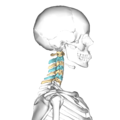
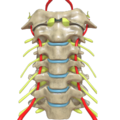
Position of human cervical vertebrae (shown in red). It consists of 7 bones, from top to bottom, C1, C2, C3, C4, C5, C6, and C7.
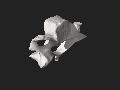
A human cervical vertebra
Details
Identifiers
Latinvertebrae cervicales
MeSHD002574
TA98A02.2.02.001
TA21032
FMA9915
Anatomical terms of bone

In tetrapods, cervical vertebrae (sg.: vertebra) are the vertebrae of the neck, immediately below the skull. Truncal vertebrae (divided into thoracic and lumbar vertebrae in mammals) lie caudal (toward the tail) of cervical vertebrae.[1] In sauropsid species, the cervical vertebrae bear cervical ribs. In lizards and saurischian dinosaurs, the cervical ribs are large; in birds, they are small and completely fused to the vertebrae. The vertebral transverse processes of mammals are homologous to the cervical ribs of other amniotes.[citation needed] Most mammals have seven cervical vertebrae, with the only three known exceptions being the manatee with six, the two-toed sloth with five or six, and the three-toed sloth with nine.[2][3]

In humans, cervical vertebrae are the smallest of the true vertebrae and can be readily distinguished from those of the thoracic or lumbar regions by the presence of a transverse foramen, an opening in each transverse process, through which the vertebral artery, vertebral veins, and inferior cervical ganglion pass. The remainder of this article focuses on human anatomy.

Structure

[edit]
Side view of a typical cervical vertebra
Despite greatly differing neck lengths, okapi (left) and giraffe (right) both have seven cervical vertebrae. The giraffe's neck is elongated by heterochrony, extension of the time for the embryonic development of these bones.[4]

By convention, the cervical vertebrae are numbered, with the first one (C1) closest to the skull and higher numbered vertebrae (C2–C7) proceeding away from the skull and down the spine. The general characteristics of the third through sixth cervical vertebrae are described here. The first, second, and seventh vertebrae are extraordinary, and are detailed later.

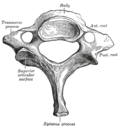
  • The bodies of these four vertebrae are small, and broader from side to side than from front to back.
    • The anterior and posterior surfaces are flattened and of equal depth; the former is placed on a lower level than the latter, and its inferior border is prolonged downward, so as to overlap the upper and forepart of the vertebra below.
    • The upper surface is concave transversely, and presents a projecting lip on either side.
    • The lower surface is concave from front to back, convex from side to side, and presents laterally shallow concavities that receive the corresponding projecting lips of the underlying vertebra.
  • The pedicles are directed laterally and backward, and attach to the body midway between its upper and lower borders, so that the superior vertebral notch is as deep as the inferior, but it is, at the same time, narrower.
  • The laminae are narrow and thinner above than below; the vertebral foramen is large and of a triangular form.
  • The spinous process is short and bifid, the two divisions being often of unequal size. Because the spinous processes are so short, certain superficial muscles (the trapezius and splenius capitis) attach to the nuchal ligament rather than directly to the vertebrae; the nuchal ligament itself attaching to the spinous processes of C2–C7 and to the posterior tubercle of the atlas.
  • The superior and inferior articular processes of cervical vertebrae have fused on either or both sides to form articular pillars, columns of bone that project laterally from the junction of the pedicle and lamina.
  • The articular facets are flat and of an oval form:
    • the superior face backward, upward, and slightly medially.
    • the inferior face forward, downward, and slightly laterally.
  • The transverse processes are each pierced by the transverse foramen also known as the foramen transversarium, which, in the upper six vertebrae, gives passage to the vertebral artery and vein, as well as a plexus of sympathetic nerves. Each process consists of an anterior and a posterior part. These two parts are joined, outside the foramen, by a bar of bone that exhibits a deep sulcus on its upper surface for the passage of the corresponding spinal nerve.
    • The anterior portion is the homologue of the rib in the thoracic region, and is therefore named the costal process or costal element. It arises from the side of the body, is directed laterally in front of the foramen, and ends in a tubercle, the anterior tubercle.
    • The posterior part, the true transverse process, springs from the vertebral arch behind the foramen and is directed forward and laterally; it ends in a flattened vertical tubercle, the posterior tubercle.

The anterior tubercle of the sixth cervical vertebra is known as the carotid tubercle or Chassaignac tubercle (for Édouard Chassaignac). This separates the carotid artery from the vertebral artery and the carotid artery can be massaged against this tubercle to relieve the symptoms of supraventricular tachycardia. The carotid tubercle is also used as a landmark for anaesthesia of the brachial plexus and cervical plexus.

The cervical spinal nerves emerge from above the cervical vertebrae. For example, the cervical spinal nerve 3 (C3) passes above C3.

Atlas and axis

[edit]

The atlas (C1) and axis (C2) are the two topmost vertebrae.

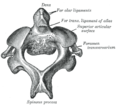
The atlas (C1) is the topmost vertebra and along with the axis forms the joint connecting the skull and spine. It lacks a vertebral body, spinous process, and discs either superior or inferior to it. It is ring-like and consists of an anterior arch, posterior arch, and two lateral masses.

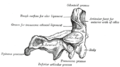
The axis (C2) forms the pivot on which the atlas rotates. The most distinctive characteristic of this bone is the strong odontoid process (dens) that rises perpendicularly from the upper surface of the body and articulates with C1. The body is deeper in front than behind, and prolonged downward anteriorly so as to overlap the upper and front part of the third vertebra.

Vertebra prominens

[edit]
Position of C7 shown in red.

The vertebra prominens, or C7, has a distinctive long and prominent spinous process, which is palpable from the skin surface. Sometimes, the seventh cervical vertebra is associated with an abnormal extra rib, known as a cervical rib, which develops from the anterior root of the transverse process. These ribs are usually small, but may occasionally compress blood vessels (such as the subclavian artery or subclavian vein) or nerves in the brachial plexus, causing pain, numbness, tingling, and weakness in the upper limb, a condition known as thoracic outlet syndrome. Very rarely, this rib occurs in a pair.

The long spinous process of C7 is thick and nearly horizontal in direction. It is not bifurcated, and ends in a tubercle that the ligamentum nuchae attaches to. This process is not always the most prominent of the spinous processes, being found only about 70% of the time, C6 or T1 can sometimes be the most prominent.

The transverse processes are of considerable size; their posterior roots are large and prominent, while the anterior are small and faintly marked. The upper surface of each usually has a shallow sulcus for the eighth spinal nerve, and its extremity seldom presents more than a trace of bifurcation.

The transverse foramen may be as large as that in the other cervical vertebrae, but it is generally smaller on one or both sides; occasionally, it is double, and sometimes it is absent.

On the left side, it occasionally gives passage to the vertebral artery; more frequently, the vertebral vein traverses it on both sides, but the usual arrangement is for both artery and vein to pass in front of the transverse process, not through the foramen.

Function

[edit]

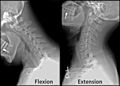
The movement of nodding the head takes place predominantly through flexion and extension at the atlanto-occipital joint between the atlas and the occipital bone. However, the cervical spine is comparatively mobile, and some component of this movement is due to flexion and extension of the vertebral column itself. This movement between the atlas and occipital bone is often referred to as the "yes joint", owing to its nature of being able to move the head in an up-and-down fashion.

The movement of shaking or rotating the head left and right happens almost entirely at the joint between the atlas and the axis, the atlanto-axial joint. A small amount of rotation of the vertebral column itself contributes to the movement. This movement between the atlas and axis is often referred to as the "no joint", owing to its nature of being able to rotate the head in a side-to-side fashion.

Clinical significance

[edit]

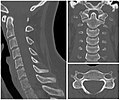
Cervical lines are annotations used in medical imaging of the cervical vertebrae, here seen on X-ray and CT, respectively. Incongruencies indicate cervical fracture, spondylolisthesis and/or ligament injury.

Cervical degenerative changes arise from conditions such as spondylosis, stenosis of intervertebral discs, and the formation of osteophytes. The changes are seen on radiographs, which are used in a grading system from 0–4 ranging from no changes (0) to early with minimal development of osteophytes (1) to mild with definite osteophytes (2) to moderate with additional disc space stenosis or narrowing (3) to the stage of many large osteophytes, severe narrowing of the disc space, and more severe vertebral end plate sclerosis (4).[5][6][7]

Injuries to the cervical spine are common at the level of the second cervical vertebrae, but neurological injury is uncommon. C4 and C5 are the areas that see the highest amount of cervical spine trauma.[8]

If it does occur, however, it may cause death or profound disability, including paralysis of the arms, legs, and diaphragm, which leads to respiratory failure.

Common patterns of injury include the odontoid fracture and the hangman's fracture, both of which are often treated with immobilization in a cervical collar or halo brace.

A common practice is to immobilize a patient's cervical spine to prevent further damage during transport to hospital. This practice has come under review recently as incidence rates of unstable spinal trauma can be as low as 2% in immobilized patients. In clearing the cervical spine, Canadian studies have developed the Canadian C-Spine Rule (CCR) for physicians to decide who should receive radiological imaging.[9]

Landmarks

[edit]

The vertebral column is often used as a marker of human anatomy. This includes:

Additional images

[edit]

See also

[edit]

References

[edit]
[edit]
Revisions and contributorsEdit on WikipediaRead on Wikipedia
from Grokipedia
The cervical vertebrae consist of the seven uppermost bones (C1 through C7) in the vertebral column, forming the foundational structure of the region between the and the thoracic spine. They support the weight of the head, encase and protect the upper portion of the , and enable extensive mobility including flexion, extension, lateral bending, and . The cervical spine is anatomically divided into two segments: the superior craniovertebral junction formed by C1 (the atlas) and C2 (the axis), and the more typical subaxial region of C3 through C7. The atlas lacks a vertebral body and instead features a ring-like structure with anterior and posterior arches that articulate directly with the of the , allowing for nodding motions. The axis is distinguished by its odontoid process (dens), a superior projection from the vertebral body that pivots within the atlas to facilitate head rotation. Vertebrae C3 through C6 share a general structure with a vertebral body, pedicles, laminae, spinous processes, and transverse processes that include foramina for the passage of vertebral arteries; C7, termed the vertebra prominens, has an elongated spinous process palpable at the base of the neck. Functionally, the cervical vertebrae work in concert with intervertebral discs, zygapophyseal (facet) joints, and ligaments such as the anterior and posterior longitudinal ligaments to balance stability and flexibility, accommodating the head's 10-12 pounds (4.5-5.4 kg) of weight while permitting the majority of the spine's total rotation, with the accounting for approximately 50% of cervical rotation. This region houses the cervical spinal nerves (C1-C8) that emerge through intervertebral foramina to innervate the , shoulders, arms, and diaphragm, underscoring its critical role in sensory and motor functions. Despite its adaptability, the cervical spine's mobility makes it vulnerable to trauma, degeneration, and conditions like whiplash or herniated discs.

Anatomy

General features

The cervical vertebrae consist of seven bones (C1–C7) that form the superior portion of the vertebral column, extending from the to the first thoracic vertebra (T1) and providing structural support for the . These vertebrae are notably smaller in size compared to those in the thoracic and regions, reflecting their role in a highly mobile segment of the spine with less weight-bearing demand. A defining characteristic is the presence of transverse foramina within the transverse processes of each (except in variations), which accommodate the vertebral arteries, vertebral veins, and sympathetic nerve fibers en route to the and head. The vertebral body of cervical vertebrae is small, rectangular in superior view, and typically broader transversely than in height, with endplates that are concave superiorly and convex inferiorly to facilitate articulation. The vertebral arch, formed by paired pedicles and laminae, encloses the for the ; the pedicles are short and directed posteriorly, while the laminae are thin and overlap those of the below. Spinous processes are short and bifid (forked) in most cervical vertebrae, providing attachment sites for muscles and ligaments, though this bifidity is absent in C7. Articular processes are oriented at approximately 45 degrees to the , with superior facets that are kidney-shaped, concave, and directed superomedially to permit flexion, extension, and lateral bending. Intervertebral discs between adjacent cervical vertebrae are relatively thin compared to those in other spinal regions, consisting of a central nucleus pulposus surrounded by the fibrous annulus fibrosus, which together allow for flexibility and absorb compressive forces. Key ligaments stabilizing the cervical vertebrae include the anterior and posterior longitudinal ligaments running along the anterior and posterior aspects of the vertebral bodies, the ligamentum flavum connecting adjacent laminae, and interspinous ligaments bridging the spinous processes. Blood supply to the cervical vertebrae is primarily provided by branches of the vertebral arteries and ascending cervical arteries, which form periosteal and nutrient networks around the bone. Innervation arises from the cervical spinal nerves (C1–C8), with dorsal rami supplying the posterior elements and ventral rami contributing to anterior structures via sinuvertebral nerves. While C1, C2, and C7 exhibit specialized modifications for enhanced mobility and prominence, these general features underpin the uniformity across the cervical series.

Atlas (C1)

The atlas, or first cervical vertebra (C1), is uniquely adapted as a ring-like structure that lacks a vertebral body and spinous process, instead comprising an anterior arch, a posterior arch, and two lateral masses that connect them to form a complete bony ring. This configuration allows it to articulate directly with the and the axis (C2) below, providing foundational support for head movement. The superior articular facets of the atlas are kidney-shaped and concave, facing upward and medially to articulate with the of the , forming the that facilitates nodding motions. In contrast, the inferior articular facets are flat and face downward, articulating with the superior facets of the axis to contribute to the . The transverse processes of the atlas are notably large and bifid, extending laterally and posteriorly; each contains a through which the and its accompanying vein pass en route to the . The anterior tubercle on the anterior arch serves as an attachment site for the superior oblique fibers of the . Blood supply to the atlas derives primarily from branches of the , including cervical radicular arteries that enter via the transverse foramina and supply the surrounding bone and soft tissues. Innervation includes sensory input from the C1 , particularly its posterior primary ramus (suboccipital nerve), which provides proprioceptive and pain sensation to the posterior aspects, while sympathetic fibers travel along the vertebral nerves accompanying the .

Axis (C2)

The axis, or second cervical vertebra (C2), is distinguished by its robust structure adapted for pivotal rotation at the atlanto-axial joint. Unlike the atlas (C1), which forms a ring-like superior support for the skull, the axis features a prominent vertebral body that is significantly larger and fused with a unique peg-like projection known as the dens or odontoid process. This dens extends superiorly from the anterior aspect of the body and serves as the primary pivot point around which the atlas rotates, enabling up to 50% of the head's rotational movement in the transverse plane. The fusion of the dens with the body typically occurs during early development, creating a strong base that withstands torsional forces during head turning. The dens is meticulously stabilized by a complex of ligaments to prevent excessive motion and maintain alignment. The transverse ligament of the atlas, a thick band spanning the posterior aspect of the dens, holds it firmly against the anterior arch of C1, acting as the primary restraint against anterior . Complementing this are the paired alar ligaments, which extend from the lateral aspects of the dens to the medial surfaces of the , limiting excessive rotation and lateral bending at the craniovertebral junction. The apical ligament, a midline structure connecting the apex of the dens to the anterior margin of the , provides additional vertical stability, though it is relatively weaker than the others. These ligaments collectively ensure the dens functions as a secure axis without compromising the patency of the . The vertebral body of C2 is broader and more robust than that of C1, reflecting its role in load-bearing and articulation. Its superior articular facets, oriented posterolaterally, directly articulate with the inferior facets of the atlas's lateral masses, forming the atlanto-axial synovial joints that permit smooth gliding and . The spinous process of C2 is notably short and bifid, providing a limited posterior projection compared to lower cervical vertebrae, while the transverse processes are sturdy with foramina that transmit the and veins, similar to other cervical levels. Muscle attachments on C2 are particularly strong to support its dynamic role; the obliquus capitis inferior originates from the spinous process of the axis and inserts on the transverse process of the atlas, aiding in head extension and , while the rotatores muscles attach to the transverse processes and laminae, contributing to fine segmental control of vertebral motion. Anatomical variations in C2 are uncommon but significant, with os odontoideum representing a key anomaly where the dens fails to fuse properly with the vertebral body, resulting in a separate ossicle. This condition, often congenital in origin, can lead to at the atlanto-axial junction due to impaired ligamentous support, though it may remain asymptomatic unless exacerbated by trauma.

Typical vertebrae (C3–C6)

The typical cervical vertebrae, designated C3 through C6, share a standardized morphology that supports both mobility and load-bearing in the subaxial cervical spine. These vertebrae feature small, rectangular vertebral bodies that increase progressively in height and width from C3 to C6, reflecting the caudal escalation in mechanical demands as the spine transitions toward thoracic levels. Prominent on the superolateral margins of each vertebral body are the uncinate processes, bilateral hook-shaped bony projections unique to the lower cervical vertebrae. These structures articulate with the inferior lateral aspects of the adjacent superior vertebral body, forming the uncovertebral joints (also termed Luschka joints), which provide lateral stability, limit excessive lateral flexion, and contribute to the overall constraint of intervertebral motion. The zygapophyseal (facet) joints, formed by the articular processes, are oriented to permit flexion and extension while restricting rotation. The superior articular processes face superoposteriorly at an angle of approximately 45 degrees to the , and the inferior articular processes face inferoanteriorly, creating an orientation that aligns with the movements essential for neck motion. Spinous processes in C3–C6 are characteristically short, bifid (forked at the tip), and directed obliquely downward and posteriorly, serving as attachment sites for interspinous ligaments, , and posterior neck muscles such as the splenius cervicis. Transverse processes are short and bifid, featuring an anterior (carotid tubercle on C6, but generally for scalene muscle origins) and a posterior for attachments like the levator scapulae and splenius cervicis; each transverse process encloses a that transmits the , vertebral vein, and . The intervertebral foramina, bordered by the pedicles, vertebral body, and articular processes of adjacent vertebrae, accommodate the passage of cervical spinal nerves and their accompanying blood vessels, ensuring neural continuity from the . This progressive caudal enlargement in body size, combined with the specialized processes and foramina, optimizes the balance between the cervical column's flexibility for head and neck movements and its capacity to transmit compressive forces from the .

Vertebra prominens (C7)

The seventh cervical , known as the vertebra prominens, serves as a transitional element between the cervical and regions of the spine, characterized by a larger vertebral body compared to the more superior cervical . This body lacks the costal demifacets typical of , distinguishing it from the adjacent T1 while maintaining the overall oval shape and height consistent with cervical morphology. The spinous process of C7 is notably longer and non-bifid—unlike the bifid processes of C3 through C6—projecting prominently and serving as a reliable clinical palpable at the base of the for identifying the cervicothoracic junction. The transverse processes of C7 are shorter and more robust than those of the upper cervical vertebrae, reflecting the transitional nature of the bone, and they typically feature small transverse that do not transmit the , which usually completes its passage through the transverse foramina after passing through the C6 . In some individuals, these foramina may be absent or particularly diminutive, instead accommodating accessory structures such as vertebral veins or nerves. The articular processes maintain a cervical orientation to support mobility, with superior facets facing posterolaterally and inferior facets anteromedially at the C7 level—approaching the more of thoracic facets—thereby facilitating flexion, extension, and rotation while bridging regional differences in spinal . Muscle attachments at C7 include the origins of the rhomboid minor from its spinous process and the ligamentum nuchae, as well as contributions to the muscle's origin along the spinous processes starting from C7 through the upper thoracic levels. A common involves the development of a rudimentary , arising from the transverse process of C7 in approximately 0.5% of the population, which may be unilateral or bilateral and can occasionally lead to neurovascular compression syndromes.

Function

Support and stability

The cervical vertebrae serve as the primary load-bearing structures supporting the weight of the , which averages 4.5–5 kg in adults, with the majority of this load transmitted through the atlanto-occipital and atlanto-axial joints at C1 and C2. As the vertebrae descend caudally from C1 to C7, the size of the vertebral bodies progressively increases to accommodate escalating compressive forces from the weight of the head and upper , enhancing overall structural integrity. Stability of the cervical spine is achieved through its characteristic lordotic curvature, or cervical lordosis, which optimizes the distribution of axial forces across the vertebral column and minimizes stress concentrations on individual segments. Key ligaments reinforce this stability; for instance, the , spanning from the to the spinous process of C7, limits excessive hyperextension by restraining posterior displacement and preventing invagination of soft tissues into the during extension. The vertebral canal within the cervical vertebrae forms a relatively spacious segment of the , offering substantial protection to the and against compressive insults, with midsagittal diameters measuring 10.7–19.7 mm at C1 and gradually narrowing to 9.2–16.8 mm at C6. This spacious configuration accommodates the relatively larger cervical while allowing for minor caudal tapering that aligns with decreasing cord diameter inferiorly. Deep cervical muscles contribute to static support by counteracting gravitational loads and maintaining postural alignment; the longus capitis, for example, acts as a key flexor originating from the anterior tubercles of the transverse processes of C3–C6 and inserting on the basilar part of the , providing segmental stability to the upper cervical vertebrae. Biomechanically, these elements balance compressive forces via tensile resistance in ligaments and muscular tension, enabling the cervical spine to tolerate axial loads of 300–500 N under controlled static conditions before reaching deformation thresholds.

Mobility and range of motion

The cervical spine provides extensive mobility to facilitate head orientation, with primary motions encompassing flexion of approximately 50°, extension of 60°, lateral of 45° to each side, and axial of 80° total. These ranges enable essential functions such as gazing upward or turning the head to scan surroundings. The overall motion is distributed across the upper and lower cervical segments, with the upper joints emphasizing pure directional movements and the lower ones supporting more coupled, multiplanar actions. Joint contributions to these motions are specialized by region. The (C0-C1) accounts for much of the flexion and extension, contributing approximately 15°–20° of total flexion and extension through its convex-concave articulation. The (C1-C2), as referenced in its anatomical structure, provides roughly 50% of total rotation—approximately 40°—via pivoting around the dens. In contrast, the subaxial segments (C3–C7) enable combined motions, with orientations allowing up to 10–15° of flexion-extension per level and significant lateral bending contributions, particularly at C4–C5 and C5–C6. Kinematic coupling enhances the efficiency and stability of these movements. For instance, lateral bending in the subaxial cervical spine is typically coupled with ipsilateral , a pattern driven by the wedge-shaped uncovertebral joints and the 45° orientation of the facet joints, which guide the vertebrae to rotate in the direction of the bend. This coupling ensures coordinated motion but can limit pure isolated movements. Several structures limit the to prevent excessive strain. Ligaments, such as the alar ligaments at the , cap rotation at about 45° per side by resisting further axial twist, while the transverse ligament primarily constrains anterior translation during rotation. elasticity further modulates motion by absorbing compressive forces and allowing controlled deformation during flexion and extension. With aging, range of motion declines by 20–30% after age 60, attributed to degeneration that stiffens the articulations and reduces segmental flexibility.

Development

Embryological origins

The cervical vertebrae originate from the paraxial mesoderm, which segments into during the fourth week of human gestation. These form in a craniocaudal sequence, with the cervical region derived primarily from somites 5 through 12, corresponding to the future C1 through C7 vertebrae. Each somite differentiates into distinct components, including the sclerotome, which is the mesenchymal tissue that migrates around the and to form the precursors of the vertebral bodies and arches. The sclerotome arises from the ventral medial portion of the under inductive signals from the and . The secretes sonic hedgehog (Shh), promoting sclerotome differentiation and ventral identity, while the contributes additional signals to pattern the dorsal components, such as the neural arches. This interaction results in the sclerotome dividing into loosely packed rostral and densely packed caudal halves, with the ventral region forming the vertebral body and the dorsal region contributing to the pedicles, laminae, and arches. Regional identity along the cervical spine is specified by from the HoxA, HoxB, HoxC, and HoxD clusters, which act as transcription factors to regulate segmental patterning. Hox paralog groups 4 and 5 primarily mediate the specification of cervical vertebral identity and morphology, with genes such as Hoxa4 (starting at C3) and Hoxc4 influencing upper cervical levels. These genes establish boundaries that align with morphological transitions, ensuring the unique features of cervical vertebrae, such as the absence of in the upper segments. Vertebral segmentation occurs through a process of resegmentation, where the caudal half of one sclerotome combines with the rostral half of the adjacent sclerotome to form each , while the intervening loose contributes to the . This mechanism ensures precise alignment between vertebrae and discs, with the persisting within the disc to form the nucleus pulposus. The timeline of cervical vertebral development begins with somitogenesis in week 4, followed by sclerotome migration and initial mesenchymal condensation by week 5. Chondrification centers appear in the vertebral anlagen around week 6, marking the transition to models. By week 8, the basic segmentation and emerging cervical curvature are established, reflecting the initial flexion of the embryonic spine.

Ossification process

The ossification of the cervical vertebrae occurs through , beginning with primary centers that form in utero and continue postnatally. For typical cervical vertebrae (C3–C7), three primary centers develop: one in the vertebral body (centrum) and two in the neural arches, appearing around 9 weeks of and completing initial ossification by the first year of life. The neurocentral synchondroses, which connect the neural arches to the vertebral body, fuse between ages 3 and 7 years, with cervical fusions typically completing around age 5–6 years. Secondary centers emerge during , including those at the tips of the spinous and transverse processes, as well as annular epiphyses on the superior and inferior surfaces of the vertebral body; these fuse by ages 20–25 years for the epiphyses and up to 25–30 years overall. The atlas (C1) develops from three primary centers: one for the anterior and two for the lateral masses, which form the posterior arches, with initial evident perinatally. The posterior arches fuse midline by ages 3–5 years, while the neurocentral synchondroses, linking the lateral masses to any rudimentary anterior elements, close between ages 5 and 8 years. In contrast, the axis (C2) arises from five primary centers: one each for the vertebral body, the two neural arches, the dens (odontoid process), and a separate center for the dens apex from the apical segment of the chondral precursor. The dens fuses to the vertebral body via the subdental by ages 3–6 years, though the fusion line may remain visible until age 11; the apical (os terminale) appears between ages 3 and 6 years and fuses by age 12. The neural arches fuse to the body by ages 6–7 years, similar to lower cervical levels. These processes derive from sclerotome-derived chondral precursors established embryonically. Mineralization requires adequate and calcium intake to support activity and deposition; deficiencies, as seen in prematurity or , can delay and lead to in preterm infants.

Clinical significance

Trauma and injuries

Trauma to the cervical vertebrae often results from high-energy mechanisms such as accidents, falls, or , leading to fractures, dislocations, or ligamentous disruptions that can compromise spinal stability and cause neurological deficits. These injuries are particularly critical due to the cervical spine's proximity to the and , where even minor displacements can result in severe outcomes like quadriplegia or . Common fractures include the , a burst injury of the C1 atlas ring typically caused by axial loading, such as in diving accidents or falls onto the head, which spreads the lateral masses and may disrupt the . The involves bilateral pedicle fractures of the C2 axis, resulting from hyperextension and distraction forces, as seen in judicial hangings or whiplash trauma, often with minimal initial displacement but potential for instability. Another frequent injury is the flexion teardrop fracture, occurring in the lower cervical vertebrae (C3-C7) due to hyperflexion combined with axial compression, where a small anterior inferior body fragment shears off, frequently associated with posterior disruption and . Hyperflexion predominates in anterior wedge fractures, while hyperextension contributes to posterior element injuries like spinous process fractures. Dislocations in the cervical spine commonly involve the , where rupture of the transverse ligament allows anterior of C1 on C2, often from flexion- forces or rheumatoid instability, leading to potential impingement. In the subaxial region (C3-C7), facet dislocations can be unilateral or bilateral, arising from hyperflexion with ; unilateral cases cause pain and , while bilateral dislocations pose a high risk of cord transection due to significant anterolisthesis. A key associated risk is spinal cord injury, particularly central cord syndrome, which arises from hyperextension trauma in older adults with preexisting cervical stenosis, pinching the central cord against osteophytes and causing greater upper extremity weakness than lower, with preserved sensation in many cases. This incomplete injury pattern accounts for about 15-25% of traumatic spinal cord injuries and highlights the vulnerability of the cervical region's central gray matter. The AO Spine classification system standardizes cervical fracture assessment, particularly for subaxial injuries (C3-C7), categorizing them into Type A (compression injuries, such as wedge or burst fractures without ligamentous damage), Type B (tension band injuries involving posterior or anterior distraction, like facet fractures with ), and Type C (translation or rotation injuries indicating gross instability, such as displaced facet dislocations). For upper cervical injuries (C1-C2), a separate AO system delineates bony (Type A), tension band (Type B), and translational (Type C) patterns, aiding in prognostic and treatment decisions. Initial management involves assessing the need for spinal immobilization based on clinical clearance criteria (e.g., or Canadian C-Spine Rule); if indicated, use a rigid and backboard to prevent secondary injury, though routine use is not recommended due to associated risks such as pain, pressure ulcers, and increased , followed by advanced imaging: computed tomography (CT) for bony detail and to evaluate soft tissues, ligaments, and cord involvement. As of 2025, emerging evidence further questions the routine use of cervical collars. Prognosis varies by injury severity; complete injuries carry poor recovery rates (less than 20% ambulatory independence), whereas incomplete injuries, like , often yield favorable outcomes with 50-75% of patients regaining walking ability and significant motor function within one year. Surgical stabilization is indicated for unstable patterns (e.g., AO Type B/C), improving neurological recovery rates compared to nonoperative approaches in select cases; innovations like AI-guided 3D-printed implants are advancing these procedures.

Degenerative conditions

Degenerative conditions of the cervical vertebrae arise from age-related wear on the intervertebral discs, facet joints, and supporting ligaments, leading to biomechanical instability and potential neural compression. These changes, often insidious and multifactorial, contrast with acute injuries by progressing gradually over years, primarily affecting individuals over 50 years of age. Cervical spondylosis represents the hallmark degenerative process, involving and height loss of intervertebral discs that shift axial loads to the vertebral endplates and joints, prompting reactive formation along the vertebral bodies and facet joints. These bony outgrowths, along with ligamentous hypertrophy, narrow the intervertebral foramina, resulting in foraminal that may impinge on exiting nerve roots. The condition affects more than 85% of people over 60 years old, though many remain . Cervical disc herniation frequently complicates , with the nucleus pulposus protruding posteriorly or laterally through a weakened annulus fibrosus, most commonly at the C5–C6 or C6–C7 levels due to their high mobility. Such herniations compress cervical nerve roots, producing with dermatomal pain and weakness, or encroach on the to cause , characterized by signs. Facet entails progressive erosion and subchondral sclerosis in the zygapophyseal joints, often exacerbated by repetitive extension and , leading to localized pain and restricted neck extension. Degeneration involving the uncovertebral joints can contribute to lateral bending restriction by altering the joint's role in guiding segmental motion. Patients typically present with axial that may radiate as radicular arm pain following a dermatomal , alongside potential instability from myelopathic involvement of descending tracts. relies on plain X-rays to detect loss of cervical and osteophytes, supplemented by MRI to quantify disc height reduction and identify neural compression. Management prioritizes conservative approaches, including nonsteroidal anti-inflammatory drugs for pain relief and to enhance stability and range of motion, which suffice for most cases. In with neurological progression, surgical decompression via addresses ventral pathology by removing offending disc material or osteophytes and stabilizing the segment; as of 2025, motion-preserving options like cervical disc arthroplasty are increasingly utilized.

Congenital and acquired variations

Congenital variations in the cervical vertebrae arise from disruptions in embryonic segmentation and development, leading to structural anomalies that can affect spinal stability and mobility. Klippel-Feil syndrome represents a classic example, characterized by the congenital fusion of two or more cervical vertebrae, most commonly involving C2 and C3, resulting in a short , limited , and a low posterior hairline. Another significant anomaly is the assimilation of the atlas (C1) to the occiput, a craniovertebral junction malformation involving partial or complete osseous fusion between these structures, which may predispose individuals to instability at the . Cervical , supernumerary bony extensions arising from the transverse processes of C7, occur in approximately 0.5–1% of the population and are often bilateral, though they may remain asymptomatic unless they compress nearby neurovascular structures. These congenital anomalies carry risks of neural compression and vascular compromise, potentially leading to neurological deficits or ischemic events. For instance, are associated with , where compression of the or subclavian vessels can cause pain, , and weakness in the upper extremities. Similarly, rotational movements in the setting of atlanto-occipital assimilation or other upper cervical anomalies may provoke bow hunter's syndrome, a rare vertebrobasilar insufficiency triggered by vertebral artery occlusion during head rotation, manifesting as , syncope, or transient ischemic attacks. Diagnosis of these variations typically begins with plain radiographs, which can reveal vertebral fusions or ectopic bony elements, though advanced imaging such as CT or MRI is often required for confirmation and assessment of associated instability. Management generally involves conservative monitoring for asymptomatic cases, with surgical fusion considered for symptomatic instability or progressive neurological compromise. Acquired non-degenerative variations in the cervical vertebrae often stem from inflammatory or traumatic processes that alter bony architecture without age-related wear. Os odontoideum, for example, presents as a separate ossicle representing the odontoid process (dens) detached from the C2 body, potentially resulting from non-union following trauma or rather than purely congenital failure. In , chronic leads to erosive changes at the articulation, including formation and odontoid erosions, which can destabilize the and risk . These acquired changes share similar diagnostic approaches, relying on plain films to identify erosions or ossicle displacement, supplemented by dynamic imaging to evaluate instability during motion. Treatment focuses on addressing the underlying condition—such as disease-modifying antirheumatic drugs for —alongside surgical stabilization via fusion for cases with significant atlantoaxial instability or neurological symptoms.

References

Add your contribution
Related Hubs
User Avatar
No comments yet.