Hubbry Logo
Common carotid arteryCommon carotid arteryMain
Open search
Common carotid artery
Community hub
Common carotid artery
logo
8 pages, 0 posts
0 subscribers
Be the first to start a discussion here.
Common carotid artery
from Wikipedia
Common carotid artery
The common carotid artery arises directly from the aorta on the left and as a branch of the brachiocephalic trunk on the right.
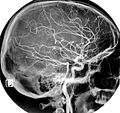
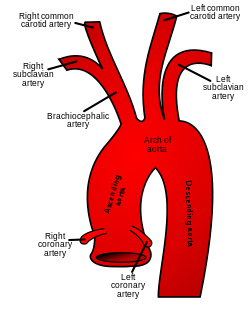
The common carotid artery and its main branches
Details
PrecursorAortic arch 3
SourceAortic arch, brachiocephalic artery
BranchesInternal carotid artery, external carotid artery
VeinInternal jugular vein
SuppliesHead and neck
Identifiers
Latinarteria carotis communis
MeSHD017536
TA98A12.2.04.006
TA24366
FMA3939
Anatomical terminology

In anatomy, the left and right common carotid arteries (carotids) (English: /kəˈrɒtɪd/[1][2]) are arteries that supply the head and neck with oxygenated blood; they divide in the neck to form the external and internal carotid arteries.[3][4]

Structure

[edit]

The common carotid arteries are present on the left and right sides of the body. These arteries originate from different arteries but follow symmetrical courses. The right common carotid originates in the neck from the brachiocephalic trunk; the left from the aortic arch in the thorax. These split into the external and internal carotid arteries at the upper border of the thyroid cartilage, at around the level of the fourth cervical vertebra.

The left common carotid artery can be thought of as having two parts: a thoracic (chest) part and a cervical (neck) part.[5] The right common carotid originates in or close to the neck and contains only a small thoracic portion. There are studies in the bioengineering literature that have looked into characterizing the geometric structure of the common carotid artery from both qualitative and mathematical (quantitative) standpoints.[4]

The average diameters of the common carotids in adult males and females are 6.5 mm and 6.1 mm respectively.[6]

In the chest

[edit]

Only the left common carotid artery has a substantial presence in the thorax. It originates directly from the aortic arch, and travels upward through the superior mediastinum to the level of the left sternoclavicular joint.[citation needed]

During the thoracic part of its course, the left common carotid artery is related to the following structures: In front, it is separated from the manubrium of the sternum by the sternohyoid and sternothyroid muscles, the anterior portions of the left pleura and lung, the left brachiocephalic vein, and the remains of the thymus; behind, it lies on the trachea, esophagus, left recurrent laryngeal nerve, and thoracic duct.

To its right side, below is the brachiocephalic trunk, and above, the trachea, the inferior thyroid veins, and the remains of the thymus; to its left side are the left vagus and phrenic nerves, left pleura, and lung. The left subclavian artery is posterior and slightly lateral to it.

In the neck

[edit]
Arteries of the neck. The right common carotid artery – labeled Common caroti in the figure – divides into the right internal carotid artery and external carotid artery.

The cervical portions of the common carotids resemble each other so closely that one description will apply to both.[citation needed]

Each vessel passes obliquely upward, from behind the sternoclavicular joint to the level of the upper border of the thyroid cartilage, where it divides.

At the lower neck, the two common carotid arteries are separated from each other by a very narrow interval which contains the trachea; but at the upper part, the thyroid gland, the larynx and pharynx separate the two arteries.

The common carotid artery is contained in a sheath known as the carotid sheath, which is derived from the deep cervical fascia and encloses also the internal jugular vein and vagus nerve, the vein lying lateral to the artery, and the nerve between the artery and vein, on a plane posterior to both. On opening the sheath, each of these three structures is seen to have a separate fibrous cover.

At approximately the level of the fourth cervical vertebra, the common carotid artery splits ("bifurcates" in literature) into an internal carotid artery (ICA) and an external carotid artery (ECA). While both branches travel upward, the internal carotid takes a deeper (more internal) path, eventually travelling up into the skull to supply the brain. The external carotid artery travels more closely to the surface, and sends off numerous branches that supply the neck and face.

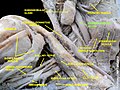
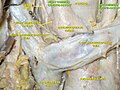
Superficial dissection of the right side of the neck, showing the carotid and subclavian arteries

At the lower part of the neck, the common carotid artery is very deeply seated, being covered by the integument, superficial fascia, the platysma muscle, deep cervical fascia, the sternocleidomastoid muscle, the sternohyoid, sternothyroid, and the omohyoid; in the upper part of its course it is more superficial, being covered merely by the integument, the superficial fascia, the platysma, deep cervical fascia, and medial margin of the sternocleidomastoid.

When the sternocleidomastoid muscle is drawn backward, the artery is seen to be contained in a triangular space known as the carotid triangle. This space is bounded behind by the sternocleidomastoid, above by the stylohyoid and the posterior belly of the digastric muscle, and below by the superior belly of the omohyoid.

This part of the artery is crossed obliquely, from its medial to its lateral side, by the sternocleidomastoid branch of the superior thyroid artery; it is also crossed by the superior and middle thyroid veins (which end in the internal jugular vein); descending in front of its sheath is the descending branch of the hypoglossal nerve, this filament being joined by one or two branches from the cervical nerves, which cross the vessel obliquely.

Sometimes the descending branch of the hypoglossal nerve is contained within the sheath.

The superior thyroid vein crosses the artery near its termination, and the middle thyroid vein a little below the level of the cricoid cartilage; the anterior jugular vein crosses the artery just above the clavicle, but is separated from it by the sternohyoid and sternothyroid.

Behind, the artery is separated from the transverse processes of the cervical vertebrae by the longus colli and longus capitis muscles, the sympathetic trunk being interposed between it and the muscles. The inferior thyroid artery crosses behind the lower part of the vessel.

Medially, it is in relation with the esophagus, trachea, and thyroid gland (which overlaps it), the inferior thyroid artery and recurrent laryngeal nerve being interposed; higher up, with the larynx and pharynx. Lateral to the artery, inside the carotid sheath with the common carotid, are the internal jugular vein and vagus nerve.

At the lower part of the neck, on the right side of the body, the right recurrent laryngeal nerve crosses obliquely behind the artery; the right internal jugular vein diverges from the artery. On the left side, however, the left internal jugular vein approaches and often overlaps the lower part of the artery.

Behind the angle of bifurcation of the common carotid artery is a reddish-brown oval body known as the carotid body. It is similar in structure to the coccygeal body which is situated on the median sacral artery.

The relations of the cervical region of the common carotid artery may be discussed in two points:

  • Internal relations of organs present inside the carotid sheath
  • two external relations of carotid sheath

Collateral circulation

[edit]

The chief communications outside the skull take place between the superior and inferior thyroid arteries, and the deep cervical artery and the descending branch of the occipital artery; the vertebral artery takes the place of the internal carotid artery within the cranium.

Variation

[edit]

Origin

[edit]

The right common carotid may rise above the level of the upper border of the sternoclavicular joint; this variation occurs in about 12 percent of cases.

In other cases, the artery on the right side may arise as a separate branch from the arch of the aorta, or in conjunction with the left carotid.

The left common carotid varies in its origin more than the right.

In the majority of abnormal cases it arises with the brachiocephalic trunk; if that artery is absent, the two carotids arise usually by a single trunk.

It is rarely joined with the left subclavian artery, except in cases of transposition of the aortic arch.

Point of division

[edit]

In the majority of abnormal cases, the bifurcation occurs higher than usual, the artery dividing opposite or even above the hyoid bone; more rarely, it occurs below, opposite the middle of the larynx, or the lower border of the cricoid cartilage. In at least one reported case, the artery was only 4 cm in length and divided at the root of the neck.

Very rarely, the common carotid artery ascends in the neck without any subdivision, either the external or the internal carotid being absent; and in a few cases the common carotid has itself been found to be absent, the external and internal carotids arising directly from the arch of the aorta.

This peculiarity existed on both sides in some instances, on one side in others.

Occasional branches

[edit]

The common carotid usually gives off no branch previous to its bifurcation, but it occasionally gives origin to the superior thyroid artery or its laryngeal branch, the ascending pharyngeal artery, the inferior thyroid artery, or, more rarely, the vertebral artery.

Left proximal common carotid artery intimal thickness (IMT) measurement and diameter by using doppler ultrasound

Diagnostics

[edit]

The condition and health of the common carotid arteries is usually evaluated using Doppler ultrasound, CT angiography or phase contrast magnetic resonance imaging (PC-MRI).

Typically, blood flow velocities in the common carotid artery are measured as peak systolic velocity (PSV) and end diastolic velocity (EDV).

In a study of normative men aged 20–29 years, the average PSV was 115 cm/sec and EDV was 32 cm/sec. In men 80 years and older, the average PSV was 88 cm/sec and EDV was 17 cm/sec.[7]

Right proximal common carotid artery normal spectral flow with PSV and EDV measurements by using doppler ultrasound

Clinical significance

[edit]

The common carotid artery is often used in measuring the pulse,[3] especially in patients who are in shock and who lack a detectable pulse in the more peripheral arteries of the body. The pulse is taken by palpating the artery just deep to the anterior border of the sternocleidomastoid muscle at the level of the superior border of the thyroid cartilage.

Presence of a carotid pulse has been estimated to indicate a systolic blood pressure of more than 40 mmHg, as given by the 50% percentile.[8]

Carotidynia is a syndrome marked by soreness of the carotid artery near the bifurcation.

Carotid stenosis may occur in patients with atherosclerosis.

The intima-media thickness of the carotid artery wall is a marker of subclinical atherosclerosis and it increases with age and with long-term exposure to particulate air pollution. [9]

[edit]

See also

[edit]

References

[edit]
[edit]
Revisions and contributorsEdit on WikipediaRead on Wikipedia
from Grokipedia
The common carotid arteries are paired elastic arteries that serve as the primary conduits for oxygenated blood to the head and regions. The right common carotid artery originates from the brachiocephalic trunk at the level of the first right , while the left common carotid artery arises directly from the in the superior . Both arteries ascend within the in the , remaining lateral to the trachea and , and typically lack major branches along their cervical course until they bifurcate at the level of the upper border of the (approximately the C4 vertebral level) into the , which supplies the and eyes, and the , which perfuses the face, , and structures. These arteries play a critical role in systemic circulation by delivering approximately 15% of to the cerebral and extracranial structures, ensuring vital oxygenation and nutrient supply essential for neurological function and . The carotid bifurcation region features specialized structures, including the —a dilated portion at the origin of the containing that detect changes in arterial pressure and help regulate through neural feedback to the via the glossopharyngeal and vagus nerves—and the , a cluster that monitors blood oxygen, levels, and pH to influence respiratory and cardiovascular responses. The common , palpable at the neck's anterior midline, serves as a key clinical indicator of and is particularly useful in assessing circulatory status during emergencies like . Clinically, the common carotid arteries are significant due to their susceptibility to , which can lead to , , or , potentially causing ischemic strokes—a leading cause of morbidity worldwide. Surgical interventions, such as or stenting, target plaque buildup at the bifurcation to restore flow, while the arteries' superficial location facilitates diagnostic imaging via , CT angiography, or MRI for early detection of . Variations, such as anomalous origins or bovine arch configurations affecting the left common carotid, occur in a notable proportion of individuals and must be considered in vascular procedures.

Anatomy

Origin

The right common carotid artery originates from the brachiocephalic trunk (also known as the innominate artery) at the upper border of the right sternoclavicular joint, posterior to the joint itself. This origin occurs in the superior mediastinum, where the brachiocephalic trunk bifurcates into the right common carotid and right subclavian arteries, providing the primary vascular supply to the right side of the head and neck. The brachiocephalic trunk itself arises as the first major branch from the . In contrast, the left common carotid artery arises directly from the aortic arch within the superior mediastinum, typically as the second branch in the standard aortic arch configuration. This direct origin positions the left common carotid approximately 2-3 cm distal to the brachiocephalic trunk on the convex superior aspect of the aortic arch. The aortic arch's typical branching pattern proceeds sequentially from proximal to distal: the brachiocephalic trunk (supplying the right arm and right head/neck), followed by the left common carotid artery (supplying the left head and neck), and finally the left subclavian artery (supplying the left arm). This arrangement ensures efficient distribution of oxygenated blood from the ascending aorta to the upper body. For surgical identification of these origins, particularly during procedures like , the tip of the manubrium sterni serves as a key landmark. The origin of the right common carotid artery is reliably located about 1 cm posterior and 1 cm superior to this sternal tip, facilitating precise dissection in the . Similarly, the left common carotid's origin can be approximated relative to the same landmark, though its deeper mediastinal position requires additional or guidance.

Course

The right common carotid artery originates from the brachiocephalic trunk immediately posterior to the right sternoclavicular joint and ascends vertically in the lower , following an oblique trajectory that continues the superior course of the trunk across the anterior aspect of the trachea. The left common carotid artery arises directly from the highest portion of the within the superior and pursues an ascending path through this thoracic compartment, positioned posterior to the left and the manubrium of the , before emerging at the left sternoclavicular joint to enter the . In the , both the right and left common carotid arteries course superiorly within the , located anterolateral to the prevertebral fascia, and extend without issuing any branches until their termination. The arteries exhibit a gentle in the cervical region, with an average axial length of approximately 8 cm (right) and 10 cm (left) from origin to bifurcation. This path maintains defined spatial relations to surrounding structures, as detailed in the relations section.

Relations

In the superior mediastinum, the left common carotid artery ascends posterior to the left brachiocephalic vein and anterior to the trachea and esophagus. As the arteries ascend through the neck within the carotid sheath, their anterolateral relations include the internal jugular vein, which lies laterally to the artery, and the vagus nerve, which is positioned posteriorly between the artery and vein. Posteriorly, the common carotid arteries relate to the sympathetic chain and the transverse processes of the , separated by the prevertebral fascia and associated muscles. For the left common carotid artery in the thoracic region, it arises adjacent to the left and lies near the , which courses along its medial aspect near the .

Bifurcation and terminal branches

The common carotid artery typically bifurcates into its terminal branches, the internal and external carotid arteries, at the level of the upper border of the , corresponding to the fourth cervical (C4). This division marks the end of the common carotid's course in the and initiates the separate pathways for cerebral and extracranial blood supply. The arises from the bifurcation and ascends within the , initially lacking any branches in its cervical portion as it proceeds toward the skull base to supply the intracranial structures, including the and eyes. In contrast, the emerges posterolaterally and immediately gives rise to its first branches: the , which descends to supply the thyroid gland and , and the , which ascends along the to vascularize its walls and related structures. At the site of bifurcation, the and are prominent anatomical features. The , located at the origin of the , contains that detect stretch from arterial wall distension, aiding in regulation via neural feedback to the . Adjacent to this, the , a small cluster in the at the bifurcation, monitors blood oxygen levels, , and , responding to hypoxia and to influence respiratory and cardiovascular adjustments.

Anatomical variations

Origin variations

The most prevalent variation in the origin of the common carotid arteries is the bovine aortic arch configuration, characterized by a shared origin of the brachiocephalic trunk and the left common carotid artery directly from the , resulting in only two major branches from the arch instead of the typical three. This variant, also known as truncus bicaroticus, occurs in approximately 13% of the based on cadaveric and studies, though reported incidences range from 10% to 25% depending on the and detection method. Embryologically, it results from abnormal regression or persistence of structures derived from the third and fourth pharyngeal arches during early gestation. This configuration can complicate endovascular procedures in the , such as deployment, due to altered vascular geometry. Another notable variation involving the right-sided great vessels is the retroesophageal (or aberrant) right subclavian artery, where the right subclavian artery originates distal to the left subclavian artery from the descending thoracic aorta and courses behind the esophagus to reach the right arm. The incidence of this anomaly is estimated at 0.5% to 2% in the general population, with higher detection rates in imaging series for vascular anomalies. (Note: While Radiopaedia synthesizes peer-reviewed data, primary incidence from autopsy and angiographic studies confirms this range.) Embryologically, it results from regression of the distal right fourth aortic arch between the right common carotid and right subclavian arteries during embryonic development, with persistence of the intersegmental artery connecting to the descending aorta; the right common carotid artery retains its standard origin from the brachiocephalic trunk, but the variant often shortens or alters the trunk's configuration, potentially affecting proximal access during thoracic surgeries. Aberrant origins of the left common carotid artery are exceedingly rare and include instances where it arises directly from the descending rather than the , or in isolated case reports, from the proximal right . Such anomalies have an overall incidence below 0.5% in large anatomical series, often identified incidentally during or , with the -derived variant being more frequently documented than vertebral origins. The embryological basis involves abnormal regression or persistence of the left-sided segments, particularly incomplete obliteration of the left dorsal distal to the left third arch, leading to the left common carotid receiving flow from lower aortic segments instead of the typical arch position. These variations may pose challenges in neonatal cardiac interventions by altering expected vascular landmarks.

Bifurcation level

The bifurcation level of the (CCA) exhibits notable anatomical variations, influencing its division into the internal and external carotid arteries. While the typical site occurs at the upper border of the , corresponding to the C3-C4 vertebral interspace, deviations such as high or low positions are documented in cadaveric and studies. These variations are classified relative to cervical vertebral levels or laryngeal landmarks, with high bifurcation defined as occurring superior to C3-C4 (often at C3 or higher, up to the ), and low bifurcation as inferior to C4 (potentially extending into the thoracic region). High bifurcation is relatively common, with incidences reported between 31.2% and 47.5% across diverse populations, though some studies indicate lower rates of 10-15% specifically above the level. For instance, in a Doppler analysis of 80 patients, 47.5% demonstrated high bifurcation above C3-C4, while a cadaveric review found 31.2% at or above C3. Low bifurcation is rarer, occurring in less than 5-11.3% of cases, with reported rates of 3.75% to 7.5% below the ; extreme low positions into the are exceptional and often unilateral. Asymmetries between the left and right CCA bifurcation levels are frequent, observed in up to 48% of individuals, potentially complicating surgical approaches like . Such bilateral differences may arise from embryological factors, with the right side occasionally showing higher positioning due to its distinct origin. These level variations can alter local , including and flow patterns at the bifurcation, thereby predisposing to atherosclerotic plaque formation. High bifurcations, in particular, are associated with increased turbulence and , elevating the risk of carotid compared to standard anatomy. Low bifurcations may similarly disrupt , though their rarity limits extensive data; overall, non-standard geometries contribute to higher plaque vulnerability through modified wall metrics.

Aberrant branches

The common carotid artery (CCA) typically lacks branches along its cervical course, but anatomical variations can result in aberrant branches arising directly from it, which are infrequently encountered during surgical or imaging procedures. These variations, while rare, are clinically significant as they may complicate interventions such as or by altering expected vascular anatomy. One documented aberrant branch is the inferior thyroid artery (ITA), which normally originates from the of the but can arise directly from the CCA in approximately 0.2% to 1.67% of cases, based on cadaveric and angiographic studies. This variant supplies the inferior thyroid gland, parathyroid glands, and adjacent structures including portions of the and , potentially increasing the risk of inadvertent ligation during neck surgeries if not identified preoperatively. The ITA in this configuration may course more anteriorly, crossing the CCA and risking compression or injury during procedures. Another rare variation involves the originating from the CCA rather than the , reported in up to 27% of cases in some dissections, though this figure may reflect specific populations or methodologies. This branch provides blood supply to the superior and gland, and its aberrant origin can lead to anomalous vascular patterns observable in , necessitating careful mapping to prevent ischemic complications. Direct branches to the or from the CCA are exceptionally uncommon but have been noted in isolated reports, often as accessory vessels contributing to pharyngeal or esophageal perfusion. A particularly unusual aberrant branch is the arising directly from the CCA, with multiple case reports describing this on the right side, often associated with absent or hypoplastic brachiocephalic trunk. Incidence is extremely low, estimated at less than 0.1% based on series, and this variant forms a direct between carotid and vertebrobasilar systems, potentially altering and complicating endovascular interpretations. Recognition of such non-standard branches, including trifurcations where a thyrolinguofacial trunk emerges from the CCA, is crucial in to avoid misdiagnosis as or iatrogenic injury during catheterizations.

Collateral circulation

Anastomotic pathways

The anastomotic pathways associated with the common carotid artery constitute a vital collateral network that enables compensatory blood flow during occlusion, primarily supporting both intracranial and extracranial circulation. These pathways interconnect the territories of the (ICA), (ECA), and vertebrobasilar system, potentially mitigating ischemic risks by rerouting blood from adjacent arterial sources. A key intracranial collateral for ICA flow is the Circle of Willis, an arterial ring at the base of the formed by the anterior and posterior communicating arteries connecting the bilateral ICAs and vertebrobasilar system. In cases of common carotid artery occlusion (CCAO), this structure facilitates retrograde filling of the distal ICA from the contralateral ICA or ipsilateral , preserving cerebral in the anterior and territories. Studies using (DSA) have demonstrated that the Circle of Willis compensates effectively when primary inflow is compromised, though its completeness varies among individuals. Extracranial anastomoses primarily involve the ECA, which links to branches via the and occipital artery. The , arising from the , provides connections through its inferior and suprascapular branches to the ECA's ascending cervical and pharyngeal arteries, allowing collateral flow to the and regions. Similarly, the occipital artery anastomoses with muscular branches of the , enabling retrograde supply to the ECA territory during CCAO. contributions occur via the ascending cervical artery, a branch of the inferior that interconnects with deep cervical and spinal arteries, supporting vertebrobasilar-ECA crossover. DSA observations in CCAO cases have identified these as prominent pathways, often visualized as "steal" phenomena where ECA flow reverses to bolster ICA supply. At the carotid bifurcation, specific loops between the ECA and ICA provide localized collaterals, such as anastomoses involving the (from ECA) with the carotid wall or hypoglossal artery remnants, forming a peribifurcation network. These loops can sustain distal ICA patency by direct retrograde filling, particularly when proximal occlusion isolates the bifurcation. Overall, the efficacy of these pathways depends on anatomical variants and chronic adaptations, with imaging modalities like (CTA) confirming their recruitment in up to four distinct routes post-CCAO.

Clinical relevance of collaterals

The adequacy of collateral circulation is a critical determinant in mitigating ischemic risk during common carotid artery occlusion, as it helps maintain cerebral and limits infarct size. In cases of occlusion, robust collaterals, such as those via the circle of Willis, can compensate for reduced flow, reducing the incidence of hemispheric by up to 50% in patients with severe . Poor collateral recruitment, however, correlates with higher rates of symptomatic ischemia, emphasizing the protective role of pre-existing anastomotic networks. Several factors influence the development and efficacy of collateral circulation in carotid artery disorders, including age and comorbidities. Advanced age is associated with diminished collateral formation due to vascular remodeling and reduced endothelial function, leading to poorer reserve in older patients. Comorbidities such as , , and small vessel disease further impair collateral status by promoting microvascular damage and chronic hypoperfusion, which paradoxically can stimulate compensatory growth if onset is gradual. Collateral circulation plays a pivotal role in distinguishing transient ischemic attacks (TIAs) from permanent deficits in common carotid artery compromise, by sustaining tissue viability during temporary flow disruptions. Adequate collaterals often limit events to TIAs by preserving penumbral , preventing progression to , whereas insufficient pathways result in larger, irreversible strokes with worse functional outcomes. This differential impact highlights collaterals' capacity to extend the therapeutic window for intervention in acute settings. Imaging evaluation of collateral flow, particularly via CT , provides prognostic insights in common carotid artery occlusion by visualizing pathway patency and predicting clinical outcomes. CT grading of collaterals, such as leptomeningeal or flow, correlates with 3-month functional recovery, enabling risk stratification for . This non-invasive assessment is essential for identifying patients likely to benefit from collateral-dependent compensation.

Embryology and development

Embryonic origins

The common carotid arteries derive primarily from the proximal portions of the third pair of , with contributions from the ventral during weeks 4 to 6 of embryogenesis, when the arteries form as a symmetric system connecting the aortic sac to the dorsal aortas. This initial formation occurs through vasculogenesis, where endothelial precursor cells assemble into primitive vascular channels that subsequently undergo canalization to establish blood flow. Development proceeds asymmetrically due to differential remodeling of the and sac. The left common carotid artery forms directly from the proximal left third , connecting to the developing . In contrast, the right common carotid artery originates from the distal segment of the brachiocephalic trunk, which arises from the elongation of the right horn of the aortic sac incorporating the proximal right third and a remnant of the right fourth . Remodeling of the aortic sac, beginning around week 5, transforms it into the bases of the great vessels, including the on the left and the brachiocephalic trunk on the right, through cell migration and selective regression of arch segments. Maturation and canalization continue through weeks 6 to 8 ( 17–20), with elongation of the common carotid segments and integration into the definitive carotid system, ensuring patency while non-functional parts regress.

Developmental anomalies

Developmental anomalies of the common carotid artery stem from errors in the differentiation of the third arteries during weeks 4-6 of embryogenesis, leading to aberrant origins, , or that compromise cerebral blood supply. These malformations are uncommon, with overall incidence of major carotid developmental defects estimated at less than 0.1% of live births, and they frequently coexist with conotruncal heart defects or chromosomal disorders. Persistent truncus arteriosus represents a critical anomaly where failure of the aorticopulmonary septum to divide results in a single arterial trunk arising from the heart, from which both systemic and pulmonary circulations originate; consequently, the common carotid arteries arise from this undivided trunk proximal to the pulmonary branches, altering their typical derivation. This condition has an incidence of approximately 1 in 10,000 live births and is strongly associated with 22q11.2 deletion syndrome due to cell migration defects affecting remodeling. Aberrant subclavian artery, particularly the left variant in the setting of a right , often follows a retroesophageal course and can disrupt normal left common carotid development, leading to anomalous origins such as direct arising from the or isolation from the . This occurs in approximately 35-60% of right cases, forming potential vascular rings that secondarily impact carotid positioning and flow, with genetic ties to 22q11.2 deletions in up to 20% of affected individuals. Hypoplasia or of the common carotid artery constitutes a rare defect, with reported incidence below 0.01%, characterized by underdeveloped or absent vessel segments that necessitate collateral circulation for cerebral perfusion; it is often linked to (22q11.2 deletion), where impaired third arch formation can lead to bilateral or unilateral carotid involvement. The 22q11.2 deletion, occurring in 1 in 4,000 live births overall, underlies approximately 50% of conotruncal and arch vessel anomalies, including carotid , through haploinsufficiency of TBX1 gene disrupting endothelial development.

Physiology

Hemodynamics

The hemodynamics of the common carotid artery (CCA) exhibit pulsatile flow patterns synchronized with the , with peak systolic velocities typically ranging from 60 to 100 cm/s in healthy adults, as assessed by . This velocity profile reflects the artery's role in transmitting high-pressure aortic pulsations to the cervical region, where flow remains largely laminar proximal to the bifurcation. Pressure gradients along the CCA, from its aortic origin to the bifurcation, are minimal in normal conditions and are influenced by the vessel's of 6 to 8 , which modulates flow resistance according to Poiseuille's principles. Larger diameters reduce these gradients by decreasing viscous losses, ensuring efficient pressure transmission to downstream branches. At the bifurcation, geometric irregularities disrupt laminar flow, generating turbulence that elevates oscillatory shear stress on the endothelium, particularly in the carotid bulb. This hemodynamic perturbation creates low-shear zones prone to endothelial dysfunction, contrasting with the uniform shear in the straight CCA segment. The volumetric blood flow rate QQ in the CCA is calculated as Q=πr2v,Q = \pi r^2 v, where rr is the vessel radius and vv is the mean velocity, yielding typical rates of 500–600 mL/min to support cerebral perfusion. This equation, derived from the continuity principle, underscores how diameter and velocity directly determine flow capacity in the carotid system.

Role in circulation

The common carotid arteries collectively deliver approximately 20% of the total to the head and regions, bifurcating into the , which supplies the and anterior circulation, and the , which perfuses the face, , , and other extracranial structures. This substantial allocation ensures adequate oxygenation and nutrient delivery to these metabolically demanding areas, with flow rates typically averaging 500-600 mL/min per artery under resting conditions. At the carotid bifurcation, the carotid sinus houses baroreceptors that play a critical role in short-term blood pressure regulation by detecting stretch in the arterial wall due to pressure changes. These mechanoreceptors transmit afferent signals via the sinus nerve of Hering, a branch of the (cranial nerve IX), to the nucleus tractus solitarius in the , triggering reflex adjustments in , cardiac contractility, and vascular tone to maintain hemodynamic stability. The common carotid artery integrates with cerebral autoregulation mechanisms, where baroafferent signals from the enhance dynamic responses to fluctuations in systemic , helping to stabilize cerebral within a range of 60-160 mmHg. In response to hypoxia, chemoreceptors in the adjacent at the bifurcation detect reduced oxygen levels, eliciting ventilatory and cardiovascular reflexes that increase and redirect blood flow to prioritize cerebral oxygenation. Through potential anastomotic pathways, such as those involving the occipital artery (a branch of the external carotid) connecting to the , the common carotid system can contribute collateral flow to the vertebrobasilar circulation, providing redundancy in posterior brain supply during transient occlusive events.

Diagnostic approaches

Imaging modalities

serves as the first-line modality for evaluating the common carotid artery due to its non-invasive nature, low cost, and ability to assess intima-media thickness (IMT) and detect atherosclerotic plaques. It combines B-mode for structural evaluation with Doppler for measurements, enabling quantification of severity. For detecting greater than 70%, demonstrates high sensitivity of approximately 90%, making it particularly effective for initial screening in or symptomatic patients. For greater than 50% , sensitivity is generally high, around 85%. Computed tomography angiography (CTA) utilizes multi-slice protocols to provide detailed three-dimensional reconstructions of the common carotid artery, facilitating precise assessment of luminal narrowing, plaque composition, and vessel . These protocols involve intravenous contrast administration and rapid scanning to capture arterial enhancement, with post-processing techniques like maximum intensity projection (MIP) enhancing visualization of the carotid bifurcation and extracranial segments. However, radiation dose considerations are critical, as standard CTA protocols can deliver effective doses ranging from 2 to 5 mSv, prompting the use of dose-reduction strategies such as algorithms to minimize exposure while preserving diagnostic quality. Recent advances include AI-enhanced analysis for automated plaque detection. Magnetic resonance angiography (MRA) offers a non-ionizing alternative for common carotid artery , excelling in contrast to delineate vessel walls and perivascular structures without risks. Non-contrast time-of-flight (TOF) MRA relies on flow-related signal enhancement to visualize arterial flow but can overestimate in areas of or slow flow. In contrast, contrast-enhanced MRA (CE-MRA) uses gadolinium-based agents to produce high-resolution images with improved and reduced scan times, providing superior accuracy for moderate to severe stenoses and better characterization of plaque ulceration or intramural . CE-MRA's advantages in resolution make it preferable for patients with contraindications to CTA, such as renal impairment or to . Conventional (DSA) remains the gold standard for detailed intraluminal assessment of the common carotid artery, particularly in pre-interventional planning for endovascular procedures, as it offers real-time dynamic imaging with high to evaluate lesion morphology and collateral flow. Performed via insertion, typically through femoral access, DSA subtracts pre-contrast mask images from post-contrast acquisitions to isolate vascular opacification. Despite its diagnostic superiority, DSA carries risks including cerebral from plaque dislodgement or , with reported complication rates of 1-2% for neurologic events in elective cases.

Functional assessments

Doppler ultrasonography serves as a primary noninvasive method for evaluating blood flow dynamics in the common carotid artery, focusing on waveform analysis to assess and flow patterns. This technique employs pulsed-wave Doppler to measure parameters such as peak systolic (PSV), end-diastolic (EDV), and derived indices like the resistive index (RI), which quantifies downstream . The RI is calculated using the RI = (PSV - EDV) / PSV, where values typically range from 0.55 to 0.7 in healthy common carotid arteries, indicating low resistance flow to the . Abnormal waveforms, such as elevated RI (>0.7), may suggest increased resistance due to distal or occlusion, aiding in the functional evaluation of arterial patency. Transcranial Doppler (TCD) ultrasonography extends the assessment to downstream cerebral flow effects originating from the common carotid artery, particularly through provocative maneuvers like common carotid artery compression (CCC). During CCC, typically lasting 10 seconds, TCD monitors (MCA) velocity for transient hyperemic responses, which reflect and collateral circulation adequacy. A normal response shows a post-compression velocity increase of 20-50% in the MCA, indicating preserved vasodilatory reserve; diminished responses signal impaired downstream , often linked to carotid . This method is valuable for detecting hemodynamic compromise in the cerebral vasculature supplied by the carotid system without direct arterial invasion. Plethysmography, often combined with (PWV) measurements, evaluates in the common carotid artery by capturing volumetric changes in blood flow and propagation speed of the . Photoplethysmography (PPG), a form of optical plethysmography, detects pulse waves at the carotid site, enabling local PWV estimation through transit time analysis between foot points, with normal values around 4-6 m/s in the common carotid segment. Carotid-femoral PWV, incorporating the common carotid as the proximal site, serves as a gold-standard metric for systemic , where velocities exceeding 10 m/s correlate with increased cardiovascular risk. These assessments highlight elastic properties and wave reflection, providing insights into age-related or pathological stiffening. Stress testing via CO2 inhalation assesses vasoreactivity in the common carotid artery's territory by inducing to evaluate cerebrovascular reserve. Patients inhale 5-6% CO2 for 1-3 minutes, prompting a rise in end-tidal CO2 and subsequent , monitored by TCD for MCA velocity increases of approximately 25-50% in healthy individuals. Blunted responses (<20% velocity change) indicate impaired vasoreactivity, often associated with carotid occlusive and heightened risk. This functional test complements baseline flow evaluations by revealing dynamic reserve capacity.

Clinical significance

Pathologies

The common carotid artery is susceptible to several acquired pathologies that can compromise cerebral blood flow and lead to ischemic events. Atherosclerotic represents the most prevalent condition, characterized by the accumulation of atherosclerotic plaques, particularly at the bifurcation where the common carotid divides into the internal and external carotid arteries. This plaque buildup narrows the vessel lumen, with risk factors including , , , diabetes mellitus, advanced age, male sex, and family history of . The North American Symptomatic Trial (NASCET) criteria quantify stenosis severity by measuring the narrowest residual lumen relative to the distal normal internal carotid artery diameter, defining severe stenosis as 70% to 99% narrowing; symptomatic lesions exceeding 70% are associated with heightened risk, establishing a threshold for clinical consideration. Carotid artery dissection involves a tear in the intimal layer of the arterial wall, allowing blood to enter and form an intramural that can narrow the lumen or lead to . This occurs either spontaneously, often linked to underlying disorders or minor trauma, or traumatically following blunt or penetrating injuries. Spontaneous cervical artery dissection has an incidence of approximately 2.43 per 100,000 person-years for internal carotid involvement, while traumatic cases are rarer, with population-based estimates around 1.76 per 100,000 annually among adults, though rates rise to 0.1% to 0.2% in severe trauma cohorts. Dissections predominantly affect the extracranial segments, including the common carotid, and may present with ipsilateral , , or transient ischemic attacks due to the hematoma's compressive effects. Fibromuscular dysplasia (FMD) is a nonatherosclerotic, noninflammatory vasculopathy that causes arterial , , or through abnormal fibrous and muscular tissue proliferation in the vessel wall. In the carotid arteries, it most commonly involves the mid to distal extracranial internal carotid but can extend to the common carotid, manifesting as the classic "string-of-beads" appearance on due to alternating and dilations in the multifocal subtype, which accounts for over 90% of cases. FMD is predominantly diagnosed in middle-aged women, comprising about 90% of affected individuals, with a estimated at 0.6% to 1.1% among women undergoing catheter for suspected , though carotid-specific rates are lower and often underrecognized. Takayasu arteritis, a granulomatous large-vessel , targets the and its major branches, including the common carotid arteries, resulting in inflammatory wall thickening, , or occlusion that impairs . The disease leads to progressive narrowing, often in the proximal segments, with clinical features such as absent pulses, bruits, or . Epidemiologically, Takayasu arteritis exhibits a higher incidence in Asian populations, with rates of approximately 0.4–3 per million person-years globally and 1–3 per million in , and it disproportionately affects women, who constitute over 90% of cases, typically presenting before age 40; prevalence approaches 40 per million in .

Surgical and interventional treatments

Surgical and interventional treatments for disorders of the common carotid artery primarily target atherosclerotic , occlusion, and related embolic risks to prevent ischemic . (CEA) is the established open surgical procedure for plaque removal, involving longitudinal arteriotomy to excise atheromatous material from the arterial wall, followed by patch angioplasty to widen the lumen and reduce restenosis risk. The Carotid Revascularization Endarterectomy versus Stenting Trial (CREST), a landmark , reported a periprocedural or death rate of 2.3% for CEA in symptomatic and patients with high-grade , significantly lower than the 4.1% observed with carotid artery stenting (CAS), though CEA carried a higher risk (1.4% vs. 0.7%). Long-term outcomes from CREST showed equivalent efficacy in prevention at 10 years, establishing CEA as the gold standard for anatomically suitable, low-to-moderate surgical-risk patients. Carotid artery stenting (CAS) offers a minimally invasive endovascular alternative, particularly for patients deemed high-surgical-risk due to comorbidities such as advanced age, prior neck surgery, or contralateral occlusion. The procedure entails percutaneous access via femoral artery, balloon predilation, deployment of a self-expanding nitinol stent to scaffold the plaque, and post-dilation, with embolic protection devices (e.g., distal filters or proximal occlusion systems) routinely used to capture debris and mitigate periprocedural stroke. In high-risk cohorts, trials like the Stenting and Angioplasty with Protection in Patients at High Risk for Endarterectomy (SAPPHIRE) demonstrated CAS noninferiority to CEA, with a composite 30-day event rate (stroke, death, or myocardial infarction) of 4.8% versus 9.8% for CEA (intention-to-treat analysis). CAS is especially indicated for common carotid lesions extending proximally, where surgical exposure is challenging, though it requires operator expertise to minimize embolization. Transcarotid artery revascularization (TCAR) is a hybrid that has emerged as an increasingly favored option for high-risk patients (anatomic or physiologic), both symptomatic and asymptomatic, with carotid , including proximal common carotid involvement; high-risk features (e.g., prior neck radiation/surgery, cardiac/pulmonary disease) particularly favor it over transfemoral CAS (tfCAS) or CEA. Performed through a small incision in the , TCAR involves direct access to the common carotid , temporary flow reversal for cerebral embolic protection, deployment, and flow restoration. As of 2025, registry data from the ROADSTER trials and beyond report periprocedural /death rates of 1.3–2.2%, with low MI rates (0.5–1.4%), demonstrating safety comparable to CEA in high-risk cohorts and suitability for lesions difficult to access transfemorally. TCAR is indicated for symptomatic ≥70% or ≥80% in patients with comorbidities precluding open surgery. For complete common carotid artery occlusion, bypass grafting serves as a reconstructive option when revascularization is feasible, typically in symptomatic cases with inadequate collaterals. Carotid-carotid crossover bypass, anastomosing the contralateral common carotid to the ipsilateral distal vessel, utilizes autologous saphenous grafts for their compliance and infection resistance, or synthetic grafts like expanded for durability in infected fields. Studies report patency rates exceeding 90% at 1 year with saphenous , comparable to synthetic alternatives, though grafts show lower risk in low-flow settings. Alternative configurations, such as axillary-carotid , employ similar graft materials and achieve sustained flow restoration with stroke-free outcomes in over 85% of cases at mid-term follow-up. Post-procedural is essential to prevent or graft occlusion following CEA, CAS, or . The 2021 American Heart Association/American Association Guideline for the Prevention of recommends dual antiplatelet (aspirin 81-325 mg daily plus clopidogrel 75 mg daily) for at least 1 month and ideally 3 months after CAS to balance ischemic and bleeding risks, transitioning to lifelong single antiplatelet monotherapy thereafter. For CEA and , aspirin monotherapy (81-325 mg daily) is standard indefinitely, with short-term dual considered in high-thrombotic-risk scenarios per individualized assessment. Adherence to these regimens has been associated with reduced 30-day thrombotic events by up to 50% in registry data.

References

Add your contribution
Related Hubs
User Avatar
No comments yet.