


Community hub
Recent from talks
Contribute something
Nothing was collected or created yet.
Tree network
View on Wikipedia
A tree topology, or star-bus topology, is a hybrid network topology in which star networks are interconnected via bus networks.[1][2] Tree networks are hierarchical, and each node can have an arbitrary number of child nodes.
Regular tree networks
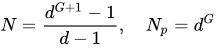
[edit]A regular tree network's topology is characterized by two parameters: the branching, , and the number of generations, . The total number of the nodes, , and the number of peripheral nodes , are given by [3]


Random tree networks
[edit]Three parameters are crucial in determining the statistics of random tree networks, first, the branching probability, second the maximum number of allowed progenies at each branching point, and third the maximum number of generations, that a tree can attain. There are a lot of studies that address the large tree networks, however small tree networks are seldom studied.[4]
Tools to deal with networks
[edit]A group at MIT has developed a set of functions for Matlab that can help in analyzing the networks. These tools could be used to study the tree networks as well.
L. de Weck, Oliver. "MIT Strategic Engineering Research Group (SERG), Part II". Retrieved May 1, 2018.
References
[edit]- ^ Bradley, Ray. Understanding Computer Science (for Advanced Level): The Study Guide. Cheltenham: Nelson Thornes. p. 244. ISBN 978-0-7487-6147-0. OCLC 47869750. Retrieved 2016-03-26.
- ^ Sosinsky, Barrie A. (2009). "Network Basics". Networking Bible. Indianapolis: Wiley Publishing. p. 16. ISBN 978-0-470-43131-3. OCLC 359673774. Retrieved 2016-03-26.
- ^ Kromer, J.; Khaledi-Nasab, A; Schimansky-Geier, L.; Neiman, A.B (2017). "Emergent stochastic oscillations and signal detection in tree networks of excitable elements". Scientific Reports. 7. arXiv:1701.01693. doi:10.1038/s41598-017-04193-8.
- ^ Khaledi-Nasab, Ali; Kromer, Justus A.; Schimansky-Geier, Lutz; Neiman, Alexander B. (2018-11-12). "Variability of collective dynamics in random tree networks of strongly coupled stochastic excitable elements". Physical Review E. 98 (5) 052303. arXiv:1808.02750. doi:10.1103/PhysRevE.98.052303.

Tree network
View on GrokipediaFundamentals
Definition and Characteristics
A tree network, also known as tree topology, is a hierarchical network structure that combines elements of star and bus topologies, featuring a central root node connected to multiple sub-nodes in a branching, non-loop configuration.[4][5] In this setup, the root serves as the primary hub, with subordinate nodes forming levels of hierarchy that extend outward like tree branches, ensuring organized data transmission without redundant paths.[6][7] At its foundation, a tree network consists of nodes, which represent interconnected devices such as computers, routers, or switches, and edges, which denote the physical or logical connections between them, forming a graph-like structure.[8] This topology draws from graph theory, where it corresponds to an acyclic connected graph, meaning all nodes are reachable from the root without forming cycles.[9] Key characteristics include the absence of cycles, which prevents data loops and simplifies routing; bidirectional data flow along the hierarchical structure, allowing communication between any nodes via parent-child paths; scalability achieved by adding branches to existing nodes without disrupting the overall structure; and a notable vulnerability at central or root nodes, where failure can isolate entire sub-branches.[5][10][11] Visually, a basic tree network diagram depicts the root node at the apex, branching downward to child nodes that further divide into additional levels, culminating in leaf nodes that serve as endpoints without further connections.[6][7] This arrangement facilitates efficient management in expansive networks by mirroring natural hierarchical patterns.[4]Historical Development
The concept of tree networks originated in the hierarchical structures of telecommunications systems during the 1960s and 1970s, where the Bell System implemented a multi-level switching hierarchy to efficiently route long-distance toll traffic across the United States. This tree-like topology organized switching offices into five classes—Class 1 Regional Centers at the root, followed by Class 2 Sectional Centers, Class 3 Primary Centers, Class 4 Toll Centers, and Class 5 End Offices—allowing traffic concentration and alternate routing through high-usage trunk groups to minimize blocking and costs.[12] Influenced by the need for scalable automation, this design evolved from electromechanical crossbar systems like the No. 4A Crossbar introduced in 1953, incorporating stored-program control for greater flexibility.[12] A key milestone was the deployment of AT&T's No. 4 Electronic Switching System (No. 4 ESS) in 1976, which applied digital time-division switching within this hierarchical framework to handle up to 107,000 terminations and support the growing volume of toll calls, marking a shift toward electronic toll networks.[12] By the late 1970s, the system integrated common-channel interoffice signaling to reduce delays, with 91 No. 4 ESS units in service by 1982, enhancing the tree structure's reliability for nationwide connectivity.[12] Tree networks emerged in local area networks (LANs) during the 1980s, building on Ethernet's initial bus topology through extensions like 10BASE-T in 1990, which enabled star-wired configurations that could be hierarchically linked into trees using repeaters and bridges. This addressed scalability issues in growing office environments, with token ring networks—introduced by IBM in 1984—also incorporating hybrid elements, such as star-wired rings that formed tree-like hierarchies for fault isolation. In the 1990s, standardization efforts solidified tree topologies in LANs, particularly through IEEE 802.1 standards, including the Spanning Tree Protocol (STP) ratified in 1990, which allowed bridged Ethernet networks to form loop-free hierarchical trees, preventing broadcast storms in multi-segment setups. Charles Spurgeon's early documentation in the 1990s on Ethernet cabling systems emphasized hierarchical designs, advocating structured wiring with backbone trunks connecting sub-stars to support enterprise-scale deployments. By the 2000s, tree networks evolved toward hybrid wired-wireless variants as precursors to Internet of Things (IoT) applications, with the Zigbee specification—based on IEEE 802.15.4 and released in 2004—supporting tree topologies in low-power wireless sensor networks for home automation and industrial monitoring. This integration combined wired backbones with wireless branches, enabling scalable, energy-efficient hierarchies that laid the groundwork for modern IoT ecosystems.Types
In the context of computer networking, tree network topologies are typically hierarchical structures combining star and bus elements. Abstract mathematical models, such as regular and random trees, are used to analyze their properties, scalability, and performance, particularly in large-scale implementations like corporate or educational networks. These models help simulate balanced versus irregular branching in subnetworks connected to the backbone.Regular Tree Networks
Regular tree networks model deterministic, hierarchical topologies where each non-leaf node (e.g., a hub or router) has a fixed branching factor , representing uniform connections to child subnetworks, and the structure spans a fixed number of levels . This symmetry mirrors ideal tree topologies with evenly distributed star subnetworks along the bus backbone, ensuring predictable data flow without cycles.[1] The total number of nodes follows the formula for a full -ary tree of height :This includes the root (central backbone), nodes at level 1, up to leaf nodes (endpoints) at the deepest level. The leaf nodes represent terminal devices in the hierarchy. Such models are useful for evaluating fault isolation and expansion in balanced tree networks, where all paths from the root to leaves are of length . For example, a binary tree model (, ) yields nodes, simulating a small departmental network with uniform branching.[2]
Random Tree Networks
Random tree networks model stochastic variations in tree topologies, where branching is irregular due to practical constraints like device placement or ad-hoc connections, often analyzed via branching processes. Each node generates a random number of children up to a maximum , with probability , over levels, leading to uneven subnetwork sizes along the backbone. This approximates real-world tree networks in dynamic environments, such as wireless sensor or peer-to-peer systems, where uniform structure is impractical.[13] The expected nodes at level is , with mean offspring . For , the network grows supercritically; variance in path lengths arises from probabilistic branching, requiring simulations for finite . In networking, this helps assess performance in irregular hierarchies, e.g., with , , , Monte Carlo methods estimate average connectivity to predict backbone load. Challenges include sensitivity to , where small changes affect scalability, making these models key for fault-tolerant designs in variable topologies.[14]Applications and Implementations
In Computer Networking
In computer networking, tree topologies are deployed as hierarchical structures to organize local area networks (LANs), wide area network (WAN) backbones, and approximations of data center fabrics such as Clos networks. These setups leverage a central root node connected to multiple branches, enabling efficient data flow in environments requiring scalability without excessive complexity. For instance, hierarchical LANs in campus or enterprise settings use tree topologies to segment traffic across departments or buildings, while WAN backbones extend connectivity over geographic distances via layered hubs. In data centers, tree-like approximations of Clos networks, often realized as fat-tree architectures, facilitate non-blocking interconnects for server clusters by stacking multiple layers of switches in a recursive tree manner.[15][16][17] Implementation typically designates the root as a high-capacity router or switch that serves as the central backbone, with branches extending through intermediate switches connected via Ethernet cables for short-range LAN segments or fiber optic links for longer WAN or data center spans. VLAN segmentation enhances scalability by logically partitioning the physical tree into isolated broadcast domains, allowing up to thousands of devices to coexist without overwhelming the network. Protocols like Spanning Tree Protocol (STP) are integral to prevent loops, dynamically electing the root and blocking redundant paths to maintain a loop-free tree.[18][7][19] Key advantages include straightforward fault isolation, where issues in a branch can be contained without disrupting the entire network, and cost-effectiveness for medium-scale deployments through modular expansion rather than full-mesh cabling. This makes tree topologies preferable for organizations balancing performance and budget in non-ultra-high-density scenarios.[5][20] Real-world examples span historical and modern contexts. In the 1990s, corporate intranets often employed Novell NetWare's hierarchical directory services, structuring servers and users in a tree-like organization for resource management across LANs. Contemporary software-defined networking (SDN) implementations, such as those using the OpenDaylight controller, integrate tree topologies for dynamic control in fat-tree data center fabrics, enabling load balancing and topology discovery via OpenFlow.[21][22] A primary limitation is the single point of failure at the root, which can cascade outages if not mitigated through redundant links or backup roots, though such measures add complexity without eliminating the inherent vulnerability.[23]In Biological and Social Systems
In biological systems, tree networks serve as fundamental models for representing evolutionary relationships and structural hierarchies. Phylogenetic trees, which depict the divergence of species over time, are hierarchical branching structures where nodes represent ancestral taxa and branches indicate evolutionary paths, enabling the reconstruction of historical relationships among organisms. These trees capture the asymmetry of descent with modification, with root nodes denoting common ancestors and leaves corresponding to extant species, as formalized in early phylogenetic systematics. For instance, in modeling species evolution, phylogenetic trees integrate genetic sequence data to infer branching patterns, revealing patterns of gene flow and divergence influenced by natural selection and drift. Seminal work by Felsenstein (1981) established likelihood-based methods for tree construction under evolutionary models, emphasizing their role in quantifying uncertainty in branching topologies.[24] Neural architectures in the brain also exhibit tree-like dendritic structures, forming hierarchical networks that process information at multiple scales. Dendrites, the branched extensions of neurons, create tree networks that receive and integrate synaptic inputs, with their electrical properties allowing compartmentalized signal propagation. In humans, these structures are notably longer and exhibit greater signal attenuation than in other mammals, enhancing computational complexity by enabling nonlinear integration within individual neurons, which contributes to the brain's superior processing capabilities. Studies on pyramidal neurons in the neocortex demonstrate that dendritic trees facilitate local decision-making, mimicking layered hierarchies that amplify the brain's overall network efficiency.[25] In social systems, tree networks model hierarchical organizations and relational dynamics, such as corporate structures and kinship lineages. Organizational charts represent authority flows as rooted trees, with top-level nodes as executives branching into subordinate roles, capturing directionality in decision-making and resource allocation. This structure emerges naturally in complex networks through processes like preferential attachment, where higher-degree nodes (leaders) connect preferentially, as observed in analyses of firm hierarchies spanning decades of data. Family trees, or genealogical networks, similarly use acyclic tree structures to trace descent, avoiding cycles to reflect unilineal inheritance patterns in human societies. Epidemic spread in social contexts is often modeled using tree networks to approximate contact patterns, particularly in the susceptible-infected-recovered (SIR) framework on homogeneous trees. In these models, infections propagate along branches from an initial node, with recovery halting further spread, allowing analytical prediction of outbreak sizes and thresholds. For example, on regular trees with fixed branching factors, the SIR dynamics yield exact solutions for the basic reproduction number, highlighting how network geometry influences containment strategies in populations with hierarchical mixing, such as schools or workplaces. Adaptations of tree models address specific biological and social phenomena, incorporating randomness or regularity to fit empirical data. Random tree networks, akin to coalescent processes, simulate genetic drift by modeling allele frequency changes through stochastic branching, where lineages merge backward in time, quantifying loss of diversity in finite populations. This approach, refined in formulations using branching processes, shows drift efficiency varying with population size and reproduction variance, applied to asexual systems like bacterial evolution. In contrast, regular tree networks idealize food webs as balanced hierarchies of trophic levels, with uniform branching representing predator-prey chains in simplified ecosystems. Such models reveal stability in idealized settings, where fixed connectivity minimizes cascades in energy flow. Tree networks uniquely capture asymmetry and directionality in natural and social hierarchies, distinguishing them from cyclic graphs by enforcing acausal flows from roots to leaves, which mirrors evolutionary ancestry or command chains. Cross-disciplinary extensions, such as tree variants of the Barabási-Albert model, generate scale-free hierarchies via preferential attachment with m=1 edges per new node, producing tree-like structures observed in both genetic phylogenies and social affiliations. Studies from the 2010s on ecological resilience underscore these properties, showing that tree-structured networks in forests enhance robustness to perturbations like logging, with hierarchical modularity buffering multi-trophic interactions against collapse, as quantified in functional diversity metrics across temperate systems.[26]Analysis and Modeling
Mathematical Properties
Tree networks, modeled as undirected acyclic connected graphs in graph theory, exhibit fundamental properties stemming from their acyclicity and connectivity. A tree with vertices contains exactly edges, ensuring no cycles and maintaining connectivity through a single path between any pair of distinct vertices.[27][28] This structure contrasts with general graphs, where cycles can lead to multiple paths and typically possible edges; the absence of cycles in trees strictly limits the edge count to linear order , specifically .[28] The diameter of a tree, defined as the length of the longest path between any two nodes, depends on the tree's balance. In a balanced tree of height , the diameter is , representing the maximum distance between leaves in opposing subtrees.[29] Centrality measures further highlight structural importance in trees. Degree centrality identifies the root as a high-degree hub, often connecting multiple branches, while betweenness centrality is typically highest at upper levels near the root or centroid, as these nodes lie on a quadratic number of shortest paths () compared to for random vertices.[30] Spectral properties of tree networks arise from the eigenvalues of their adjacency matrix. For regular trees of degree , the largest eigenvalue, or spectral radius, approximates , bounding the growth rate of walks on the infinite -regular tree.[31] General equations underscore tree enumeration and structure: the average degree is strictly less than 2, given by for , derived from the handshaking lemma and edge count.[28] Additionally, the number of distinct spanning trees in a complete graph with labeled vertices is given by Cayley's formula, , counting all possible tree configurations.[32]Performance Evaluation
Performance evaluation of tree networks focuses on operational metrics that highlight their hierarchical structure's impact on efficiency. Latency in tree networks is primarily proportional to the tree depth , as data packets must traverse multiple hops from leaves to the root and back, accumulating propagation and queuing delays at each level.[33] Throughput is constrained by the root node's bandwidth, which serves as the central aggregation point for all traffic, limiting overall network capacity under high loads.[34] Fault tolerance is a strength for leaf node failures, enabling graceful degradation where the network continues operating with reduced capacity by isolating the affected peripheral without impacting the rest of the system; enhanced variants like fat-trees support rerouting for broader fault tolerance.[35] Common evaluation methods rely on simulations to quantify these metrics, such as using tools like NS-2 to model packet flows and compute average packet delay as , where path lengths represent hop counts across packets.[36] These simulations reveal bottlenecks like root congestion, where inbound traffic from multiple branches overwhelms the central link, causing queue buildup and packet drops.[37] Mitigation strategies include load balancing across branches or adopting multi-root variants like fat-tree architectures, which distribute bandwidth more evenly to reduce single-point overloads.[17] Comparative analyses show tree networks offer lower implementation costs than mesh topologies but exhibit higher latency in high-traffic scenarios due to longer average paths.[38] For instance, in large-scale wireless sensor networks, tree topologies demonstrate greater end-to-end delays and lower throughput compared to meshes, which benefit from multiple redundant paths for faster routing.[38] Recent studies in the 2020s have explored AI-optimized tree structures for 5G backhaul, using machine learning to dynamically adjust hierarchies for low-latency traffic aggregation in dense deployments; as of 2025, AI/ML integration continues to advance autonomous optimization in 5G networks.[39][40]Tools and Resources
Software for Simulation
Several open-source software tools facilitate the simulation of tree networks, allowing researchers to model hierarchical structures, test protocols, and evaluate performance metrics such as delay and throughput. Among the most prominent is the NS-3 simulator, a discrete-event network simulator primarily designed for Internet systems research and education.[41] NS-3 supports the construction of tree topologies through its topology helpers, enabling protocol testing on both regular and random tree configurations by defining nodes, links, and routing.[42] Key features of NS-3 for tree network simulation include automated generation of hierarchical topologies using PointToPointHelper for wired links or WifiHelper for wireless variants, traffic injection via applications like UDP Echo at leaf nodes to simulate data flows from periphery to root, and visualization tools such as PCAP trace files or the NetAnim animator for displaying packet propagation across hierarchies.[43] For instance, a typical usage example involves scripting a tree with degree (each non-leaf node connects to three children) and generations (root at level 0, leaves at level 3), where UDP clients at leaves send packets to a server at the root; end-to-end delay is measured by subtracting packet send timestamps from receive timestamps in trace outputs.[44] NS-3 is freely available for download from its official repository, with comprehensive tutorials in the documentation for beginners to build and run such simulations.[45] Another widely used tool is OMNeT++, a modular, component-based C++ framework for building network simulators, particularly suited for hierarchical modeling of tree networks through its nested module system. OMNeT++ enables the definition of regular or random tree structures in NED files, specifying parent-child connections, with support for traffic injection at leaves via message-passing behaviors in C++ modules and visualization of hierarchies using the Qtenv runtime environment to monitor data flows and latencies.[46] For example, a simulation might configure a root node to broadcast messages downward, with leaves responding upward, allowing analysis of propagation in structured trees. Like NS-3, OMNeT++ offers free downloads and beginner-friendly tutorials via its documentation and IDE.[47] Post-2018 enhancements in NS-3 have expanded support for wireless tree networks, including updated Wi-Fi models for IEEE 802.11ax and 802.11be standards, which facilitate simulations of ad-hoc or mesh trees in IoT scenarios, addressing gaps in earlier versions for dynamic wireless hierarchies. These tools collectively provide accessible, extensible platforms for simulating tree networks without reliance on proprietary software.Analytical Frameworks
Analytical frameworks for tree networks encompass computational tools and theoretical methods that enable the computation of structural invariants, centrality measures, and robustness indicators without relying on full-scale simulations. These frameworks leverage graph theory to quantify properties unique to acyclic connected structures, such as diameter, path lengths, and spectral characteristics. Key implementations include the MIT Matlab Toolbox for Network Analysis, which provides routines for eigenvalue-based partitioning and identification of tree-specific features like leaf nodes, facilitating the study of algebraic connectivity in tree-like graphs.[48] This toolbox, developed between 2006 and 2011, supports spectral analysis relevant to tree networks by computing the second smallest eigenvalue of the Laplacian matrix, a measure of connectivity robustness.[48] In Python, the NetworkX library offers extensive graph algorithms tailored to trees, including generation via recursive branching processes and computation of metrics like the Wiener index, defined as the sum of shortest-path distances between all pairs of nodes.[49] For instance, NetworkX'sbalanced_tree function constructs regular trees with specified branching factors, while wiener_index efficiently calculates this topological descriptor, which is particularly tractable for trees due to their unique paths. An illustrative application is computing the clustering coefficient using average_clustering, which yields zero for any tree, underscoring the absence of cycles and thus no local triangles.[50]
For statistical inference on tree networks, the igraph package in R, updated to version 2.2.1 as of October 2025, provides functions for hypothesis testing and model validation, such as verifying tree acyclicity with is_tree and estimating centrality via eigenvector methods adapted to sparse structures.[51] igraph supports recursive tree construction through adjacency matrix manipulations and enables bootstrap resampling for inferring properties like degree distributions in random trees.
Advanced theoretical frameworks include generating functions for enumerating random trees, as formalized in Otter's seminal 1948 work, which derives the asymptotic number of unlabeled trees using ordinary generating functions satisfying functional equations like for rooted trees. This approach allows exact counting and probabilistic generation of tree ensembles. Complementing this, percolation theory assesses robustness by modeling edge or node failures; on trees, the critical percolation threshold is precisely for a regular tree of degree , below which the network fragments, as derived in classic bond percolation models. These methods, implemented in tools like NetworkX's percolation functions, quantify failure tolerance without exhaustive enumeration.