Hubbry Logo
TsaaganTsaaganMain
Open search
Tsaagan
Community hub
Tsaagan
logo
8 pages, 0 posts
0 subscribers
Be the first to start a discussion here.
Tsaagan
Tsaagan
from Wikipedia

Tsaagan
Temporal range: Late Cretaceous, 75 Ma
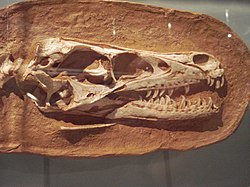
Holotype skull
Scientific classification Edit this classification
Kingdom: Animalia
Phylum: Chordata
Class: Reptilia
Clade: Dinosauria
Clade: Saurischia
Clade: Theropoda
Family: Dromaeosauridae
Clade: Eudromaeosauria
Subfamily: Velociraptorinae
Genus: Tsaagan
Norell et al., 2006
Species:
T. mangas
Binomial name
Tsaagan mangas
Norell et al., 2006

Tsaagan (meaning "white") is a genus of dromaeosaurid dinosaur from the Djadokhta Formation of the Late Cretaceous of Mongolia.

Discovery and naming

[edit]
Skeletal showing the known remains from the holotype

The holotype of Tsaagan was discovered in 1996 and first identified as a specimen of Velociraptor. After a CAT-scan in May 1998 it was concluded that it represented a new genus. In December 2006 its type species was named and described by Mark Norell, James Clark, Alan Turner, Peter Makovicky, Rinchen Barsbold and Timothy Rowe. The species name, Tsaagan mangas, should be read as a whole with the generic name qualifying the specific epithet, and is derived from the Mongolian words for "white monster" (цагаан мангас),[1] although with an accidental misspelling of the word Tsagaan.

The holotype specimen, IGM 100/1015, was found near Xanadu in Ömnögovi Province in layers of the Djadokhta Formation dating to the Campanian, about 75 million years ago. It consists of a well-preserved skull and series of ten neck vertebrae as well as a damaged left shoulder girdle. It is the only specimen found of Tsaagan and belonged to an adult individual.[1]

Description

[edit]
Life restoration

Tsaagan was a medium-sized dromaeosaurid. In 2010 Gregory S. Paul estimated its length at 2 metres (6.6 ft), its weight at 15 kilograms (33 lb).[2] The skull in general appearance resembles that of Velociraptor but differs from it in many details. It is more robust and smooth on top; unique derived traits, autapomorphies, include long paroccipital processes and basipterygoids at the back of the skull and a jugal touching the squamosal.[1]

Classification

[edit]

Tsaagan is a member of the group Dromaeosauridae. A cladistic analysis by Norell et al. originally indicated it was more precisely a member of the Velociraptorinae.[1] In 2010 an analysis showed it was closely related to Linheraptor;[3] subsequently Senter (2011) and Turner, Makovicky and Norell (2012) argued that Linheraptor exquisitus is in fact a junior synonym of Tsaagan mangas.[4][5] Xu, Pittman et al. (2015) reject this synonymy by responding to the counterarguments proposed using new and existing details of Linheraptor's anatomy.[6]

Below are the results for the Eudromaeosauria phylogeny based on the phylogenetic analysis performed by Currie and Evans in 2019:[7]

Eudromaeosauria

Paleoenvironment

[edit]

Tsaagan represents the only dromaeosaurid remains (other than isolated teeth) known from the Ukhaa Tolgod region, though another dromaeosaurid, Velociraptor, is known from the same Djadokhta Formation. Animals that may have shared the same habitat with Tsaagan include Protoceratops, Shuvuuia, the small mammal Zalambdalestes, the multituberculate mammal Kryptobaatar, as well as several lizards and two yet-undescribed species of troodontid and dromaeosaurid.[1]

See also

[edit]

References

[edit]
Revisions and contributorsEdit on WikipediaRead on Wikipedia
from Grokipedia
Tsaagan is a of medium-sized, carnivorous dromaeosaurid theropod that lived during the stage of the epoch, approximately 75 million years ago, in what is now the of . The type and only recognized species is Tsaagan mangas, named after the white color of the quarry sediment where it was found ("tsaagan" meaning "white" in Mongolian) and "mangas" meaning "monster" in Mongolian. Known from a single well-preserved specimen (IGM 100/1015) consisting of a complete , lower jaws, and the first eight , T. mangas represents an adult individual with a skull measuring 201 mm in length. The is estimated to have reached a total body length of about 2 meters (6.6 ft) and a weight of roughly 15 kg (33 lb). Fossils were recovered from the Djadokhta Formation at the Ukhaa Tolgod locality in , a site renowned for yielding articulated theropod remains in aeolian dune deposits. Tsaagan is distinguished from other dromaeosaurids by features such as a straight, untwisted, and pendulous paroccipital process; a large and anteriorly located ; and a jugal-squamosal contact that excludes the postorbital from the infratemporal . Phylogenetic analyses place it within Velociraptorinae () as a derived member closely related to mongoliensis, and it coexisted with this close relative in the same formation.

History of Research

Discovery

The specimen of Tsaagan (IGM 100/1015) was discovered in 1993 by during a joint paleontological expedition conducted by the and the Mongolian Academy of Sciences at the Xanadu sublocality of Ukhaa Tolgod, in the Upper Djadokhta Formation of , . Due to superficial resemblances in cranial morphology and the abundance of Velociraptor mongoliensis fossils from the same site, the specimen was initially regarded as referable to that species. The find represented a significant addition to the dromaeosaurid record from this productive locality, which had previously yielded numerous theropod remains but only limited diversity beyond Velociraptor. Further preparation and analysis in May 1998 involved CT scanning of the at the University of Texas High-Resolution Computed Tomography Facility, using sagittal slices of 0.5 mm thickness, which exposed internal cranial structures and highlighted autapomorphic features distinguishing it from and other dromaeosaurids. This non-destructive imaging confirmed the specimen's adult maturity, evidenced by fused neurocentral sutures and obliterated braincase sutures, and prompted its recognition as a distinct . The preserves a nearly complete (201 mm long) with articulated mandibles, the first ten , and a partially damaged , though postcranial elements beyond the neck are minimal.

Naming and Etymology

Tsaagan mangas was formally named and described in December 2006 by a team of paleontologists including Mark A. Norell, James M. Clark, Alan H. Turner, Peter J. Makovicky, Rinchen Barsbold, and Timothy Rowe, in a publication within the American Museum Novitates series. The genus name Tsaagan derives from the Mongolian word for "," chosen to reference the white color of the quarry sediment where the specimen was discovered. The species epithet mangas comes from the Mongolian term for "monster," alluding to the elongate, snake-like appearance of the . The description was based on the holotype specimen IGM 100/1015, consisting of a well-preserved and the first ten , collected from the Upper Djadokhta Formation at Ukhaa Tolgod in Mongolia's . This initial publication highlighted key anatomical distinctions from the related dromaeosaurid mongoliensis, such as a straight and untwisted paroccipital process, the presence of a large anterior maxillary , and a jugal-squamosal contact that excludes the postorbital from the infratemporal . Due to variations in Mongolian transliteration, the genus name is sometimes rendered as Tsagaan, though the original publication uses Tsaagan.

Physical Description

Cranial Anatomy

The of Tsaagan mangas measures approximately 20 cm in length from the to the occipital condyle, presenting a robust, low-profile structure with a smooth dorsal surface and lacking the tall observed in some other dromaeosaurids such as . The snout constitutes about 59% of the total skull length, contributing to its elongated appearance. Distinctive cranial features include elongated, pendulous paroccipital processes that are straight and untwisted distally, differing from the twisted processes in taxa like Velociraptor mongoliensis. The jugal contacts the squamosal directly, thereby excluding the postorbital from the margin of the infratemporal , a condition shared with some other dromaeosaurids. The is notably robust, measuring 103 mm in length and 38 mm in height, with a prominent antorbital fossa bordered by a large maxillary positioned at its anterior edge; the tooth row along the spans 90 mm. Dentition follows a heterodont pattern typical of dromaeosaurids, with the bearing four labiolingually compressed, recurved teeth that lack serrations. The preserves 13 tooth positions occupied by relatively homodont, conical, recurved teeth featuring fine posterior serrations at a of 3–3.5 denticles per millimeter; the fifth maxillary tooth is slightly enlarged compared to others. The dentary holds 14–15 similarly recurved teeth, with no serrations on the anterior carinae but posterior serrations present, consistent with adaptations for a carnivorous diet. CT scans of the braincase reveal details of the endocranial anatomy, including narrow bordered by cristae cranii on the frontals; however, the relative olfactory bulb size is enlarged, with an olfactory bulb to length ratio of 36%, exceeding that of many non-maniraptoriform theropods and indicating enhanced olfactory capabilities. Auditory structures include a large dorsal tympanic recess, separation of the ovalis and pseudorotunda by a partial interfenestralis, and a spacious floccular recess with posteriorly rotated , features that align with those in other dromaeosaurids like . The braincase is less pneumatic overall than in Velociraptor mongoliensis, with reduced tympanic recesses.

Postcranial Skeleton

The postcranial skeleton of Tsaagan mangas is incompletely known, primarily represented by an articulated series of ten (from the atlas to the tenth) and a partial left scapulocoracoid from the specimen (IGM 100/1015). The are elongated and hollow, with pneumatic foramina present in the of the third, fifth, seventh, and eighth vertebrae, as well as prominent pneumatic recesses and laminae on the neural arches; this pneumatization suggests a lightweight axial construction adapted for speed and agility in a dromaeosaurid. The neural arches are broad and square in dorsal view, with well-developed but caudally diminishing epipophyses, and the tenth cervical is transitional, featuring a more cylindrical centrum and ventral keel without a hypapophysis. Associated appear partially fused to the seventh through ninth vertebrae, though preservation limits full assessment. The damaged scapulocoracoid indicates a robust , with the bearing an everted process and a laterally directed glenoid facet, while the possesses a low , a weak subglenoid shelf, and an unusual dorsoventrally elongate . No appendicular elements beyond the are preserved. Overall body size is estimated at approximately 2 meters in total length and 15 kg in mass, reflecting a slender build consistent with other small . Limb proportions, while not directly preserved, are inferred to feature long hindlimbs suited for , including a large, sickle-shaped second pedal ungual (hallux) as seen across .

Systematics and Classification

Taxonomic History

The specimen of Tsaagan mangas (IGM 100/1015) was discovered in 1996 at the Ukhaa Tolgod locality in the Djadokhta Formation of and initially identified as a specimen of mongoliensis based on superficial cranial similarities. A high-resolution conducted in May 1998 at the revealed key distinguishing features, such as the unique configuration of the paroccipital processes and antorbital , prompting its recognition as a distinct . This led to its formal as a new and within in 2006 by Norell, Clark, Turner, Makovicky, Barsbold, and Rowe, who tentatively placed it in the subfamily Velociraptorinae based on shared skull traits including a large promaxillary and the orientation of the lacrimal duct. In 2011, Senter proposed synonymizing Tsaagan mangas with the closely related Linheraptor exquisitus (described in 2010), arguing that their similar overall proportions and lack of robust autapomorphies warranted considering Linheraptor a junior . This view was echoed by Turner, Makovicky, and Norell in , who supported the merger in their comprehensive review of dromaeosaurid systematics, attributing observed differences to preservational or intraspecific variation rather than taxonomic distinction. However, these proposals overlooked several consistent morphological variances, such as subtle differences in the paroccipital orientation and dentary morphology. The synonymy was firmly rejected in 2015 by Xu, Choiniere, Tan, , and Pittman, who conducted a detailed comparison of 61 cranial and postcranial features between the holotypes, identifying multiple autapomorphies unique to each , including a distinct jugal-squamosal contact in Linheraptor and differences in the quadrate's pneumatic structure in Tsaagan. Their phylogenetic analysis further supported Tsaagan and Linheraptor as closely related but distinct velociraptorines. Since then, no major taxonomic revisions have occurred, with Tsaagan consistently recognized as valid in broader dromaeosaurid reviews and phylogenies, such as those by Pei et al. (2020), which recover it as sister to Linheraptor within Velociraptorinae.

Phylogenetic Relationships

Tsaagan mangas is classified within , a subclade of , and specifically placed in the subfamily Velociraptorinae based on cladistic analyses of cranial and postcranial characters. Phylogenetic studies recover Tsaagan as the sister taxon to Linheraptor exquisitus, with this pair forming the to Velociraptor mongoliensis. This positioning highlights Tsaagan's close evolutionary ties to other Asian dromaeosaurids from the Djadokhta Formation. Key shared derived traits among Tsaagan and its velociraptorine relatives include a low, elongate profile that contributes to a streamlined cranial morphology, elongated and pendulous paroccipital processes that extend posteriorly without distal twisting, and characterized by recurved, ziphodont teeth with prominent posterior serrations. These features distinguish velociraptorines from other eudromaeosaurians and suggest adaptations for agile predation, such as enhanced bite force or maneuverability during hunts. A comprehensive phylogenetic by and Evans in 2019, incorporating expanded cranial data from multiple dromaeosaurid taxa, reaffirmed Tsaagan's membership in Velociraptorinae and positioned it as a basal member within the , supported by bootstrap values indicating robust support for its relationships. This utilized a modified from prior studies, emphasizing characters like the configuration of the basisphenoid recess and cranial fenestrae to resolve interrelationships among Asian forms. Tsaagan represents part of a broader of dromaeosaurids in during the stage of the , characterized by diverse velociraptorine forms adapted to arid environments of the region. This Asian assemblage, including Tsaagan, contrasts with contemporaneous North American eudromaeosaurians like the group (Dromaeosaurinae), which exhibit more robust builds and different cranial proportions, reflecting potential biogeographic divergence.

Paleoecology

Geological Context

The Djadokhta Formation, from which Tsaagan fossils derive, is a Upper unit assigned to the stage, dating to approximately 75 million years ago. It primarily consists of eolian sandstones, including cross-stratified dune deposits ( E-1) and vaguely bedded sandstones with concretionary sheets ( E-2), interbedded with paleosols that indicate periodic dune stabilization and soil formation. These lithologies reflect a environment characterized by seasonal dunes, occasional interdune ponds or oases (represented by thin and M), and rare conglomeratic input from basin-margin alluvial fans ( C). The Ukhaa Tolgod locality, situated in the Nemegt Basin of southern , features exposures akin to the renowned "" at Bayn Dzak, with a stratigraphic sequence dominated by eolian up to 36.5 meters thick. Fossils here, including those of Tsaagan, are predominantly preserved within structureless sandstones ( S), interpreted as sandslide or mass-wasting deposits from dune faces, alongside burrow collapses that suggest biogenic activity in stabilized dunes. This setting points to an arid to punctuated by occasional flash floods or wetter intervals that facilitated sediment mobilization and preservation. Age determination for the Djadokhta Formation relies on , with key index taxa such as andrewsi and mongoliensis defining faunal zones shared across localities like Bayn Dzak and Ukhaa Tolgod; no direct radiometric dates are available, but magnetostratigraphic correlation to the end of Chron 33 through Chron 32 places it between approximately 75 and 71 million years ago. Taphonomic evidence from the Tsaagan (IGM 100/1015), a partial and cervical series from the Xanadu sublocality, indicates a death assemblage with preburial exposure, arthropod scavenging, and minor disarticulation, followed by rapid burial in eolian sands that minimized further disturbance.

Contemporaneous Biota and Inferred Interactions

The Djadokhta Formation at Ukhaa Tolgod, , where Tsaagan mangas is known from, preserves a diverse assemblage indicative of an arid, eolian-dominated with ephemeral water sources. Key contemporaries include herbivorous dinosaurs such as Protoceratops andrewsi and oviraptorids (e.g., osmolskae), small carnivorous theropods like the alvarezsaurid Shuvuuia deserti and troodontid Byronosaurus jaffei, belonging to families such as Macrocephalosauridae and Priscagamidae, and mammals including the multituberculate Kryptobaatar dashzevegi and the eutherian Zalambdalestes lechei.3545[1:ANDTFU]2.0.CO;2/A-New-Dromaeosaurid-Theropod-from-Ukhaa-Tolgod-Ömnögöv-Mongolia/10.1206/0003-0082(2006)3545[1:ANDTFU]2.0.CO;2.full) As a member of Dromaeosauridae, Tsaagan mangas was carnivorous, with its serrated, recurved teeth suited for slicing flesh from small- to medium-sized vertebrate prey, likely including abundant small mammals like Zalambdalestes and juvenile dinosaurs such as young Protoceratops or oviraptorids.3545[1:ANDTFU]2.0.CO;2/A-New-Dromaeosaurid-Theropod-from-Ukhaa-Tolgod-Ömnögöv-Mongolia/10.1206/0003-0082(2006)3545[1:ANDTFU]2.0.CO;2.full) Its estimated posterior bite force of approximately 150 N suggests capability for dispatching smaller prey rather than large animals, consistent with a predatory niche focused on agile pursuits in open dune environments. Possible pack-hunting behavior, as observed in related dromaeosaurids like Deinonychus antirrhopus from bonebed assemblages, may have extended to Tsaagan, facilitating coordinated attacks on slightly larger prey, though no direct fossil evidence exists for this in the taxon.3545[1:ANDTFU]2.0.CO;2/A-New-Dromaeosaurid-Theropod-from-Ukhaa-Tolgod-Ömnögöv-Mongolia/10.1206/0003-0082(2006)3545[1:ANDTFU]2.0.CO;2.full) As a dromaeosaurid, Tsaagan mangas was likely an agile predator, with inferred adaptations such as a lightweight build, elongated hindlimbs for speed, and enlarged sickle-shaped pedal claws typical of its relatives, for slashing and subduing prey during close-range encounters in the sparsely vegetated desert landscape. The specimen (IGM 100/1015), comprising a nearly complete and , represents a mature adult estimated at about 2 in total body length, with no associated growth series available to infer ontogenetic shifts in or diet.3545[1:ANDTFU]2.0.CO;2/A-New-Dromaeosaurid-Theropod-from-Ukhaa-Tolgod-Ömnögöv-Mongolia/10.1206/0003-0082(2006)3545[1:ANDTFU]2.0.CO;2.full) Within the velociraptorine subclade, Tsaagan likely occupied a specialized predatory niche, potentially partitioning resources from sympatric mongoliensis through differences in skull proportions; Tsaagan's relatively broader rostrum and maxillary may have enhanced maneuverability or grip on evasive small prey like and mammals, contrasting with Velociraptor's narrower build suited for different hunting tactics.3545[1:ANDTFU]2.0.CO;2/A-New-Dromaeosaurid-Theropod-from-Ukhaa-Tolgod-Ömnögöv-Mongolia/10.1206/0003-0082(2006)3545[1:ANDTFU]2.0.CO;2.full) This coexistence with other small carnivores such as troodontids and alvarezsaurids implies competitive interactions for similar prey items, contributing to a complex in the Campanian-aged community.

References

Add your contribution
Related Hubs
User Avatar
No comments yet.