Hubbry Logo
DaurlongDaurlongMain
Open search
Daurlong
Community hub
Daurlong
logo
8 pages, 0 posts
0 subscribers
Be the first to start a discussion here.
Daurlong
Daurlong
from Wikipedia

Daurlong
Temporal range: Early Cretaceous (Aptian), ~121.23 Ma
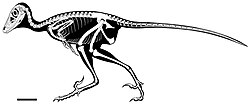
Skeletal reconstruction of Daurlong
Scientific classification Edit this classification
Kingdom: Animalia
Phylum: Chordata
Class: Reptilia
Clade: Dinosauria
Clade: Saurischia
Clade: Theropoda
Family: Dromaeosauridae
Genus: Daurlong
Wang et al., 2022
Species:
D. wangi
Binomial name
Daurlong wangi
Wang et al., 2022

Daurlong (meaning "Daur dragon") is an extinct genus of dromaeosaurid dinosaur from the Early Cretaceous (Aptian) Longjiang Formation of China. The genus contains a single species, D. wangi, known from a nearly complete skeleton. Daurlong represents the first described occurrence of a preserved intestinal region in a theropod closely related to birds.[1]

Discovery and naming

[edit]
Holotype of Daurlong

The Daurlong holotype specimen, IMMNH-PV00731, was found in sediments of the Longjiang Formation (Pigeon Hill locality) of Morin Dawa Daur Autonomous Banner, Inner Mongolia, China. This locality is dated to the Aptian age of the Early Cretaceous period. It consists of a nearly complete specimen of an individual, including a near-perfectly articulated skull. A partial anuran skeleton was also preserved on the holotype slab.[1]

In 2022, Daurlong wangi was described as a new genus and species of dromaeosaurid theropod dinosaurs by Xuri Wang, Andrea Cau, Bin Guo, Feimin Ma, Gele Qing, and Yichuan Liu based on these remains. The generic name, "Daurlong", combines a reference to the Daur Nation with the Chinese "龙" ("lóng"), meaning "dragon." The specific name, "wangi", honors Wang Junyou, the director of the Inner Mongolia Museum of Natural History.[1]

Description

[edit]
Daurlong holotype abdominal region
Life reconstruction

Daurlong was a mid-sized dromaeosaurid, about 1.5 m (4.9 ft) long. The preserved specimen is 85% the size of the Tianyuraptor holotype, and 93% the size of the Zhenyuanlong holotype. The skull is about 94% the length of the femur, and the forelimbs are less than 60% of the length of the hindlimbs. The specimen preserves plumage along the back of the skull and neck, and the edges of the tail. The fossil does not include pennaceous remiges and rectrices, as in Zhenyuanlong. A bluish layer preserved in the Daurlong specimen ribcage matches the intestinal tract seen in the Scipionyx holotype.[1]

Classification

[edit]

In their phylogenetic analyses, Wang et al. (2022) recovered Daurlong as a member of the Dromaeosauridae, in a clade containing Tianyuraptor and Zhenyuanlong. The cladogram below displays the results of their phylogenetic analyses.[1]

Dromaeosauridae

References

[edit]
Revisions and contributorsEdit on WikipediaRead on Wikipedia
from Grokipedia
Daurlong is an extinct genus of mid-sized dromaeosaurid theropod dinosaur that lived during the epoch, approximately 130–120 million years ago, in what is now , . The type and only known species is Daurlong wangi, represented by a single nearly complete, articulated skeleton ( IMMNH-PV00731) measuring about 1.5 meters in length. This specimen, discovered in the Longjiang Formation at the Pigeon Hill locality, uniquely preserves evidence of along the dorsal margin and tail, as well as a black-bluish layer indicating intestinal structures in the . Named for the of the region ("Daur dragon"), Daurlong wangi was formally described in 2022 based on its distinctive cranial and postcranial features, including a slender subnarial ramus of the , a large promaxillary recess, robust maxillary teeth, and a bowed with a fan-shaped distal end on the first sternal rib. Phylogenetic analysis places it within the family, closely related to other dromaeosaurids such as Tianyuraptor ostromi and suni, suggesting niche segregation among these predatory dinosaurs to avoid resource competition. The significance of Daurlong wangi lies in its exceptional preservation, marking the first documented case of intestinal contents in a theropod near the bird lineage; the gut region contains a partial , confirming an component in its diet alongside , mammals, and other . This discovery provides rare insights into the gastrointestinal anatomy and digestive evolution of dromaeosaurids, supporting conservatism in theropod gut structure similar to that seen in modern crocodylians and . As part of the diverse Lower , Daurlong highlights the ecological complexity of feathered, bird-like predators in ancient East Asian ecosystems.

Discovery and research history

Geological context

The Daurlong fossils were recovered from the Longjiang Formation, a Lower Cretaceous (Aptian stage, approximately 125–113 million years ago) stratigraphic unit exposed in the Morin Dawa Daur Autonomous Banner of Inner Mongolia, China. This formation represents a key component of the broader Early Cretaceous sedimentary record in northeastern China, characterized by layered deposits that record episodic volcanic activity and sedimentation in a continental setting. The Longjiang Formation is integrated into the , a renowned (middle stage, ~135–120 Ma) assemblage spanning multiple provinces in , known for its diverse terrestrial and aquatic life forms preserved in volcanic-influenced environments. The depositional setting was predominantly lacustrine, with fine-grained sediments such as tuffaceous shales and siltstones accumulating in basins amid recurrent , which supplied ash layers and facilitated rapid burial of organisms. These conditions, including low-energy bottom waters and falls, promoted exceptional preservation across the biota, including soft tissues in some specimens. The specific locality yielding the Daurlong holotype is Pigeon Hill (also known as the Pigeon Hill locality), situated near Taipingqiao Village in Yuanbaoshan Town (Baoshan ), within the Morin Dawa Daur Autonomous . This site, at coordinates 48°39′40.76″N 123°52′41.15″E, lies in the upper part of the Longjiang Formation, where gray tuffaceous siltstones and mudstones dominate, reflecting a stable lacustrine phase interrupted by volcanic inputs. Age constraints for the Longjiang Formation at Pigeon Hill are provided by zircon U-Pb of tuff layers, yielding 121.23 ± 0.74 Ma, consistent with the stage. Biostratigraphic correlations further support this timing, based on co-occurring fish (e.g., lycopterids) and assemblages typical of the , which align with regional faunal zones across and .

Excavation and preservation

The holotype specimen of Daurlong wangi, cataloged as IMMNH-PV00731 and housed at the Museum of Natural History, was discovered in 2022 at the Pigeon Hill locality (N 48°39′40.76″/E 123°52′41.15″) in the Morin Dawa Daur Autonomous Banner, , , during fieldwork conducted by a team of paleontologists from the Chinese Academy of Geological Sciences. This nearly complete, articulated skeleton, preserved in a single slab, measures approximately 1.5 meters in length from the tip of the snout to the tail and includes most of the , vertebrae, , limbs, and pelvic elements, with some minor crushing and displacement observed in the ribcage and areas. Taphonomic conditions responsible for the specimen's exceptional preservation involved rapid burial in fine-grained, anoxic sediments of a lacustrine environment within the Lower Cretaceous Longjiang Formation, which inhibited bacterial decay and oxidative processes that typically degrade soft tissues. This swift entombment, likely following the animal's death in or near a lake, resulted in the retention of articulated posture and the formation of a distinctive black-bluish layer in the abdominal region through authigenic mineralization influenced by decay bacteria, preserving impressions of internal structures such as the intestines. Additionally, filament-like impressions suggestive of feathers are visible along the limbs and tail, further highlighting the site's conducive conditions for soft-tissue fossilization, akin to those in the broader . Preparation of the employed careful mechanical techniques, such as using fine tools to remove overlying matrix, combined with chemical consolidation to stabilize fragile elements and impressions without compromising the soft-tissue details. Advanced imaging methods, including (UV) fluorescence photography to detect mineral infillings and scanning (SEM) on gold-coated samples at 15–20 kV using JSM-6700 and ZEISS SIGMA-500 instruments, were utilized to document and analyze the preserved features non-destructively. These approaches ensured the specimen's integrity for ongoing study while revealing microscopic details of the mineralization processes.

Initial description and naming

Daurlong wangi was formally described and named in a 2022 scientific paper published in Scientific Reports by a team led by Xuri Wang, including Andrea Cau, Bin Guo, Feimin Ma, Gele Qing, and Yichuan Liu, under the title "Intestinal preservation in a birdlike dinosaur supports conservatism in digestive canal evolution among theropods." The description introduced Daurlong as a new genus and species of dromaeosaurid theropod dinosaur from the Lower Cretaceous Longjiang Formation of the Jehol Biota in Inner Mongolia, China, based on an exceptionally preserved holotype specimen (IMMNH-PV00731) that includes articulated skeletal elements and soft tissue impressions. The genus name Daurlong combines "Daur," referring to the indigenous to the region of discovery in , with "long" (龙), the Chinese word for "dragon," reflecting both cultural and faunal significance. The species epithet wangi honors Wang Junyou, director of the Museum of , in recognition of his contributions to research and fossil collection in the area. This naming occurred as part of the systematic section of the paper, where the authors established D. wangi as a distinct within . In the initial description, the authors distinguished Daurlong wangi from closely related dromaeosaurids such as Tianyuraptor and Zhenyuanlong based on preliminary skeletal characteristics, including longer and more robust maxillary teeth, a more robust ulna, a bowed scapula, and differences in the antorbital fossa and carpal structure. The holotype specimen is housed at the Inner Mongolia Museum of Natural History (IMMNH) in Hohhot, China, where it serves as the primary reference for ongoing studies of Jehol theropods.

Anatomy and description

Skeletal features

The skeleton of Daurlong wangi is represented by a single nearly complete and articulated specimen (IMMNH-PV00731), measuring approximately 1.5 m in total length. This dromaeosaurid exhibits a combination of plesiomorphic and derived traits typical of paravian theropods, with several autapomorphies distinguishing it within . The skull is relatively short, measuring about 94% of length, with proportions comparable to those in Halszkaraptor, Microraptor, and Saurornitholestes, but shorter than in Velociraptor. It features a slender subnarial ramus of the that extends beyond the external naris, forming a right angle with the occlusal margin; the external naris is small and tear-shaped, oriented caudodorsally. The bears a large, shallow caudodorsal fossa and a trapezoidal promaxillary recess at the rostroventral corner of the antorbital fossa, with the pila promaxillaris wider than the pila interfenestralis and a stepped transition on the ventral ramus. The is ovoid and large, with the scleral ring's external diameter comprising about 93% of the orbital diameter. The includes four premaxillary teeth, of which one preserved crown is unserrated, with a sharp apex and slight distal curvature near the apex; the ten maxillary teeth (one missing) are robust and fang-like, particularly the middle ones, with blade-shaped crowns that are slightly curved distally and bear dense serrations on the distal carinae of select teeth (e.g., the second, fourth, and last preserved). The postcranial skeleton includes ten , which are articulated but poorly preserved, followed by six sacral vertebrae. The forelimbs are robust and less than 60% the length of the hindlimbs, with a bowed shorter than the , a subrectangular equal in length to the humeral shaft, and the first sternal featuring a fan-shaped distal end. The and are notably robust, exceeding those in Tianyuraptor, with a wide semilunate carpal overlapping metacarpal II; the manual unguals are curved. The has an ilium that is 64% of length, with the preacetabular process longer than the postacetabular process. The hindlimbs show a that is 91% of tibia length, and the pedal unguals are strongly recurved with prominent but low flexor tubercles, including a sickle-shaped ungual on digit II. The tail is long, approximately 4.4 times length, stiffened by a caudotheca of ossified tendons extending from the rostralmost caudal vertebrae, supported by chevrons.

Soft tissue and gut contents

The holotype specimen of Daurlong wangi (IMMNH-PV00731) displays exceptional preservation, particularly within the , providing rare insights into the internal of a non-avialan theropod . A prominent black-bluish layer occupies the caudal half of the ribcage, delineated by the gastral basket and pubis, and is interpreted as impressions of the intestinal tract. This structure extends caudally from the ninth dorsal centrum, achieving its maximum depth between the tenth and eleventh dorsal vertebrae, closely mirroring the intestinal configuration observed in the basal theropod samniticus. The intestinal impressions exhibit phosphatization, characterized by densely packed microcrystals measuring 1–3 µm in diameter, indicative of authigenic mineralization driven by decay bacteria shortly after . This taphonomic process preserved the outline of the digestive tract while leaving no trace of the , likely due to the acidic gastric environment that prevented mineralization of its contents. The absence of remnants highlights differential preservation influenced by physiological gradients in the decaying organs, a pattern consistent with other exceptionally preserved theropod viscera. Among the gut contents, the imprint of a partial anuran () skeleton is preserved adjacent to the left metatarsals, representing undigested remains of an ingested amphibian and evidencing a faunivorous diet at the time of death. No fish scales or other vertebrate remains are evident in the preserved material, underscoring the specificity of this dietary snapshot. The frog specimen, while not fully articulated, confirms amphibian consumption in this dromaeosaurid. Additional soft tissues include impressions of feathers along the dorsal margin of the postorbital region of the , the presacral neural spines, and the lateral edges of the tail. These feathers are short, pennaceous, and symmetrical, oriented at an angle of approximately 15–20° backward relative to the body axis, forming compound structures with multiple filaments. Such preservations, integrated with the underlying skeletal framework, illustrate the feathered typical of paravian theropods. Comparatively, the preserved digestive morphology in Daurlong aligns with that of other faunivorous theropods and modern crocodylians, featuring a relatively simple gastrointestinal organization without the specialized or reduced intestine length seen in extant birds. This configuration supports evolutionary conservatism in the alimentary canal among non-avialan theropods, with bird-like digestive adaptations emerging later in avialan .

Size and proportions

The holotype specimen of Daurlong wangi represents a nearly complete and articulated measuring approximately 1.5 meters in total length. Daurlong exhibits a gracile build characteristic of microraptorine dromaeosaurids, featuring elongated hindlimbs relative to the body and comparatively reduced forelimbs. The tail is long, comprising a significant portion of the overall body length and contributing to a slender, elongated silhouette. In terms of scaling, Daurlong is mid-sized among microraptorine dromaeosaurids, smaller than the larger eudromaeosaur Achillobator (over 5 m long) but larger than basal forms like Microraptor (under 1 m long). It corresponds to about 85% the size of the Tianyuraptor ostromi holotype and 93% that of Zhenyuanlong suni.

Taxonomy and classification

Etymology

The genus name Daurlong is derived from the Daur Nation, referencing the indigenous people of the Hulunbuir region of Inner Mongolia, China, where the holotype specimen was discovered, combined with long (龙), the Mandarin Chinese term for "dragon". The specific epithet wangi honors Wang Junyou, director of the Inner Mongolia Museum of . The full binomial Daurlong wangi was formally established in the original scientific description published in 2022.

Phylogenetic position

Daurlong wangi is classified within the family , a of feathered theropod dinosaurs characterized by their sickle-shaped claws and bird-like features. Phylogenetic analyses place it in a "Tianyuraptor-like" alongside Tianyuraptor ostromi and suni, forming a basal position within that is closer to eudromaeosaurs than to microraptorines. This positioning highlights its affinities with other short-armed dromaeosaurids from the , distinguishing it from the longer-armed members of Microraptorinae. The cladistic analysis supporting this placement was conducted using an expanded derived from prior studies on paravian theropods, incorporating morphological characters from skeletal elements such as the , vertebrae, and limbs. Employing both parsimony methods (via TNT 1.5 software with 100 New Technology searches) and (via BEAST 2.6 with 100 million generations), the analysis included a range of basal paravians and dromaeosaurids, with the (Meleagris gallopavo) as an extant outgroup calibrator. In the resulting trees, Daurlong emerges as a sister taxon to within this Tianyuraptor-like group, supported by shared synapomorphies including an extensive rostral antorbital region with a short subcutaneous preantorbital , a reduced deltopectoral crest of the , and an elongated preacetabular process of the ilium. Additionally, its robust, fang-like maxillary teeth with dense serrations on the distal carinae align with dental features observed in other Asian dromaeosaurids, further reinforcing its phylogenetic ties. This placement has implications for understanding theropod evolution in Asia, as Daurlong's occurrence in the Longjiang Formation of the underscores the diversity of feathered dromaeosaurids in this region and supports an Asian origin for the Tianyuraptor-like lineage. The analysis contributes to resolving the mosaic distribution of traits among paravians, bridging basal forms with more derived eudromaeosaurs like those from .

Paleobiology and paleoecology

Diet and feeding

Daurlong wangi was a faunivorous predator, subsisting primarily on small vertebrates such as amphibians, as directly evidenced by the partial skeleton of an anuran preserved within the abdominal cavity of the holotype specimen. This frog, found adjacent to the metatarsi and measuring approximately 3 cm in length, represents the first documented instance of amphibian predation in a dromaeosaurid, highlighting opportunistic carnivory on accessible prey near aquatic environments. While no fish remains were preserved, the dentition suggests potential capability for capturing slippery aquatic or semi-aquatic vertebrates. The feeding apparatus of D. wangi included robust, fang-like maxillary —ten of which are preserved—with dense serrations on some carinae, adapted for gripping and puncturing soft-bodied prey like amphibians to prevent escape. A single, slightly curved, unserrated premaxillary further supported initial prey seizure. The recurved manual claws, featuring prominent flexor tubercles, and the enlarged sickle-shaped pedal claw on digit II would have facilitated prey dispatch through slashing or pinning maneuvers, consistent with predatory behaviors inferred in other small dromaeosaurids. Comparisons to related Jehol Biota dromaeosaurids, such as Tianyuraptor and Zhenyuanlong, reveal similar dentition for small vertebrate predation, though Daurlong's preserved gut contents uniquely confirm amphibian consumption, distinguishing it from more generalized records in microraptorine taxa. There is no anatomical or fossil evidence indicating herbivory or hunting of large prey, aligning with its estimated body length of 1.5 m and agile, bird-like build suited for pursuing diminutive animals. The gut contents, including the anuran remains, provide direct taphonomic evidence of these habits, as elaborated in the Soft tissue and gut contents section.

Habitat and environment

Daurlong wangi inhabited the in northeastern , a terrestrial and freshwater ecosystem marked by subtropical forested lakesides, numerous wetlands, and seasonal that influenced local environmental dynamics. The humid climate supported dense vegetation around fault-bound lakes, with volcanic activity contributing to rapid burial and exceptional fossil preservation in lacustrine sediments. This setting, spanning the to stages (approximately 130–120 million years ago), fostered a complex shaped by tectonic and climatic factors. The flora of the was dominated by , accompanied by ferns, cycads, and early angiosperms, forming multilayered forests that provided for arboreal and ground-dwelling organisms. , preserved in the Longjiang Formation of , coexisted with a rich assemblage of vertebrates, including feathered theropods such as , early avialans like , abundant fish taxa including Lycoptera, amphibians such as anurans, and theropods such as Migmanychion laiyang from the same locality. Other contemporaries in the broader biota encompassed dromaeosaurids like Tianyuraptor ostromi and Zhenyuanlong suni, highlighting niche partitioning among predatory theropods. This diverse, volcanic-influenced biota supported over 100 taxa, reflecting high and ecological complexity in a region of small basins with intermittent freshwater and terrestrial deposition. As a mid-sized dromaeosaurid approximately 1.5 long, Daurlong occupied a predatory niche within this , likely in forested or lakeside areas to exploit available prey while minimizing competition through body size and morphological specializations. The Longjiang Formation's association with the Jehol underscores a setting conducive to such interactions, though specific behavioral details remain inferred from .

Evolutionary significance

Daurlong wangi provides critical insights into the evolution of theropod digestive systems, representing the first documented case of intestinal preservation in a non-avian theropod closely related to birds. The reveals a with a coiled and straight , exhibiting a black-bluish coloration indicative of phosphatized soft tissues, which aligns with patterns observed in the basal coelurosaur Scipionyx samniticus. This preservation demonstrates conservatism in the overall organization of the digestive canal among faunivorous theropods, bridging the morphological gap between crocodylians and modern birds within the lineage. The specimen's feathering further illuminates the development of bird-like traits in maniraptoran theropods. Daurlong preserves pennaceous feathers along the dorsal margin and tail, though these are relatively short and lack the elongated remiges or rectrices seen in more aerially adapted relatives like . As a mid-sized dromaeosaurid from the , Daurlong fills a significant gap in the diversity of Asian theropods, particularly among paravians. Its phylogenetic affinities place it near Tianyuraptor and , linking microraptorine and eudromaeosaurian clades and highlighting a radiation of feathered predators in eastern that contributed to the origins of avian lineages. Overall, Daurlong enhances the Jehol Biota's prominence as a key repository of transitional fossils, offering evidence of niche segregation among dromaeosaurids based on body size and ecology, which underscores the biota's role in documenting the theropod-to-bird transition.
Add your contribution
Related Hubs
User Avatar
No comments yet.