

 | You can help expand this article with text translated from the corresponding article in Ukrainian. (July 2022) Click [show] for important translation instructions.
|
Uman (Ukrainian: Умань, IPA: [ˈumɐnʲ] ⓘ, Polish: Humań) is a city in Cherkasy Oblast, central Ukraine. It is located to the east of Vinnytsia. Located in the east of the historical region of Podolia, the city rests on the banks of the Umanka River. Uman serves as the administrative center of Uman Raion (district). It hosts the administration of Uman urban hromada, one of the hromadas of Ukraine.[2] Population: 81,525 (2022 estimate).[1]
Key Information


_P1260332.jpg)


Among Ukrainians, Uman is known for its mention in Taras Shevchenko's longest poem, Haidamaky ("The Haidamaks", 1841).[3] The city is also a pilgrimage site for Breslov Hasidic Jews and a major center of gardening research containing the dendrological park Sofiyivka and the University of Gardening.
Uman (Humań) was a privately owned city of Poland and the Polish–Lithuanian Commonwealth.
Name
[edit]In addition to the Ukrainian: Умань, in other languages the name of the city is Polish: Humań and Yiddish: אומאַן (local Yiddish pronunciation 'Imen').
History
[edit]Polish rule
[edit]Uman was first mentioned in historical documents in 1616, when it was under Polish rule.[4] It was part of the Bracław Voivodeship of the Lesser Poland Province. Its role at this time was as a defensive fort to withstand Tatar raids, containing a prominent Cossack regiment that was stationed within the town. In 1648 it was taken from the Poles by Ivan Hanzha, colonel to Cossack leader Bohdan Khmelnytsky, and Uman was converted to the administrative center of the Cossack regiment in the region.[4]
Poland retook Uman in 1667, after which the town was deserted by many of its residents who fled eastward to Left-bank Ukraine.[4] From 1670–1674, Uman was the residence of the Hetman of right-bank Ukraine.[citation needed]. It was part of Ottoman Empire between 1672 and 1699.
Under the ownership of the Potocki family of Polish nobles (1726–1832) Uman grew in economic and cultural importance. A Basilian monastery and school were established at this time.[4]
The Uman region was the site of haidamaky uprisings in 1734, 1750, and 1768.[4] Notably during the latter, Cossack rebels Maksym Zalizniak and Ivan Gonta captured Uman during the Koliyivshchyna uprising against Polish rule. During this revolt, a massacre took place against Jews, Poles and Ukrainian Uniates.[4] On the very first day large numbers of Ukrainians deserted the ranks of Polish forces and joined the rebels when the city was surrounded. Thousands from the surrounding areas fled to the Cossack garrison in Uman for protection. The military commander of Uman, Mladanovich, betrayed the city's Jews and allowed the pursuing Cossacks in, in exchange for clemency towards the Polish population.[citation needed] In the span of three days an estimated[by whom?] 20,000[citation needed] Poles and Jews were slain with extreme cruelty, according to numerous Polish sources, with one source[5] giving an estimate of 2,000 casualties.
The Polish 8th National Cavalry Brigade was garrisoned in the city in 1790.[6]
Russian and Soviet rule
[edit]With the 1793 Second Partition of Poland, Uman became part of the Russian Empire and a number of aristocratic residences were built there. In 1795, Uman became a povit/uezd center in Voznesensk Governorate, and in 1797, in Kyiv Governorate.[4]
Into the 20th century, Uman was linked by rail to Kyiv and Odesa, leading to the rapid development of its industrial sector.[4] Its population grew from 10,100 in 1860 to 29,900 in 1900 and over 50,000 in 1914.[4] According to the Russian census of 1897, Uman with a population of 31,016 was the second largest city of Podolia after Kamianets-Podilskyi.
In 1941, the Battle of Uman took place in the vicinity of the town, where the German army encircled Soviet positions. Adolf Hitler and Benito Mussolini visited Uman in 1941. Uman was occupied by German forces from 1 August 1941, to 10 March 1944.[citation needed] The Germans operated the AGSSt 16 assembly center for prisoners of war in 1941, and the Stalag 349 POW camp from September 1941 to October 1943.[7]
In January 1989 the population was 90,596 people.[8][9]
Independent Ukraine
[edit]As of 2011, the city has optical and farm-machinery plants, a cannery, a brewery, a vitamin factory, a sewing factory, a footwear factory, and other industrial enterprises. The main architectural monuments are the catacombs of the old fortress, the Basilian monastery (1764), the city hall (1780–1782), the Dormition Roman Catholic church in the Classicist style (1826), and 19th-century trading stalls.[4]

Uman's landmark is a famous park complex, Sofiyivka (Ukrainian: Софiївка; Polish: Zofiówka), founded in 1796 by Count Stanisław Szczęsny Potocki, a Polish noble, who named it for his wife Sofia. The park features a number of waterfalls and narrow, arching stone bridges crossing the streams and scenic ravines.[citation needed]
Until 18 July 2020, Uman was designated as a city of oblast significance and did not belong to Uman Raion even though it was the center of the raion. As part of the administrative reform of Ukraine, which reduced the number of raions of Cherkasy Oblast to four, the city was merged into Uman Raion.[10][11]
During the Russian invasion of Ukraine, Uman was hit by Russian artillery on 24 February 2022, which led to the death of a cyclist. The incident was caught on camera.[12] Another Russian missile strike on 28 April 2023 hit a residential building in the city, killing at least 23 people including 6 children and injuring dozens more.[13][14] The airstrike was quickly followed by a Telegram post by the Russian Ministry of Defense of an image of a missile launch with the caption "right on target".[15]
Demographics
[edit]| Year | Pop. | ±% |
|---|---|---|
| 1897 | 31,016 | — |
| 1926 | 43,821 | +41.3% |
| 1939 | 44,384 | +1.3% |
| 1959 | 44,546 | +0.4% |
| 1970 | 63,378 | +42.3% |
| 1979 | 78,897 | +24.5% |
| 1989 | 90,596 | +14.8% |
| 2001 | 88,735 | −2.1% |
| 2011 | 87,437 | −1.5% |
| 2022 | 81,525 | −6.8% |
| Source: [16] | ||
Distribution of the population by native language according to the 2001 census:[17][18]
| Language | Number | Percentage |
|---|---|---|
| Ukrainian | 81 933 | 93.27% |
| Russian | 5 600 | 6.38% |
| Other[a] | 310 | 0.35% |
| Total | 87 843 | 100.00% |
| a Those who did not indicate their native language or indicated a language that was native to less than 1% of the local population. |
Economy
[edit]The city possesses some 21 large and 450 small businesses among which agricultural, pharmaceuticals, food and spirits companies.[19][20]
Jewish community
[edit]A large Jewish community lived in Uman in the 18th and 19th centuries. During the Second World War, in 1941, the Battle of Uman took place in the vicinity of the town, where the German army encircled Soviet positions. The Germans deported the entire Jewish community, murdering around 17,000 Jews,[21] and completely destroyed the Jewish cemetery, burial place of the victims of the 1768 uprising as well as Rebbe Nachman of Breslov. After the war, a Breslov Hasid managed to locate the Rebbe's grave and preserved it when the Soviets turned the entire area into a housing project.[21]
Since the 1990s there has been a small, but growing, Jewish population in Uman, concentrated around the tomb of Rebbe Nachman of Breslov on Pushkina street. The local Jews are mostly involved in pilgrimage of Jewish tourists that arrive to the town. In 2018, the community saw large growth with about 10–20 families coming from Israel, accompanied by a small movement of young American couples.[citation needed] Newcomers to the city are concentrating around Skhidna St, with some toward Nova Uman area. In conjunction with this growth in the community, a new school of Yiddish was established.[citation needed]
Jewish cemetery
[edit]The Jewish cemetery in Uman served as the burial site for local Jews, including victims of the 1768 Haidamak uprising, as well as Rebbe Nachman of Breslov, a prominent Hasidic leader and founder of the Breslov Hasidic movement. The cemetery was destroyed by Nazi forces during World War II, and much of the site was later redeveloped into residential and urban infrastructure during the Soviet era. Despite extensive construction in the area, the grave of Rebbe Nachman of Breslov was preserved by members of the Breslov Hasidic community, particularly through efforts led by Reb Michel Dorfman, who organized discreet visits and obtained Soviet assurances to protect the site during development.[22]
Following the collapse of the Soviet Union, unauthorized construction continued on the former cemetery grounds, including residential and commercial developments, often without full archaeological or religious consideration. Efforts to halt further construction and to mark or preserve the cemetery have faced legal and political challenges. In 1994, a presidential decree designated the area surrounding Rebbe Nachman’s grave as a Historical and Cultural Center, prohibiting new construction. This designation was reaffirmed in 1995 by the Cherkasy Regional Council, which recognized the cemetery as a cultural monument. Despite these protections, illegal construction has continued since the 1990s. In 2024, the Uman City Council adopted a plan that significantly reduced the protected zone, raising concerns over the site’s vulnerability to further encroachment.[23]
International Jewish organizations and other advocacy groups have called for preservation and partial restoration of the site, but enforcement has been inconsistent, and some new buildings remain atop known burial areas. The United States government has also expressed concern. The United States Commission for the Preservation of America’s Heritage Abroad, a federal agency responsible for protecting cultural sites related to the heritage of U.S. citizens, has approved a project to erect a monument on the cemetery grounds to help protect it from further desecration.[24] The Historical and Cultural Center of Uman, established in 2022 with the participation of Hasidic community members and heritage experts, also works to preserve the site and promote awareness of its historical significance.
Pilgrimage to Rebbe Nachman's grave
[edit]
Every Rosh Hashana, there is a major pilgrimage by tens of thousands of Hasidim and others from around the world to the burial site of Rebbe Nachman of Breslov, located on the former site of the Jewish cemetery in a rebuilt synagogue.[25] Rebbe Nachman Me'Uman spent the last five months of his life in Uman,[26] and specifically requested to be buried there. As believed by the Breslov Hasidim, before his death he solemnly promised to intercede on behalf of anyone who would come to pray on his grave on Rosh Hashana, "be he the worst of sinners"; thus, a pilgrimage to this grave provides the best chance of getting unscathed through the stern judgement which, according to Jewish faith, God passes everybody on Yom Kippur.[27]
The Rosh Hashana pilgrimage dates back to 1811, when the Rebbe's foremost disciple, Nathan of Breslov, organized the first such pilgrimage on the Rosh Hashana after the Rebbe's death. The annual pilgrimage attracted hundreds of Hasidic Jews from Ukraine, Belarus, Lithuania and Poland throughout the 19th and early 20th centuries, until the Bolshevik Revolution of 1917 sealed the border between Soviet Russia (later the Ukrainian SSR within the Soviet Union) and Poland. A handful of Soviet Hasidic Jews continued to make the pilgrimage clandestinely; some were discovered by the KGB and exiled to Siberia, where they died.[citation needed]
The pilgrimage ceased during World War II and resumed on a drastically smaller scale in 1948. From the 1960s until end of the Cold War in 1989, several hundred American and Israeli Hasidic Jews made their way to Uman, both legally and illegally, to pray at the grave of Rebbe Nachman. In 1988, the Soviets allowed 250 men to visit the Rebbe's grave for Rosh Hashana. In 1989, over 1,000 Hasidic Jews gathered in Uman for Rosh Hashana 1989. In 1990, 2,000 attended.[21][28] In 2008, attendance reached 25,000 men and boys.[29] In 2018, over 30,000 Jews made the Rosh Hashanah pilgrimage to Uman.[30]
In the mid-2010s, Israelis from many sectors of Israel's Ultra-Orthodox community, including many Mizrahi Jewish rabbis, make the pilgrimage. The event brings together a wide variety of Orthodox society, from Yemenite yeshiva students, to former Israeli prison inmates, and American hippies.[31] In 2022, following the Russian invasion of Ukraine, the number of pilgrims coming to Uman for Jewish New Year was approximately 10,000, or about one-third of the number in 2021.[32]
The annual pilgrimage is regarded as Uman's main economic industry.[33]
Sports and facilities
[edit]WFC Pantery Uman
[edit]Pantery Uman is Ukrainian professional women's football club from Uman. The team play in the Top Division, and in the Women's Cup.[34]
Geography
[edit]Climate
[edit]| Climate data for Uman (1991–2020) | |||||||||||||
|---|---|---|---|---|---|---|---|---|---|---|---|---|---|
| Month | Jan | Feb | Mar | Apr | May | Jun | Jul | Aug | Sep | Oct | Nov | Dec | Year |
| Record high °C (°F) | 12.2 (54.0) |
18.3 (64.9) |
23.6 (74.5) |
28.8 (83.8) |
34.3 (93.7) |
35.0 (95.0) |
38.9 (102.0) |
37.3 (99.1) |
32.8 (91.0) |
28.1 (82.6) |
21.2 (70.2) |
15.8 (60.4) |
38.9 (102.0) |
| Mean daily maximum °C (°F) | −0.9 (30.4) |
0.9 (33.6) |
6.9 (44.4) |
15.4 (59.7) |
21.5 (70.7) |
24.9 (76.8) |
26.8 (80.2) |
26.5 (79.7) |
20.6 (69.1) |
13.4 (56.1) |
5.8 (42.4) |
0.6 (33.1) |
13.6 (56.5) |
| Daily mean °C (°F) | −3.4 (25.9) |
−2.3 (27.9) |
2.5 (36.5) |
9.7 (49.5) |
15.4 (59.7) |
19.0 (66.2) |
20.9 (69.6) |
20.1 (68.2) |
14.5 (58.1) |
8.3 (46.9) |
2.8 (37.0) |
−1.8 (28.8) |
8.8 (47.8) |
| Mean daily minimum °C (°F) | −5.9 (21.4) |
−5.0 (23.0) |
−1.4 (29.5) |
4.2 (39.6) |
9.3 (48.7) |
13.2 (55.8) |
15.0 (59.0) |
14.3 (57.7) |
9.2 (48.6) |
4.1 (39.4) |
0.1 (32.2) |
−4.3 (24.3) |
4.4 (39.9) |
| Record low °C (°F) | −32.2 (−26.0) |
−30.0 (−22.0) |
−23.8 (−10.8) |
−11.1 (12.0) |
−3.4 (25.9) |
0.0 (32.0) |
6.0 (42.8) |
2.0 (35.6) |
−6.0 (21.2) |
−10.0 (14.0) |
−20.0 (−4.0) |
−27.2 (−17.0) |
−32.2 (−26.0) |
| Average precipitation mm (inches) | 38 (1.5) |
34 (1.3) |
36 (1.4) |
41 (1.6) |
52 (2.0) |
81 (3.2) |
68 (2.7) |
49 (1.9) |
61 (2.4) |
43 (1.7) |
43 (1.7) |
40 (1.6) |
586 (23.1) |
| Average precipitation days (≥ 1.0 mm) | 7.6 | 6.7 | 7.8 | 6.9 | 8.3 | 8.4 | 7.8 | 5.8 | 6.7 | 5.8 | 6.3 | 7.6 | 85.7 |
| Average relative humidity (%) | 84.9 | 81.6 | 74.5 | 64.4 | 65.9 | 69.1 | 69.2 | 66.9 | 73.2 | 79.3 | 85.3 | 86.8 | 75.1 |
| Source 1: World Meteorological Organization[35] | |||||||||||||
| Source 2: Climatebase.ru (extremes)[36] | |||||||||||||
Science and education
[edit]| Universities | |
|---|---|
| Institutes and colleges | |
| Academy of Sciences (research institutes) |
The city's highest educational institutions are the Uman National University of Horticulture and the Uman State Pedagogical University.[4]
Notable people
[edit]- Ivan Gonta (c. 1705-1768) - Ukrainian rebel and commander of Uman Cossack militia
- Yehuda Magidovitch (1886-1961) - Israeli architect
- Nachman of Breslov - Jewish religious leader
- Yuriy Smolych (1900-1976) - Ukrainian Soviet writer
Twin towns – sister cities
[edit] Ashkelon, Israel
 Davis, California, United States
 Gniezno, Poland
 Haapsalu, Estonia
- Kórnik, Poland
- Łańcut, Poland
 Milford Haven, Wales, United Kingdom
- Nof HaGalil, Israel
 Radviliškis, Lithuania
 Romilly-sur-Seine, France
- Safed, Israel


Gallery
[edit]-
 Church (19th century)
 -
 The Ohel of Rebbe Nachman of Breslov
 -
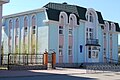 An office building
 -
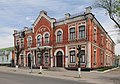 Late 19th century architecture
 -
 School building (mid-19th century)
 -
 Hotel Sofiivskyi
 -
 Uman University
 -
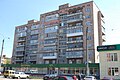 Soviet apartment blocks
 -
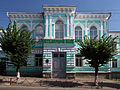 Agrotechnical college
 -
 Police department
 -
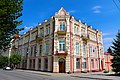 Sadova Street
 -
 Commercial Bank (mid-19th century)
 -
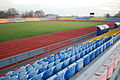 Tsentralnyi Stadium
,_%D0%B2%D1%83%D0%BB%D0%B8%D1%86%D1%8F_%D0%9D%D0%B5%D0%B1%D0%B5%D1%81%D0%BD%D0%BE%D1%97_%D0%A1%D0%BE%D1%82%D0%BD%D1%96_39.jpg)


.jpg)
.jpg)
.jpg)
.jpg)
,_%D0%A1%D0%B0%D0%B4%D0%BE%D0%B2%D0%B0_%D0%B2%D1%83%D0%BB._2.jpg)


See also
[edit]- Sofiyivka Park – a landscape park near the city
References
[edit]- ^ a b Чисельність наявного населення України на 1 січня 2022 [Number of Present Population of Ukraine, as of January 1, 2022] (PDF) (in Ukrainian and English). Kyiv: State Statistics Service of Ukraine. Archived (PDF) from the original on 4 July 2022.
- ^ "Уманська територіальна громада" (in Ukrainian). decentralization.gov.ua.
- ^ Magocsi, A History of Ukraine, 1996, p297
- ^ a b c d e f g h i j k "Uman". Encyclopedia of Ukraine. Retrieved 26 September 2011.
- ^ Paul Robert Magocsi "A History of Ukraine", Univ. of Washington Press 1996, p.300
- ^ Gembarzewski, Bronisław (1925). Rodowody pułków polskich i oddziałów równorzędnych od r. 1717 do r. 1831 (in Polish). Warszawa: Towarzystwo Wiedzy Wojskowej. p. 10.
- ^ Megargee, Geoffrey P.; Overmans, Rüdiger; Vogt, Wolfgang (2022). The United States Holocaust Memorial Museum Encyclopedia of Camps and Ghettos 1933–1945. Volume IV. Indiana University Press, United States Holocaust Memorial Museum. pp. 49, 350. ISBN 978-0-253-06089-1.
- ^ Всесоюзная перепись населения 1989 г. Численность городского населения союзных республик, их территориальных единиц, городских поселений и городских районов по полу
- ^ Умань // Большой энциклопедический словарь (в 2-х тт.). / редколл., гл. ред. А. М. Прохоров. том 2. М., "Советская энциклопедия", 1991. стр.525
- ^ "Про утворення та ліквідацію районів. Постанова Верховної Ради України № 807-ІХ". Голос України (in Ukrainian). 18 July 2020. Retrieved 3 October 2020.
- ^ "Нові райони: карти + склад" (in Ukrainian). Міністерство розвитку громад та територій України. 17 July 2020.
- ^ "Ukraine Casualties in the Hundreds As Civilians Bear Brunt of Russia's Attack". Newsweek. 24 February 2022.
- ^ "Death toll in Uman rises to 14 including 2 children". Ukrainska Pravda. 28 April 2023. Retrieved 28 April 2023.
- ^ Karolina Hird; Riley Bailey; Grace Mappes; George Barros; Layne Philipson; Frederick W. Kagan (28 April 2023). "Russian Offensive Campaign Assessment, April 28, 2023". understandingwar.org. ISW. Retrieved 29 April 2023.
Geolocated footage shows large-scale damage to a residential building in Uman, with the death toll reaching 20 civilians, including children, as of 1700 local time on April 28.
- ^ Rosa, Andrea; Arhirova, Hanna; Rising, David (28 April 2023). "Russian missile and drone attack in Ukraine kills 23 people". Associated Press.
- ^ "Cities & Towns of Ukraine".
- ^ "Рідні мови в об'єднаних територіальних громадах України" (in Ukrainian).
- ^ "All-Ukrainian population census". db.ukrcensus.gov.ua. State Statistics Service of Ukraine. Retrieved 21 July 2025.
- ^ "Uman Greenhouse Works". www.utk.org.ua. Retrieved 2 July 2025.
- ^ "Ukrainian beer company 'Umanpivo'. Ukrainian plant for the production of beer, cider". Umanpivo. Retrieved 2 July 2025.
- ^ a b c "Uman! Uman! Rosh HaShanah! A guide to Rebbe Nachman's Rosh HaShanah in Uman". Breslov.
- ^ Maimon, Nasan (2 September 2021). "Saving the Kever of Rebbi Nachman". Anash.org. Retrieved 21 July 2025.
- ^ "Єврейські громади всього світу вимушені просити уряд США захистити їхню святиню в Умані". www.golos.com.ua (in Ukrainian). 29 March 2024. Retrieved 21 July 2025.
- ^ "Uman Cemetery Marker". U.S Commission for the Preservation of America's Heritage Abroad. Retrieved 21 July 2025.
- ^ David M. Gitlitz & Linda Kay Davidson Pilgrimage and the Jews (Westport: CT: Praeger, 2006), 115-117.
- ^ Kaplan, Aryeh (1985). "Until the Mashiach: Rabbi Nachman's biography: an annotated chronology". Jerusalem/New York: Breslov Research Institute. Chapter 24: Uman 5570 (1810).
- ^ "Anyone in the world, be he the worst and most corrupt of sinners, would he come to my grave, give a penny to charity on my behalf and chant the Ten Mizmorim, then would I overturn the very Heavens on his behalf, and from the Most High of Heights would I descend to the Deepest Depths of Hell, to pull him out" (Breslov website (Hebrew) [1]).
- ^ See the article "A New Phase in Jewish-Ukrainian Relations" by Mitsuharo Akao
- ^ "Hasidic Jews celebrate holiday in Uman" Archived 2010-05-14 at the Wayback Machine Jewish Telegraphic Agency, 2008-10-02. Retrieved 2009-08-01.
- ^ "30,000 Israelis Heading to Uman for Rosh Hashanah". 5 September 2018.
- ^ Rosh Hashana in Uman: A Jewish anarchy By NATAN ODENHEIMER, 10/02/2016, Jerusalem Post
- ^ This year's Jewish New Year celebrations in Uman were unlike the previous years, Hromadske International, via Twitter. 4 October 2022.
- ^ [2] How Do You Say Shofar in Ukrainian? The strange and wonderful Hasidic pilgrimage to Uman, Ukraine., By Menachem Kaiser
- ^ "Пантери (Умань)". womensfootball.com.ua. Retrieved 16 October 2025.
- ^ "Uman Climate Normals 1991–2020". World Meteorological Organization Climatological Standard Normals (1991–2020). World Meteorological Organization. Archived from the original on 22 April 2025. Retrieved 22 April 2025.
- ^ "Uman, Ukraine Climate Data". Climatebase. Retrieved 5 November 2021.
- ^ "Міжнародні зв'язки". uman-rada.gov.ua (in Ukrainian). Uman. Retrieved 31 March 2020.
Bibliography
[edit]- (in Ukrainian) (1972) Історіа міст і сіл Української CCP - Черкаська область (History of Towns and Villages of the Ukrainian SSR - Cherkasy Oblast), Kyiv.
External links
[edit]

(in English) Uman in the Encyclopedia of Ukraine
- (in Ukrainian) Uman informational portal
- (in Ukrainian) Evening Uman. Uman informational portal and newspaper
- (in Ukrainian) Uman photos. Uman biggest photos collection portal
- (in Ukrainian) Uman videos. YouTube channel of videos of Uman
- The Remarkable-And Tragic History-Of a Ukrainian Jewish Town
- (in English) All about Uman Archived 2007-10-26 at the Wayback Machine
- History of Jewish Community in Uman
- Uman News and informational portal Archived 4 February 2017 at the Wayback Machine

| International | |
|---|---|
| National | |
| Geographic | |
| Other | |

Etymology
Name origin and historical variations
The name of Uman derives from the Umanka River, on whose banks the city is situated, with the river itself attested as early as 1497 in the Suprasl Chronicle under the form Uma.[6] The city's first documented mention as a settlement occurred in 1616, when it appeared in Polish records as a possession of the magnate Valentiy Kalynovskyi, then part of the Polish–Lithuanian Commonwealth.[2] Etymological analysis traces the hydronym to earlier Indo-European roots, with linguist Oleg Trubachev linking Uman' to the recorded form Oumena from circa 1000 AD, suggesting a pre-Slavic substrate influence potentially denoting a watercourse or marshy feature, though definitive consensus among philologists remains elusive.[7] Historical orthographic variations reflect linguistic and political shifts: in Polish sources, it appears as Humań; in Russian imperial documents, as Uman' (Умань); and in modern Ukrainian, consistently as Uman' (Умань), adhering to Cyrillic conventions established in the 19th century.[8] 18th-century European maps occasionally rendered it as Gumanie or Human', possibly influenced by phonetic transcription from local dialects or administrative Latinization, but these do not alter the core hydronymic basis. Speculative derivations, such as ties to Turkic-Tatar terms for "commander" or ancient tribal names like Kumania, lack support in primary archival evidence and are dismissed by scholars favoring the riverine origin.[7]Geography
Location and physical features
Uman is located in Cherkasy Oblast in central Ukraine, with geographic coordinates of approximately 48°45′N 30°13′E.[9] The city occupies the banks of the Umanka River, a 43 km-long tributary of the Yatran River that flows southeast of the urban area.[10] It lies roughly 188 km south of Kyiv along major transport routes.[9] The municipal territory covers an area of 41 km².[10] The physical landscape of Uman features flat to gently undulating plains characteristic of Ukraine's forest-steppe zone, with chernozem soils overlying loess deposits.[11] Elevations range from about 166 m to an average of 219 m above sea level.[10][12] Prominent physical features include the Sofiyivka Dendrological Park, a 180-hectare landscape garden with artificial waterfalls, grottos, and exotic plantings created between 1796 and 1806.[13] The urban layout centers on a historic core shaped by 18th- and 19th-century development around administrative and religious sites, extending outward to include planned residential and industrial zones from the 20th century.[14]Climate and environmental conditions
Uman experiences a humid continental climate (Köppen Dfb), marked by distinct seasons with cold, snowy winters and warm, humid summers.[15] Average annual temperatures range from about 8°C, with January mean lows near -7°C and July highs averaging 28°C; extremes can drop below -20°C in winter or exceed 35°C in summer. Precipitation averages 618 mm annually, fairly evenly distributed but with summer maxima from convective storms, totaling around 60-80 mm monthly in peak periods. Seasonal extremes include prolonged winter cold snaps and variable summer conditions prone to droughts or intense rainfall events causing localized flooding.[16] Historical records indicate occasional severe droughts, as in central Ukraine during the 2007-2010 period, reducing soil moisture and crop yields, alongside floods from spring snowmelt or heavy June-July rains, with events exceeding 50 mm/day recorded regionally.[17] Soviet-era infrastructure, including inadequate drainage systems, has historically worsened flood impacts by impeding runoff in the flat terrain.[18] Environmental conditions reflect intensive agriculture in the surrounding Cherkasy Oblast, where fertilizer and pesticide runoff pollutes local waterways like the Umanka River, elevating nutrient levels and risking algal blooms.[19] The Russo-Ukrainian War since 2022 has introduced disruptions, including halted environmental monitoring and increased unregulated waste from displaced activities, compounding baseline degradation without direct frontline combat in Uman itself.[20] Over the past century, temperatures have risen by about 1.8°C in the area, correlating with fewer frost days but no definitive shift in precipitation patterns.[21]History
Origins and medieval period
The territory encompassing modern Uman, situated along the Umanka River in the forested-steppe zone of central Ukraine, featured prehistoric settlements dating back to the Scythian era, with over 100 ancient sites and burial mounds documented in the broader Cherkasy region.[22] These early human activities were shaped by the area's geography, providing fertile land for agriculture yet exposing it to southward nomadic pressures due to its proximity to the Pontic-Caspian steppe. However, no direct archaeological evidence ties specific pre-medieval structures to the site of Uman itself, indicating sparse permanent habitation amid migratory threats.[22] During the Kyivan Rus' period (9th–13th centuries), the region served as a frontier zone, but sustained Mongol invasions beginning in 1237–1240 led to widespread devastation and depopulation across southern Rus' lands, including areas near Uman. Subsequent raids by Crimean Tatars and Nogai hordes in the 13th–14th centuries further emptied the steppe borders, with estimates suggesting thousands of captives taken annually from eastern European territories, disrupting settlement continuity. This causal dynamic—open plains facilitating rapid incursions—left the locale largely unfortified and underpopulated until the late medieval resurgence under Lithuanian rule.[23] The Grand Duchy of Lithuania incorporated the Podilia and adjacent territories by the mid-14th century, initiating border defenses against Tatar nomads through wooden stockades and watchposts, though Uman as a distinct settlement lacks pre-16th-century documentation. Systematic reconstruction efforts in the 15th century focused on repopulating vulnerable riverine sites for strategic control, leveraging natural barriers like the Umanka for rudimentary fortifications. The first verifiable record of Uman emerges in 1616 under Polish administration within the Bracław Voivodeship, describing it as a nascent border outpost amid ongoing defenses.[2][24]Polish–Lithuanian Commonwealth era
Uman entered the Polish–Lithuanian Commonwealth as part of the Bracław Voivodeship territories transferred from the Grand Duchy of Lithuania to the direct control of the Polish Crown via the Union of Lublin signed on July 1, 1569.[25] As a private magnate town, it was governed feudally by its noble owners, who held privileges granting extensive administrative, judicial, and economic authority over serfs and tenants, typical of the Commonwealth's latifundia system in Right-Bank Ukraine.[26] The Potocki family acquired ownership around 1652, consolidating control and developing fortifications amid ongoing border threats.[1] The local economy centered on agricultural production under serfdom, with peasants bound to the land and obligated to labor on noble estates, exporting grain through regional trade routes to Baltic ports—a cornerstone of the Commonwealth's export economy that fueled magnate wealth but exacerbated social tensions from exploitative labor demands.[27] Uman served as a regional hub for grain collection and fairs, though recurrent Cossack revolts disrupted commerce and highlighted the fragility of noble dominance over Orthodox Ruthenian populations resentful of Polish Catholic rule and associated leaseholders. In the 1670s, during the Polish–Ottoman War (1672–1676), the area faced intensified Ottoman and Crimean Tatar incursions, with local defenses mobilized to repel raids that threatened Podolian and Bracław frontiers, though Uman itself avoided full capture.) Cossack unrest peaked in the Koliivshchyna uprising of 1768, when Haidamak rebels under Maksym Zalizniak and Ivan Gonta—initially a Potocki militia officer—seized Uman in June, targeting Polish nobles, officials, and their Jewish intermediaries in a massacre that killed thousands and briefly established rebel control before royal forces suppressed the revolt.[28] This event, rooted in peasant grievances over serfdom and noble privileges, underscored the Commonwealth's internal destabilization from ethnic-religious divides and weak central authority.Russian Empire period
Uman was annexed by the Russian Empire in 1793 as part of the Second Partition of the Polish–Lithuanian Commonwealth, transitioning from Polish administration to imperial control within the Kiev Governorate, where it served as the seat of Uman uyezd.[29] This incorporation subjected the city to centralized governance aimed at Russification and resource extraction, with local economy centered on agriculture and trade amid a multiethnic populace including Ukrainians, Poles, and a growing Jewish community.[30] Tsar Nicholas I's reforms, enacted via the 1827 military conscription statute, imposed 25-year service on Jewish boys as young as 12 across the Pale of Settlement, including Uman, as a means to enforce assimilation through isolation from families and incentives for conversion to Orthodoxy.[31] These cantonist policies, which conscripted over 50,000 Jewish minors empire-wide by mid-century, bred widespread resentment due to their coercive nature and disruption of communal life, delaying broader emancipation and exacerbating socioeconomic divides between Jews, restricted to commerce and crafts, and Christian peasants.[32] Emancipation efforts remained limited, with Jews confined to the Pale until partial relaxations in the 1860s, perpetuating occupational stereotypes and interethnic friction. The late 19th-century expansion of Russia's rail network, including lines linking Kiev to Odessa, enhanced Uman's role in grain and sugar trade, spurring modest population growth from around 10,000 in the 1860s to over 30,000 by 1897.[33] However, ethnic tensions boiled over in anti-Jewish pogroms, part of empire-wide unrest following Alexander II's assassination in 1881 and during the 1905 Revolution; in Uman, specific outbreaks on August 6 and November 3, 1905, killed at least 14 Jews amid looting driven by economic competition and tacit official tolerance.[34] The 1897 imperial census recorded a substantial Jewish presence in Uman, comprising over 40% of residents by the pre-World War I peak, underscoring vulnerabilities to such violence fueled by tsarist policies restricting Jewish land ownership and mobility.[35] Industrialization efforts were minimal, with the city relying on agrarian processing rather than heavy manufacturing, amid broader imperial delays in regional development.Soviet Union era
Following the establishment of Soviet control over Uman in 1920, collectivization policies initiated in the late 1920s forcibly consolidated private farms into state-controlled collectives, disrupting local agricultural production in this central Ukrainian grain-growing region. These measures, aimed at extracting surplus for industrialization elsewhere in the USSR, culminated in the Holodomor famine of 1932–1933, which caused millions of deaths across Ukraine through grain requisitions exceeding harvest yields and blacklisting of non-compliant villages. Empirical records indicate excess mortality rates in rural districts of Cherkasy Oblast, encompassing Uman, reached tens of thousands, with survivors reporting widespread starvation and cannibalism amid policies that prioritized urban food supplies.[36][37] Industrialization drives under the Five-Year Plans prompted forced urbanization, shifting labor from decimated rural areas to emerging factories in Uman focused on agricultural machinery production and food processing to support collective farm outputs. By the 1930s, facilities manufacturing tractors, harvesters, and grain-handling equipment employed thousands, though output was hampered by shortages of skilled workers and raw materials, reflecting broader inefficiencies in Soviet central planning where quotas often exceeded realistic capacities. This urbanization, while stabilizing urban employment, exacerbated demographic strains from famine losses, with population figures in Uman dropping sharply from pre-1930 levels before partial recovery through internal migration.[38][39] During World War II, Nazi forces occupied Uman from August 1941 to March 1944, subjecting the city to intense destruction as a frontline hub in Operation Barbarossa, with widespread looting, forced labor, and mass executions. German units and local auxiliaries conducted pogroms, including a major anti-Jewish rampage on September 21, 1941, targeting Uman's pre-war Jewish community of several thousand; systematic killings by Einsatzgruppen and collaborators eliminated nearly all remaining Jews through shootings and ghetto confinement, contributing to Ukraine's "Holocaust by bullets" where over 1 million Jews perished. The occupation razed much of the urban infrastructure, leaving Uman in ruins upon Soviet liberation, with post-war assessments documenting severe infrastructural and human losses.[40][41] Post-war reconstruction under Stalin involved Stalinist purges targeting perceived nationalists and "kulaks" in Uman, with NKVD operations executing or deporting local officials and intellectuals amid broader Ukrainian campaigns that claimed tens of thousands of lives. Atheism drives closed synagogues, including Uman's main facility by the late 1930s and the last remaining one in the late 1950s, converting them into warehouses or clubs as part of state efforts to eradicate religious practice, reducing overt Jewish life to underground observance.[33][42] Under Khrushchev's thaw in the 1950s–1960s, mass housing projects introduced prefabricated khrushchevka blocks in Uman to address wartime overcrowding, providing basic apartments to industrial workers but plagued by poor construction quality, thin walls, and chronic shortages of utilities and space. Population stabilized around 50,000 by the 1970s–1980s per Soviet census data, reflecting slowed growth from war and famine demographics alongside Russification policies that suppressed Ukrainian language and identity in education and media, fostering cultural assimilation under centralized control.[43]Post-independence and Russo-Ukrainian War
Following Ukraine's declaration of independence on December 1, 1991, confirmed by a referendum with over 90% national support, Uman integrated into the new sovereign state as an urban-type settlement in Cherkasy Oblast, retaining its role as a regional administrative and cultural center amid the country's broader economic transitions and political instabilities.[44] The city experienced limited direct repercussions from the 2013–2014 Euromaidan protests, which primarily unfolded in Kyiv and western Ukraine, with no recorded major unrest or transformative local effects documented in Uman.[45] The escalation of the Russo-Ukrainian War into a full-scale Russian invasion on February 24, 2022, brought direct threats to Uman, located approximately 200 miles from frontline areas, through repeated aerial attacks targeting civilian infrastructure. A Kh-101 cruise missile strike on April 28, 2023, partially destroyed a nine-story apartment building, killing 23 civilians—including six children—and injuring at least 75 others, marking one of the deadliest single incidents against Ukrainian residential structures since the invasion began.[46][47] Additional strikes damaged energy and municipal facilities, contributing to localized blackouts and disruptions, though Uman avoided sustained ground combat or occupation.[48] These attacks prompted significant population displacement, with Uman's pre-war population of around 80,000 reduced by emigration and internal evacuation, exacerbating Ukraine's national trend of over 6 million refugees and millions more internally displaced by mid-2025. Infrastructure repairs relied heavily on international aid, including Western military and humanitarian assistance, which sustained basic services but highlighted dependencies on external funding amid stalled domestic reconstruction efforts.[49] Despite these challenges, annual Hasidic pilgrimages to Rabbi Nachman's tomb persisted as a marker of cultural continuity, drawing over 35,000 visitors—primarily from Israel—for Rosh Hashanah in September 2025, even under wartime risks and air raid alerts.[50][51] In July 2025, Ukraine's Cabinet of Ministers designated the tomb complex a monument of national significance, elevating its protection status and facilitating enhanced security measures ahead of pilgrimages. This move coincided with a bilateral Israel-Ukraine security agreement announced in September 2025, aimed at safeguarding pilgrims through coordinated evacuations, intelligence sharing, and emergency protocols, reflecting pragmatic cooperation amid ongoing hostilities.[52][53][54]Demographics
Population dynamics and trends
Uman's population stood at approximately 85,000 residents in the period immediately preceding Russia's full-scale invasion in February 2022.[55] [56] This figure reflected a gradual stabilization after decades of decline from higher levels recorded in earlier Soviet-era estimates, amid Ukraine's broader demographic challenges of sub-replacement fertility rates hovering around 1.1-1.2 children per woman and net out-migration. The 2022 invasion prompted significant population flux in Uman, with over 127,000 internally displaced persons (IDPs) passing through the city in the initial months as a reception hub, though many continued onward.[57] Concurrently, national emigration patterns—driven by conflict, economic disruption, and mobilization—resulted in a net outflow, particularly among working-age adults and youth, contributing to an estimated population of 81,525 by late 2022.[58] Ukraine-wide data indicate that such declines were amplified by a sharp drop in births, with the total fertility rate falling to 0.897 in 2022 from 1.148 in 2021, accelerating aging trends where the median age exceeded 41 years pre-war.[59] Post-2022 patterns show partial returns of some IDPs and emigrants amid stabilizing frontlines away from central Ukraine, yet sustained low birth rates (below 1.0) and ongoing emigration—estimated at 25% or more among youth cohorts in non-occupied regions—have prevented recovery, projecting further shrinkage unless reversed by policy interventions.[60] [61] Official Ukrainian estimates, derived from State Statistics Service extrapolations excluding occupied territories, underscore these dynamics without city-specific censuses since 2001, highlighting reliance on administrative data amid wartime constraints.[62]Ethnic, linguistic, and religious composition
According to the 2001 Ukrainian census for Cherkasy Oblast, of which Uman is the administrative center, ethnic Ukrainians comprised 93.1% of the population (1,301,200 individuals), ethnic Russians 5.4% (75,600), Belarusians 0.3% (3,900), and other groups including Poles, Jews, Tatars, and Moldovans totaling under 1% each.[63] These figures reflect a post-Soviet ethnic structure dominated by Ukrainians, contrasting with earlier imperial and Soviet eras when Russification policies diluted Ukrainian majorities through migration and cultural suppression; no national census has occurred since 2001 due to political instability and the ongoing war, though provisional estimates suggest minimal deviation in central regions like Cherkasy, potentially with reduced Russian shares from wartime emigration of Russian-identifying residents.[63] Linguistically, Ukrainian has asserted dominance since independence, reversing Soviet-era Russification that favored Russian in urban administration and education. National surveys indicate that by 2025, 68% of Ukrainians used Ukrainian in everyday life, up from 50% in 2022, with 62% speaking only Ukrainian at home; in central oblasts like Cherkasy, usage rates exceed national averages, approaching 80-90% post-2014 language laws mandating Ukrainian in public spheres.[64][65] Russian persists among some older residents and in private settings but has declined sharply since the 2022 invasion, as pro-Russian speakers faced social pressure and relocation amid national mobilization for Ukrainian-language unity.[64] Religiously, the resident population is predominantly Eastern Orthodox Christian, aligning with national patterns where over 60% identify as Orthodox (split between the independent Orthodox Church of Ukraine and the Moscow Patriarchate affiliate, though the former predominates post-2018 autocephaly).[66] The Jewish community numbers under 1% (fewer than 500 permanent residents as of 2019), diminished from historical peaks but culturally central due to Uman’s role as the burial site of Rebbe Nachman, drawing seasonal Hasidic pilgrims that temporarily swell the Orthodox Jewish presence by tens of thousands annually.[67] Other minorities, including Protestants and Muslims, constitute negligible shares, with post-Soviet revivals emphasizing Ukrainian Orthodox identity over diluted imperial religious mixes. The 2022 war has further homogenized affiliations, as Russian Orthodox ties waned amid geopolitical schisms, prompting shifts toward independent Ukrainian denominations.[66]Economy
Primary sectors and industries
Agriculture forms the backbone of Uman's primary economic sectors, with intensive cultivation of grain crops such as wheat, barley, and corn predominant due to the region's chernozem soils and favorable climate. Sugar beets are also a significant crop, historically tied to local processing facilities and contributing to the oblast's output of over 175,000 tons harvested in recent campaigns. These activities support employment in farming and related logistics, with private farms adapting through technology for yield optimization post-Soviet collectivization.[68][69] Light manufacturing complements agriculture, focusing on food processing for products like canned goods, dairy, and sugar refinement from local beets. Enterprises produce agricultural equipment, including machinery for planting and harvesting, fostering a localized supply chain that reduces import dependency. Pre-2022, these industries accounted for a substantial share of the city's industrial output, with food processing leveraging raw materials from surrounding fields.[68][70] Following Ukraine's independence in 1991, state-owned enterprises in Uman—such as sugar plants and machinery factories—underwent privatization in the 1990s, transitioning from central planning to market-oriented operations amid widespread corruption allegations that undermined efficiency gains. This shift integrated primary sectors into broader value chains, though persistent energy shortages from infrastructural decay led to verifiable production dips, prompting private adaptations like diversified crop rotations and modular equipment to mitigate intermittency.[71]Role of religious tourism
Religious tourism, centered on the annual pilgrimage to the tomb of Rebbe Nachman of Breslov, injects substantial revenue into Uman’s economy, with over 35,000 Hasidic pilgrims attending the 2024 Rosh Hashanah gatherings alone.[72][73] These visitors, predominantly from Israel, generate income through lodging, where weekly rents can reach $400 per person, transportation via routes often traversing Moldova due to wartime restrictions, and purchases from local vendors supplying food and essentials.[74][75] Estimates indicate the pilgrimage contributes over $20 million annually to the city, supporting sectors like hospitality and agriculture by channeling funds to farmers and service workers earning above-average wages of 10-12 hryvnias per hour during peak season.[76][74] Local authorities collect a tourist tax of 5% of the minimum wage from foreign pilgrims, yielding approximately 20 million hryvnias in preliminary 2025 estimates, which bolsters the municipal budget for infrastructure maintenance.[77][78] This seasonal economic surge offsets strains such as heightened cleanup costs—around 1.5 million hryvnias allocated for post-pilgrimage sanitation in the pilgrims' quarter—and temporary overcrowding, while creating jobs in policing, security, and vending that sustain year-round viability tied to the site's heritage status.[77] However, the pilgrimage's dominance as Uman's primary economic driver raises concerns about over-dependence, as disruptions from ongoing conflict could exacerbate vulnerabilities in the city's bus manufacturing and grain processing base.[79][80]Impacts of conflict and external factors
The Russian invasion of Ukraine beginning February 24, 2022, severely disrupted Uman's economy, primarily through nationwide export halts in agriculture and manufacturing, sectors central to Cherkasy Oblast's output including grain processing and bus production.[81] These blockades, compounded by Black Sea port closures, contributed to a national GDP contraction of 29.1% in 2022, with regional ripple effects inflating local unemployment beyond 20% amid factory slowdowns and labor displacement.[82] Western sanctions on Russia indirectly strained Uman's input-dependent industries via elevated global energy and fertilizer prices, exacerbating production costs for agrarian operations despite the city's distance from frontlines.[83] Infrastructure vulnerabilities, including power grid attacks affecting central Ukraine, necessitated repairs funded by international aid exceeding billions for energy restoration, though Uman-specific damages remained limited compared to eastern oblasts. Religious pilgrimage provided a partial economic offset, with over 30,000 Hasidic visitors in 2022 sustaining local services and generating revenue for accommodations and cleanup estimated in millions of hryvnias annually, despite heightened security expenditures.[80] Pre-invasion systemic corruption, reflected in Ukraine's Corruption Perceptions Index score of 32/100 in 2021, had undermined fiscal buffers and infrastructure maintenance, reducing adaptive capacity to wartime shocks per expert assessments of governance inefficiencies.[84] By 2025, escalating security concerns led to restrictions on large gatherings, threatening this tourism revenue stream.[85]Jewish Heritage
Rebbe Nachman and Breslov Hasidism
Rebbe Nachman of Breslov (April 4, 1772–October 16, 1810), great-grandson of the Baal Shem Tov—the founder of Hasidism—developed the Breslov variant of Hasidic thought, which prioritizes individual spiritual striving over communal structures or hereditary leadership. His teachings, compiled posthumously by disciple Rabbi Noson Sternhartz in works like Likutei Moharan, stress simcha (joy) as essential for overcoming despair and effecting tikkun (rectification) of personal and cosmic flaws amid worldly suffering, viewing joy not as fleeting emotion but as a deliberate antidote to existential fragmentation. Central to Breslov practice is hitbodedut, a form of solitary, unstructured prayer where adherents converse directly with God in everyday language, often in nature, to foster unmediated divine connection and self-examination.[86][87] In 1810, as his tuberculosis worsened, Nachman relocated from Ukraine's Breslov region to Uman, a city then under Russian imperial control with a sizable Jewish population, where he died and was interred in the local Jewish cemetery. This choice of burial site tied Uman irrevocably to his legacy, as he explicitly directed followers to visit his grave annually on Rosh Hashanah—the Jewish New Year—for prayer and renewal, promising, "My followers should come to me for Rosh Hashanah, and I will help them." He framed such visits as a means to draw sustenance from his spiritual influence, aligning with his broader doctrine that proximity to a tzaddik (righteous intermediary) aids in transcending personal limitations during judgment-laden holidays.[88][89] Breslov Hasidism disseminated primarily through Sternhartz's transcriptions of Nachman's oral lessons, eschewing a rebbe successor and emphasizing autonomous adherence to the founder's texts, which sustained the movement despite leadership vacuums. The Holocaust decimated Ukrainian Jewish centers, leaving Breslov adherents few in number, but post-1945 revival occurred via survivors who preserved manuscripts and oral traditions, particularly in Israel, where figures like Rabbi Levi Yitzchak Bender disseminated teachings from Jerusalem, enabling gradual expansion without reliance on dynastic authority. This textual fidelity underscores Uman's role as a fixed point of orientation in Nachman's system, distinct from other Hasidic groups' evolving hierarchies.[87][90]Historical Jewish community
Jews first settled in Uman during the 16th century, with significant community development occurring in the 18th century as the city emerged as a trading center under Polish-Lithuanian rule.[91] By the 17th century, Jewish arendators—leaseholders managing estates and taverns—had established economic footholds, often fostering local resentments documented in tax records for their intermediary roles in agriculture and distilling.[92] This influx contributed to Uman's Jewish population growth, though it was disrupted by the 1768 Haidamak uprising, which massacred thousands of Jews alongside Poles and Uniates in the city.[93] In the 19th century, Uman's Jews dominated the shtetl economy through crafts such as tailoring and blacksmithing, as well as distilling and tavern management, comprising a substantial portion of urban trade amid Russian imperial rule after 1793.[33] These roles, while economically vital, intensified antisemitic tensions, evidenced by periodic violence and restrictions. By the early 20th century, the community numbered several thousand, but civil war pogroms in 1919 claimed over 400 lives in multiple attacks by passing troops.[24][33] World War II devastated Uman's resident Jewry; pre-war population exceeded 13,000, concentrated in a ghetto established near the bazaar in 1941, which German forces liquidated through mass shootings at the Jewish cemetery starting October 8, 1941, exterminating nearly all inmates.[94] Post-war Soviet policies stifled revival, with the remnant community—reduced to a few hundred by 1926 figures—facing assimilation pressures via Yiddish schools and kolkhozes, though religious practice was curtailed.[24] Emigration waves in the 1970s and especially 1990s, amid perestroika and Ukraine's independence, further depleted numbers, as Soviet Jews, including those from Uman, migrated en masse to Israel and the United States, leaving minimal resident presence by the late 20th century.[95]Cemetery and burial sites
The Jewish cemetery in Uman, established in the 18th century, contains over 20,000 graves from the local Jewish community, including mass burial sites for victims of historical pogroms. The site's focal point is the ohel enclosing the tomb of Rebbe Nachman of Breslov, who was buried there in October 1810 next to remains from the 1768 Haidamak massacre; the structure was expanded in the post-Soviet 1990s amid rising pilgrimage demands and efforts to reclaim control from local non-Jewish authorities.[29][96] Mass graves within or adjacent to the cemetery hold thousands of victims from the 1768 Uman massacre, during which Haidamaks and peasants killed between 2,000 and 20,000 Jews, Poles, and Ukrainian Uniates, often torturing and burying them in shallow pits. World War II added further mass graves, as Nazi forces and collaborators exterminated Uman's remaining Jewish population of around 7,000, with executions and burials documented in regional Holocaust records, though precise cemetery-specific counts remain limited due to wartime destruction and incomplete postwar surveys.[97][33] Preservation challenges include sporadic vandalism, such as the 2021 desecration of the grave of Rebbe Nachman's daughter with pig remains, highlighting tensions despite state protections. In July 2025, Ukraine's Cabinet of Ministers upgraded the Nachman tomb to national heritage status, enabling enhanced conservation funding, including a $2 million renovation project to address deterioration from weather and heavy foot traffic.[98][53][99] Maintenance records from Jewish heritage organizations emphasize ongoing tombstone mapping and site stabilization to prevent further erosion, prioritizing archaeological documentation over ritual expansions.[100]Pilgrimage and Religious Significance
Annual Rosh Hashanah gatherings
The annual Rosh Hashanah gatherings in Uman attract tens of thousands of pilgrims, primarily Breslov Hasidim, who converge on the city for communal prayers and rituals despite ongoing conflict and official travel warnings from governments including Ukraine and Israel.[101][50] In 2023, over 35,000 attendees participated, marking an increase from approximately 20,000 in 2022; similar figures of around 35,000 were reported for 2024, with estimates reaching 38,000 for 2025 according to the United Jewish Community of Ukraine.[102][51][103] Central practices include intensive prayer sessions, the sounding of the shofar—a ram's horn instrument symbolizing spiritual awakening—and the Tashlich ceremony, where participants gather at nearby bodies of water to symbolically cast away sins through recitation and gestures.[104][105][80] Pilgrims also engage in all-night Torah study sessions and ritual immersions in mikvehs for purification, often culminating in festive meals featuring symbolic foods such as apples dipped in honey for a sweet year and pomegranates representing abundance.[103] These activities persist amid air raid risks, with eyewitness reports from media embedded in Uman describing continuous chants, music, and dances filling the streets around the ohel from eve to eve.[5] The scale of these gatherings has expanded significantly since the 1990s, when only a few dozen pilgrims attended annually, evolving into a mass phenomenon driven largely by organized groups from Israel, with numbers surging to tens of thousands by the 2000s through coordinated travel and promotion.[54][106] Security measures have adapted accordingly, including a 2025 bilateral agreement between Israel and Ukraine establishing joint protocols for police coordination, medical evacuations, and volunteer support to protect attendees amid wartime threats.[54][107][105] This pact involves enhanced monitoring and rapid response teams, reflecting logistical evolution to sustain the event's continuity.[108]Organizational and logistical aspects
The logistics of the annual Rosh Hashanah pilgrimage to Uman are coordinated through a combination of volunteer-led initiatives from Jewish organizations and official support from Ukrainian local authorities, with supplementary international cooperation primarily between Israel and Ukraine. Volunteer networks, such as those operated by United Hatzalah, establish on-site medical response infrastructure, including emergency teams stationed near key gathering areas to handle health needs amid the influx of tens of thousands of visitors. These efforts extend to provisioning food and basic supplies through community-driven distributions, reducing reliance on strained public resources during peak periods.[54] Transportation hubs experience significant pressure from the surge in arrivals, primarily via charter flights from Israel and other countries, supplemented by buses and trains; to mitigate bottlenecks, temporary enhancements like additional border personnel and airport facilities are implemented under bilateral agreements.[109] Local authorities in Uman reinforce infrastructure around the Rabbi Nachman memorial complex, deploying extra police for crowd control and security, while the city council manages economic inflows through a streamlined tourist tax system requiring pilgrims to pay 5% of Ukraine's minimum wage, which funds municipal budgets and ensures revenue transparency.[103][110][78] Since Russia's full-scale invasion in 2022, adaptations have included heightened joint security protocols between Ukrainian and Israeli entities, focusing on police, medics, and volunteer deployments to safeguard against wartime risks, though pilgrim numbers have fluctuated—dropping initially but rebounding to over 30,000 in 2025 without fully halting the event.[54][50] These measures prioritize operational continuity, with local planning calibrated to annual peaks via budgeted reinforcements rather than permanent expansions, balancing self-organized community efforts against state-managed oversight.[72]Controversies and societal tensions
Local residents in Uman have frequently raised concerns over disruptions caused by the influx of tens of thousands of Hasidic pilgrims during Rosh Hashanah, including noise from large gatherings and music, litter accumulation in streets and near the cemetery, and temporary spikes in rental prices that locals attribute to price gouging by landlords and vendors catering to visitors.[111][112] These issues have led to tensions, with reports of acrimony escalating into physical altercations between pilgrims and residents, as well as accusations of petty theft during the event.[111] Incidents of vandalism against Jewish sites, such as graffiti on the tomb of Rebbe Nachman, and assaults on pilgrims have occurred periodically, with Ukrainian authorities noting that such attacks are not isolated but often underreported due to victims' reluctance to engage with local police.[113][114] The ongoing Russo-Ukrainian war has intensified debates over the pilgrimage's risks, as families, including those with children, continue to attend despite repeated advisories from multiple governments warning against travel to Uman due to missile strikes, air raid threats, and inability to guarantee safety for mass gatherings.[115][116][117] Ukrainian officials have explicitly urged pilgrims to stay away, citing Uman's proximity to conflict zones and the diversion of security and medical resources needed for wartime defense to manage the event, which strains local infrastructure already burdened by blackouts and evacuations.[50][103] While the pilgrimage provides an economic boost through pilgrim spending on lodging and services—estimated to benefit local businesses during departures in 2025—critics argue it fosters dependency on transient tourism amid national crisis, potentially exacerbating unreported crimes like drug-related incidents and brawls that overwhelm understaffed law enforcement.[77][118][109] Some observers have critiqued the event as imposing a foreign cultural dynamic on Uman, where the Hasidic influx temporarily alters the town's Orthodox Christian character with visible religious practices and large-scale partying that locals view as disruptive to daily life and community norms.[112] This has fueled broader societal tensions, including occasional resistance from Ukrainian authorities considering restrictions on entry, though no outright ban materialized in 2025 despite pre-event threats tied to security concerns.[85][119] The Israeli government's allocation of approximately 10 million shekels (about $2.7 million) in 2025 to subsidize the pilgrimage—covering logistics like chartered flights—has drawn domestic backlash for prioritizing the event over war-related needs, highlighting opportunity costs in resource allocation during heightened conflict.[120][121][122]Education and Science
Key institutions and developments
The Uman National University of Horticulture, founded in 1844 as a gardening school and elevated to university status post-independence, stands as the region's leading institution for agricultural higher education, with faculties dedicated to agronomy, horticulture, ecology, and engineering technologies. It enrolls over 6,000 students in 13 undergraduate programs across 19 specialties, including postgraduate and doctoral training in 18 majors, emphasizing practical agrotechnical skills through experimental farms and laboratories.[123][124][125] Soviet-era research infrastructure, including agronomic experimental stations established in Uman for crop testing and breeding, has persisted into the post-Soviet period, supporting ongoing applied research in fruit, vegetable, and grain technologies. These facilities, integrated into the university's operations, facilitate field trials and variety development that align with regional horticultural needs.[126][127] After Ukraine's 1991 independence, the university gained national designation in 1998, while affiliated vocational institutions underwent privatization, expanding access to agrotechnical training programs tailored to market demands in farming machinery, soil management, and plant protection. It now oversees seven vocational colleges in Cherkasy and Odesa oblasts, delivering certificate-level education focused on hands-on agrotech competencies, with enrollment emphasizing short-cycle programs to address labor shortages in agriculture.[128] The 2022 Russian invasion prompted shifts to hybrid and online delivery at the university and colleges to sustain enrollment amid infrastructure strains and student mobilization, though Cherkasy region's relative stability limited full closures compared to eastern oblasts; learning outcomes have shown declines in practical fieldwork due to disrupted access to experimental sites.[129][130] Key scientific outputs include patents from university researchers, such as Ukrainian Utility Model Patent No. 129205 (2020) for breeding materials in spring emmer wheat (Triticum dicoccum), contributing to resilient crop varieties amid climatic variability.[131]Scientific contributions and challenges
The Uman National University of Horticulture, established in 1844 as the Main School of Horticulture and relocated to Uman, pioneered advancements in fruit tree cultivation, ornamental gardening, and viticulture through experimental stations and applied research in the late 19th and early 20th centuries.[132][133] Researchers such as V.V. Pashkevych developed techniques for regional adaptation of crops, contributing to Ukraine's early horticultural industry by enhancing yield stability and pest resistance in southern soils.[134] By the mid-20th century, these efforts extended to soil science, with studies on agrochemical properties and fertility management that informed national farming practices.[135] In contemporary terms, the university maintains 14 research laboratories focused on plant breeding and sustainable agriculture, yielding innovations like adaptive potato varieties for the Forest-Steppe region and commercialized projects in fruit production as of 2012.[136][137] These outputs, disseminated via the Bulletin of Uman National University of Horticulture, emphasize practical applications in soil conservation and crop resilience, though publication metrics remain modest compared to global benchmarks.[138] Post-2014 political instability and the ongoing war have exacerbated brain drain in Ukrainian science, with an estimated 10% drop in research publications since 2022, including losses of skilled personnel from institutions like Uman National University of Horticulture.[139] Systemic corruption, reflected in Ukraine's 2024 Corruption Perceptions Index score of 35/100 (ranking 105th globally), further impedes grant allocation and research funding, favoring patronage over merit in academic projects.[140] Despite these hurdles, applied agricultural research in Uman demonstrates wartime resilience, with adaptations in crop diversification and soil management sustaining output amid disruptions; for instance, family farms and institutional trials have maintained productivity through decentralized, low-input strategies.[141][142]Notable Individuals
Historical figures
Franciszek Salezy Potocki (1700–1772), a Polish-Lithuanian nobleman and voivode of Kyiv, acquired Uman through family inheritance and served as its primary magnate in the mid-18th century. He initiated the restoration of the city in the late 1750s, transforming it into a key commercial hub by organizing annual fairs that drew merchants from Poland, Ukraine, Turkey, Armenia, and Russia, thereby boosting regional trade networks centered on grain, cattle, and textiles.[24][93] Potocki's administration included maintaining a private Cossack militia to secure the estate, which played a role in local defense but contributed to tensions culminating in the 1768 Koliyivshchyna uprising. Under his ownership, Uman experienced economic growth, with population increases supporting fortified trade routes, though this prosperity was disrupted by the haidamaka revolt that captured the city.[143] Ivan Gonta (?–1768), a Cossack captain in Potocki's household militia stationed in Uman since 1757, defected during the uprising led by Maksym Zalizniak, enabling the rebels to seize the fortress on June 20–21, 1768. Gonta's forces, numbering several hundred, joined approximately 2,000 haidamaks, resulting in the massacre of up to 20,000 residents, primarily Poles, Jews, and Ukrainian Catholics, amid widespread pillaging. He was subsequently captured, tried, and executed by quartering in Kyiv.[143] Maksym Zalizniak (ca. 1740–after 1794), a former imperial soldier and haidamaka leader from near Chyhyryn, commanded the rebel advance on Uman after taking Cherkasy and Korsun, proclaiming himself hetman upon entry. His forces exploited grievances over serfdom and religious oppression, coordinating with Gonta to breach defenses, which marked a peak of the uprising's violence before Russian intervention dispersed the rebels. Zalizniak was imprisoned in Siberia but later pardoned.[144]Contemporary personalities
Oleksandr Tsebrii (1974–2024) served as mayor of Uman from 2015 to 2020, focusing on local infrastructure and administrative reforms in the post-Soviet era.[145] In February 2022, following Russia's full-scale invasion of Ukraine, Tsebrii enlisted in the Armed Forces, rising to platoon commander in the 58th Separate Motorized Infantry Brigade, where he led assault operations until his death on July 24, 2024, near Pokrovsk in Donetsk Oblast.[146] Posthumously awarded the Hero of Ukraine title on December 9, 2024, for his military contributions, Tsebrii exemplified civic leadership transitioning to frontline defense amid the ongoing conflict.[147] Iryna Pletnyova, mayor since 2020, has managed Uman's response to wartime challenges, including converting public facilities into shelters and prioritizing education for over 1,000 internally displaced children fleeing frontline areas since 2022.[57] She has coordinated logistics for annual Hasidic pilgrimages despite security risks, noting in 2022 that insufficient bomb shelters limited safety guarantees for up to 40,000 visitors, while balancing resident concerns over resource strain.[148] Alla Marchenko, a scholar born in Uman, researches the city's role as a Hasidic pilgrimage center, drawing on her local background to analyze Rabbi Nachman's legacy and modern visitor dynamics through ethnographic studies.[149] Her work, supported by fellowships, documents global influences on Uman's cultural identity, including post-Soviet adaptations of religious tourism.[149]International Relations
Twin towns and partnerships
Uman maintains formal twinning agreements with several international cities, primarily aimed at fostering cultural exchanges, educational collaborations, and humanitarian aid, particularly intensified following Russia's 2022 invasion of Ukraine. These partnerships emphasize practical mutual support, such as financial assistance for infrastructure repair and refugee aid, over ceremonial symbolism.[150][151]| Partner City | Country | Established | Key Benefits |
|---|---|---|---|
| Davis | United States | 1988 | Provided humanitarian aid including funds for refugee support and medical supplies during the 2022 Russian invasion; ongoing cultural and educational exchanges.[150][57] |
| Częstochowa | Poland | 2019 | Youth exchange programs and community development initiatives; facilitated cross-border cooperation on historical and religious heritage projects.[152] |
| Kristianstad | Sweden | 2025 | Formalized on June 10, 2025, focusing on municipal resilience, urban planning support, and post-war recovery assistance through EU-aligned networks.[151] |