


Community hub
Recent from talks
Contribute something
Nothing was collected or created yet.
VARTA
View on Wikipedia | This article has multiple issues. Please help improve it or discuss these issues on the talk page. (Learn how and when to remove these messages)
|


Key Information


VARTA AG (pronounced [ˈvaʁta]; German: Vertrieb, Aufladung, Reparatur transportabler Akkumulatoren, lit. 'distribution, recharging and repair of portable accumulators') is a German company manufacturing batteries for global automotive, industrial, and consumer markets.
History
[edit]VARTA was founded by Adolph Müller in 1887, and established in 1904 as a subsidiary of Accumulatoren-Fabrik AFA.[1] After World War I, VARTA together with AFA was acquired by German industrialists Günther Quandt and Carl Hermann Roderbourg.[2] After World War II, most of the VARTA shares passed from Günther Quandt to his son Herbert Quandt. The subsidiary in East Berlin was later occupied by the Soviet Union, and was named BAE Batterien.
In 1977, VARTA's businesses were split up by Herbert Quandt; battery and plastics operations were retained in VARTA, but the pharmaceuticals and specialty chemical businesses were transferred to a new company called Altana and the electrical business was spun off into a company called CEAG. Quandt left the company's shares to his children.[citation needed]
In 2002, the consumer battery activities (excluding button cells) were sold to Rayovac. By 2006, VARTA had sold all its operating divisions, and the Quandts had sold their shares. VARTA then liquidated its remaining assets, contracts, liabilities and shareholdings, in particular the manufacture and sale of VARTA batteries, while continuing its company businesses.[citation needed] The automotive battery business was acquired by Johnson Controls, and were sold on to Brookfield Business Partners in 2018.[3] The button cell and home energy storage businesses were acquired by Montana Tech Components.[citation needed] In 2019, VARTA acquired its former consumer battery business back from Energizer.[4]
On 19 October 2017, 11.6 million shares of VARTA were floated on the stock market (Prime Standard[further explanation needed]), with an additional 1.74 M bought by underwriters (green shoe[further explanation needed]), out of a total of 38.2 M shares.[failed verification] With an issue price of €17.50 the company had a value of €668.5 million.[5][6] On 2 January 2019, American company Energizer took control over VARTA's consumer battery segment.[7][8] On 29 May 2019, VARTA signed an agreement to acquire the VARTA consumer batteries business for the Europe, Middle East and Africa regions (including the manufacturing and distribution facilities in Germany) from Energizer, which was completed on 2 January 2020.[9][10]
In 2020, the German- and the state of Baden-Württemberg government gave VARTA €300 million for the construction of a production facility for electric vehicle (EV) lithium-ion batteries, based on the "Important Projects of Common European Interest" (IPCEI) initiative, but the company decided to abandon the project two years later to cut cost. In 2023 they cut 800 jobs.[11][12]
An attack on their IT systems in February 2024 forced production down for a month[13] and prevented the scheduled Annual general meeting in May 2024, with the news resulting in a temporary exchange loss of some 8.4%.[14]
By June 2024 VARTA had accumulated debt of nearly €500 million and informed the Amtsgericht Stuttgart about a major restructuring.[11] According to press reports from July 2024, the company intended to reduce its nominal capital to zero, which would devaluate its stock.[11] Martin Buchenau commented in the Handelsblatt in late July 2024, that while minor shareholders are destined to lose everything, major shareholder Michael Tojner and Porsche are entangled in a bitter fight with creditors about who will give up how much of the money they lent to VARTA.[15] Along those lines, in August 2024 a compromise was reached: the shareholders lose their stock, the banks write off €285 million of VARTA's debt, Porsche and Tojner make a new combined investment of €60 million and become the owners of VARTA.[16] The deal was based on the 'Act on the Stabilization and Restructuring Framework for Companies' (Gesetz über den Stabilisierungs- und Restrukturierungsrahmen für Unternehmen, StaRUG) from 2021. Under the act, a majority of creditors have to agree to a restructuring plan, then approval of shareholders can be substituted by a court decision, preventing the shareholders from blocking their own sequestration.[17]
In October 2024, Germany's Federal Cartel Office approved Porsche's acquisition of a non-controlling interest in VARTA as well as a majority of shares and sole control of V4Drive Battery, its business unit for large-format lithium-ion cells for electric cars.[18]
Products
[edit]-
 Poliflex-Accumulator from VARTA microbattery
 -
 Rechargeable batteries from VARTA
 -
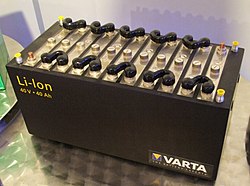 Lithium-ion-accumulator
 -
 Zinc–carbon battery: monocel with the design of the 1970s
 -
 Battery from Pertrix
 -
 VARTA Pertrix 74, 15-volt battery
 -
 Coin cells from VARTA
 -
 VARTA combi charger with two VARTA NiCd accumulators (2100 mAh, AA)
 -
 LED-torch light produced by VARTA
 -
 VARTA solar charger model 57082 with two 2100 mAh Ni–MH rechargeable batteries


References
[edit]- ^ "VARTA History". VARTA. Archived from the original on 22 January 2017. Retrieved 26 March 2015.
- ^ "VARTA Founder Villa Roderbourg history". Villa. Retrieved 2 December 2024.
- ^ "Johnson Controls sells Varta Battery - Auto Repair Focus". autorepairfocus.com. 20 November 2018. Retrieved 19 August 2024.
- ^ "VARTA AG buys back its consumer batteries business". evertiq.com. 2019. Retrieved 19 August 2024.
- ^ "Angaben zum Unternehmen". Frankfurt Stock Exchange. 20 October 2017. Archived from the original on 21 October 2017. Retrieved 2 December 2024.
- ^ VARTA AG beendet Angebotszeitraum vorzeitig und legt Emissionspreis bei 17,50 Euro je Aktie fest, Presse release Varta AG at dgap.de, 18 October 2017 (written in German language)
- ^ Manager-Magazin.de: Energizer übernimmt Varta-Batterien
- ^ "Energizer Holdings, Inc. Announces the Closing of the Spectrum Brands' Battery and Portable Lighting Business Acquisition". 2 January 2019. Retrieved 1 February 2022.
- ^ "VARTA AG acquires VARTA Consumer Batteries business from Energizer". 29 May 2019. Archived from the original on 1 February 2022. Retrieved 1 February 2022.
- ^ "VARTA AG successfully completes acquisition of VARTA Consumer Batteries business from Energizer". 2 January 2020. Archived from the original on 1 February 2022. Retrieved 1 February 2022.
- ^ a b c Clemens Schreiber: "Restrukturierung auf Schwäbisch", TAZ, 23 July 2024
- ^ "Europa entdeckt Batterieproduktion" TAZ, 1 December 2020, retrieved 17 June 2025
- ^ "Hackerangriff auf Varta: Produktion erst nach einem Monat wieder angelaufen" unternehmen-cybersicherheit.de, 13 March 2024
- ^ "Varta-Aktie knickt ein: Verschiebung von Jahresabschluss und Hauptversammlung" finanzen.net, 15 March 2024
- ^ "Varta ist der GAU für Kleinaktionäre" Handelsblatt.de, 25 July 2024
- ^ "Varta ist der GAU für Kleinaktionäre" Porsche steigt bei Varta ein – Banken müssen bluten, 18 August 2024
- ^ Dr. Thomas Hausbeck: "Wenig Chancen für private Varta-Aktionäre" lto.de, published 17 September 2024, retrieved 18. September 2024
- ^ Miranda Murray (31 October 2024), German cartel office approves Porsche's sole control of Varta's V4Drive Reuters.
External links
[edit]

| Brands |  | |
|---|---|---|
| Subsidiaries | ||
| Affiliates | ||
| People | ||
| Related topics | ||
| ||

| International | |
|---|---|
| National | |
VARTA
View on GrokipediaVARTA AG is a German battery technology company founded in 1887 by Adolf Müller and headquartered in Ellwangen, Baden-Württemberg, that develops, produces, and markets micro batteries, household batteries, lithium-ion small cells, battery packs, and energy storage systems for consumer, industrial, and high-tech applications.[1][2][3]
With more than 130 years of experience, the company has pioneered battery innovations, including powering early electric vehicles in 1893, Fridtjof Nansen's North Pole expedition, Neil Armstrong's moon landing, and operations on the International Space Station.[1][3]
VARTA AG employs approximately 4,200 people across five production facilities in Europe and Asia, serving over 75 countries, and positions itself as a leader in sustainable, high-performance energy solutions, particularly in microbatteries for hearing aids and lithium-ion technologies for portable devices and stationary storage.[4][2]
While its automotive battery division operates separately under Clarios LLC, VARTA AG maintains focus on non-vehicle segments, emphasizing research and development to advance battery safety, efficiency, and environmental standards.[2]
Overview
Company Profile
VARTA AG is a German battery manufacturer founded in 1887 and headquartered in Ellwangen, Baden-Württemberg.[5][6] The company operates as a subsidiary of Montana Tech Components AG following a financial restructuring completed in early 2025, which included a capital reduction to zero, a subsequent capital increase, and delisting from the Frankfurt Stock Exchange.[7][8] VARTA AG engages in the research, development, production, and sale of micro batteries, household batteries, large-format lithium-ion batteries, and energy storage systems for automotive, industrial, consumer, and high-tech applications.[9] The company emphasizes high-end energy storage solutions, including lithium-ion cells and microbatteries tailored for demanding environments such as renewable energy integration and specialized industrial uses.[4][10] VARTA's strategic positioning targets growth in booming segments like lithium-ion systems for electric vehicles and stationary storage, leveraging over 130 years of battery technology expertise for reliable performance in extreme conditions, including space and expedition applications.[4][11] In fiscal year 2024, VARTA AG generated revenue of €793.2 million, operating through key segments focused on lithium-ion solutions, microbatteries, and consumer products amid efforts to stabilize following financial pressures.[12][10]Core Business Segments
VARTA AG's core business is structured around two primary segments: Lithium-Ion Solutions & Microbatteries, and Household Batteries.[10] The Lithium-Ion Solutions & Microbatteries segment encompasses the development and production of advanced rechargeable cells and packs, targeting high-tech applications such as medical devices, Internet of Things (IoT) systems, and automotive components, alongside primary microbatteries for specialized uses like hearing aids and wearables.[12] This division positions VARTA as a market leader in microbatteries, leveraging proprietary technologies for compact, reliable power sources in precision electronics.[13] The Household Batteries segment supplies primary and rechargeable batteries to end consumers, including alkaline cells for household devices and lead-acid starters for automotive applications.[14] It maintains a broad portfolio serving everyday power needs while integrating sustainable rechargeable options.[12] Following the completion of its recapitalization on April 1, 2025, VARTA AG streamlined operations by divesting non-core units, such as the V4Drive business to Porsche on March 4, 2025, to concentrate resources on these segments.[15] [16] The company now prioritizes expansion in high-end lithium-ion technologies and European innovation leadership for energy storage, aiming to capitalize on demand in industrial and customized solutions.[16] This strategic refocus supports diversified revenue from consumer, industrial, and emerging tech markets without reliance on large-scale automotive cell production.[12]History
Founding and Early Development (1887–1945)
Adolf Müller established the Accumulatoren-Fabrik Tudorschen Systems Büsche & Müller OHG in Hagen, Germany, in 1887, laying the foundation for VARTA as a manufacturer of rechargeable lead-acid accumulators. These early batteries targeted emerging electrical applications amid rapid technological advancements, including the internal combustion engine and early electric devices.[5][3] The venture recognized the growing demand for reliable energy storage in Germany's industrializing economy, producing accumulators suited for higher-power needs rather than low-current primaries.[17] By the early 1900s, the company had integrated into Accumulatoren-Fabrik AG (AFA) as a subsidiary in 1904, enabling scaled production for industrial and vehicular uses. Accumulators powered the German postal service's electric vehicles from 1909 onward, supporting urban logistics during electrification efforts.[18] VARTA's products also proved durable in extreme environments, with accumulators employed in polar expeditions, such as North Pole ventures, highlighting their robustness for remote, low-maintenance power.[5] Automotive adoption accelerated by 1914, as lead-acid batteries became standard for reliable engine starting in Germany's expanding motor industry.[19] The interwar period saw further diversification amid post-World War I restructuring, including acquisition by industrialists Günther Quandt and Carl Hermann Roderbourg. In 1926, AFA acquired Pertrix Chemische Fabrik AG, pioneers of storable dry-cell batteries, introducing VARTA to primary cells for portable devices like flashlights and signaling equipment.[20] This complemented accumulator lines, addressing low-current demands in telecommunications and consumer goods during Germany's industrial boom. Factory expansions in Hagen and Berlin supported output growth, aligning with national electrification and automotive surges.[18] By the 1930s, VARTA's dual focus on rechargeable storage and dry cells positioned it as a key supplier, though wartime demands from 1939 to 1945 shifted production toward military applications, including batteries for vehicles and equipment.[21]Post-War Expansion and Innovations (1945–1990s)
Following World War II, VARTA rebuilt its operations under Herbert Quandt's leadership, prioritizing rechargeable batteries for emerging consumer electronics and the growing automotive sector.[22] The company shifted focus to mass production advancements from 1955 onward, implementing innovations that reduced manufacturing costs and enhanced battery maintenance for vehicles and industrial machinery.[3] VARTA advanced nickel-cadmium (NiCd) technology, producing sealed rechargeable cells suitable for portable devices and space applications. In 1969, VARTA microbatteries powered the integrated motors of Hasselblad cameras used on the Apollo 11 mission, enabling film advancement during the first moon landing.[23] These NiCd batteries demonstrated reliability in extreme conditions, contributing to VARTA's reputation in high-performance energy storage. In 1977, VARTA underwent a strategic split orchestrated by Herbert Quandt, separating its battery and plastics divisions—which remained under VARTA—from pharmaceuticals and chemicals, later forming Altana AG. This restructuring enabled deeper specialization in automotive and microbattery segments.[22] Post-1970, VARTA introduced the leak-proof Varta Super Dry automotive battery, a key innovation that prevented electrolyte spills and improved safety in vehicle applications.[17] By the 1990s, VARTA had solidified its market position through expanded production of NiCd rechargeables for consumer goods like flashlights and chargers, alongside ongoing refinements in automotive lead-acid batteries for mass-market vehicles.[3] These developments underscored VARTA's pivot toward durable, high-cycle-life solutions amid rising demand for portable power.[22]Ownership Changes and Restructuring (2000s–2010s)
In the early 2000s, VARTA underwent major divestitures to streamline operations amid competitive pressures in the battery sector. On October 1, 2002, Rayovac Corporation completed the acquisition of VARTA's global consumer battery business—excluding button cells—for approximately $262 million, integrating it into Rayovac's portfolio to expand international reach and achieve combined annual sales exceeding $1 billion.[24][25] Concurrently, in November 2002, Johnson Controls Inc. purchased the automotive battery division, allowing VARTA to refocus on specialized segments like microbatteries.[26] These transactions, driven by market consolidation and the need for capital efficiency, resulted in the consolidation of microbattery activities under VARTA Microbattery GmbH, with ownership transferring to Swiss-based Montana Tech Components AG following the restructuring.[5] Under Montana Tech Components' stewardship through the 2010s, VARTA prioritized expansion in lithium-ion technologies, capitalizing on surging demand for high-performance cells in portable devices and emerging electric vehicle applications, which supported revenue growth in niche markets.[5] This period involved internal restructuring to enhance production capabilities and innovation in energy-dense batteries, positioning the company for independence amid the global battery boom fueled by consumer electronics proliferation and automotive electrification trends. To achieve full operational autonomy and finance further scaling, VARTA AG was established as the parent holding company, culminating in an initial public offering on the Frankfurt Stock Exchange's Prime Standard segment on October 19, 2017.[27] The IPO priced shares at €17.50 each, raising approximately €190 million through a capital increase, which enabled debt reduction and investments in lithium-ion capacity without reliance on prior owners.[28] This listing marked VARTA's transition to public status, emphasizing self-directed strategic control.[29]Recent Financial Challenges and Recapitalization (2020s)
In the early 2020s, VARTA AG pursued aggressive expansion into lithium-ion batteries for electric vehicles (EVs), investing heavily in capacity amid anticipated market growth, but encountered setbacks from slower-than-expected EV adoption in Europe and intensified competition from low-cost Asian manufacturers, particularly in China.[30][31] Supply chain disruptions, including raw material volatility and a cyber attack in 2023, exacerbated operational strains, contributing to rising costs and delayed projects.[32][33] By 2024, these pressures led to declining revenues, with VARTA issuing profit warnings in April due to overcapacity in its V4Drive EV battery unit and inability to service approximately €485 million in debt.[34][35] The company initiated StaRUG restructuring proceedings in July 2024 under German corporate stabilization laws, aiming to avert insolvency through debt haircuts and operational refocus, though initial plans faced delays from lender negotiations and shareholder opposition.[36][37] In August 2024, VARTA secured a restructuring agreement with a majority of lenders, including investment from Porsche AG, reducing financial liabilities by €285 million and targeting a debt level of around €200 million while prioritizing core segments like microbatteries over EV expansion.[38][39] This culminated in March 2025 with a capital reduction to zero—effectively wiping out existing shareholders—and a subsequent capital increase via cash and in-kind contributions, alongside delisting from the Frankfurt Stock Exchange to streamline governance.[8][40] The recapitalization was finalized in April 2025, slashing debt to €230 million and securing long-term financing, enabling a strategic pivot to innovation in high-end energy storage while exiting underperforming EV ventures.[16][41] CEO Michael Ostermann later attributed the crisis to overambitious growth targets, stating the firm had "wanted too much in too short a time" without adequate adaptation to market realities.[30] This process, upheld against shareholder appeals by German courts in January 2025, preserved operations but highlighted vulnerabilities in Europe's battery sector amid global overcapacity.[42][43]Products and Technologies
Consumer and Automotive Batteries
VARTA manufactures alkaline primary batteries for a variety of household devices, including remote controls, flashlights, toys, and medical equipment like blood pressure monitors. These batteries, such as the Longlife Power series in AA, AAA, C, D, and 9V formats, utilize mercury-free alkaline chemistry to deliver consistent power output with up to 10% higher performance compared to standard alkaline cells.[44][45] The design emphasizes leak-proof construction and a shelf life extending up to 10 years under proper storage conditions, ensuring reliability for intermittent use in low-drain applications.[46] In the automotive domain, VARTA specializes in lead-acid starter batteries, including AGM variants tailored for vehicles with start-stop systems and regenerative braking. AGM batteries like the Silver Dynamic series provide high vibration resistance, rapid recharge capability, and cold cranking amps ratings up to 760 CCA for models such as the A7 (70Ah), supporting European OEM integrations in passenger cars and light commercial vehicles.[47][48] As a prominent supplier in Europe, VARTA's automotive batteries are factory-fitted by major manufacturers and recognized for market-leading durability in demanding fleet operations.[47] Both consumer alkaline and automotive AGM lines incorporate designs optimized for recyclability, with VARTA participating in European battery recycling initiatives to recover lead, plastic, and other materials, achieving recovery rates exceeding 95% for lead-acid types. These batteries also demonstrate robust performance in extreme temperatures, from -40°C to 60°C, due to enhanced electrolyte formulations and casing materials that resist thermal degradation and maintain capacity under vibration or high humidity.[49][50][51]Microbatteries and Specialized Cells
VARTA Microbattery GmbH specializes in primary microbatteries, including silver oxide and lithium-based button and coin cells, designed for high-reliability applications in miniaturized devices. These cells provide stable voltage, low self-discharge, and resistance to corrosive environments, distinguishing them from larger battery formats by their compact scale and emphasis on long-term durability.[52][53] Silver oxide cells, nominal voltage 1.55 V, serve watches, hearing aids, and medical diagnostics, offering consistent performance in low-drain scenarios with capacities ranging from 0.006 Ah to 0.16 Ah and diameters starting at 4.8 mm. Mercury-free since 2010, they incorporate leak-proof seals to safeguard electronics, with guaranteed shelf lives of at least four years for hearing aid variants under standard storage conditions.[54][55][56] Lithium primary cells, such as lithium manganese dioxide types, deliver higher energy density for memory backup, sensors, and implantable medical devices, supporting extended operational lifetimes with minimal leakage risk. These microbatteries enable miniaturization for precision applications, with VARTA verifying performance through pre-tested combinations ensuring fit and safety in custom assemblies.[57][58][59]Lithium-Ion Solutions and Energy Storage
VARTA develops lithium-ion battery solutions encompassing small cells, customized packs, and integrated systems tailored for electric vehicles (EVs), e-bikes, and consumer electronics, prioritizing high energy density and rapid charging capabilities.[60] The company's V4Drive platform, rebranded as V4Smart following Porsche's acquisition of a majority stake on March 4, 2025, focuses on ultra-high-performance cylindrical lithium-ion cells, such as the V21700HD-25(B), designed for automotive integration including booster applications in models like the Porsche 911 GTS.[15] [61] These cells enable charge times from 0% to 100% in under six minutes, supporting scalability in hybrid and electric powertrains.[62] In energy storage, VARTA offers modular lithium-ion systems for residential and industrial use, including the VARTA.wall series with capacities expandable from 10 to 20 kWh, featuring high-quality cells compliant with stringent German safety standards and optimized for photovoltaic integration.[63] These AC and DC-coupled systems utilize lithium-ion chemistry for efficient charge-discharge cycles without memory effects, enhancing self-consumption of renewable energy.[64] For broader scalability, VARTA's CellPac BLOX packs provide semi-customized solutions minimizing engineering timelines for industrial applications.[60] Complementing lithium-ion efforts, VARTA coordinates the ENTISE research project, launched September 24, 2024, to advance sodium-ion battery technology as a cost-effective, resource-abundant alternative for stationary storage and EVs, targeting industrial-scale production with reduced environmental impact.[65] The initiative, involving 15 partners and €7.5 million in funding, aims to prototype round cells for evaluation in energy storage systems.[66] Following financial restructuring in 2025, VARTA has shifted toward premium, Europe-centric lithium-ion solutions to mitigate global supply chain vulnerabilities, emphasizing localized development for supply security as demonstrated at The smarter E Europe 2025 event with products like VARTA.wall.[13] This strategy leverages in-house cell expertise to align with European regulatory demands for sustainable, high-efficiency storage.[30]Operations and Markets
Manufacturing and Global Presence
VARTA AG's core manufacturing operations are centered in Germany, with principal facilities at Ellwangen for consumer batteries and energy storage systems, and Nördlingen for lithium-ion cell production. The Ellwangen site, serving as the company headquarters, initiated advanced home storage system production in June 2024, incorporating automated assembly lines capable of outputting up to 100,000 units annually once fully operational. Meanwhile, the Nördlingen plant, expanded in 2021 with 15,000 square meters of dedicated space, focuses on high-performance lithium-ion cells to meet growing demand in portable and industrial applications. These German sites underscore VARTA's emphasis on precision engineering and quality control in primary production.[67][68][69] To optimize costs, VARTA operates supplementary facilities in Romania for Eastern European production, and in Indonesia and China for Asian manufacturing, enabling efficient scaling in labor-intensive processes. These sites, totaling five production locations across Europe and Asia, support global output while distributing operational risks. A February 2024 cyberattack disrupted operations at plants in Germany, Romania, and Indonesia, highlighting interdependencies in the network but confirming active utilization of these venues.[70][71][72] In response to geopolitical tensions and supply chain vulnerabilities, VARTA has prioritized European production expansions, such as the Ellwangen gigafactory launched in 2023 with over €20 million invested, aiming to bolster regional autonomy and create approximately 120 jobs. This strategy mitigates risks from Asian dependencies, aligning with broader efforts to localize critical battery manufacturing amid global disruptions. Sales and distribution networks extend to the United States, Europe, and Asia, facilitating presence in over 75 countries.[73][74][75]Research, Development, and Innovation Focus
VARTA AG maintains dedicated research facilities, including a center in Nördlingen, Germany, focused on battery modules, systems, automation, and digital business models, alongside a new 3,500-square-meter innovation hub in Graz, Austria, established in 2024 to advance lithium-ion and microbattery technologies.[76][77] The Graz facility emphasizes optimizing existing battery chemistries for efficiency and exploring post-lithium alternatives, positioning VARTA as a leader in next-generation energy storage.[78] A key area of innovation involves printed batteries, where VARTA develops novel active materials for thin, flexible energy storage devices compatible with printed electronics, including prototypes advancing toward industrialization.[79] This work builds on projects like BatMat, targeting rechargeable printed systems with enhanced performance for integration into compact applications.[80] In pursuit of sustainable alternatives, VARTA leads the ENTISE consortium, launched in May 2024 with 15 industry and academic partners, to engineer scalable sodium-ion batteries offering improved capacity, cycle stability, and environmental benefits over lithium-based systems.[81] The project prioritizes cost-effective cell chemistries using abundant sodium resources, aiming for industrial viability in stationary and mobile storage.[82] VARTA's lithium-ion advancements include the ECO2LIB initiative, concluded in November 2024, which yielded batteries with higher energy density, longevity, and reduced costs through optimized materials and processes.[83] Collaborative efforts, such as with Porsche on high-performance cylindrical cells, integrate joint expertise in electrode design and production scaling to achieve ultra-high energy densities.[84] The company holds 522 granted patents and conducts ongoing research into new electrochemical materials, supporting innovations in electrode grids, polymer-gel electrolytes, and mercury-free cells to enhance safety and performance.[76][85] These efforts extend VARTA's historical battery innovations toward sustainable manufacturing practices, including resource-efficient processes validated in recent EU-funded projects.[83]Key Applications and Customers
VARTA's batteries serve automotive original equipment manufacturers (OEMs), particularly in low-voltage applications for modern vehicles, covering 99% of the market through portfolios developed in collaboration with major partners.[86] In heavy commercial vehicles, VARTA's ProMotive AGM batteries have been approved and integrated as original equipment by leading manufacturers for their latest generations.[87] Porsche, a prominent OEM customer, acquired a majority stake in VARTA's V4Drive unit in 2024, rebranding it as V4Smart to produce ultra-high-performance lithium-ion cylindrical cells for advanced automotive applications.[15][88] Microbatteries from VARTA find deployment in high-reliability sectors such as Internet of Things (IoT) devices, wearables, and medical applications, including drug delivery systems and hearing aids, where lithium-ion coin cells like the CoinPower series enable compact, rechargeable power for Bluetooth-enabled sensors, fitness trackers, and wireless headphones.[89][90][91] These solutions support energy harvesting backups and robotics in industrial settings, prioritizing long-term stability and mechanical robustness for networked systems.[92] In energy storage, VARTA provides lithium-ion systems for residential and renewable integration, often as complete AC or DC setups with inverters, targeting end-users in Europe and North America amid competition from Asian suppliers.[93][94] Automotive ancillary uses extend to eCall emergency systems, tracking, smart keys, and toll collection, emphasizing reliability in safety-critical environments.[95][96]Financial Performance and Challenges
Historical Financial Milestones
VARTA AG conducted its initial public offering on the Frankfurt Stock Exchange's Prime Standard segment on October 19, 2017, issuing shares at €17.50 each and raising gross proceeds of approximately €233 million, including €150 million from new shares and additional offerings from existing shareholders.[29] [97] The IPO funds were allocated primarily toward scaling production capacities in lithium-ion batteries amid rising demand for portable electronics and energy storage applications. Revenue grew steadily post-IPO, reaching €245.7 million in fiscal year 2017, €275.8 million in 2018 (a 12.2% increase), and €367.0 million in 2019 (a 33.1% year-over-year rise), reflecting expansion in core segments.[98] This growth was predominantly driven by the Microbatteries business unit, which recorded double-digit sales increases annually and maintained high profitability margins due to its market leadership in primary and rechargeable cells for hearing aids, wearables, and industrial sensors.[99] [100] The Lithium-Ion Battery Packs segment contributed to revenue acceleration, with 2019 announcements detailing financed expansions to exceed 100 million cells produced annually by leveraging IPO capital and operational earnings for facility upgrades in Germany.[101] Overall compound annual revenue growth averaged approximately 22% from 2017 to 2019, underscoring microbatteries' role as the stable profit anchor amid lithium-ion scaling efforts.[102]Recent Declines and Market Pressures
Varta AG's revenue began declining in 2022 amid a post-boom correction in the lithium-ion battery sector, dropping from €940 million in 2021 to €780 million in 2022, with further reductions to approximately €810 million in 2023 and €794 million in 2024.[103][104] These contractions were exacerbated by oversupply in the electric vehicle (EV) battery market, where global production capacity outpaced demand growth, leading to inventory buildups and pricing pressures that rippled into adjacent segments like small lithium-ion cells and energy storage systems (ESS).[105][106] Concurrently, lithium carbonate prices crashed over 80% from their 2022 peaks through 2023-2024, signaling broader supply gluts driven by accelerated mining and Chinese overproduction, which depressed margins across the value chain despite lowering raw material costs for manufacturers like Varta.[105] The company's delayed adjustments to these volatile conditions compounded the downturn, as volatile orders for small-format lithium-ion cells persisted into 2023-2024, alongside supply chain disruptions that hindered responsiveness.[107] Aggressive pricing from Chinese competitors intensified pressure on Varta's premium microbatteries and hearing aid cells, eroding market share in segments where cost advantages from Asian scale outweighed European quality premiums.[30][108] Prior overexpansion into capital-intensive lithium-ion production—scaling capacity to 200 million cells annually by 2021—exposed Varta to underutilization risks without sufficient hedging against commodity cycles or demand shortfalls, as critiqued in analyst assessments of strategic overreach during the 2019-2021 hype.[109][35] Varta's CEO later acknowledged this as pursuing "too much in too short a time," highlighting internal governance shortcomings in risk assessment amid sector-wide volatility.[30] External observers noted lapses in proactive supply chain reconfiguration, leaving the firm reactive to ESS demand slumps tied to high interest rates and slower renewable integration from 2022 onward.[110][111]2025 Restructuring and Takeover
In January 2025, the Stuttgart Restructuring Court confirmed Varta AG's restructuring plan under the German StaRUG framework, enabling a takeover by Porsche AG and Austrian investor Michael Tojner through a €60 million capital injection to stabilize the company's finances.[112][37] On January 23, 2025, the Stuttgart Regional Court rejected shareholder appeals challenging the plan's confirmation, establishing its legal binding nature and paving the way for implementation without further delays.[43][112] The core financial mechanics involved a mandatory capital reduction to €0, effectively diluting pre-existing shareholders to zero recovery of equity value, followed by an immediate capital increase funded by the new investors; this process culminated in the delisting of Varta's shares from the Frankfurt Stock Exchange on March 11, 2025.[8][40] These measures slashed approximately €285 million in debt, recapitalized the balance sheet, and shifted ownership control to Tojner and Porsche, each indirectly acquiring 50% stakes by April 1, 2025, thereby enabling a strategic refocus on high-end energy storage technologies while preventing insolvency proceedings.[113][16][114]Achievements and Criticisms
Technological and Historical Achievements
VARTA's origins trace to 1887, when it was established as the Accumulatoren-Fabrik AG in Hagen, Germany, initially focusing on lead-acid batteries for emerging electric vehicles and stationary power applications.[5] By 1893, VARTA batteries powered the first electric cars in Germany, demonstrating early reliability in high-demand mobility uses.[115] The company expanded into polar expeditions, supplying durable batteries for Roald Amundsen's 1911 South Pole journey and subsequent North Pole ventures, where extreme cold and isolation tested power longevity.[116] A pivotal historical milestone occurred in 1969, when VARTA silver-zinc batteries equipped Neil Armstrong's Hasselblad camera during NASA's Apollo 11 moon landing, ensuring reliable operation in vacuum and temperature extremes.[117] This success built on prior space qualifications, affirming VARTA's engineering for mission-critical reliability. In 2018, VARTA provided a custom lithium-based battery pack for the "Orbit" mission to the International Space Station, selected over competitors for superior performance in power density and thermal stability.[118][119] Technologically, VARTA has advanced lithium coin cells, achieving a verified 10-year shelf life under IEC 60086-2 standards for models like the CR2032, enabling long-term storage without significant capacity loss.[120] In automotive applications, VARTA's lead-acid batteries incorporate up to 99% recycled lead, supporting closed-loop sustainability while maintaining cycle life suitable for European climates and start-stop systems.[121] As a European leader, VARTA expanded research in 2024 with a state-of-the-art facility in Graz, Austria, focusing on printable zinc-based batteries and high-energy-density lithium-ion variants for wearables and IoT, positioning it amid global supply chain shifts toward localized production.[122][76]Management and Governance Criticisms
Varta AG's management has faced scrutiny for inadequate risk management practices, particularly in failing to promptly mitigate exposure to market volatility and supply chain vulnerabilities, which exacerbated operational overcapacity. Analyses highlight that disruptions in global supply chains, including access to critical raw materials for battery production, were not sufficiently anticipated or diversified against, leading to production inefficiencies and excess capacity amid fluctuating demand.[123] This stemmed from a lack of robust governance, risk, and compliance (GRC) frameworks, where customer portfolio diversification—such as heavy reliance on a single major client like Apple—was overlooked, amplifying financial strain during economic downturns.[123][124] The company's governance structure has been criticized for weak oversight in balancing aggressive expansion with prudent financial controls, especially in a sector dominated by state-supported competitors from Asia that rapidly scaled production. Varta's leadership pursued rapid capacity buildup and investments without adequate hedging against interest rate hikes and profitability erosion, resulting in unsustainable debt levels and curtailed R&D funding.[30] As acknowledged by then-CEO Markus Glaser-Müller in June 2025, the firm "wanted too much in too short a time," prioritizing growth in lithium-ion and energy storage segments over resilience to macroeconomic pressures like raw material price swings and reduced orders from global crises.[30][125] These shortcomings contributed to a near-insolvency scenario by mid-2024, underscoring deficiencies in enterprise-wide risk monitoring and scenario planning. Independent assessments point to insufficient GRC integration as a core failure, allowing internal decisions to overlook competitive threats from subsidized rivals and internalize supply risks without contingency buffers.[123] Despite formal two-tier board structures emphasizing compliance, practical implementation lagged, enabling overextension that necessitated StaRUG restructuring proceedings.[36]Shareholder and Stakeholder Disputes
In January 2025, a group of VARTA AG shareholders filed objections against the company's StaRUG restructuring plan, which entailed a capital reduction to zero, effectively wiping out equity holders and leaving them with no recovery.[43][42] The Stuttgart Regional Court dismissed these objections as inadmissible on January 24, 2025, rendering the plan legally binding and non-appealable, while subsequent appeals by small shareholders were rejected, confirming total losses for non-consenting equity investors.[127][112] This cram-down mechanism under Germany's StaRUG framework prioritized creditor recovery over shareholder interests, with new ownership transferring to investor DDr. Michael Tojner and Porsche AG, who injected €60 million in fresh capital.[128][37] Creditor negotiations preceding the plan involved intense discussions among syndicated lenders, promissory note holders, and strategic investors, reducing VARTA's debt from €485 million to €200 million through haircuts and new financing, though some tensions arose over terms before consensus was reached in August 2024.[37][41] Employee stakeholders faced indirect pressures from the proceedings, as the reorganization influenced operations and workforce stability in 2024-2025, but no major public disputes or strikes materialized, with the focus remaining on financial restructuring rather than labor conflicts.[129] The VARTA case has fueled debates on StaRUG's implications for investor protections, highlighting risks for minority and retail shareholders in German firms undergoing pre-insolvency restructurings, potentially undermining confidence in equity investments in distressed battery and manufacturing sectors.[130][128] Critics argue the framework's shareholder cram-downs, as upheld by courts including the Federal Constitutional Court, favor secured creditors and new investors at the expense of equity, raising questions about equitable treatment in future high-profile cases.[128][32]References
- https://www.varta-ag.com/en/about-varta/sustainability/[governance](/page/Governance)