Hubbry Logo
search
logo
Vanity
Vanity
current hub
2243346

Vanity

logo
Community Hub0 Subscribers
Read side by side
from Wikipedia
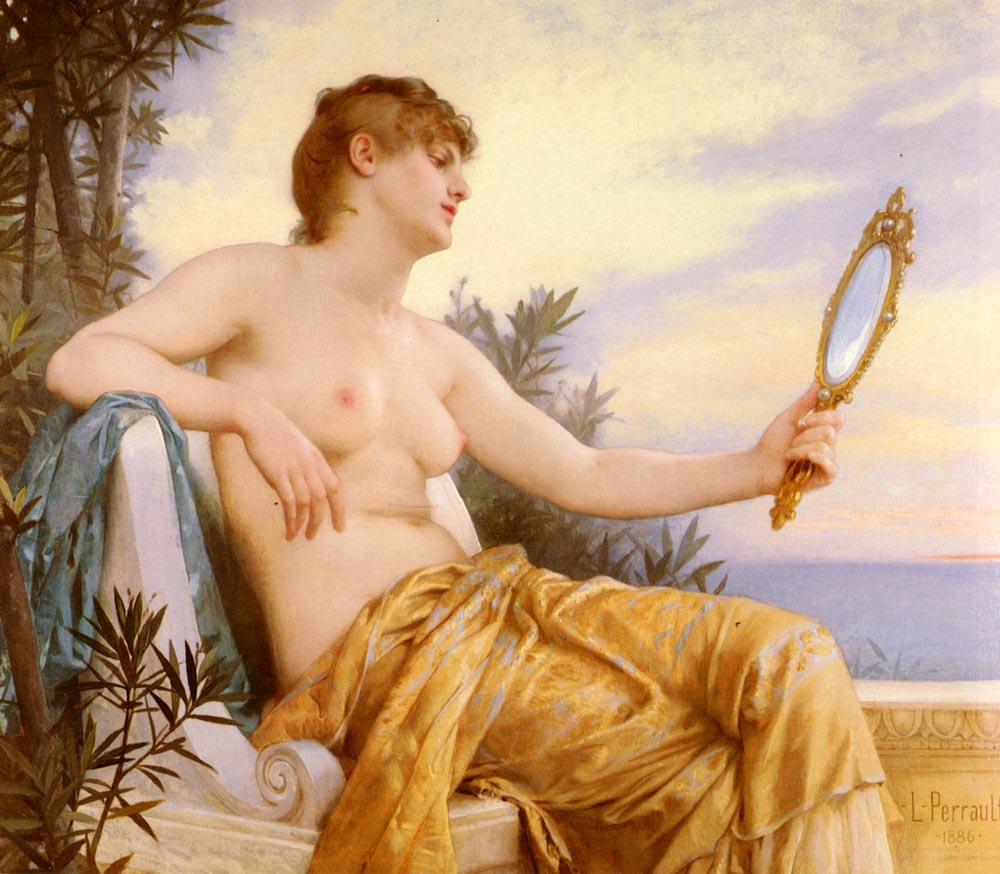
Vanitas (Latin for vanity) by Léon Bazille Perrault, 1886

Vanity is the excessive belief in one's own abilities or attractiveness compared to others. Prior to the 14th century, it did not have such narcissistic undertones, and merely meant futility.[1] The related term vainglory is now often seen as an archaic synonym for vanity, but originally meant considering one's own capabilities and that God's help was not needed, i.e. unjustified boasting;[2] although glory is now seen as having a predominantly positive meaning,[citation needed] the Latin term from which it derives, gloria, roughly means boasting, and was often used as a negative criticism.[3]

Religion and philosophy

[edit]

In many religions, vanity, in its modern sense, is considered a form of self-idolatry in which one likens oneself to the greatness of God for the sake of one's own image, and thereby becomes separated and perhaps in time divorced from the Divine grace of God. In Christian teachings, vanity is an example of pride, one of the seven deadly sins.[4]

Philosophically, vanity may be a broader form of egotism and pride. Friedrich Nietzsche wrote that "vanity is the fear of appearing original: it is thus a lack of pride, but not necessarily a lack of originality."[5] One of Mason Cooley's aphorisms is "Vanity well fed is benevolent. Vanity hungry is spiteful."[5]

Symbolism

[edit]
Nosce Te Ipsum (Allegory of Vanity), engraving by Jacob Neefs after a drawing by Jacob Jordaens

In Western art, vanity was often symbolized by a peacock, and in Biblical terms, by the Whore of Babylon. During the Renaissance, vanity was often represented as a naked woman, sometimes seated or reclining on a couch. She attends to her hair with comb and mirror. The mirror is sometimes held by a demon or a putto. Symbols of vanity include jewels, gold coins, a purse, and the figure of death.[citation needed]

Some depictions of vanity include scrolls that read Omnia Vanitas ("All is Vanity”), a quotation from the Latin translation of the Biblical book of Ecclesiastes.[6] Although the term vanitas (Latin, "emptiness") originally meant not obsession by one's appearance, but the ultimate fruitlessness of humankind's efforts in this world, the phrase summarizes the complete preoccupation of the subject of the picture.

"The artist invites us to pay lip-service to condemning her," writes Edwin Mullins, "while offering us full permission to drool over her. She admires herself in the glass, while we treat the picture that purports to incriminate her as another kind of glass—a window—through which we peer and secretly desire her."[7] The theme of the recumbent woman often merged artistically with the non-allegorical one of a reclining Venus.

In this 1859 painting Daydreams by Thomas Couture, the vice of vanity is shown through a boy blowing bubbles.[8] The Walters Art Museum.

In his table of the seven deadly sins, Hieronymus Bosch depicts a bourgeois woman admiring herself in a mirror held up by a devil; behind her is an open jewelry box. A painting attributed to Nicolas Tournier, which hangs in the Ashmolean Museum, is An Allegory of Justice and Vanity: a young woman holds a balance, symbolizing justice; she does not look in a mirror or the skull on the table before her. Johannes Vermeer's painting Girl with a Pearl Earring is sometimes believed to depict the sin of vanity, because the young girl has adorned herself before a glass without further positive allegorical attributes.[citation needed]

All is Vanity, by Charles Allan Gilbert (1873–1929), carries on this theme. An optical illusion, the painting depicts what appears to be a large grinning skull. Upon closer examination, it reveals itself to be a young woman gazing at her reflection in the mirror. In the 1997 film The Devil's Advocate, Satan (Al Pacino) claims that "vanity is his favourite sin".

Such artistic works served to warn viewers of the ephemeral nature of youthful beauty, as well as the brevity of human life and the inevitability of death.

See also

[edit]

Further reading

[edit]

References

[edit]
Revisions and contributorsEdit on WikipediaRead on Wikipedia
from Grokipedia
Vanity is the excessive belief in one's own abilities, attractiveness, or achievements, often accompanied by an inordinate desire for admiration or praise from others, irrespective of merit.[1][2] This quality, synonymous with conceit or inflated self-regard, represents a form of self-centeredness that prioritizes personal glorification over objective reality or humility.[3] The word "vanity" originates from the Latin vanitas, denoting emptiness, worthlessness, or futility, and entered English in the 13th century through Old French.[1][4] Historically, it has encompassed both moral and existential dimensions: in moral terms, it signifies personal self-conceit or vainglory, while in a broader sense, it refers to the transient and insubstantial nature of worldly pursuits.[4] This dual usage traces back to medieval Christian thought, where vanity (often as vainglory) and pride were closely related vices, both condemned for elevating self over God, though sometimes distinguished by internal versus external aspects.[3] In religious contexts, vanity holds particular prominence in the Hebrew Bible's Book of Ecclesiastes, where the preacher Qoheleth declares, "Vanity of vanities, all is vanity," using the Hebrew term hevel to evoke the ephemeral quality of life, akin to vapor or breath that dissipates quickly.[5][6] This theme underscores the futility of human endeavors—wealth, pleasure, and wisdom—without divine purpose, influencing Christian theology to link vanity with the sin of pride, one of the seven deadly sins, as an excessive love of self that redirects rightful glory from God to empty acclaim.[3][7] Philosophically, vanity has been examined as a fundamental human drive shaping social and economic behavior. Enlightenment thinkers like David Hume described it as a desire for reputation that precedes genuine pride, motivating individuals to seek external approval even when undeserved.[8] Similarly, Adam Smith, in The Theory of Moral Sentiments, portrayed vanity as the impulse to be seen as worthy of attention, fueling the pursuit of distinction, wealth, and adornment in society.[3] Later philosophers, including Friedrich Nietzsche, integrated vanity into analyses of egoism and self-love, viewing it as an inevitable yet potentially constructive aspect of human striving.[9]

Definitions and Etymology

Core Definitions

Vanity primarily refers to an excessive or inflated belief in one's own abilities, attractiveness, or achievements, often characterized by self-admiration and conceit.[1] This sense emphasizes a personal preoccupation with one's superiority, detached from objective merit.[4] In a distinct usage, vanity denotes the quality of being worthless, futile, or devoid of lasting value, conveying a sense of emptiness or transience.[1][4] The phrase "vanity of vanities," originating from biblical texts, exemplifies this meaning to highlight the ultimate futility of human endeavors. While the terms are sometimes used interchangeably, in theological contexts, vanity (or vainglory) refers to an inordinate desire to manifest one's own excellence through external display seeking praise, differing from pride, which is an uncontrolled desire for self-esteem.[10][11][12] Everyday language reflects these nuances through objects like the vanity mirror or vanity table, which are dressing tables designed for personal grooming and self-examination, evoking the theme of self-focused admiration.[1][13]

Historical Etymology

The term "vanity" derives from the Latin vanitas, which denotes emptiness, worthlessness, or futility, stemming ultimately from vanus, meaning empty or void.[14] This root reflects a sense of something devoid of substance or lasting value, as seen in classical Latin usage where vanitas often connoted deception or idleness.[4] The word entered Old French as vanité around the 12th century, retaining connotations of self-conceit alongside emptiness and lack of resolve.[15] By the early 13th century, "vanity" appeared in English as a borrowing from Old French vanité, with its earliest recorded use around 1230 in the religious prose text Hali Meidenhad, where it signified that which is vain, futile, or worthless.[4] The term gained prominence through religious literature, particularly in English translations of the Bible's Book of Ecclesiastes, where the Vulgate's Latin vanitas (from Jerome's 4th-century rendering of the Hebrew hevel, meaning vapor or transience) was adopted to convey futility and the ephemeral nature of human endeavors.[6] For instance, Wycliffe's Bible (late 14th century), Tyndale's New Testament (1526), and the King James Version (1611) all employed "vanity" in phrases like "vanity of vanities," emphasizing life's ultimate pointlessness in a religious context of transience.[5] In medieval English literature, Geoffrey Chaucer employed "vanity" in moral and allegorical works to denote worldly futility, as in his late 14th-century Retraction appended to The Canterbury Tales, where he revokes his "translaciouns and enditynges of worldly vanitees," referring to profane writings that distract from spiritual pursuits.[16] Chaucer's usage in tales like The Pardoner's Tale further illustrates this sense of vain, deceptive pursuits leading to moral downfall.[4] During the 16th and 17th centuries, the meaning of "vanity" in English expanded beyond primary associations with futility—especially in scriptural and moral contexts—to encompass personal pride, conceit, or excessive self-admiration, as evidenced in secular prose and drama of the period.[14] This evolution allowed the term to critique individual vainglory alongside broader existential emptiness, though its religious linkage to futility persisted.[4]

Religious and Philosophical Contexts

Biblical and Abrahamic Interpretations

In the Hebrew Bible, the Book of Ecclesiastes prominently features the theme of vanity through the repeated refrain in Ecclesiastes 1:2: "Vanity of vanities, says the Preacher, vanity of vanities! All is vanity."[17] This declaration, attributed to Qoheleth (often identified with King Solomon), underscores the transience and insubstantiality of human endeavors and life's pursuits, with the Hebrew term hevel—literally "vapor" or "breath"—evoking the fleeting, ephemeral nature of existence under the sun.[18] Throughout the book, this motif frames worldly wisdom, labor, and pleasures as ultimately futile, urging a turn toward reverence for God amid life's impermanence.[19] In the New Testament, the concept of vanity extends to the cosmic consequences of human sin, particularly in Romans 8:20, where Paul states that "the creation was subjected to futility, not willingly, but because of him who subjected it, in hope."[20] This subjection to mataiotēs (futility or vanity) is interpreted as the result of the original sin in Genesis 3:17, where humanity's fall imposed decay and frustration upon the entire created order, rendering it unable to achieve its intended purpose without divine redemption.[21][22] The passage links this vanity to the broader narrative of sin's dominion, yet infuses it with eschatological hope, as creation awaits liberation through the glory of God's children.[23] Patristic theology, particularly in Augustine of Hippo's Confessions, elaborates on vanity as a disordered attachment to temporal goods, rooted in sin's distortion of human desire. In Book 2, Chapter 3, Augustine recounts his youthful theft of pears not for hunger but for the sheer thrill, illustrating how sin thrives on the vanity of pursuing fleeting pleasures over eternal truth.[24] He views such attachments as an "affective disorder" arising from original sin, where the soul clings to insubstantial worldly objects—wealth, fame, or bodily delights—mistaking them for lasting fulfillment, thus perpetuating spiritual emptiness. This interpretation aligns with Ecclesiastes' transience, positioning vanity as a barrier to union with God, resolvable only through grace and redirection toward the divine.[25] Islamic scripture parallels these Abrahamic views in the Quran's Surah Al-Hadid 57:20: "Know that the life of this world is but amusement and diversion and adornment and boasting to one another and rivalry in respect of wealth and children; like the example of a rain whose [resulting] plant growth pleases the tillers; then it dries and you see it turned yellow; then it becomes [scattered] debris." This verse depicts worldly life (hayat al-dunya) as la'ib (play) and lahw (amusement), transient and deceptive like vegetation that withers, emphasizing its ultimate futility compared to the afterlife. In Tafsir Ibn Kathir, this is explained as a divine reminder of the world's pomp and rivalry, which distract from Allah's truth and lead to delusion (matāʿ al-ghurūr), urging believers to prioritize eternal rewards over material vanities.[26] Such interpretations reinforce vanity as a test of faith, echoing the shared Abrahamic emphasis on transcending temporal illusions.

Broader Philosophical Views

In ancient Greek philosophy, vanity is conceptualized as an excess of inflated self-regard that claims undeserved honors. Aristotle, in his Nicomachean Ethics, positions proper pride (megalopsychia) as the virtuous mean between the extremes of excessive vanity (kenodoxia, or empty vainglory)—characterized by pretentiousness and disregard for moderation—and servile humility, which undervalues one's worth.[27] This view underscores vanity as a personal flaw that disrupts ethical balance by deviating from the doctrine of the mean. Eastern philosophies frame vanity through lenses of impermanence and illusion, emphasizing detachment from material pursuits. In Buddhism, the principle of anicca (impermanence) reveals the vanity inherent in clinging to transient phenomena, as all conditioned existence is subject to arising, decay, and dissolution, rendering attachments futile and a source of suffering (dukkha). Similarly, Hinduism's concept of maya portrays the material world as an illusory veil (maya) that engenders vanity by obscuring the eternal reality of Brahman, leading individuals to vainly pursue ephemeral desires and identifications with the body and possessions. These perspectives contrast vanity with authentic pride by highlighting its root in delusion, advocating transcendence over self-aggrandizement. Modern Western philosophers further explore vanity's role in human motivation and ethics. Arthur Schopenhauer, in essays like "On the Vanity of Existence," depicts vanity as the inescapable outcome of the "will to live"—a blind, insatiable force driving perpetual striving amid inevitable pain and boredom, where achievements prove hollow and life itself a vain oscillation between desire and disillusionment.[28] Friedrich Nietzsche, critiquing this in Thus Spoke Zarathustra, portrays vanity as resentment (ressentiment)-fueled pettiness among the weak, who invert noble values into egalitarian mediocrity to mask their impotence, distinguishing it from the affirmative pride of the overman who embraces life's chaos without self-pity. Existentialist thought, particularly Jean-Paul Sartre's, ties vanity to mauvaise foi (bad faith), a mode of self-deception where individuals vainly deny their radical freedom by conforming to rigid social roles or external determinations, fabricating an illusory essence to evade authentic self-creation and responsibility. This ethical critique positions vanity as antithetical to genuine pride, which requires confronting absurdity without evasion, though it risks solipsistic isolation if unchecked.

Symbolism and Representations

In Art and Iconography

In art and iconography, vanity has been depicted through allegorical figures and symbolic motifs that emphasize the fleeting nature of beauty, wealth, and earthly pleasures. Personifications of Vanity appear in medieval illuminated manuscripts, often as female figures holding mirrors or combs to symbolize self-admiration and moral folly, drawing from biblical narratives like Bathsheba's bath, which was interpreted as an emblem of vainglory and temptation. These representations evolved from earlier classical influences, where Roman art occasionally alluded to vanity through Venus-like figures gazing into mirrors, signifying the perils of excessive self-regard, though not as a named deity but as a thematic virtue-vice contrast in moral iconography.[29] During the Renaissance, particularly in Northern European still-life paintings, the vanitas genre flourished as a direct visual meditation on vanity's transience, incorporating everyday objects laden with symbolic weight. Harmen Steenwyck's Still Life: An Allegory of the Vanities of Human Life (c. 1640), housed in the National Gallery, London, exemplifies this with a skull representing mortality, an hourglass denoting the passage of time, and a soap bubble evoking the fragility of life and riches, all arranged to remind viewers of Ecclesiastes' proclamation that "all is vanity."[30] Such works, rooted in Protestant moralism, used precise, monochromatic compositions to underscore the futility of material pursuits, influencing a broader tradition where extinguished candles and wilting flowers further symbolized inevitable decay.[29] In the Baroque period, vanity's theme shifted toward dramatic narratives of self-obsession and downfall, as seen in Caravaggio's Narcissus (c. 1597–1599), now in the Galleria Nazionale d'Arte Antica, Rome. The painting captures the mythological youth frozen in admiration of his reflection, his hand reaching toward the illusory image in a pool, illustrating the destructive allure of vanity that leads to isolation and death, with Caravaggio's chiaroscuro heightening the psychological tension between desire and reality.[31] This interpretation aligns with the era's Catholic emphasis on sin and redemption, using the Greek myth to warn against narcissistic pride.[32] Modern interpretations of vanity in art often critique societal constructs of identity and appearance, particularly through feminist lenses. Cindy Sherman's Society Portraits series (2008) features the artist in grotesque, exaggerated guises as aging socialites, laden with heavy makeup and jewelry, to satirize the vanity and superficiality of elite femininity, exposing how cultural expectations distort self-perception and enforce performative identities.[33] These photographs, exhibited at institutions like the Museum of Modern Art, New York, build on historical vanitas by subverting traditional symbols—replacing skulls with plastic surgery-like distortions—to highlight contemporary obsessions with youth and status, thereby linking personal vanity to broader gender politics.[34]

In Literature and Allegory

In classical literature, the myth of Narcissus from Ovid's Metamorphoses establishes the archetype of vanity as self-absorption leading to destruction. Narcissus, a youth of extraordinary beauty, rejects all suitors, including the nymph Echo, and becomes entranced by his own reflection in a pool, ultimately wasting away from unrequited love for his image and transforming into the narcissus flower. This narrative, detailed in Book 3 of the epic, serves as a cautionary tale against excessive pride and self-love, influencing subsequent literary depictions of vanity as a fatal flaw.[35] Medieval morality plays further personify vanity as a symbol of fleeting worldly attachments that distract from spiritual salvation. In the anonymous 15th-century play Everyman, aspects of vanity are represented through abstract figures such as Beauty and Goods, which Everyman seeks but that abandon him during his allegorical journey toward death and judgment, illustrating the superficiality of material pleasures and appearances that fail in the face of mortality. The play's structure, drawing on Christian doctrine, contrasts these ephemeral companions—such as Kindred and Fellowship—with enduring virtues like Good Deeds, emphasizing vanity's role in hindering moral reckoning. Biblical motifs of transience, such as those in Ecclesiastes, subtly underpin these allegories without dominating the dramatic action.[36] The 19th century saw vanity satirized as a pervasive social force in novels critiquing class and ambition. William Makepeace Thackeray's Vanity Fair (1848), subtitled A Novel Without a Hero, portrays Regency and early Victorian England as a microcosm of hypocrisy and self-interest, where characters like the cunning Becky Sharp navigate societal ladders through manipulation and charm. Thackeray draws the title from John Bunyan's Pilgrim's Progress, using the fair as a metaphor for a world driven by "vanity and vexation of spirit," exposing how social climbing and appearances corrupt personal integrity.[37] In 20th-century literature, Oscar Wilde's The Picture of Dorian Gray (1890) delves into vanity's capacity for profound moral corruption. The protagonist, Dorian Gray, trades his soul for eternal youth, allowing a portrait to bear the scars of his hedonistic excesses while he remains outwardly pristine; this Faustian bargain illustrates how vanity fuels a descent into vice, culminating in self-destruction. Influenced by aestheticism, Wilde critiques the pursuit of beauty at the expense of ethics, with Dorian's arc revealing the portrait as a mirror of inner decay.

Cultural and Modern Applications

Social and Psychological Dimensions

Vanity manifests in psychological theories as a key trait intertwined with narcissistic tendencies, particularly aspects of Narcissistic Personality Disorder (NPD) as outlined in the DSM-5. The DSM-5 criteria for NPD describe a pervasive pattern of grandiosity, need for admiration, and lack of empathy, where preoccupation with one's appearance and self-importance contributes to the grandiosity dimension.[38] Research distinguishes vanity from broader narcissism by emphasizing its focus on pride in physical attributes and reduced social empathy, often serving as a core component of NPD's maladaptive self-enhancement. This linkage highlights vanity's role in distorted self-perception, where individuals prioritize external validation over genuine interpersonal connections. In social contexts, vanity drives consumerism and amplifies through social media platforms like Instagram, fostering a cycle of self-image obsession and material acquisition. Studies show that higher vanity traits correlate with increased Instagram usage intensity, social comparison, and materialism, leading to greater involvement in luxury brand consumption as users seek to project idealized selves.[39] For instance, vain individuals exhibit compulsive engagement with brand content on Instagram, where the platform's visual emphasis on appearance reinforces consumer behaviors aimed at status signaling and social approval.[40] These dynamics contribute to broader societal pressures, where vanity fuels economic trends in fashion and beauty industries by equating self-worth with purchasable enhancements. Gender and cultural variations in vanity reveal evolving societal norms, from restrictive historical expectations to contemporary empowerment efforts. In Victorian society, female vanity was heavily critiqued yet socially enforced through practices like corsetry, which women adopted to conform to an hourglass silhouette symbolizing modesty and fertility, often at the cost of physical health and autonomy.[41] This era viewed such adornments as both a moral failing and a necessity for social standing, embedding vanity in gender roles that prioritized male gaze over personal agency. In contrast, modern body positivity movements challenge these legacies by promoting unconditional self-acceptance, reducing the psychological burden of appearance-based vanity and encouraging diverse body representations to combat gender-specific image pressures.[42] Vanity exhibits both positive and negative dimensions, with adaptive forms bolstering self-confidence while maladaptive ones precipitate isolation. Adaptive vanity, akin to healthy self-sufficiency in narcissism scales, can enhance personal esteem by motivating grooming and presentation that fosters positive social interactions and resilience.[43] Conversely, maladaptive vanity—characterized by exploitative entitlement and excessive reliance on external admiration—erodes relationships, leading to social withdrawal and emotional isolation as individuals prioritize superficial validation over authentic bonds.[44] This duality underscores vanity's potential as a double-edged psychological force, where moderation supports well-being but excess aligns with NPD's interpersonal deficits.[45]

Commercial and Everyday Uses

In the publishing industry, vanity publishing involves authors funding the production of their books through publishers who charge fees for services like printing and distribution, rather than selecting works based on commercial viability. This model traces its roots to 19th-century commission publishers, who required authors to cover costs upfront, often leading to exploitative practices that persisted into the 20th century.[46] The term "vanity press" gained prominence in the 1920s and 1930s, reflecting the perceived self-indulgence of authors seeking publication without traditional gatekeeping.[46] By the late 20th century, the rise of digital platforms like Amazon's Kindle Direct Publishing (KDP), launched in 2007, shifted the landscape toward accessible self-publishing, where authors retain control and avoid large upfront payments to intermediaries, though vanity presses continue to operate alongside these options.[47] Vanity license plates, also known as personalized or custom plates, allow vehicle owners to select unique alphanumeric combinations for an additional fee, serving as a practical expression of individuality in everyday transportation. The practice began in the United States in the early 1930s, with Pennsylvania issuing the first such plates in 1931, initially limited to initials or short phrases.[48] Most states now regulate these through departments of motor vehicles, prohibiting offensive content while permitting personalization for a one-time fee typically ranging from $20 to $50, plus annual renewal costs that vary by jurisdiction.[49] For example, California charges $98 initially for standard personalized plates (as of recent reports), emphasizing both revenue generation and regulatory oversight to ensure public acceptability.[49] In the beauty and fashion sectors, "vanity" appears in branding that evokes elegance and self-admiration, as seen in publications like Vanity Fair magazine. Originally launched in 1913 by Condé Nast as a sophisticated alternative to rivals like Vogue, the magazine has historically emphasized high-style editorials, celebrity beauty trends, and luxury cosmetics, blending cultural commentary with aspirational aesthetics.[50] Revived in 1983, it continues to feature in-depth coverage of fashion weeks, makeup innovations, and personal grooming, positioning "vanity" as a celebrated aspect of modern lifestyle.[51] The phrase "vanity project" commonly describes commercial or entertainment ventures driven more by an individual's ego or prestige than by market demand or profitability. In business, it refers to initiatives like extravagant corporate headquarters built for symbolic status rather than necessity, while in entertainment, it often denotes films or albums where creators exert excessive control, such as a director starring in and funding their own screenplay.[52] This idiom underscores the risks of self-indulgence in professional contexts, where such projects may yield limited returns despite high investments.[53]

References

User Avatar
No comments yet.