



Community hub
Recent from talks
Contribute something
Nothing was collected or created yet.
Variable speed of light
View on WikipediaA variable speed of light (VSL) is a feature of a family of hypotheses stating that the speed of light may in some way not be constant, for example, that it varies with frequency, in space, or over time. Accepted classical theories of physics, and in particular general relativity, predict a constant speed of light in any local frame of reference and in some situations these predict apparent variations of the speed of light depending on frame of reference, but this article does not refer to this as a variable speed of light. Various alternative theories of gravitation and cosmology, many of them non-mainstream, incorporate variations in the local speed of light.
Attempts to incorporate a variable speed of light into physics were made by Robert Dicke in 1957, and by several researchers starting from the late 1980s.
VSL should not be confused with faster than light theories, which depends on a medium's refractive index or its measurement in a remote observer's frame of reference in a gravitational potential. In this context, the "speed of light" refers to the limiting speed c of the theory rather than to the velocity of propagation of photons.
Historical proposals
[edit]Background
[edit]While the speed of light is generally considered to be a constant, the idea that physical "constants" might be variable has a long history. One of early proposals was Dirac large numbers hypothesis. Looking for variation in these constants is an important way of testing the physical laws.[1][2]
Einstein's equivalence principle, on which general relativity is founded, requires that in any local, freely falling reference frame, the speed of light is always the same.[3][4] This leaves open the possibility, however, that an inertial observer inferring the apparent speed of light in a distant region might calculate a different value. Spatial variation of the speed of light in a gravitational potential as measured against a distant observer's time reference is implicitly present in general relativity.[5] The apparent speed of light will change in a gravity field and, in particular, go to zero at an event horizon as viewed by a distant observer.[6] In deriving the gravitational redshift due to a spherically symmetric massive body, a radial speed of light dr/dt can be defined in Schwarzschild coordinates, with t being the time recorded on a stationary clock at infinity. The result is
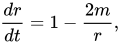
where m is MG/c2 and where natural units are used such that c0 is equal to one.[7][8]
Dicke's proposal (1957)
[edit]Robert Dicke, in 1957, developed a VSL theory of gravity, a theory in which (unlike general relativity) the speed of light measured locally by a free-falling observer could vary.[9] Dicke assumed that both frequencies and wavelengths could vary, which since resulted in a relative change of c. Dicke assumed a refractive index (eqn. 5) and proved it to be consistent with the observed value for light deflection. In a comment related to Mach's principle, Dicke suggested that, while the right part of the term in eq. 5 is small, the left part, 1, could have "its origin in the remainder of the matter in the universe".


Given that in a universe with an increasing horizon more and more masses contribute to the above refractive index, Dicke considered a cosmology where c decreased in time, providing an alternative explanation to the cosmological redshift.[9]: 374
Subsequent proposals
[edit]Several hypotheses for varying speed of light, seemingly in contradiction to general relativity theory, have been published, including those of Giere and Tan (1986)[10] and Sanejouand (2009).[11] In 2003, Magueijo gave a review of such hypotheses.[12]
Cosmological models with varying speeds of light[13] have been proposed independently by Jean-Pierre Petit in 1988,[14] John Moffat in 1992,[15] and the team of Andreas Albrecht and João Magueijo in 1998[16] to explain the horizon problem of cosmology and propose an alternative to cosmic inflation.
Relation to other constants and their variation
[edit]Dimensionless and dimensionful quantities
[edit]Units are vital for experimental measurements and comparing the results of experiments to theory necessarily entangles units and the physical constants. Physical constants with units are not fundamental. Any equation of physical law can be expressed in a form in which all dimensional quantities are normalized against like-dimensioned quantities (called nondimensionalization), resulting in only dimensionless quantities remaining. Only variation of these dimensionless quantities change the nature of physics.[17] A physical theory that postulates a varying fine-structure constant can be express as either a variable speed of light or a variable electric charge.[18]
Physicists often adopt natural units in which the physical constants c, G, ħ = h/(2π), 4πε0, and kB take the value one, resulting in every physical quantity being normalized against its corresponding Planck unit.[18] When Planck units are used and such equations of physical law are expressed in this nondimensionalized form, no dimensional physical constants such as c, G, ħ, ε0, nor kB remain, only dimensionless quantities,[19] as predicted by the Buckingham π theorem.
Gravitational constant G
[edit]In 1937, Paul Dirac and others began investigating the consequences of natural constants changing with time.[20] For example, Dirac proposed a change of only 5 parts in 1011 per year of the Newtonian constant of gravitation G to explain the relative weakness of the gravitational force compared to other fundamental forces. This has become known as the Dirac large numbers hypothesis.
However, Richard Feynman showed[21] that the gravitational constant most likely could not have changed this much in the past 4 billion years based on geological and solar system observations, although this may depend on assumptions about G varying in isolation. (See also strong equivalence principle.)
Fine-structure constant α
[edit]One group, studying distant quasars, has claimed to detect a variation of the fine-structure constant[22] at the level in one part in 105. Other authors dispute these results. Other groups studying quasars claim no detectable variation at much higher sensitivities.[23][24][25]
The natural nuclear reactor of Oklo has been used to check whether the atomic fine-structure constant α might have changed over the past 2 billion years. That is because α influences the rate of various nuclear reactions. For example, 149
Sm captures a neutron to become 150
Sm, and since the rate of neutron capture depends on the value of α, the ratio of the two samarium isotopes in samples from Oklo can be used to calculate the value of α from 2 billion years ago. Several studies have analysed the relative concentrations of radioactive isotopes left behind at Oklo, and most have concluded that nuclear reactions then were much the same as they are today, which implies α was the same too.[26][27]
Paul Davies and collaborators have suggested that it is in principle possible to disentangle which of the dimensionful constants (the elementary charge, the Planck constant, and the speed of light) of which the fine-structure constant is composed is responsible for the variation.[28] However, this has been disputed by others and is not generally accepted.[29][30]
Criticisms of various VSL concepts
[edit] | This article or section possibly contains original synthesis. Source material should verifiably mention and relate to the main topic. (May 2016) |
General critique of varying c cosmologies
[edit]From a very general point of view, G. F. R. Ellis and Jean-Philippe Uzan expressed concerns that a varying c would require a rewrite of much of modern physics to replace the current system which depends on a constant c.[31][32] Ellis claimed that any varying c theory (1) must redefine distance measurements; (2) must provide an alternative expression for the metric tensor in general relativity; (3) might contradict Lorentz invariance; (4) must modify Maxwell's equations; and (5) must be done consistently with respect to all other physical theories. VSL cosmologies remain out of mainstream physics.
References
[edit]- ^ Uzan, Jean-Philippe (29 March 2011). "Varying Constants, Gravitation and Cosmology". Living Reviews in Relativity. 14 (1) 2. arXiv:1009.5514. Bibcode:2011LRR....14....2U. doi:10.12942/lrr-2011-2. ISSN 2367-3613. PMC 5256069. PMID 28179829.
- ^ Unzicker, A. (2009). "A look at the abandoned contributions to cosmology of Dirac, Sciama, and Dicke". Annalen der Physik. 521 (1): 57–70. arXiv:0708.3518. Bibcode:2009AnP...521...57U. doi:10.1002/andp.20095210108. ISSN 1521-3889. S2CID 11248780.
- ^ Will, Clifford M. (2018-09-30). Theory and Experiment in Gravitational Physics. Cambridge University Press. p. 238. ISBN 978-1-108-57749-6.
- ^ Misner, Charles W.; Thorne, Kip S.; Wheeler, John Archibald (2017-10-03). Gravitation. Princeton University Press. p. 297. ISBN 978-1-4008-8909-9.
- ^ Weinberg, S. (1972). Gravitation and Cosmology. London: Wiley. p. 222. ISBN 978-0-471-92567-5.
- ^ Bergmann, Peter (1992). The Riddle of Gravitation (1st reprint from 1968 ed.). New York: Dover. p. 94. ISBN 978-0-486-27378-5.
- ^ Tolman, Richard (1958). Relativity Cosmology and Thermodynamics (1st reprint from 1934 ed.). Oxford UK: Oxford. p. 212.
- ^ Stavrov, Iva (2020). Curvature of Space and Time, with an Introduction to Geometric Analysis. Providence, Rhode Island: American Mathematical Society. p. 179. ISBN 978-1-4704-6313-7. OCLC 1202475208.
- ^ a b Dicke, Robert (1957). "Gravitation without a Principle of Equivalence". Reviews of Modern Physics. 29 (3): 363–376. Bibcode:1957RvMP...29..363D. doi:10.1103/RevModPhys.29.363.
- ^ Giere, A. C.; Tan, A. (1986). "A Derivation of Hubble". Chinese Journal of Physics. 24 (3): 217–219.
- ^ Sanejouand, Yves-Henri (2009). "Empirical evidences in favor of a varying-speed-of-light". Europhysics Letters. 88 59002. arXiv:0908.0249. doi:10.1209/0295-5075/88/59002. S2CID 121784053.
- ^ Magueijo, João (2003). "New varying speed of light theories". Reports on Progress in Physics. 66 (11): 2025–2068. arXiv:astro-ph/0305457. Bibcode:2003RPPh...66.2025M. doi:10.1088/0034-4885/66/11/R04. S2CID 15716718.
- ^ Barrow, J. D. (1998). "Cosmologies with varying light-speed". Physical Review D. 59 (4) 043515. arXiv:astro-ph/9811022. Bibcode:1999PhRvD..59d3515B. doi:10.1103/PhysRevD.59.043515. S2CID 119374406.
- ^ Petit, Jean-Pierre (1988). "An interpretation of cosmological model with variable light velocity" (PDF). Mod. Phys. Lett. A. 3 (16): 1527–1532. Bibcode:1988MPLA....3.1527P. CiteSeerX 10.1.1.692.9603. doi:10.1142/S0217732388001823.
- ^ Moffat, John (1993). "Superluminary Universe: A Possible Solution to the Initial Value Problem in Cosmology". International Journal of Modern Physics D. 2 (3): 351–366. arXiv:gr-qc/9211020. Bibcode:1993IJMPD...2..351M. doi:10.1142/S0218271893000246. S2CID 17978194.
- ^ Albrecht, A.; Magueijo, J. (1999). "A time varying speed of light as a solution to cosmological puzzles". Physical Review. D59 (4) 043516. arXiv:astro-ph/9811018. Bibcode:1999PhRvD..59d3516A. doi:10.1103/PhysRevD.59.043516. S2CID 56138144.
- ^ Barrow, John D. (2002). The constants of nature: from Alpha to Omega--the numbers that encode the deepest secrets of the universe (1st American ed.). New York: Pantheon Books. ISBN 978-0-375-42221-8.
- ^ a b Uzan, Jean-Philippe (2003). "The fundamental constants and their variation: Observational status and theoretical motivations". Reviews of Modern Physics. 75 (2): 403–455. arXiv:hep-ph/0205340. Bibcode:2003RvMP...75..403U. doi:10.1103/RevModPhys.75.403. S2CID 118684485.
- ^ Mcweeny, R. (May 1973). "Natural Units in Atomic and Molecular Physics". Nature. 243 (5404): 196–198. Bibcode:1973Natur.243..196M. doi:10.1038/243196a0. ISSN 0028-0836.
- ^ Dirac, Paul A. M. (1938). "A New Basis for Cosmology". Proceedings of the Royal Society A. 165 (921): 199–208. Bibcode:1938RSPSA.165..199D. doi:10.1098/rspa.1938.0053. S2CID 121069801.
- ^ Feynman, Richard P.; Leighton, R.; Sands, M. (2006) [1964]. "7: The Theory of Gravitation". The Feynman Lectures on Physics. Vol. 1 (definitive ed.). Addison Wesley Longman. ISBN 0-8053-9045-6.
- ^ Webb, J. K.; Murphy, M. T.; Flambaum, V. V.; Dzuba, V. A.; Barrow, J. D.; Churchill, C. W.; Prochaska, J. X.; Wolfe, A. M. (2001). "Further Evidence for Cosmological Evolution of the Fine Structure Constant". Physical Review Letters. 87 (9) 091301. arXiv:astro-ph/0012539. Bibcode:2001PhRvL..87i1301W. doi:10.1103/PhysRevLett.87.091301. PMID 11531558. S2CID 40461557.
- ^ Chand, H.; Srianand, R.; Petitjean, P.; Aracil, B. (2004). "Probing the cosmological variation of the fine-structure constant: results based on VLT-UVES sample". Astron. Astrophys. 417 (3): 853–871. arXiv:astro-ph/0401094. Bibcode:2004A&A...417..853C. doi:10.1051/0004-6361:20035701. S2CID 17863903.
- ^ Srianand, R.; Chand, H.; Petitjean, P.; Aracil, B. (2004). "Limits on the time variation of the electromagnetic ne-structure constant in the low energy limit from absorption lines in the spectra of distant quasars". Physical Review Letters. 92 (12) 121302. arXiv:astro-ph/0402177. Bibcode:2004PhRvL..92l1302S. doi:10.1103/PhysRevLett.92.121302. PMID 15089663. S2CID 29581666.
- ^ Levshakov, S. A.; Centurion, M.; Molaro, P.; D'Odorico, S. (2005). "VLT/UVES constraints on the cosmological variability of the fine-structure constant". Astron. Astrophys. 434 (3): 827–838. arXiv:astro-ph/0408188. Bibcode:2005A&A...434..827L. doi:10.1051/0004-6361:20041827. S2CID 119351573.
- ^ Petrov, Yu. V.; Nazarov, A. I.; Onegin, M. S.; Sakhnovsky, E. G. (2006). "Natural nuclear reactor at Oklo and variation of fundamental constants: Computation of neutronics of a fresh core". Physical Review C. 74 (6) 064610. arXiv:hep-ph/0506186. Bibcode:2006PhRvC..74f4610P. doi:10.1103/PHYSREVC.74.064610. S2CID 118272311.
- ^ Davis, Edward D.; Hamdan, Leila (2015). "Reappraisal of the limit on the variation in α implied by the Oklo natural fission reactors". Physical Review C. 92 (1) 014319. arXiv:1503.06011. Bibcode:2015PhRvC..92a4319D. doi:10.1103/physrevc.92.014319. S2CID 119227720.
- ^ Davies, P. C. W.; Davis, Tamara M.; Lineweaver, Charles H. (2002). "Cosmology: Black holes constrain varying constants". Nature. 418 (6898): 602–603. Bibcode:2002Natur.418..602D. doi:10.1038/418602a. PMID 12167848. S2CID 1400235.
- ^ Duff, M. J. (2002). "Comment on time-variation of fundamental constants". arXiv:hep-th/0208093.
- ^ Carlip, S. & Vaidya, S. (2003). "Black holes may not constrain varying constants". Nature. 421 (6922): 498. arXiv:hep-th/0209249. Bibcode:2003Natur.421..498C. doi:10.1038/421498a. PMID 12556883. S2CID 209814835.
- ^ Ellis, George F. R. (April 2007). "Note on Varying Speed of Light Cosmologies". General Relativity and Gravitation. 39 (4): 511–520. arXiv:astro-ph/0703751. Bibcode:2007GReGr..39..511E. doi:10.1007/s10714-007-0396-4. S2CID 119393303.
- ^ Ellis, George F. R.; Uzan, Jean-Philippe (March 2005). "c is the speed of light, isn't it?". American Journal of Physics. 73 (3): 240–247. arXiv:gr-qc/0305099. Bibcode:2005AmJPh..73..240E. doi:10.1119/1.1819929. ISSN 0002-9505. S2CID 119530637.