


Community hub
Variational quantum eigensolver
View on WikipediaIn quantum computing, the variational quantum eigensolver (VQE) is a quantum algorithm for quantum chemistry, quantum simulations and optimization problems. It is a hybrid algorithm that uses both classical computers and quantum computers to find the ground state of a given physical system. Given a guess or ansatz, the quantum processor calculates the expectation value of the system with respect to an observable, often the Hamiltonian, and a classical optimizer is used to improve the guess. The algorithm is based on the variational method of quantum mechanics.
It was originally proposed in 2014, with corresponding authors Alberto Peruzzo, Alán Aspuru-Guzik and Jeremy O'Brien.[a][1][2] The algorithm has also found applications in quantum machine learning and has been further substantiated by general hybrid algorithms between quantum and classical computers.[3] It is an example of a noisy intermediate-scale quantum (NISQ) algorithm.
Description
[edit]Pauli encoding
[edit]The objective of the VQE is to find a set of quantum operations that prepares the lowest energy state (or minima) of a close approximation to some target quantity or observable. While the only strict requirement for the representation of an observable is its efficiency in estimating its expectation values, it is often more straightforward if the operator has a compact or simple expression in terms of Pauli operators or tensor products of Pauli operators.
For a fermionic system, it is often most convenient to qubitize: that is to write the many-body Hamiltonian of the system using second quantization, and then use a mapping to write the creation-annihilation operators in terms of Pauli operators. Common schemes for fermions include Jordan–Wigner transformation, Bravyi–Kitaev transformation, and parity transformation.[4][5]
Once the Hamiltonian is written in terms of Pauli operators and irrelevant states are discarded (finite-dimensional space), it would consist of a linear combination of Pauli strings consisting of tensor products of Pauli operators (for example ), such that



- ,
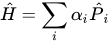
where are numerical coefficients. Based on the coefficients, the number of Pauli strings can be reduced in order to optimize the calculation.[6]

The VQE can be adapted to other optimization problems by adapting the Hamiltonian to be a cost function.[7]
Ansatz and initial trial function
[edit]The choice of ansatz state depends on the system of interest. In gate-based quantum computing, the ansatz is given by a parametrized quantum circuit, whose parameters can be updated after each run. The ansatz has to be adaptable enough to not miss the desired state. A common method to obtain a valid ansatz is given by the unitary coupled cluster (UCC) framework and its extensions.[5]
If the ansatz is not chosen adequately the procedure may halt at suboptimal parameters that do not correspond to a minima. In this situation, the algorithm is said to have reached a 'barren plateau'.[5]

The ansatz can be set to an initial trial function to start the algorithm. For example, for a molecular system, one can use the Hartree–Fock method to provide a starting state that is close to the real ground state.
Another variant of the ansatz circuit is the hardware efficient ansatz, which consists of sequence of 1 qubit rotational gates and 2 qubit entangling gates.[citation needed] The number of repetitions of 1-qubit rotational gates and 2-qubit entangling gates is called the depth of the circuit.
Measurement
[edit]The expectation value of a given state with parameters , has an expectation value of the energy or cost function given by



so in order to obtain the expectation value of the energy, one can measure the expectation value of each Pauli string (number of counts for a given value over the total number of counts). This step corresponds to measuring each qubit in the axis provided by the Pauli string.[7] For example, for the string , the first qubit is to be measured in the x-axis, while the last two are to be measured in the y-axis of the Bloch sphere. If measurement in the z-axis is only possible, then Clifford gates can be used to transform between axes. If two Pauli strings commute, then they can be both measured simultaneously using the same circuit and interpreting the result according to the Pauli algebra.

Variational method and optimization
[edit]Given a parametrized ansatz for the ground state eigenstate, with parameters that can be modified, one is sure to find the parametrized state that is closest to the ground state based on the variational method of quantum mechanics. Using classical algorithms in a digital computer, the parameters of the ansatz can be optimized. For this minimization, it is necessary to find the minima of a multivariable function. Classical optimizers using gradient descent can be used for this purpose.[7]
Formulation
[edit] |
For a given Hamiltonian (H) and a state vector if we can vary arbitrarily then will be the ground state energy and would be a ground state (assuming no degeneracy). But the above minimization problem over all possible states , where state is dimensional, is impractical. Thus to restrict the search space to a more practical size (e.g. poly(n)), we need to restrict the to only a subset of possible n-qubit states which is based on conventional physics, chemistry and quantum mechanics knowledge.





Algorithm
[edit]The adjoining figure illustrates the high level steps in the VQE algorithm.
The circuit controls the subset of possible states that can be created, and the parameter contains the variational parameters, where the number of parameters chosen are enough to lend the algorithm expressive power to compute the ground state of the system, but not too big to increase the computational cost of the optimization step.


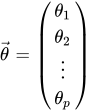
By running the circuit many times and constantly updating the parameters to find the global minima of the expectation value of the desired observable, one can approach the ground state of the given system and store it in a quantum processor as a series of quantum gate instructions.
In case of gradient descent, its required to minimize a cost function where for the VQE case . The update rule is:



where r is the learning rate (step size) and

In order to compute the gradients, the parameter shift rule is used.[8][9]
Example
[edit]Considering a single Pauli gate example:

where P = X,Y or Z, then

As, . Thus,




The above result has interesting properties as:
- The same circuit can be used to evaluate and
- needs to be evaluated 2 times to arrive at the gradient value
- As the angle precision is large, gate precision can be kept low


Advantages and disadvantages
[edit] |
- The VQE circuit does not require many gates compared with quantum phase estimation algorithm (QPE), it is more robust to errors and lends itself well to error mitigation strategies.
- It is a heuristic method and thus does not guarantee convergence to the ground state value. The method is highly influenced by the choice of ansatz circuit and the optimization methods.
- Number of measurements required to conclude the value of ground state is higher compared to the QPE and scales approximately with the number of terms in the Hamiltonian.
- VQE can run on NISQ hardware.
- VQE is highly versatile, as problems (apart from chemistry) can be expressed as Hamiltonians.
Use
[edit]In chemistry
[edit]As of 2022, the variational quantum eigensolver can only simulate small molecules like the helium hydride ion[1] or the beryllium hydride molecule.[10] Larger molecules can be simulated by taking into account symmetry considerations. In 2020, a 12-qubit simulation of a hydrogen chain (H12) was demonstrated using Google's Sycamore quantum processor.[11]
See also
[edit]Notes
[edit]- ^ Full authors: Alberto Peruzzo, Jarrod McClean, Peter Shadbolt, Man-Hong Yung, Xiao-Qi Zhou, Peter J. Love, Alan Aspuru-Guzik and Jeremy L. O'Brien. All equally contributing.
References
[edit]- ^ a b Peruzzo, Alberto; McClean, Jarrod; Shadbolt, Peter; Yung, Man-Hong; Zhou, Xiao-Qi; Love, Peter J.; Aspuru-Guzik, Alán; O'Brien, Jeremy L. (2014). "A variational eigenvalue solver on a photonic quantum processor". Nature Communications. 5 (1): 4213. arXiv:1304.3061. Bibcode:2014NatCo...5.4213P. doi:10.1038/ncomms5213. ISSN 2041-1723. PMC 4124861. PMID 25055053.
- ^ Bharti, Kishor; Cervera-Lierta, Alba; Kyaw, Thi Ha; Haug, Tobias; Alperin-Lea, Sumner; Anand, Abhinav; Degroote, Matthias; Heimonen, Hermanni; Kottmann, Jakob S.; Menke, Tim; Mok, Wai-Keong; Sim, Sukin; Kwek, Leong-Chuan; Aspuru-Guzik, Alán (2022-02-15). "Noisy intermediate-scale quantum algorithms". Reviews of Modern Physics. 94 (1) 015004. arXiv:2101.08448. Bibcode:2022RvMP...94a5004B. doi:10.1103/RevModPhys.94.015004. hdl:10356/161272.
- ^ McClean, Jarrod R; Romero, Jonathan; Babbush, Ryan; Aspuru-Guzik, Alán (2016-02-04). "The theory of variational hybrid quantum-classical algorithms". New Journal of Physics. 18 (2) 023023. arXiv:1509.04279. Bibcode:2016NJPh...18b3023M. doi:10.1088/1367-2630/18/2/023023. ISSN 1367-2630. S2CID 92988541.
- ^ Steudtner, M (2019). Methods to simulate fermions on quantum computers with hardware limitations (PhD Thesis). University of Leiden.
- ^ a b c Tilly, Jules; Chen, Hongxiang; Cao, Shuxiang; Picozzi, Dario; Setia, Kanav; Li, Ying; Grant, Edward; Wossnig, Leonard; Rungger, Ivan; Booth, George H.; Tennyson, Jonathan (2022-06-12). "The Variational Quantum Eigensolver: A review of methods and best practices". Physics Reports. 986: 1–128. arXiv:2111.05176. Bibcode:2022PhR...986....1T. doi:10.1016/j.physrep.2022.08.003. S2CID 243861087.
- ^ Seeley, Jacob T.; Richard, Martin J.; Love, Peter J. (2012-12-12). "The Bravyi-Kitaev transformation for quantum computation of electronic structure". The Journal of Chemical Physics. 137 (22): 224109. arXiv:1208.5986. Bibcode:2012JChPh.137v4109S. doi:10.1063/1.4768229. ISSN 0021-9606. PMID 23248989. S2CID 30699239.
- ^ a b c Moll, Nikolaj; Barkoutsos, Panagiotis; Bishop, Lev S; Chow, Jerry M; Cross, Andrew; Egger, Daniel J; Filipp, Stefan; Fuhrer, Andreas; Gambetta, Jay M; Ganzhorn, Marc; Kandala, Abhinav; Mezzacapo, Antonio; Müller, Peter; Riess, Walter; Salis, Gian (2018). "Quantum optimization using variational algorithms on near-term quantum devices". Quantum Science and Technology. 3 (3): 030503. arXiv:1710.01022. Bibcode:2018QS&T....3c0503M. doi:10.1088/2058-9565/aab822. ISSN 2058-9565. S2CID 56376912.
- ^ Wierichs, David; Izaac, Josh; Wang, Cody; Lin, Cedric Yen-Yu (2022-01-01). "General parameter-shift rules for quantum gradients". Quantum. 6: 677. arXiv:2107.12390. doi:10.22331/q-2022-03-30-677.
- ^ Markovich, Liubov; Malikis, Savvas; Polla, Stefano; Tura, Jordi (2024-06-01). "Parameter shift rule with optimal phase selection". Physical Review A. 109 (6) 062429. APS. doi:10.1103/PhysRevA.109.062429.
- ^ Kandala, Abhinav; Mezzacapo, Antonio; Temme, Kristan; Takita, Maika; Brink, Markus; Chow, Jerry M.; Gambetta, Jay M. (2017). "Hardware-efficient variational quantum eigensolver for small molecules and quantum magnets". Nature. 549 (7671): 242–246. arXiv:1704.05018. Bibcode:2017Natur.549..242K. doi:10.1038/nature23879. ISSN 1476-4687. PMID 28905916. S2CID 4390182.
- ^ Arute, Frank; Arya, Kunal; Babbush, Ryan; et al. (2020). "Hartree-Fock on a superconducting qubit quantum computer". Science. 369 (6507): 1084–1089. arXiv:2004.04174. Bibcode:2020Sci...369.1084.. doi:10.1126/science.abb9811. ISSN 0036-8075. PMID 32855334. S2CID 215548188.
| General | |||||||||
|---|---|---|---|---|---|---|---|---|---|
| Theorems | |||||||||
| Quantum communication |
| ||||||||
| Quantum algorithms | |||||||||
| Quantum complexity theory | |||||||||
| Quantum processor benchmarks | |||||||||
| Quantum computing models | |||||||||
| Quantum error correction | |||||||||
| Physical implementations |
| ||||||||
| Quantum programming | |||||||||


Variational quantum eigensolver
View on GrokipediaIntroduction
Overview
The Variational Quantum Eigensolver (VQE) is a hybrid quantum-classical algorithm designed to approximate the ground-state energy and corresponding wavefunction of a quantum system by preparing variational trial states using parameterized quantum circuits and minimizing the expectation value of the system's Hamiltonian through classical optimization.[1][3] This approach leverages the variational principle, ensuring that the resulting energy serves as an upper bound to the true ground-state value, while the Hamiltonian—representing the total energy of the system—is encoded into measurable observables on the quantum hardware.[1][3] VQE has emerged as a key method in the Noisy Intermediate-Scale Quantum (NISQ) era, where quantum devices with 50–100 qubits and imperfect gates limit the feasibility of fully fault-tolerant algorithms.[3] It addresses quantum many-body problems, such as simulating molecular electronic structures for quantum chemistry applications, which scale exponentially and become intractable on classical computers for systems beyond a few atoms.[1] By requiring only short-depth circuits and tolerating noise through iterative refinement, VQE enables practical computations on current quantum hardware without the need for error correction.[3] At a high level, the algorithm proceeds by initializing parameters for a quantum ansatz circuit on the quantum processor to generate a trial state, measuring the energy expectation value via repeated executions, and feeding these results to a classical routine that adjusts the parameters to lower the energy until convergence.[1][3] This iterative hybrid loop exploits the strengths of both quantum state preparation and classical optimization, making VQE suitable for exploring ground states in condensed matter physics and beyond.[3]History
The variational quantum eigensolver (VQE) originated in 2014 with the work of Peruzzo et al., who introduced it as a hybrid quantum-classical algorithm to approximate ground-state energies of molecular Hamiltonians using limited quantum resources.[1] Their approach leveraged the variational principle within a photonic quantum processor, enabling practical simulations despite hardware noise.[1] This marked a pivotal shift toward near-term quantum algorithms suitable for noisy intermediate-scale quantum (NISQ) devices. A key early milestone was the first experimental demonstration of VQE on the He–H⁺ molecule in the same 2014 study, where Peruzzo et al. achieved chemical accuracy for bond dissociation energies using a four-qubit setup.[1] In 2016, VQE was extended to the H₂ molecule on superconducting qubit hardware.[4] Subsequent extensions in 2017 by Kandala et al. advanced the method by introducing hardware-efficient ansatze optimized for superconducting quantum processors, alongside readout error mitigation techniques to enhance reliability on multi-qubit systems.[5] Further developments included explorations of unitary coupled-cluster ansatze, which provided chemically inspired trial wavefunctions for improved expressivity, as detailed in the comprehensive review by McArdle et al. From 2018 onward, VQE gained widespread accessibility through integration into open-source frameworks such as IBM's Qiskit (via its Aqua chemistry module) and Google's Cirq paired with OpenFermion, enabling standardized implementations and simulations across diverse hardware backends.[6] The focus on NISQ-era applications intensified after Google's 2019 Sycamore experiment demonstrated quantum advantage, prompting refinements in VQE toward hardware-efficient ansatze that minimize circuit depth and error accumulation on available processors.Theoretical Foundations
Variational Principle
The variational theorem, a cornerstone of quantum mechanics, states that for a Hermitian Hamiltonian operator $ H $ with ground-state eigenvector $ |\psi_0\rangle $ and corresponding eigenvalue $ E_0 $, the expectation value $ \langle \psi | H | \psi \rangle $ for any normalized trial state $ |\psi\rangle $ satisfies $ \langle \psi | H | \psi \rangle \geq E_0 $, with equality holding only if $ |\psi\rangle = |\psi_0\rangle $.[7] This principle, often expressed through the Rayleigh quotient $ R(\psi) = \frac{\langle \psi | H | \psi \rangle}{\langle \psi | \psi \rangle} $, ensures that the ground-state energy minimizes the energy functional over the Hilbert space.[8] The proof relies on the Rayleigh-Ritz method, which approximates the ground state by minimizing the Rayleigh quotient over a finite-dimensional trial manifold spanned by basis functions. Consider a trial state $ |\phi(\mathbf{a})\rangle = \sum_i a_i |\phi_i\rangle $ in a subspace of dimension $ N $; the estimated energy is $ E_{\text{est}}(\mathbf{a}) = \frac{\sum_{i,j} a_i^* a_j \langle \phi_i | H | \phi_j \rangle}{\sum_{i,j} a_i^* a_j \langle \phi_i | \phi_j \rangle} $, minimized by solving the generalized eigenvalue problem $ \det(H - \lambda S) = 0 $, where $ H_{ij} = \langle \phi_i | H | \phi_j \rangle $ and $ S_{ij} = \langle \phi_i | \phi_j \rangle $.[8] The lowest eigenvalue of this matrix provides an upper bound to $ E_0 $, as the subspace projection restricts the minimization, and expanding the basis monotonically decreases the estimates toward the exact value from above.[9] In the context of quantum computing, this principle extends to parameterized trial states prepared on quantum hardware, such as variational quantum circuits $ |\psi(\boldsymbol{\theta})\rangle = U(\boldsymbol{\theta}) |\psi_{\text{init}}\rangle $, where $ U(\boldsymbol{\theta}) $ is a parameterized unitary operator and $ \boldsymbol{\theta} $ denotes tunable parameters.[7] The Rayleigh quotient is then approximated by measuring $ \langle \psi(\boldsymbol{\theta}) | H | \psi(\boldsymbol{\theta})\rangle $ on the device, enabling hybrid quantum-classical optimization to approach the ground state within hardware constraints.[8] A key implication for the variational quantum eigensolver (VQE) is its provision of rigorous upper bounds on the ground-state energy, as the variational theorem guarantees that any computed expectation value exceeds or equals $ E_0 $, offering a quantifiable measure of approximation quality without requiring full coherence over the system evolution.[7] This property distinguishes VQE from phase estimation methods and facilitates reliable error assessment in noisy intermediate-scale quantum devices.[9]Quantum Hamiltonians and Encoding
In the context of the variational quantum eigensolver (VQE), quantum Hamiltonians relevant to applications like quantum chemistry are typically formulated in second-quantized form to describe fermionic systems, such as electrons in molecules. This representation leverages creation ($ \hat{a}^\dagger_p \hat{a}_q $) operators that obey anticommutation relations, efficiently capturing the many-body nature of the problem while reducing the Hilbert space dimensionality compared to first quantization. The general form of the electronic Hamiltonian isAlgorithm Components
Ansatz Design
In the variational quantum eigensolver (VQE) algorithm, the ansatz serves as a parameterized quantum circuit that generates a trial wavefunction to approximate the ground state of a target Hamiltonian. This trial state is expressed as $ |\psi(\boldsymbol{\theta})\rangle = U(\boldsymbol{\theta}) |0\rangle $, where $ U(\boldsymbol{\theta}) $ is a unitary operator depending on variational parameters $ \boldsymbol{\theta} $, and $ |0\rangle $ is typically an initial reference state such as the all-zero computational basis state.[1] The ansatz's role is to provide a flexible, ansatz-dependent manifold of states over which the variational principle minimizes the energy expectation value, enabling the identification of low-energy eigenstates on noisy intermediate-scale quantum devices.[13] Ansatzes are broadly classified into hardware-efficient and problem-inspired types, each tailored to balance computational feasibility and representational power. Hardware-efficient ansatzes prioritize compatibility with current quantum hardware by employing shallow circuits composed of alternating layers of single-qubit rotation gates (e.g., $ R_x(\theta_i) $ and $ R_z(\theta_i) $) and native entangling two-qubit gates (e.g., CNOT or CZ), often arranged in a brickwork pattern to minimize gate depth and mitigate noise.[14] For example, in the PennyLane quantum software library, a hardware-efficient ansatz for a 2-qubit VQE can be implemented with num_layers=2; for each layer, apply RY(params[layer, wire]) to each wire, then CZ on wires [0,1]. This matches the two-local style with single-qubit rotations and linear entanglement.[15] This design has demonstrated effectiveness in simulating small molecular Hamiltonians, such as $ \ce{H2} $ and $ \ce{LiH} $, achieving chemical accuracy with reduced circuit overhead on superconducting qubit platforms.[14] In contrast, problem-inspired ansatzes incorporate domain-specific structure, such as the unitary coupled-cluster singles and doubles (UCCSD) form, which emulates classical coupled-cluster theory by exponentiating anti-Hermitian operators corresponding to fermionic single and double excitations mapped to Pauli strings via Jordan-Wigner or Bravyi-Kitaev transformations.[16] The UCCSD ansatz, $ U(\boldsymbol{\theta}) = e^{T(\boldsymbol{\theta}) - T^\dagger(\boldsymbol{\theta})} $, where $ T $ includes excitation amplitudes, excels in quantum chemistry applications by capturing electron correlation effects with high fidelity.[16] Initial trial functions often begin with a physically motivated reference state to accelerate convergence and improve accuracy. In quantum chemistry contexts, the Hartree-Fock (HF) state—representing a mean-field approximation of the molecular orbital configuration—is commonly used as the starting point, prepared by applying a sequence of gates to encode the occupied orbitals into the qubit register.[13] Adaptive ansatzes, such as the adaptive derivative-assembled pseudo-Trotter (ADAPT) VQE, extend this by incrementally constructing the circuit: operators are selected from a predefined pool (e.g., fermionic excitations) based on their gradient magnitude with respect to the energy, building a compact ansatz layer-by-layer to enhance qubit efficiency and reduce depth for molecules like $ \ce{LiH} $.[17] This approach has shown reductions to fewer than 50% of the parameters of fixed UCCSD forms while maintaining chemical accuracy.[17] Key considerations in ansatz design revolve around the trade-off between expressivity—the ansatz's capacity to span a diverse set of quantum states approaching the true ground state—and trainability, which ensures reliable optimization without encountering barren plateaus where gradients vanish exponentially.[18] Highly expressive ansatzes, such as deep hardware-efficient circuits, risk trainability issues due to concentration of the energy landscape around its mean, leading to exponentially small gradients as system size increases; this phenomenon, analyzed in two-layer circuits, underscores the need for shallower, structured designs.[19] To mitigate barren plateaus, practitioners favor ansatzes with limited depth (e.g., 1-2 layers) or symmetry-preserving elements, ensuring the variational landscape remains navigable for problems up to 20 qubits.[19]Measurement Protocol
In the variational quantum eigensolver (VQE), the measurement protocol involves estimating the expectation value of the encoded Hamiltonian $ H = \sum_k c_k P_k $, where $ c_k $ are coefficients and $ P_k $ are Pauli strings, to evaluate the energy of a trial state $ |\psi\rangle $. This is achieved by computing $ \langle H \rangle = \sum_k c_k \langle P_k \rangle $, with each $ \langle P_k \rangle $ obtained through projective measurements on the quantum hardware. For a given Pauli string $ P_k $, the measurement basis is rotated via single-qubit gates to align with the eigenbasis of $ P_k $, after which the circuit is executed multiple times (shots) to sample measurement outcomes; the expectation value is then estimated from the frequency of +1 and -1 eigenvalues.[1] To mitigate the high circuit depth and measurement overhead associated with measuring each $ P_k $ separately, Pauli terms are grouped into sets of mutually commuting operators, allowing simultaneous estimation in a single measurement basis per group. This reduces the number of required quantum circuits from the total number of Pauli terms (often scaling exponentially with system size) to the number of such commuting groups, which can be found using graph coloring algorithms on the commutation graph of the terms. A prominent example is tapered measurements, which exploit Abelian symmetries (e.g., particle number or spin conservation) in the Hamiltonian to eliminate redundant qubits and Pauli terms while preserving the spectrum, further lowering the measurement cost. For instance, in fermionic systems encoded via Jordan-Wigner or Bravyi-Kitaev transformations, up to $ 2^s $ terms can be tapered off, where $ s $ is the number of independent symmetries.[20] Measurement errors arise primarily from shot noise, which introduces statistical variance inversely proportional to the number of shots per term, and readout errors, where misclassification of qubit states biases the estimates. These can be mitigated using zero-noise extrapolation (ZNE), which amplifies noise artificially (e.g., by inserting idle gates or twirling) and extrapolates the observable to the zero-noise limit via polynomial fitting, improving accuracy without additional hardware assumptions. Symmetry verification techniques complement this by post-selecting on measurement outcomes that respect the system's symmetries, discarding erroneous data and reducing bias from decoherence. The measurement overhead remains a bottleneck, as the number of circuits scales linearly with the number of Pauli groups (typically $ O(N^4) $ for $ N $-orbital quantum chemistry Hamiltonians before grouping), requiring thousands to millions of shots for precision. Optimizations like quantum stochastic drift (qDRIFT) address this by probabilistically sampling Pauli terms with probabilities proportional to $ |c_k| $, effectively estimating $ \langle H \rangle $ with fewer circuits at the cost of increased shot variance, which scales favorably for sparse or weakly correlated terms. This sampling approach can reduce the effective measurement cost by factors of 10–100 in practice for molecular simulations.Classical Optimization
The classical optimization component of the variational quantum eigensolver (VQE) aims to minimize the variational energy expectation value , where denotes the parameters of the quantum ansatz and is the target Hamiltonian. This minimization leverages the variational principle to approximate the ground-state energy, with the classical routine iteratively updating based on energy evaluations obtained from quantum measurements.[10] The process integrates both gradient-based and derivative-free optimization algorithms, selected based on factors such as noise tolerance, computational cost, and the dimensionality of . For instance, gradient-based methods like Adam, which employs adaptive moment estimates with hyperparameters such as learning rates and momentum coefficients, or L-BFGS, a quasi-Newton approach approximating the Hessian for efficient updates in low-dimensional spaces, require analytical gradients of .[10] In contrast, derivative-free methods such as COBYLA, a constrained optimization by linear approximations algorithm that uses simplex-based searches, or Nelder-Mead, which performs direct landscape sampling without derivatives, are particularly robust in noisy quantum environments where gradient estimation may be unreliable.[10][1] A cornerstone for gradient-based optimization in VQE is the parameter-shift rule, which enables exact computation of partial derivatives through additional quantum circuit evaluations. For Pauli rotation gates (e.g., , , ) with standard generator coefficients, the rule computes the gradient asMathematical Formulation
Core Equations
The variational quantum eigensolver (VQE) relies on minimizing a parameterized cost function to approximate the ground-state energy of a quantum Hamiltonian . The core cost function is the expectation value of the Hamiltonian with respect to a parameterized trial wavefunction , given byAlgorithm Steps
The variational quantum eigensolver (VQE) operates through an iterative hybrid quantum-classical procedure to approximate the ground state energy of a given Hamiltonian. The steps are outlined below in a structured format, drawing from the original formulation and subsequent refinements for practical implementation.[10]- Encode the Hamiltonian into Pauli observables. The input Hamiltonian , representing the quantum system of interest (e.g., from quantum chemistry or materials simulation), is transformed into a qubit-based representation. This involves mapping fermionic or other operators to a sum of Pauli strings: , where are coefficients and are tensor products of Pauli matrices (). Common mappings include the Jordan-Wigner or Bravyi-Kitaev transformations to ensure the encoding is compatible with qubit hardware. This step enables the expectation value to be computed additively from measurements of the individual .[10]
- Initialize ansatz parameters . A parameterized quantum circuit, or ansatz, is selected to generate trial states within a variational manifold. The parameters (e.g., rotation angles in the circuit) are initialized, often starting from a mean-field solution such as the Hartree-Fock approximation to provide a physically motivated initial guess close to the ground state. Random initialization may also be used in some cases.[10]
- Quantum evaluation: Prepare and measure via Pauli grouping. The trial state is prepared on a quantum processor by executing the ansatz circuit with the current . The energy is estimated by measuring the expectation values for each Pauli term, typically grouped into commuting sets to minimize the number of distinct quantum circuits required (e.g., via qubit-wise or full commutativity partitioning). Multiple shots are performed per group to reduce statistical error. Measurement techniques are detailed in the Measurement Protocol section.[10]
- Classical update: Optimize to minimize ; iterate until convergence. The estimated is passed to a classical computer, where an optimization routine (e.g., gradient-based or derivative-free methods) updates to lower the energy. This quantum-classical feedback loop repeats, with the quantum evaluation providing the objective function evaluations for the optimizer.[10]