Hubbry Logo
Vert skatingVert skatingMain
Open search
Vert skating
Community hub
Vert skating
logo
8 pages, 0 posts
0 subscribers
Be the first to start a discussion here.
Vert skating
Vert skating
from Wikipedia

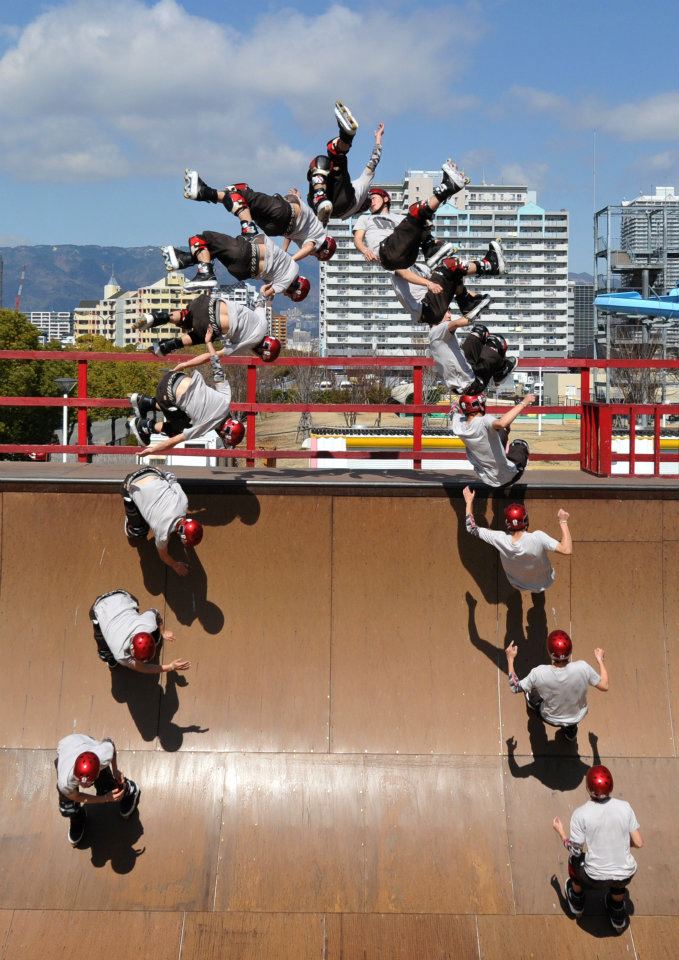
A sequence of still images has been stitched together to show the path taken by Takeshi Yasutoko doing an Alley-Oop Liu-Kang Flatspin 540

Vert skating or vertical skating is a discipline using skates like inline skates or roller skates on a vert ramp, a style of half-pipe. In vert skating, the skater is able to achieve more air-time as compared to other styles of skating, meaning skaters can perform complicated aerial maneuvers and acrobatic tricks, such as spins and flips.

The intent of vert skating is to ride higher than the coping (the metal pipe on top of the ramp) and perform spins or flips.[1] It focuses on complicated aerial maneuvers, such as spins and flips.[2] The intent of the skater is to build speed until they are of sufficient height above the edge of the ramp to perform various aerial acrobatics.[3] In competitions skaters have limited time, often less than a minute, to impress the judges by landing numerous and difficult tricks, having a good flow and consistency, having creativity with the routine and most importantly having a good style.[4]

The first X Games, in 1995, featured four inline skating events: best trick/big air, men's and women's vert, men's street, and men's downhill.[5] At its heyday in 1998, inline skating had the most events of any sport at the X Games, featuring vert triples (a three-person team based vert event), women's street, and women's downhill in addition to the original events.[6]

However, the sport soon fell out of fashion and by 2004, vert skating was the only remaining event at the X Games – including just one men's and women's combined contest.[7] For the 2005 X Games, aggressive inline was dropped entirely and the vert competition was replaced by women's skateboarding.[8]

Vert skating is considered a challenging sport: as of 2012 there are fewer than 15 professional vert skaters attending competitions.[citation needed]

X Games results

[edit]

Men's vert

[edit]
Year 1st place, gold medalist(s) 2nd place, silver medalist(s) 3rd place, bronze medalist(s)
1995 Tom Fry (AUS) Cesar Mora (AUS) Manuel Billiris (AUS)
1996 Rene Hulgreen (DNK) Tom Fry (AUS) Chris Edwards (USA)
1997 Tim Ward (AUS) Taïg Khris (FRA) Chris Edwards (USA)
1998 Cesar Mora (AUS) Matt Salerno (AUS) Taïg Khris (FRA)
1999 Eito Yasutoko (JPN) Cesar Mora (AUS) Matt Salerno (AUS)
2000 Eito Yasutoko (JPN) Takeshi Yasutoko (JPN) Cesar Mora (AUS)
2001 Taïg Khris (FRA) Takeshi Yasutoko (JPN) Shane Yost (AUS)
2002 Takeshi Yasutoko (JPN) Eito Yasutoko (JPN) Marc Englehart (USA)
2003 Eito Yasutoko (JPN) Takeshi Yasutoko (JPN) Record not available

Sources:[6][9][10][11]

Women's vert

[edit]
Year 1st place, gold medalist(s) 2nd place, silver medalist(s) 3rd place, bronze medalist(s)
1995 Tash Hodgeson (NZL) Angie Walton (USA) Laura Connery (USA)
1996 Fabiola da Silva (BRA) Jodie Tyler (AUS) Tash Hodgeson (NZL)
1997 Fabiola da Silva (BRA) Claudia Trachsel Ayumi Kawasaki (JPN)
1998 Fabiola da Silva (BRA) Ayumi Kawasaki (JPN) Maki Komori (JPN)
1999 Ayumi Kawasaki (JPN) Fabiola da Silva (BRA) Maki Komori (JPN)
2000 Fabiola da Silva (BRA) Ayumi Kawasaki (JPN) Merce Borrull (ESP)
2001 Fabiola da Silva (BRA) Ayumi Kawasaki (JPN) Record not available
2002 Records not available
2003 Records not available

Sources:[6][12][13][14][15][16]

Vert triples

[edit]

Vert triples was a mixed-gender team AIL vert event and was included at two X Games, 1998 in San Diego and 1999 in San Francisco. Fabiola da Silva and Ayumi Kawasaki competed on a triples team with Andre Englehart in 1999. Maki Komori is the only woman to have medaled in vert triples at the X Games, winning bronze as part of a team with the Yasutoko brothers, Takeshi and Eito, in 1999.

Year 1st place, gold medalist(s) 2nd place, silver medalist(s) 3rd place, bronze medalist(s)
1998
  • Paul Malina (AUS)
  • Sam Fogarty (AUS)
  • Viorel Popa (USA)
  • Cesar Mora (AUS)
  • Mike Budnik (USA)
  • Matt Salerno (AUS)
1999
  • Taïg Khris (FRA)
  • Javier Bujanda (ESP)
  • Sven Boekhorst (NLD)
  • Cesar Mora (AUS)
  • Mike Budnik (USA)
  • Matt Salerno (AUS)
  • Takeshi Yasutoko (JPN)
  • Eito Yasutoko (JPN)
  • Maki Komori (JPN)

Sources:[6][9][15][17][18][19]

Vert

[edit]

Men's and women's vert were combined at the 2004 X Games in Los Angeles. Fabiola da Silva was the only woman to qualify for participation in the event and placed sixth in the finals.

Year 1st place, gold medalist(s) 2nd place, silver medalist(s) 3rd place, bronze medalist(s)
2004 Takeshi Yasutoko (JPN) Record not available Eito Yasutoko (JPN)

Sources:[9][10]

Other notable vert skaters

[edit]

Skaters who participated in vert events at the X Games but did not medal or who participated at other major international events include:

See also

[edit]

References

[edit]
Revisions and contributorsEdit on WikipediaRead on Wikipedia
from Grokipedia
Vert skating, also known as vertical skateboarding, is a discipline of that involves riding a on ramps or half-pipes featuring near-vertical transitions, where athletes gain momentum to perform aerial tricks, flips, spins, and grinds at high speeds. Originating in the mid-1970s in during a severe , when surfers and early skateboarders like the team began practicing in empty swimming pools, vert skating transformed from an improvised activity into a structured style facilitated by purpose-built ramps and half-pipes. This evolution was propelled by innovations such as the in the late 1970s, which enabled skaters to leave the ramp surface and execute more complex aerial maneuvers. The sport gained widespread popularity in the 1980s through professional competitions and figures like , who pioneered aerial techniques by skating up pool walls and performing 180-degree flips, and , who dominated vert contests by winning 73 out of 103 professional events and holding the world championship title from 1984 to 1996. Hawk further elevated the discipline by inventing over 100 tricks and landing the first 900-degree spin in 1999 at the , a milestone that showcased the sport's potential for extreme rotations. Key elements of vert skating include pumping to build speed on the ramp's curved transitions, carving turns, and executing signature tricks such as the McTwist (a 540-degree aerial rotation), the (a 180-degree turn with a leg kick-out), the Caballerial (a backside 360 while riding fakie), the Invert (a one-handed handplant), and the Backside Smith Grind (a grind on the coping with the back truck). Typically performed on 12-foot-high (3.6-meter) vert ramps, the discipline requires protective gear like helmets and pads due to the high risks involved, and it emphasizes balance, timing, and air awareness. While vert skating shares roots with other styles like and skateboarding, it remains distinct for its focus on vertical airs rather than urban obstacles, though public vert ramps are scarce today, often limiting practice to private facilities or events. The sport has influenced global action sports, including , and continues to evolve with recent achievements like 12-year-old Gui Khury's first 1080-degree spin in 2021 and 14-year-old Arisa Trew's historic first female 900 in 2024. Featured prominently in the since 1995 but absent from the Olympics (which prioritize and formats), vert skating endures as a high-flying cornerstone of culture.

Overview

Definition and Characteristics

Vert skating, also known as vertical skateboarding, is a discipline within that involves riding on ramps or half-pipes featuring near-vertical transitions, typically reaching 90 degrees, to perform aerial maneuvers and transitions between horizontal and vertical surfaces. This style emphasizes exploiting the ramp's curvature to build and maintain speed for launching into the air above the , distinguishing it from flat-ground focused variants like street skating. Key characteristics of vert skating include the need for sustained momentum through pumping and carving along the transitions, enabling skaters to drop in from the top of the ramp and execute flips, , or grinds while airborne. Sessions revolve around achieving significant air heights in professional settings and precision in re-entering the ramp, with the half-pipe's vertical walls providing the platform for gravity-defying airs. Physically, vert skating demands exceptional balance to navigate the shifting angles of the ramp, precise timing for initiating tricks mid-flight, and robust core strength to control body position during high-speed launches and landings. These requirements ensure skaters can generate and sustain the velocity necessary for complex aerial rotations without losing stability. Due to the elevated nature of vert ramps, safety risks are amplified compared to lower-profile , with falls from significant heights leading to serious injuries such as concussions and fractures. Protective gear like helmets and wrist guards is essential to mitigate these hazards, as miscalculated airs can result in severe trauma from the ramp's unforgiving vertical drops.

Relation to Other Skateboarding Styles

Vert skating distinguishes itself from street skating through its reliance on engineered structures like ramps and half-pipes, enabling vertical transitions and high-amplitude aerials, whereas street skating adapts urban elements such as curbs, stairs, and handrails for flatground tricks and grinds. This contrast highlights vert's emphasis on momentum-driven flow in controlled environments versus street's improvisational navigation of public spaces. In relation to park skating, vert represents a more focused subset centered on strict vertical inclines for explosive airs, while encompasses diverse terrain like , transitions, and rails that allow for continuous lines blending speed and technical elements. Vert skating's stylistic roots trace back to , where skaters replicate wave-like carving motions—transitioning smoothly from horizontal bases to vertical walls—in contrast to longboarding's emphasis on sustained, downhill cruising along linear paths. Competition judging in vert prioritizes amplitude, trick difficulty, and maneuver variety on a 0-100 overall impression scale per run, setting it apart from street's focus on creativity, originality, and clean execution amid varied obstacles.

History

Origins in the 1960s and 1970s

Vert skating emerged in the mid-1960s in coastal , where early skateboarders began experimenting with inclined surfaces to mimic maneuvers, laying the groundwork for vertical riding. By the mid-1970s, a severe in emptied countless backyard swimming pools, transforming these drained, kidney-shaped structures into ideal ramps for skaters seeking steeper transitions and higher speeds. This adaptation was particularly prominent in suburban areas of , where access to ocean waves was limited, prompting surfers to transfer their fluid, aggressive styles onto concrete curves. The influence of was instrumental in shaping vert skating's early aesthetics and techniques, with pioneers like Jeff Ho playing a central role. Ho, a skilled surfer and shop owner, co-founded the Zephyr Competition Team—better known as the —in the mid-1970s alongside Craig Stecyk and , recruiting a group of young talents from and Santa Monica. At the 1975 Bahne/Cadillac National Championships in Del Mar, the debuted their innovative, low-to-the-ground approach infused with surf-inspired flow, dominating multiple divisions and introducing vertical elements that revolutionized the sport by emphasizing aerial grabs and vertical wall rides over traditional freestyle. Their style, born from practicing in empty pools during the 1976-1977 , emphasized speed, power, and improvisation, setting vert apart from earlier, more rigid forms of . A pivotal technological advancement came in 1973 with Frank Nasworthy's invention of (urethane) wheels under the Cadillac brand, which offered far superior grip and durability on ramps compared to the slippery clay wheels of the . This innovation enabled skaters to tackle steeper angles and smoother surfaces in pools and early ramps without frequent slippage, accelerating the shift toward true vertical riding and sparking a broader resurgence in participation. By the late 1970s, these wheels facilitated the first dedicated vert contests, such as the 1977 U.S. Open at Kona Skatepark, which featured purpose-built half-pipes and marked the formal recognition of vert as a competitive discipline. In its cultural context, vert skating served as an outlet for suburban youth confronting the monotony of American life, where and limited recreational options fueled a DIY ethos. Skaters responded by constructing homemade ramps from and 2x4s in backyards and empty lots, replicating pool transitions when drought restrictions or property access barred pool sessions. This innovation not only democratized vertical skating but also cultivated a sense of and amid the era's conservative social norms, turning into a catalyst for creative expression.

Evolution in the 1980s and Beyond

The 1980s marked a significant boom for vert skating, driven by major sponsorships and the professionalization of the sport. Companies like Vision Skateboards and Powell-Peralta played pivotal roles by assembling elite vert teams, including riders who pushed the boundaries of aerial maneuvers on half-pipes. Powell-Peralta's Bones Brigade team, in particular, elevated vert through innovative designs and high-profile contests, fostering a competitive scene that attracted widespread attention. A key milestone was turning professional at age 14 in 1982 with Powell-Peralta, symbolizing the youth-driven surge in vert's popularity and technical advancement. Entering the 1990s, vert skating achieved mainstream recognition through media and events that amplified its spectacle. The debut of the in 1995 introduced vert as a core discipline, showcasing high-flying tricks to a global television audience and solidifying its status as an . This exposure culminated in the release of in 1999, a video game that popularized vert mechanics and culture among millions, inspiring a new generation to emulate aerial stunts on ramps. From the 2000s onward, vert skating expanded globally while adapting to new formats and challenges. International growth was evident in regions like , where events such as the 2000 qualifiers promoted vert competitions, and , home to influential vert pioneers who integrated local ramp culture. Skateboarding's inclusion in the Olympics, announced in 2016 and debuting in 2020 as park and street events, incorporated vert-inspired elements like transitions but excluded pure vert half-pipe, prompting adaptations in hybrid formats. Despite these advances, vert skating faced a decline in the post-2000s era as street skating gained dominance due to its urban accessibility and video-driven innovation, leading to fewer dedicated vert facilities and contests. This shift reduced vert's mainstream visibility, but revivals emerged through niche events like ongoing vert competitions and youth-led ramps, sustaining its core community. Into the , vert continued to thrive in dedicated events, with the featuring vert in (June 2025), where won gold in men's vert, and (August 2025). Tony Hawk's Vert Alert returned in 2025, hosting competitions and a legends demo in , showcasing new tricks like 10-year-old Ema Kawakami's first triple 900. However, the declined to add vert to the LA28 Olympics in April 2025, despite advocacy for its inclusion.

Equipment and Facilities

Skateboards and Protective Gear

Vert skateboards are designed with specific adaptations to handle the high speeds, steep transitions, and aerial demands of riding. Decks are typically wider, ranging from 8.25 to 8.5 inches, providing enhanced stability and foot placement during launches and landings. Trucks often feature stiffer bushings to maintain control and stability at high velocities on ramps, while widths match the deck for balanced turning. Wheels are larger, measuring 54 to 60 mm in , to generate speed on the curved surfaces of vert ramps and reduce friction during transitions. Protective gear is essential for vert skaters due to the risk of falls from heights of 10 to 15 feet, common in standard vert ramps where the coping sits at the top of the transition. Full-face helmets offer comprehensive head protection against impacts, while knee and elbow pads with hard caps and thick foam absorb shocks from slides and crashes. Mouthguards are recommended to safeguard teeth and jaws during high-impact collisions. Key manufacturers like Santa Cruz produce vert-specific boards known for durable construction suited to aggressive ramp use. Girl Skateboards also supplies decks popular in vert and park settings, emphasizing versatile shapes for aerial maneuvers. Skateboard evolution for vert has progressed from simple 1970s wooden planks—often basic boards with roller skate trucks—to modern decks incorporating composite materials like layered with Canadian for increased strength and reduced weight. Maintenance is crucial given the abrasive nature of ramp surfaces; wheels wear quickly from grinding against transitions, requiring frequent inspection and replacement every few sessions to prevent flat spots and maintain speed. Regular cleaning of bearings and rotation of wheels in an X-pattern help extend component life and ensure consistent performance.

Ramps, Half-Pipes, and Venues

Vert half-pipes are U-shaped structures designed to allow skaters to gain speed and height through curved transitions leading to a vertical section. These ramps typically feature a total height of 11 to 14 feet, including a vertical extension of 1 to 2 feet at the top, enabling aerial maneuvers and inverts. The width across the flat bottom usually measures 20 to 24 feet, with the overall structure spanning up to 40 feet to accommodate the transitions and deck platforms. At the top edge of the vertical section, a rounded —often made of galvanized —is installed to facilitate grinds and slides. Ramp construction emphasizes durability and smooth riding surfaces, commonly using multiple layers of phenolic-laminated or Skatelite—a composite of plastics and resins—over or pressure-treated frames. These materials resist wear from repeated impacts and weather exposure, with Skatelite providing a consistent, grippy texture that lasts 10 to 20 years under professional use. Portable minirampts, smaller versions under 6 feet high, are built for or temporary setups using lighter frames and can be disassembled for transport, contrasting with permanent structures anchored on foundations for stability in high-traffic venues. Early iconic venues like the Upland Pipeline Skatepark in California, operational from 1977 to 1989, featured groundbreaking vert elements including the first purpose-built fullpipe and combi pool that influenced modern half-pipe design. This park, located in Upland, became a hub for pioneering vert skaters due to its challenging transitions and speed-generating layout. In San Francisco, the Haight-Ashbury area, including spots near Skates on Haight shop (opened 1974), hosted informal vert sessions that contributed to the local scene's development amid the urban skate culture of the 1970s and 1980s. Contemporary venues, such as those used in Dew Tour events, incorporate 14-foot vert ramps with extended 20-foot roll-ins to support professional competitions and boost massive airs. Safety standards in modern half-pipes prioritize through features like 42-inch safety railings on decks, padded bumpers on edges, and spectator barriers to separate viewing areas from active zones. Transitions often include foam padding to cushion falls during learning or high-speed drops, while overall park designs follow guidelines recommending fenced perimeters and height limits under 14 feet for controlled access and reduced risk. These elements ensure venues remain accessible for skaters of varying skill levels while minimizing hazards.

Techniques and Tricks

Fundamental Vert Maneuvers

Fundamental vert maneuvers form the core skills for beginners transitioning to ramp skating, emphasizing balance, speed generation, and controlled aerials on half-pipes or vert ramps. These techniques build confidence and prevent injury by focusing on body positioning and rather than advanced rotations. Mastering them requires practice on smaller transitions before progressing to full vert setups, typically 12 feet high with vertical extensions. Dropping in is the initial commitment technique where the skater positions the board's on the ramp's at the top, with the back foot applying pressure to initiate , followed by shifting weight forward as the front wheels engage the transition. This maneuver generates initial speed and sets the rhythm for subsequent runs, requiring full body lean into the ramp to avoid hesitation-induced falls. Proper execution involves keeping knees bent and eyes focused down the ramp for stability. Pumping involves rhythmic shifts of body weight—squatting low at the bottom of the transition and extending upward near the top—to convert into without foot pushes, allowing sustained speed on vert ramps. By moving the center of mass inward during curves, skaters exploit conservation of to increase progressively, countering losses and enabling higher amplitudes over multiple passes. This technique is crucial for maintaining flow in transitions and is often practiced first on mini-ramps. Basic airs introduce controlled takeoffs, starting with riding fakie (backward in regular stance) or switch-stance (opposite footing forward) to build directional versatility, followed by simple grabs for stability during flight. The indy grab, performed backside, entails reaching the back hand to the toeside rail between the feet at the air's peak, providing control and style while tucking the knees for height. Similarly, the stalefish grab, a frontside variation, uses the rear hand to grasp the heelside rail behind the back leg, mirroring the indy but on the opposite rail for balanced aesthetics and security. These grabs, executed below the coping on early airs, enhance board control without rotation, progressing from flatground ollies to ramp launches. The progression path begins with static balance exercises on flat ground, such as stationary ollies and manual pushes, to develop board feel, before advancing to dynamic ramp riding on mini half-pipes for pumping and basic carves. Once comfortable, skaters incorporate dropping in on smaller transitions (4-6 feet), gradually scaling to full vert while integrating airs and grabs for fluid sessions; protective gear like helmets and is essential throughout to support safe repetition.

Advanced Aerial and Invert Tricks

Advanced aerial tricks in vert skating represent the pinnacle of technical proficiency and risk, involving multiple rotations and flips executed at significant heights above the ramp's . The 540, a foundational yet advanced aerial maneuver, requires the skater to launch from the transition, rotate one and a half times (540 degrees) in the air while maintaining board control, often incorporating grabs for stability and style. This trick, first popularized on vertical ramps in the early , demands precise timing to generate sufficient airtime and rotational momentum without losing orientation upon landing. More complex variations, such as varial flips combined with rotations exceeding 360 degrees—like the 540—involve flipping the board mid-rotation, adding an extra layer of difficulty through board manipulation during high-speed spins. The McTwist exemplifies aerial innovation, consisting of a 540-degree frontside performed while inverted, where the skater plants both hands on the , tucks the board between the legs, and spins the body before re-entering the ramp. Invented by in 1984 at a skate camp in , this trick blended aerial with invert elements, instantly elevating the sport's acrobatic boundaries and becoming a staple in competitive vert routines. Its enduring impact lies in the seamless fusion of height, spin, and inversion, requiring exceptional upper-body strength and spatial awareness to execute cleanly. Invert maneuvers further push the limits of vert skating by inverting the body fully or partially against the ramp's vertical face, emphasizing balance and core control. Handplants, a core invert technique, involve approaching the backside or frontside, planting both hands on the edge while lifting the board overhead and inverting the body to a near-handstand position before dropping back in. This maneuver, rooted in pool skating adaptations, tests a skater's ability to compress and extend dynamically without stalling. Variations may incorporate grabs, such as an indy, during the invert for added style and control. The evolution of these tricks traces from rudimentary 1970s ramp slashes—sharp cuts up the vertical wall to build speed and height—toward the 1990s' acrobatic milestones, driven by advancements in ramp design and skater experimentation. Early slashes in backyard pools and wooden ramps laid the groundwork for aerial launches, but by the 1980s, consistent half-pipes enabled sustained inversions and spins. The 1999 landing of the 900—a two-and-a-half rotation (900 degrees) aerial without inversion, achieved after 11 attempts at the X Games V in San Francisco—marked a transformative moment, inspiring combinations like 900s with flips and grabs that integrated street-style technicality into vert. This progression has continued into the 2020s with achievements such as Gui Khury's first 1080-degree spin in 2021 and Arisa Trew's first female 900 in 2024. It reflects iterative innovation, where pros adapted ollies and flips from street skating to vert contexts, expanding rotational thresholds from 360s to 1080s. In competitions, advanced tricks are evaluated primarily on (the height achieved above the , often exceeding 10 feet for elite performances), difficulty (complexity of rotations, flips, and grabs), and completion without falls or bails, which can deduct up to 50% of a run's score. Judges assess overall run flow, where seamless linking of aerials and inverts amplifies scores, with establishing scale—higher airs enable more rotation time—while difficulty weighs the risk of multi-axis maneuvers like McTwists into 540s. Clean execution, including stable landings and stylistic grabs like fakie indies, ensures full credit, prioritizing verifiable completion over attempted complexity.

Competitions

Major International Events

Vert skating has featured in several major international competitions beyond the . The , launched in 2005, included skateboard vert events until around 2012, showcasing rivalries among top vert skaters like and . Vert Alert, an annual free competition since 2012, attracts elite vert skateboarders for best-trick formats and legends demos. In recent years, has elevated vert internationally with the inaugural at the 2024 in Italia, where Brazilians dominated the men's final and Americans led the women's.

X Games and Results

The , organized by , have played a pivotal role in elevating vert skating to mainstream prominence since the event's inception. Skateboard vert made its debut at the inaugural Summer in 1995 in , featuring individual runs on a where competitors performed sequences of aerial tricks judged on difficulty, , and execution. Over the years, vert formats have evolved to include best-trick competitions, where skaters attempt single high-impact maneuvers in a ; superfinals, in which top qualifiers from preliminary heats compete head-to-head for medals; and doubles, a team-based event emphasizing synchronized runs and board passes between partners to showcase collaboration rather than solo performance. These structures have allowed vert skating to highlight both technical innovation and athletic synergy, drawing global audiences and fostering the sport's growth. In men's vert, dominated the early era, securing 10 gold medals across various formats from 1995 to 2003, including vert singles in 1995 and 1997, doubles from 1997 to 2002, and best trick in 1999 and 2003. His performances, such as landing the first —a 900-degree aerial rotation—in the 1999 Vert Best Trick final, set benchmarks for amplitude and spin that influenced generations of skaters. More recently, captured attention in 2012 by landing the first 1080 in competition during the Vert Best Trick at Asia in , earning gold at age 12 and pushing the boundaries of rotational tricks on vert ramps. Women's vert at the has seen trailblazing contributions from pioneers like Cara-Beth Burnside, who won gold in the inaugural women's vert event in 2003, helping establish the discipline amid limited opportunities for female athletes and advocating for equal prize money. In the 2000s, emerged with multiple medals, including golds in 2007 and 2009, demonstrating advanced inverts and airs that advanced women's vert progression. The vert doubles format, introduced in 1997 at III in , evolved into a staple team event by the early 2000s, with pairs like and Andy Macdonald winning six consecutive golds from 1997 to 2002 through innovative board transfers and combo runs that highlighted partnership and creativity over individual feats.

Notable Skaters

Pioneering Vert Skaters

, born in 1968 in , , emerged as a dominant figure in vert skating during the , revolutionizing the sport with his technical precision and aerial innovations. He is credited with inventing the , a trick involving two and a half rotations (900 degrees) in the air, which he first landed successfully at the 1999 in after 11 attempts. Hawk's dominance in vert competitions during this era is underscored by his 10 gold medals, including wins in Vert and Vert Doubles events from 1995 to 2003. Steve Caballero, a key member of the Powell-Peralta Bones Brigade in the 1980s, advanced vert skating through his inventive tricks and versatility, helping transition the discipline from pure ramp riding to more fluid, street-influenced styles in later decades. He invented the Caballerial in 1980, a fakie 360 ollie performed on transition that became a foundational maneuver in both vert and street skating. Caballero's contributions bridged the high-air vert era of the 1980s—where he set a long-standing record for the highest halfpipe air at 11 feet—with modern skateboarding by incorporating technical flips and grinds into ramp sessions. Members of the , the influential Zephyr Competition Skateboarding Team from Santa Monica and , , pioneered vert-style skating in empty swimming pools during , establishing an aggressive, surf-inspired approach that laid the groundwork for vert. , a core Z-Boy, was instrumental in developing vertical pool riding techniques, including frontside airs and deep-end carves that emphasized speed and power over freestyle precision. This raw style profoundly influenced subsequent vert innovations by prioritizing flow and risk-taking on curved transitions. Among the early women in vert skating, stood out as the only female member of the in the 1970s, competing alongside the team at events like the 1975 Del Mar Nationals and adapting their aggressive pool techniques with a distinctive, unapologetic style that challenged gender norms in the sport. Pioneers like Lynn Cooper also contributed in the late 1970s by skating drained pools in , such as those at Swan Pools in Anaheim around 1976-77, helping evolve vert from freestyle roots into a more aerial-focused discipline.

Contemporary Vert Athletes

Andy MacDonald, an American vert specialist active through the 1990s and 2000s, amassed eight X Games medals in vert skating, including golds in 1996 and 1998, establishing him as a consistent performer renowned for his powerful and reliable aerial maneuvers on the halfpipe. His longevity in the discipline, with bronzes as late as 2013, highlights his enduring influence on modern vert competitions. Bob Burnquist of Brazil dominated vert and big air events in the 2000s and 2010s, securing gold medals in vert including 2000 Vert Best Trick and 2001 Vert, alongside additional medals for a total of several in vert disciplines. Burnquist's innovations on the mega-ramp, which extended vert-style airs to greater heights and distances, have reshaped the boundaries of halfpipe skating by inspiring hybrid tricks that blend traditional vert with big-air elements. Emerging talents have pushed vert boundaries further, exemplified by American , who at age 12 landed the first-ever 1080 rotation on a using a mega-ramp in 2012, a feat recognized by and marking a milestone in aerial progression. , a Brazilian vert prodigy, achieved the first 1080 spin in vert at age 12 in 2021 and has since dominated vert events, winning double gold in Vert and Vert Best Trick at Chiba 2024 and 2025 as of June 2025, accumulating 14 medals by age 16. Arisa Trew, an Australian vert skater, made history as the first woman to land a in 2024 at age 14 and continued her rise with gold medals in Women's Skateboard Vert at 2025, tying for the most golds by a female teenager with seven as of June 2025.

References

Add your contribution
Related Hubs
User Avatar
No comments yet.