Hubbry Logo
Vinca majorVinca majorMain
Open search
Vinca major
Community hub
Vinca major
logo
8 pages, 0 posts
0 subscribers
Be the first to start a discussion here.
Vinca major
Vinca major
from Wikipedia

Vinca major
Scientific classification Edit this classification
Kingdom: Plantae
Clade: Tracheophytes
Clade: Angiosperms
Clade: Eudicots
Clade: Asterids
Order: Gentianales
Family: Apocynaceae
Genus: Vinca
Species:
V. major
Binomial name
Vinca major
Synonyms
  • Vinca major var. variegata Loud.

Vinca major, with the common names bigleaf periwinkle, large periwinkle, greater periwinkle and blue periwinkle, is a species of flowering plant in the family Apocynaceae, native to the western Mediterranean. Growing to 25 cm (10 in) tall and spreading indefinitely, it is an evergreen perennial, frequently used in cultivation as groundcover

Description

[edit]

Vinca major is a trailing vine, spreading along the ground and rooting along the stems to form dense masses of groundcover individually 2–5 metres (6+1216+12 ft) across and up to 25 centimetres (10 in) high, perhaps even 50–70 cm (20–28 in).

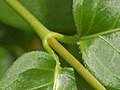
The leaves are opposite, nearly orbicular at the base of the stems and lanceolate at the apex, 3–9 cm (1–3+12 in) long and 2–6 cm broad, glossy dark green with a leathery texture and an entire but distinctly ciliate margin, and a hairy petiole 1–2 cm long.

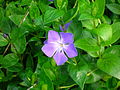
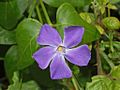
The flowers are hermaphrodite, axillary and solitary, violet-purple, 3–5 cm in diameter, with a five-lobed corolla. The calyx surrounding the base of the flower is 10–17 millimetres (1234 in) long with hairy margins. The flowering period extends from early spring to autumn.

Similar species

[edit]

The closely related Vinca minor is similar but smaller, with narrower, hairless leaves.

Taxonomy

[edit]

Subspecies

[edit]

There are two subspecies, with geographically separate ranges:

  • Vinca major subsp. major - leaf petioles finely hairy, hairs short (Southern Europe)
  • Vinca major subsp. hirsuta (Boiss.) Stearn (syn. V. pubescens d'Urv.) - leaf petioles densely hairy, hairs longer; petals much narrower (Caucasus, northeastern Turkey)

Etymology

[edit]

The genus name probably derives from the Latin word vincire, meaning snip, as the long creeping vines were used to prepare garlands. The Latin specific epithet major means "larger",[1] relative to the similar V. minor.

Distribution and habitat

[edit]

This species is found in southern Europe and northern Africa, from Spain and southern France east to the western Balkans, and also in northeastern Turkey and the western Caucasus. These are also found in lower Himalayan ranges in Asia.

It prefers moist undergrowth, woodlands, hedgerows and banks along the rivers at an altitude of 0–800 m (0–2,625 ft) above sea level. It grows well in full sun and in deep shade.

As an invasive plant

[edit]

Vinca major is an invasive species in temperate parts of the United States, South Africa[2] Australia, and New Zealand. It is especially a common noxious weed 'smothering' native plants and diversity in riparian area and oak woodland habitats of coastal California. It forms dense strands that envelop other plant life and can prevent saplings and shrubs from growing by blocking out the light. Periwinkle moves from place to place, with unintentional human help, in dumped garden waste or as plant fragments carried along in water.[3]

Cultivation

[edit]

Vinca major is a commonly grown ornamental plant in temperate gardens for its evergreen foliage, spring flowers, and groundcover or vine use.

Many cultivars are available, with differences in flowers, such as white to dark violet flowers, and different patterns and colors of variegated foliage. The cultivar 'Variegata' has gained the Royal Horticultural Society's Award of Garden Merit.[4][5]

It contains the following compounds: vinblastine, vincristine, vindesine and vinorelbine.

[edit]

References

[edit]
[edit]
Revisions and contributorsEdit on WikipediaRead on Wikipedia
from Grokipedia

Vinca major L., commonly known as greater periwinkle or bigleaf periwinkle, is an trailing vine in the family , native to the Mediterranean region from eastward to Asia Minor. It features stout, semi-procumbent stems reaching 12 to 36 inches long, with opposite, glossy dark green ovate leaves up to 3 inches in length and solitary funnel-shaped blue-violet flowers blooming primarily in spring.
Widely planted as an ornamental ground cover for its dense mat-forming habit and tolerance of shade and poor soils, V. major reproduces vegetatively via rooting stems and can spread aggressively, often escaping cultivation to invade woodlands, riparian zones, and disturbed areas. In non-native regions such as parts of North America, it forms extensive monocultures that suppress native vegetation, reduce biodiversity, and alter soil conditions through its allelopathic effects and physical smothering. Authorities in several U.S. states classify it as invasive due to its persistence under forest canopies and difficulty of control, recommending avoidance in landscaping to prevent ecological disruption.

Botanical Description

Morphology and Growth Habits

is an in the family, characterized by trailing, prostrate to ascending stems that root at the nodes to form dense mats of groundcover. The stems are stout, somewhat woody at the base, and can extend up to 2 meters in length, growing 15-45 cm in height while spreading indefinitely. Leaves are , simple, and , with ovate to cordate blades measuring 3-9 cm long and 2-6 cm wide, featuring glossy dark green surfaces, prominent veins, and entire to slightly margins. Flowers emerge solitarily from leaf axils in spring, typically violet-blue and funnel-shaped, 3-5 cm in diameter, with five petals and a corolla tube containing milky characteristic of the . The plant exhibits a primarily vegetative life cycle, relying on stem rooting for and expansion, which enables rapid mat formation and persistence in shaded, low-light environments. It demonstrates adaptations such as tolerance to periodic once established and a preference for partial to full shade, where it maintains foliage vigor without significant .

Similar and Distinguishing Species

is most frequently confused with the closely related Vinca minor, from which it differs in several morphological traits. Leaves of V. major are larger, measuring up to 3 inches long, broadest below the middle, and featuring cordate to nearly rounded bases, in contrast to the smaller leaves of V. minor, which are broadest near the middle with rounded to cuneate bases. Petioles of V. major bear hairs, while those of V. minor are glabrous; additionally, V. major exhibits ciliate leaf margins and species-specific trichome distribution on the epidermis. Flowers of V. major are larger and typically deeper violet-blue compared to the paler, pinker blue of V. minor. Phylogenetic analyses of the tribe Vinceae within support the of species, confirming V. major and V. minor as distinct taxa based on molecular markers and character evolution. Other , such as (commonly called annual vinca or periwinkle), share superficial floral resemblances but differ markedly in habit and origin. V. major forms trailing, evergreen mats as a perennial vine suited to shade, whereas C. roseus grows as an upright, bushy annual that prefers full sun and loses leaves in . Flowers of C. roseus are predominantly pink or white and lack the mat-forming growth of V. major, with C. roseus native to rather than .

Taxonomy and Nomenclature

Classification and Phylogeny

Vinca major Linnaeus belongs to the genus Vinca in the family Apocynaceae, order Gentianales, class Magnoliopsida, phylum Magnoliophyta, kingdom Plantae. This placement reflects its inclusion in the asterid clade of eudicot angiosperms, characterized by features such as opposite leaves and sympetalous corollas typical of the family. The species was formally described by Carl Linnaeus in the first edition of Species Plantarum published on May 1, 1753. Subsequent taxonomic frameworks, including those by Antoine Laurent de Jussieu for Apocynaceae in 1789, have maintained this classification without major revisions. Cytological studies indicate that V. major has a number of 2n=92, contrasting with the 2n=46 observed in related diploid species like V. minor, evidence of likely arising from chromosome doubling in a V. minor-like ancestor. This condition, potentially cryptic in some analyses, contributes to the species' vigor and adaptability, as supported by measurements showing elevated DNA content consistent with tetraploidy. Molecular phylogenetic analyses, utilizing markers such as rbcL, matK, and nuclear ITS regions, confirm the genus Vinca within the tribe Vinceae of subfamily Rauvolfioideae in Apocynaceae, with V. major forming a clade alongside other Mediterranean-centered species. These studies trace the genus's origins and diversification to the Mediterranean Basin, where ancestral lineages adapted to woodland understories, with V. major exhibiting basal relations to herbaceous perennials in the group. DNA sequencing has validated the monophyly of Vinca, resolving earlier uncertainties in apocynaceous tribe boundaries and emphasizing evolutionary shifts toward perennial habits in Euro-Mediterranean habitats.

Subspecies and Varieties

Vinca major is recognized as comprising three subspecies: V. major subsp. major, subsp. balcanica, and subsp. hirsuta, differentiated primarily by geographic distribution and subtle morphological traits such as pubescence and regional adaptations. Subsp. major, the nominate form, occurs across southern Europe to the Caucasus, featuring typical glabrous to sparsely hairy stems and leaves with entire margins. Subsp. balcanica is restricted to the northern Balkan Peninsula, where it exhibits localized variations potentially linked to edaphic conditions, though detailed diagnostic traits remain understudied in peer-reviewed literature. Subsp. hirsuta, found in northern Turkey and western Transcaucasia, is distinguished by increased hairiness on stems and calyces, reflecting adaptation to drier microhabitats. Certain varieties, such as var. oxyloba, have been proposed based on sharper apices and pod characteristics in Mediterranean populations, but taxonomic authorities synonymize it under the due to insufficient genetic or consistent morphological divergence. Horticultural selections, including the variegated 'Variegata' with cream-margined leaves, represent artificial variants selected for ornamental use rather than natural infraspecific ; these show intraspecific plasticity but lack wild distributional evidence. Empirical assessments indicate overall low genetic differentiation within V. major, with morphological variations often attributable to environmental plasticity rather than fixed genotypic differences, cautioning against over-classification of putative varieties.

Etymology

The genus name derives from the Latin verb vincire, meaning "to bind" or "to wind around," a reference to the long, flexible stems of these plants that were traditionally employed in wreath-making or garlands. The specific major, from Latin for "larger" or "greater," distinguishes this species by its comparatively bigger leaves, flowers, and overall stature relative to the smaller . Common names such as "greater periwinkle" or "bigleaf periwinkle" emphasize this size differential, with "periwinkle" tracing to the vincapervinca, an ancient designation for the that evolved into the modern genus name through linguistic adaptation in medieval herbals. Regional variants include "large periwinkle" in some European contexts, reflecting consistent botanical distinctions based on morphology rather than local .

Native Range and Ecology

Geographic Distribution

Vinca major is native to , spanning the western and central Mediterranean Basin, with confirmed occurrences in , (including and ), , , the northwest Balkan Peninsula, and . Its range extends eastward through the East Aegean Islands and into the region, encompassing the and Transcaucasus, as well as Lebanon-Syria. Global biodiversity databases, such as GBIF, document over 100,000 occurrence records for V. major, with the highest densities aligning to these native locales based on vouchers and georeferenced observations, primarily from temperate Mediterranean and Asia-Temperate floristic regions. These verified extents exclude introduced populations and highlight core distributions in coastal and submontane zones suitable for its habit. Early European herbals, including editions from the 1630s, record V. major in Mediterranean contexts, corroborating its pre-modern presence in native territories likely augmented by ancient trade corridors along sea routes, though primary distribution reflects natural biogeographic patterns rather than solely anthropogenic dispersal.

Preferred Habitats and Adaptations

persists in its native Mediterranean range across and northwest , primarily in understories, scrublands, and on rocky slopes where partial to deep shade predominates. It favors moist, well-drained soils of varied textures, including loams and those with rocky substrates, enabling establishment in heterogeneous forest floors and disturbed edges. Empirical observations from native sites in indicate occurrence on neutral to slightly alkaline soils with values ranging from 6.7 to 7.2, reflecting tolerance to mildly acidic through basic conditions (approximately 5.5–7.5). Key adaptations include foliage that maintains photosynthetic capacity year-round under low light, coupled with stoloniferous growth where trailing stems root at nodes to form dense mats. This predominates over , conferring resilience to periodic disturbances like herbivory or drought by facilitating rapid clonal expansion and gap colonization without dependence on variable . The production of milky containing alkaloids, such as vincamine precursors, serves as a chemical deterrent against herbivores, reducing foliage damage and supporting persistence in grazed or browsed habitats. In native , V. major interacts competitively through mat formation, which shades soil surfaces and monopolizes nutrients and moisture, potentially limiting diversity by hindering native establishment even in equilibrium communities. Field data from European woodlands reveal its capacity to displace co-occurring via resource preemption, though balanced by native predators and pathogens that curb dominance in undisturbed settings. These traits—shade acclimation, clonal , and defensive chemistry—underlie its stable occupancy in patchy, light-limited environments characteristic of Mediterranean ecosystems.

Introduced Distributions and Invasiveness

Global Spread Patterns

Vinca major was introduced to from in the 1700s primarily as an ornamental ground cover for gardens and landscapes. This early dissemination via colonial trade and horticultural interest facilitated its establishment in temperate regions, with current distributions spanning multiple states including , where it occupies disturbed sites, and the , reflecting patterns tied to historical European settlement and practices. Subsequent introductions occurred in the through analogous ornamental pathways during periods of European and global plant exchange in the 19th and early 20th centuries. In , it arrived via and has proliferated in temperate zones across states such as Victoria, , , , and , often aligning with urban development and coastal human habitations. Similar vectors propelled its spread to and , where it established in areas of British and European influence, forming dense covers in modified habitats proximate to settlements. Documented spread patterns emphasize vegetative propagation from intentional plantings and inadvertent dispersal via discarded debris, with post-2000 mapping revealing ongoing encroachment into urban-wildland interfaces. such as the Invasive Plant Atlas track this progression, highlighting concentrations in regions with mild climates and anthropogenic disturbance, underscoring human-mediated vectors as the dominant mode of global dissemination beyond its native Eurasian range.

Mechanisms of Invasion and Management

Vinca major primarily invades new areas through vegetative propagation, with trailing stems rooting at nodes upon soil contact and underground rhizomes facilitating clonal expansion, enabling the formation of dense mats that exclude other . This predominates, as production is infrequent and seedlings are rarely observed in naturalized populations, particularly in regions like where viable appears negligible. Human activities accelerate spread, including intentional horticultural plantings that escape cultivation, inadvertent of stem fragments via garden waste dumping or flowing water, and establishment along shaded corridors from discarded material. Management strategies emphasize integrated approaches targeting the plant's extensive , with mechanical removal proving effective for small infestations when all stems, nodes, stolons, and rhizomes are meticulously extracted to prevent resprouting, though repeated efforts over multiple seasons are often required due to fragmentation potential. applications, such as foliar sprays of at concentrations around 360 g per 100 L, have demonstrated high efficacy, achieving up to 96% plant brown-out six months post-treatment in field trials, while lower rates or alternatives like yield reduced control at 59%. Mulching or covering treated areas can suppress regrowth, but complete eradication remains challenging owing to persistent rhizomes and the plant's capacity to regenerate from small remnants, necessitating follow-up monitoring and treatments for at least two to three years. Biological control agents remain unestablished and ineffective based on available evidence.

Empirical Ecological Impacts

Vinca major forms dense, evergreen mats that suppress native vegetation, leading to reduced and abundance in invaded and sites. In , these mats exclude herbaceous natives and inhibit seedling germination and performance of co-occurring species, creating near-monocultures in shaded understories. Plot-based observations in riparian and habitats document displacement of native herbs, with success correlating positively with prior disturbance levels such as or canopy gaps. Invasion alters local soil properties and through and accumulation, decreasing penetration and potentially modifying moisture retention beneath mats, though empirical quantification varies by site edaphic conditions. Biogeochemical effects include shifts in cycling due to the plant's persistent foliage, which decomposes more slowly than native , influencing microbial activity and availability; however, causal studies specific to V. major remain limited compared to congeners like V. minor. Long-term monitoring in U.S. Forest Service assessments highlights inconsistent invasion intensity, with higher impacts in mesic, disturbed riparian zones where exacerbates exclusion of -dependent natives. Direct toxicity to is undocumented, but indirect effects arise from homogenization, reducing structural diversity for ground-nesting birds and small mammals reliant on heterogeneous understories. Riparian invasions amplify sensitivity in these ecosystems, as dense cover shades streambanks, potentially disrupting algal and communities supporting aquatic-riparian food webs, though foraging appears unaffected. USDA reports note no widespread faunal declines attributable solely to V. major, attributing variability to landscape context and co-invaders.

Viewpoints on Invasiveness: Benefits vs. Harms

Critics, including state wildlife agencies, argue that Vinca major poses significant harms by forming dense monocultures that displace native vegetation, thereby reducing biodiversity and altering ecosystem services such as soil nutrient cycling and habitat availability for understory species. In regions like California, where it is classified as invasive, the plant's rapid vegetative spread via rooting stems chokes out competitors in shaded woodlands and riparian zones, leading to long-term shifts in plant community composition. These concerns are echoed by invasive species databases, which highlight its lack of value to local wildlife due to toxicity and failure to support native food webs, potentially exacerbating declines in specialist pollinators and herbivores. However, empirical studies on pollinator interactions reveal limited direct negative impacts, as V. major flowers prolifically and attracts generalist insects like bees and butterflies, suggesting monocultures may not uniformly disrupt pollination services in disturbed landscapes. Proponents of V. major, particularly horticulturists and land managers, emphasize its benefits as a robust agent in degraded or sloped sites where native alternatives fail to establish quickly. Its trailing vines root at nodes to stabilize , preventing runoff in urban and roadside settings, and serve as a low-water, drought-tolerant groundcover that reduces the need for mowing or chemical inputs compared to traditional turfgrasses. In practical , this translates to lower long-term maintenance costs, with some regional guidelines noting that evergreen groundcovers like periwinkle can cut upkeep expenses by up to 20% through minimized and labor in suitable non-natural habitats. Debates center on whether the "invasive" designation warrants blanket restrictions, with some ecologists and advocating pragmatic use in non-sensitive, anthropogenically disturbed areas where V. major fills voids left by bare soil or failing natives without threatening intact ecosystems. Studies and expert commentaries question uniform harm assessments, arguing that invasion risks are context-dependent—higher in pristine forests but negligible in urban edges—and that overregulation ignores trade-offs like rapid site stabilization amid climate-driven erosion pressures. advocates further contend that managed plantings provide aesthetic and functional value, countering alarmist narratives from conservation groups by highlighting its pest resistance and adaptability as assets in resource-limited settings, though they acknowledge needs to prevent escape.

Horticultural and Practical Applications

Cultivation Techniques

Vinca major is propagated vegetatively through stem cuttings or by division of established clumps. Stem cuttings, typically 4 to 6 inches long, root readily when taken from healthy shoots and planted in moist or . The plant also spreads naturally by rooting at stem nodes where they contact the , facilitating easy in garden settings. Optimal cultivation occurs in USDA hardiness zones 7 to 9, where it establishes as an ground cover reaching 6 to 12 inches in height with indefinite spread. It prefers partial shade with 2 to 6 hours of direct sunlight daily but tolerates full sun or heavy shade, though excessive sun may scorch foliage in hot climates. Soils should be moist, well-drained, and humus-rich for best growth, yet it adapts to average, occasionally dry, or poor soils once established, demonstrating tolerance to and low fertility. Maintenance involves minimal intervention; water regularly during establishment to maintain , then reduce to occasional deep watering as develops. Fertilization is unnecessary in fertile soils and should be limited to avoid promoting excessive vegetative spread, with balanced applications only if growth is sluggish. or mowing can control vigor by cutting back stems in spring or after flowering to encourage denser mats and prevent overgrowth. The plant exhibits resistance to many common garden stresses but may require monitoring for or nematodes, treatable via cultural practices or targeted insecticides.

Landscaping and Erosion Control Uses

Vinca major serves as a robust groundcover in managed landscapes, particularly in shaded or partially shaded sites, where its prostrate growth habit forms dense, mats up to 6 inches high and spreading indefinitely via rooting stems. This characteristic makes it suitable for covering large areas under trees or along borders, providing aesthetic appeal through glossy leaves and spring-blooming violet flowers while requiring little upkeep once established. Its tolerance for poor, dry soils enhances its utility in challenging garden settings. For erosion control, Vinca major is applied on slopes, embankments, and banks, leveraging its fibrous root network to bind particles and reduce runoff-induced degradation. The plant's vigorous trailing stems create a that minimizes exposure, with extension services documenting its effectiveness in stabilizing disturbed sites in temperate climates. Additionally, the thick foliage layer suppresses establishment by shading the ground and competing for resources, often outperforming sparse native alternatives in high-traffic or low-light conditions. Introduced to North American cultivation in the 1700s as an ornamental from its Mediterranean native range, Vinca major has since been propagated for these practical roles, with commercial nurseries promoting its rapid coverage for cost-effective long-term site management over repeated mulching or mowing. In heavy shade where grass fails, it delivers sustained retention without demands post-establishment, though monitoring is advised to contain spread.

Economic and Property Value Considerations

Vinca major remains commercially available through wholesale propagation and retail nurseries in regions without sales bans, such as parts of the southeastern United States, where it supports local horticultural supply chains as an evergreen groundcover option. Suppliers offer rooted plug liners for transplanting, enabling cost-efficient scaling for landscapers seeking durable, shade-tolerant coverage. While specific sales revenue for Vinca major is not isolated in national horticulture data, its inclusion in broader nursery inventories contributes to the sector's $13.8 billion in U.S. floriculture, nursery, and specialty crop sales reported for 2019. As a low-maintenance alternative to turfgrass or in urban and suburban settings, Vinca major enhances aesthetics and functionality by providing year-round foliage and weed suppression, potentially lowering long-term upkeep costs through reduced need for , fertilization, and pest interventions. In shaded, disturbed areas like those adjacent to or pavement, it outperforms less vigorous natives or alternatives such as by forming dense mats that prevent without requiring frequent replacement, as observed in controlled suburban applications in where spread is limited by environmental constraints. Empirical cases in urban environments demonstrate its without displacing native vegetation, countering blanket bans by highlighting superior performance in human-modified landscapes over higher-maintenance options. appraisals often link such groundcover enhancements to improved , though direct valuation for Vinca major specifically remains undocumented in peer-reviewed assessments.

Chemical Properties and Human Interactions

Toxicity Profile

Vinca major contains alkaloids, including vincamine, which contribute to its toxicity profile across mammals. These compounds disrupt cellular function, particularly , leading to systemic effects upon . In humans, of plant parts typically induces gastrointestinal symptoms such as , , , and , with potential for in higher doses; dermal contact with the sap may cause . Veterinary and toxicological assessments classify the plant as moderately toxic, with risks amplified in cases of substantial consumption, though human poisoning incidents remain infrequent and generally self-limiting without intervention. For animals, particularly pets and livestock, toxicity manifests more severely, encompassing vomiting, depression, tremors, seizures, and cardiovascular instability, potentially progressing to coma or death in acute exposures. Empirical reports from veterinary sources document neurotoxic effects in grazing and sheep, including incoordination, muscle tremors, and convulsions following consumption of foliage. The ASPCA and similar organizations advise restricting access in areas frequented by dogs, cats, and horses due to observed cases of alkaloid-induced and cellular disruption. Livestock losses have been attributed to periwinkle grazing, underscoring its unpalatability yet hazardous potential when forage is limited.

Medicinal and Phytochemical Potential

Vinca major contains various indole alkaloids, including vincamine, which is recognized for its vasodilatory properties and potential in supporting and cognitive function through mechanisms such as inhibition and increased blood flow. Other alkaloids isolated from its aerial parts, such as 10-methoxyperakine, vincawajine, and reserpinine, contribute to its profile, though their specific pharmacological activities remain under-explored compared to those from related like . Leaf extracts of Vinca major have demonstrated activity, attributed to and that scavenge free radicals in assays, as well as antibacterial effects against pathogens like and via inhibition zone measurements in a 2021 phytochemical analysis. These properties correlate with the extract's total phenolic and content, varying by extraction solvent (e.g., yielding higher antioxidants than water), but efficacy depends on species-specific factors and preparation methods, with no standardized therapeutic doses established. While the genus is associated with alkaloids like and —dimeric indoles used in for their microtubule-disrupting antimitotic effects—Vinca major yields primarily monomeric eburnane-type s such as vincamine, which lack comparable potency against cancer cells and are not clinically sourced from this species; remains the primary commercial origin for antitumor vinca alkaloids. Cytotoxic effects observed in Vinca major extracts against cell lines like A375 are preliminary and linked to alkaloid content, but fall short of the targeted efficacy seen in genus-derived chemotherapeutics. Traditional applications of Vinca major and related periwinkles include remedies for , leveraging vincamine's hypotensive effects observed in animal models and early human studies, where doses of 10-30 mg standardized extracts reduced systolic pressure by without significant clinical trials confirming long-term safety or efficacy in isolated V. major preparations. Variability in yield due to environmental factors, combined with risks of overdose-induced or interactions, underscores the need for rigorous extraction standardization before considering therapeutic viability, as empirical data remains sparse and largely extrapolated from genus-level research.

References

Add your contribution
Related Hubs
User Avatar
No comments yet.