Hubbry Logo
VoayVoayMain
Open search
Voay
Community hub
Voay
logo
8 pages, 0 posts
0 subscribers
Be the first to start a discussion here.
Voay
Voay
from Wikipedia

Voay
Temporal range: Late Pleistocene, 0.1–0.01 Ma[1]
Divergence estimates suggest Oligocene origin
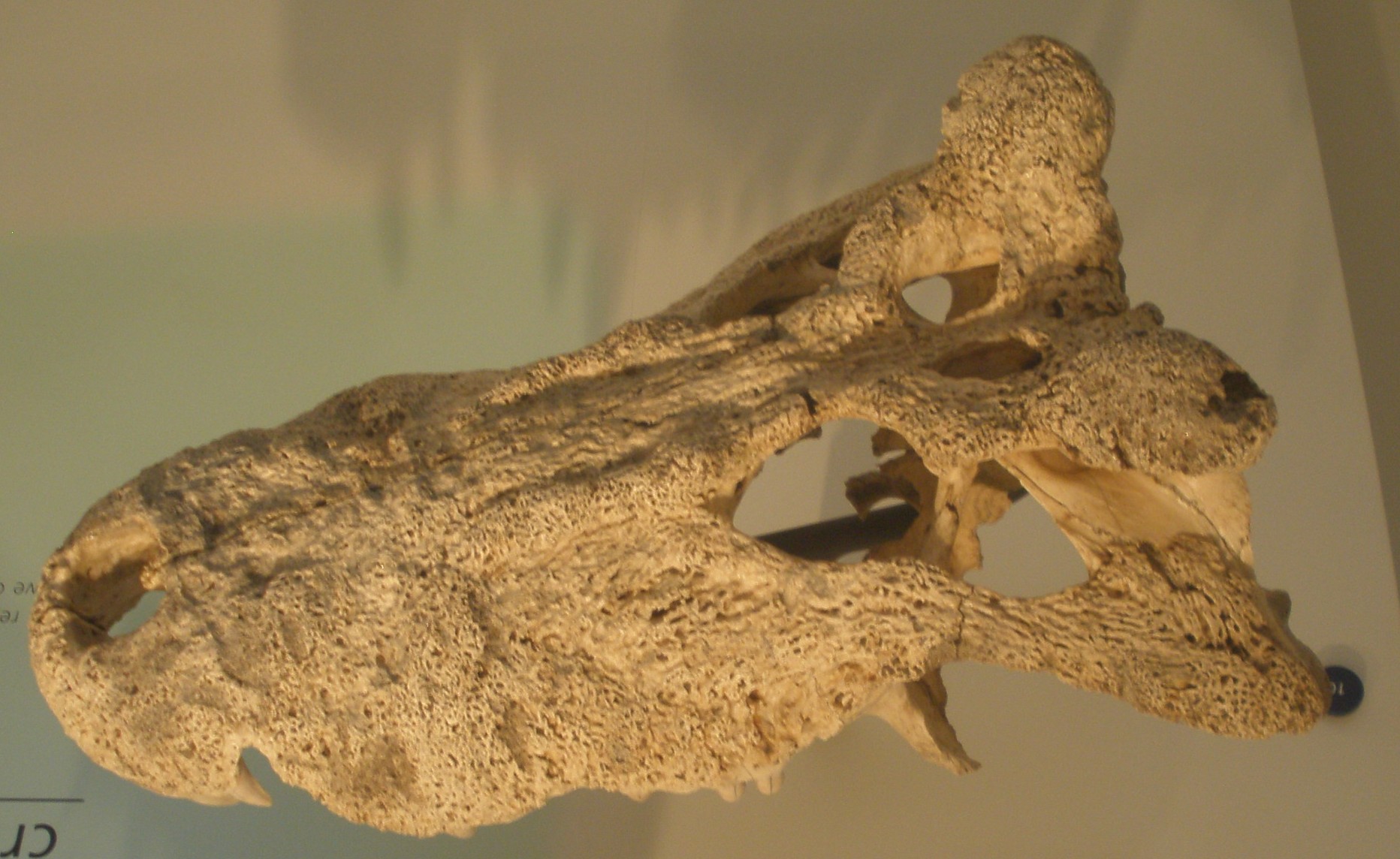
Skull, American Museum of Natural History
Scientific classification Edit this classification
Kingdom: Animalia
Phylum: Chordata
Class: Reptilia
Clade: Archosauria
Order: Crocodilia
Superfamily: Crocodyloidea
Family: Crocodylidae
Subfamily: Crocodylinae
Genus: Voay
Brochu, 2007
Type species
Voay robustus
(Grandidier & Vaillant, 1872)
Synonyms

Crocodylus robustus Grandidier & Vaillant, 1872

Voay is an extinct genus of crocodile from Madagascar that lived during the Late Pleistocene to Holocene, containing only one species, V. robustus. Numerous subfossils have been found, including complete skulls, noted for their distinctive pair of horns on the posterior, as well as vertebrae and osteoderms from such places as Ambolisatra and Antsirabe. The genus is thought to have become extinct relatively recently. It has been suggested to have disappeared in the extinction event that wiped out much of the endemic megafauna on Madagascar, such as the elephant bird and Malagasy hippo, following the arrival of humans to Madagascar around 2000 years ago.[2] Its name comes from the Malagasy word for crocodile.

Description

[edit]
Life reconstruction

One unusual feature of V. robustus that distinguishes it from other crocodilians is the presence of prominent "horns" extending from the posterior portion of the skull. They are actually the posterolaterally extended corners of the squamosal bone. Other related crocodilians such as Aldabrachampsus also had similar bony projections, although in Aldabrachampsus these projections were more like crests than horns.[3] Another diagnostic characteristic is the near-exclusion of the nasals from the external naris. It had a shorter and deeper snout than the extant Crocodylus niloticus, as well as relatively robust limbs. The osteoderms had tall keels and were dorsally symmetrical with curved lateral margins, running the entire length of the postcranial body.[4]

V. robustus would have measured around 3.5–4 m (11–13 ft) long and weighed about 170 kg (370 lb).[5][6] These estimates suggest that V. robustus was the largest predator to have existed in Madagascar in recent times. Its size, stature, and presumed behavior is similar to the modern Nile crocodile (Crocodylus niloticus). Because V. robustus shared so many similarities with the Nile crocodile there must have been a great deal of interspecies competition for resources between the two crocodile genera if they were to have coexisted with one another. It has recently been proposed that the Nile crocodile only migrated to the island from mainland Africa after V. robustus had become extinct in Madagascar.[5] However, this was subsequently disproved after some Crocodylus specimens from Madagascar were found to be at least 7,500 years old and contemporaneous with Voay.[7]

Phylogenetics

[edit]

When V. robustus was first described in 1872, it was originally assigned to the genus Crocodylus.[8] It was later found to morphologically have had more in common with the extant Osteolaemus, or dwarf crocodile, than Crocodylus. Some features it shared with Osteolaemus include a depressed pterygoid surface that forms a choanal "neck" on the palate. Because it was not close enough to be placed in the same genus as the dwarf crocodile, it was assigned to the new genus in 2007. Before this reassignment, the species was considered by some to be synonymous with Crocodylus niloticus. However, this was most likely due to a misinterpretation of remains from the living C. niloticus with V. robustus and the poor description of the original material from which the species was described.[9][10] In contrast to the morphological similarities with Osteolaemus, a 2021 study using paleogenomics found Voay to be a sister group to Crocodylus, with both genera diverging in the mid-late Oligocene; this indicates that the apparent similarities with Osteolaemus are likely due to convergent evolution.[11]

The below cladogram shows the results of the 2021 study,[11] with supplementary data from the 2023 study by Sales-Oliveira et al.:[12]

Crocodylidae
Osteolaeminae

Brochuchus

Rimasuchus

Osteolaemus osborni Osborn's dwarf crocodile

Osteolaemus tetraspis Dwarf crocodile

Osteolaemus sp. West

Crocodylinae
Voay

Voay robustus

Crocodylus

Crocodylus johnstoni Freshwater crocodile

Crocodylus novaeguineae New Guinea crocodile

Crocodylus halli Hall's New Guinea crocodile

Crocodylus mindorensis Philippine crocodile

Crocodylus porosus Saltwater crocodile

Crocodylus siamensis Siamese crocodile

Crocodylus palustris Mugger crocodile

Crocodylus suchus West African crocodile

Crocodylus niloticus Nile crocodile

Crocodylus rhombifer Cuban crocodile

Crocodylus intermedius Orinoco crocodile

Crocodylus acutus American crocodile

Crocodylus moreletii Morelet's crocodile

(crown group)

References

[edit]
Revisions and contributorsEdit on WikipediaRead on Wikipedia
from Grokipedia
Voay is an extinct of endemic to , containing the single species Voay robustus, which inhabited the island from the through the until its recent extinction as recently as approximately 1,300–1,400 years ago. This robust crocodylian was a top predator in its , distinguished by its short, deep and prominent squamosal "horns" projecting from the , features that set it apart from modern crocodiles ( niloticus). Reaching lengths of approximately 3.5–4 meters, V. robustus likely preyed on large vertebrates in riparian and habitats across southwestern and the central highlands. Originally described in 1872 as Crocodylus robustus, the genus was reclassified as Voay in 2007 based on morphological analysis, initially placing it within the subfamily due to similarities in skull structure and sinus pneumatization. However, subsequent paleogenomic studies using from subfossil remains have revealed a closer phylogenetic relationship to the genus , with divergence estimated around 24.9 million years ago during the late . These findings highlight Voay's unique evolutionary history, potentially involving competition or hybridization with introduced C. niloticus populations. The extinction of Voay robustus is attributed to human activities following the arrival of Austronesian settlers in around 2,000 years ago, including direct and egg collection, compounded by alterations and the arrival of C. niloticus. Subfossil evidence, including skulls, vertebrae, and osteoderms from sites like Ampoza, provides detailed insights into its , such as a dorsoventrally high braincase and extensive paratympanic sinuses, suggesting adaptations for predation in marshy environments. As one of the last megafaunal predators on the island, Voay exemplifies the impacts of human-mediated faunal turnover in isolated ecosystems.

Taxonomy

Etymology and Naming

The genus Voay was formally erected in 2007 by paleontologist Christopher A. Brochu to distinguish the extinct Malagasy crocodile from the genus Crocodylus, based on phylogenetic analyses indicating a closer relationship to African dwarf crocodiles in the subfamily Osteolaeminae. The name Voay derives from the Malagasy word for "crocodile," selected to emphasize the taxon's endemic occurrence in Madagascar. The species epithet robustus was originally assigned in 1872 by Alfred Grandidier and Léon Vaillant, who described subfossil remains from central as Crocodylus robustus, highlighting the robust skeletal construction evident in the fragmentary material. This initial classification persisted until Brochu's revision, which transferred the species to the new while retaining the specific name due to its descriptive accuracy for the heavy-built cranium and postcrania.

Classification History

Voay was first described in 1872 by Alfred Grandidier and Léon Vaillant based on subfossil remains from Amboulintsatre, , where they named it Crocodylus robustus due to its robust cranial features distinguishing it from the living (Crocodylus niloticus). In 2007, Christopher A. Brochu reclassified Crocodylus robustus into a new monotypic , Voay, placing it within the subfamily based on phylogenetic analysis of cranial morphology, which highlighted autapomorphies such as a triangular "horn" on the squamosals and differences in supratemporal fenestrae that set it apart from Crocodylus species, including the . A 2021 paleogenomic study by Evon Hekkala and colleagues provided molecular evidence revising Voay's after over 150 years of taxonomic , recovering partial mitochondrial genomes from 1,300–1,400-year-old specimens that positioned Voay robustus as the sister taxon to the genus , with an estimated divergence around 24.9 million years ago (late ). This finding contradicted the prior morphology-based placement in alongside African dwarf crocodiles ( spp.), highlighting in cranial features and supporting a distinct evolutionary lineage closer to .

Description

Physical Characteristics

Voay robustus exhibits a distinctive cranial morphology characterized by triangular squamosal horns positioned over the ears, contributing to the genus's renowned "horned" appearance and distinguishing it from closely related crocodylians. The skull of Voay is notably robust, with deep maxillae that support a broad, dorsoventrally deep . This configuration, marked by a vaulted and a relatively short prenarial rostrum, underscores the structural strength of the cranium. Such features reflect adaptations for exerting significant bite force, as evidenced by the enlarged alveoli and robust dental architecture observed in subfossil specimens. The body of Voay is protected by an armored composed of osteoderms, akin to those in extant crocodilians, but with particularly thick dorsal scutes. These osteoderms are square-shaped, exhibiting a highly pitted dorsal surface and a central spiny process that likely enhanced defensive capabilities. Overall, specimens suggest an adult body length of approximately 5 meters, emphasizing the genus's substantial size within its .

Size and Morphology

Voay robustus reached an estimated adult length of approximately 5 meters and weighed about 170 kg, based on comparisons to related crocodylians. evidence reveals a distinctive cranial morphology, including a shorter and broader rostrum relative to the elongate snout of the , with 15–16 maxillary teeth per side arranged in a robust suited to its predatory role. The postcranial skeleton exhibits variations in limb proportions, with more robust humeri and femora than in niloticus, supporting a semi-aquatic complemented by strong terrestrial locomotion capabilities. Prominent horn-like projections arise from the squamosal bones on the , a diagnostic feature distinguishing Voay from extant crocodylians.

Distribution and Habitat

Geographic Range

Voay robustus was endemic to the island of , with all known fossils confined to this location and no evidence indicating presence elsewhere, such as the African mainland or other islands, thereby confirming its status as an island endemic. Fossils have been primarily recovered from subfossil sites situated in the central highlands and southwestern regions of the island. Key localities yielding Voay remains include the central highland site of Ampasambazimba, as well as in the same region, and southwestern sites such as Ampoza and those near Belo-sur-Tsiribihina. Recent discoveries in flooded caves, such as Vintany Cave in the Mikea Forest, further confirm presence in southwestern subarid regions. These discoveries, spanning multiple deposits, demonstrate a widespread distribution across , from inland plateaus to western lowlands. The spatial extent of Voay's range overlapped with the period following human colonization of approximately 2,000 years ago.

Environmental Preferences

Voay robustus primarily inhabited freshwater ecosystems across , including low-energy river systems, lakes, marshes, floodplains, and . Subfossil remains from sites spanning the central highlands to southwestern coastal regions indicate a broad tolerance for diverse aquatic environments, from paleolakes at elevations around 1,500 meters on the Central High Plateau to interdunal swales and flooded caves in subarid areas. These depositional contexts suggest a preference for slow-moving or standing waters that supported abundant vegetation, as evidenced by associations with megafaunal remains like those of extinct hippopotamuses in wetland assemblages. The species' ecological niche likely emphasized calm, vegetated waters in Madagascar's tropical and subtropical zones, with inferences drawn from subfossil sites indicating presence in highland lakes and marshes as well as southwestern rivers. Voay exhibited potential adaptations for a less water-dependent lifestyle, inferred from its extensive paratympanic sinuses similar to dwarf crocodiles ( spp.), allowing exploitation of both aquatic and adjacent terrestrial habitats, potentially enabling short excursions beyond water bodies. Evidence from subfossil beds further supports tolerance for environmental variability, including seasonal flooding in floodplains and periods of in lacustrine settings that later became hypersaline. Associated in these deposits, such as giant lemurs and , point to and riparian niches rich in prey resources amid vegetated shorelines. Voay's distribution was strictly endemic to , with no evidence of occurrence beyond the island.

Paleobiology

Diet and Predatory Behavior

Voay robustus exhibited a carnivorous diet as a generalist predator, primarily targeting fish, birds, and small- to medium-sized mammals in Madagascar's wetland environments, much like the modern Nile crocodile (Crocodylus niloticus). This opportunistic feeding strategy allowed it to exploit a diverse range of available prey in aquatic and semi-aquatic habitats, including rivers, lakes, and marshes. Fossil evidence further supports predation on larger terrestrial animals, with bite marks on subfossil bones of giant lemurs (such as Palaeopropithecus maximus, weighing over 30 kg) indicating that Voay robustus ambushed and consumed these heavier-bodied species, particularly at lake and marsh sites where such remains are abundant. The ' skull morphology underscores its adaptation for powerful predation, featuring a robust build with dense packing and a near-full occlusion in adults, which facilitated the capture and processing of sizable prey. These traits, combined with a broad and strong adductor musculature inferred from endocranial features, enabled a bite force suited to in water, where Voay robustus likely lurked to strike at passing animals before dragging them underwater. Such mechanics mirror those of C. niloticus, supporting the parallel in their predatory roles as apex predators. Bite marks on fossils, characterized by deep punctures, scores, and furrows from conical teeth, reveal Voay robustus's opportunistic approach, targeting large prey without strong size selectivity and contributing to predation pressure on Madagascar's in ecosystems. This behavior likely intensified in paleolake settings, where subfossil assemblages show higher frequencies of damage on larger bones compared to other predators. Overall, these lines of anatomical and taphonomic evidence portray Voay robustus as a versatile top predator integral to the Pleistocene of central .

Reproduction and Growth

Voay robustus, as a member of the Crocodylia clade, was likely oviparous, producing eggs that females would have laid in clutches within nests constructed on riverbanks or similar semi-aquatic sites influenced by its habitat preferences. Clutch sizes and nesting behaviors in close relatives, such as species in the genus , typically involve 20–60 eggs buried in mounds of vegetation or excavated holes, with incubation lasting around 80–90 days depending on environmental . Growth patterns for Voay robustus are inferred from subfossil ontogenetic material, including limb bones, which indicate that individuals attained adult body lengths of 3.5–4.0 meters based on measurements ranging from 270–335 mm. These specimens exhibit features such as smooth humeral shaft surfaces and deep ridges consistent with advanced age and maturity. Drawing from growth trajectories in its sister taxon , such as the , Voay likely reached at 3–4 meters after approximately 10–12 years, with initial rapid growth of about 30 cm per year in juveniles slowing thereafter. Skeletal remains of Voay robustus reveal intraspecific variation in cranial features, including horn size, which may reflect potentially linked to display or behaviors, alongside ontogenetic changes. Such dimorphism aligns with patterns observed in extant crocodylians, where males often develop exaggerated structures for intrasexual competition.

Extinction

Timeline of Extinction

The subfossil record of Voay robustus spans approximately 16,000–18,000 years, from deposits to the late , with remains recovered from multiple sites across , including Ampoza and the Central High Plateau near . Early subfossils, associated with dated vertebrate faunas, indicate presence as far back as around 17,000–19,000 calibrated years (cal ), while later specimens extend to about 1,000 cal . Voay robustus coexisted with early human settlers in , who arrived approximately 2,300 years ago during the late , overlapping with the crocodile's persistence in riverine and habitats. This period of overlap lasted until the recent , as evidenced by subfossil associations in human-influenced landscapes, though direct interactions remain inferred from site rather than specific artifacts. A decline in Voay robustus subfossils becomes evident after approximately 2,000 years ago, marking a reduction in abundance compared to earlier records, based on dated assemblages from key localities. The latest confirmed remains, from Ampoza in southwestern , yield radiocarbon dates of 1,380 ± 30 ¹⁴C years (calibrated to 1,364–1,280 cal ) and 1,450 ± 30 ¹⁴C years (calibrated to 1,422–1,307 cal ), corresponding to roughly 1,300–1,400 years ago or circa 600–700 CE. These (AMS) dates on dental confirm Voay's survival into the early medieval period before its final disappearance.

Possible Causes

The extinction of Voay robustus is primarily attributed to anthropogenic pressures following the arrival of humans on Madagascar, particularly through direct hunting and habitat modification associated with the expansion of Austronesian populations during the late Holocene. Archaeological evidence from subfossil sites indicates that Voay remains are often found in association with human artifacts and subfossils, suggesting overhunting for food, skins, and possibly eggs, as historical accounts describe local consumption of crocodile eggs in regions where Voay persisted into the medieval period. While radiocarbon dates indicate extinction around 1,300 years ago, some ethnohistoric accounts suggest possible survival into more recent historical periods, though this remains unconfirmed by direct evidence. Butchery marks on some megafaunal bones, including those potentially linked to crocodylians, further support intensified exploitation by agropastoralist communities after approximately 1200 calibrated years before present (cal yr BP). Habitat alteration exacerbated these pressures, as slash-and-burn agriculture and for settlement spread across wetlands and riverine environments preferred by Voay, leading to fragmentation and loss of suitable aquatic habitats during the agropastoralist phase around 1300–1000 cal yr . This human-induced landscape transformation is evidenced by increased fire signatures and records showing vegetation shifts coinciding with Voay's decline, which radiocarbon dates place as recent as 1380 ± 30 ¹⁴C yr . Competition with introduced species, notably the (Crocodylus niloticus), which arrived on by at least 7,500 years ago (oldest remains dated 7,670–7,510 cal ), may have contributed to Voay's displacement in overlapping niches, particularly as human activities cleared vegetation and altered waterways, facilitating the invader's establishment. Limited direct evidence exists for interspecific conflict, but phylogenetic and ecological analyses suggest resource overlap in predatory roles within 's freshwater systems intensified pressures on the endemic Voay. Climate shifts during the late Holocene, including periods of and around 1600 cal yr BP, potentially exacerbated habitat loss by reducing availability, though these environmental changes alone are insufficient to explain Voay's without synergistic impacts. Paleoclimate reconstructions from stalagmites and lake sediments indicate drier conditions in eastern and central , which could have stressed Voay populations already vulnerable to and habitat disruption.

Phylogeny

Evolutionary Relationships

Voay robustus was as a distinct genus in 2007 based on morphological evidence, placing it within the subfamily and identifying it as more closely related to the extant African dwarf crocodiles () than to the true crocodiles (). This phylogenetic position highlights shared derived characteristics with , supporting its inclusion in alongside other African crocodylians. A 2021 paleogenomic analysis using ancient from specimens confirmed that Voay diverged from the lineage leading to true crocodiles () approximately 25 million years ago (95% highest posterior density: 19–32 million years ago) during the , predating the radiation of crown-group around 16 million years ago. This molecular evidence positions Voay as the sister taxon to , conflicting with prior morphological placements in and suggesting an African origin followed by dispersal to .

Fossil Record

The fossil record of Voay is composed primarily of subfossil bones recovered from deposits in caves and swamps across , spanning the to the early . These remains, often found alongside other extinct , provide evidence of the genus's persistence into the post-Pleistocene period, with radiocarbon dates indicating survival until at least 1,300–1,400 years ago. Key sites include Ampoza in the southwest, in the central highlands, and Tsaramody in the Sambaina Basin, where cranial, postcranial, and osteodermal elements have been unearthed. Notable early specimens consist of nearly complete skulls from 19th-century collections at the in , originally described as Crocodylus robustus by Grandidier and Vaillant based on material from southern near Amboulisatre. These include accession MNHN F.1908-5, a well-preserved highlighting the species's distinctive "horned" bosses on the frontal bones. Additional historical material, such as partial skeletons from , is housed in institutions like the in , comprising vertebrae, ribs, and limb bones from multiple individuals. Recent analyses in 2021 of subfossil specimens from the Ampoza cave site, collected during the 1927–1930 Franco-Anglo-American expedition and held at the (AMNH FR-3101 and FR-3103), yielded partial mitochondrial genomes via extraction. These finds, dated to 1,380 ± 30 and 1,450 ± 30 ¹⁴C years BP, confirmed Voay robustus's survival and provided material for taxonomic revisions distinguishing it from extant crocodiles (Crocodylus niloticus). A complete subfossil skull (AMNH FR-3102) from the same locality further documents the species's morphology.

References

Add your contribution
Related Hubs
User Avatar
No comments yet.