


Community hub
Watch strap
View on Wikipedia

A watch strap, watch band, watch bracelet or watch belt is a bracelet that straps a wrist watch onto the wrist.[1] Watch straps may be made of leather, plastic, polyurethane, silicone, rubber, FKM, cloth, or metal, sometimes in combination. It can be regarded as a fashion item, serving both a utilitarian and decorative function. Some metal watch straps may be plated with, or even in rare cases made of, precious metals.
Types
[edit]Watch straps may close with a buckle or a folding clasp.[2] Expanding watch straps are designed to expand elastically, often by the use of metal springs in a segmented design, and may be slipped on like a bracelet. Attachment points for the strap to the watch are largely standardized, with a spring bar (a spring-loaded double-ended pin) used to anchor the watch strap to holes in a bracket that is integral to the watch case, allowing worn watch straps to be replaced or swapped with new straps for fashion purposes.
Velcro watch straps (SEB 12100030 CF 55052-5 S/N 120) supplied by Omega Watch Co. and American Velcro Inc were first used for Project Mercury NASA space missions.[3]
Metal watch straps are typically stainless steel. The most common metal watch strap styles are the folded link, pushpin, and screw-in styles.[4]
A Bund strap are two leather watch straps with a separate piece of leather to sit on the wrist that serves the purpose of protecting the wearer's wrist from discomfort and pain caused by the extreme conditions in fighter and bomber aircraft cockpits. So, it acts as a protective layer between the skin and the metal watch.
Both metal watch cases and watch straps incorporating metal parts can sometimes cause contact dermatitis in susceptible individuals.[5] Special anti-allergy watch straps, like a NATO style watch strap, which shield the skin from exposure to metal parts, are available for people with this type of dermatitis.
Specialist expanding watch straps exist for use with diving watches. The use of wet, or in some cases, dry suits require the strap to expand in order to accommodate the added material, which increases the circumference of the wrist. Many watch straps intended for diving watches have rippled or vented sections near the attachment points on the watch case to facilitate the required flexibility to strap the watch around the bare wrist or around wet or dry suits.
NATO straps
[edit]NATO watch straps, also known as "NATO Straps" or "G10 straps",[6] were developed by the UK Ministry of Defence (MoD) for wartime usage (DefStan 66-47 Issue 2 states the colour of the 20 mm wide nylon ribbon shall be to BS 4800 card number 3, reference 18B25, colour "Admiralty Grey").[7] It is a one-piece strap fed through the spring bars of the watch case, then slid into the appropriate notch and folded back to secure the excess strap and prevent it from sticking out of the main watch strap portion.[8][9]

As the style gained popularity following its introduction in 1973, military personnel began to customize their watch straps, incorporating the colours of their regimental ties and/or stable belts, creating the colourful striped patterns NATO straps are known for.[10]
The Zulu watch strap is a NATO watch strap adaptation using a thicker weave of fabric and more substantial metal hardware employing rounded loops and an oval-shaped buckle and both are typically made of nylon.
MN (Marine Nationale) straps are made from elastic and comes with an adjustable buckle. They were originally intended for dive watches as they were designed to be easily removed from the wrist of a wetsuit.[11]
Perlon straps,[12] Marine Nationale straps,[13][14] Zulu straps, and NATO straps go completely around the wrist, including behind the case. Other wrist strap styles allow the back of the watch case to directly contact the skin.[15]
Watch strap types
[edit]-
 A leather watch strap.
 -
 A leather strap on a Laco Flieger watch with origins dating to World War II.
 -
![HMT Pilot watch on a custom leather bund strap.[16]](//upload.wikimedia.org/wikipedia/commons/thumb/7/78/Pilot_watch_on_a_bund_strap.jpg/120px-Pilot_watch_on_a_bund_strap.jpg)
-
 A specialist expanding rubber watch strap for diving watches.
 -
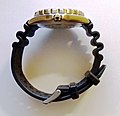 Polyurethane expanding watch strap on a diving watch.
 -
 A cloth watch strap dating to World War I.
 -
 Dark admiralty grey coloured NATO strap worn by a British soldier.
 -

-

-
 A watch with a segmented stainless steel watch bracelet.
 -
 A silver-plated metal watch bracelet, showing signs of wear.
 -
 A watch with a gold-plated ROWI Fixoflex expandable/retractable elastic watch bracelet.
 -
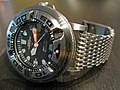 A watch with a stainless steel mesh bracelet.
 -
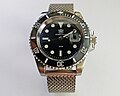 A watch with a stainless steel Milanese (braided mesh variant) bracelet.
 -
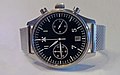 A watch with a stainless steel Milanese (braided mesh variant) bracelet.
 -
![A watch with a fine stainless steel Milanese (dense and tight braided mesh variant) bracelet.[17]](//upload.wikimedia.org/wikipedia/commons/thumb/8/8f/Cadisen_C8173_automatic_wristwatch_2.jpg/120px-Cadisen_C8173_automatic_wristwatch_2.jpg) A watch with a fine stainless steel Milanese (dense and tight braided mesh variant) bracelet.[17]
A watch with a fine stainless steel Milanese (dense and tight braided mesh variant) bracelet.[17] -
 Stainless steel bracelet with closed deployant clasp featuring 6 micro adjustment holes.
 -
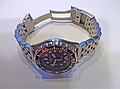 Stainless steel bracelet with opened deployant clasp.
 -
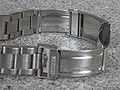 Stainless steel bracelet with deployant clasp and diver's extension.
 -
 Rolex "Glidelock" micro adjustment deployant clasp for diving watches
 -
 A buckle fastening for a leather watch strap.


![HMT Pilot watch on a custom leather bund strap.[16]](https://en.wikipedia.org/wiki/File:Pilot_watch_on_a_bund_strap.jpg)


![A watch with a fine stainless steel Milanese (dense and tight braided mesh variant) bracelet.[17]](https://en.wikipedia.org/wiki/File:Cadisen_C8173_automatic_wristwatch_2.jpg)


Clasps
[edit]A folding clasp or deployant clasp or deployant buckle is a device used to close a watch strap. (Butterfly clasps have a symmetrical appearance).
-
Stainless steel bracelet deployant clasp with divers extension
-
 Leather watch strap with a butterfly clasp closure.
See also
[edit]
References
[edit]- ^ "Watchstrap".
- ^ Army, United States Department of the (1971). Craft Techniques in Occupational Therapy. U.S. Government Printing Office.
- ^ "Who made the original NASA Velcro watch bands?". May 2021.
- ^ "Stainless Steel Bracelet Construction: The Folded Link, Push-Pin, and Screw-In Bracelet Systems".
- ^ "Contact dermatitis - Symptoms and causes". Mayo Clinic.
- ^ Turner, Anthony; Nye, James; Betts, Jonathan (2022-07-28). A General History of Horology. Oxford University Press. p. 480. ISBN 978-0-19-260936-6.
- ^ "Defence Standard 66-47, Issue 2, "Strap, Wrist Watch" (PDF).
- ^ "Your Watch Needs a NATO Strap". Fortune. Retrieved 2019-11-17.
- ^ "How Did NATO Straps Get Their Name?". SJX Watches.
- ^ "The Fascinating and Humble History of the NATO Watch Strap". Gear Patrol. December 8, 2023.
- ^ https://www.gearpatrol.com/watches/serica-ref-5303-pld/
- ^ "Braided Perlon watch bands, tough nylon fabric, adjustable length". www.esprit-nato.com. Retrieved 2025-05-25.
- ^ Colston, Penelope (5 March 2025). "Watch Bands Inspired by Old Parachute Webbing". The New York Times.
- ^ "The Original MN Strap by Erika's Originals". erikasoriginals.com. Retrieved 2025-05-25.
- ^ "The Best NATO Strap for Watches in 2025: A Comprehensive Guide". notostrapstore.com. January 6, 2025.
- ^ "Atern Goods | Bespoke Watch Straps - Bund Straps". aterngoods.com. Archived from the original on 2025-05-22. Retrieved 2025-08-11.
- ^ What is Milanese watch band? A brief history of Mesh watch band
Watch strap
View on GrokipediaOverview
Definition and function
A watch strap is defined as a flexible band that connects the watch case to the wearer's wrist, securing the timepiece while allowing for natural movement.[5] This term is often used for non-metallic flexible bands, distinguishing it from metal bracelets, which are composed of articulated links for flexibility and durability.[6] Typically attached via lugs and spring bars, the strap ensures a stable yet removable connection to the case.[7] The primary functions of a watch strap include securely fastening the watch to the wrist to prevent slippage during daily activities.[8] It also distributes the weight of the timepiece evenly across the wrist, reducing pressure points and promoting long-term comfort, particularly for heavier watches.[9] Additionally, the strap enhances the watch's aesthetic appeal, enabling it to complement different outfits and occasions through varied textures and colors.[1] Finally, it provides minor shock absorption to help protect the watch case from impacts encountered in everyday use.[10] Watch straps generally measure 18-24 mm in width at the lugs to match standard case designs, ensuring compatibility across a wide range of timepieces.[11] Their interchangeable nature allows for easy customization, permitting wearers to alter the strap without affecting the watch case or movement.[12] In modern horology, the watch strap has evolved from a simple utilitarian component to an integral fashion element, influencing the overall style and personalization of the wristwatch.[8] This shift emphasizes its role in blending functionality with expressive design choices.[13]Basic anatomy
A watch strap, also known as a band, consists of several core components that ensure secure attachment and functionality. The main body forms the primary length of the strap, providing the structure that wraps around the wrist and supports the watch case. Keepers (also commonly called band keepers, strap keepers, or simply loops; alternative terms include retainer or hoop) are small loops—often made from the same material as the strap (such as leather, silicone, or fabric)—positioned on the buckle side near the attachment point. They secure the excess length of the strap after fastening, preventing flapping, snagging, or unnecessary wear. In pass-through (military-style or double-pass) designs, such as some NATO variants, multiple keepers are used to manage longer excess lengths through tucking methods.[14][15] For metal bracelets, end links serve as the initial segments that directly interface with the watch case, often featuring a curved or angled design to align seamlessly with the lugs. Hardware such as spring bars—small, spring-loaded metal pins—connect these components to the watch, enabling straightforward installation and removal.[14] Attachment mechanisms integrate the strap with the watch case through the lugs, which are the protruding extensions on either side of the case designed to hold the strap. Spring bars insert into holes within the lugs, compressing slightly for insertion and expanding to lock in place, facilitating quick-release swaps without specialized tools. Lug width, measured as the distance between the inner edges of the lugs, standardizes sizing; for instance, 20 mm is a common measurement for men's watches, ensuring compatibility across various models.[16][17][11] Variations in strap construction influence fit and aesthetics. Single-pass designs thread the strap material once under the watch case for a streamlined, lightweight profile, while two-pass configurations loop the material twice around the case for added durability and a fuller appearance. Profiles may be padded, offering a cushioned, ergonomic shape for enhanced comfort during extended wear, or flat, providing a sleek, low-profile option that sits closer to the wrist.[14] Spring bars, a pivotal innovation, permit tool-free strap changes in modern watches and were first patented in 1916 by Charles Depollier to simplify maintenance and customization.[18]History
Origins and early development
The transition from pocket watches to wristwatches, which necessitated the development of dedicated straps, began in the late 19th century during the Boer War (1899–1902), when British soldiers adapted pocket watches by attaching them to leather straps for hands-free timekeeping in combat.[3] This innovation gained further momentum among military personnel around 1900 and with early aviators, who required quick access to time for practical operations. Prior to this, timepieces were primarily pocket watches secured by chains or fobs, but the demands of warfare prompted the adaptation of watches to the wrist, with early straps serving as simple attachments to enable quick glances at the time without fumbling in pockets.[19] A pivotal advancement occurred in 1904 when Louis Cartier designed the first modern wristwatch for Brazilian aviator Alberto Santos-Dumont, featuring a simple leather strap secured by a buckle for adjustability and comfort during flight.[20] These early designs typically employed basic leather or fabric loops, often hand-stitched and attached via rudimentary lugs or pins, prioritizing durability over ornamentation in response to the functional needs of early adopters.[19] World War I (1914-1918) markedly accelerated the adoption of wristwatches and their leather straps among pilots and soldiers, as the necessity for rapid, unobstructed time reference in trench and aerial combat made them indispensable tools. Soldiers and aviators modified pocket watches with leather wristlets or commissioned custom straps, transforming what had been viewed pre-1900 as a delicate feminine accessory—often resembling jewelry for women—into a rugged masculine essential that symbolized utility and resilience in wartime conditions. This shift not only popularized straps but also embedded them in everyday male fashion post-war.[21][22]20th century advancements
The interwar period and World War II marked significant shifts toward durable, utilitarian watch straps designed for military use, with canvas and fabric materials gaining prominence for their affordability and resilience in harsh conditions. By the early 1940s, one-piece fabric straps became standard issue for soldiers in the Allied forces, including the United States and Great Britain, as they provided enhanced security by eliminating the risk of a broken end link rendering the strap unusable. These straps, often made from cotton webbing or canvas, were pull-through designs that passed under the watch case for added stability during combat or aviation duties.[23][24] Post-war innovations further refined military specifications, culminating in the 1973 British Ministry of Defence directive for a single-piece nylon strap known as the G10 or NATO strap, emphasizing reliability through its woven construction and admiralty grey color for camouflage. Detailed in Defence Standard 66-15, this 280mm-long strap featured a heat-welded stainless steel buckle and was required for all service watches to withstand extreme environments without failure. Its one-piece design ensured functionality even if the buckle was damaged, building directly on WWII fabric precedents.[25][24] The 1960s and 1970s dive watch boom introduced rubber straps as a waterproof alternative, with Tropic straps emerging around 1960 as vulcanized natural rubber bands tailored for professional divers. Drawing on vulcanization techniques originally developed for tires in the 19th century but adapted for horology, these straps offered superior elasticity, UV resistance, and integration with bezel extensions to protect rotating dive bezels from sand and impacts. Brands like Rolex and Blancpain fitted them as original equipment on models such as the Submariner, enhancing overall water resistance up to 300 meters.[26][27][28] In the luxury segment, metal bracelets evolved for everyday robustness, with Rolex debuting early Oyster-linked designs in collaboration with supplier Gay Frères during the 1930s, refining them from narrow Bonklip bands to more comfortable, tapered profiles by the decade's end. The formal Oyster bracelet, patented in 1947 and introduced in 1948, featured three-piece flat links for flexibility and durability, becoming a staple for Oyster-cased watches like the Datejust. The 1980s quartz era popularized interchangeable strap systems amid the fashion watch surge, allowing quick swaps between metal, leather, and synthetics on affordable quartz models from brands like Swatch, which launched in 1983 with modular, colorful bands to match outfits.[29][30][31] The 1970s fashion explosion transformed straps into status symbols, with colorful synthetic materials like vibrant rubber and resin gaining traction in bold, expressive designs that reflected the era's disco and pop culture influences. These affordable synthetics, often in hues like electric blue or hot pink, adorned quartz and digital watches, democratizing personalization and shifting focus from functionality to aesthetic versatility.[26][32]Materials
Natural materials
Natural materials for watch straps primarily include leather and fabric variants, offering organic alternatives prized for their comfort and aesthetic appeal in formal and casual settings. Leather straps are commonly crafted from cowhide or the finer-grained calfskin, providing durability and a smooth texture suitable for everyday wear. Exotic leathers, such as alligator, add a luxurious scale pattern and enhanced texture, often sourced from farmed animals to meet ethical standards.[33] These materials undergo tanning processes that preserve the hide while imparting specific qualities: vegetable tanning uses natural tannins from plants, resulting in a firmer initial structure that softens over time and develops a rich patina; in contrast, chrome tanning employs chromium salts for a quicker process, yielding softer, more supple leather resistant to daily wear.[34][35] A key property of high-quality leather straps, particularly those vegetable-tanned, is the development of patina—a natural darkening and luster that emerges from exposure to skin oils, sunlight, and handling, enhancing the strap's character and vintage appeal over years of use.[36] Exotic leathers face sustainability challenges due to potential over-exploitation of species, addressed by the 1973 Convention on International Trade in Endangered Species of Wild Fauna and Flora (CITES), which regulates global trade in protected hides like alligator to ensure farmed sourcing and prevent illegal poaching.[37] Leather straps account for approximately 40% of the U.S. watch accessory market, reflecting their enduring popularity for elegant, skin-conforming comfort.[38] While leather offers elegant aging through patina, it is sensitive to moisture, which can cause warping or staining if exposed to water, making it less ideal for wet environments. Sizing typically involves punched holes along the strap for pin buckles, allowing incremental adjustments, or continuous lengths compatible with deployment clasps for seamless fitting without visible perforations.[39][40] Fabric variants, such as canvas or cotton weaves, provide lightweight, breathable options that promote air circulation and reduce sweat buildup during extended wear. These materials excel in durability against abrasion while remaining flexible and comfortable against the skin. Historically, canvas and cotton straps saw widespread use in military applications during World War I and II, valued for their rugged strength in tents, uniforms, and watch bands that withstood harsh field conditions without adding bulk.[41][42]Synthetic materials
Synthetic materials for watch straps encompass man-made polymers designed for enhanced durability, flexibility, and resistance to environmental factors, making them ideal for active lifestyles and sports applications. These include rubber, silicone, nylon, and polyurethane, which offer alternatives to natural materials by providing waterproof and hypoallergenic properties without the need for extensive upkeep.[43][44] Rubber and silicone straps are prized for their hypoallergenic qualities and complete waterproofing, ensuring comfort during prolonged exposure to water or sweat. Rubber straps, particularly those made from vulcanized rubber, were introduced in the 1960s primarily for dive watches, providing a reliable seal against moisture.[26][32] High-end variants utilize FKM, a fluoropolymer also known as fluoroelastomer, which excels in dive straps due to its superior resistance to heat, chemicals, and abrasion, maintaining integrity in demanding conditions.[26][44][45] Silicone, fully synthetic and softer than traditional rubber, offers similar waterproofing while being more elastic and skin-friendly, often preferred for everyday active wear.[46][47] Nylon and polyurethane straps emphasize quick-drying capabilities and flexibility, suiting them for sports and tactical uses. Nylon weaves, such as the Zulu variant, feature a thicker, multi-layered construction that enhances strength and breathability, allowing rapid evaporation of moisture after submersion or perspiration.[48][49] Polyurethane, a synthetic rubber analog, provides comparable flexibility with added resistance to wear, often molded into seamless profiles for a snug, irritation-free fit.[43] Production of rubber and silicone straps typically involves injection molding, which creates uniform, seamless designs that conform precisely to the wrist without gaps or bulk, while nylon straps are woven and polyurethane may be molded or coated.[50][51][52] A notable advantage of silicone over standard rubber is its enhanced resistance to UV fading, preserving color and texture during outdoor exposure, though both materials withstand typical environmental stresses effectively.[47] Synthetic straps are commonly available in widths of 18mm to 22mm, accommodating a broad range of watch cases from mid-sized divers to larger sport models.[11] Overall, these materials deliver affordability and low-maintenance appeal—requiring only simple rinsing for cleaning—but may convey a less luxurious feel compared to premium organics, prioritizing function over elegance.[53][54][55]Metallic materials
Metallic materials form the backbone of premium watch straps, offering durability, elegance, and a sense of luxury that distinguishes them from more flexible alternatives. These straps, often referred to as bracelets, are typically constructed from solid metal links or woven meshes, providing a rigid yet adjustable fit suitable for formal and everyday wear. Stainless steel dominates due to its balance of affordability and resilience, while precious metals elevate the status of high-end timepieces. Titanium provides a lightweight alternative, and engineering innovations, such as interlocking links and corrosion-resistant alloys, ensure these straps withstand daily use while maintaining aesthetic appeal.[56] Stainless steel is the most prevalent metallic material for watch straps, prized for its corrosion resistance and hypoallergenic properties, particularly in the 316L grade, which contains molybdenum to enhance durability against environmental factors like sweat and saltwater. This grade is widely adopted across luxury brands for its low reactivity with skin and ability to retain polish over time. A iconic example is the Oyster-style three-link design, featuring a wide center link flanked by narrower outer links, which Rolex patented in 1947 to provide both flexibility and robustness, influencing modern bracelet constructions. These bracelets often weigh between 100 and 150 grams, contributing to a substantial wrist presence that underscores the watch's quality. Titanium, often in grades like Grade 2 or Grade 5 (Ti-6Al-4V), is valued for its high strength-to-weight ratio, being approximately 40-45% lighter than stainless steel while offering excellent corrosion resistance and hypoallergenic properties, making it ideal for sports watches and those seeking reduced wrist fatigue. Titanium bracelets, typically constructed with similar link designs to steel, are common in dive and pilot watches from brands like Rolex and Omega, and weigh around 50-80 grams depending on size.[57][56] Precious metals like gold and platinum are reserved for higher-end dress watches, where solid 18k gold or platinum construction imparts unparalleled luxury and value retention. Gold straps, typically in yellow, white, or rose variants, are either solid for maximum opulence or plated over a base metal for accessibility, though plating requires periodic reapplication to prevent fading. Platinum, being denser and more resistant to tarnish, is favored in ultra-premium models for its subtle sheen and rarity, often paired with diamond-set cases to amplify sophistication. These materials, while exquisite, demand careful handling to avoid scratches, emphasizing their role in heirloom-quality pieces. Mesh designs, particularly the Milanese weave, offer a lighter alternative within metallic straps, consisting of finely interlocked stainless steel wires for enhanced breathability and comfort against the skin. Originating in 19th-century Italy, where Milanese artisans developed the intricate weaving technique for jewelry, this style gained prominence in mid-20th-century watchmaking for its smooth, hair-resistant surface. Revived in the post-war era, Milanese straps provide a vintage-inspired elegance, adjustable via sliding clasps rather than links, and are less prone to trapping moisture compared to solid-link bracelets. A contemporary adaptation is the Milanese Loop, a stainless steel mesh band with a fully magnetic closure for infinite adjustability, ensuring ease of fit and breathability suitable for modern smartwatches; it is compatible with Apple Watch models featuring 44mm and 45mm cases.[58][59] Overall, metallic watch straps excel in longevity, often lasting over 10 years with minimal wear when properly maintained, far outpacing softer materials. Their primary drawback is weight, which can feel cumbersome during extended wear, though adjustability through removable links allows customization to individual wrist sizes using simple tools. This engineering focus on precision and endurance makes metallic bracelets a cornerstone of luxury horology, evolving from early 20th-century innovations to contemporary standards of craftsmanship.Strap Types
Traditional straps
Traditional straps form the foundation of classic watch designs, prioritizing refined aesthetics and everyday versatility for formal and casual attire. These non-specialized bands emphasize timeless elegance over rugged functionality, often crafted to complement dress or mechanical timepieces. Leather dress straps exemplify traditional styling with their tapered profiles, commonly narrowing from 20 mm at the lugs to 16 mm at the buckle end to ensure a sleek, proportionate appearance on the wrist.[60] Stitched edges along the perimeter provide an elegant finish while reinforcing the material against wear, making these straps ideal for polished ensembles.[61] High-quality examples, such as those in Italian calf leather, feature precise row or V-stitching to elevate their sophisticated appeal.[62] Fabric casual straps introduce subtle texture and lightness to traditional options, typically employing simple woven or ribbed patterns for breathability and a relaxed vibe suitable for daily wear. These designs draw from vintage influences, appearing frequently in reissues of heritage watches to evoke mid-century charm without compromising modern comfort.[63] Woven nylon or canvas variants maintain flexibility and resistance to creasing, positioning them as accessible alternatives to leather for less formal occasions.[64] Common variations in traditional straps include padding beneath the leather or fabric surface to enhance cushioning during prolonged use, promoting all-day wearability.[65] Saddle stitching, a robust double-needle technique, bolsters seam integrity for extended longevity, a feature particularly valued in collections of mechanical watches where durability aligns with artisanal heritage.[66] Leather-based traditional straps account for about 30% of the global watch strap market as of 2023, highlighting their prevalence in non-sport segments.[67] The 2010s marked a notable evolution with the widespread adoption of quick-release spring bars in traditional straps, enabling tool-free exchanges to adapt styles seamlessly across outfits.[68] This innovation, patented in variations as early as 2015, has since become standard in many premium offerings, blending convenience with classic form.[69]Military and tactical straps
Military and tactical watch straps are engineered for extreme durability and functionality in demanding environments, often drawing from military standards to ensure reliability during fieldwork, combat, or survival scenarios. These straps prioritize resistance to abrasion, impacts, and environmental stressors over aesthetics, featuring robust constructions like multi-layer weaves and secure pass-through designs that prevent detachment even under duress.[70] The NATO strap, a hallmark of this category, consists of a single piece of woven nylon that passes between the watch lugs and under the case, providing redundancy if spring bars fail during shocks. NATO straps often feature keepers (also known as band keepers, strap keepers, or simply loops), typically metal loops, to secure the excess nylon after passing under the case, with some variants using multiple keepers to manage longer excess lengths in pass-through designs, enhancing security and reducing movement. Introduced in 1973 under British Ministry of Defence (MoD) specification NSN 6645-99-124-2986, it was designed to withstand impacts and maintain watch security in military operations. Traditional variants include Admiralty grey for Royal Air Force use, emphasizing its utilitarian origins.[70][71][72][73] Zulu straps offer a variation on this theme, employing a one-piece nylon construction with thicker padding and heavier hardware for enhanced cushioning and robustness in tactical applications. This design provides a more padded feel compared to the flatter NATO profile, making it suitable for modern tactical watches used in prolonged field operations.[74][75] Paracord variants, braided from high-strength nylon cord originally derived from parachute suspension lines, incorporate emergency utility by allowing unraveling for tasks like securing gear or creating snares. Constructed with ballistic nylon elements, these straps exhibit tensile strength exceeding 550 pounds, enabling them to double as survival tools in austere conditions.[76][77] These strap types gained significant civilian popularity after 2000, propelled by brands like Casio G-Shock, which integrated or inspired compatible rugged nylon designs for everyday adventurers seeking military-grade toughness.[73][24]Sport and dive straps
Sport and dive straps are engineered for demanding physical activities and aquatic environments, prioritizing flexibility, water resistance, and comfort during extended wear. These straps facilitate secure fit and minimal irritation, essential for sports like swimming, diving, and fitness training, where sweat, saltwater, and pressure can compromise lesser materials. Unlike traditional or military variants, they emphasize hydrodynamic properties and rapid moisture management to support performance without hindering movement. Rubber dive straps, particularly the iconic Tropic style originating in the 1960s, feature ventilation holes to dissipate sweat and heat, enhancing wearer comfort in humid or active conditions. These straps often include a bezel gasket to seal against moisture ingress, preserving the watch's integrity during submersion. Building on 20th-century advancements in vulcanized rubber, they are constructed from durable materials like NBR or FKM, ensuring suppleness and resistance to corrosion. Dive watches equipped with such straps must adhere to ISO 6425 standards, which mandate water resistance capabilities up to at least 100 meters, with many models rated to 200 meters to accommodate professional diving depths.[78][27][79][80] Silicone sport bands have gained prominence since the 2010s, especially with the rise of fitness trackers and smartwatches, due to their exceptional flexibility and non-slip texture that prevents shifting during vigorous exercise. Soft and hypoallergenic, these bands resist cracking and fading from UV exposure or sweat, making them ideal for daily athletic use without compromising aesthetics. Their seamless integration with devices like the Apple Watch underscores their evolution into versatile, user-friendly options for modern sports enthusiasts.[81][82] Hybrid designs combine rubber bases with fabric inserts, such as Cordura, to boost breathability while maintaining water resistance for transitional activities from land to sea. These configurations excel in quick-drying performance, often evaporating moisture in under five minutes, reducing discomfort post-immersion. Evolving from 1960s scuba watch innovations, contemporary iterations incorporate eco-rubber derived from recycled tires, promoting sustainability without sacrificing durability or functionality, as seen in brands like Zenith.[83][84][85]Closures and Fasteners
Buckles and clasps
Buckles and clasps are essential metal closures that secure watch straps around the wrist, providing both functionality and aesthetic refinement through precise mechanics designed for durability and ease of use. These components typically attach to the strap ends, allowing the watch to fasten securely while minimizing stress on the material. The most common types include the pin buckle, deployant clasp, and butterfly clasp, each offering distinct advantages in security and comfort. The pin buckle, also known as a tang or ardillon buckle, is the simplest and oldest form of closure for watch straps, resembling a traditional belt buckle. It consists of a frame with a hinged prong (the tang) that inserts through one of several pre-punched holes in the strap's free end to secure it. Primarily used on leather straps, this design dates back to the early 20th century, when wristwatches adopted basic belt-style buckles post-World War I for practical fastening. Its straightforward mechanism ensures reliable hold without complex parts, though it requires periodic hole adjustments for fit. The deployant clasp, often called a deployment or folding clasp, features a multi-layered folding mechanism that opens via push-buttons or levers, distributing pressure evenly across the strap ends to reduce wear compared to pin styles. Invented and patented by Louis Cartier in 1910, it revolutionized secure fastening by allowing the strap to "deploy" smoothly without piercing holes, making it ideal for both leather and metal bracelets. Commonly found on luxury watches, including those from brands like Omega, the deployant provides a seamless integration with the strap, enhancing both elegance and longevity. The butterfly clasp is a refined variant of the deployant, characterized by a double-folding structure that creates an exceptionally low-profile fit against the wrist. This design folds the clasp inward twice upon closure, secured by pressure-sensitive levers, which contributes to its discreet appearance and secure hold. Often equipped with micro-adjustment features for fine-tuning fit without removing links, the butterfly clasp is favored in high-end metal bracelets for its balance of security and comfort.Alternative closures
Hook-and-loop fasteners, commonly known as Velcro, provide an adjustable and user-friendly alternative to traditional buckles for watch straps, particularly in casual, sport, or tactical settings. Invented by Swiss engineer George de Mestral in 1941 after observing burrs adhering to fabric during a hike, the system combines a rough hook strip with a soft loop strip to create a secure yet releasable bond; de Mestral received his first patent for the design in 1954.[86] Adapted for watch straps in the 1980s, Velcro gained popularity in military-inspired gear and surf watches, such as the Freestyle Shark Leash model, which featured a Velcro band mimicking surfboard leashes for quick adjustments during active use.[87] These fasteners excel in environments requiring rapid sizing changes, as the strips can be pulled tight or loosened infinitely without predefined holes, making them ideal for varying wrist sizes or swelling during physical activity. These characteristics also make them particularly suitable for individuals with arthritis or limited hand mobility, as they allow simple adjustments and accommodate wrist swelling without requiring fine motor skills associated with traditional buckles.[88] Velcro straps are especially prevalent in children's watches due to their simplicity and safety, allowing easy self-adjustment without small pins or tools that could pose choking hazards. Brands like Flik Flak incorporate official Velcro closures in their educational timepieces, emphasizing durability and comfort for young wearers.[89] In terms of longevity, high-quality Velcro fasteners in apparel and accessory applications, including watch bands, can endure up to 2,000 or more open-and-close cycles before losing significant holding strength, though exposure to dirt or abrasion may accelerate wear in rugged conditions.[90] Constructed typically from nylon or polyester, these straps are lightweight, breathable, and resistant to water and sweat, enhancing their suitability for sport and dive applications where traditional closures might fail under strain. Sliding buckles represent another friction-based alternative, commonly paired with rubber or silicone straps to eliminate the need for punched holes and enable seamless micro-adjustments. These mechanisms feature a metal or polymer slider that grips the strap material through tension, allowing the user to pull the strap through the buckle and lock it at precise positions, often in 1mm increments for a customized fit without tools. For instance, Sinn's quick-adjust silicone straps incorporate a sliding micro-adjustment system in the folding clasp, facilitating on-the-fly changes ideal for dynamic activities.[91] This design is particularly advantageous for synthetic sport straps, as the smooth rubber surface provides consistent friction without stretching or deforming over time, ensuring reliability in wet or high-movement scenarios. Magnetic clasps offer a modern, minimalist closure option, employing embedded rare earth magnets—typically neodymium—for a snap-together securement that appears seamless on the strap. These clasps align magnetic poles at the strap ends, providing tool-free fastening and incremental adjustments by sliding segments apart or together, though they are best limited to synthetic materials like FKM rubber or silicone to avoid interference with metal components. Products such as LYSMVIVI's magnetic silicone bands demonstrate this technology's ease, with the magnets delivering a strong hold (up to several pounds of force) while allowing effortless release.[92] The primary advantages include aesthetic simplicity and rapid application with minimal finger dexterity required, making them especially useful for individuals with arthritis or limited hand mobility. Their efficacy depends on magnet strength and strap composition to prevent accidental detachment during intense use. Stretchy slip-on bands provide an additional alternative with no clasp or buckle required. Typically constructed from elastic materials such as fabric or silicone, these bands are stretched over the hand and then contract to fit the wrist securely. This design eliminates the need for any manipulation of fasteners, making it ideal for people with arthritis or reduced dexterity, as it reduces physical strain and accommodates wrist swelling without requiring fine motor skills. Overall, alternative closures like these prioritize adjustability and low maintenance, contrasting with precise metal mechanisms and aligning well with the demands of sport and dive straps, while also addressing accessibility needs for users with physical limitations.Care and Maintenance
Cleaning methods
Cleaning watch straps requires methods tailored to the material to avoid damage such as cracking, discoloration, or corrosion while preserving functionality and appearance. For all types, it is essential to first remove the strap from the watch case using a spring bar tool to prevent water ingress into the movement, which could compromise seals and cause internal damage.[93][94] Regular cleaning every 1-2 weeks is recommended for straps subjected to daily wear to remove sweat, dirt, and oils that accumulate and lead to premature wear.[95] For leather straps, use a soft cloth lightly dampened with warm water and mild soap to gently wipe the surface, focusing on areas prone to soiling like the underside and edges; avoid full immersion in water, as it can cause swelling, warping, or separation of the lining. After cleaning and air drying away from direct heat or sunlight, apply a thin layer of beeswax-based conditioner quarterly to restore moisture and protect against drying, ensuring even application with a cloth to prevent buildup.[93][94] Synthetic straps, including rubber and nylon varieties, benefit from rinsing with fresh water immediately after exposure to sweat, salt, or chemicals to prevent residue buildup. For deeper cleaning, soak in a solution of mild detergent and warm water for a few minutes, then gently scrub with a soft brush to address stains, followed by thorough rinsing under lukewarm water and air drying in a shaded, well-ventilated area to maintain flexibility and avoid shrinkage.[96][97] Metal straps, such as those made from stainless steel or precious alloys, should be wiped with a soft cloth and mild soap solution to remove fingerprints and light tarnish without scratching the finish. For thorough cleaning of links and clasps, an ultrasonic cleaner filled with a mild watch cleaning solution can be used for 10-15 minutes to dislodge embedded dirt, followed by multiple rinses in distilled water and immediate drying with a compressed air blower or soft cloth to prevent water spots or oxidation.[94][98] Light scratches on stainless steel watch bracelets can be effectively removed using specialized metal polishing cloths, such as Cape Cod polishing cloths. These cloths are impregnated with a fine polishing compound and are considered safe for addressing light surface scratches without removing excessive material, making them a preferred choice among watch enthusiasts over more aggressive abrasives that may damage the finish. The recommended procedure is:- Clean the bracelet with mild soap and water to remove dirt and oils, then dry thoroughly.
- Gently rub the polishing cloth over the scratched area, following the grain of the metal for brushed finishes or using circular motions for polished finishes.
- Apply light pressure and check progress frequently to avoid over-polishing.
- Remove any residue with a microfiber cloth.