


Community hub
Recent from talks
Contribute something
Nothing was collected or created yet.
Wauconda, Illinois
View on Wikipedia

Key Information


Wauconda (/ˌwɔːˈkɒndə/ or /wəˈkɒndə/) is a village in Lake County, Illinois, United States, a northwest suburb of Chicago. Per the 2020 census, the population was 14,084.[5] It is the site of the Wauconda Bog Nature Preserve, a National Natural Landmark. Wauconda Community Unit School District 118 serves students from Pre-K through 12th grade who live in Wauconda and surrounding communities (Island Lake, Lakemoor, Volo, and unincorporated sections of McHenry County). Fremont School District 79 also serves students from communities from northern part of Wauconda.
History
[edit]1800s
[edit]According to local legend, Wauconda was named after an indigenous chief whose name translated as 'spirit water'.[citation needed]
Many early settlers of Wauconda came from New England and New York by covered wagon or through the Erie Canal and the Great Lakes.[6]
Elihu Hubbard built the first log cabin on the bank of Bangs Lake in 1836. Justus Bangs, the first settler in Wauconda, built a house next to the lake in 1848 and the lake was later named after him. In 1840, members of the Ho-Chunk tribe who did not leave the shores of the Fox River often went to the area to trade. In 1849, Wauconda was organized into a town by a vote of the people of Lake County to divide Lake County into towns. There were 1,695 votes cast and all except three were in favor of the division. The first town meeting was held on the 1st Tuesday in April 1850 where the first officers were elected and appointed. I.[6]
Wauconda's first school was built in 1839 and the area's post office was moved to Wauconda on June 27, 1849, with Hazard Green becoming its first postmaster.[6]
Elder Joel Wheeler of McHenry built the first Baptist church in Wauconda in the autumn of 1838. A Methodist church was organized on September 3, 1852, by Reverend C. French, and built in 1856 on the Commons. Both Methodists and Baptists attended prayer at the church until February 1870, when the Baptists reorganized and built a new church on October 30, 1870. A Roman Catholic church was built in 1877 and its first trustees were James S. Murray, Charles Davlin, Felix Givens, John Givens, Hugh Davlin, and Owen McMahon. Its first priest was Father O'Neil.[6]
In 1850, Wauconda had a population of around 200 residents, and the town had three goods stores, two public houses and various mechanics.[6]
The Village of Wauconda was incorporated on August 18, 1877.
1900s
[edit]By the early 1900s, Wauconda was a popular resort village for Chicago residents and Bangs Lake was made suitable for beaches. The Palatine, Lake Zurich and Wauconda Railroad was completed and hauled agricultural products, delivered mail, transported local passengers, and brought vacationers and day-trippers out from Chicago. Although the railroad did not help develop Wauconda, which remained a small town, it flourished as a resort, and residents depended on it for supplies and for mail.[7]
The railroad closed in 1920 due to lack of business. Later in the decade, Phil's Beach was opened by Phil Froehlke and the right-of way was purchased for Route 176 (Liberty Street) through the center of town.
By the end of the 1930s, Wauconda's population exceeded 500 residents. At the end of the 1960s, Wauconda had three elementary schools, a junior high, and a high school. By the end of the 1970s there were about 5,600 residents living in Wauconda.
In the early 1950s, a bypass for US-12 was built to go around Wauconda.
Throughout the 1980s, most of the beaches on Bangs Lake gradually closed down. They were replaced by houses, townhomes, and other development. Development continued into the 1990s and 2000s as individuals from the outlying Chicago suburbs sought cheaper land. Large new subdivisions were developed north of the town center and small suburbs were established in the surrounding areas.
2000s
[edit]In 2000, Wauconda's population was 9,386. By 2020, it had grown to 14,084 residents.
The village completed a switch to Lake Michigan water in October 2019. This was the largest infrastructure project in village history, costing $48 million.[8]
On April 4, 2023, a referendum was held in the village to determine home rule status.[9] The result of the referendum was to reject home rule status.[10]
Geography
[edit]According to the 2010 census, Wauconda has a total area of 5.732 square miles (14.85 km2), of which 5.05 square miles (13.08 km2) (or 88.1%) is land and 0.682 square miles (1.77 km2) (or 11.9%) is water.[11]
Demographics
[edit]| Census | Pop. | Note | %± |
|---|---|---|---|
| 1880 | 298 | — | |
| 1890 | 368 | 23.5% | |
| 1900 | 397 | 7.9% | |
| 1910 | 368 | −7.3% | |
| 1920 | 399 | 8.4% | |
| 1930 | 554 | 38.8% | |
| 1940 | 639 | 15.3% | |
| 1950 | 1,173 | 83.6% | |
| 1960 | 3,227 | 175.1% | |
| 1970 | 5,460 | 69.2% | |
| 1980 | 5,688 | 4.2% | |
| 1990 | 6,294 | 10.7% | |
| 2000 | 9,448 | 50.1% | |
| 2010 | 13,603 | 44.0% | |
| 2020 | 14,084 | 3.5% | |
| U.S. Decennial Census[12] 2010[13] 2020[14] | |||
2020 census
[edit]| Race / Ethnicity (NH = Non-Hispanic) | Pop 2000[15] | Pop 2010[13] | Pop 2020[14] | % 2000 | % 2010 | % 2020 |
|---|---|---|---|---|---|---|
| White alone (NH) | 8,047 | 10,317 | 9,981 | 85.17% | 78.84% | 70.87% |
| Black or African American alone (NH) | 38 | 107 | 155 | 0.40% | 0.79% | 1.10% |
| Native American or Alaska Native alone (NH) | 8 | 9 | 6 | 0.08% | 0.07% | 0.04% |
| Asian alone (NH) | 169 | 564 | 480 | 1.79% | 4.15% | 3.41% |
| Native Hawaiian or Pacific Islander alone (NH) | 0 | 2 | 0 | 0.00% | 0.01% | 0.00% |
| Other race alone (NH) | 11 | 20 | 36 | 0.12% | 0.15% | 0.26% |
| Mixed race or Multiracial (NH) | 50 | 160 | 459 | 0.53% | 1.18% | 3.26% |
| Hispanic or Latino (any race) | 1,125 | 2,424 | 2,967 | 11.91% | 17.82% | 21.07% |
| Total | 9,448 | 13,603 | 14,084 | 100.00% | 100.00% | 100.00% |
2000 Census
[edit]As of the census[16] of 2000, there were 9,448 people, 3,611 households, and 2,404 families residing in the village. The population density was 2,445.0 inhabitants per square mile (944.0/km2). There were 3,822 housing units at an average density of 989.1 units per square mile (381.9 units/km2). The racial makeup of the village was 90.2% White, 0.4% African American, 0.3% Native American, 1.8% Asian, 0.0% Pacific Islander, 6.4% from other races, and 0.9% from two or more races. 11.9% of the population reported being Latino of any race.
There were 3,611 households, out of which 100% had children under the age of 18 living with them, 54.2% were married couples living together, 8.3% had a female householder with no husband present, and 33.4% were non-families. 27.4% of all households were made up of individuals, and 9.4% had someone living alone who was 65 years of age or older. The average household size was 2.58 and the average family size was 3.16.
In the village, the population was spread out, with 25.1% under the age of 18, 7.2% from 18 to 24, 35.8% from 25 to 44, 20.5% from 45 to 64, and 11.4% who were 65 years of age or older. The median age was 36 years. For every 100 females, there were 101.9 males. For every 100 females age 18 and over, there were 98.1 males.
The median income for a household in the village was $65,805, and the median income for a family was $56,576. Males had a median income of $64,027 versus $43,125 for females. The per capita income for the village was $40,355. About 2.1% of families and 4.0% of the population were below the poverty line, including 2.1% of those under age 18 and 4.0% of those age 65 or over.
Government
[edit]Wauconda's local government consists of a Mayor, Clerk, and six member Board of Trustees who are elected to four-year overlapping terms of office. Village Board meetings are held on the first and third Tuesday of the month.[17] Committee of the Whole meetings are held the first and third Tuesdays of the month.[18]
The Village Administrator oversees all village departments and serves as a liaison between the village residents and the Board. The Administrator supervises the daily operations of the village with the assistance of staff, including the Chief of Police and the directors of Public Works, Finance, Human Resources/Risk Management, Information Technology, Environmental Quality, Building and Zoning, and Economic Development.
Fire/Rescue is provided by the Wauconda Fire Protection District, an independent taxing body covering all of the Village of Wauconda, all or parts of 10 other communities, 6 townships, and unincorporated parts of Lake and McHenry Counties.[19]
There is a library on Main Street, called Wauconda Area Library, which serves the village.
Transportation
[edit]Route 12 (north to south), IL 176 (west to east), and IL 59 serve as important roads for the village connecting its surrounding area.
The closest international airport is O'Hare International Airport and is located approximately 30 miles or around 40 minutes away. Midway International Airport is located approximately 49 miles away or around 70 minutes away.
Events
[edit]On January 28, 2005, over 2,900 people participated in a snowball fight for ten minutes, setting a new world record for the most participants in such an event.[20]
A weekly farmer's market is held on Main Street on Thursdays from July to September.[21]
A three day long carnival takes place yearly in June named Wauconda Fest, which takes place by the skate park, near the Park District building and Wauconda High School.[22]
Many other events are held throughout the year, such as an annual expo in February, inside of the Wauconda High School, Fourth of July fireworks held yearly on July 3,[23] a Memorial Day parade,[24] and outdoor movies.
In popular culture
[edit]- The Blues Brothers was partially filmed in the village. A segment of the chase scene during the final third of the film featured the US-12 highway overpass over IL-176 (Liberty St.),[25] as was a scene with the Blues Brothers driving onto Phil's Beach on North Main Street.[26]
- In 2018, the village began to receive prank phone calls with the release of the superhero film Black Panther. This was because, in the film, the homophonous fictional country Wakanda serves as the primary setting.[27]
References
[edit]- ^ a b c U.S. Geological Survey Geographic Names Information System: Wauconda, Illinois
- ^ "History of Wauconda". History of Wauconda. Archived from the original on April 29, 2023. Retrieved April 28, 2023.
- ^ "Village Board of Wauconda, IL". Retrieved January 19, 2022.
- ^ "2020 U.S. Gazetteer Files". United States Census Bureau. Retrieved March 15, 2022.
- ^ "Wauconda village, Illinois". United States Census Bureau. Archived from the original on March 27, 2023. Retrieved April 15, 2022.
- ^ a b c d e "History of Wauconda | Wauconda, IL". wauconda-il.gov. Archived from the original on February 27, 2018. Retrieved May 9, 2018.
- ^ Wauconda Government (April 25, 2023). "FY2023 Budget Book" (PDF). Retrieved May 7, 2023.
- ^ "Wauconda, IL". www.wauconda-il.gov. Retrieved May 7, 2023.
- ^ "Wauconda Home Rule Referendum". www.wauconda-il.gov. Archived from the original on December 8, 2023. Retrieved May 7, 2023.
- ^ Lake County, IL (April 20, 2023). "Election Night Reporting". Lake County Il Election Results. Archived from the original on May 7, 2023. Retrieved May 7, 2023.
- ^ "G001 - Geographic Identifiers - 2010 Census Summary File 1". United States Census Bureau. Archived from the original on February 13, 2020. Retrieved December 25, 2015.
- ^ "Decennial Census of Population and Housing by Decades". US Census Bureau.
- ^ a b "P2 Hispanic or Latino, and Not Hispanic or Latino by Race – 2010: DEC Redistricting Data (PL 94-171) – Wauconda village, Illinois". United States Census Bureau.
- ^ a b "P2 Hispanic or Latino, and Not Hispanic or Latino by Race – 2020: DEC Redistricting Data (PL 94-171) – Wauconda village, Illinois". United States Census Bureau.
- ^ "P004 Hispanic or Latino, and Not Hispanic or Latino by Race – 2000: DEC Summary File 1 – Wauconda village, Illinois". United States Census Bureau.
- ^ "U.S. Census website". United States Census Bureau. Retrieved January 31, 2008.
- ^ "Mayor & Village Board". www.wauconda-il.gov. Archived from the original on March 27, 2023. Retrieved March 27, 2023.
- ^ "Committee of fhe Whole". www.wauconda-il.gov. Archived from the original on March 27, 2023. Retrieved March 27, 2023.
- ^ "Resources | Wauconda Fire District". Wauconda Fire Resources. Archived from the original on April 29, 2023. Retrieved April 28, 2023.
- ^ "Illinois town breaks snowball fight mark". UPI. January 30, 2005. Retrieved October 15, 2022.
Some 2,936 people showed up in Wauconda, Ill., Saturday to beat the Guinness Book of World Records mark of 2,473 participants in a sustained snowball fight.
- ^ "Wauconda Farmers Market". Lake County, Illinois Convention and Visitors Bureau. Archived from the original on April 7, 2023. Retrieved April 6, 2023.
- ^ "Wauconda Fest". Wauconda Park District. Archived from the original on April 7, 2023. Retrieved April 7, 2023.
- ^ "Independence Day Fireworks Celebration". www.wauconda-il.gov. Archived from the original on April 7, 2023. Retrieved April 6, 2023.
- ^ "Wauconda Memorial Day Parade". Archived from the original on September 11, 2023. Retrieved September 10, 2023.
- ^ "Police Crash Site :: Blues Brothers Central". Archived from the original on March 15, 2012. Retrieved July 30, 2011.
- ^ "Crowded Beach :: Blues Brothers Central". Archived from the original on March 15, 2012. Retrieved July 30, 2011.
- ^ Moran, Dan (February 23, 2018). "Wauconda, not to be confused with Wakanda, has an accidental association with 'Black Panther'". Chicago Tribune. Archived from the original on March 27, 2023. Retrieved March 18, 2018.
Sources
[edit]External links
[edit]Municipalities and communities of Lake County, Illinois, United States | ||
|---|---|---|
| Cities | 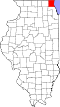 | |
| Villages |
| |
| Townships | ||
| CDPs | ||
| Other unincorporated communities | ||
| Former settlements | ||
| Footnotes | ‡This populated place also has portions in an adjacent county or counties | |
| International | |
|---|---|
| National | |
| Other | |

Wauconda, Illinois
View on GrokipediaHistory
Origins and early settlement
The region encompassing present-day Wauconda was originally inhabited by the Potawatomi tribe, who utilized the area's lakes and prairies for hunting, fishing, and seasonal encampments prior to European arrival.[6] The Potawatomi ceded their lands in northeastern Illinois, including Lake County, under the 1833 Treaty of Prairie du Chien, agreeing to relocate west of the Mississippi River within three years, which facilitated subsequent white settlement.[7] The name "Wauconda" derives from a Native American term akin to "Wakonda," signifying a spiritual power invoked in natural forms, though local lore of a buried chief named Wauconda lacks supporting evidence.[8] European settlement commenced in 1836 with the arrival of Justus Bangs and his brother Mark, who constructed the area's first permanent dwelling near Bangs Lake, drawn by fertile lands and water access suitable for farming and milling.[9] [6] Justus Bangs, recognized as Wauconda's earliest settler, hailed from Vermont and represented the influx of migrants from New England and New York states traveling via covered wagons or Great Lakes routes.[9] By 1839, Andrew Cook, a Bangs family associate, erected a cabin adjacent to theirs and assisted in building a log schoolhouse, marking initial communal infrastructure amid a landscape of scattered homesteads focused on subsistence agriculture.[10] Many early pioneers were interconnected through kinship, originating from similar eastern locales, which fostered tight-knit family networks essential for survival in the isolated frontier.[9] Formal organization began in 1849 under Justus Bangs' leadership, with the village platted in 1850 by Bangs and Cook to promote land sales; initially dubbed "Bangs Lake," it later adopted "Wauconda."[10] [11] In 1850, Cook constructed the township's first brick house using locally fired clay, signaling a shift toward more durable structures and economic viability through brick production.[10] These developments laid the groundwork for Wauconda's emergence as a rural agricultural hub in Lake County.[9]19th-century development
The township of Wauconda was organized in 1849, with its first town meeting convened on the first Tuesday in April 1850, marking a formal step toward structured local governance amid expanding settlement.[12] Early infrastructure included a log schoolhouse constructed around 1839 by settlers Andrew Cook and associates near Justus Bangs's property, serving the nascent community's educational needs.[10] By the mid-1840s, Cook had begun producing bricks from local clay deposits, enabling more durable construction and hinting at nascent non-agricultural enterprise.[10] In 1850, Justus Bangs and Andrew Cook platted the village layout to promote land sales, dubbing the unincorporated settlement Bangs Lake—though locals variously referred to it by other names—laying the groundwork for commercial expansion around the lake.[10] That same year, Cook built the area's first brick residence on his farm at what is now 711 North Main Street, exemplifying the shift from log cabins to sturdier homes as population density increased.[13] The community's population reached about 200 by 1850, sustaining three general stores, two taverns, and a range of mechanics' shops, indicative of a modest but diversified local economy beyond subsistence farming.[12] Further influxes bolstered development, including the 1854 arrival of John and Lydia Pratt from Vermont, who led 19 relatives and associates in purchasing land from Justus Bangs, a kin relation, to establish farms and integrate into the agrarian fabric.[13] Most early residents hailed from New England and New York states, bringing traditions of Yankee self-reliance that shaped the village's Protestant ethos and cooperative institutions.[12] The 1840s to early 1850s represented Wauconda's initial peak of organic growth, driven by fertile prairie soils suited to grain and dairy production, though isolation from major transport limited scale.[9] Slow maturation culminated in formal incorporation as the Village of Wauconda on August 18, 1877, with Robert Harrison elected as its inaugural president, enabling centralized administration of services like roads and fire protection amid persistent agricultural dominance.[10] Throughout the century, the economy centered on farming, with Bangs Lake facilitating limited milling and recreation, but without rail connectivity—unlike nearby Waukegan, served since 1855—the village remained a self-contained rural hub rather than a transport node.[14][6]20th-century expansion
In the early 20th century, Wauconda served as a resort destination for Chicago-area vacationers, featuring summer homes encircling Bangs Lake, which had been dredged and sanded to form beaches suitable for recreation such as skating and social gatherings.[15] The village's population was recorded at 368 in 1910, supported by a modest commercial base including dry goods stores, taverns, a creamery, and a lumber yard.[10] Infrastructure advancements included the completion of the Palatine, Lake Zurich & Wauconda Railroad in 1913, which improved access for tourists and agricultural shipments despite its financial struggles and closure in 1924; paving of Main Street in 1922; and hard-surfacing of Rand Road (U.S. Route 12) in 1924, facilitating better regional connectivity.[15][10] By 1939, the population had reached 550, with the economy blending farming, local trades, and seasonal tourism.[10] Post-World War II suburbanization accelerated expansion, as returning veterans from Chicago's West and Northwest Sides converted lakeside cottages into year-round housing, boosting the population from 650 in 1946 to nearly 1,300 by 1952.[10] This influx marked a shift from rural-resort character to permanent residential settlement, with further growth to over 2,200 residents by 1956, accompanied by the opening of the Wauconda Shopping Center to serve emerging commercial needs.[7] Population continued rising to 4,775 in 1963 and 5,662 in 1974, driven by proximity to Chicago and demand for affordable suburban living amid regional metropolitan sprawl.[10] The late 20th century saw sustained development as Wauconda evolved into a suburban enclave, drawing families with its lakeside setting and community-oriented environment, resulting in a population of 6,294 in 1990 and 9,448 in 2000.[10] This period featured residential subdivisions replacing some recreational areas, such as beaches phased out in favor of housing developments, while maintaining economic ties to Lake County's broader growth patterns.[7][6]21st-century growth and challenges
The population of Wauconda grew substantially in the early 21st century, increasing from 9,448 residents in 2000 to 13,603 in 2010 and reaching 14,084 by 2020, reflecting a 44% rise over the first decade driven primarily by residential expansion.[16][17] This surge outpaced regional averages, with the village adding approximately 28.7% of its housing stock between 2000 and 2009 through new subdivisions and townhome developments, such as expansions in areas like Liberty Lakes and Highland Terrace.[18][19] Ongoing projects, including 60 new townhomes and 15 single-family homes in recent years, have continued to support modest housing growth amid broader suburban demand in Lake County.[20] Economically, Wauconda has pursued targeted development along U.S. Route 12, adopting a strategy in the 2010s to attract retail, service, and light industrial businesses through infill redevelopment and incentives like tax increment financing (TIF) districts.[3][21] The downtown TIF area, established to upgrade aging commercial structures and utilities, aims to draw anchors such as grocery stores and restaurants to boost property tax revenue and local commerce, addressing gaps in the business mix that emerged from prior residential-heavy expansion.[21] Village officials have leveraged state tools like enterprise zones alongside federal incentives to foster a balanced economy, though progress has been incremental compared to the housing boom.[22] Challenges in sustaining growth include post-2010 population stagnation, with only a 3% increase from 2010 to 2023 and a recent annual decline of about 0.43%, attributed to broader regional shifts away from suburban Illinois locales.[17][23] Infrastructure strains from earlier development, particularly flooding around Bangs Lake affecting over 70 properties, prompted the 2025 Outfall Improvements Project to enhance stormwater outfalls and mitigate recurrent inundation.[24] Street reconstruction efforts, such as the 2023 North Street Improvement Project incorporating storm sewer upgrades, have addressed aging roadways and drainage, but limited municipal tools like TIF districts highlight ongoing fiscal constraints in funding commercial revitalization without over-relying on residential taxes.[25][26]Geography
Location and physical features
Wauconda is located in Lake County, northeastern Illinois, approximately 44 miles (71 km) northwest of downtown Chicago and within the Chicago-Naperville-Elgin Metropolitan Statistical Area.[27] Its central geographic coordinates are 42°15′50″N 88°08′40″W.[28] The village sits at an average elevation of 245 meters (804 feet) above sea level, amid terrain shaped by glacial activity typical of the region.[29] [30] A defining physical feature is Bangs Lake, a natural glacial lake spanning about 297 acres with a surface elevation of 766.2 feet (233.5 meters), which forms the centerpiece of the community's landscape and supports local ecology and recreation.[31] [32]Climate and environment
Wauconda lies within the humid continental climate zone (Köppen Dfa), featuring hot, humid summers and cold, snowy winters with precipitation distributed year-round.[33] [34] The average annual rainfall totals 36 inches, slightly below the U.S. average of 38 inches, while snowfall averages 40 inches annually.[35] July marks the warmest month, with average highs of 84°F and lows of 64°F, whereas the cold season spans approximately 3.1 months from late November to early March, often bringing freezing temperatures and wind.[36] The local environment centers on Bangs Lake, a 306-acre natural glacial lake with a maximum depth of 32 feet and average depth of 10.9 feet, supporting recreational fishing and boating amid a 6.3-mile shoreline.[31] [37] Watershed influences from the Fox River contribute to nutrient inflows, prompting ongoing management for invasive aquatic plants such as Eurasian watermilfoil and curly leaf pondweed via mechanical harvesting.[38] Periodic algae blooms, including Gloeotrichia echinulata in July 2024, arise in clear, sediment-exposed shallows, though the lake remains off Illinois EPA's impaired waters list based on average water quality metrics.[39] [40] Adjacent natural areas include the Wauconda Bog, a mature, open-water-free wetland preserving over 100 plant species, some rare or relict, as a biodiversity refuge.[5] Historical industrial activity has left a legacy at the 60-acre Wauconda Sand & Gravel Superfund site, encompassing licensed and unlicensed landfills that underwent EPA remediation for contamination risks.[41] Community initiatives, such as those by Go Green Wauconda, promote sustainable practices to mitigate development pressures on these features.[42]Government and administration
Local government structure
The Village of Wauconda operates under the trustee form of municipal government as defined in the Illinois Municipal Code, featuring an elected legislative body responsible for policy-making and oversight. The primary elected officials consist of a mayor (also designated as village president), six trustees comprising the Village Board of Trustees, and a village clerk, all serving four-year terms with staggered elections to ensure continuity.[43] The mayor presides over board meetings, votes only to break ties, and holds veto authority over ordinances, which can be overridden by a two-thirds majority of the trustees.[44] The Village Board exercises legislative powers, including enacting local ordinances, approving annual budgets, appointing department heads, and overseeing village operations through routine and special meetings held on the first and third Tuesdays of each month at 7:00 p.m.[45][44] Meetings typically include approval of a consent agenda for non-controversial items, followed by roll-call votes on substantive matters such as zoning amendments, contracts, and fiscal policies.[45] Day-to-day administration is delegated to an appointed village administrator, who reports directly to the mayor and board, coordinates departmental activities (including finance, public works, and community development), implements board directives, and manages a staff of approximately 50 full-time employees across various functions.[46] The village clerk supports governance by recording minutes, authenticating documents, and handling elections and financial certifications as required by state law.[43] This structure emphasizes elected accountability while distributing executive responsibilities to professional management, aligning with common practices in Illinois trustee villages to balance resident input with efficient service delivery.Fiscal policies and taxation
The Village of Wauconda operates on a fiscal year from May 1 to April 30, during which the Finance Department prepares the annual operating and capital budgets, as well as the Annual Comprehensive Financial Report (ACFR), adhering to standards that have earned a Certificate of Achievement for Excellence in Financial Reporting from the Government Finance Officers Association since 2008.[47] Budgets are developed collaboratively by village staff, with input from the Village Board and third-party consultants, serving as the primary spending plan for municipal operations, infrastructure, and capital projects.[48] Illinois property tax caps constrain levy growth to the lesser of 5% or the increase in the Consumer Price Index, excluding new construction or annexed property, which limits the village's ability to expand revenue through property taxes without voter approval or qualifying exemptions.[49] Property taxes constitute a major revenue source for the village, though the effective rate in Wauconda stands at 3.25% of assessed value, exceeding the national median and reflecting Lake County's high overall tax burden, where schools receive approximately 69% of collections in comparable areas.[50] The village's portion funds general operations and services, with historical levies targeted for specific needs like street maintenance; for instance, a 2016 referendum sought a 0.1% increase to generate $233,000 annually for road rebuilding, adding about $300 yearly to a $300,000 home's bill.[51] Tax increment financing (TIF) districts, established along Route 176 in 2013 and Main Street in 2025, redirect property tax increments from redevelopment areas into special funds for infrastructure and economic incentives, rather than distributing them to overlapping taxing bodies like schools, to stimulate private investment without raising baseline rates.[52] In addition to property taxes, the village relies on sales taxes and intergovernmental transfers. The combined sales tax rate is 7.0%, comprising Illinois's 6.25% state rate plus a 0.75% local portion prior to recent adjustments.[53] Effective January 1, 2026, the Village Board approved a 1% grocery tax on qualifying food items—replacing a state-level tax being eliminated—and a separate 1% non-home rule sales tax on general merchandise and prepared foods (excluding autos, groceries, and prescriptions), projected to yield $250,000–$300,000 and $1.5 million annually, respectively, for services, road resurfacing, and potential property tax relief through 2031.[54] Other revenues include shares of state income taxes (budgeted at $2.485 million for FY 2025/26) and cannabis taxes ($23,000), supporting a balanced approach that avoids over-reliance on any single source amid state-mandated caps.[55]Political representation
Wauconda operates under a council-manager form of government, with the Village President (commonly referred to as the mayor) and a six-member Board of Trustees serving as the elected legislative body. These officials are elected to staggered four-year terms in nonpartisan municipal elections held every two years in April. As of October 2025, the Village President is Jeff A. Sode, whose current term expires in May 2027 following his reelection in the April 1, 2025, general election under the Wauconda Strong 2025 slate.[44][56] The Board of Trustees consists of Tim Howe, Tom Shaw, Nicole Strauts, Sam Stein, David Geary, and Matthew Brown, with terms expiring in May 2025 or May 2027 depending on the seat.[44][57] The board meets biweekly on the first and third Tuesdays to approve ordinances, budgets, and policies, with the president presiding and voting only to break ties.[44] At the county level, Wauconda falls within Lake County Board District 2, represented by Adam Schlick, a Republican elected in the 2022 cycle and serving a four-year term through 2026.[58][59] The 21-member Lake County Board handles county-wide services such as public health, transportation, and land use, with decisions made by majority vote in committee and full board sessions.[60] In the Illinois General Assembly, Wauconda residents are represented in the 26th State Senate District by a Republican senator and in the 52nd State House District by Martin McLaughlin (Republican), who was reelected in November 2024 for a term ending January 2027.[61][62] The 52nd House District encompasses Wauconda along with nearby communities like Island Lake and Volo, focusing on issues such as property taxes and infrastructure funding.[62] Federally, Wauconda is primarily within Illinois's 6th Congressional District, represented by Sean Casten (Democrat) since 2019, with his current term running through January 2027 following the 2024 election.[63] The district covers parts of Lake and surrounding counties, emphasizing energy policy and economic development. Illinois's U.S. senators are Dick Durbin (Democrat, serving since 1997) and Tammy Duckworth (Democrat, serving since 2017), both reelected in cycles offset from House terms. Local representation aligns with Illinois's nonpartisan municipal tradition at the village level, contrasting with partisan state and federal offices where Republican control predominates in Wauconda's legislative districts amid Lake County's mixed political composition.[44]Demographics
Population trends
The population of Wauconda grew substantially from the late 20th century into the 2010s, driven by suburban expansion in Lake County and proximity to the Chicago metropolitan area. According to U.S. Census Bureau data, the village's population increased from 6,508 in 1990 to 9,448 in 2000, reflecting a 45.2% rise amid residential development. This upward trajectory continued, with the 2010 census recording 13,603 residents, a 43.9% gain from 2000, as new housing subdivisions attracted families seeking affordable suburban living.[64][16] By 2020, the population reached its peak of 14,084, a modest 3.6% increase from 2010, supported by ongoing construction in areas like the northern village limits. However, post-2020 estimates indicate a reversal, with the population declining to 14,011 in 2021, 13,949 in 2022, and 13,891 in 2023, at an annual rate of approximately -0.4%. This recent stagnation aligns with broader suburban trends in northern Illinois, where high property costs and remote work shifts have slowed net migration. A 2018 special census had briefly estimated 14,125 residents, highlighting variability in enumeration methods.[65][64][16]| Year | Population | Percent Change from Prior Decade |
|---|---|---|
| 1990 | 6,508 | - |
| 2000 | 9,448 | +45.2% |
| 2010 | 13,603 | +43.9% |
| 2020 | 14,084 | +3.6% |
Racial and ethnic composition
As of the 2019–2023 American Community Survey five-year estimates, Wauconda's population of 14,010 residents is predominantly non-Hispanic White, accounting for 72.3% (10,133 individuals).[17] Hispanic or Latino residents of any race constitute 18.1% (2,540 individuals), reflecting a notable ethnic minority presence primarily of Mexican origin as inferred from broader Lake County patterns in the same dataset.[17] Non-Hispanic Asian residents comprise 5.6% (789 individuals), with non-Hispanic individuals identifying as other or multiple races making up 3.5% (485 individuals).[17] Non-Hispanic Black residents represent a small fraction at 0.4% (63 individuals), consistent with low representation in suburban Lake County communities.[17] These figures indicate a shift from earlier decennial census data, where the 2020 Census reported a higher Hispanic share of 21.1% alongside 70.9% identifying as White (including some Hispanic), underscoring growth in ethnic diversity driven by regional migration patterns.[66] The data, derived from self-reported responses, aligns with U.S. Census Bureau methodologies that separate race and Hispanic ethnicity to capture multiracial and overlapping identities accurately.[17]| Racial/Ethnic Group | Percentage | Count (approx.) |
|---|---|---|
| White (non-Hispanic) | 72.3% | 10,133 |
| Hispanic or Latino (any race) | 18.1% | 2,540 |
| Asian (non-Hispanic) | 5.6% | 789 |
| Other/multiple races (non-Hispanic) | 3.5% | 485 |
| Black (non-Hispanic) | 0.4% | 63 |
Socioeconomic data
As of the 2019-2023 American Community Survey (ACS) five-year estimates, the median household income in Wauconda was $112,438, with a per capita income of $45,602.[17] The poverty rate stood at 6.52% of the population.[67] Educational attainment among residents aged 25 and older showed 91.9% holding a high school diploma or higher equivalent, and 39.4% possessing a bachelor's degree or higher.[17] [68] In terms of employment, the labor force participation rate for the population aged 16 and older was 72.6%, with an unemployment rate of 3.6% among the civilian labor force.[17]Economy
Employment sectors
The primary employment sectors for residents of Wauconda, Illinois, are retail trade, manufacturing, and health care and social assistance, reflecting the village's position as a suburban community with proximity to Chicago's metropolitan economy. Data from the 2022 American Community Survey indicate that 1,016 residents work in retail trade, 957 in manufacturing, and 947 in health care and social assistance, comprising the largest shares of local employment.[67] Wauconda's business landscape supports these sectors through dedicated infrastructure, including industrial business parks that host manufacturing headquarters and distribution operations, such as Synergy Flavors for flavor production. Retail employment is bolstered by national chains like Walgreens, Tractor Supply, and Jewel-Osco along Routes 12 and 176, while health care roles often extend to nearby facilities in Lake County. Manufacturing emphasizes specialized areas like precision machining, electronics assembly, and plastic injection molding, contributing to the village's industrial base.[69][22]Housing and real estate trends
The housing market in Wauconda has exhibited strong price appreciation in recent years, driven by limited inventory and demand from commuters seeking proximity to the Chicago metropolitan area. As of September 2025, the median sale price for homes reached $352,000, marking a 23.9% increase from the prior year, with the median price per square foot at $204, up 11.1%.[70] This reflects a very competitive market, scoring 76 out of 100 on competitiveness indices, where homes sell after an average of 41 days on the market.[70] Listing prices show slight softening amid broader Illinois trends of stabilizing inventory, with the median listing price at $386,500 in September 2025, down 1.5% year-over-year, and $193 per square foot.[71] Over the preceding 12 months, median sale prices averaged $387,000, a 25% rise from the prior period, with properties moving in about 21 days—faster than the national average of 53 days—underscoring persistent seller advantages due to low supply.[72] Average home values, per Zillow's index, stood at $333,343 as of late 2025, up 5.5% annually, though this lags the sharper sale price gains reported by transaction-focused trackers.[73] In the broader ZIP code 60084 encompassing Wauconda, August 2025 data indicated median sales of $416,000, up 22.4% year-over-year, with homes lingering 46 days on market, signaling continued tightness relative to Lake County averages where sales occur in roughly 27 days and prices rose 4% annually.[74][75] Historical context reveals steadier growth prior to recent surges: median property values were $268,300 in 2023, below the national average of $303,400, with decade-long appreciation at 54.6% through earlier periods.[67][76] Forecasts for Illinois suburbs like Wauconda anticipate 3-5% price growth in 2025-2026, tempered by easing mortgage rates and modest inventory increases, though local demand from employment in nearby tech and manufacturing sectors sustains upward pressure.[77]| Metric | September 2025 Value | Year-over-Year Change |
|---|---|---|
| Median Sale Price | $352,000 | +23.9% |
| Median Listing Price | $386,500 | -1.5% |
| Average Home Value | $333,343 | +5.5% |
| Days on Market (Sales) | 41 | N/A |