Hubbry Logo
Scaled Composites White Knight TwoScaled Composites White Knight TwoMain
Open search
Scaled Composites White Knight Two
Community hub
Scaled Composites White Knight Two
logo
8 pages, 0 posts
0 subscribers
Be the first to start a discussion here.
Scaled Composites White Knight Two
from Wikipedia

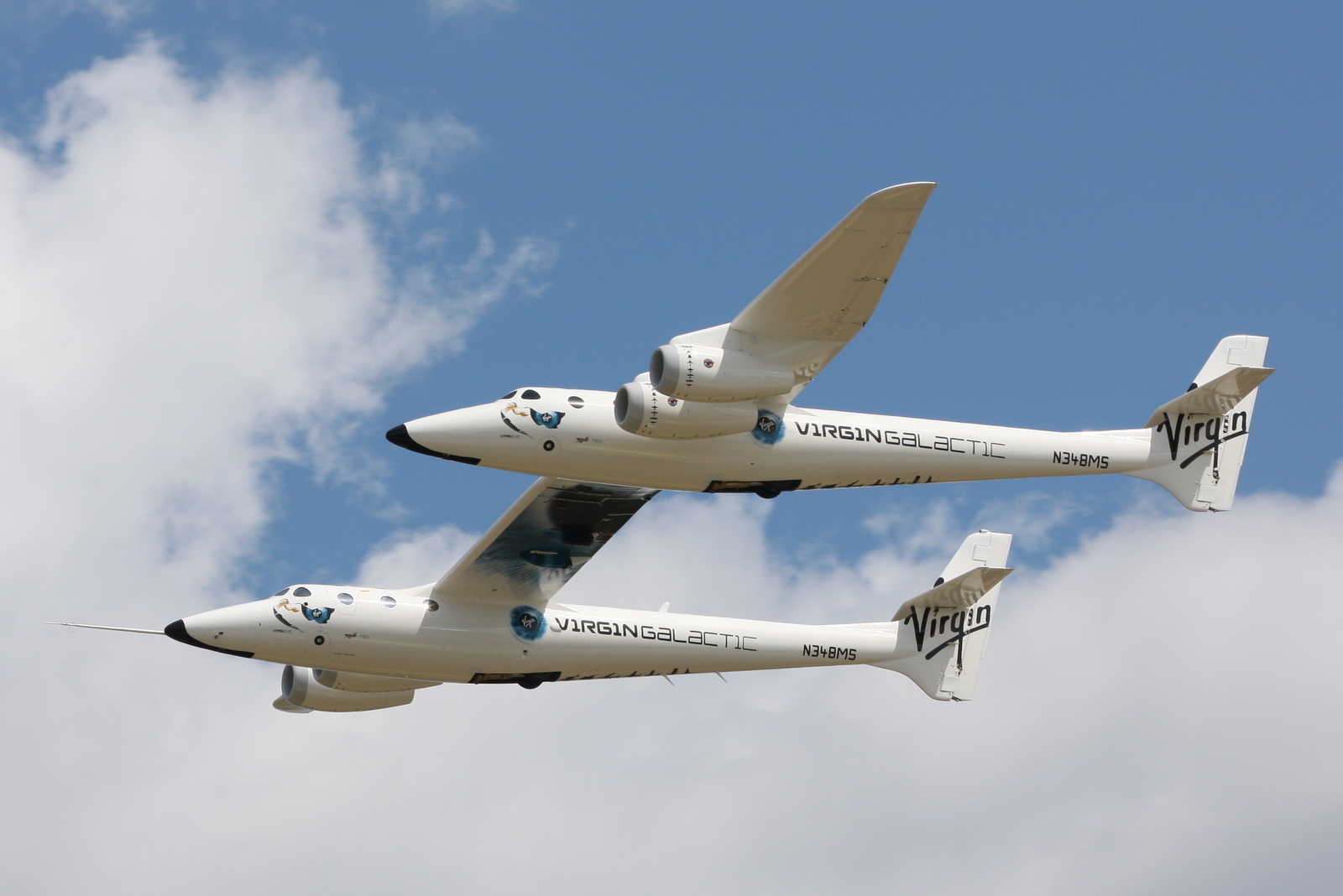
The Scaled Composites Model 348 White Knight Two (WK2) is a quadjet cargo aircraft that was used to lift the SpaceShipTwo (SS2) spacecraft to release altitude. It was developed by Scaled Composites from 2007 to 2010 as the first stage of Tier 1b, a two-stage to suborbital-space crewed launch system. WK2 is based on the successful mothership to SpaceShipOne, White Knight, which itself was based on Proteus.

Key Information

With an "open architecture" [citation needed] design and explicit plans for multi-purpose use, the aircraft could also operate as a zero-g aircraft for passenger training or microgravity science flights, handle missions in high-altitude testing more generally, or be used to launch payloads other than SpaceShipTwo.[3] A study of use of the aircraft as a forest fire water bomber has also been mentioned, one that would utilize a large carbon composite water tank that could be quickly replenished to make repeat runs over fires.[3]

The first White Knight Two is named VMS Eve after Richard Branson's mother Eve Branson; it was officially unveiled on July 28, 2008, and flew for the first time on December 21, 2008. The second was expected to be named VMS Spirit of Steve Fossett after Branson's close friend Steve Fossett, who died in an aircraft accident in 2007.[4][5] As of 2024, it is not clear if any other SS2 and WK2 vehicles than VSS Enterprise, VSS Unity and VMS Eve will actually be built (especially, as of 2024, VMS Spirit of Steve Fossett has not been built).

History

[edit]

In 2008, Virgin Galactic ordered two White Knight Two vehicles.[6] Together, WK2 and SS2 were to form the basis for Virgin Galactic's fleet of suborbital spaceplanes.

In November 2010, The Spaceship Company had announced that it planned to build at least three additional White Knight Two aircraft and an additional five SpaceShipTwo rocket planes, the aircraft to be built by Virgin after the initial prototypes of each craft are built by Scaled Composites.[7]

During 2012–2014, Virgin Galactic was also considering use of the WhiteKnightTwo as the air-launch platform for a new two-stage liquid-fueled rocket small satellite launcher called LauncherOne.[8] In the event—by late 2015—they decided to use a larger carrier aircraft for the job.[9]

Design

[edit]
PW308 used on the White Knight Two

White Knight Two is roughly three times larger than White Knight in order to perform a captive flight with the larger SpaceShipTwo spacecraft. The WK2 is similar in wingspan to a Boeing B-29 Superfortress.[10] White Knight Two is a very modern aircraft, as even the flight control cables are constructed of carbon fiber, using a new patented design.[3]

WK2 was planned to provide preview flights offering several seconds of weightlessness before the suborbital event. It was intended to have a service ceiling of about 60,000 ft (18 km), offering a dark blue sky to passengers. This would have allowed tourists to practice before the real flight.[11]

White Knight Two is of twin fuselage design with four jet engines mounted two on each wing.[12] One fuselage was planned to be an exact replica of that of SpaceShipTwo (to allow tourist training), and the other was planned to offer 'cut-rate' trips to the stratosphere.[13]

The design is quite different from the White Knight, both in size, use of tail, engine configuration and placement of cockpit(s). The White Knight used two T-tails, but the White Knight Two uses two cruciform tails. Engine configuration is also very different. White Knight Two has four engines hung underneath the wings on pylons while White Knight's pair of engines were on either side of its single fuselage.

Timeline of introduction

[edit]
White Knight Two at its rollout and christening ceremony on July 28, 2008

Virgin Galactic contracted aerospace designer Burt Rutan to build the mothership and spacecraft.[14][15]

On January 23, 2008 the White Knight Two design was revealed.[16] On July 28, 2008 the completion and rollout of the first aircraft, Eve, (Tail Number: N348MS[17]) occurred at Scaled's Mojave headquarters. Branson predicted that the maiden space voyage would take place in 18 months: "It represents... the chance for our ever-growing group of future astronauts and other scientists to see our world in a completely new light."

On March 22, 2010 the VMS Eve completed its 25th flight, the first occasion it carried a SpaceShipTwo, VSS Enterprise. In a flight of 2 hours 54 minutes, it ascended to an altitude of 45,000 ft (14,000 m).[18]

The launch customer of White Knight Two was Virgin Galactic, which was planned to have the first two units, and exclusive rights to the craft for the first few years.

Flight test program

[edit]

An extensive flight test program of VMS Eve, with nearly twenty flights between December 2008 and August 2009, was undertaken to validate the design and gradually expand the aircraft operating envelope.[19][20] The flight tests were complete by September 2009, and testing with SpaceShipTwo began in early 2010.[21]

Aircraft specifications

[edit]

Data from Virgin Galactic Presentation 2007[22]

General characteristics

  • Crew: 2 (flight crew) + spaceship launch crew
  • Capacity: payload 17,000 kg (37,479 lb)[23] to 50,000 ft (15,240 m). Planned 200 kg satellite to LEO when carrying a LauncherOne orbital launch vehicle (White Knight Two never carried a LauncherOne rocket on an orbital space launch mission, so this payload figure is theoretical).[24]
  • Length: 78 ft 9 in (24 m)
  • Wingspan: 141 ft 1 in (43 m)
  • Powerplant: 4 × Pratt & Whitney Canada PW308 turbofan engines, 6,900 lbf (30.69 kN) thrust each

Performance

  • Service ceiling: 70,000 ft (21,300 m) [23]

See also

[edit]

References

[edit]
[edit]
Revisions and contributorsEdit on WikipediaRead on Wikipedia
from Grokipedia
The Scaled Composites Model 348 White Knight Two (WK2), also known as Virgin Mother Ship (VMS) Eve, is a twin-fuselage, quadjet carrier aircraft designed and built by as the air-launch platform for Virgin Galactic's suborbital , capable of carrying the spacecraft to a release altitude of approximately 15,000 meters (50,000 feet) before deployment. It features a unique catamaran-style configuration with a single-piece, high-aspect-ratio wing spanning 42.7 meters (140 feet), constructed primarily from carbon composites to enable high-altitude operations and payload flexibility. Powered by four PW308A engines, each providing 30.7 kN (6,900 lbf) of thrust, the aircraft achieves a of 31,840 kg (70,200 lb), a service ceiling exceeding 16,700 meters (55,000 feet), and a range of up to 4,815 km (2,600 nautical miles) without payload. Development of White Knight Two began in 2007 as part of Virgin Galactic's Tier 1b program, evolving from the earlier (used for ) and incorporating elements of the high-altitude aircraft to support commercial suborbital tourism. The aircraft was unveiled on July 28, 2008, at ' facility in , and completed its maiden flight on December 21, 2008, from . By March 27, 2009, it had achieved its third test flight, demonstrating stable performance at speeds up to 140 knots and altitudes over 5,500 meters (18,000 feet). Named VMS Eve in honor of (mother of ), it became the first of a planned pair, with a second airframe (VMS Spirit of ) proposed but not completed as of 2025. The design also supports additional roles, including zero-gravity training, microgravity research, high-altitude testing, and potential non-space applications like . White Knight Two's operational history includes over 100 flights by 2023, primarily supporting test and commercial missions from bases in Mojave and , . It underwent a major overhaul in Mojave starting in late 2021, including upgrades to the center pylon for integration, culminating in a return to flight on February 15, 2023, where it reached 12,650 meters (41,500 feet) during a 2.5-hour test. Relocated permanently to in 2023, VMS supported test flights and commercial operations through mid-2024. As the largest all-carbon-composite aircraft in service, it exemplifies advanced for reusable space access, with its dual cockpits enabling pilot training and redundancy during missions. As of November 2025, following a pause in commercial flights after June 2024, VMS remains a cornerstone of Virgin Galactic's fleet and is conducting functional check flights in preparation for integration with next-generation Delta-class vehicles, targeting up to 125 flights annually from 2026.

History and Development

Conception and Funding

The success of Scaled Composites' White Knight carrier aircraft and SpaceShipOne in 2004, which achieved the first private manned suborbital flights and won the $10 million Ansari X Prize, demonstrated the viability of air-launched suborbital systems and inspired ambitions for commercial space tourism. This milestone, funded initially by Microsoft co-founder Paul Allen, highlighted the need for a scaled-up carrier to support larger payloads and repeated operations for paying passengers, leading Scaled Composites to conceptualize White Knight Two as part of Virgin Galactic's broader Tier 1b program. Following the 2005 partnership agreement between Virgin Galactic and Scaled Composites for the Tier 1b program, In 2008, ordered two White Knight Two aircraft from , positioning them as the primary carriers for the fleet in pursuit of routine suborbital tourism. The initial vehicle was named VMS Eve in honor of , mother of founder , symbolizing the personal commitment to the project. Virgin Galactic provided approximately $200 million in funding to for the development of White Knight Two and related prototypes, leveraging the legacy to advance commercial goals. This investment supported the creation of a larger platform to enable scalable operations, with initial design objectives centered on air-launching payloads to suborbital altitudes while prioritizing reusability and safety for the emerging industry. White Knight Two was engineered as an evolution of the original , featuring a twin-fuselage configuration to enhance stability and provide an unobstructed envelope for releasing at around 50,000 feet (15,240 meters). This design allowed for heavier lift capabilities compared to its predecessor, accommodating the demands of commercial missions without compromising aerodynamic efficiency.

Construction and Rollout

The construction of White Knight Two began in 2007 at ' facility in , where the aircraft was assembled using advanced composite materials to achieve a yet robust structure capable of supporting heavy payloads. Key engineering milestones during the build included the fabrication of the aircraft's 141-foot , which featured twin booms to accommodate the vehicle centrally, and the integration of specialized release mechanisms to ensure safe deployment of the suborbital at altitude. The aircraft, named VMS Eve, was completed by mid-2008 and publicly unveiled on July 28, 2008, at the in a ceremony attended by representatives, marking a significant step in the commercial spaceflight program funded by the company. VMS Eve achieved its on December 21, 2008, lasting approximately 1 hour, with test pilot Pete Siebold at the controls. In November 2010, announced plans to construct a second White Knight Two aircraft, designated VMS Spirit of in honor of the late aviator and supporter, but as of 2025, it remains unbuilt due to shifts in program priorities toward operational suborbital missions.

Design and Engineering

Airframe Configuration

The White Knight Two features a distinctive twin-fuselage "" configuration, consisting of two parallel s connected by a central, unswept single-piece that spans between them, with each fuselage designed to accommodate two engines and creating an open central bay for attachment. This layout positions the fuselages approximately 45 feet (13.7 meters) apart, optimizing structural integrity while providing unobstructed access for loading and integration of large payloads like the vehicle suspended beneath the . The airframe measures 77.7 feet (23.7 ) in , with a of 140 feet (42.7 ) and an overall of 25.9 feet (7.9 ), making it the largest all-carbon-fiber-composite built at the time of its development. Constructed primarily from advanced carbon fiber composites, the structure achieves an exceptional strength-to-weight ratio, enabling efficient operations at high altitudes where lighter materials reduce fuel consumption and enhance lift capacity. Aerodynamically, the aircraft employs an inverted design that contributes to its high-altitude performance by minimizing induced drag and improving lift distribution across the broad span, supporting sustained flight up to release altitudes around 50,000 feet (15,240 meters). Each is supported by tail booms extending from the , fitted with vertical and horizontal stabilizers to ensure yaw and pitch stability, particularly during the critical phase of release. For payload integration, the White Knight Two incorporates a central underside cradle, or pylon, specifically engineered to securely carry the between the fuselages, supplying conditioned air, pressurization, and electrical power to the attached vehicle during captive flights. The release system allows for a controlled in-flight detachment at approximately 50,000 feet, facilitating a safe aerodynamic drop for the suborbital vehicle to ignite its engines. This configuration supports an expansive envelope with ground-level access for maintenance and loading.

Propulsion and Systems

The propulsion system of the White Knight Two consists of four PW308A engines, each delivering 6,900 pounds of . These engines, equipped with full-authority digital control (), provide efficient performance at high altitudes and are mounted in pairs beneath each wing on pylons to optimize the aircraft's balance and during payload carriage. The fuel system employs Jet-A aviation fuel, with a capacity sufficient to support flights exceeding 2.5 hours, allowing the aircraft to climb to the designated release altitude for suborbital missions. This endurance is critical for operations involving the transport of heavy payloads over extended distances, such as transitions from the to remote launch sites. Avionics on the White Knight Two include mechanical flight controls using carbon fiber cables, which enable precise handling and stability when managing substantial payloads like the vehicle. Integrated GPS and inertial systems support accurate positioning and , facilitating seamless operations between ground bases and high-altitude release points. These systems enhance and efficiency in the demanding environment of air-launched space missions. Auxiliary systems provide crew pressurization capable of maintaining habitable conditions up to the aircraft's service ceiling of feet, ensuring comfort and functionality for the flight crew and any onboard launch personnel. Environmental control systems further regulate cabin atmosphere, temperature, and air quality during prolonged suborbital support flights.

Testing and Operations

Initial Flight Tests

The initial flight tests of the White Knight Two commenced with its maiden flight on December 21, 2008, from the in . Piloted by chief Pete Siebold, the one-hour flight focused on validating basic handling qualities and airworthiness of the twin-fuselage, all-carbon . The test was deemed successful, with all major systems performing as expected despite challenging weather conditions including rare snowfall in the area. The test program progressed through a series of unmanned and manned flights in 2009, emphasizing systems checkout, performance evaluation, and stability of the unique twin-fuselage configuration without the payload. A significant occurred on the third flight on March 27, 2009, which lasted over 2.5 hours—the longest duration to date—and reached a maximum speed of 140 knots and an altitude exceeding 18,000 feet. This flight successfully completed additional objectives, including in-flight engine restarts, thrust asymmetry assessments, and evaluations of the aircraft's handling characteristics, confirming the inherent stability of the design. By mid-2009, the initial phase of testing had advanced substantially, with flights achieving altitudes of 52,000 feet and the aircraft's maximum operational speeds, as reported by Pete Siebold. These efforts culminated in late 2009 with the aircraft demonstrating readiness for carriage, paving the way for integration with while maintaining a focus on solo airworthiness validation. The program, conducted primarily by Scaled Composites pilots including Siebold, underscored the aircraft's reliability for its role as a suborbital launch platform.

SpaceShipTwo Integration and Captive Flights

The integration phase of White Knight Two with prototypes marked a critical step in preparing for suborbital operations, focusing on captive carry flights where the spaceplane remained firmly attached to the carrier aircraft, VMS Eve, to evaluate structural mating, aerodynamic interactions, and system compatibility without separation. These tests built on White Knight Two's initial solo flights by introducing the substantial payload mass of , approximately 13,500 kg (29,800 lb), to assess handling, stability, and endurance under real-world conditions. The primary objectives included verifying the payload's secure attachment, monitoring vibration and load distribution during takeoff, climb, and cruise, and ensuring the dual-aircraft configuration could achieve the targeted release altitude of around 15,000 meters (50,000 feet). The inaugural captive flight took place on March 22, 2010, from in California, with —the first prototype—carried aloft by White Knight Two for 2 hours and 54 minutes, reaching a maximum altitude of 13,700 meters (45,000 feet). Piloted by test pilots and Clint Nichols, the mission successfully demonstrated the mated vehicle's basic , including takeoff performance and low-speed handling, while collecting data on aerodynamic drag and control authority. This flight, the 25th overall for White Knight Two, confirmed the structural integrity of the custom pylon and release interface designed by . Subsequent captive carries progressively incorporated more complex evaluations, such as configurations to simulate fuel loads and passenger weights, alongside functional checks of the electromagnetic release mechanism to ensure reliable separation readiness. By 2014, the program had completed at least 12 captive flights with VSS Enterprise, accumulating hundreds of hours of mated flight time and refining operational procedures for the carrier-spaceplane system. These tests highlighted the need for iterative adjustments to White Knight Two's trim and flight controls to accommodate the forward-shifted center of gravity caused by SpaceShipTwo's mass distribution, particularly during prolonged cruises at high altitudes where fuel burn altered balance dynamics. Flights typically ranged from 2.5 to over 4 hours in duration, with the extended profiles allowing for thorough data collection on thermal loads, avionics integration, and emergency abort scenarios while the spaceplane remained captive. Representative examples include a June 9, 2011, flight that tested release arming sequences without activation, and later missions incorporating simulated payload shifts to mimic operational variability. This rigorous testing regime ensured the system's reliability before advancing to independent operations. The captive flight series culminated in a smooth transition to drop tests, with the first free-flight release of VSS Enterprise occurring on October 10, 2010, from an altitude of 13,700 meters (45,000 feet) over the . Released under pilot command, the spaceplane executed an 11-minute unpowered glide, validating reentry configurations and landing procedures while White Knight Two maintained visual oversight. This milestone shifted focus from attached testing to standalone capabilities, paving the way for powered flights.

Suborbital Launch Missions

White Knight Two (WK2), also known as VMS Eve, functions as the dedicated carrier aircraft for Virgin Galactic's (SS2) vehicles, enabling suborbital launches by air-dropping the spaceplane at approximately 13,700 meters (45,000 feet) altitude. This two-stage system allows SS2 to ignite its hybrid post-release, propelling it to altitudes exceeding the (100 km) for brief periods of before a controlled glide landing. All SS2 suborbital missions, spanning test and commercial phases, have relied on WK2 for initial ascent from either in or in . The suborbital launch program began with powered test flights in 2013 using the prototype VSS Enterprise, marking the initial integration of WK2 with SS2 hardware. Early missions focused on validating the air-launch separation, rocket ignition, and aerodynamic control. For instance, the first powered flight (PF1) on April 29, 2013, achieved Mach 1.2 and an apogee of 16.8 km, confirming basic drop-and-burn dynamics without incident. Subsequent tests progressively increased performance: PF2 on September 5, 2013, reached 21 km at Mach 1.43, while PF3 on January 10, 2014, hit 21.6 km. Tragedy struck during PF4 on October 31, 2014, when VSS Enterprise disintegrated mid-flight due to a in feathering the vehicle, resulting in the death of co-pilot and severe injuries to pilot Peter Siebold; the mission had aimed for a higher apogee but was aborted at around 15 km. Following the 2014 incident, shifted to the operational , resuming powered tests in 2018 after extensive safety modifications. These flights built confidence in the system, with PF04 on December 13, 2018, marking the first to cross 80 km at Mach 3, and Unity 22 on July 11, —the company's first fully crewed suborbital mission—reaching approximately 85 km with founder aboard, demonstrating end-to-end operational readiness. By , apogees consistently exceeded 85 km, enabling about four minutes of microgravity for passengers. Fifteen powered flights were conducted through 2023, refining reentry profiles and integration, such as scientific experiments for and the . Commercial suborbital operations commenced in 2023 with the Galactic series, transitioning from research-focused tests to paying customer flights. on June 29, 2023, carried three Italian researchers to 85.1 km, executing 13 experiments during a 60-second burn initiated after WK2 release. This mission, piloted by Mike Masucci and Nicola Pecile, validated the full tourist profile from . Subsequent flights, including on August 10, 2023 (first private astronauts to ~88 km), and Galactic 07 on June 8, 2024 (featuring a engineer), maintained similar profiles, each accommodating up to six passengers for suborbital joyrides. By mid-2024, had completed 7 successful commercial missions as part of 12 total suborbital flights to space, transporting 32 individuals to space overall, though operations paused thereafter to develop next-generation Delta-class vehicles, with retired. WK2 remains in service for potential future air-launches or support roles.
MissionDateVehicleApogee (km)Key NotesSource
PF04 (Unity)Dec 13, 201882.0First above 80 km
Unity 22Jul 11, 2021~85Branson's flight
Jun 29, 202385.1First commercial
Galactic 07Jun 8, 2024~88Final SS2 flight

Incidents and Current Status

During a test flight on October 31, 2014, White Knight Two, operating as the carrier aircraft for (the first vehicle), successfully released the spacecraft at approximately 46,000 feet over the before the Enterprise experienced a catastrophic in-flight breakup due to a in prematurely deploying the feathering system. The carrier aircraft, undamaged, remained airborne and landed safely at shortly thereafter, with no injuries to its crew. This incident highlighted the separation risks in air-launched systems but did not affect White Knight Two's structural integrity or operational readiness. White Knight Two has experienced no major accidents in its operational history, though minor technical issues have occurred. In August 2010, during a at following a test flight, the left main collapsed due to a mechanical failure, resulting in minor damage to the aircraft but no injuries to the crew. The incident was quickly addressed, and the aircraft returned to service after repairs, underscoring the robustness of its design despite the demands of high-altitude carrier operations. As of November 2025, VMS Eve (registration N348MS), the sole operational White Knight Two, remains Virgin Galactic's primary carrier aircraft, having accumulated over 100 flights since its 2008 debut, including captive carry tests, ferry missions, and suborbital launch support. A second White Knight Two unit, initially planned but never constructed due to shifting program priorities, has not materialized. The aircraft underwent a functional check flight on August 27, 2025, from , confirming its readiness for continued use in upcoming Delta-class spaceplane operations starting in 2026. As of November 2025, Virgin Galactic's Q3 financial update confirmed the Delta-class program remains on schedule for initial test flights in Q3 2026 and commercial operations in Q4 2026, with VMS Eve upgraded to enable a flight rate of up to 125 missions annually. Looking ahead, VMS Eve is expected to support an increased flight cadence of up to 125 missions per year with the more efficient Delta vehicles, potentially extending its service life before eventual retirement. Amid Virgin Galactic's ongoing financial challenges, including paused commercial operations since mid-2024 to focus on next-generation development, there are discussions of repurposing the aircraft for high-altitude payloads, leveraging its 50,000-foot ceiling for atmospheric and scientific experiments.

Technical Specifications

General Characteristics

The White Knight Two (WK2), also known as VMS Eve, is a twin-fuselage carrier aircraft developed by for air-launching the suborbital . Constructed entirely from carbon fiber reinforced polymer (CFRP), it employs a catamaran-style configuration with two parallel fuselages spaced approximately 45 ft (13.7 m) apart, connected by a single, unswept wing for optimal structural efficiency and payload integration. This design enables flexible payload mounting, including a central pylon for captive carry and release of the SpaceShipTwo vehicle, while providing conditioned air, pressurization, and electrical support during flight. The aircraft accommodates a flight of two pilots, with space in the pressurized right for up to four launch crew members responsible for operations. Its capacity supports up to 13,600 kg (30,000 lb) delivered to 15,240 m (50,000 ft) altitude, suitable for suborbital missions. The empty weight is approximately 36,000 lb (16,329 kg), and the maximum takeoff weight reaches 31,840 kg (70,200 lb). Key dimensions include a length of 77.7 ft (23.7 m), a of 140 ft (42.7 m), and a of 25.9 ft (7.9 m).
CharacteristicSpecification
Crew2 pilots + up to 4 launch crew
Payload Capacity13,600 kg (30,000 lb) to 50,000 ft
Empty Weight~36,000 lb (~16,329 kg)
Max Takeoff Weight70,200 lb (31,840 kg)
77.7 ft (23.7 m)
140 ft (42.7 m)
25.9 ft (7.9 m)
Carbon fiber reinforced polymer; twin-fuselage layout

Performance

The White Knight Two exhibits robust performance characteristics optimized for high-altitude carrier operations, enabling it to loft payloads to suborbital launch conditions. Powered by four PW308A engines, each providing approximately 30.7 kN (6,900 lbf) of thrust, its maximum cruise speed reaches Mach 0.65. At release altitude, it achieves approximately knots (345 mph; 556 km/h), providing the dynamic stability needed for precise separation during missions. The aircraft's ferry range extends to 2,600 nautical miles (4,815 km) without payload, supporting logistical transfers, while its service ceiling exceeds 16,700 m (55,000 ft), with reported capabilities up to 21,000 m (70,000 ft). With a of 3,000 ft/min (15 m/s), it efficiently ascends to these altitudes, and endurance stands at 11 hours without payload or 3-4 hours when configured with payload, balancing and mission duration. Payload performance is a core strength, as the White Knight Two can deliver at approximately Mach 0.5 (300 knots) from 50,000 ft (15,240 m), imparting critical initial for the subsequent rocket burn while minimizing structural stresses on the mated system. This capability stems in part from the integrated propulsion, which sustains the necessary power output throughout the climb and cruise phases.

References

Add your contribution
Related Hubs
User Avatar
No comments yet.