


Community hub
Recent from talks
Contribute something
Nothing was collected or created yet.
Scaled Composites White Knight
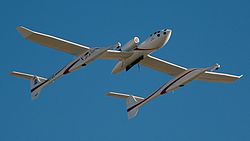
View on WikipediaThe Scaled Composites Model 318 White Knight (now also called White Knight One) is a jet-powered carrier aircraft that was used to launch its companion SpaceShipOne, an experimental spaceplane. The White Knight and SpaceShipOne were designed by Burt Rutan and manufactured by Scaled Composites, a private company founded by Rutan in 1982. On three separate flights in 2004, White Knight conducted SpaceShipOne into flight, and SpaceShipOne then performed a sub-orbital spaceflight, becoming the first private craft to reach space.
Key Information


The White Knight is notable as an example of a mother ship which carried a parasite aircraft into flight, releasing the latter which would then execute a high-altitude flight, or a sub-orbital spaceflight. This flight profile is shared with The High and Mighty One and Balls 8, two modified B-52s which carried the North American X-15 into flight. It is also shared with White Knight Two, a descendant which carries SpaceShipTwo into flight as part of the Virgin Galactic fleet.
Following the SpaceShipOne flights, the White Knight was contracted for drop tests of the Boeing X-37 spaceplane, from June 2005 until April 2006. The White Knight was retired from service in 2014, and is in the inventory of the Flying Heritage Collection.
Design and development
[edit]


The Scaled Composites model number for White Knight is 318. White Knight is registered with the Federal Aviation Administration as N318SL.[1]

The White Knight carrier airplane was designed around the twin afterburning General Electric J85 engines, which were selected for their availability and low cost. The aircraft was a completely new independent design. White Knight and SpaceShipOne shared the same forward fuselage outer mold line (OML) to reduce development costs and with the original intent to allow for White Knight to act as a flying simulator for training SpaceShipOne pilots. White Knight first flew on August 1, 2002. The flight was aborted shortly after takeoff due to a problem with the outboard wing spoilers. These trailing edge spoilers were designed to greatly increase the glide slope so that the White Knight vehicle could act as a flying simulator for training of SpaceShipOne pilots. During the first flight, the mechanical over-center torque was insufficient to maintain the spoilers in the closed position. The spoilers deployed into the free stream and began a limit cycle forcing the pilot (Mike Melvill) to abort. The spoilers were subsequently disabled completely and the desire for a steep glide slope matching SpaceShipOne was abandoned.
White Knight next flew on August 5, 2002, and this time performed well. Development proceeded over the next few months. With White Knight developed and evaluated, on April 18, 2003, White Knight and SpaceShipOne were presented to the media.
Subsequently, White Knight flew as part of the Tier One program that won the Ansari X Prize on October 4, 2004.
Afterwards, White Knight was used to carry and launch DARPA's experimental X-37 spaceplane for its approach and landing tests in 2005 and 2006.
It was followed up by the White Knight Two, which has a similar but larger design.
SpaceShipOne program
[edit]Flights of White Knight are numbered, starting with flight 1 on August 1, 2002. Flights where SpaceShipOne was carried also get one or two appended letters. An appended "C" indicates that the flight was a captive carry, and "L" indicates that SpaceShipOne was launched. If the flight actually flown differs in category from the intended flight, then two letters are appended, the first giving the intended mission and the second the mission actually performed.
| Flight | Date | SS1 Pilot | SpaceShipOne flight |
|---|---|---|---|
| 24C | May 20, 2003 | Peter Siebold | 01C |
| 29C | July 29, 2003 | Brian Binnie | 02C |
| 30L | August 7, 2003 | Brian Binnie | 03G |
| 31LC | August 27, 2003 | Brian Binnie | 04GC |
| 32L | August 27, 2003 | Brian Binnie | 05G |
| 37L | September 23, 2003 | Peter Siebold | 06G |
| 38L | October 17, 2003 | Peter Siebold | 07G |
| 40L | November 14, 2003 | Brian Binnie | 08G |
| 41L | November 19, 2003 | Brian Binnie | 09G |
| 42L | December 4, 2003 | Peter Siebold | 10G |
| 43L | December 17, 2003 | Peter Siebold | 11P |
| 49L | March 11, 2004 | Brian Binnie | 12G |
| 53L | April 8, 2004 | Brian Binnie | 13P |
| 56L | May 13, 2004 | Brian Binnie | 14P |
| 60L | June 21, 2004 | Mike Melvill | 15P |
| 65L | September 29, 2004 | Mike Melvill | 16P |
| 66L | October 4, 2004 | Brian Binnie | 17P |
X-37 test program
[edit]White Knight was contracted to perform both captive carry and drop test flights of the DARPA/Boeing X-37. First captive carry flight was on June 21, 2005, and first drop was on April 7, 2006 (the X-37 was subsequently damaged on landing at Edwards Air Force Base). Initially, the flights originated from Mojave, but following the landing incident, the program was moved to Air Force Plant 42 in Palmdale, California, and at least five subsequent flights were made there.
Adaptive Compliant Wing test program
[edit]In late 2006, White Knight flew a seven-flight test program of the adaptive compliant wing developed by FlexSys Inc. with funding by the Air Force Research Laboratory. A laminar flow test article was mounted vertically under White Knight's centerline pylon for the 20-flight-hour research program that tested the flexible wing's aerodynamic characteristics.[2][3]
Retirement to museum
[edit]In July 2014 White Knight made its final planned flight, arriving at Paine Field in Everett, Washington, to become part of the Flying Heritage Collection.[4]
Specifications
[edit]Data from Scaled Composites[5][6]
General characteristics
- Crew: 3
- Capacity: 8,000 lb (3,600 kg) payload
- Wingspan: 83 ft (25 m)
- Empty weight: 6,360 lb (2,885 kg)
- Max takeoff weight: 18,000 lb (8,165 kg)
- Fuel capacity: 6,400 lb (2,900 kg)
- Powerplant: 2 × General Electric J85-GE-5 afterburning turbojet, 2,400 lbf (11 kN) thrust each dry, 3,600 lbf (16 kN) with afterburner
Performance
- Service ceiling: 53,000 ft (16,000 m)
Other features and capabilities
[edit]- Carriage and launch of payloads up to 7,000 lb (3,200 kg)
- Altitude capability above 53,000 ft
- Large, three-place cabin (60 in (1,524 mm) diameter outside, 59 in (1,499 mm) inside)
- Sea level cabin qualified for unlimited altitude
- ECS scrubs CO2, removes humidity and defogs windows
- Two crew doors with dual seals and dual-pane windows
- Manual flight controls with three-axis electric trim
- Avionics include INS-GPS navigator, flight-director, flight test data (recording and T/M), air-data, vehicle health monitoring, backup flight instruments, and video system
- The 82 ft (25 m) wing can be extended to 93 ft (28 m) for increased climb capability
- Super-effective, pneumatic speed brakes allow steep descent with L/D < 4.5
- Hydraulic wheel brakes and nose-gear steering
- Pneumatic main gear retraction
- Dual-bus electrical power system
- Cockpit allows single-pilot operation (VMC-day conditions only)
See also
[edit]References
[edit]- ^ "FAA Registry (N318SL)". Federal Aviation Administration.
- ^ Scott, William B, "Morphing Wings", Aviation Week & Space Technology, 2006-11-27
- ^ Scott, William B, "White Knight Back in Action", Aviation Week & Space Technology, 2006-11-27
- ^ "SpaceShipOne's White Knight Airplane Makes Final Flight". NBC News. 2014-07-22.
- ^ "Posterboard - White Knight". Archived from the original on 2007-12-10. Retrieved 2007-11-28.
- ^ "White Knight". Scaled Composites. Retrieved 24 January 2019.
External links
[edit]
- Scaled Composites' Tier One website Archived 2018-04-07 at the Wayback Machine
- White Knight's FAA registration
- WhiteKnight to launch X-37 test flights
| Related companies |  | |
|---|---|---|
| Notable people |
| |
| Background | ||
| Programs / ships | ||
| Related topics | ||
 |
This aircraft article is missing some (or all) of its specifications. If you have a source, you can help Wikipedia by adding them. |
Scaled Composites White Knight
View on GrokipediaDesign and Development
Concept and Origins
The Scaled Composites Tier One program, initiated in the late 1990s, represented a pioneering effort to develop a privately funded, reusable suborbital spaceflight system, with early design explorations beginning as far back as 1996. This initiative was primarily funded by Paul Allen, the Microsoft co-founder, who established Mojave Aerospace Ventures in 2000 to support the project financially, committing an estimated $20–25 million to enable low-cost access to space without reliance on government resources. The program's core ambition was to demonstrate the feasibility of private space travel, focusing on innovative aerospace designs that could achieve suborbital altitudes exceeding 100 kilometers while prioritizing safety and reusability.[6][9][10] Burt Rutan, the founder and chief designer of Scaled Composites, envisioned Tier One as a complete air-launched system comprising a carrier aircraft—later named White Knight—and a mated suborbital vehicle, SpaceShipOne, to revolutionize space access by bypassing traditional ground-based rockets. Drawing inspiration from historical programs like the X-15 and frustrated by the high costs and bureaucracy of NASA's shuttle program, Rutan aimed to create a lightweight, pilot-controlled system using composite materials for rapid prototyping and cost efficiency. The vision centered on competing for the Ansari X Prize, a $10 million challenge announced in 1996 to spur non-governmental human spaceflight, requiring two crewed suborbital missions within two weeks using a reusable vehicle.[11][5][10] Key design goals for White Knight emphasized its role as a high-altitude mothership, capable of releasing payloads from approximately 50,000 feet to optimize the suborbital vehicle's performance while minimizing fuel requirements. The aircraft adopted a distinctive twin-fuselage configuration with short, wide wings and vertical tail booms, allowing it to cradle SpaceShipOne between the fuselages for stable carriage and launch, and incorporated off-the-shelf turbojet engines to enhance development speed and reduce expenses.[3] This approach aligned with Rutan's philosophy of leveraging proven commercial components alongside custom composites to achieve economic viability in private aerospace ventures.[9][11] The project was formally announced in 2001, marking the start of full-scale development under Mojave Aerospace Ventures, and was explicitly tied to SpaceShipOne as its integrated launch platform to meet the X Prize criteria for private innovation in spaceflight. This announcement galvanized interest in the Tier One effort, positioning Scaled Composites as a leader in the emerging commercial space sector.[10][6]Engineering Features
The Scaled Composites White Knight employs a unique twin-boom fuselage design, with two slender fuselages connected by a large central wing, enabling the aircraft to carry SpaceShipOne securely nestled between the booms for mated flight.[1] This configuration enhances structural integrity while minimizing aerodynamic interference during the high-altitude climb to release point.[12] Propulsion is provided by two General Electric J85-GE-5 afterburning turbojet engines mounted externally on the upper surface of the central wing, each delivering up to 3,850 lbf (17.13 kN) of thrust when afterburners are engaged.[3] These engines were selected for their proven reliability and availability, contributing to the aircraft's high thrust-to-weight ratio essential for simulating spaceflight maneuvers and reaching altitudes exceeding 50,000 feet.[1] The airframe utilizes advanced composite construction, predominantly carbon fiber reinforced polymers, to achieve a lightweight yet robust structure that supports rapid prototyping and iterative design refinements characteristic of Scaled Composites' approach.[1] This material choice facilitates efficient payload carriage without compromising structural strength under flight loads. Aerodynamic features include high-aspect-ratio wings spanning 82 feet (25 meters), which generate the necessary lift for fuel-efficient operation at subsonic speeds and high altitudes, optimizing performance during the long climb phase.[1] Stability for payload release is augmented by the twin-boom layout's natural dihedral effect and large deployable speed brakes, allowing precise control and minimal disturbance to the separating vehicle at speeds around 120 knots.[12]Construction and Testing
Construction of the Scaled Composites Model 318 White Knight occurred at the company's facility in Mojave, California, as part of the Tier One suborbital spaceflight program.[13] The twin-fuselage carrier aircraft integrated composite structures for its wings and booms, along with two General Electric J85-GE-5 turbojet engines, leveraging Scaled Composites' expertise in rapid prototyping to expedite assembly.[3] The White Knight completed assembly in time for its maiden flight on August 1, 2002, from Mojave Air and Space Port.[1] This initial sortie encountered an issue with the outboard spoilers, resulting in an early abort shortly after takeoff.[3] A follow-up flight on August 5, 2002, proceeded successfully, marking the start of a series of evaluations to confirm structural integrity and flight characteristics.[3] Over the ensuing months, the White Knight underwent multiple test flights to validate airworthiness, simulate payload carriage under its central pylon, and test release mechanisms in preparation for operational roles.[14] By late 2003, these sorties included captive-carry demonstrations with SpaceShipOne mated to the carrier, accumulating flight hours that confirmed the platform's stability at release altitudes around 47,000 feet.[12]Operational History
SpaceShipOne Carrier Role
The Scaled Composites White Knight served as the dedicated air-launch carrier for SpaceShipOne, with the suborbital spacecraft mated beneath the carrier's fuselage via a custom pylon and release mechanism designed for precise separation during high-altitude flight.[1] This integration allowed White Knight to transport SpaceShipOne to release altitudes ranging from approximately 46,000 to 50,000 feet, where the copilot would initiate detachment in level flight, enabling SpaceShipOne to glide briefly before igniting its hybrid rocket motor for ascent.[15][16] The configuration shared identical cockpit elements, including seats, windows, controls, and avionics, to facilitate pilot training transitions between the carrier and spacecraft.[16] White Knight conducted a series of 17 test flights carrying SpaceShipOne from 2003 to 2004, encompassing captive carries, unpowered glides, and powered ascents, with the carrier logging over 60 total sorties in support of the program.[12] Key missions included the Ansari X Prize-winning flights in 2004: flight 15P on June 21, reaching an apogee of 328,491 feet with pilot Mike Melvill in SpaceShipOne and Brian Binnie commanding White Knight from 47,000 feet; flight 16P on September 29, achieving 337,700 feet again with Melvill in SpaceShipOne and Binnie on White Knight from 46,500 feet; and flight 17P on October 4, attaining a record 367,500 feet with Brian Binnie piloting SpaceShipOne and Mike Melvill flying White Knight from 47,100 feet.[15] These operations alternated pilots between the vehicles to maximize experience sharing.[6] Operationally, White Knight followed a standardized climb profile involving a 60-minute ascent, often in spirals, to the release altitude using its twin turbojet engines, with fuel management optimized for the extended duration and potential loiter periods to align with optimal launch windows.[16][6] Post-release, the carrier would maneuver clear while telemetry systems on both vehicles transmitted data to mission control for real-time tracking of SpaceShipOne's trajectory, rocket burn, and reentry.[17] This role enabled White Knight to support the first privately funded, manned suborbital spaceflights, with SpaceShipOne successfully crossing the 100-kilometer Kármán line on three occasions, demonstrating reusable private space access.[12][17]X-37A Air-Launch Tests
In 2005, Scaled Composites' White Knight entered a collaboration with Boeing and the Defense Advanced Research Projects Agency (DARPA) to support the development and testing of the X-37A Orbital Test Vehicle, an unpiloted reusable spaceplane originally conceived by NASA in the late 1990s and transferred to DARPA in 2004 for approach and landing demonstrations.[18][19] This effort focused on using White Knight as a high-altitude carrier to simulate air-launch conditions, building on its prior role in suborbital flights while adapting to the military vehicle's requirements for autonomous reentry and landing validation.[20] The testing program included multiple captive-carry flights to verify integration and aerodynamics before progressing to free-flight drops. A notable captive-carry occurred on June 21, 2005, when White Knight ascended to operational altitude with the X-37A secured beneath its fuselage, followed by additional captive flights on March 24, 2006, to refine high-altitude handling at around 40,000 feet without release.[18][19] These were succeeded by three free-flight tests in 2006: the first on April 7, releasing the X-37A at approximately 37,000 feet for an autonomous glide and landing at Edwards Air Force Base, though it sustained minor nose wheel damage upon rollout; a second on August 18; and a third on September 26, all demonstrating controlled descent from air-launch altitudes.[20][19] To accommodate the X-37A, which differed in size, weight, and configuration from prior payloads, White Knight underwent modifications to its under-fuselage carriage system, including adjustments to the release pylon for secure attachment of the vehicle's mockup and full-scale prototypes, along with center-of-gravity balancing to maintain stability during ascent to 40,000 feet.[18] These changes ensured compatibility with the X-37A's compact 29.5-foot length and 5,000-pound mass, allowing for precise weight distribution without compromising the carrier's performance.[19] The air-launch tests successfully validated the X-37A's flight dynamics, autonomous guidance, and landing precision under DARPA's Approach and Landing Test Vehicle phase, extending the envelope beyond low-speed ground evaluations and confirming feasibility for high-altitude releases.[20] However, no further air-launches were pursued for orbital operations; the program transitioned to the U.S. Air Force's X-37B variant, which achieved its first spaceflight via rocket launch in 2010, leveraging the glide test data for reentry technologies.[19]Adaptive Compliant Wing Program
The Mission Adaptive Compliant Wing (MACW) program employed the Scaled Composites White Knight as a flight test platform to evaluate seamless morphing wing technology for enhanced aerodynamic performance in high-altitude, long-endurance aircraft. Led by FlexSys Inc. in collaboration with the U.S. Air Force Research Laboratory (AFRL), the initiative focused on compliant mechanisms that enable variable camber without gaps or hinges, reducing drag and improving fuel efficiency. NASA contributed through supporting research under the Convergent Aeronautics Solutions project, building on the core AFRL-funded development.[21][22] Modifications to White Knight involved mounting a subscale MACW prototype—measuring 50 inches in span and 30 inches in chord with an aspect ratio of 1.67 (enhanced to 4.45 using endplates)—on an underbelly stub pylon along the aircraft's centerline. The trailing-edge flap utilized flexible composite skins and internal compliant structures to achieve seamless deflections of ±10 degrees at rates up to 30 degrees per second, integrated with a natural laminar flow airfoil to optimize airflow continuity. These adaptations allowed testing at full-scale dynamic pressure and Mach numbers representative of target missions, while minimizing structural weight penalties compared to conventional hinged flaps.[21] Flight tests occurred between October and December 2006 at Mojave Air and Space Port, California, encompassing seven sorties and totaling 27 flight hours. Primary evaluation points included Mach 0.40 at 25,000 feet (Reynolds number 3.3 million) and Mach 0.55 at 40,000 feet (Reynolds number 2.8 million), with 36 discrete test conditions assessing flap performance across angles of attack from -2 to +6 degrees. The program demonstrated reliable actuation and aerodynamic response at these high-altitude, subsonic regimes, validating the system's durability under real-world flight loads.[21] Results confirmed the MACW's ability to sustain laminar flow over roughly 60% of the chord length, yielding drag reductions that extended mission range by more than 15% through improved lift-to-drag ratios. The technology also enhanced control authority and reduced noise, with no observed gaps or structural failures during deflections. These findings substantiated compliant morphing as a viable approach for future aircraft, including UAVs and efficiency-focused transports, influencing subsequent designs by enabling lighter, more adaptable airframes.[21][22]Additional Test Missions
Following the SpaceShipOne program, the White Knight aircraft was repurposed as a high-altitude payload platform, enabling a series of additional test missions that underscored its adaptability for research and development activities. Scaled Composites utilized the vehicle for miscellaneous roles, including support for atmospheric research, data relay, telecommunications, imaging, reconnaissance experiments, and micro-satellite launch demonstrations, which leveraged its ability to reach altitudes above 45,000 feet while carrying diverse payloads.[1] These missions extended to third-party collaborations, where White Knight facilitated integrations of sensor pods and other equipment for high-altitude data collection and surveillance applications, demonstrating its value as a flexible testbed for non-program-specific R&D. The aircraft's core design flexibility, with its twin-fuselage configuration and robust mounting points, allowed for rapid reconfiguration between flights without extensive downtime.[1] Throughout its operational life, White Knight accumulated numerous flights dedicated to these varied R&D efforts, contributing to advancements in aerospace technologies while encountering only minor operational challenges, such as routine engine adjustments that were promptly resolved to maintain flight schedules.[1]Retirement and Preservation
Final Operational Flights
Following the completion of its primary roles in supporting SpaceShipOne, the X-37A tests, and other adaptive programs, White Knight transitioned to limited post-program operations from 2012 to 2014, serving as a for-hire payload platform for missions including reconnaissance, surveillance, atmospheric research, data relay, telecommunications, imaging, and micro-satellite booster launches.[1] These sorties were infrequent, focused on maintenance checks and minor demonstrations to sustain airworthiness while Scaled Composites prioritized the development and deployment of White Knight Two for Virgin Galactic's SpaceShipTwo program.[1] The decision to retire White Knight was driven by the airframe's advancing age after over a decade of intensive experimental use, escalating maintenance costs, and the operational shift to its successor aircraft, with Scaled Composites announcing the end of active service in early 2014.[23] This marked the conclusion of its operational history, underscoring its contributions to suborbital and aerial research.[1] White Knight's last operational flight occurred on July 21, 2014, as a ferry mission from Mojave Air and Space Port, California, to Paine Field in Everett, Washington, piloted by Scaled Composites test pilots Peter Siebold and an unnamed copilot.[24] The approximately two-hour flight served solely to relocate the aircraft for preservation, after which it was grounded upon arrival, with no further airworthiness certification or flight operations pursued.[23] Decommissioning proceeded immediately, transitioning the vehicle from active duty to static display status.[24]Museum Relocation and Display
In 2014, Mojave Aerospace Ventures, a joint venture between Scaled Composites and Paul Allen, donated the White Knight to Paul Allen's Flying Heritage Collection at Paine Field in Everett, Washington.[24][1] The aircraft completed its final operational flight from Mojave Air and Space Port to Paine Field on July 21, 2014, piloted by Scaled Composites test pilots, arriving intact for integration into the museum.[23][25] Following its arrival, the White Knight underwent preparation for static display, including cleaning and labeling of key components to ensure long-term preservation of its historical features from the SpaceShipOne era.[24] By 2015, it was suspended indoors in Hangar C of the Flying Heritage & Combat Armor Museum, positioned alongside a full-scale SpaceShipOne replica to illustrate the pioneering role in private suborbital spaceflight.[26] The exhibit is accessible to the public through the museum's regular hours and guided tours, which highlight the aircraft's contributions to aviation innovation.[27] After Paul Allen's death in 2018, the collection remained under his estate's management until 2022, when it was acquired by the Wartime History Museum, a nonprofit founded by Walmart heir Steuart Walton, ensuring continued display at Paine Field.[28][29] As of 2025, the White Knight continues as a static exhibit in the Flying Heritage & Combat Armor Museum, supporting educational programs on the history of private space exploration, with no plans for restoration to airworthy condition.[26][1]Technical Specifications
General Characteristics
The Scaled Composites White Knight is a twin-fuselage, high-altitude carrier aircraft constructed primarily from carbon fiber epoxy composites, employing sandwich construction techniques with honeycomb and PVC foam cores for the airframe.[30] This design enables a lightweight structure suitable for air-launching payloads while maintaining structural integrity at high altitudes. The aircraft's twin fuselages are connected by a central wing and a pylon for mounting payloads such as SpaceShipOne.[1]Key Specifications
| Attribute | Value |
|---|---|
| Wingspan | 82 ft (25 m)[1] |
| Length | 71 ft (22 m) |
| Height | 16 ft (5 m) |
| Empty weight | 6,360 lb (2,885 kg)[1] |
| Maximum takeoff weight | 18,000 lb (8,165 kg) with payload[1] |
| Crew | 2 pilots, with capacity for additional observers[1] |