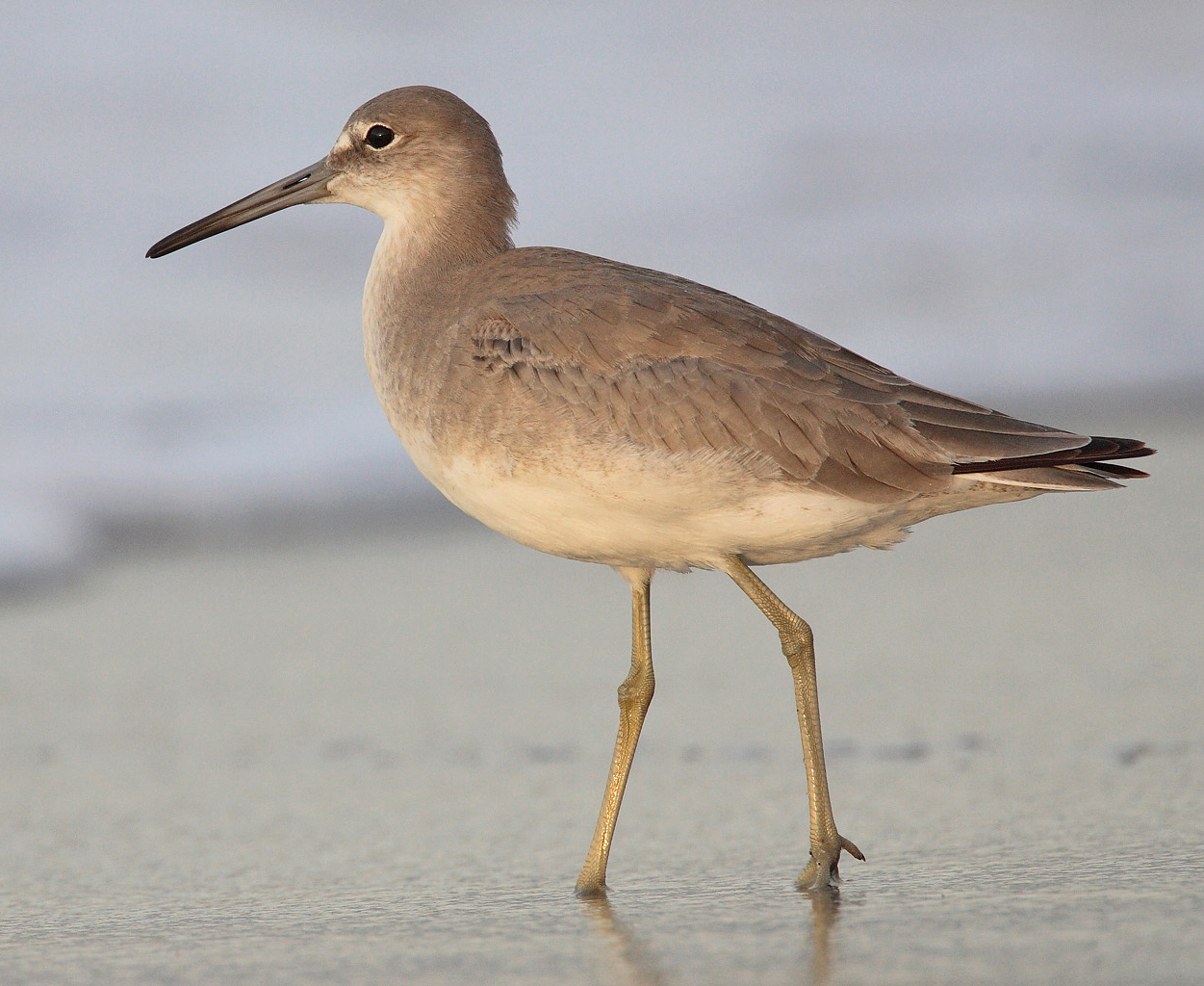
Willet
Willet
Main page
2229775

Willet

logo
Community Hub0 subscribers
Read side by side
from Wikipedia

Willet
Scientific classification Edit this classification
Kingdom: Animalia
Phylum: Chordata
Class: Aves
Order: Charadriiformes
Family: Scolopacidae
Genus: Tringa
Species:
T. semipalmata
Binomial name
Tringa semipalmata
(J. F. Gmelin, 1789)
Subspecies
  • T. s. semipalmata eastern willet
  • T. s. inornata western willet
  Breeding
  Nonbreeding
Synonyms[2]
  • Scolopax semipalmatus J. F. Gmelin, 1789
  • Symphemia semipalmata (J. F. Gmelin, 1789)
  • Catoptrophorus semipalmatus (J. F. Gmelin, 1789)
  • Totanus semipalmatus (J. F. Gmelin, 1789)

The willet (Tringa semipalmata) is a large shorebird in the family Scolopacidae. It is a relatively large and robust sandpiper and is the largest of the species called "shanks" in the genus Tringa. Its closest relative is the lesser yellowlegs, a much smaller bird with a very different appearance apart from the fine, clear, and dense pattern of the neck, which both species show in breeding plumage. It breeds in North America and the West Indies and winters in southern North America, Central America, the West Indies and South America.

Taxonomy

[edit]

The willet was formally described in 1789 by the German naturalist Johann Friedrich Gmelin in his revised and expanded edition of Carl Linnaeus's Systema Naturae. He placed it in the genus Scolopax and coined the binomial name Scolopax semipalmata.[3] Gmelin based his description on the "semipalmated snipe" from New York that had been described in 1785 by both the English ornithologist John Latham and by the Welsh naturalist Thomas Pennant.[4][5] The willet was formerly assigned to the genus Catoptrosorus that had been introduced for the species in 1827 by Charles Lucien Bonaparte.[6][7] In 2006 it was moved to the current genus Tringa based on a molecular phylogenetic study published the previous year.[8][9] The genus name Tringa is the Neo-Latin word given to the green sandpiper by the Italian naturalist Ulisse Aldrovandi in 1603 based on Ancient Greek trungas, a thrush-sized, white-rumped, tail-bobbing wading bird mentioned by Aristotle. The specific epithet semipalmata combines the Latin semi- meaning "half" or "small" with palmatus meaning "palmate".[10]

Two subspecies are recognised:[11]

  • T. s. inornata (Brewster, 1887): breeds from the Prairie Provinces of Canada south to northeastern California, northern Colorado and western Nebraska; winters mainly on the Pacific coasts from the southern United States from coastal S USA to northern South America as far south as northern Chile. Some winter on the Atlantic coast southwards from the southern United States.[12]
  • T. s. semipalmata (Gmelin, 1789): breeds from southern Newfoundland and along the Atlantic coast of the United States into the Gulf of Mexico, including the Caribbean Islands; winters in the West Indies and along the eastern coast of South America as far south as southern Brazil and Argentina. There are no documented records of this taxon wintering in the United States.[13]

It has been suggested that the two subspecies be treated as separate species as there are clear differences in distribution, behavior, morphology, and genetics, but this has yet to be widely adopted.[14]

The willet is a very rare vagrant to Europe with records from the Azores, mainland Portugal, France, Norway and Finland. The Portuguese record from Alcochete near Lisbon on 29 April 2009 showed characteristics of the eastern subspecies.[15]

Description

[edit]
The white wing band is distinctive in flight, both above and below

The willet is an inelegant and heavily built shorebird with a structure similar to that of the common redshank but being larger in size than the greater yellowlegs while resembling a godwit in flight with black primary coverts and primaries contrasting with a broad white band, white secondaries with a white rump and gray tail band. With its reclassification into the Tringa genus, it stands as the largest species in this prominent sandpiper genus.[16] It is 31–41 cm (12–16 in) in overall length and weighs 200–330 g (7.1–11.6 oz). The sexes are similar in plumage but the female is slightly larger.[17]

The black underwing coverts may be conspicuous in flight. Willets are identified on the ground by their gray legs and shortish, heavy but straight bill. The plumage is gray above with a white rump, and white below with a distinct white area above the lores and a narrow whitish eye ring giving the bird a spectacled appearance. The underparts are white. In breeding plumage, the bird shows brown barring on the upperparts. Non-breeding birds are plainer.[citation needed]

Voice

[edit]

The willet's name is onomatopoeic and refers to its loud piercing "pill-will-willet" territorial song.,[18] which is higher pitched and repeated at a faster rate in Eastern willets than in Western birds.[19] Other calls include a predator response call given by breeding birds which is a repeated, staccato "kleep", while non breeding birds alarms include a high, pitched anxious "kip-kip-viek" call and a "kreei" call. They also have a distinctive call when crossing another willet's territory and this "klay-dir" call is also used as a contact call when willets are migrating.[19]

Distribution and habitat

[edit]

Two subspecies (which may actually be different species)[20] have very different breeding habitats. The eastern willet breeds in coastal saltmarshes while the western willet breeds in freshwater prairie marshes, sloughs, potholes and other inland wetlands. In winter both subspecies are coastal birds being found on both rocky and sandy coasts as well as on mudflats and in coastal marshes.[19]

Behavior and ecology

[edit]

They are territorial both on the breeding grounds and on the wintering areas but form loose breeding colonies or wintering groups. When displaying the wings are held stiffly and downcurved in flight while on the ground the display gives prominence to the distinctive pattern of the underwings. They are normally vigilant birds, with the birds closer to the landward edge of a saltmarsh being the first to utter their alarm calls, in a manner reminiscent of the common redshank in Europe, although some individuals may be approachable.[17]

Food and feeding

[edit]

Willets are flexible in their feeding habits and hunt by walking steadily and pecking prey from the substrate, although they also probe into the mud or silt with their sensitive bill and may actively stalk larger prey in shallow water. A favored prey on the coasts is small fiddler crabs as well as mole crabs, worms, clams and other invertebrates.[21] They have also been known to occasionally eat plant material. Willets also actively hunt more mobile prey such as fish and aquatic insects in the water and will wade up to their bellies to pursue such prey. Prey recorded in western willets during breeding include water scavenger beetles (Hydrophilidae), diving beetles (Dytiscidae), snout beetles (Curculionidae), spiders (Araneae) and fish (Cypriniformes).[22] In winter, western willets have been recorded eating shore crabs (Hemigrapsus), brachyuran crabs (Uca princeps, Leptuca crenulata), crabs (Pachygrapsus), clams (Macoma, Gemma gemma), nereid worms (Neanthes), mussels (Mytilus), whelks (Nassariidae) and others.[22] Eastern willets eat primarily marine coastal prey, including fiddler crabs (Minuca minax, Minuca pugnax, Leptuca pugilator), other crabs (Armases cinereum, Sesarma reticulatum), mole crabs (Emerita talpoida), amphipods (Corophium volutator) and other marine invertebrates.[22] The sensitive bill means that willets can hunt at night as well as during the day.[19][23][18] They often use rocks, trees or fence posts to perch on.[18]

Breeding

[edit]
Egg

The male normally leads the female through the territory and creates trial nest scrapes for the female to consider until she selects the site. The nest is a shallow depression scraped out by the birds using their feet and breast, it measures 15 cm across and 5 cm deep. It is placed among grass close to the water's edge in western willets and in saltmarsh or sand dunes in eastern willets. If the nest is placed among grass the female may pull grass stalks over the nest for camouflage. Fine grass leaves and small pebbles may be used to line the nest and grass lining may be brought from some distance where the nest is on bare ground. The male and female may form a long-term monogamous bond and return to the same territory in successive breeding seasons. The male defends the territory from other willets, challenging his neighbors with a ritualized walk along the mutual boundary of their territory, and often this leads to fights. Both sexes incubate the eggs for 22–29 days, although the male tends to incubate at night, the female departs from the territory before the precocial young are fledged leaving them in the care of the male for the last two weeks or so before they fledge.[19][24][18]

Conservation

[edit]

The willet is still common in some parts of its range despite an apparent decline since the 1960s. It is also considered to be a species at risk of becoming threatened or endangered without conservation action. The western subspecies is threatened by the conversion of native grasslands and drainage of wetlands for agriculture while the wintering habitat has been degraded locally in California by coastal development. Willets are also vulnerable to being killed by colliding with power lines laid through their wetland breeding areas. The passage of the Migratory Bird Treaty Act in 1918 protected the willet from intensive exploitation by hunters for food and allowed its numbers to rebound to present levels.[19] There are a total of 250,000 willets in North America, of which 150,000 were counted from the western flyway, and 90,000 in the eastern. Since the Western willet winters in the east, that means that there are probably much less than 90,000 Eastern willets.[13]

[edit]

References

[edit]
Revisions and contributorsEdit on WikipediaRead on Wikipedia
from Grokipedia
The Willet (Tringa semipalmata) is a large, chunky shorebird characterized by its long, straight bill, thick gray legs, and distinctive black-and-white wing stripes that flash prominently in flight.[1][2] Measuring about 15 inches (38 cm) in length, it exhibits mottled brown plumage with barring during the breeding season and plain grayish tones in winter, with western populations appearing slightly larger and paler overall.[2] Known for its loud, ringing call resembling "pill-will-willet," the species is a common sight along North American coastlines and inland wetlands, where it probes mudflats and beaches for food.[1][2] Willetts inhabit a variety of open habitats, including beaches, mudflats, rocky shores, tidal estuaries, and marshes, with breeding grounds differing by subspecies: the Eastern Willet favors coastal salt marshes along the Atlantic and Gulf Coasts, while the Western Willet nests in freshwater marshes, prairies, and grasslands of the interior.[1][2] Their range spans much of North America, with breeding occurring from the Great Plains and western Canada to the eastern seaboard; migrants and winter residents extend to southern coastal regions, including Florida, Texas, and even parts of the Pacific coast, though northern interior breeders primarily head to the coasts during migration.[1][2] These birds are diurnal and nocturnal foragers, using their sensitive bill tips to detect and consume a diet primarily consisting of insects, crustaceans like fiddler crabs, marine worms, small mollusks, fish, and occasional plant matter.[1][2] Behaviorally, Willetts are territorial and vocal, employing a variety of calls such as the sharp "kuk-kuk" alarm note and performing aerial displays during courtship, where males fly in circles while calling.[2] They often nest in loose colonies, with both parents sharing incubation duties for their clutch of 4 (rarely 5) blotched, olive-buff eggs over 22–29 days; precocial young leave the nest shortly after hatching and are cared for primarily by the male after the female departs early.[2] To deter predators, adults may use a "broken-wing" distraction display.[1] Conservation-wise, the species is rated Least Concern by the IUCN, with a global population estimated at 250,000 (decreasing); while the Eastern Willet recovered from near-extinction due to 19th-century hunting following the 1918 Migratory Bird Treaty Act, ongoing threats include habitat loss from development and sea-level rise.[1][2][3] The oldest recorded Willet lived to 10 years and 3 months.[1]

Taxonomy and nomenclature

Etymology

The common name "Willet" derives from the bird's loud, repetitive alarm call, which sounds like "pill-will-willet" and is often heard during territorial defense or when flushed.[1][2] This onomatopoeic naming convention highlights the bird's vocal prominence in its marshy habitats, where the call serves to announce its presence and deter intruders.[4] The scientific binomial, originally assigned as Catoptrophorus semipalmatus by early taxonomists, reflects key morphological features. The genus name Catoptrophorus combines Greek roots katoptron (mirror) and phoros (bearing or carrying), alluding to the conspicuous white wing stripe that flashes like a mirror in flight.[5] The specific epithet semipalmatus stems from Latin semi- (half) and palmatus (webbed or palmate), describing the partial webbing between the toes that aids in wading through soft substrates.[1][4] Although the genus has since been synonymized with Tringa based on molecular evidence, the original nomenclature persists in historical literature.[4] In older ornithological texts, the Willet was referred to as the "semipalmated tattler," a name emphasizing its semi-webbed feet and chattering vocalizations akin to those of tattler shorebirds.[6] This regional variation appeared in early American accounts, distinguishing it from other sandpipers before the modern common name became standardized.[7]

Classification

The Willet belongs to the family Scolopacidae, which encompasses sandpipers, snipes, and related shorebirds. Within this family, it is currently classified as Tringa semipalmata in the genus Tringa, a diverse group of typically long-legged waders known as shanks. This placement reflects its shared morphological and genetic affinities with other Tringa species, such as the yellowlegs and redshanks. Historically, the Willet was assigned to the monotypic genus Catoptrophorus as Catoptrophorus semipalmatus, a reclassification introduced by Charles Lucien Bonaparte in 1827 to distinguish it from other Tringa species based on distinctive morphological traits like its robust build and prominent wing patterns.[8] The species was originally described by Carl Linnaeus in 1758 under the name Tringa semipalmata in the tenth edition of Systema Naturae. This early placement in Tringa persisted until the 19th-century revision, which highlighted the Willet's apparent morphological divergence. However, molecular phylogenetic analyses in the early 2000s prompted a return to Tringa, as DNA sequence data from multiple genes demonstrated that Catoptrophorus is nested within the Tringa clade, indicating parallel evolution of certain traits rather than deep generic divergence. The American Ornithological Society formalized this merger in its 2006 checklist supplement. Phylogenetically, the Willet occupies a position within the Tringa genus that reflects an early divergence from other species in the group, with genetic studies, including analyses of multiple genes, estimating this split around 8.5 million years ago during the late Miocene.[9] These studies confirm its basal placement relative to many core Tringa lineages, such as the yellowlegs (T. melanoleuca and T. flavipes), to which it forms a close sister relationship, while underscoring the overall monophyly of Tringa within the subfamily Tringinae of Scolopacidae. This evolutionary history highlights the Willet's retention of ancestral states amid adaptive radiations in shorebird morphology and ecology.

Subspecies

The Willet (Tringa semipalmata) is divided into two recognized subspecies: the Eastern Willet (T. s. semipalmatus) and the Western Willet (T. s. inornatus).[10] These subspecies exhibit distinct morphological, behavioral, and ecological traits shaped by their breeding environments.[11] The Eastern Willet (T. s. semipalmatus) breeds primarily in coastal salt and brackish marshes along the Atlantic coast from New Brunswick to Tamaulipas, Mexico.[10] It displays more ornate barring and darker patterning in its breeding plumage compared to the western form, along with higher-frequency and faster-paced songs that contribute to its more vocal nature during the breeding season.[10] In contrast, the Western Willet (T. s. inornatus) breeds in inland freshwater wetlands, wet grasslands, and prairies across the Great Plains from southern Canada to the intermountain region of the northwestern United States.[10] This subspecies is on average 10% larger, with paler overall plumage, less intricate barring in breeding attire, and lower-frequency, longer-duration songs; it also shows reduced aggression in territorial displays relative to the eastern form.[12] Genomic analyses indicate that the subspecies diverged approximately 700,000 years ago during the Pleistocene epoch, likely due to isolation by glacial events that separated eastern coastal and western inland populations. Mitochondrial DNA reveals reciprocally monophyletic haplotypes with no evidence of hybridization or significant gene flow, as mean migration rates are estimated at near zero (0.0002 individuals per generation). Identification between the subspecies is straightforward in breeding ranges due to plumage and vocal differences but challenging in non-breeding areas, such as wintering grounds in Central and South America, where both forms converge on similar gray-brown, inconspicuous plumage; subtle cues like size, bill structure, and residual mottling may aid separation.[12][10]

Description

Physical characteristics

The Willet (Tringa semipalmata) is a large, stocky shorebird measuring 33–41 cm in length, with a wingspan of approximately 70 cm and a body mass ranging from 200–330 g.[11][13] Its build supports a robust foraging style in coastal environments, with broad, rounded wings that enhance maneuverability during flight.[11] The bird features a thick, straight bill, typically 6–6.5 cm long, which is considerably longer than the head and suited for probing soft substrates to extract invertebrates.[14][11] The legs are long and bluish-gray, providing stability in shallow water, while partial webbing between the toes aids in wading across mudflats and marshy areas.[13][11] Adult plumage varies seasonally: breeding individuals display mottled gray-brown upperparts with barring and streaking, complemented by a bold black-and-white striped pattern on the wings that is particularly conspicuous in flight, along with a white rump.[11][13] In non-breeding plumage, the overall appearance is plainer and grayer, with reduced patterning.[11] Juveniles exhibit a duller version of the non-breeding plumage, characterized by buff fringes on the upperpart feathers that create a scaly effect.[11][15] Sexual dimorphism is minimal, with females averaging slightly larger than males but showing no notable differences in plumage.[13] Subspecies exhibit subtle plumage variations, such as the Western Willet (T. s. inornata) appearing paler and less barred than the Eastern Willet (T. s. semipalmata).[11] The long legs enable efficient pursuit of prey on the ground, and the slight toe webbing supports movement through wet sediments.[13]

Voice

The Willet's vocal repertoire includes a distinctive primary call known as the "pill-will-willet," a loud, ringing phrase consisting of three parts: a series of short "pill" notes (typically 3-5, mean 3.30), followed by "will" and "willet." This call, often delivered from the ground or in flight, functions primarily in territorial defense and mate attraction during the breeding season, resembling the territorial songs of passerines in its role for advertising presence and repelling intruders.[16] Acoustic analysis reveals a harmonic structure with a fundamental frequency around 1.1 kHz and emphasized overtones, with the full phrase lasting approximately 0.785 seconds (SD 0.039); the maximum frequency reaches up to 2.7 kHz in the eastern subspecies (Tringa semipalmata semipalmata), which exhibits a higher pitch and shorter duration (0.59 seconds) compared to the western subspecies (T. s. inornata) at 2.5 kHz maximum and 0.78 seconds.[16][17] In non-breeding periods, the Willet employs a sharp flight call described as "kleep" or a churring "churr," particularly when in migration flocks or disturbed. This double-noted call, rising then falling in pitch, serves as an alarm signal and aids in maintaining contact within groups, with a broad frequency range spanning 2-5 kHz and durations varying by intensity (e.g., 0.113 seconds for high-intensity versions, SD 0.041).[16] Functions extend to predator distraction, where the "kleep" accompanies broken-wing displays to lure threats away from nests or young, enhancing survival in open habitats.[16][10] Vocalizations show clear seasonal variations, with more complex and frequent songs like the repeated "pill-will-willet" dominating the breeding season for courtship and defense, while wintering birds are notably quieter, relying on simpler alarm calls.[16][10] The eastern subspecies produces calls at a higher overall pitch (e.g., inter-song intervals of 0.16 seconds versus 0.20 seconds in the western), aiding in species recognition and reproductive isolation despite subtle auditory similarities to human ears.[17] This primary call also inspired the bird's common name, as noted in early ornithological descriptions.[10]

Distribution and habitat

Geographic range

The Willet (Tringa semipalmata) exhibits a broad distribution across the Americas, with distinct ranges for its two recognized subspecies: the eastern Willet (T. s. semipalmata) and the western Willet (T. s. inornata). The eastern subspecies breeds primarily in coastal salt marshes along the Atlantic and Gulf coasts of North America, extending from Nova Scotia in Atlantic Canada southward to Florida, Mexico, and sporadically into the Caribbean.[3][15] In contrast, the western subspecies breeds in inland freshwater wetlands and marshy grasslands across the interior of North America, ranging from the prairie provinces of central Canada through the Great Plains to the Rocky Mountains, and from southern British Columbia southward to central Texas.[1][4][18] During the non-breeding season, Willets of both subspecies migrate to coastal regions of the southern United States and southward into Central and South America. Eastern Willets winter mainly along the northern coasts of South America, including areas in Brazil, Argentina, French Guiana, and Peru, with some individuals utilizing Pacific coasts of Central America.[19][20] Western Willets winter in coastal habitats from Washington state and New Jersey southward to Chile, including the West Indies and northern South America.[12][15] Small populations of the eastern subspecies remain year-round in southern Florida and parts of Texas, while inland year-round occurrences are rare across the species' range.[13] Vagrant records of Willets outside their typical American range are infrequent but documented in Europe and the Pacific. In Europe, sightings include the United Kingdom, Azores, mainland Portugal, France, Norway, and Finland, with notable occurrences in the 2010s.[21] In the Pacific, vagrants have been recorded in Hawaii and the [Mariana Islands](/page/Mariana Islands).[22] Historical data indicate a northward expansion of the breeding range since the early 1900s, particularly along the eastern coast, with recovery and shifts in distribution linked to climate change influences, as evidenced by eBird observations and modeling up to 2025.[23][24][25]

Habitat preferences

The Willet (Tringa semipalmata) exhibits distinct habitat preferences that vary by subspecies and life stage, with the eastern subspecies (T. s. semipalmata) favoring coastal saline environments and the western subspecies (T. s. inornata) selecting inland freshwater systems during breeding. Eastern Willets breed primarily in coastal salt marshes along the Atlantic and Gulf coasts, where they utilize areas dominated by dense Spartina alterniflora (smooth cordgrass) and Spartina patens (saltmeadow cordgrass) for nesting cover.[26][27] Western Willets, in contrast, breed in freshwater wetlands, prairie marshes, sloughs, potholes, and wet grasslands across the interior Great Plains and western states, preferring short, sparse vegetation near water bodies such as prairie pothole ponds.[28][29] During the non-breeding season, both subspecies converge on coastal habitats, including mudflats, estuaries, sandy beaches, rocky intertidal zones, and tidal channels, extending from the U.S. coasts to Central and South America.[1][30] Willets often roost in mangroves or vegetated dunes adjacent to these foraging areas, providing elevated shelter from tides and predators.[30] Microhabitat requirements emphasize protection from tidal inundation and access to shallow water edges. Nests are typically placed on elevated hummocks, spoil piles, or high marsh zones to avoid flooding, with surrounding vegetation providing concealment.[27] Foraging occurs along shallow water margins, generally under 15 cm deep, in open wetland edges that support prey availability without dense cover.[31] The eastern subspecies demonstrates adaptations to saline environments through its exclusive use of salt marshes tolerant of high salinity levels, while both avoid heavily urbanized coasts in favor of relatively undisturbed natural wetlands.[13] Willets prefer temperate to subtropical climate zones for breeding, with eastern populations in coastal areas from Nova Scotia to Texas and western ones in prairie regions up to southern Canada.[2] However, salt marsh habitats critical to eastern Willets are vulnerable to sea-level rise, which can lead to inundation, erosion, and conversion to open water, potentially reducing nesting cover and elevating extinction risk in low-elevation coastal zones.[32]

Behavior and ecology

Diet and foraging

The Willet (Tringa semipalmata) is an opportunistic feeder with a diet dominated by invertebrates, including small crustaceans such as fiddler crabs (Uca spp.) and mole crabs (Emerita spp.), insects like beetles and larval dipterans, mollusks including clams and snails, and polychaete worms. Small fish and amphibians are taken opportunistically, particularly in shallow waters, while plant matter constitutes a minor component of the diet. In estuarine environments, crustaceans and mollusks form the bulk of consumption due to their abundance in mudflats and intertidal zones. Inland in freshwater marshes, the emphasis shifts toward burrowing insects and smaller crustaceans.[33][34][35] Foraging occurs primarily through a peck-probe method, where the bird walks steadily while visually scanning for prey, pecking at surface items or probing soft substrates with its long, straight bill to extract buried organisms. Additional techniques include lifting debris or vegetation to uncover hidden prey and occasional shallow dives or wading in water less than 5 cm deep. Activity is diurnal and nocturnal, peaking during ebb and low tides in coastal areas to access exposed foraging grounds, with birds often foraging solitarily or in loose, non-cohesive flocks that facilitate vigilance without intense competition. Success rates vary by habitat, season, and prey density, ranging from about 2% to 70% in observed studies, with lower rates often in winter coastal areas influenced by tidal cycles and substrate type.[36][35][33] Dietary composition exhibits seasonal variations aligned with habitat use and prey availability; during the breeding season in coastal marshes, crustaceans comprise a larger proportion to meet elevated energy needs, while insects become more prominent during migration stopovers in inland wetlands. Kleptoparasitism is infrequent but documented, with Willets occasionally stealing prey from larger shorebirds like the long-billed curlew (Numenius americanus). They compete for resources with similarly sized species, including plovers (Charadrius spp.), leading to aggressive interactions over prime foraging patches.[36][37][38]

Breeding biology

The Willet exhibits a monogamous mating system, with pairs often forming long-term bonds and returning to the same territories in successive seasons.[28] Courtship displays include aerial flights where males raise and flutter their wings while emitting characteristic "pill-will-willet" calls, which also serve to defend territories.[38] These vocalizations and displays help establish pair bonds, with copulation involving rapid wing flapping and clicking sounds from the male.[38] Breeding occurs seasonally, with eastern Willets (T. s. semipalmata) initiating activities from April to July in coastal salt marshes, while western Willets (T. s. inornata) breed from May to August in inland prairie wetlands and grasslands.[28][39] Clutch size typically ranges from 3 to 4 eggs, laid over about 6 days in a simple ground scrape lined with grass, debris, or pebbles, often situated near foraging areas on elevated, dry ground adjacent to wetlands.[28][38] The eggs are olive-buff or greenish-brown, marked with dark spots, and measure approximately 1.9–2.4 inches in length.[28] Both parents share incubation duties for 22–29 days (averaging 25 days), with the male typically handling nighttime shifts.[28][38] The chicks are precocial, hatching with open eyes and downy plumage, and leave the nest within 1–2 days to follow parents, who provide protection and feed them for up to 4 weeks until fledging at around 30 days.[28][38] The female often departs after 2 weeks, leaving the male to continue brooding and guarding the young.[28] Nesting success varies annually and by region, with hatching rates ranging from 20% to 50% in coastal studies and higher (up to 43–70%) in prairie habitats; predation by mammals such as foxes and birds like gulls represents the primary cause of failure.[40][41] Overall fledging success can reach 50–70% in favorable conditions, though it is influenced by predator abundance and habitat quality.[41]

Migration patterns

The Willet exhibits distinct migration patterns that vary by subspecies, with the eastern Willet (Tringa semipalmata semipalmata) undertaking long-distance migrations to northern South America and the western Willet (T. s. inornata) completing shorter journeys primarily to coastal areas of Mexico and the southern United States.[18] Eastern Willets breed along the Atlantic and Gulf coasts and winter mainly in northern South America, including Guyana to Brazil, while western Willets breed in interior wetlands of the central and western United States and Canada, wintering along the Pacific coast from California southward to Ecuador.[18] This strong migratory connectivity (range-wide estimate of 0.90) underscores the need for subspecies-specific conservation, as the two populations show minimal overlap in nonbreeding ranges.[18] Southbound migration typically begins post-breeding in late July to early August for adults, extending through October, with juveniles following later; northbound movements occur from March to May, with eastern Willets departing wintering grounds as early as late March and arriving on breeding sites by April.[28][18] Fall migrations are more protracted and variable, allowing for extended stopovers, whereas spring migrations are rapid and direct.[13] Populations in southern breeding ranges, such as parts of Texas and Tamaulipas, may be largely non-migratory or exhibit only partial migration, remaining year-round in coastal wetlands.[28] Eastern Willets follow coastal and oceanic routes along the Atlantic Flyway, often crossing the Caribbean to reach South American wintering grounds, with documented stopovers in wetlands like those in Suriname en route to Brazil.[42][18] Western Willets migrate overland, primarily through the Mississippi Valley during northward movements in April, joining routes from southern Atlantic wintering areas before dispersing to Pacific coastal sites.[42] Key stopover habitats include coastal wetlands such as those in the Chesapeake Bay region for eastern populations during both directions of travel, where birds refuel amid the broader network of Atlantic and Gulf coast marshes.[28] Physiological adaptations enable these journeys, including pre-migratory fueling on high-fat diets, like other shorebirds, enabling substantial increases in body mass (up to 50–100%) through subcutaneous and internal fat deposits, providing energy for sustained flight.[43] Willets, like other shorebirds, are capable of non-stop flights exceeding 1,000 km, supported by efficient lipid metabolism during endurance travel.[44] Orientation relies on a combination of magnetic cues detected via cryptochromes in the eyes and celestial navigation using stars, allowing precise route adherence even over oceanic expanses.[45]

Conservation

Population status

The global population of the Willet (Tringa semipalmata) is estimated at approximately 250,000 mature individuals, with the overall status considered stable but showing a slow decline of 6–15% over the past three generations (about 18 years).[3] This estimate, derived from Partners in Flight assessments, encompasses both subspecies across their breeding range in North America.[46] The species is classified as Least Concern by the IUCN, reflecting its large range and population size that do not meet vulnerability thresholds. Population trends differ between subspecies. The eastern Willet (T. s. semipalmata), which breeds in coastal marshes along the Atlantic and Gulf coasts, has shown increases in some regions, such as Massachusetts, where Breeding Bird Survey (BBS) data indicate positive growth from 1966 to 2022.[47] In contrast, the western Willet (T. s. inornata), breeding in interior prairies and wetlands, has experienced declines, including a 15% reduction in nonbreeding populations in the San Francisco Bay area over the past 30 years (approximately since the mid-1990s).[18] These trends contribute to the species' overall gradual decrease, though eastern populations represent a growing proportion of the total. Monitoring efforts rely on long-term citizen science and standardized surveys. The Christmas Bird Count (CBC) and North American Breeding Bird Survey (BBS) provide key data on abundance and distribution, with BBS coverage encompassing over 80% of the breeding range.[48] eBird citizen science contributions supplement these, revealing regional variations such as stable to slightly increasing detections in eastern breeding areas, with an estimated annual trend of around 1–2% growth in parts of the Northeast U.S. from 2009 to 2023. A 2011–2012 survey estimated 117,000 eastern Willets in the northeastern U.S. alone, highlighting the importance of these programs for tracking subspecies-specific changes.[47] Breeding densities vary by habitat but typically range from 1 to 5 pairs per km² in suitable marsh and prairie wetlands, with higher concentrations (up to 21 pairs per km²) recorded in optimal areas like the northeastern drift plains of North Dakota.[40] These metrics help inform carrying capacity assessments in monitored sites. Historically, Willet populations plummeted in the late 19th century due to intensive market hunting for food and eggs, nearly extirpating the eastern subspecies from parts of its range, including the northeastern U.S.[2] Recovery began following the 1918 Migratory Bird Treaty Act, which prohibited hunting and allowed numbers to rebound significantly by the mid-20th century.[28] This historical context underscores the species' resilience, though current trends emphasize the need for continued vigilance.

Threats and management

The Willet (Tringa semipalmata) faces several anthropogenic and environmental threats that impact its coastal and wetland habitats. Habitat loss due to coastal development has been a primary concern, with significant conversions of salt marshes for urban and industrial uses; for instance, approximately 60% of salt marshes in Jamaica Bay, New York, have transitioned to mudflats since the 1950s due to reduced sediment supply and human alterations.[49] Sea-level rise exacerbates this vulnerability, posing risks to nesting sites through inundation and erosion; projections indicate that under moderate scenarios, up to 70% of wintering habitat for the western subspecies (T. s. inornata) could be lost by 2080, with broader eastern populations potentially facing 20-50% reductions in suitable nesting areas by 2100.[50][51] Predation by both native and invasive species, including raccoons, red foxes, and feral cats, contributes to nest failure rates, with studies in Virginia showing predation as the leading cause of egg and chick losses.[52] Climate change amplifies these pressures through intensified storms that disrupt migration and breeding, as more severe hurricanes can flood nests and alter foraging grounds along the Atlantic and Gulf coasts.[53] In the western ranges, droughts degrade prairie wetlands essential for the inornata subspecies, reducing prey availability and suitable breeding sites during dry periods.[54] Conservation efforts for the Willet emphasize habitat protection and restoration. The species has been safeguarded from hunting since the 1918 Migratory Bird Treaty Act, which prohibits take without permits and has aided population recovery from early 20th-century declines.[52] Key management includes designation of protected areas such as National Wildlife Refuges, where breeding and stopover sites are monitored and maintained to buffer against development. Restoration initiatives focus on replanting native Spartina grasses to enhance marsh resilience against erosion and sea-level rise, with projects in the Gulf and Atlantic regions aiming to rebuild degraded wetlands.[55] In the 2020s, the National Audubon Society has advanced coastal resilience programs, including habitat enhancement for shorebirds like the Willet through policy advocacy and on-the-ground restoration to mitigate climate impacts.[56] Subspecies-specific monitoring in western ranges tracks population trends for T. s. inornata, with recommendations for heightened protections due to its sensitivity to grassland conversion and drought, potentially warranting a Vulnerable listing if declines accelerate.[18] Overall, the Willet is classified as Least Concern by the IUCN Red List as of 2025, with an estimated 250,000 mature individuals, though the population is decreasing due to these cumulative threats; ongoing interventions aim to stabilize numbers through integrated habitat management.[3]

References

User Avatar
No comments yet.