Hubbry Logo
Bill WillinghamBill WillinghamMain
Open search
Bill Willingham
Community hub
Bill Willingham
logo
8 pages, 0 posts
0 subscribers
Be the first to start a discussion here.
Bill Willingham
Bill Willingham
from Wikipedia

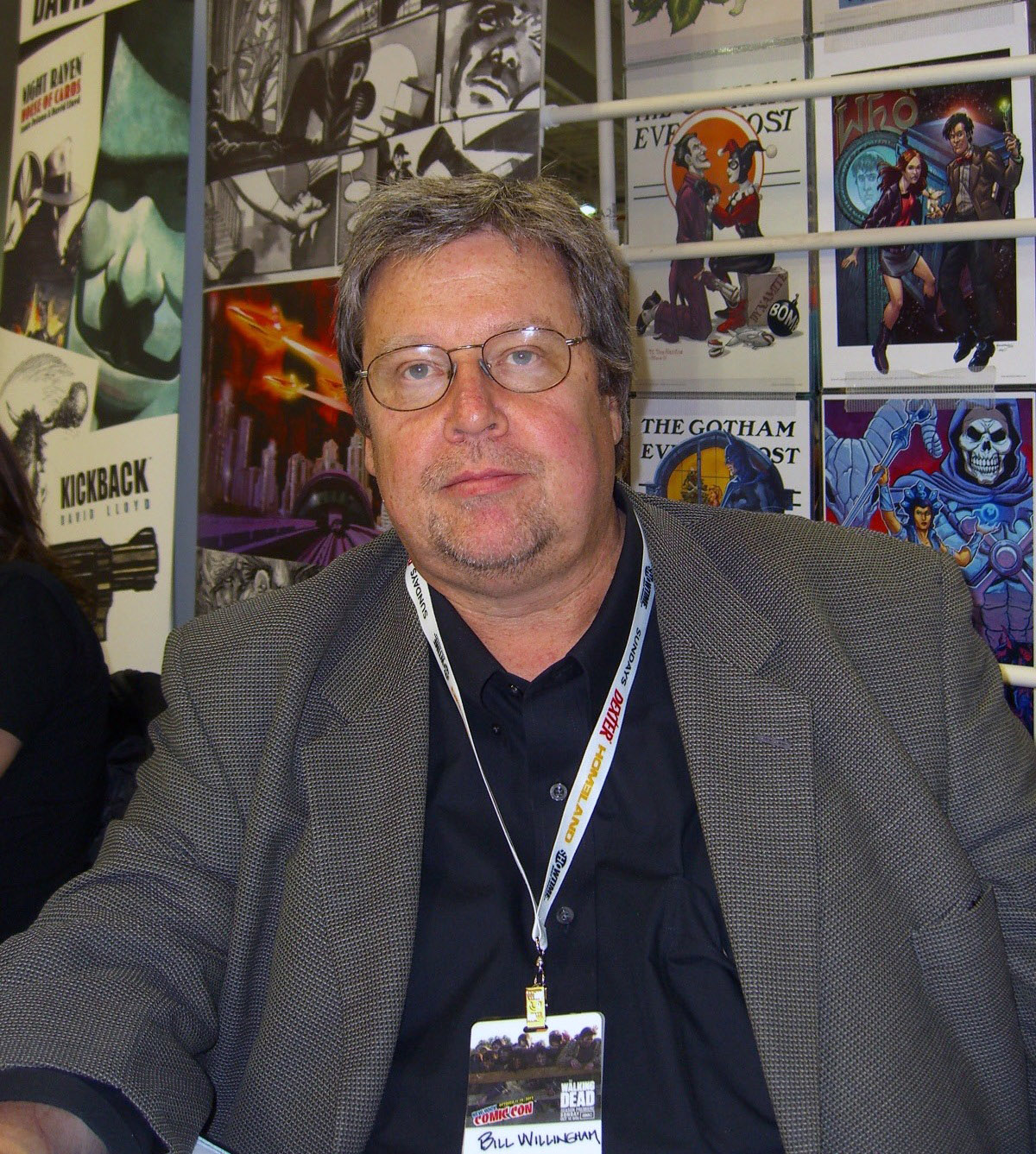
William Willingham (born 1956) is an American writer and artist of comics, known for his work on the series Elementals and Fables.

Key Information

Career

[edit]

William Willingham was born in Fort Belvoir, Virginia.[2] During his father's military career the family also lived in Alaska, California, and finally three years in Germany.[3] Willingham got his start from the late 1970s to early 1980s as a staff artist for TSR, Inc., where he illustrated a number of their role-playing game products. He was the cover artist for the AD&D Player Character Record Sheets, Against the Giants, Secret of Bone Hill, the Gamma World book Legion of Gold, and provided the back cover for In the Dungeons of the Slave Lords. He was an interior artist on White Plume Mountain, Slave Pits of the Undercity, Ghost Tower of Inverness, Secret of the Slavers Stockade, Secret of Bone Hill, Palace of the Silver Princess, Isle of Dread, The Mansion of Mad Professor Ludlow,[4] Food Fight,[5] In the Dungeons of the Slave Lords, the original Fiend Folio, Descent into the Depths of the Earth, Assault on the Aerie of the Slave Lords, Against the Giants, Queen of the Spiders, Realms of Horror, and the second and third editions of the Top Secret role-playing game. He also wrote and illustrated a couple of 1982 adventures for the game Villains & Vigilantes for Fantasy Games Unlimited, Death Duel with the Destroyers and The Island of Doctor Apocalypse.[6] Willingham also produced the alien race design artwork for the original Master of Orion video game.[7]

He first gained attention for his 1980s comic book series Elementals published by Comico, which he both wrote and illustrated; this series featured the Destroyers characters from his Villains & Vigilantes adventures as guest-stars.[6] He contributed stories to Green Lantern and started his own independent, black-and-white comic book series Coventry which lasted only 3 issues.[8] He also produced the pornographic series Ironwood for Eros Comix.

In the late 1990s, Willingham produced the 13-issue Pantheon for Lone Star Press and wrote a pair of short novels about the modern adventures of the hero Beowulf, and a fantasy novel Down the Mysterly River published by the Austin, Texas writer's collective, Clockwork Storybook, of which Willingham was a founding member. In the early 2000s, he began writing for DC Comics, including the limited series Proposition Player, a pair of limited series about the Greek witch Thessaly from The Sandman, and the series Fables.[9] In 2003, Fables won the Will Eisner Comic Industry awards for best serialized story and best new series.[10]

He describes himself as "rabidly pro-Israel" and says that Fables "was intended from the beginning" as a metaphor for the Israeli–Palestinian conflict, although he argues that Fables is not "a political tract. It never will be, but at the same time, it's not going to shy away from the fact that there are characters who have real moral and ethical centers, and we're not going to apologize for it."[11]

Willingham worked on the Robin series from 2004 to 2006, and established Shadowpact, a title spun off his Day of Vengeance limited series. He also wrote Jack of Fables, an ongoing spin-off of his Fables series, co-written by Lilah Sturges.[12] At the 2007 Comic Con International, he announced that he would be writing Salvation Run, a mini-series about supervillains who are banished to an inhospitable prison planet.[13][14] He handed over the writing to Sturges after two issues because of illness.[15] He worked on DCU: Decisions, a four-issue mini-series that deals with Green Arrow's endorsement of a political candidate.[16] Again with Sturges, he began writing the Vertigo series House of Mystery,[17] and DC's Justice Society of America with issue #29.[18][19]

In 2009, Willingham agreed to write for Angel by IDW Publishing, initiated a new storyline titled "Immortality for Dummies".[20]

In late 2010 (with cover dates January–April 2011), Willingham wrote the four-issue mini-series Warriors Three for Marvel Comics, illustrated by Neil Edwards.[21]

At 2013 New York Comic Con it was announced that Willingham would be writing a seven-part mini series for Dynamite Entertainment (with art by Sergio Fernandez Davila).[22] The series is Legenderry: A Steampunk Adventure and includes some of Dynamite's licensed and public domain characters in a steampunk setting. The series was released in January 2014, and a collected edition was published in January 2015.[23]

In September 2023, Willingham put his Fables series into the public domain after a dispute with DC Comics over publishing and media rights for Fables.[24] DC has since responded that Fables is wholly owned by them and the company will take appropriate action to protect its intellectual property.[25]

Works

[edit]

The issues listed include those where writing credits are for at least one story included in the issue.

Title Issue(s) Cover Dates Publisher
Justice Machine Annual #1 1983 Texas Comics
Elementals #1–23 1984 – March 1988 Comico
Justice Machine Featuring The Elementals #1–4 May–August 1986 Comico
Elementals Special #2 January 1989 Comico
Elementals vol. 2 #1–16
#18–22
March 1989 – May 1991
June 1991 – March 1992
Comico
Morningstar Special #1 1990 Comico
Time Wankers #4–5 April–August 1991 Fantagraphics
Ironwood #1–11 1991 Fantagraphics, Eros Comix imprint
Elementals: Sex Special #1 1991 Comico
Elementals: Ghost of a Chance #1 December 1995 Comico
Elementals: The Vampire's Revenge #2 August 1996 Comico
Coventry #1–3 November 1996 – July 1997 Fantagraphics
Mythography #2, #4 February, June 1997 Bardic Press
Pantheon #1–13 May 1998 – August/September 1999 Lone Star Press
Pantheon: Ancient History #1 August/September 1999 Lone Star Press
Flinch #7 December 1999 DC Comics, Vertigo imprint
Proposition Player #1–6 December 1999 May 2000 DC Comics, Vertigo imprint
The Dreaming #55 December 2000 DC Comics, Vertigo imprint
The Sandman Presents: Everything You Always Wanted To Know About Dreams... But Were Afraid To Ask #1 July 2001 DC Comics, Vertigo imprint
The Sandman Presents: The Thessaliad #1–4 March–June 2002 DC Comics, Vertigo imprint
Fables #1–162 July 2002 – May 2024 DC Comics, Vertigo imprint
X-Men Unlimited #49 August 2003 Marvel Comics
Batman: Legends of the Dark Knight #168 August 2003 DC Comics
Robin vol. 2 #121–147 February 2004 – April 2006 DC Comics
The Sandman Presents: Thessaly: Witch for Hire #1–4 April–July 2004 DC Comics, Vertigo imprint
Batman Vol. 1 #631–633, #643–644 October–December 2004, Early–Late October 2005 DC Comics
Day of Vengeance #1–6 June–November 2005 DC Comics
Day of Vengeance: Infinite Crisis Special #1 March 2006 DC Comics
Shadowpact #1–16 July 2006 – 2007 DC Comics
Jack of Fables #1–50 September 2006 – March 2011 DC Comics, Vertigo imprint
Fables: 1001 Nights of Snowfall 2006 DC Comics, Vertigo imprint
DCU Infinite Holiday Special #1 February 2007 DC Comics
Peter and Max: A Fables Novel 2009 DC Comics, Vertigo imprint
Justice Society of America (vol. 3) #29–40 2009–2010 DC Comics
Angel: Immortality for Dummies #28–32 2010 IDW Publishing
Warriors Three #1–4 January–April 2011 Marvel Comics
Legenderry: A Steampunk Adventure #1–7 2014 Dynamite Entertainment
Lark's Killer #1–10 2017–2018 1First Comics

References

[edit]
[edit]
Revisions and contributorsEdit on WikipediaRead on Wikipedia
from Grokipedia
William "Bill" Willingham (born December 22, 1956) is an American comics writer and artist recognized for his contributions to the industry spanning over four decades, particularly as the creator of the series Elementals and the award-winning Fables. Willingham launched his professional career in the 1980s with Elementals, a creator-owned superhero title published by First Comics that explored mature themes and garnered attention for its narrative depth. In 2002, he debuted Fables under DC Comics' Vertigo imprint, depicting fairy tale and folklore characters exiled to contemporary New York City following an invasion of their homelands, which blended fantasy, intrigue, and political allegory while earning fourteen Eisner Awards, including for Best New Series and Best Serialized Story. Other notable works include Coventry, Proposition Player, and contributions to DC titles like Shadowpact and Jack of Fables, a spin-off from his flagship series. In 2023, amid ongoing disputes with DC Comics involving delayed royalty payments, attempted contract alterations, and restrictions on completing the planned final , Willingham announced that he was irrevocably dedicating Fables—including its characters, spin-offs, and related properties—to the , citing his inability to litigate due to financial constraints and a philosophical stance favoring creator control for an initial period followed by public access. DC Comics countered that trademarks remain under their ownership and that copyrights for published materials were not affected by Willingham's unilateral declaration, asserting continued legal protections. This action highlighted tensions between creators and corporate publishers in the industry regarding rights.

Early Life and Background

Childhood and Formative Influences

William Willingham was born in December 1956 in , , to a shaped by his father's . The frequent relocations required by his father's career took the to locations including and , fostering an adaptable environment during Willingham's early years. These moves exposed him to diverse regional influences, though specific details on dynamics or worldview formation remain limited in available accounts. Willingham's initial engagement with storytelling emerged through popular media and school activities. As a young boy, he received comic books from his mother to occupy him during illnesses when she was at work, sparking an enduring fascination with the medium's narrative possibilities. He also enjoyed animated series such as The Rocky and Bullwinkle Show, which instilled an early appreciation for whimsical, adventure-driven tales blending humor and fantasy elements. By junior high school, Willingham began experimenting with , transforming a routine assignment into more imaginative out of boredom with its constraints. Lacking formal artistic training, he developed his skills as a self-taught draftsman and storyteller through personal hobbies, laying the groundwork for his later pursuits in without overlapping into professional endeavors. This period of informal practice emphasized narrative invention over structured education, influencing his affinity for reimagining archetypal stories in unconventional ways.

Entry into Comics

Willingham's initial forays into the comics field occurred in the late 1970s, when he traveled across the United States pitching story ideas and artwork to publishers in an effort to establish himself as both a writer and artist. Unable to break in immediately, he joined TSR, Inc., as a staff artist around 1980, where he illustrated role-playing game modules and advertisements, including comic-style ads for Dungeons & Dragons that appeared in Marvel Comics publications. This role provided practical training in sequential art and fantasy illustration, as Willingham later described using the position to improve his drawing abilities, which he felt were inadequate for direct comics work at the time. His motivations were rooted in a passion for fantasy narratives, honed through role-playing games, and admiration for illustrators like , whose dynamic depictions of mythic scenes influenced his style. While at TSR, Willingham collaborated with fellow artist Jeff Dee to propose a dedicated line to company founder , underscoring his ambition to blend RPG storytelling with the medium. Though the proposal did not materialize, this experience bridged his hobbyist interests—such as self-taught sketching and genre fiction consumption—to professional aspirations, culminating in early published contributions like backup stories for independent titles in the early 1980s.

Professional Career

Independent Publishing and Elementals (1980s–1990s)

In the early 1980s, during the rise of the comics publishing movement, Bill Willingham created and launched Elementals, a series incorporating fantasy and mythological elements, through Comico Comics, with the first issue released in November 1984. Willingham wrote the series and handled penciling and inking for most of its initial 23 issues, enabling him to maintain complete creative autonomy and introduce mature content such as , , and sexual themes to depict psychologically realistic characters. Comico exemplified an early creator-friendly model, granting Willingham ownership of the property and freedom from editorial oversight, which contrasted with the restrictive practices of major publishers at the time. This arrangement allowed rapid development of the storyline, often improvised with minimal advance planning, while fostering positive reader reception for its innovative approach to narratives. Despite these advantages, independent publishing posed logistical challenges, including initial frictions between Willingham and Comico over business operations rather than creative decisions, as both adapted to the nascent structures of non-corporate production. remained precarious amid reliance on direct sales and limited distribution, compounded by Comico's aggressive expansion attempts that strained resources without robust financial backing. As the progressed into the , Elementals continued its run through September 1988 for the initial volume, navigating the industry's contraction following the mid-decade speculative boom, during which Comico faced escalating financial woes leading to operational collapse. Willingham's multifaceted role evolved to incorporate guest artists like for select issues, reflecting adaptive strategies to sustain output under tightening market conditions.

Transition to Mainstream Publishers (1990s–2000s)

In the early 1990s, following the bankruptcy of Comico in 1991, Willingham shifted toward freelance opportunities while maintaining some independent projects. He wrote and illustrated the erotic series Ironwood, published by Eros Comix from 1991 to 1994, which explored themes of interstellar politics and sexuality through a centered on a young noblewoman's adventures. Concurrently, he launched Coventry, an independent black-and-white comic series under in 1992, depicting an alternate-history American state; the title ran for only three issues before concluding due to limited commercial success. These efforts highlighted Willingham's versatility in handling mature content with fewer restrictions than corporate environments imposed, allowing for unfiltered exploration of complex societal structures. Willingham began contributing to major publishers, marking his entry into mainstream editorial pipelines. For DC Comics, he scripted stories in the Green Lantern series during the 1990s, including contributions to the 1990 ongoing title that navigated the character's cosmic mythology and personal conflicts. His involvement extended to anthology-style work, such as appearances in Amazing Heroes Swimsuit Special from 1990 to 1993, which showcased pin-up art and short features to build industry visibility. Additionally, in the late 1990s, he wrote the 13-issue Pantheon for Lone Star Press (1998–1999), a superhero saga blending mythological elements, though the publisher's small scale offered relative creative latitude compared to larger entities. These gigs contrasted with his indie roots by introducing collaborative dynamics and deadline pressures, foreshadowing tensions over creative control in bigger studios. Parallel to comics, Willingham's illustration work for role-playing games bolstered his network. He provided artwork for TSR's modules and supplements throughout the 1990s, including character designs and interior illustrations that emphasized dynamic fantasy scenes, aiding connections within the gaming-comics crossover community before TSR's acquisition by in 1997. This diversified portfolio enhanced his reputation for reliable storytelling and visual flair, positioning him for expanded mainstream opportunities without fully relinquishing autonomous projects.

Fables Era and Vertigo/DC Collaboration (2002–2015)

Willingham pitched the concept for Fables to Vertigo editor Shelly Bond in 2002, drawing from an earlier, more complex idea he refined into a focused suitable for , leading to the series' debut in July 2002 under DC Comics' Vertigo imprint, known for mature-audience titles. The publishing arrangement positioned Fables as creator-owned property under Willingham, distinct from traditional work-for-hire models, though DC retained extensive publication and licensing controls as part of the Vertigo deal structure. Willingham served as the sole writer for the entire original run, which spanned 150 issues published monthly from July 2002 to July 2015, concluding with the oversized finale Fables #150: Farewell. He collaborated closely with penciler Mark Buckingham, who illustrated over 110 issues starting from early in the series, providing visual consistency amid occasional guest artists for specific arcs, while inkers like Steve Leialoha contributed to the production pipeline. Editorial oversight from Bond and DC/Vertigo ensured alignment with imprint standards, influencing pacing and thematic boundaries without overriding Willingham's creative direction on story outlines. Production milestones included annual specials, such as Fables #81 (2008), which expanded backstory elements, and crossovers like The Great Fables Crossover (2009–2010), a nine-issue event spanning Fables #83–85, Jack of Fables #33–35, and The Literals #1, coordinating multiple titles under Willingham's writing. Spin-offs emerged as extensions of the main series' production ecosystem, including Jack of Fables (2006–2011, co-written with Matthew Sturges) and Fairest (2011–2015), both approved and published by Vertigo to capitalize on the franchise's momentum while maintaining Willingham's oversight on interconnected elements. This era marked Willingham's most sustained output at DC, with the collaborative model enabling the series' longevity through scripted issues, variant covers, and collected editions that supported ongoing serialization.

Later Projects and Industry Shifts (2015–Present)

Following the conclusion of the main Fables series in July 2015, Willingham returned to DC Comics in 2021 for the six-issue miniseries Batman vs. Bigby! A Wolf in Gotham, published under the Black Label imprint, which crossed over elements from Fables with the Batman mythos in a noir-style murder investigation set in Gotham City. This project featured Bigby Wolf, the Fables character, clashing with Batman amid a string of killings tied to fairy-tale lore, marking Willingham's selective re-engagement with mainstream superhero publishing amid ongoing Fables-related developments. Willingham also contributed to planned Fables revivals under , including the delayed Fables: The Black Forest arc intended as a direct continuation, though production stalled due to contractual and logistical issues with the publisher. These efforts reflected broader industry trends post-2015, where mature reader imprints like Black Label aimed to retain creator-driven titles amid declining Vertigo-style prestige , even as digital platforms and streaming adaptations reshaped distribution and audience expectations for serialized graphic storytelling. Shifting away from corporate comics, Willingham pursued independent prose ventures, compiling and publishing short fiction collections such as The Complete Prose Works, Part Two in 2024 through Critical Blast Publishing, which included the supernatural thriller novella Comes the Hunter. This move aligned with a post-2015 surge in indie and options enabled by platforms like , where Willingham began serializing original stories and essays starting in 2023, bypassing traditional gatekeepers to reach readers directly amid comics' pivot toward creator-owned digital models and revivals. His commentary on industry evolution highlighted frustrations with major publishers' handling of creator rights and royalties, attributing shifts to a more adversarial environment that favored short-term corporate priorities over long-term collaborative storytelling.

Major Works

The Fables series depicts a clandestine community of immortal fairy tale characters, referred to as Fables, who fled their enchanted Homelands after a catastrophic by an enigmatic Adversary, an event that unified disparate mythical realms under conquest. These exiles now inhabit modern , with humanoid Fables blending into society in the hidden enclave of Fabletown while non-human ones reside at The Farm, a rural upstate property glamoured for secrecy. Leadership falls to figures like , who manages bureaucratic affairs as deputy mayor, and , the reformed serving as sheriff to enforce secrecy and resolve internal conflicts amid the strains of assimilation. The narrative unfolds through episodic tales that juxtapose folklore archetypes against contemporary urban life, incorporating elements like glamours to mask non-human traits and a strict mundy (non-Fable human) non-interference policy. Central arcs drive the overarching quest to liberate the Homelands. The "Homelands" storyline follows Boy Blue, a Fable operative, as he infiltrates the occupied territories using stolen artifacts like a cloak of invisibility and the Vorpal Sword to conduct espionage, recover fallen comrades' remains, and assess the Adversary's grip on conquered worlds, revealing the desolation of linked realms such as Kardan and The Rus. In "War and Pieces," the exiles mount a direct assault on the Empire, pitting Fable forces in strategic engagements against the Adversary's armies and emperor, with outcomes hinging on alliances, betrayals, and the mobilization of mythical weaponry. These arcs emphasize tactical espionage and warfare, highlighting the Fables' resource scarcity against a vast imperial foe. Related series expand character-focused narratives within the shared universe. tracks the opportunistic trickster Jack Horner following his expulsion from Fabletown for financial schemes, chronicling his cross-country exploits in the American heartland, encounters with rogue Fables, and confinement in the Golden Boughs Retirement Community—a prison for fading myths managed by the bureaucratic Mr. Revise, where disbelief erodes existence until societal forgetting completes erasure. Fairest spotlights female Fables' standalone adventures, beginning with Briar Rose's goblin abduction and evasion, and encompassing Rapunzel's isolated ordeals, Cinderella's detective pursuits amid Fabletown intrigue, and the Snow Queen's manipulative schemes, weaving horror, humor, and reinterpretations to uncover hidden backstories. The franchise's narrative approach features adversarial protagonists and pervasive moral ambiguity, where traditional heroes exhibit flaws like deceit, violence, and self-interest, diverging from binary ethics to portray ethical gray zones in , warfare, and personal vendettas among immortals bound by shared trauma yet divided by old rivalries. This structure allows exploration of causal consequences from mythical pasts clashing with mundane realities, without resolving tensions into simplistic victories.

Elementals and Early Creations

The Elementals series centers on four ordinary individuals—Tommy Czuchra (, earth), Rebecca Golden (, water), Jeff Murphy (Vortex, air), and Ginny (Morningstar, fire)—who perish in distinct tragedies and are subsequently resurrected by cosmic elemental entities as immortal avatars endowed with superhuman powers corresponding to their elements. These protagonists, operating primarily from , confront a panoply of supernatural adversaries, including ancient mystic forces like the entity and manifestations of primordial evil from the Shadowspear, which embody existential threats to humanity. The narrative delves into the psychological toll of their undeath, interpersonal dynamics strained by , and the moral imperatives of combating unalloyed evil, often integrating horror motifs such as grotesque transformations and existential dread. Willingham innovated within the superhero genre by foregrounding mature examinations of heroism's costs, including erotic undertones in power manifestations and a stark of good versus that predated similar deconstructions in mainstream titles. Experimental story arcs explored crossover integrations, such as the team's debut entanglement with the Justice Machine roster in a shared-universe event, allowing for expanded threat scales and character interactions across titles. Certain arcs, involving escalating cosmic conflicts and unresolved elemental lore, highlighted Willingham's ambition for serialized mythology but occasionally culminated in open-ended confrontations due to narrative pivots. Among other pre-Fables creations, Proposition Player (1999–2000) follows Joey Martin, a casino-employed gambler specializing in enlivening incomplete poker games, who impulsively acquires soul vouchers from patrons in a bar wager, thrusting him into a metaphysical governed by warring gods and demons. The plot analogizes high-stakes to fantasy mechanics, where players navigate chance, bluffing, and otherworldly pacts with souls as currency, underscoring themes of fate's capriciousness and human agency amid divine machinations. Similarly, Pantheon (1995–1998) depicts a cadre of superhuman protagonists, including figures like , in a sprawling epic of interdimensional warfare and personal sacrifice, where heroes volunteer for cataclysmic battles against chaos entities and would-be dominators, emphasizing intricate world-building and the fragility of mortal resolve in god-like conflicts. These works collectively showcase Willingham's penchant for blending mythological stakes with character-driven realism, prefiguring the layered fantasies of his later output.

Other Comics, Prose, and Adaptations

Willingham wrote and created the DC Comics miniseries in 2005, which led to the ongoing series from 2006 to 2008, assembling a team of antiheroes including characters like Nightmaster, Blue Devil, and Enchantress to combat magical threats in the . The series comprised 25 issues plus specials, emphasizing ensemble dynamics amid demonic incursions and infernal wars. He produced the adult-oriented fantasy series for Eros Comix, running 16 issues from 1991 to 1994, featuring a medieval setting with explicit content centered on themes of adventure, intrigue, and sensuality involving a young navigating a corrupt empire. Additional standalone comics include contributions to titles like Salvation Run in 2008, from which he withdrew due to health issues after initial issues. In prose, Willingham published the middle-grade fantasy novel Down the Mysterly River in 2011, following Boy Scout Max "the Wolf" Baker and anthropomorphic companions through a perilous, allegorical quest blending adventure and self-discovery elements. He has also penned short stories such as "Fearless Space Pirates of the Outer Rings," "Comes the Hunter," and "The Short Unhappy Life of Gully Foyle," compiled in personal collections shared via his in 2025, often exploring speculative themes outside comics format. Early career ties to role-playing games include artwork for TSR's modules, providing covers and illustrations for titles like (1981) and Secret of Bone Hill (1981), influencing his transition into fantasy illustration and narrative design. Adaptation efforts for non-core works have been limited; saw unproduced pitches for animated or live-action exploration in the 1990s, but no developments materialized by 2025 due to content sensitivities. Prose pieces like Down the Mysterly River received interest for family-oriented screen versions, yet remained undeveloped as of October 2025.

Reception and Legacy

Critical Acclaim and Awards

Fables, Willingham's signature series launched in 2002, garnered significant recognition within the comics industry, securing 14 across categories such as Best New Series in 2003, Best Ongoing Series in 2006 and 2007, and Best Writer for Willingham in 2009. The series also received multiple nominations for the for Best Graphic Story, including for volumes such as War and Pieces (2008), The Dark Ages (2010), and Rose Red (2012), highlighting its appeal to and fantasy audiences. These accolades underscored Fables' commercial viability, as the series sustained strong direct market sales, with trade paperback collections like Fables Vol. 17: Inherit the Wind moving over 14,000 units in 2012 through comic shops alone. Running for 150 issues until 2015, supplemented by spin-offs such as Jack of Fables and Fairest, it demonstrated enduring reader engagement and influenced subsequent urban fantasy comics by popularizing the reinterpretation of public-domain fairy tale characters in contemporary, politically layered narratives. Critics have noted its role in elevating mature fairy tale adaptations, blending myth with real-world intrigue to appeal to adult audiences. Willingham's earlier works, including Elementals, received more niche praise but lacked comparable award traction, with acclaim centering on his innovative superhero rather than broad industry honors. Overall, Fables' awards and metrics positioned Willingham as a key figure in Vertigo's golden era, contributing to the imprint's reputation for sophisticated genre storytelling.

Criticisms and Debates on Style and Themes

Critics have pointed to inconsistencies in pacing within Fables, noting that Willingham's storytelling often suffers from uneven structure, with arcs that drag through filler before abrupt resolutions. For instance, after over 75 issues, some reviewers argued that the series declined into meandering plots lacking the initial coherence, exemplified by prolonged subplots in later volumes that failed to advance core conflicts effectively. Similar complaints arose regarding unresolved elements, such as the anticlimactic handling of major threats in arcs like the war against the Adversary, where buildup exceeded payoff and left lingering questions about character motivations. In Elementals, plot critiques centered on filler episodes disrupting momentum, particularly issues 23–29 of the first volume, which consisted of one-shot stories with minimal ties to the overarching narrative of supernatural threats and team dynamics. These interruptions, compounded by scheduling delays, contributed to perceptions of fragmented continuity, though direct authorial flaws were less emphasized than publisher instability. Debates on character development in Fables highlight flaws in depth and consistency, with fans and artists observing that while archetypes like start with compelling moral ambiguities, later reduce them to repetitive tropes without sufficient evolution. Some critiques note digressions into isolated character spotlights that prioritize stylistic flourishes over relational growth, leading to underdeveloped supporting casts amid the expansive ensemble. Thematic discussions often revolve around perceived conservative and libertarian undertones, such as the emphasis on pragmatic and hierarchical order among the exiled Fables, contrasting with critiques of collectivist or idealistic governance. In arcs like "," interpreters have identified a against progressive academic or institutional overreach, portraying animal characters' rebellion as a of unchecked equality devolving into tyranny. Worldbuilding elements, including fairy-tale figures adapting through cunning and personal agency in a modern setting, have been read as endorsing survivalist over communal reforms, though Willingham's integration of these ideas draws mixed responses from those viewing them as ideological imposition rather than neutral reinterpretation. These interpretations remain contested, with some attributing them to the series' satirical edge rather than explicit advocacy.

Controversies

Dispute with DC Comics over Fables Rights

In the years following the conclusion of the main Fables series in 2015, Bill Willingham alleged multiple breaches of contract by DC Comics, including failures to consult him on artistic decisions such as cover artists and formats, as well as delayed and underreported royalty payments that required him to pursue recovery of amounts like $30,000. DC reportedly attributed some lapses to administrative oversights described as "fell through the cracks," a phrase Willingham later prohibited via email in communications with the publisher. A significant point of contention involved DC's licensing of Fables intellectual property to third parties without adequate compensation or input from Willingham, notably the 2013–2014 deal with for video game adaptation, where characters and storylines were altered without his approval. Post-release, DC allegedly reneged on promised payments related to the Telltale project, instead offering Willingham a reduced "consulting " contingent on signing a , which he rejected. Willingham further claimed DC admitted in internal discussions to interpreting their publishing agreement as granting them unrestricted authority to modify the property, including licensing deals that bypassed his oversight. During negotiations for a potential 20th anniversary revival of Fables in 2021–2023, DC sought to structure new issues as work-for-hire arrangements, which would transfer ownership of those works to the publisher, contrary to the original contract's terms preserving Willingham's sole holder status. Willingham resisted, asserting in communications that he retained full rights while granting DC only exclusive publishing privileges, a position rooted in the initial agreement signed around 2002. DC retracted the work-for-hire demand after pushback but proceeded with a limited 12-issue service contract, amid Willingham's repeated offers to renegotiate or mutually terminate the deal, which went unaddressed. DC Comics countered Willingham's ownership assertions by maintaining joint rights under their ongoing contracts, denying breaches that would forfeit their publishing exclusivity and challenging any unilateral actions affecting the property. According to Willingham, DC's legal team dismissed his grievances by suggesting litigation as the sole recourse and blocked escalations to higher corporate levels, while attempting to reinterpret agreements to assert broader control over Fables derivatives. These exchanges highlighted divergent contract interpretations, with Willingham viewing DC's actions as systemic violations eroding creator protections, though DC upheld the validity of their exclusive rights without publicly detailing specific rebuttals to the alleged breaches. On September 15, 2023, Bill Willingham announced via his newsletter that he had irrevocably placed the Fables comic book property, including all related spin-offs and characters, into the . He stated this action was taken in response to perceived mistreatment by DC Comics under their publishing agreement, though he emphasized the declaration applied specifically to the underlying elements he controlled. DC Comics promptly disputed the validity of Willingham's declaration in a statement released on September 18, 2023, asserting that Fables remained under their control due to work-for-hire provisions in the original contracts, which vested ownership of the published works with the publisher. The company clarified that it retained rights to reprint existing Fables collections and stories, and warned that unauthorized uses could infringe on trademarks or other protected elements. As of October 2025, DC continues to exercise control over reprints and licensing, with no published works entering the and no formal litigation initiated to resolve the dispute. The declaration has sparked discussions on creators' rights in the comics industry, highlighting tensions between unilateral copyright relinquishment and contractual obligations in work-for-hire arrangements. Willingham encouraged fan and independent adaptations of Fables elements, but DC's position has deterred widespread exploitation, leaving the legal status of works ambiguous pending potential clarification through office rulings or court decisions. This aftermath underscores ongoing uncertainties in dedication, particularly for collaborative media where multiple stakeholders hold competing claims.

Views on Industry and Politics

Perspectives on Comics Industry Practices

Willingham has long advocated for creator ownership models in comics, emphasizing arrangements where artists and writers retain rights rather than ceding them to publishers under work-for-hire terms common in mainstream companies. His early series Elementals, launched in through the independent publisher Comico, exemplified this approach, allowing him full creative control as both writer and artist while distributing through direct market channels that bypassed traditional corporate oversight. This indie model contrasted sharply with dominant industry practices at major publishers like DC and Marvel, where creators often face diluted control and perpetual licensing dependencies, a dynamic Willingham has critiqued as prioritizing corporate longevity over individual innovation. In observations spanning the 2000s to 2020s, Willingham highlighted trends in editorial interference and contract enforceability, noting how publishers increasingly reinterpret agreements to exert post-publication influence, such as demanding unconsulted changes to artwork or delaying royalty disbursements under vague pretexts. He argued that such practices erode trust and stifle creativity, with contracts—intended as binding protections—frequently undermined by institutional resources favoring large entities over individual creators. These issues, drawn from decades of negotiations, underscore his view that mainstream publishers' overreach hampers the medium's vitality compared to self-published or creator-driven indie efforts. Willingham supports placing works into the after limited protection periods as a counter to monopolistic IP retention, proposing reforms like 20 years of creator exclusivity followed by to prevent corporate hoarding that benefits few at culture's expense. He described existing frameworks as "a mishmash of unethical backroom deals" designed to entrench corporate control, advocating shorter terms—maximum 30 years total—to foster broader reuse and innovation without perpetual lockups. This stance positions dedication as a strategic tool for creators to reclaim agency against entrenched publisher dominance.

Political and Philosophical Stances

Bill Willingham has expressed right-leaning political positions, including a critique of in superhero narratives, advocating for a return to characters embodying "loftier ideals" and an "unshakable " rather than "grim and gritty" anti-heroes. In a 2009 essay, he referenced conservative commentator Rush Limbaugh's pledge to avoid decadent media and positioned America as a historical force for good, aligning with traditionalist views on heroism and national exceptionalism. During a 2015 Gen Con panel titled "Writing Women Friendly Comics," Willingham challenged concepts of systemic privilege, stating, "I don’t think being a white dude is a " and rejecting it as a disqualification for creating diverse stories, while questioning whether hiring should prioritize "the best female that’s available or just any female." He emphasized merit-based over identity-driven mandates, bristling at the notion that cultural appropriation inherently harms narratives, arguing instead that poor execution determines quality. These remarks prioritized individual competence and traditional authorship over enforced representation, drawing accusations of insensitivity from progressive critics, including comic retailers who boycotted his works citing and . Philosophically, Willingham exhibits libertarian inclinations, favoring pragmatic hierarchies and skepticism toward utopian ideals, as reflected in his works' synthetic reimagining of through individual agency and survivalist realism. His 2023 declaration placing Fables into the underscored a commitment to free expression and reform, critiquing perpetual corporate monopolies under current laws: "Fables has been my baby for about twenty years now. It’s time to let it go," proposing instead limited creator exclusivity (20-30 years maximum) to prevent exploitation by large entities like DC Comics, which he accused of contractual breaches. This act aimed to empower public creativity over proprietary control, countering narratives of benevolent corporate stewardship in media.

References

Add your contribution
Related Hubs
User Avatar
No comments yet.