Recent from talks
Nothing was collected or created yet.
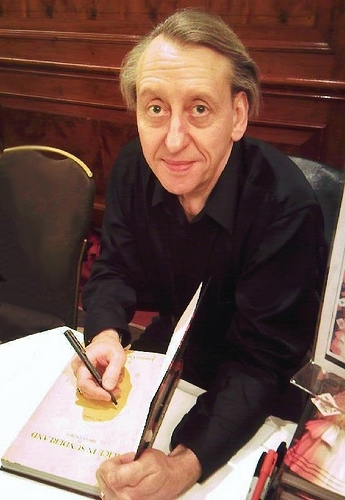
Bryan Talbot
View on Wikipedia
Bryan Talbot (born 24 February 1952) is a British comics artist and writer, best known as the creator of The Adventures of Luther Arkwright and its sequels Heart of Empire and The Legend of Luther Arkwright, as well as the Grandville series of books. He collaborated with his wife, Mary M. Talbot to produce Dotter of Her Father's Eyes, which won the 2012 Costa biography award.[1]
Key Information
Early life
[edit]Bryan Talbot was born in Wigan, Lancashire,[2] on 24 February 1952.[3] He attended Wigan Grammar School, the Wigan School of Art, and Harris College in Preston, Lancashire, from which he graduated with a degree in Graphic Design.[4]
Career
[edit]Talbot began his comics work in the underground comix scene of the late 1960s. In 1969 his first work appeared as illustrations in Mallorn, the British Tolkien Society magazine,[5] followed in 1972 by a weekly strip in his college newspaper. He continued in the scene after leaving college, producing Brainstorm Comix, the first three of which formed The Chester P. Hackenbush Trilogy, a character reworked by Alan Moore as Chester Williams for Swamp Thing.[6]
Talbot started The Adventures of Luther Arkwright in 1978. It was originally published in Near Myths and continued on over the years in other publications, including Pssst! and by the publisher Valkyrie Press. It was eventually collected into one volume by Dark Horse Comics. Along with Raymond Briggs' When the Wind Blows, it is considered one of the first British graphic novels.[citation needed] In the early-to-mid 1980s Talbot provided art for some of 2000 AD's flagship serials, producing three series of Nemesis the Warlock, as well as occasional strips for Judge Dredd.
Talbot moved to the U.S. market in the 1990s and principally worked for DC Comics on titles such as Hellblazer,[7] Batman: Legends of the Dark Knight, and Dead Boy Detectives. Talbot collaborated with Neil Gaiman on The Sandman and provided art for the "Fables & Reflections", "A Game of You", and "Worlds' End" story arcs.[8][9] His The Tale of One Bad Rat (1994) deals with a girl's recovery from childhood sexual abuse. He drew The Nazz limited series which was written by Tom Veitch and worked with Tom's brother Rick Veitch on Teknophage, one of a number of mini-series he drew for Tekno Comix. Talbot has illustrated cards for the Magic: The Gathering collectible card game. He has illustrated Bill Willingham's Fables,[10] as well as returning to the Luther Arkwright universe with Heart of Empire.
In 2006, he announced the graphic novel Metronome, an existential, textless erotically charged visual poem,[11][12] written under the pseudonym Véronique Tanaka.[13] He admitted that he was the author in 2009.[14] Talbot turned down an offer to appear in character as Tanaka for an in-store signing of the work.[15]
In 2007 he released Alice in Sunderland, which documents the connections between Lewis Carroll, Alice Liddell, and the Sunderland and Wearside area.[16] He wrote and drew the layouts for Cherubs!, which he describes as "an irreverent fast-paced supernatural comedy-adventure."[17]
In 2019 it was reported that Talbot was producing the third installment in the Arkwright series, titled The Legend of Luther Arkwright,[18] which was published by Dark Horse in 2022.
In April 2024, it was announced that Talbot will be inducted into the Will Eisner Comic Awards Hall of Fame, the highest accolade for comic writers and artists from across the world.[19]
Awards and recognition
[edit]- 1985 Eagle Award for Favourite Character for Torquemada, from Nemesis the Warlock [20]
- 1988:
- Eagle Award for Favourite Artist (British)[21]
- Eagle Award for Favourite New Comic, for The Adventures of Luther Arkwright
- Eagle Award for Favourite Character (UK), for Luther Arkwright
- Eagle Award for Favourite Comic Cover, for The Adventures of Luther Arkwright
- 1989 Society of Strip Illustration Mekon Award for "Best British Work" for The Adventures of Luther Arkwright[22][23]
- 1995 UK Comic Art Award for Best New Publication for The Tale of One Bad Rat
- 1996 Eisner Award for Best Graphic Album: Reprint, for The Tale of One Bad Rat
- 1999 Haxtur Award, for Best Long Comic Strip for The Tale of One Bad Rat
- 2000 Inkpot Award[24]
- 2007:
- BSFA Award nominee, Best Novel, for Alice in Sunderland
- Nominated for "Award for Favourite Comics Writer/Artist" Eagle Award[25]
- Nominated for "Favourite Original Graphic Novel" Eagle Award, for Alice in Sunderland
- 2008: Nominated for "Best Painter or Multimedia Artist (interior art)" Eisner Award.[26]
- 2009 Talbot was given an Honorary Doctorate of Arts by University of Sunderland in July 2009, the first time this has been done for a comic book artist.[27]
- 2010: Nominated for "Favourite Original Graphic Novel Published During 2009" Eagle Award for Grandville
- 2012:
- Talbot was awarded an Honorary Degree of Doctor of Letters on 17 July 2012 by Northumbria University in recognition of his lifetime's work in the graphic novel field.[28]
- Winner of the Costa biography award for Dotter of Her Father's Eyes, with Mary Talbot.[1]
- Prix SNCF for "Best Bande Dessinée 2012" for Grandville Mon Amour[29]
- 2014: Guest of honor at NordicFuzzCon.
- 2018: Elected a Fellow of the Royal Society of Literature.[30]
Bibliography
[edit]2000 AD
[edit]Tharg's Future Shocks
[edit]- "The Wages of Sin" (with Alan Moore, in 2000 AD No. 257, 1982)
Ro-Busters
[edit]- Ro-Busters: "Old Red Eyes is Back" (with Alan Moore, in 2000AD Annual 1983, 1982)
Nemesis the Warlock
[edit]- "The Gothic Empire (Book IV)" (in 2000 AD No. 390–406, 1984–1985)
- "Vengeance of Thoth (Book V)" (in 2000 AD No. 435–445, 1985)
- "Torquemurder (Book VI)" (in 2000 AD No. 482–487 and 500–504, 1986–1987)
- Torquemada: "The Garden of Alien Delights" (with Pat Mills, in Diceman No. 3, 1986)
Sláine
[edit]- "The Time Killer" (with Pat Mills, in 2000 AD No. 431, 1985)
Judge Dredd
[edit]- "House of Death" (with John Wagner/Alan Grant, in Diceman No. 1, 1986)
- "Last Voyage of the Flying Dutchman" (with John Wagner/Alan Grant, in 2000 AD No. 459, 1986)
- "Judge Dredd and the Seven Dwarves" (with John Wagner/Alan Grant, in Judge Dredd Annual 1987, 1986)
- "Ladies' Night" (with John Wagner/Alan Grant, in 2000AD Annual 1987, 1986)
- "Caterpillars" (script by Michael Carroll, coloured by Alwyn Talbot, in 2000 AD No. 1730, April 2011)
Enemy Alien
[edit]- "Enemy Alien" (with script and pencils Mike Matthews, in 2000AD Sci-Fi Special 1987)
Memento
[edit]- "Memento" (in 2000 AD Prog 2002, 2001)
Ad Astra
[edit]- Frank Fazakerly, Space Ace of the Future (October 1978 - September 1981)[2]
Avatar Press
[edit]- Nightjar (with Alan Moore, in Alan Moore's Yuggoth Cultures and Other Growths No. 1, Avatar Press, 2003)
Brainstorm Comix
[edit]Chester P. Hackenbush, the Psychedelic Alchemist
[edit]- "Out of the Crucible", in Brainstorm Comix #1 (Alchemy, 1975)
- "From Here to Infinity", in Brainstorm Comix #2 (Alchemy, 1976)
- "A Streetcar Named Delirium", in Brainstorm Comix #4 (Alchemy, 1977)
Amazing Rock'n'Roll Adventures
[edit]- "The Omega Report", in Brainstorm Comix #6 (Alchemy, 1978)
Dark Horse Comics
[edit]- The Tale of One Bad Rat (1995, ISBN 1-56971-077-5)
DC Comics/Vertigo
[edit]- Hellblazer Annual No. 1 (written by Jamie Delano, 1989)
- The Nazz (written by Tom Veitch, issue #1 coloured by Steve Whittaker and issues #2-4 coloured by Les Dorscheid, 1990 - 1991)
- Batman: Dark Legends (reprints Batman: Legends of the Dark Knight No. 39 – 40, 50, 52 – 54, 1996, ISBN 1-85286-723-X)
The Sandman
[edit]- The Song of Orpheus (in Sandman Special 1, inks by Mark Buckingham, coloured by Daniel Vozzo, 1991)
- A Game of You (DC Comics, 1991–1992, ISBN 1-56389-089-5 )
- Fables and Reflections (DC Comics, 1991–1993, ISBN 1-56389-105-0 )
- Worlds' End (DC Comics, 1993, ISBN 1-56389-170-0)
- The Dreaming No. 9–12 (writer, with artists Dave Taylor (No. 9) and Peter Doherty (No. 10–12), DC Comics, February–May 1997)
- The Dead Boy Detectives (with Ed Brubaker, Vertigo, four-issue mini-series, 2001)
Shade, the Changing Man
[edit]- The Santa Fe Trail (written by Peter Milligan, inks by Mark Pennington, coloured by Daniel Vozzo, August 1991)
Fables
[edit]- Bag o’Bones (with Bill Willingham, Vertigo, 2004, ISBN 1-4012-0256-X)
Desperado Publishing
[edit]- Cherubs! (with Mark Stafford, graphic novel, 104 pages, Desperado Publishing, November 2007, ISBN 0-9795939-9-9)
Jonathan Cape
[edit]- Alice in Sunderland (graphic novel, Jonathan Cape, April 2007, ISBN 978-0-224-08076-7)
- Dotter of Her Father's Eyes (written by Mary M. Talbot, 2012)
- Sally Heathcote: Suffragette ( written by Mary Talbot, lettering, layouts and rough pencils by Bryan, finished artwork by Kate Charlesworth, 2014)
- The Red Virgin and the Vision of Utopia (written by Mary M. Talbot, 2016)
- Rain (Graphic Novel) (written by Mary M. Talbot, 2019)
Grandville
[edit]- Grandville (graphic novel, 104 pages, November 2009)
- Grandville Mon Amour (graphic novel, 104 pages, December 2010)
- Grandville Bête Noire (graphic novel, 104 pages, December 2012)
- Grandville: Nöel (graphic novel, Jonathan Cape, November 2014)
- Grandville: Force Majeure (graphic novel, Jonathan Cape, November 2017)
Luther Arkwright
[edit]- The Papist Affair (in The Mixed Bunch 1, 1976)
- The Adventures of Luther Arkwright (various publishers: 1978–1989, ISBN 1-56971-255-7)
- For A Few Gallons More (with Chris Welch, in Moon Comics 3, 1979 Street Comics)
- The Fire Opal of Set (in Imagine 14, 1984 TSR UK Ltd)
- Heart of Empire: Or the Legacy of Luther Arkwright (Dark Horse Comics, nine-issue limited series, 1999, ISBN 1-56971-567-X)
- The Legend of Luther Arkwright (Dark Horse Books, 2022, ISBN 9-781-50673-647-1)
Moonstone Books
[edit]- The Naked Artist: Comic Book Legends. Calumet City, Illinois: Moonstone Books. 2007. ISBN 978-1-933076-25-6.
NBM Publishing
[edit]- The Art of Bryan Talbot (96 pages, NBM Publishing, December 2007, ISBN 1-56163-512-X)
- Metronome (as Véronique Tanaka,[14] 64 pages, NBM Publishing, May 2008, ISBN 1-56163-526-X)
Sounds
[edit]- Scumworld (credited to The Crabs from Uranus, 1983 – 1984)
Tekno Comix
[edit]- Neil Gaiman’s Mr. Hero the Newmatic Man (Issue #1, six pages pencils and inks, written by Rick Veitch, coloured by Angus McKie, 1995)
- Neil Gaiman’s Mr. Hero the Newmatic Man (Issue #2, five pages, inked by Angus McKie (1995, Tekno Comix Written by Rick Veitch, coloured by Angus McKie, 1995)
- Neil Gaiman’s Wheel of Worlds one shot, 11 pages (1995, Tekno Comix, written by Rick Veitch, coloured by Angus McKie,)
- Neil Gaiman's Teknophage (pencils only, written by Rick Veitch, Issues #1-6, 1995-1996)
- Neil Gaiman's Phage: Shadow Death (script, with pencils by David Pugh and inks by Tim Perkins, six-issue limited series, Tekno Comix, June–November 1996)
Other
[edit]- Superharris with Bonk in Hac, Harris College's Student Newspaper 1971 - 1972)
- Brainworms (script by Matthias Schultheiss, in Crisis presents the Second Xpresso Special, 1991)
References
[edit]- ^ a b "Hilary Mantel wins 2012 Costa novel prize". BBC News. 2 January 2013. Archived from the original on 13 April 2014. Retrieved 2 January 2013.
- ^ a b Ó Méalóid, Pádraig (1 October 2009). "The road from Wigan Pier: Bryan Talbot talks with Pádraig Ó Méalóid, part one". Forbidden Planet. Archived from the original on 28 June 2013. Retrieved 13 April 2014.
- ^ Miller, John Jackson (10 June 2005). "Comics Industry Birthdays". Comics Buyer's Guide. Iola, Wisconsin. Archived from the original on 18 February 2011.
- ^ "Bryan Talbot: biography". The Official Bryan Talbot website. n.d. Archived from the original on 4 March 2014. Retrieved 11 March 2012.
- ^ "Bryan Talbot". Lambiek Comiclopedia. 2012. Archived from the original on 14 October 2012.
- ^ Whitson, Roger (Winter 2007). "Engraving the Void and Sketching Parallel Worlds: An Interview with Bryan Talbot". ImageTexT. Archived from the original on 15 December 2012.
- ^ Irvine, Alex (2008). "John Constantine Hellblazer". In Dougall, Alastair (ed.). The Vertigo Encyclopedia. London, United Kingdom: Dorling Kindersley. pp. 102–111. ISBN 978-0-7566-4122-1. OCLC 213309015.
- ^ Bender, Hy (1999). The Sandman Companion. New York City: DC Comics. pp. 266–270. ISBN 978-1563894657.
- ^ Burgas, Greg (7 January 2013). "Comics You Should Own – Sandman". Comic Book Resources. Archived from the original on 10 April 2014.
- ^ Irvine, "Fables" in Dougall, pp. 72–81
- ^ "A Graphic Poem..." Down The Tubes. 16 July 2006. Archived from the original on 24 July 2008.
- ^ Johnston, Rich (17 July 2006). "Lying in the Gutters Volume 2 Column 61". Comic Book Resources. Archived from the original on 27 September 2008.
- ^ Ó Méalóid, Pádraig (2 October 2009). "Rabbit Holes, Detective Badgers, and Cherubs Part Two of Bryan Talbot's Interview with Pádraig". Forbidden Planet. Archived from the original on 28 June 2013. Retrieved 13 April 2014.
- ^ a b Gordon, Joe (14 April 2009). "Shaved her leg and then he was a she". Forbidden Planet. Archived from the original on 22 July 2012. Retrieved 13 April 2014.
- ^ Holland, Stephen (2009). "Talbot Unmasked". Metronome.shadowgallery.co.uk. Archived from the original on 13 April 2014.
It's a shame you never came to sign here, as I suggested at the time, in high heels, wig and lipstick.
- ^ Robertson, Ross (27 March 2007). "News focus: Alice in Pictureland". Sunderland Echo. Archived from the original on 2 April 2007. Retrieved 29 March 2007.
- ^ Gravett, Paul (2007). "Bryan Talbot: An Artistic Wonder From Wearside". Paul Gravett. Archived from the original on 24 October 2007.
- ^ Johnston, Rich (21 August 2009). "After Twenty Years, Bryan Talbot Returns With 'The Legend of Luther Arkwright'". Bleeding Cool. Archived from the original on 9 August 2020. Retrieved 29 December 2020.
- ^ Leatherdale, Duncan (7 April 2024). "Bryan Talbot: The comics legend lurking in a Sunderland basement". BBC News. Retrieved 8 April 2024.
- ^ "Eagle Awards Previous Winners 1985". Eagle Awards. 2013. Archived from the original on 23 October 2013.
- ^ "Eagle Awards Previous Winners 1988". Eagle Awards. 2013. Archived from the original on 23 October 2013.
- ^ Johnston, Rich. "After Twenty Years, Bryan Talbot Returns With 'The Legend of Luther Arkwright'," Bleeding Cool (August 21, 2019).
- ^ Freeman, John. "Timelord Talbot!", DownTheTubes.net (29 July 2012).
- ^ "Inkpot Award Winners". Hahn Library Comic Book Awards Almanac. Archived from the original on 9 July 2012.
- ^ "Eagle Awards Previous Winners 2008". Eagle Awards. 2013. Archived from the original on 23 October 2013.
- ^ Brady, Matt (14 April 2008). "2008 Eisner Award Nominees Named". Newsarama. Archived from the original on 25 January 2009.
- ^ "University honour for comic book artist". Sunderland Echo. 18 July 2009. Archived from the original on 29 August 2012.
- ^ "Honour for ground-breaking writer and artist". Northumbria University. 17 July 2012. Archived from the original on 28 July 2012.
- ^ Freeman, John (4 June 2012). "Bryan Talbot scoops SNCF Award for Grandville Mon Amour". DownTheTubes.net.
- ^ "Talbot, Bryan". Royal Society of Literature. 1 September 2023. Retrieved 27 June 2025.
External links
[edit]- Official site
- Bryan Talbot at the Comic Book DB (archived from the original)
- Bryan Talbot at the Grand Comics Database
- Bryan Talbot at Mike's Amazing World of Comics
- "Memento" and "From Homogenous to Honey", free online comics by Talbot
- The Moorcock Effect Archived 1 November 2010 at the Wayback Machine by Bryan Talbot, Heliotrope 5, 2008
Interviews
[edit]- British Comics Month – Bryan Talbot speaks, Forbidden Planet, 26 July 2006
- Curioser and curioser – Bryan draws on Alice, Sunderland Echo, 17 March 2008
Bryan Talbot
View on GrokipediaEarly life
Childhood and family background
Bryan Talbot was born on 24 February 1952 in Wigan, Lancashire.[1] As the only child of working parents—a coal miner father and a hairdresser mother—he spent much of his early years in relative solitude, engaging in solitary play with toys or viewing programming on a small black-and-white television set.[5][6] Talbot's family environment fostered nascent artistic inclinations, with his mother's practice of sketching hairstyles for clients and his father's hobby of watercolour painting providing early exposure to creative expression and encouragement for his own drawing pursuits.[3] From a young age, he consumed British nursery comics such as Jack and Jill, which contributed to his developing interest in illustrated storytelling amid the industrial backdrop of post-war Wigan.[5]Education and formative influences
Talbot attended Wigan Grammar School before pursuing art studies at the Wigan School of Art, where he spent one year but reported learning little from instructors focused on abstract art.[7] He then transferred to Harris College (now part of the University of Central Lancashire) in Preston, Lancashire, graduating in the early 1970s with a Diploma in Graphic Design; he was the first in his family to receive higher education.[1][3] Talbot's formal education provided limited practical instruction in representational drawing, as he later described being poorly served by teachers at both grammar school and art college, prompting extensive self-study using library books on anatomy, perspective, and techniques.[8] This autodidactic approach shaped his foundational skills, compensating for what he viewed as deficiencies in institutional training.[7] Key formative influences included 1960s Marvel Comics, particularly the dynamic artwork of Jack Kirby, as well as later artists like Jim Steranko, Jim Starlin, and Barry Smith, whose innovative styles inspired his early interest in sequential art.[6] The 1967 publication The Penguin Book of Comics, which analyzed the medium's history and potential, proved pivotal in recognizing comics' narrative depth beyond juvenile entertainment.[9] Additionally, 1960s cinema from directors such as Sam Peckinpah and Nicholas Roeg influenced his visual storytelling sensibilities, emphasizing dramatic pacing and psychological realism that would inform his mature graphic novel work.[10]Professional career
Underground and early independent work
Talbot's initial forays into comics occurred in the late 1960s, with his first published illustrations appearing in Mallorn, the magazine of the British Tolkien Society, in 1969.[1] By 1972, he contributed a weekly strip to his college newspaper, honing his skills amid the burgeoning British comics fandom.[11] These early efforts laid the groundwork for his immersion in the underground comix scene, where he embraced countercultural themes and experimental storytelling during the mid-1970s.[8] From 1975 to 1978, Talbot created, wrote, and drew the Brainstorm Comix series, published by the small independent Alchemy Press.[1] This anthology featured predominantly original British content by Talbot, including the hallucinatory Chester P. Hackenbush trilogy—"A Streetcar Named Delirium"—which explored drug-fueled narratives and psychedelic visuals characteristic of underground comix.[12] Issue 3, released in 1977, continued this storyline and introduced Talbot's enduring character Luther Arkwright in the short "The Papist Affair," blending parallel worlds and political intrigue.[13] Brainstorm represented Talbot's five-year commitment to the underground medium, pushing boundaries against mainstream conventions with dense, adult-oriented tales.[1] Transitioning to early independent work, Talbot serialized The Adventures of Luther Arkwright starting in 1978 within Near Myths, a short-lived independent science fiction anthology edited by Gary Leach.[14] This nine-issue narrative, self-directed by Talbot, expanded the Luther Arkwright concept into a multiverse-spanning epic, emphasizing quantum physics and alternate histories through intricate, painterly artwork.[15] The first collected edition appeared in 1982 via Never Ltd., a venture associated with Talbot, establishing it as a pioneering British graphic novel with over 200 pages of original material.[1] These independent efforts showcased Talbot's autonomy in production and distribution, predating his mainstream forays and influencing the UK's shift toward creator-owned comics.[16]Contributions to 2000 AD
Talbot commenced his professional engagement with the British science fiction anthology comic 2000 AD in 1983, initially contributing artwork to short stories and established series under editor Alan McKenzie.[1] His most prominent work for the publication was illustrating three installments of the ongoing Nemesis the Warlock series, scripted by Pat Mills: Book IV (The Gothic Empire), Book V (Vengeance of Thoth), and Book VI (Torquemurder).[16] These episodes, serialized between 1984 and 1987, depicted the demonic anti-hero Nemesis battling the tyrannical Torquemada in a gothic, interstellar setting infused with religious allegory and anti-fascist themes, earning acclaim for Talbot's detailed, atmospheric linework that contrasted Mills' earlier collaborations with artist Kevin O'Neill.[17] The segments were later collected in Titan Books editions, contributing to the series' enduring status within 2000 AD lore.[18] Beyond Nemesis, Talbot provided illustrations for anthology segments including Tharg's Future-Shocks, such as the twist-ending tale "The Wages of Sin" scripted by Alan Grant (under the pseudonym "Alan Moore" in some attributions, though primarily Grant).[7] He also drew episodes of Ro-Busters for a 2000 AD annual, Sláine, and early Judge Dredd stories, often in full color for specials, showcasing his versatility in adapting to the anthology's high-energy, satirical style.[19] These contributions, typically spanning 5-10 pages per installment, highlighted Talbot's skill in dynamic action sequencing and character design amid 2000 AD's punk-inflected, anti-authoritarian narratives.[20] Talbot returned to 2000 AD sporadically in later decades, producing the self-written and painted 12-page silent, full-color story "Memento" in Prog 2002, which explored themes of memory and loss without dialogue.[21] In 2011, he illustrated the Judge Dredd one-shot "Caterpillars," scripted by Michael Carroll, portraying the law enforcer's intervention in a dystopian undercity rife with bio-engineered threats and social decay.[22] These later works demonstrated Talbot's evolution toward more introspective and painterly techniques while aligning with the title's speculative edge.[23]Mainstream and graphic novel publications
Talbot contributed artwork to several DC Comics titles in the 1990s, marking his entry into the American mainstream market. He illustrated the two-part "Mask" story in Batman: Legends of the Dark Knight #50-51, published in 1993, which featured a psychological narrative involving Batman's confrontation with a hallucinatory foe.[24] He also provided illustrations for issues of The Sandman written by Neil Gaiman, including contributions to story arcs exploring dream realms and literary adaptations, as well as work on Hellblazer scripted by Jamie Delano, focusing on supernatural horror elements centered on the exorcist John Constantine.[16] These assignments, spanning approximately four years, showcased Talbot's detailed linework and atmospheric shading in serialized superhero and Vertigo-imprint horror contexts.[15] Parallel to these mainstream efforts, Talbot developed his reputation through creator-owned graphic novels, emphasizing long-form storytelling unbound by monthly comic constraints. The Tale of One Bad Rat, published by Dark Horse in 1994, follows Helen Brackenfield, a young runaway confronting childhood trauma through anthropomorphic rats inspired by Beatrix Potter's style, blending whimsy with themes of abuse recovery; the book remains in print due to its emotional resonance and Potter homage.[24] Heart of Empire: The Legacy of Luther Arkwright, released by Dark Horse in 1999, serves as a sequel to his earlier multiverse saga, depicting political machinations in an alternate Victorian England with intricate plotting across 230 pages.[24] The Grandville series, published by Jonathan Cape from 2005 to 2017 across five volumes, established Talbot's steampunk anthropomorphic universe, where detective Inspector LeBrock investigates crimes in a France-dominated Europe populated by animals; volumes include Grandville (2005), Bête Noire (2010), Noir (2012), Mon Amour (2014), and Force Majeure (2017), each averaging 100-150 pages with detailed engraved-style art evoking 19th-century illustration.[24] Later works expanded into biographical and historical graphic novels, such as Alice in Sunderland (Jonathan Cape, 2007), a 300-page exploration of Lewis Carroll's connections to the Northeast England region using mixed media collages.[24] Dotter of Her Father's Eyes (Jonathan Cape, 2012), co-created with Mary Talbot, interweaves personal memoir with James Joyce's daughter Lucia's biography, earning the 2012 Costa Biography Award for its innovative dual narrative.[24] Subsequent titles include Sally Heathcote, Suffragette (Jonathan Cape, 2014), chronicling the women's suffrage movement through fictional protagonist Sally's experiences, and The Red Virgin and the Vision of Utopia (Jonathan Cape, 2016), a biography of anarchist Louise Michel.[24] More recent publications encompass The Legend of Luther Arkwright (Jonathan Cape/Dark Horse, 2022), concluding the Arkwright cycle at 234 pages, and Armed With Madness (SelfMadeHero, 2023), profiling surrealist artist Leonora Carrington.[24] A prequel, The Casebook of Stamford Hawksmoor, set for Jonathan Cape in 2025, introduces Grandville's Victorian precursors in 172 pages.[24] These graphic novels, often exceeding 200 pages, prioritize authorial control, historical research, and experimental layouts over commercial serialization.[15]Later career and collaborations
Talbot's later career featured innovative graphic novels that blended historical research, steampunk elements, and anthropomorphic storytelling. In 2007, he released Alice in Sunderland, a sprawling work examining the cultural and historical ties between Lewis Carroll, Alice Liddell, and the North East England region, particularly Sunderland, through a mix of memoir, theater history, and visual pastiche.[25] This was followed by the Grandville series, an alternate-history steampunk saga set in a world of anthropomorphic animals inspired by 19th-century French art, with the initial volume Grandville published in 2009 and subsequent installments including Grandville Mon Amour (2010), Grandville Bête Noire (2012), Grandville Noël (2014), and Grandville: The Ambition of Edison Rex (2015), culminating in a collected edition in 2021.[26] From 2012 onward, Talbot increasingly collaborated with his wife, Mary Talbot, a comics scholar, producing graphic memoirs that interwove personal narrative with biography. Their debut joint effort, Dotter of Her Father's Eyes (2012), parallels Mary's childhood experiences with James Joyce's daughter Lucia, earning the Costa Biography Award.[27] Subsequent projects included Sally Heathcote: Suffragette (2014, co-created with Kate Charlesworth), which dramatizes the UK women's suffrage movement through a fictional protagonist; The Red Virgin: A Revolutionary Life of Louise Michel (2018), profiling the French anarchist; and Rain: Four Stories of Climate Change and Hope (2019), addressing environmental themes via speculative vignettes.[28][29] These works showcased Talbot's illustrative versatility in supporting textual depth, often drawing on archival material for authenticity.[30]Major works
Luther Arkwright series
The Luther Arkwright series is a science fiction comic work created and illustrated by Bryan Talbot, centering on the protagonist Luther Arkwright, a paranormal operative navigating threats across parallel universes in a multiverse framework.[31] The narrative explores themes of chaos versus order, alternate histories, and interdimensional conflict, drawing structural influences from Michael Moorcock's multiverse concepts, as evidenced by Moorcock's introductory essay to the original work.[32] Talbot's storytelling incorporates experimental techniques, including non-linear plotting and dense visual symbolism, blending historical events like variants of the English Civil War with speculative elements such as psychic abilities and cosmic entropy.[15] The foundational entry, The Adventures of Luther Arkwright, originated with unpublished material from the 1970s underground comix scene and early anthology appearances, but achieved completion as a nine-issue black-and-white limited series published by Valkyrie Press between October 1987 and April 1989.[33] This edition, totaling approximately 200 pages, was republished in expanded form by Dark Horse Comics in 1997 and 2008, with the latter featuring new scans from original artwork.[34] The series received critical acclaim for its intricate artwork and narrative ambition, earning four Eagle Awards in 1988 for Favourite Artist, Best New Comic, Best Comic Cover, and Favourite Character (Luther Arkwright), alongside the Society of Strip Illustration Award for Best Graphic Novel; it was also nominated for three Eisner Awards.[34] [33] Talbot extended the saga with Heart of Empire: The Legacy of Luther Arkwright, a nine-issue color miniseries issued by Dark Horse Comics starting April 1999 and collected in trade paperback in March 2001.[35] This sequel shifts focus to Luther's daughter in a dystopian, imperial alternate Britain, amplifying the original's multiversal scope with political intrigue and familial legacy.[33] The most recent installment, The Legend of Luther Arkwright, was released on July 14, 2022, by Jonathan Cape as a 200-plus-page oversized hardcover, concluding arcs initiated decades earlier while introducing new multiverse perils.[36] Talbot's self-publishing and artistic control underscore the series' independence from mainstream constraints, contributing to its status as a landmark in British graphic novels for pioneering mature, intellectually rigorous science fiction comics.[31]Grandville series
The Grandville series is a five-volume graphic novel sequence written and illustrated by Bryan Talbot, blending steampunk aesthetics, alternate history, and noir thriller elements. Published between 2009 and 2017 by Dark Horse Comics in North America and Jonathan Cape in the United Kingdom, it depicts a world dominated by anthropomorphic animals following France's victory in the Napoleonic Wars, with Britain having recently achieved independence after a century of occupation. Humans exist as a marginalized underclass termed "doughfaces," laboring in subservient roles amid advanced steam-powered machinery and ornate Art Nouveau-inspired architecture.[37][38] The narrative centers on Detective Inspector Archie LeBrock, a burly badger from Scotland Yard, who probes murders entangled in geopolitical tensions, terrorist plots, and criminal syndicates, frequently venturing into the lavish French capital of Grandville (an alternate Paris). Each installment builds a serialized arc of escalating conspiracies, incorporating influences from Victorian detective fiction, French fin-de-siècle art, and British anthropomorphic traditions. The volumes are:- Grandville (2009)[39]
- Grandville Mon Amour (2010)[40]
- Grandville Bête Noire (2012)[41]
- Grandville Noël (2014)[42]
- Grandville Force Majeure (2017)[43]
