Hubbry Logo
Jim WoodringJim WoodringMain
Open search
Jim Woodring
Community hub
Jim Woodring
logo
8 pages, 0 posts
0 subscribers
Be the first to start a discussion here.
Jim Woodring
Jim Woodring
from Wikipedia

James William Woodring (born October 11, 1952) is an American cartoonist, fine artist, writer and toy designer. He is best known for the dream-based comics he published in his magazine Jim, and as the creator of the anthropomorphic cartoon character Frank, who has appeared in a number of short comics and graphic novels.

Key Information

Since he was a child, Woodring has experienced hallucinatory "apparitions", which have inspired much of his surreal work. He keeps an "autojournal" of his dreams, some of which have formed the basis of some of his comics. His most famous creation is fictional—the pantomime comics set in the universe he calls the Unifactor, usually featuring Frank. These stories incorporate a highly personal symbolism largely inspired by Woodring's belief in Vedanta from Hindu philosophy. He also does a large amount of surrealist painting, and has been the writer on a number of comics from licensed franchises published by Dark Horse and others.

Woodring identified Bimbo's Initiation as "one of the things that laid the foundation for my life's philosophy."[1]

Woodring has won or been nominated for a number of awards. He placed twice on The Comics Journal's list of the 100 best comics of the century, with the Frank stories ranked #55, and The Book of Jim ranked #71.

Biography

[edit]

The elder of two children, Woodring was born in Los Angeles. He suffered from hallucinations (which he called "apparitions") of floating, gibbering faces over his bed (among other visions) when he was a child, and "was obsessed with death at a tender age"[2] and was afraid his parents would come into his bedroom and kill him. He had behavioral problems, finding himself unable to stop himself from doing things he knew he should not be doing, which he says he did not bring in line until he got married. Woodring has also been diagnosed with prosopagnosia.[3][4]

He graduated from high school in 1970 and went to Glendale Junior College for about two months. While there,

"I had the most significant hallucination of my life in this art history class. I took it as an omen that I should just get the hell out of school and stay out! [Laughs.] This hallucination was so much more interesting than the class — it seemed to have forced its way into the classroom and jumped out of the screen where these slides were being projected in order to tell me that I should be somewhere else. I felt that this image had gone to a lot of work to get into the building and get into that room and wait for the screen to turn blank and then appear at me to honk at me to go. So I did."

— Jim Woodring[2]

Woodring dropped out of college and spent the next year and a half as a garbage man.[2] During this time he developed a serious drinking problem, which lasted about eight years. He eventually quit drinking because he felt it was interfering with his growth as an artist.

Animation industry

[edit]

In 1979[2] he was persuaded by his best friend[2][5] John Dorman to take work as an artist with the Ruby-Spears animation studio. He did "[s]toryboards during the production season and presentation work during the off-season." He did work for the cartoon shows Mister T, Rubik the Amazing Cube, and Turbo Teen, and he has often said that these were the worst cartoons ever produced. At that time, he formed friendships with and was somewhat mentored by celebrated comic book artists Gil Kane and Jack Kirby, who were both disgruntled with the comics business and were working in animation at the time.

Comics

[edit]

While working at Ruby-Spears he began self-publishing Jim, an anthology of comics, dream art and free-form writing which he described as an "autojournal". In 1986, Woodring was introduced by Gil Kane to Gary Groth of Fantagraphics Books. Jim was published as a regular series by Fantagraphics starting in 1986, to critical acclaim if less than spectacular sales, and Woodring became a full-time cartoonist. Frank, a wordless surrealist series which began as an occasional feature within Jim, became his best-known work, eventually spinning off into its own series in 1996. Most of the content of the first of the two volumes of Jim were collected as The Book of Jim in 1993, which was subsequently ranked as #71 on The Comics Journal's100 best comics of the century list.

"There are a lot of elements in the stories that mean something to me that shouldn't mean anything to anybody else, though of course I hope they do. I use these radially symmetrical shapes and bilateral symmetrical shapes and those have both got a different import to me. They stand for different specific qualities. So if Frank cracks open a jar and a bilat comes out, that means one thing. If he cracks it open and a jiva comes out, that means something else. It's like saying a stench came out or a mouse came out. I have this symbolic language worked out."

Jim Woodring, 2002[6]

Woodring created a short-lived comics series for children, Tantalizing Stories, with Mark Martin. This was the place in which his character, Frank, first featured prominently, in stories that "have a dreamlike flow and an internal logic to them"[6] written in a "symbolic visual language"[6] that is "defined by thick, unforgiving cartoon lines that marry Walt Kelly with Salvador Dalí." [7] Most of the Frank stories have been done in black and white, but a number are notable for being in (usually painted) full color. In particular, Woodring was nominated for "Best Colorist" at the 1993 Eisner Awards for the story Frank in the River. The Comics Journal ranked the Frank stories #55 in its list of the 100 best comics of the century.

He has also worked as a freelance illustrator and comics writer, adapting the film Freaks with F. Solano Lopez for Fantagraphics and writing comics based on Aliens and Star Wars for Dark Horse.

Woodring produced a new Frank book in 2005 (The Lute String) and in 2010 his first graphic novel-length Frank book, Weathercraft, which found itself on a number of "Best of 2010" lists.[8][9][10] This was followed up with another, Congress of the Animals, in May 2011. Woodring says that, while he had been away from comics, he built up a backlog of new stories, and he intends to complete a total of four 100-page books like Weathercraft and Congress of the Animals, and then return to the types of stories he had done in Jim.[11]

Other projects

[edit]

In June 2010, Scott Eder Gallery[12] in Brooklyn featured a solo show of Jim's Weathercraft art.[13]

A 48-minute DVD called Visions of Frank: Short Films by Japan's Most Audacious Animators was released by Japan's PressPop Music in 2005. It is a collection of nine animated shorts created between 2000 and 2005, each produced by a different artist or team interpreting a different Frank work. Aside from designing the packaging, Woodring had no input into the production of these films, leaving their interpretation entirely up to the animators.[14]

In 2010, a 93-minute documentary was released entitled The Lobster and the Liver: The Unique World of Jim Woodring,[15] directed by Jonathan Howells.

As of April 2011, Woodring keeps an infrequently updated blog,[16] where he sometimes posts panels from works-in-progress, including Weathercraft and Congress of the Animals, as well as other projects, such as new paintings and the construction and demonstration of a working seven-foot dip pen.

Woodring and his wife, Mary, have a son named Maxfield, who has published a graphic novel of his own titled OAK, printed with a grant from the Xeric Foundation, a page[17] from which was featured on November 18, 2012 as an entry for Woodring's blog.[16]

In October, 2022 woodring released his 400 page comics odyssey entitled One Beautiful Spring Day, featuring eccentric woodcut-style panels with clean black outlines and hatched shadows.[18]

Recurring characters

[edit]

Frank characters

[edit]

The stories involving these characters occur in the surreal world Woodring calls the Unifactor.

Frank
A bipedal, bucktoothed animal of uncertain species with a short tail, described by Woodring as a "generic anthropomorph" and "naive but not innocent", "completely naive, capable of sinning by virtue of not knowing what he's really about."[19] The character design is reminiscent of old American animated shorts from the 1920s and 1930s, such as from Fleischer Studios. Usually he appears in black and white, but when he appears in colour his fur is purple.

Others

[edit]
Jim
The artist himself featured prominently in most of his early dream comics.
Pulque
A perpetually drunken, man-sized, Spanish-speaking frog-creature. Pulque inexplicably hangs around with a group of suburban American children, despite the fact that he and the children cannot understand each other and are drawn in markedly different styles.
Chip and Monk
Boyhood friends.
Big Red
A large street cat who hunts and kills with an appropriately cat-like gusto. This is made chilling by Red's dialogue with his prey: "I'll kill you," shrieks a terrified possum, "I killed the old owl!" Red mutters an amused response, "That's nice," as he moves in for the kill.

Themes and motifs

[edit]
Dreams
Woodring keeps a dream journal[2] and has turned several of these dreams into comics, which he "tr[ies] to make it as verbatim as possible."[2] Most of these were published in Jim. Since the mid-1990s he has turned away from stories explicitly based on real dreams, later saying: "I got sick of drawing myself. I don't ever want to draw myself again.".[6] He has since focused primarily on stories based in the Unifactor, the surreal Frank universe.

"It's tough to beat a frog for animal symbolism. When they're still, they're completely motionless, sometimes for hours. When they jump, they fly like greased lightning. They metamorphose, and ultimately live in two worlds. They are weirdly anthropomorphic, and of course they are beautiful to look at and fun to draw. I'll never tire of or be ambivalent toward frogs."

Woodring, 2010[11]
Frogs
feature prominently in Woodring's comics, and their symbolism seems to change from story to story. Often they are spiritually-minded but rather pompous creatures, but they can sometimes be sinister and alien. At other times, they are "average joes", struggling to protect their homes or their families from predators. A giant cartoon painting of a frog leaning against a wall made up the cover of the first issue of Jim in 1986, and frogs framed the cover of Weathercraft in 2010.
Jivas
appear frequently in Woodring's autobiographical dream comics and in Frank, where they appear as floating, flexible, colorful, occasionally radiant bulbous spindles resembling children's tops, and are both cognizant and motile, and neither vaporous nor altogether benevolent. Woodring has occasionally referred to them as "angels" and "conditioned souls".[14] In some Jim stories the Jivas can speak, and in one he accidentally pierces one's skin and it deflates like a balloon.
The Unifactor
The world in which Frank and associated characters appear, "a world where concepts like justice and logic read as alien",[20] "a picturesque but occasionally sinister world inhabited by alien plantlife and mischievous creatures, dream-logic and unknowable forces".[11]
The Unifactor functions under its own internal logic; death, destruction and mutilation in one story do not necessarily have any bearing on subsequent stories—Manhog removes the skin from his own leg in Manhog Beyond the Face,[21] which seems to leave no mark on him in other stories; and in a single issue of Jim, he has all his limbs, skin, and most of his facial features removed, becoming a mutilated jiva-like figure in one story, only to reappear later on in a separate story, apparently "normal", only to be killed, stuffed and sewn back up again.[22] On the positive side, however, Manhog, due to a chain of events started by a Jerry-Chicken, becomes civilized, cultured and the owner of a stately manor. This has no effect on his savage bestial nature in following stories.

Other work

[edit]

As a comics historian, Woodring has written about T. S. Sullivant and other classic cartoonists for The Comics Journal. He also interviewed cartoonist Jack Davis for the publication.

Woodring illustrated Microsoft's Comic Chat program, an IRC client previously packaged with multiple versions of Internet Explorer.

He illustrated the cover of The Grifters' 1996 album Ain't My Lookout. He also illustrated the front cover, endpapers and the song "Toy Boy" in singer-songwriter Mika's 2009 EP Songs for Sorrow.[3][23]

For years, Woodring ran ads for "Jimland Novelties" in the back of his comics. These toys, books and oddities included a kit to make a frog's (severed) legs swim by hooking them up to a little motor, and another kit for leaving Woodring's own fingerprints around your home. For a time, Woodring was sending his readers free drawings, his "jiva portraits" of what he imagined their souls looked like. A sample of the "Jimland Novelties" pages can be glimpsed in the back of The Book of Jim.

Collaborations

[edit]

In 1991 and 1992, Woodring illustrated the Harvey Pekar stories Snake, Watching the Media Watchers and Sheiboneth Beis Hamikdosh for American Splendor.[24] and for Introducing Dennis Eichhorn, which appeared in Real Stuff #1.

Woodring did the artwork for Dennis Eichhorn's The Meaning of Life in Real Stuff #3, and contributed the cover to issue #8.

Woodring wrote the scripts for the comic-book adaptation of Freaks, illustrated by Francisco Solano Lopez and colored by Mary Woodring.

In the 1990s, Woodring wrote a number of stories for Dark Horse Comics that were based on the Aliens franchise. The stories were illustrated by Kilian Plunkett, Jason Green and Francisco Solano Lopez, and have been collected as Aliens: Labyrinth in 1997 and Aliens: Kidnapped in 1999.

Released in November 2013, Woodring created an interpretative story based on artwork from Yo La Tengo's album Fade. The resultant product is a set of three soft vinyl figurines (sculpted by Tomohiro Yasui) representing the band members; they come with a DVD featuring an animated short (5:20 minutes) called The Tree, featuring music by Yo La Tengo (plus a "bonus comic" from Woodring is included with the rest).

Toys

[edit]

Woodring's strange toy creations have been sold in vending machines in Japan and are available in American comics shops. In a 2002 interview with The Comics Journal, Woodring said that he was gradually leaving comics behind because they simply were not lucrative enough, and he was increasingly concentrating on individual paintings. He made his return to comics at the turn of the decade, however, producing two new graphic novels.

Style

[edit]

Stories

[edit]

Woodring's work often has a nightmarish surreal quality. Woodring told The Comics Journal that under the right circumstances he is capable of "hallucinating like mad."[2] The desire to draw something that "wasn't there" was always of "paramount importance" to Woodring.

Artwork

[edit]

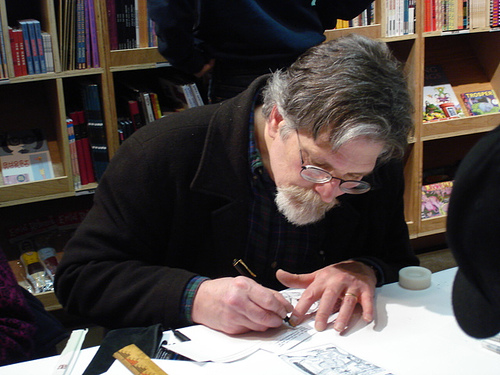
Woodring's drawing style in the black-and-white Frank stories has often been mistaken for brushwork due to the greatly varying thickness of the linework typical of brush cartooning, but he has insisted,[note 1] and indeed demonstrated[citation needed], that it is done with a Brause #29 Index Finger dip pen.[25] He has said, "pen and ink for me is the ne plus ultra of drawing."[2]

In his Frank stories, Woodring employed a style that combined 1920s–30s Fleischer Studios-like character designs with an Eastern architectural and design flavor. He also makes heavy use of a distinctive controlled wavy line that adds contour and texture to the backgrounds, which has become his trademark.

Woodring also works in charcoal and paint (mostly in watercolor). A selection of these works (mostly charcoal) appeared in the collection Seeing Things in 2005.

Beliefs

[edit]

Woodring is a follower of Vedanta, and aspects of this philosophy often appear in his stories. He says, "Meditation is the uber-skill. It ought to be taught in elementary school."[14]

Artistic influences

[edit]

Cartooning

[edit]

Woodring singles out for praise the cartoon work of Mark Martin, Justin Green, Rachel Bell, John Dorman, Mark Newgarden, Roy Thomkins, Peter Bagge, Terry LaBan, Chester Brown, Seth, Joe Matt, Robert Crumb, Charles Burns, Gilbert Hernandez, Jaime Hernandez, Lat,[19] Gil Kane and Jack Kirby (Woodring inked and colored Kirby's designs during his time at Ruby-Spears). He considers Kim Deitch to be "the most under-appreciated comic artist working today."[26]

Art

[edit]

Harry McNaught,[2][19] Boris Artzybasheff,[2] 17th Century Dutch painting,[2] Ingres,[2] Salvador Dalí

Literature

[edit]

Woodring has read widely in literature. Under the Volcano[6] by Malcolm Lowry and Les Misérables by Victor Hugo are two works that he has mentioned more than once in interviews.

Music

[edit]

Woodring frequently mentions Captain Beefheart, Bill Frisell as musical favorites, but also "schmaltzy, potent, cheap pop music with strings from the late 50s and early 60s, the Theme from A Summer Place, Holiday for Strings, the theme from Midnight Cowboy...that sort of dreck."[14] He also listens to a lot of classical music—his brother, with whom he's close, is a classical musician and has introduced him to much of what he listens to.[2][14]

Critical reception

[edit]

Reaction amongst critics and fellow artists has generally been quite positive, despite low sales.[note 2]

"Frank, and I say this without a shred of hyperbole, is a work of true genius by one of the all-time greats."

Awards

[edit]

In December 2006, he became one of the first group of United States Artists Fellows. His work was featured prominently at the Centre National de la Bande Dessinée et de l’Image in Angoulême, France as part of the international comics festival held there in January 2007. The following year, Woodring received an Inkpot Award at the 2008 San Diego Comic-Con, and he was awarded an Artist Trust/Washington State Arts Commission Fellowship in the fall of 2008. In November 2014 he received the Lynd Ward Prize from the Pennsylvania Center for the Book, for his graphic novel Fran.

Year Organisation Award To Award Result
1993 Harvey Awards[28] Woodring Best Colorist Won
Tantalizing Stories Presents Frank in the River Best Single Issue or Story Won
Eisner Awards[29][30] Frank in the River Best Short Story Nominated
Best Colorist Nominated
1996 Jim Best Cover Artist Nominated
Best Writer/Artist, Humor Nominated
1998 Ignatz Awards[31] Frank Vol. 2 Outstanding Graphic Novel or Collection Nominated
2003 Ignatz Awards The Frank Book Outstanding Graphic Novel or Collection[32] Nominated
Artist Trust Woodring Gap Award Won
2006 United States Artists Woodring and Bill Frisell Fellowship Won
2008 Artist Trust Woodring Won
Inkpot Awards Woodring Comic Arts Won
2010 Rasmuson Foundation and Artist Trust Woodring one month residency in Homer, Alaska Won
The Stranger Woodring Genius of Literature Won
2014 Pennsylvania Center for the Book Woodring Lynd Ward Graphic Novel Prize Won

Collected works

[edit]

Woodring has published a large number of short works in diverse periodicals and anthologies. Below is a list of collections of some of those works, but a large amount has yet to be collected in book form. As of April 2011, many of these works are out of print.

Solo

[edit]
Year Title Publisher ISBN Notes
1993 The Book of Jim Fantagraphics Books 1-141-29836-8 foreword by Mark Martin
1994 Frank Vol. 1 978-1-560-97153-5
1997 Frank Vol. 2 978-1-56097-279-2
2002 Trosper
(with music by Bill Frisell)
1-56097-426-5
2003 The Frank Book 1-56097-534-2 foreword by Francis Ford Coppola
Oneiric Diary Dark Horse Comics 1-59307-002-0 notebook with blank pages
2004 Pupshaw and Pushpaw Press Pop 4-9900812-9-3
2005 Seeing Things Fantagraphics Books 1-56097-648-9
The Lute String
リュートの弦
Presspop Gallery 978-4-90309-003-0
2006 The Frank color stories 978-4-90309-006-1
2008 The Museum of Love and Mystery 978-4-903090-14-6
The Portable Frank Fantagraphics Books 978-1-56097-978-4 foreword by Justin Green
2010 Weathercraft 978-1-60699-340-8
2011 Congress of the Animals 978-1-60699-437-5
2012 Problematic: Sketchbook Drawings 2004–2012 978-1-60699-594-5
2013 Fran 978-1-60699-661-4
2018 Poochytown 978-1-68396-119-2
2020 And Now Sir, Is This Your Missing Gonad? 978-1-68396-326-4
2022 One Beautiful Spring Day Fantagraphics Books 978-1-68396-555-8 a compilation of Congress of the Animals, Fran and Poochytown, along with 100 pages never before published

As writer

[edit]
Year Title Collaborator(s) Publisher ISBN
1997 Aliens: Labyrinth Kilian Plunkett
(Illustrator)
Dark Horse Comics 1-56971-245-X
1998 Star Wars: Jabba the Hutt: Art of the Deal Art Wetherell
Monty Sheldon
(Illustrators)
978-1569713105
1999 Aliens: Kidnapped Jason Green,
Francisco Solano Lopez
(Illustrators)
978-1569713723

See also

[edit]

Notes

[edit]

References

[edit]

Further reading

[edit]
[edit]
Revisions and contributorsEdit on WikipediaRead on Wikipedia
from Grokipedia
James William Woodring (born October 11, 1952) is an American cartoonist, fine , , and toy designer renowned for his surreal, dreamlike that explore hallucinatory and anthropomorphic worlds without dialogue. Born in , , to a toxicologist father and inventor mother, Woodring experienced vivid childhood hallucinations, apparitions, and psychological quirks, including diagnoses of autism and , which profoundly shaped his artistic vision. Self-taught as an , he drew early inspiration from animators like , , and the Fleischer Brothers, as well as surrealists such as and . Woodring's career began in the underground comix scene of the 1970s and 1980s, where he contributed to publications like CARtoons and Two-Bit Comics, while working odd jobs such as garbage collector and merry-go-round operator to support himself. In the 1980s, he overcame periods of drug and , , and waking nightmares, eventually stabilizing and working as a for animation studios including Ruby-Spears, where he collaborated with legends like and . He launched his autobiographical illustrated journal series JIM in 1980, which collected in The Book of Jim (1992), blending personal anecdotes with bizarre, hallucinatory vignettes. In 1987, Woodring relocated to , Washington, where he lives with his wife Mary, and began his signature pantomime comic Frank in 1991, featuring the cat-like humanoid Frank navigating the uncanny "Unifactor" realm alongside pets Pupshaw and Pushpaw. His mature works, published primarily by , include the graphic novels Weathercraft (2010), which earned a * nomination and The Stranger’s Genius Award; Congress of the Animals (2011); Fran (2013); and Poochytown (2018), culminating in the expansive One Beautiful Spring Day (2022). Woodring's style employs clean black outlines, wavy hatching, and meticulously etched details to evoke a woodcut-like quality, blending cute, childlike characters with horrifying, ironic parables that restore an inescapable , often drawing from his lifelong visions of jivas (living souls) and otherworldly creatures. Beyond comics, he has created charcoal drawings (Seeing Things, 2005), sculptures, and multimedia collaborations, such as with musician , earning accolades including two (1993), a Artists Fellowship (2006), an (2008), and the Graphic Novel Prize (2014). Praised by figures like , , and for his unique, unsettling yet familiar narratives, Woodring's oeuvre has influenced , with his paintings and drawings exhibited in galleries from to New York.

Biography

Early years

James William Woodring was born on October 11, 1952, in , , into a middle-class family. His father worked as an and inventor, creating devices such as a babysitting beacon, while his mother served as a toxicologist at the Los Angeles County Coroner's office. The family lived in the , where Woodring's early years were shaped by a suburban environment amid the surrounding mountains. From a young age, Woodring experienced vivid hallucinations and psychological quirks that profoundly influenced his surreal worldview. Beginning around age three or four, he reported seeing large, silent, rotating cartoony faces hovering over his bed, as well as apparitions like glowing faces, frogs, and hearing a lion's roar. These visions, distinct from dreams, included paranoid delusions such as fears that his parents would each other, leading to confusion between reality and imagination. In adulthood, he was diagnosed with autism and (the inability to recognize familiar faces), conditions that contributed to his unique perceptual experiences. He also exhibited compulsive behaviors, such as cutting new jeans with , and an early obsession with that instilled constant anxiety. To cope, Woodring began drawing these hallucinations, fostering an early connection between his inner experiences and visual expression. Woodring's interest in art emerged in childhood, sparked by comic books, television cartoons, and illustrated media. He was particularly captivated by the surreal elements in works like the Fleischer Brothers' Betty Boop's Initiation (1933), which he later credited with laying the foundation for his philosophical outlook. Influences included and animations, as well as comic artists like , , and contributors to Mad magazine such as Jack Davis. His first attempts at cartooning occurred during elementary school, where he sketched inspired by these sources, developing skills through self-directed practice rather than formal instruction. As a teenager, Woodring experimented with alcohol and in an effort to recapture the hallucinations that had faded, intensifying his imaginative world but also leading to personal turmoil. These experiences culminated in a near-death incident involving a railroad, after which he quit drugs, though the episode later informed his autobiographical work. Delusions contributed to him of high school, and he faced institutionalization during his teens for psychiatric evaluation, though no definitive diagnosis was made. Largely self-taught, Woodring honed his artistic abilities through a Famous Artists correspondence course, bypassing traditional education before entering professional pursuits.

Animation career

In the early 1980s, Woodring moved to Seattle to enroll in animation courses at the Burnley School of Art and Advertising Design. There, he honed skills that led to early freelance opportunities in the local animation scene. During the late 1970s, prior to his formal studies, Woodring contributed to educational films and took on freelance illustration assignments for regional studios in Los Angeles. By 1979, he joined the Ruby-Spears animation studio as an artist, producing storyboards and layouts for series such as Turbo Teen. In the 1980s, he advanced to employment at Will Vinton Studios, where he created claymation shorts, including the award-winning Pogeybait (1984). In the late , Woodring's animation work expanded to include contributions for , such as network idents and pilots like The Thing That Beckoned, as well as collaborations on episodes of Ren & Stimpy. These projects showcased his distinctive surreal style within commercial television . By the , Woodring stepped back from animation due to burnout and a growing commitment to , though he maintained occasional involvement through storyboarding. This transition allowed him to focus on independent creative pursuits, overlapping briefly with early comics experiments during animation downtime.

Comics and illustration career

Woodring entered the underground comix scene in the early 1980s, contributing surreal and hallucinatory stories to anthologies such as Weirdo, edited by and later , where his work appeared alongside other alternative cartoonists. He also self-published the anthology series Jim starting in 1980, which documented his personal experiences through illustrated autojournals blending prose, drawings, and dream-inspired comics. These early efforts established his reputation for bizarre, wordless narratives influenced by his background, which informed the pacing and visual rhythm of his print work. In 1990, Woodring launched the Frank series as a standalone comic book with , evolving from short strips in magazines like and Tantalizing Stories—co-created with —into longer graphic novels exploring a surreal, anthropomorphic world. The series quickly gained cult status for its storytelling and intricate linework, with compiling early stories in collections like The Book of Jim (1992). During the 1980s and 1990s, Woodring contributed essays and illustrations to , analyzing cartooning history and sharing insights on artists like T.S. Sullivant, while using the platform to promote his independent projects. These writings highlighted his role as both creator and commentator in the movement. By the 2000s, Woodring expanded into illustration, designing album covers for musicians including Bill Frisell's Gone, Just Like a Train (1998) and Ain't My Lookout by The Grifters (1996), blending his signature with commercial design. His illustrations for other media, such as book covers and promotional art, further showcased his versatility, often incorporating dreamlike elements from his comic universe while adapting to collaborative formats. This period marked a shift toward broader recognition, with exhibitions and publications solidifying his influence in both comics and . After a hiatus, Woodring returned in 2025 with the curation of the Jim Woodring 2026 Art Calendar for , selecting twelve surreal images from his oeuvre and pairing them with historical annotations to perplex and illuminate viewers. This project, released on October 7, 2025, signals ongoing engagement with print media, building on his legacy of innovative, self-contained visual narratives.

Frank series characters

Frank is the central protagonist of Jim Woodring's wordless comic series, depicted as an inquisitive, bipedal critter resembling a generic anthropomorph with buckteeth and a short tail, inhabiting the surreal realm known as the Unifactor. His silent, curious nature drives him into a variety of bizarre adventures, ranging from whimsical explorations to nightmarish trials that test his resilience and often symbolize paths toward personal equilibrium, as he invariably returns to a stable state after disruptions. Accompanying Frank are his loyal, inseparable companions Pupshaw and Pushpaw, a pair of small, dog-like demigod figures shaped vaguely like a heart and a handbag, respectively, who serve as both pets and enigmatic aides in his journeys. These mischievous entities scamper about, lick surfaces, and enable or complicate Frank's escapades through their playful yet unpredictable behaviors, such as venturing into the "real" world where they encounter frightening elements beyond the Unifactor's boundaries. Their bond with Frank underscores themes of companionship amid chaos, occasionally highlighting karmic repercussions in their shared misadventures. In opposition to Frank's innocence stands Manhog, a grotesque, porcine antagonist characterized by his wrinkled, humanoid-pig form that crawls on all fours, embodying gluttony, base desires, and unchecked consumption. Despite his villainous traits, Manhog displays underlying good-heartedness, seeking affection and evolving from self-serving actions to more sincere interactions, often watching over Frank in a parental manner and even rescuing him from peril. His recurring confrontations with Frank illustrate dynamics of temptation and consequence within the Unifactor. Among other notable figures in the Frank ensemble is the Whim, a sinister, stick-thin with devilish horns who acts as a mischievous enforcer, contorting reality to his whims and introducing political intrigue or punitive elements into the narratives. The series also features various hybrid creatures, such as bizarre amalgamations of animals and machines, which populate the landscape and interact with the core cast in fleeting, often antagonistic or symbiotic ways, first emerging in early strips to heighten the dreamlike unpredictability of Frank's world.

Other characters and settings

In his early , particularly the self-published Jim series launched in 1980 and later issued by from 1987 to 1996, Woodring introduced standalone characters drawn from his dream journals, depicting human-animal hybrids navigating absurd, hallucinatory scenarios. Notable among these are , an embodiment of drunkenness portrayed as a chaotic, anthropomorphic figure indulging in surreal escapades; Chip, a diminutive entity embodying mischief in fragmented vignettes; and , a contemplative hybrid appearing in introspective, otherworldly interludes that explore of . These figures operate independently of larger narratives, emphasizing Woodring's fascination with subconscious manifestations over structured plots, as compiled in the 2014 collection Jim: Jim Woodring's Notorious Autojournal. Woodring's short stories often feature dream entities as peripheral protagonists, manifesting as ephemeral beings in pantomime tales that blur reality and . These entities, inspired by Woodring's lifelong experiences with apparitions and recorded in his "autojournal," appear in works like those in Seeing Things (2005), where abstract forms interact with shifting environments in wordless sequences evoking unease and wonder. Such creations differ from the more recurrent ensemble in his Frank adventures by their narrative isolation, serving as isolated explorations of the psyche rather than interconnected lore. A recurring setting across Woodring's oeuvre is the Unifactor, a dreamlike, unnamed realm characterized by impossible architecture—twisting spires, floating geometries, and landscapes defying conventional physics—that underpins many standalone pieces beyond specific character arcs. This environment, described by Woodring as an autonomous "literary construct" dictating visual logic, appears in early Jim stories and later illustrations, fostering a hypnotic atmosphere of perpetual metamorphosis. In his and designs, Woodring populates later works with minor, abstract beings that extend his surreal vocabulary without ties to prior narratives. Pieces like Crazy Bird (2010s) and The Duck (2010s), showcased in his gallery, depict enigmatic, hybrid forms in minimalist compositions evoking primal instincts and the . These evolve into three-dimensional , such as the Pupshaw and Pushpaw figures produced by Presspop in 2005, which translate ethereal entities into tangible, collectible objects blending whimsy with subtle menace.

Artistic Style

Narrative techniques

Jim Woodring employs wordless pantomime narratives in his comics, particularly since the 1990s, to convey emotion and action exclusively through visuals, eschewing dialogue, speech balloons, and onomatopoeia for a hypnotic, timeless quality. This approach, evident in his Frank series, enhances universality and avoids cultural specificity, as Woodring has explained: "I decided to make it wordless because I wanted it to be timeless and universal." He further noted that "words can be deceptive... Images are less open to interpretation," underscoring the technique's reliance on visual clarity to drive the story. Woodring's plotting adheres to non-linear, dream-logic structures, drawing from hallucinations to create surreal, unpredictable sequences that prioritize emotional over conventional progression. In Frank tales, such as encounters with Jivas—living substances that grow and pursue the protagonist—or Manhog, events unfold in a hallucinatory manner, mirroring the Unifactor's dictating force without textual guidance. These narratives feature cyclical plots that emphasize consequence rather than resolution, restoring an "essential harmony" by the end; for example, in Congress of the Animals (2011), disruptions to Frank's life are undone, returning him to his initial state as if no lasting change occurred. Woodring described this as ensuring "the opening balance… was restored at the end of every story." His stories often build through episodic vignettes that form larger arcs, with short, standalone segments interconnecting within the broader Unifactor setting, as in Frank's factory labors or meetings with Fran. Early works like the anthology Tantalizing Stories (1992–1994) exemplify this, presenting discrete episodes that later expand into graphic novels such as Weathercraft (2010). Woodring also experiments with formats to reframe narratives, including omnibus collections like One Beautiful Spring Day (2022), which weaves Congress of the Animals, Fran, and Poochytown into a 400-page tale with 100 new pages of episodic content, offering fresh perspectives on recurring elements.

Visual techniques

Jim Woodring employs detailed line work, utilizing both and to achieve varying line thicknesses that mimic fluid motion and depth in his illustrations. He often works with a Winsor & Newton Series 7 and for expressive strokes, while employing dip s for precise detailing, creating a style frequently mistaken for pure brushwork due to its dynamic variance. This technique is executed on , where initial sketches are inked over, allowing for corrections and refinements before finalizing the piece. His anthropomorphic designs blend cute and grotesque elements through exaggerated proportions and fluid anatomy, as seen in characters like Frank, an upright-walking cat with bulbous features and elastic limbs that shift seamlessly between endearing and unsettling forms. These figures populate his surreal worlds, where proportions distort to emphasize emotional or psychological states, enhancing the narrative's dreamlike unease without relying on text. Woodring maximizes black-and-white contrasts and to evoke tension, employing extensive cross-hatching to build textures and shadows that render environments dense and oppressive. In panel layouts, he favors irregular grids that disrupt traditional flow, using vast areas of white space to heighten isolation or ambiguity, as in sequences where empty panels amplify the surreal progression of events. Over time, Woodring's style evolved from the loose, sketchy lines of his early underground comix in the Jim series—characterized by autobiographical, hallucinatory vignettes with rougher, more improvisational rendering—to the polished, intricate illustrations in later books like Weathercraft and Congress of the Animals. This refinement involved tighter compositions and meticulous detailing, transforming raw visionary impulses into highly controlled, labyrinthine visuals that deepen the surrealism of his wordless narratives.

Themes and Philosophy

Recurring motifs

Woodring's works frequently depict karmic cycles of action and retribution, where characters' misdeeds trigger elaborate, bizarre punishments that enforce a equilibrium within the Unifactor's self-regulating system. In stories like Weathercraft, a corpulent beast's gluttonous excesses lead to transformative ordeals, culminating in temporary enlightenment before regressing into primal states, illustrating endless loops of bliss and consequence. These cycles underscore a universe governed by intuitive yet incomprehensible logic, where retribution manifests through surreal escalations rather than direct . Central to this symbolism is the exploration of desire and , often portrayed through undergoing transformations that hint at paths to spiritual enlightenment. Characters like Manhog embody craven impulses, devouring indiscriminately until forced into redemptive acts that border on nirvana, such as gazing into a mirror revealing the illusion of self. In Fran, Frank's obsessive pursuit of the elusive Fran evokes thwarted longing, disrupted by her shape-shifting autonomy, symbolizing desire's inevitable frustration amid domestic disintegration. These motifs draw from transcendental influences, transforming base urges into vehicles for fleeting insight, though enlightenment remains ephemeral and cyclical. Architectural elements recur as representations of the , featuring impossible machines and labyrinthine landscapes that warp reality and trap inhabitants in disorienting reveries. Opulent follies, Moorish-inspired temples, and shifting terrains inspired by foothills evoke claustrophobic interiors and lush, treacherous gardens, where structures like curious museums serve as portals for self-confrontation. Strange devices and morphing hybrids further animate these environments, blending organic and mechanical forms to symbolize the mind's hidden machinations. The deliberate absence of text in Woodring's reinforces an internal, non-verbal experience, compelling readers to engage intuitively with the imagery's primal symbolism. By eschewing and captions, the narratives achieve timeless universality, avoiding linguistic shortcuts that might distort the dreamlike flow and instead inviting personal interpretation of the Unifactor's silent tableau. This motif aligns briefly with Woodring's views on , as the wordless cycles mirror eternal returns without explicit narrative resolution. However, in his forthcoming book Quacky (announced 2025, release 2026), Woodring incorporates text alongside images in a Big Little Book format, aiming to provide deeper insight into his characters' transformative adventures.

Personal beliefs

Jim Woodring's personal philosophies are deeply rooted in , particularly , which he has described as his primary spiritual discipline for over three decades. In a 2011 interview, he explained that informs his contemplative practices, stating, "The power of pondering turns out to be infinite and eternal. It exists in ... the more time you spend in contemplation, the more you realize." He has incorporated Vedantic concepts into his narratives, such as overt references to the philosophy in his 2010 Weathercraft, where themes of illusion and reality align with non-dualistic ideas. Woodring has also alluded to karma as a guiding principle in life, noting in a 2022 conversation that "the karmic hammer has spared me many times when I deserved to be smashed," reflecting his belief in cosmic consequences and protections. Central to Woodring's is his belief in dreams and hallucinations as portals to , originating from vivid childhood experiences that shaped his creative output. He has recounted frequent hallucinations during elementary school, including "glowing faces and shapes hovering in the air over me, and sometimes an enormous eye," which persisted into adulthood and served as direct inspirations for his surreal imagery. These visions, documented in his "autojournal" of dreams, inform an automatic drawing process where narratives emerge spontaneously; as he described in 2011, "When I sit down to do a Frank story, I’ve got no preconception... They just materialize out of thin air." This method allows him to access realms, viewing such states as pathways to deeper understanding beyond ordinary perception. In a 2025 interview, he reaffirmed that these childhood hallucinations and dreams continue to influence his work, emphasizing art's role as a personal spiritual outlet. Woodring conceives of art as both a and a meditative , essential for spiritual growth and ethical reflection. In contributions to , including essays and interviews from the 1990s onward, he has articulated how cultivates and , urging creators to transcend ego-driven for higher truths. He has emphasized meditation's in sustaining amid physical decline, stating in 1993, "When my hand is shaking and my eye is dim, that's the time to immerse myself in and contemplation." This perspective frames art not merely as expression but as a practice that points to an encompassing reality, where "the smart thing… is to let go of the fun of the art and get into the hard work of attaining and understanding that higher reality." In recent post-2020 interviews, Woodring has reflected on aging, , and environmental interconnectedness during his long-term residency on Vashon Island, Washington, as of 2025. Turning 70 in 2022, he conveyed a sense of urgency and renewal, saying, "I feel a strong disinclination to continue as I have been doing... Aside from the looming deadline the future teems with promise," signaling a shift toward more purposeful work amid awareness of mortality. His island life, surrounded by natural landscapes, has amplified themes of ecological harmony in projects like One Beautiful Spring Day (2022), which explores conservation and the balance between human actions and the environment, drawing from his observations of local and broader planetary concerns. In a 2025 , he noted moving to Vashon Island for solitude and reflecting on Seattle's changes, preferring the quiet rural life that supports his creative and contemplative practices. These reflections underscore his evolving of as a response to impermanence and stewardship.

Influences

Cartooning and comics

Woodring's early exposure to cartooning included inspirations from animators such as Walt Disney, Tex Avery, and the Fleischer Brothers, whose imaginative animation styles contributed to his interest in surreal and fantastical visuals. Woodring's early exposure to cartooning was profoundly shaped by the satirical and grotesque humor of MAD Magazine artists, particularly Jack Davis and Basil Wolverton, whose exaggerated, irreverent styles instilled in him a appreciation for grotesque satire that informed his initial forays into comics. In interviews, Woodring has recalled MAD as a formative "school" for his artistic development, highlighting its role in sparking his interest in cartoons over traditional superhero comics. He has also cited admiration for the dreamlike, fantastical sequences in Windsor McCay's and the richly detailed, adventurous fantasy in E.C. Segar's , which contributed to his interest in surreal, immersive comic worlds. These early newspaper strip traditions emphasized imaginative panel layouts and bizarre adventures, elements that resonated with Woodring's own hallucinatory visions. The movement of the 1960s and 1970s further molded Woodring's raw, experimental style, with pioneers like and exemplifying the freedom to explore personal and subversive themes without commercial constraints. Woodring has acknowledged Crumb's immense impact, stating he had to consciously avoid imitating his wavery line and autobiographical intensity, while the broader underground scene, including Rodriguez's gritty, politically charged work, encouraged Woodring's early unpolished, hallucinatory drawings. Among contemporary peers, Woodring has praised Jaime Hernandez for infusing pantomime comics with profound emotional depth, as seen in Love and Rockets, where silent sequences convey complex relationships and inner turmoil—a technique that paralleled Woodring's own wordless narratives. He described the Hernandez brothers' work as defying comprehension due to its masterful restraint and humanity, influencing his approach to evoking feeling through visuals alone. These comic influences collectively fed into Woodring's narrative techniques, blending surrealism with emotional resonance.

Fine arts and literature

Jim Woodring's visual and thematic sensibilities draw significantly from the surrealist tradition in fine arts, particularly the works of Max Ernst, Hieronymus Bosch, and Salvador Dalí, which emphasize bizarre imagery and explorations of the subconscious. Ernst's collage techniques and dreamlike compositions have informed Woodring's approach to constructing otherworldly narratives, blending everyday forms into uncanny hybrids that evoke a sense of hidden psychological depths. Similarly, Bosch's intricate, fantastical paintings, with their teeming scenes of moral allegory and grotesque invention, resonate in Woodring's depictions of the Unifactor—a realm of perpetual transformation and moral ambiguity—providing a historical precedent for his interest in the surreal as a vehicle for subconscious revelation. Woodring encountered these influences early through a 1968 retrospective on surrealism and Dada at the Los Angeles County Museum of Art, which featured seminal works by Ernst and others, igniting his fascination with art that defies rational logic. In literature, Woodring's inspirations include transgressive and poetic voices that probe the irrational and the visionary, such as Arthur Rimbaud's hallucinatory verse and Alfred Jarry's absurdist plays, which parallel the nonsensical logic and pataphysical whimsy in his silent stories. The poet Kenneth Patchen's experimental writings, blending verse with visual elements, left a lasting mark on Woodring during his youth, influencing his integration of text and image to convey emotional and philosophical resonance. Victor Hugo's epic prose in also impacted him profoundly, highlighting literature's capacity for deep emotional immersion that Woodring seeks to echo through visual means, though he notes the limitations of comics in achieving such literary intensity. His works often evoke the dreamlike wanderings of Lewis Carroll's , sharing a focus on nonsensical worlds and childlike curiosity amid the bizarre. Musical influences contribute to the pacing and atmospheric quality of Woodring's narratives, particularly the ambient and minimalist compositions of , whose sparse, evocative piano pieces mirror the slow, meditative rhythm of his wordless tales and their evocation of dream states. Additionally, the transcendental synergy of image and sound in Philip Glass's score for has shaped Woodring's appreciation for multimedia forms that induce altered perceptions, informing the hypnotic flow of his . These non-sequential influences from and distinguish themselves by providing Woodring with a foundation in symbolic density and irrational beauty, which he adapts into his cartooning to explore transformation without relying on narrative linearity.

Major Works

Solo comics and books

Jim Woodring's solo career began with the self-published Jim, which he produced from 1980 to 1986, featuring autobiographical and hallucinatory short stories drawn from his dreams and daily experiences. Books picked up the series in 1987, publishing issues through 1990 and resuming from 1993 to 1996, during which Woodring refined his signature style of wordless, surreal narratives. In 1991, released Jim, a standalone collection compiling early stories from the zine alongside new pieces, drawings, and s, presented in a 144-page format that showcased Woodring's evolving autojournalistic approach. Woodring's breakthrough came with the Frank comic series. Frank first appeared in 1991 in the anthology Buzz #2. Fantagraphics published the Frank series from 1996 to 2001, producing four issues (#1 in 1996, #2 in 1997, #3 in 2000, and #4 in 2001), each gathering short stories featuring the anthropomorphic cat-like character Frank and his companions Pupshaw and Pushpaw amid grotesque, dreamlike scenarios. These were initially issued in oversized black-and-white paperback formats, emphasizing Woodring's meticulous ink linework. In 2003, Fantagraphics compiled the complete run into The Frank Book, a 224-page hardcover (with a 2011 softcover edition) that included all Frank tales from 1991 to 2003, plus bonus material like the unfinished "Frank's High Horse" conclusion, solidifying the series as a cornerstone of alternative comics. The 2010s marked Woodring's shift to longer-form graphic novels, forming what is known as the Frank trilogy, all published by in hardcover editions with full-color covers and black-and-white interiors. Weathercraft (2010, 104 pages) served as the inaugural volume, a standalone tale starring the humanoid hog Manhog in a cyclical narrative of torment and enlightenment within the Unifactor. This was followed by Congress of the Animals (2011, 112 pages), where Frank confronts loss and exile after a train journey disrupts his world, blending adventure with philosophical undertones. The trilogy concluded with Fran (2013, 104 pages), depicting Frank's quest to reclaim his companion Fran from monstrous forces, emphasizing themes of desire and redemption in a picaresque structure. Post-trilogy, Woodring continued producing collected editions and new material through . Problematic: Sketchbook Drawings 2004-2012 (2013, hardcover, 152 pages) gathered hundreds of sketches capturing spontaneous visions, speculative anatomy, and surreal vignettes, offering insight into his creative process outside sequential storytelling. In 2022, One Beautiful Spring Day (hardcover, 400 pages) collected the previously published graphic novels Congress of the Animals (2011), Fran (2013), and Poochytown (2018), alongside 100 pages of new connecting material, forming a unified wordless epic of transformation and horror in the Unifactor. has played a central role in these publications, handling both initial releases and subsequent reissues, such as the deluxe second edition of Weathercraft in 2017 with expanded dimensions for enhanced visual impact. Recent editions include the Jim Woodring 2026 Art Calendar (2025, wall calendar format), featuring twelve hand-selected surreal artworks with curated historical annotations, extending Woodring's influence into illustrative print media.

Collaborations and adaptations

Woodring's early career included significant contributions to animation studios, where he worked as a character designer and layout artist on shows such as the based on The A-Team character and the cartoon in the 1980s. During this period at , he collaborated alongside legendary cartoonist , contributing to the studio's output of Saturday morning cartoons. In the comics medium, Woodring frequently wrote scripts for adaptations and illustrated works by other authors. He scripted the four-issue comic adaptation of Tod Browning's 1932 horror film Freaks, published by ' Monster imprint in 1992, with artwork by and colors by Mary Woodring. For , he wrote the three-issue Aliens: Labyrinth (1993–1994), illustrated by Kilian Plunkett, and the single-issue Aliens: Kidnapped (1997), featuring art by himself, Justin Green, and López. He also penned the Star Wars: Tales of the Jabba's Palace story "The Hunt for Aurra Sing" in 1995–1996, drawn by Art Wetherell and inked by Monty Sheldon. As an illustrator, Woodring provided art for Harvey Pekar's American Splendor stories "Snake," "Watching the Media Watchers," and "Sheiboneth Beis Hamikdosh" (1991–1992), as well as pieces in Dennis P. Eichhorn's Real Stuff, including "Introducing Dennis Eichhorn" (Vol. 1 #1, 1991) and "The Meaning of Life" (Vol. 3 #1, 1992). Additional illustration work includes Blue Block (1993, ), scripted by Scott Deschaine, and the 12-page educational comic Smokey Bear: Friend of the Forest (1997) for the U.S. Forest Service, co-created with Deschaine. Adaptations of Woodring's own creations have extended his surreal universe into other media. The character Frank inspired Visions of Frank (2005), a DVD compilation of nine animated shorts produced by Japan's PressPop Music between 2000 and 2005, each interpreting a classic Frank comic strip through techniques like CGI, cel animation, stop-motion, and sand painting by various Japanese animators. In 2013, Woodring collaborated with band on Fade, producing a of their album's artwork, a short animated film, and a set of three soft-vinyl figurines manufactured by PressPop. Woodring's partnerships in toy design have brought his characters into three-dimensional form, often through Japanese manufacturers. He co-designed the Crazy Newts vinyl figure series in 2001 with Creative Products, featuring bizarre, capsule-toy-style collectibles sold in vending machines. PressPop produced several Frank-related vinyl figures starting in 2006, including sets with Pupshaw and Pushpaw (sculpted by Kei Hinotani), as well as standalone pieces like Lorbo (). These collaborations emphasize Woodring's penchant for whimsical, surreal sculptural interpretations of his anthropomorphic figures. Musical collaborations highlight Woodring's multimedia approach. He created album cover art for jazz guitarist Bill Frisell's Gone, Just Like a Train (1998) and With Dave Holland and Elvin Jones (2001), and their joint projects culminated in Trosper (2013), a wordless comic accompanied by a six-minute Frisell-composed soundtrack. Their ongoing partnership, including the stage performance Mysterio Sympatico and images from Seeing Things (2006), earned a Artists Fellowship in 2006. More recently, Woodring illustrated the 2022 edition of David Lindsay's 1920 novel , published by Beehive Books, with an introduction by that explores the book's philosophical and cultural resonances. In 2022, he contributed artwork to the anthology Jamming with Aleksandar Zograf (revised edition), a collaborative comic project initiated by the Serbian artist in 2002.

Other projects

Woodring has designed a variety of limited-edition figures based on his characters, often produced in collaboration with manufacturers like Presspop. Notable examples include the Frank Doll Set, featuring articulated figures of Frank, Pupshaw, and Pushpaw in both black-and-white and color variants, with editions limited to 1,000 pieces each. Other designs encompass the Lorbo glow-in-the-dark figure and the Doll, limited to 500 overseas editions, alongside earlier releases like the Dorbel series in various colors such as monotone blue (50 pieces) and grayscale. These vinyl sculptures have been sold through specialty retailers and galleries, extending his character designs into three-dimensional forms. In addition to toys, Woodring has pursued through drawings and paintings, exhibited in galleries across and New York during the 1990s through 2010s. His works appeared at Roq La Rue in in 1999, showcasing paintings and graphic elements under the title "Boyfriend of The Weather." In New York, exhibitions included a 1993 show at Bess Cutler Gallery and the 2015 "You Drive!" presentation at Scott Eder Gallery, featuring oil paintings and pieces like "Oh Hell, Jimmy." 's Frye Art Museum hosted "The Pig Went Down to the Harbor at Sunrise and Wept" in 2017, highlighting his surreal imagery. Earlier, the Bookstore & Gallery presented "Seeing Things: The Art of Jim Woodring" in 2007, focusing on his drawings compiled in the accompanying book of the same name. Woodring participated in an artist's residency at the Bunnell Street Arts Center in , in March 2012, where he created sketchbook drawings amid continuous snowfall. These personal projects contributed to collections like Problematic: Sketchbook Drawings 2004–2012, documenting quick sketches, figure studies, and conceptual explorations. Among his miscellaneous outputs, Woodring has produced annual art calendars, such as the 2026 edition published by , featuring twelve hand-selected surreal images with additional illustrations and curated historical dates on matte stock. Posters and prints of his artwork are available through publishers and galleries, including limited-edition reproductions of pieces like those from his 2008 Seeing Things series.

Reception and Legacy

Critical response

Woodring's work garnered early recognition within underground comics circles during the 1980s and 1990s, particularly through Fantagraphics Books, where he became a mainstay contributor starting in 1987. Reviews in The Comics Journal highlighted his surreal innovation, praising the dreamlike quality and hallucinatory apparitions in series like Frank as revelatory and distinct from contemporary peers. This acclaim positioned him as a key figure in the transition from underground to alternative comics, with his blend of autobiography and fantasy earning consistent attention in the journal's pages throughout the decade. The Frank trilogy—comprising Frank (1990s collections), Weathercraft (2010), Congress of the Animals (2011), and Fran (2013)—achieved broader mainstream acclaim for its visual storytelling and thematic depth. Outlets like lauded Woodring's extraordinary draftsmanship and ability to craft hilarious yet hallucinatory narratives, comparing his style to antique European woodcuts and underground artists such as R. Crumb. Critics appreciated the trilogy's exploration of existential themes through wordless sequences, evoking a sense of pure dream logic rendered with etching-like precision. Post-2010 analyses have balanced praise for Woodring's visual with critiques of accessibility stemming from his predominantly wordless format. In a 2013 review of Fran, the work was commended for its mythopoeic scope and disruption of narrative presumptions, distilling antics into a linguistic reality that challenges readers' expectations of protagonists and closure. However, some observers noted potential limitations in its patriarchal undertones and subjective perspectives, which could oversimplify gendered dynamics and render interpretations elusive. echoed this in 2022, celebrating the trilogy's otherworldly specificity and blend of cute and horrifying elements while pointing to the ambiguity of its moral voids as both a strength and a barrier to straightforward engagement. Recent coverage from 2023 to 2025 underscores Woodring's enduring influence in indie comics, with interviews and discussions in outlets like and emphasizing his role in inspiring surrealist experimentation among younger creators. For instance, a 2025 highlighted his ongoing projects as a testament to the timeless appeal of his Unifactor world, reinforcing his legacy as a visionary in visual narrative.

Awards and recognition

Jim Woodring's career has been marked by numerous accolades in the comics and illustration fields, beginning with early recognition for his innovative use of color and storytelling in the Frank series. In 1993, he received two : one for Best Colorist and another for Best Single Issue or Story for Tantalizing Stories Presents Frank in the River. That same year, Woodring earned multiple Eisner Award nominations, including Best Short Story for "Frank" in Pictopia #2, Best Painter/Multimedia Artist for Frank in the River. Throughout the 2000s and 2010s, Woodring's surreal graphic novels garnered further honors, highlighting his mastery of wordless narrative. In 2006, he was awarded a Artists Fellowship, recognizing his contributions to American arts. The 2008 from acknowledged his broad impact on and . His 2010 work Weathercraft won The Stranger's Genius Award for Literature, celebrating its philosophical depth and visual innovation. In 2012, Congress of the Animals earned the Special Jury Prize at the , a significant international milestone for his style. The book also received an Eisner Award nomination for Best Writer/Artist that year. Woodring's 2014 graphic novel Fran was awarded the Graphic Novel Prize, with judges praising its "hypnotic and subliminal" qualities. More recently, in the , Woodring has been featured in major exhibitions such as the "Masters of Style" panel at Comic-Con International in 2020, affirming his status among leading American cartoonists. In 2025, he appeared in prominent features, including an in-depth interview on the Direct Edition podcast discussing his surrealist influences and creative process.

References

Add your contribution
Related Hubs
User Avatar
No comments yet.