Hubbry Logo
Wollaton HallWollaton HallMain
Open search
Wollaton Hall
Community hub
Wollaton Hall
logo
8 pages, 0 posts
0 subscribers
Be the first to start a discussion here.
Wollaton Hall
Wollaton Hall
from Wikipedia

Wollaton Hall is an Elizabethan country house of the 1580s standing on a small but prominent hill in Wollaton Park, Nottingham, England. The house is now Nottingham Natural History Museum, with Nottingham Industrial Museum in the outbuildings. The surrounding parkland has a herd of deer, and is regularly used for large-scale outdoor events such as rock concerts, sporting events and festivals.

Key Information

Wollaton and the Willoughbys

[edit]
Wollaton Hall, rear view

Wollaton Hall was built between 1580 and 1588 for Sir Francis Willoughby and is believed to be designed by the Elizabethan architect, Robert Smythson, who had by then completed Longleat, and was to go on to design Hardwick Hall. The general plan of Wollaton is comparable to these, and was widely adopted for other houses, but the exuberant decoration of Wollaton is distinctive, and it is possible that Willoughby played some part in creating it.[1] The style is an advanced Elizabethan with early Jacobean elements.

Wollaton is a classic prodigy house, "the architectural sensation of its age",[2] though its builder was not a leading courtier and its construction stretched the resources he mainly obtained from coalmining; the original family home was at the bottom of the hill. Though much re-modelled inside, the "startlingly bold" exterior remains largely intact.[3]

On 21 June 1603, Willoughby's son Sir Percival Willoughby hosted Anne of Denmark and her children Prince Henry and Princess Elizabeth at Wollaton.[4] Charles, later Charles I, came in 1604.[5]

Description

[edit]
Oblique view of the main facade
Oblique view from the rear

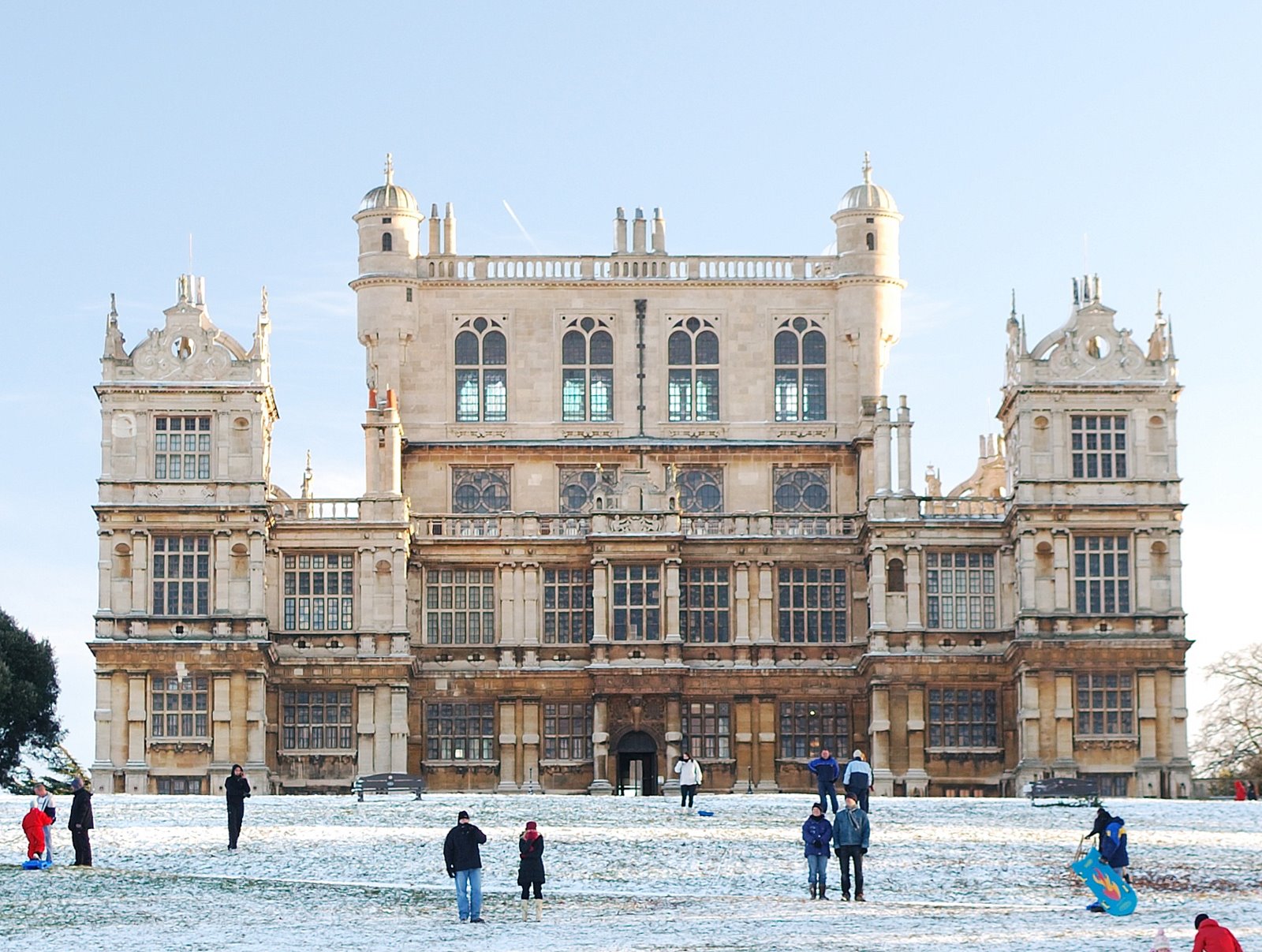
The building consists of a central block dominated by a hall three storeys high, with a stone screen at one end and galleries at either end, with the "Prospect Room" above that. From this there are extensive views of the park and surrounding country. There are towers at each corner, projecting out from this top floor. At each corner of the house is a square pavilion of three storeys, with decorative features rising above the roof line. Much of the basement storey is cut from the rock the house sits on.[6]

The floor plan has been said to derive from Serlio's drawing (in Book III of his Five Books of Architecture) of Giuliano da Majano's Villa Poggio Reale near Naples of the late 15th century, with elevations derived from Hans Vredeman de Vries.[7] The architectural historian Mark Girouard has suggested that the design is in fact derived from Nikolaus de Lyra's reconstruction, and Josephus's description, of Solomon's Temple in Jerusalem,[8] with a more direct inspiration being the mid-16th century Mount Edgcumbe in Cornwall, which Smythson knew.[9]

The building is of Ancaster stone from Lincolnshire, and is said to have been paid for with coal from the Wollaton pits owned by Willoughby; the labourers were also paid this way. Cassandra Willoughby, Duchess of Chandos recorded in 1702 that the master masons, and some of the statuary, were brought from Italy. The decorative gondola mooring rings carved in stone on the exterior walls offer some evidence of this, as do other architectural features. There are also obvious French and Dutch influences. The exterior and hall have extensive and busy carved decoration, featuring strapwork and a profusion of decorative forms. The window tracery of the upper floors in the central block and the general busyness of the decoration look back to the Middle Ages,[6] and have been described as "fantasy-Gothic".[10]

Later history

[edit]
The screen in the hall

The house was unused for about four decades before 1687, following a fire in 1642, and then re-occupied and given the first of several campaigns of re-modelling of the interiors.[6] Paintings on the ceilings of the two main staircases and round the walls of one are attributed to Sir James Thornhill and perhaps also Louis Laguerre, carried out around 1700.[6] Re-modelling was carried out by Wyatville in 1801 and continued intermittently until the 1830s.

The hall remains essentially in its original Elizabethan state, with a "fake hammerbeam" wood ceiling of the 1580s, in fact supported by horizontal beams above, but given large and un-needed hammerbeams for decoration.[6] The slightly earlier roofs of the great halls at Theobalds and Longleat were similar.[11]

The gallery of the main hall contains Nottinghamshire's oldest pipe organ, thought to date from the end of the 17th century, possibly by the builder Gerard Smith. It is still blown by hand. Beneath the hall are many cellars and passages, and a well and associated reservoir tank, in which some accounts report that an admiral of the Willoughby family took a daily bath.

The Willoughbys were noted for the number of explorers they produced, most famously Sir Hugh Willoughby who died in the Arctic in 1554 attempting a North East passage to Cathay. Willoughby's Land is named after him.

In 1881, the house was still owned by the head of the Willoughby family, Digby Willoughby, 9th Baron Middleton, but by then it was "too near the smoke and busy activity of a large manufacturing town... now only removed from the borough by a narrow slip of country", so that the previous head of the family, Henry Willoughby, 8th Baron Middleton, had begun to let the house to tenants and in 1881 it was vacant.[12]

Wollaton Hall was sold by the 11th Baron Middleton to the Nottingham Corporation for £200,000 (equivalent to £14.41 million in 2023).[13] Estate and personal papers of the Willoughby family were used to create the Middleton collection at the department of Manuscripts and Special Collections, The University of Nottingham. They include the Wollaton Antiphonal and the single manuscript holding the 13th-century post-Arthurian romance Le Roman de Silence.[14]

Nottingham Council opened the hall as a museum in 1926. In 2005 it was closed for a two-year refurbishment and re-opened in April 2007. The prospect room at the top of the house, and the kitchens in the basement, were opened up for the public to visit, though this must be done on one of the escorted tours. The latter can be booked on the day, lasts about an hour, and a small charge is made.

In 2011, key scenes from the Batman movie The Dark Knight Rises were filmed outside Wollaton Hall.[15] The Hall was featured as Wayne Manor.[16][17] The Hall is five miles north of Gotham, Nottinghamshire, through which Gotham City indirectly got its name.[18]

Gardens

[edit]
Wollaton Hall seen from inside the north entrance to the park on Wollaton Road.

Wollaton Hall Park is Grade II* listed on the Register of Historic Parks and Gardens.[19]

The Camellia House[20] is a listed building in its own right, as are many other buildings and structures,[21] including a doric temple and Ha-Ha.

Owners of Wollaton Hall

[edit]

Similar buildings

[edit]

In 1855, Joseph Paxton designed Mentmore Towers in Buckinghamshire, which borrows many features from Wollaton. Both properties have been used as film locations for Christopher Nolan's Batman trilogy of films, featuring as Wayne Manor – the latter in Batman Begins and Wollaton Hall itself in The Dark Knight Rises.

Nottingham Natural History Museum

[edit]

Since Wollaton Hall opened to the public in 1926, it has been home to the city's natural history museum.[22] On display are some of the items from the three quarters of a million specimens that make up its zoology, geology, and botany collections. These are housed in six main galleries:

  • Natural Connections Gallery
  • Bird Gallery
  • Insect Gallery
  • Mineral Gallery
  • Africa Gallery
  • Natural History Matters Gallery

The museum started life as an interest group at the Nottingham Mechanics' Institution; it is now owned by the Nottingham City Council.

In 2017 the museum hosted a tour of dinosaur skeletons titled Dinosaurs of China, Ground Shakers to Feathered Flyers. The exhibition was attended by over 125,000 people.[23]

From July 2021 to August 2022, the Nottingham Natural History Museum featured the world's first exhibit of Titus, a "real" Tyrannosaurus rex fossil which was discovered in Montana, in the United States, in 2014.[24]

[edit]

See also

[edit]

Notes

[edit]

References

[edit]
[edit]
Revisions and contributorsEdit on WikipediaRead on Wikipedia
from Grokipedia
Wollaton Hall is a Grade I listed Elizabethan country house situated on a prominent hill within the 500-acre Wollaton Park in , . Built between 1580 and 1588 for the wealthy coal mine owner Sir Francis Willoughby, it was designed by the renowned Elizabethan architect Robert Smythson and stands as one of 's finest examples of a , characterized by its bold classical influences and exuberant ornamentation. Today, the hall functions as a dedicated , housing extensive collections of specimens, fossils, and minerals while preserving its historic interiors for public tours and events. The architecture of Wollaton Hall exemplifies early style, constructed from Ancaster with a square plan featuring projecting corner towers, symmetrical elevations adorned with Doric, Ionic, and Corinthian orders, paired pilasters, strapwork, and niches containing classical statuettes. Its central , topped by a prospect room, includes original features like a Smythson-designed screen and groined vaulting in the basement, though later alterations—such as those by Jeffry Wyattville in the early —added service wings, staircases, and glazing while maintaining the building's grandeur. The surrounding deer park, enclosed between 1492 and 1510, enhances the estate's landscape, with formal gardens and pleasure grounds developed in the late 18th century. Historically, the hall passed through the Willoughby family for centuries, enduring a major fire in 1801 that prompted restorations, before acquired it in 1925 and converted it into a the following year. Refurbished in 2007, it has gained modern cultural prominence, notably serving as the exterior for in the 2012 film , drawing visitors to its blend of architectural splendor and natural exhibits.

History

Construction and Early Ownership

Wollaton Hall was commissioned in 1580 by Sir Francis Willoughby, a prominent landowner, and completed in 1588 under the design of the Elizabethan architect Robert Smythson. The project represented a major undertaking, transforming the existing Wollaton estate into a grand new seat for the Willoughby family. The construction was financed primarily through Willoughby's substantial wealth derived from operations in Wollaton and surrounding areas of , which he had inherited in 1564 and expanded into a key industrial venture. However, the immense costs of the build contributed to financial pressures on Willoughby, who borrowed extensively to realize the vision despite declining coal revenues in the late . Willoughby himself did not reside in the completed hall, passing away in 1596, after which it passed to his son-in-law Sir Percival Willoughby. As a quintessential Elizabethan , Wollaton Hall embodied the era's architectural ambition, serving as a bold symbol of the owner's rising status and prosperity amid England's flowering. These lavish structures were typically erected by wealthy to demonstrate cultural and economic power, often with the potential to host royal progresses. Initially purposed as the primary family residence, the hall was equipped for entertaining elite guests, reflecting Willoughby's aspirations for social elevation through hospitality and display. In its early years under Willoughby ownership, the hall quickly gained prominence through notable royal visits, underscoring its role in courtly networks. In 1603, Queen Anne of , accompanied by her son Prince Henry, stayed at Wollaton during her progresses in following the accession of James I. The following year, in 1604, the young —later King Charles I—also visited, hosted by Sir Percival Willoughby, further affirming the estate's status as a venue for monarchical entertainment.

Willoughby Family Legacy

Sir Francis Willoughby (c. 1546/7–1596), a prominent landowner and industrialist, amassed significant wealth through ownership of coal mines in the region, which provided the financial foundation for constructing Wollaton Hall between 1580 and 1588..aspx) His marriage in 1564 to Elizabeth Littleton, daughter of Sir John Littleton of , produced six daughters but no surviving sons, leading to strategic family arrangements for inheritance. The eldest daughter, (c. 1563–1629), married her cousin Sir Percival Willoughby (c. 1560–1643) of Bore Place, , in December 1580, uniting two branches of the family and positioning Percival as to the Wollaton estate. Upon Francis's death in 1596, Percival succeeded to Wollaton, though the estate was burdened with debts exceeding £35,000 from the hall's construction, far outstripping the family's annual income of less than £600. The Willoughby lineage continued through Percival and Bridget's children, including their son Francis (1588–1665), who inherited in 1643 and pursued interests in while managing family properties. Marriage alliances strengthened the family's connections, such as daughter Margaret's union with Robert Spencer, 1st Baron Spencer, in 1587, and others linking to prominent houses like the family. A pivotal event occurred in 1642 during the , when Parliamentarian forces partially occupied Wollaton Hall, causing significant fire damage that rendered much of the interior uninhabitable and contributed to its long-term neglect. Percival, knighted in 1603, had already faced financial pressures, including for debt in 1606 and being outlawed multiple times in the 1620s, prompting sales of ancillary lands in and to alleviate burdens. Subsequent generations, including grandson Thomas Willoughby (1650?–1729), who was created 1st Baron Middleton in 1712, grappled with ongoing financial strains exacerbated by the hall's repair costs and shifting economic priorities. In the 17th and 18th centuries, the family increasingly rented out Wollaton Hall and surrounding tenancies to generate income, as direct maintenance proved unsustainable amid accumulated debts and the preference for residences like Middleton Hall in Warwickshire. By the late 18th century, the Willoughbys had largely ceased residing at Wollaton, viewing it as an outdated and costly encumbrance, with the estate falling into further disrepair until sporadic family visits in the 1680s by Cassandra Willoughby (1670–1735), who documented the lineage. This shift marked the waning of the family's direct stewardship, shaping Wollaton's identity as a symbol of Elizabethan grandeur overshadowed by practical necessities.

19th- and 20th-Century Transitions

In the early , Wollaton Hall underwent significant alterations following a in 1801 that damaged the interior. Jeffry Wyatt (later known as Wyattville) was commissioned to remodel the house and associated park buildings between 1801 and 1805, with further works in and 1832. These changes included the addition of a servants' wing in to accommodate the expanding household needs of the Willoughby family. By the mid-19th century, 's primary residence had shifted away from Wollaton Hall. After the death of the 7th Baron Middleton in 1856, the family ceased to reside there regularly, leading to periods of limited occupancy. In 1867, the estate was leased to Henry Ackroyd Esq., marking a temporary shift in management while retained ownership. By 1881, under Digby Willoughby, 9th Baron Middleton, the hall was considered too proximate to the encroaching industrial smoke and activity of , resulting in its vacancy and only occasional family visits thereafter. The early 20th century saw Wollaton Hall fall into neglect due to prolonged vacancy, exacerbating structural concerns and potential fire risks from disuse. Facing heavy death duties following the First World War and the death of the 10th Baron Middleton, the 11th Baron Middleton sold the hall and 500-acre park to in 1925 for £200,000 (equivalent to approximately £14.41 million in 2023). Preparations for public use began immediately, including engineering assessments to confirm the building's suitability despite its condition; the upper floors were deemed structurally sound for adaptation. The hall officially opened to the public in , transitioning from private estate to municipal asset.

Architecture

Design Influences and Layout

Wollaton Hall's architectural design reflects the Elizabethan synthesis of classical and native traditions, drawing significant inspiration from Sebastiano Serlio's Five Books of Architecture, a seminal that circulated widely in and influenced the adoption of symmetrical plans and classical orders. The hall's layout adapts Serlio's illustrations of Italian villas, such as those by Giuliano da Maiano, incorporating a centralized block with flanking elements to create a bold, unified composition that prioritizes visual impact over strict functionality. Further influences include biblical and contemporary precedents: architectural historian Mark Girouard argues that the elevated prospect room crowning the central tower evokes descriptions of Solomon’s Temple in Jerusalem, as reconstructed in medieval texts like Nikolaus de Lyra's, symbolizing divine order and elevation. A more proximate model is in , whose dramatic skyline and tower placements Smythson emulated to enhance the hall's silhouette against the surrounding parkland. Robert Smythson devised an innovative square plan for the hall, featuring a prominent three-storey central block projecting from the south front, flanked by two three-bay wings and capped by four corner towers, each rising to cupolas for added vertical emphasis. This configuration separated public reception areas, like the , from private chambers while maximizing prospect rooms for panoramic views over the estate, embodying the era's emphasis on and control. Constructed primarily of Ancaster stone—a fine, weather-resistant from —the building's material choice underscored both practical durability in England's climate and the prestige of importing high-quality , bartered via Willoughby's coal trade. As a , Wollaton Hall exemplified the Elizabethan vogue for ostentatious country seats designed to impress monarchs and courtiers, with its expansive scale and theatrical layout serving as a stage for hospitality and social display rather than mere habitation.

Exterior Features

Wollaton Hall's exterior is built primarily from Ancaster , with lead roofs covering the structure, giving it a uniform pale appearance characteristic of Elizabethan . The building follows a square plan, with four projecting square corner towers each rising three storeys and incorporating banqueting rooms, topped by elaborate strapwork pediments featuring gadrooned oculi and statuettes. These towers are accented by classical balustrades that emphasize the symmetry of the facade. The ornamentation showcases Italian Mannerist influences, including extensive strapwork detailing and grotesque masks integrated into friezes, some depicting heads of Native American Indians alongside classical motifs. Niches on the walls house panels with sculpted busts of Roman and Greek figures, as well as later additions like Charles I, while carved stone gondola rings at the bases of pilasters evoke a continental flair, possibly alluding to the owner's aspirations for grandeur. Heraldic elements appear in decorative panels, reinforcing the Willoughby family's legacy through symbolic emblems. In the 19th century, additions altered the western side, including a single-storey service extension in Hollington sandstone designed by Jeffry Wyatville in 1823, featuring service yards and early 19th-century casement and sash windows. Nearby stable blocks, originating in the 18th century but expanded with a riding school in 1829, now serve as the Nottingham Industrial Museum, preserving the site's historical evolution without overshadowing the original Elizabethan exterior. Wollaton Hall holds Grade I listed status from Historic England (entry 1255269), recognized for its exceptional architectural and historical significance as a key 16th-century country house.

Interior Features

The interior of Wollaton Hall retains significant Elizabethan features alongside later modifications that reflect its evolving use over centuries. The central , constructed between 1580 and 1588 to designs by Robert Smythson, exemplifies advanced with a screen passage featuring two round-headed arches supported by Doric columns and strapwork ornamentation. At its west end stands a stone bearing the Willoughby , originally positioned elsewhere in the house but relocated around 1823, set against pink diamond-set flagstone flooring from the 1580s. The hall's most striking element is its elaborate fake , complete with shields and , which simulates traditional while actually supported by concealed horizontal beams; this roof was repainted around 1804 and again in the mid-20th century. Surviving Elizabethan decorative elements include intricate ceilings in select chambers, showcasing the period's exuberant style with heraldic motifs and strapwork patterns. Following a fire in 1642, the interiors underwent restoration in the , including the addition of a late-17th-century west stair porch, which helped preserve core structures amid repairs. By the early , further extensive remodelings were led by architect Jeffry Wyatville starting in 1801, prompted by another fire in 1801 that damaged much of the original fabric. These works introduced oak entablatures in the around 1832, along with plaster panels in the west dining room and other spaces, blending Regency influences with the existing Elizabethan framework. The north and south staircases, redesigned by Wyatville around 1804 as imperial geometric flights with lattice balustrades, provide access to upper levels and feature early 18th-century wall and paintings: by on the north stair and on the south. At the roof level, the Prospect Room—remodeled by Wyatville circa 1804—offers panoramic views and includes a Regency-style divided into three panels with a bucrania , trompe l'oeil painted swags, and shell-motif niches framing six-panel doors; steel lattice beams were added in the for structural support. In 2005–2007, the hall closed for a comprehensive refurbishment that addressed structural repairs to the fabric, restored decorative elements like those in the Prospect Room, and incorporated modern accessibility upgrades, including the installation of a new internal lift providing access to all public floors. This work enabled the Prospect Room's opening to guided public tours for the first time, enhancing appreciation of its historical interiors while ensuring compliance with contemporary standards.

Park and Gardens

The Deer Park

The Deer Park at Wollaton Hall encompasses approximately 500 acres (203 hectares) of historic parkland, designated as a Grade II* registered park and garden for its significant historical and landscape value. Established in the late 15th and early 16th centuries, the park was enclosed between 1492 and 1510 by the Willoughby family as a private deer park, forming part of the broader estate that originally spanned around 801 acres. This early enclosure transformed open medieval fields into a managed landscape, integrating natural contours with designed features to create a picturesque setting around the hall. Historically, the served multiple purposes beyond its primary role as hunting grounds, where deer were pursued for sport and sustenance by the estate owners. It also functioned as for and supported agricultural activities, with field enclosures documented from the onward. Remnants of early are evident, as the Willoughby family exploited subsurface reserves beginning in the early , leaving subtle traces in the such as old shafts and altered . The has hosted a herd of deer since its inception, initially including and wild white , evolving into the current population of over 200 animals comprising around 90 and 120 , maintained as a continuous presence from Elizabethan times. Today, the Deer Park is managed by , which acquired the estate in 1925 and opened it as a in 1926, emphasizing conservation to preserve its historic character and . Efforts include tree replacement along avenues of and lime, maintenance for , and controlled deer population management to ensure ecological balance. Visitors enjoy extensive paths winding through mature woodlands and along tree-lined avenues, a large lake supporting aquatic life, and open grasslands ideal for informal such as walking and picnicking, all while observing the grazing deer herds. These naturalistic elements provide a stark contrast to the more structured formal gardens adjacent to the hall.

Formal Gardens and Outbuildings

The formal gardens at Wollaton Hall, situated behind the Elizabethan , encompass a series of manicured landscapes developed from the late onward, blending geometric parterres with later ornamental features. The 18th-century walled garden, constructed between 1783 and 1788 as a spanning approximately 1.7 hectares, features high brick walls listed as Grade II and includes the Head Gardener's Cottage along with remnants of a former large conservatory. In the , this derelict site has undergone significant restoration led by the Wollaton Historical & Conservation Society and the Wollaton Walled Garden Project, a volunteer initiative that has revived flower beds, a , vegetable plots, an orchard, and a tree nursery since the early 2000s, with expansion plans approved in May 2025 to enhance public access and horticultural heritage. Among the notable structures within the formal gardens is the Camellia House, an early 19th-century glasshouse built in 1823 by architect Jeffry Wyatville, recognized as one of the earliest cast-iron-framed examples in Britain and listed as Grade II*. This innovative structure, originally designed for exotic plants like camellias, incorporates a unique system and now houses replicas of Roman statues from the hall's south terrace. Nearby, the Doric Temple, a Grade II* listed constructed around 1800, serves as a with an attached bridge, featuring reused 17th-century elements such as Roman columns and plaster reliefs to evoke . Victorian-era additions to the gardens include an established in the mid-19th century. A rockery, though initially developed in the Victorian style with and rock features, was substantially rebuilt around 1980 and further restored between 2022 and 2023 by volunteers, incorporating rhododendrons and reset stonework to maintain its ornamental character. The outbuildings adjacent to the hall include the stable block, begun in 1738 and extended in 1774 and 1829 with the addition of a riding school, which was repurposed in 1975 as the Nottingham Industrial Museum to showcase local manufacturing heritage, including textile machinery and steam engines. These structures integrate with the formal gardens, providing a transition to the broader deer park landscape. Seasonal enhancements, such as the Wollaton Winter planned for November to December 2025, will illuminate the gardens with a 2-kilometer featuring installations, festive , and themed zones to highlight their historical features during the holiday period.

Modern Use

Nottingham Natural History Museum

Wollaton Hall opened to the public as Nottingham's Natural History Museum in 1926, following its acquisition by the previous year. It serves as the largest dedicated museum in , housing a collection of approximately 750,000 objects spanning , , , and related fields. The museum's establishment marked a significant transition for the Elizabethan mansion, transforming it into a public institution focused on preserving and displaying specimens for educational and scientific purposes. The museum features six permanent galleries that showcase diverse aspects of the natural world. The Natural Connections Gallery explores human interactions with nature, emphasizing themes such as and conservation through interactive displays and specimens of . The Bird Gallery, styled after a museum, displays birds and game heads, including two rare specimens collected in 1850 from and . The Insect Gallery highlights with exhibits of , moths, beetles, and a depicting a Caribbean habitat. Complementing these, the Mineral Gallery presents rocks, , and fossils, primarily from British sources, while the Africa Gallery focuses on African and ecosystems through and artifacts. The Natural History Matters Gallery addresses contemporary issues like and climate impact with modern specimens and educational materials. As part of the World of Wonder redevelopment project, the Discovering Dinosaurs gallery opened on April 1, 2025, featuring specimens such as a Tyrannosaurus rex skeleton, Lufengosaurus, and , along with exhibits on dinosaur discovery and life. Collection highlights include extensive local fossils from Nottinghamshire's geological sites, such as those from the and formations, providing insights into prehistoric life in the region. collections feature detailed mounts of birds, mammals, and game animals, many dating to the 19th and early 20th centuries, alongside preserved specimens in the , which holds 100,000 pressed plants and flowers. Artifacts from the Willoughby family's era, including items collected during their tenure, are integrated into displays to connect the hall's historical legacy with its scientific role. The geological collection encompasses 47,000 items, underscoring the museum's emphasis on regional . Temporary exhibitions have drawn significant attention, enhancing the museum's profile with international loans. In 2017, the Dinosaurs of China exhibition showcased over 30 real fossils and replicas from major Chinese sites, attracting visitors interested in Asian . From July 2021 to August 2022, the T. rex exhibition featured the near-complete skeleton of a Tyrannosaurus rex discovered in , marking the first such display in in over a century and viewed by more than 70,000 visitors. The museum supports robust educational programs, offering curriculum-linked workshops and facilitated school visits for pupils across all ages, with activities centered on hands-on exploration of collections like fossils and . These initiatives, including self-guided trips and specialist sessions on topics such as and , engage thousands of students annually, fostering . Visitor numbers contribute to its role as a key cultural asset, with exhibitions like demonstrating strong public interest in .

Cultural and Public Events

Wollaton Hall has served as a prominent filming location for major productions, most notably portraying in Christopher Nolan's (2012), where exterior and interior scenes utilized the Elizabethan mansion and its surrounding deer park. The site's grand and expansive grounds have also attracted other film and television crews, contributing to its cultural visibility beyond its role as a . The hall and park host a variety of annual public events that engage visitors with the site's history and natural beauty. Hidden History Tours, offered daily from January to November at 11 a.m. and 2 p.m., provide behind-the-scenes access to lesser-known rooms and corridors, revealing stories of the hall's past inhabitants for £8 per person plus standard admission. Summer concerts feature prominently through festivals like Splendour, a two-day music event returning in July 2026 with headliners such as and , held across multiple stages in . Additionally, deer park walks encourage exploration of the 500-acre grounds, including guided wellbeing sessions on the first Sunday of each month from 10 a.m. to 11:30 a.m. for £2, and seasonal family trails with interactive activities. These events complement the as the site's primary attraction by emphasizing entertainment and . In 2025, Wollaton Hall marks the centenary of its purchase by in 1925, with special programs organized by local historical groups to commemorate the transition from private estate to public asset. The Wollaton Historical & Conservation Society's 2025-2026 program highlights this milestone through talks and exhibitions on the Willoughby family's legacy and the estate's sale. An post from the hall notes the acquisition's significance, tying it to the 1926 opening as a . A highlight of the 2025 calendar is the inaugural Wollaton Winter Light Trail, running from November 26 to December 31, which transforms the grounds into an immersive festive experience with light installations, soundscapes, and seasonal themes across a nearly 1-mile route. Produced by WePop, the event includes interactive displays and warm-up spots like stalls, drawing families for its enchanting atmosphere. Public access to Wollaton Hall and its park is managed with seasonal policies to ensure year-round enjoyment while preserving the site. The deer park opens daily from 8 a.m. on weekdays and 9 a.m. on weekends and bank holidays, remaining accessible throughout the year. The hall itself shifts to winter hours starting November 3, operating from 11 a.m. to 4 p.m. daily, with a new "pay once, visit all year" ticket introduced in allowing unlimited entry to the hall and related museums for enhanced accessibility.

Comparisons

Similar Elizabethan Buildings

Wollaton Hall, designed by the Elizabethan architect Robert Smythson between 1580 and 1588, exemplifies the prodigy house tradition and shares key stylistic and structural affinities with other works attributed to him, particularly Hardwick Hall in Derbyshire. Constructed in the 1590s for Bess of Hardwick, Hardwick mirrors Wollaton's grand scale and innovative U-shaped plan, adapted from earlier Smythson designs like the lost Worksop Manor, but with a more restrained facade emphasizing large windows and classical proportions over Wollaton's exuberant ornamentation. Both structures represent the pinnacle of Elizabethan country house architecture, prioritizing symmetry, elevated siting, and ostentatious display to reflect their patrons' wealth and status. Another comparable Smythson project is in East , begun in the late and completed around 1610 for the Griffith family. Like Wollaton, it features prominent corner towers, intricate strapwork friezes, and a central hall layout, though Burton Agnes adopts a more compact H-plan with less dramatic elevation. These shared elements, including the use of strapwork that evokes leather tooling and classical grotesques, underscore Smythson's consistent approach to blending Gothic traditions with emerging motifs across his commissions. As one of the earliest large-scale Elizabethan country houses, in , initiated in 1567 by Sir John Thynne, served as a functional peer to Wollaton, influencing the development of through its pioneering replacement of a medieval with a symmetrical, stone-built . While Smythson is credited with contributions to Longleat's later phases, its bold classical detailing and parkland integration parallel Wollaton's emphasis on accessibility and grandeur, marking both as transitional works from Tudor to fully styles. These buildings collectively draw from continental influences, notably the treatises of , whose designs informed specific features like the geometric floor patterns at Wollaton—derived from Serlio's woodcuts in Regole generali di architettura—and comparable fireplaces at both Wollaton and Hardwick, adapting Italianate elements to English contexts. Such borrowings highlight Smythson's role in disseminating principles, evident in the lodges of and analogous structures at his other projects.

Later Architectural Inspirations

One of the most prominent 19th-century buildings directly inspired by Wollaton Hall is in , designed by and constructed between 1852 and 1855 for Baron Mayer Amschel de Rothschild. The mansion's external design closely replicates Wollaton's Elizabethan silhouette, including its symmetrical facade, prominent corner towers, and central lantern tower, all executed in the same Ancaster stone to evoke the original's dramatic profile atop a hill. This revival structure marked a deliberate homage to Robert Smythson's 16th-century masterpiece, adapting its scale for Victorian opulence while incorporating modern innovations like . Mentmore Towers also shares a notable cultural connection with Wollaton Hall through their shared use as exteriors for Wayne Manor in Christopher Nolan's Batman film trilogy. Mentmore featured in Batman Begins (2005) as the intact family estate, while Wollaton appeared in The Dark Knight Rises (2012) as the rebuilt version following the destruction depicted in the prior film. This parallel underscores how both halls' striking, turreted profiles have appealed to modern media interpretations of Gothic grandeur. Wollaton Hall's influence extended to other Victorian-era country houses, such as Westonbirt House in , designed by Lewis Vulliamy and built between 1863 and 1872 for Robert Holford. Modeled explicitly on Wollaton's early style, Westonbirt features a comparable square plan with projecting corner towers and a central hall block, blending Elizabethan symmetry with 19th-century refinements. These examples illustrate Wollaton's role in inspiring the revival, where its towering, pavilion-like elements echoed in numerous minor country houses during the Victorian Gothic period, promoting a nostalgic reinterpretation of . In the 20th and 21st centuries, conservation efforts at Wollaton Hall have paralleled those at other Grade I listed Elizabethan sites, such as in , where both have faced similar challenges from stone erosion and structural aging due to their exposed Ancaster stone construction. Major restoration projects at Wollaton, including a £25 million initiative in the early 2000s to repair crumbling facades and interiors, reflect broader heritage strategies employed at comparable properties to preserve these rare survivals of Smythson's innovative designs against environmental decay and public use pressures. As of 2025, Wollaton remains on Historic England's Heritage at Risk Register, with condition rated very bad but improving through phased repairs (Phase 1 commenced May 2024; Phase 2 February 2025, completion June 2025), alongside new entry charges to fund upkeep and walled garden restoration approved in May 2025—highlighting ongoing vulnerabilities shared with fellow Elizabethan gems.

References

Add your contribution
Related Hubs
User Avatar
No comments yet.